Key Highlights
- How Many Public Universities Are in Australia and What Makes Them Different in 2026?
- What Are the Best Public Universities in Australia by QS Ranking 2026?
- What Are the Current Public Universities in Australia for International Students by Fees?
- Which Latest Public University in Australia Has the Highest Acceptance Rate?
- What Are the Current Best Public Universities in Australia for Indian Students — by Discipline?
- What Scholarships Are Available at Australian Public Universities for Indian Students in 2026?
- How Does Studying at a Leading Regional Public University in Australia Benefit Indian Students?
- How Do You Apply to Current Public Universities in Australia as an Indian Student?
- How Can TerraTern Help You Get into the Best Australian Public University in 2026?
- 2026 Industry Context
- CONCLUSION
Australia's public universities are the backbone of the nation's world-class higher education system, providing internationally accredited degrees, robust research opportunities, and clear pathways for post-study work for Indian students. There are 40 public universities in Australia funded by the Australian government, registered with TEQSA, and approved under CRICOS to accept international students. Unlike the United States or the United Kingdom, there are no private universities in the traditional sense in Australia, with all but a handful of the universities listed in global rankings being public universities in Australia.
Key 2026 Facts at a Glance:
-
Total Public Universities: 40 (including 37 in Australia proper, 2 international campuses, 1 specialty institution)
-
Group of Eight (Go8): 8 top research universities in Australia (all in the top 200 of the QS World University Rankings)
-
Top Three: University of Melbourne, ANU, University of Sydney
-
International Fees (Master's): AUD $22,000–$50,000/year (INR 12.1–27.5 lakh) at Go8 universities
-
Eligibility: The acceptance rate of most Australian public universities is between 60- 85%, which is more attainable than that of UK or US universities
-
Post-Study: All public universities provide 2-4 years open work visa (Subclass 485) after study.
How Many Public Universities Are in Australia and What Makes Them Different in 2026?
There are 40 public universities in Australia in 2026, all funded by the Australian government, registered with TEQSA for quality assurance and approved by CRICOS to enrol international students. Australia, in contrast to the US, UK and India, lacks a historical public/private dichotomy of research universities. Almost all of the institutions in the QS World University Rankings are public universities in Australia.
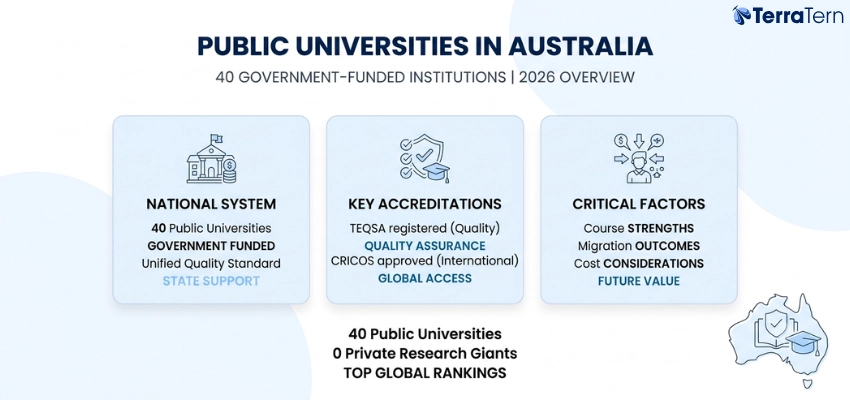
For Indian students, this changes the paradigm from ownership to university groupings, strengths of courses, cost and migration outcomes in choosing between public universities in Australia.
Australia's University Groupings:
|
Grouping |
Members |
Focus |
QS Ranking Range |
|
Group of Eight (Go8) |
ANU, UMelbourne, USydney, UNSW, UQueensland, Monash, UWA, Adelaide |
Research-intensive, elite |
QS Top 13–113 globally |
|
Australian Technology Network (ATN) |
RMIT, Curtin, UTS, UniSA, QUT |
Applied research, industry partnerships |
QS Top 200–500 |
|
Innovative Research Universities (IRU) |
La Trobe, Griffith, Western Sydney, Newcastle, Charles Darwin, Murdoch, Flinders |
Regional and community focus |
QS Top 400–1000+ |
|
Regional Universities Network (RUN) |
6 smaller regional universities |
Rural and regional communities |
Unranked–QS Top 1000 |
|
Other Public Universities |
All remaining 40 institutions |
Varied |
Varies |
What Are the Best Public Universities in Australia by QS Ranking 2026?
The top public universities in Australia on the QS World University Rankings 2026 list are the University of Melbourne (#13), University of Sydney (#18), UNSW Sydney (#19), Australian National University (#30), Monash University (#37), University of Queensland (#40) and University of Western Australia (#72). These are all part of the esteemed Group of Eight (Go8) and are among the top universities in the world.
The public universities in Australia are excellent for Indian students for providing world-class education, internationally recognised degrees, broad research opportunities, and good opportunities for post-graduation employment.
Top Public Universities in Australia — Rankings Table (2026):
|
Rank (QS World) |
University |
State |
Group |
Key Strengths |
Int'l Master's Fees (AUD/year) |
Int'l Master's Fees (INR/year) |
|
#13 |
University of Melbourne |
VIC |
Go8 |
Research, Law, Medicine, MBA |
$38,000–$52,000 |
20.9–28.6 lakh |
|
#18 |
University of Sydney |
NSW |
Go8 |
Law, Business, Engineering, Medicine |
$40,000–$55,000 |
22–30.3 lakh |
|
#19 |
UNSW Sydney |
NSW |
Go8 |
Engineering, Business, Law, Tech |
$40,000–$52,000 |
22–28.6 lakh |
|
#30 |
Australian National University (ANU) |
ACT |
Go8 |
Research, Politics, Sciences, Law |
$35,000–$50,000 |
19.3–27.5 lakh |
|
#37 |
Monash University |
VIC |
Go8 |
Pharmacy, Engineering, Business, IT |
$32,000–$48,000 |
17.6–26.4 lakh |
|
#40 |
University of Queensland (UQ) |
QLD |
Go8 |
Biomedical, Mining Eng, Business |
$32,000–$48,000 |
17.6–26.4 lakh |
|
#72 |
University of Western Australia (UWA) |
WA |
Go8 |
Mining, Engineering, Biomedical |
$30,000–$45,000 |
16.5–24.8 lakh |
|
#113 |
University of Adelaide |
SA |
Go8 |
Engineering, Wine (unique!), Medicine |
$28,000–$42,000 |
15.4–23.1 lakh |
|
#133 |
University of Technology Sydney (UTS) |
NSW |
ATN |
IT, Business, Design, Journalism |
$28,000–$40,000 |
15.4–22 lakh |
|
#149 |
RMIT University |
VIC |
ATN |
Engineering, Design, Business, IT |
$28,000–$40,000 |
15.4–22 lakh |
|
#193 |
Macquarie University |
NSW |
IRU |
Data Science, Finance, Linguistics |
$28,000–$40,000 |
15.4–22 lakh |
|
#213 |
Queensland University of Technology (QUT) |
QLD |
ATN |
IT, Business, Creative Industries |
$25,000–$38,000 |
13.8–20.9 lakh |
|
#238 |
Curtin University |
WA |
ATN |
Mining, Engineering, Business |
$26,000–$38,000 |
14.3–20.9 lakh |
|
#258 |
University of Newcastle |
NSW |
IRU |
Engineering, Medicine, Education |
$24,000–$36,000 |
13.2–19.8 lakh |
|
#301 |
La Trobe University |
VIC |
IRU |
Health Sciences, Business, Law |
$24,000–$35,000 |
13.2–19.3 lakh |
Exchange rate: 1 AUD ≈ INR 55 (July 2026 approximate; verify before planning). Fees are indicative; actual fees vary by course and faculty. Always verify on the university's official admissions page.
Also Read: Top 10 Best Regional Areas In Australia For PR
What Is the Latest Group of Eight (Go8) and Why Does It Matter for Indian Students?
The Group of 8 is a coalition of Australia's eight leading research-intensive universities, including the University of Melbourne, the University of Sydney, UNSW Sydney, the Australian National University, Monash University, the University of Queensland, the University of Western Australia and the University of Adelaide. All eight are in the top 200 in the world and are the equal of the Russell Group in the UK or the Ivy League in the USA for research and employer recognition.
Why Go8 is important to students from India:
-
Better Recognition by Employers Around the World and in India: Multinational companies and Big 4 consulting companies in particular are looking for students from Go8 campuses.
-
Increased Research Scholarships (Including Research Training Program): Fees offset for postgraduate research students
-
Increased Structure: For career services and employer relationships within the campus community
-
Stricter Admissions Criteria: (Competitive, but not exclusive — most of the Go8 universities have 60-70% of their eligible applicants accepted)
-
Pros: Higher international fees (AUD $32,000- $52,000 per year compared to AUD$22,000 – $32,000 at non-Go8) and more competitive student visa processing in 2026 as a result of the cap policy
What Are the Current Public Universities in Australia for International Students by Fees?
The tuition fees of public universities in Australia for international students are from AUD $18,000 – 22,000 per year (INR 9.9 – 12.1 lakh) for smaller and regional universities to AUD $40,000 – 55,000 per year (INR 22 – 30.3 lakh) for the leading Group of Eight universities. Public universities in Australia do not offer international students free tuition, unlike the other countries mentioned, such as Germany and Norway, and some European countries.
Indian students intending to study abroad must be aware of the fee structure of Australian public universities for planning and choosing universities.
The fees of public universities in Australia for international students by university tier and course level are:
|
Tier |
Examples |
Undergrad Annual (AUD/INR) |
Master's Annual (AUD/INR) |
PhD / Research |
|
Go8 (Top 8) |
Melbourne, USydney, UNSW, ANU |
$32,000–$45,000 / 17.6–24.8L |
$38,000–$55,000 / 20.9–30.3L |
RTP scholarship offsets fees for eligible researchers |
|
ATN (Technology Network) |
RMIT, UTS, Curtin, QUT |
$28,000–$38,000 / 15.4–20.9L |
$28,000–$42,000 / 15.4–23.1L |
Research fees similar or slightly lower |
|
IRU / Regional |
La Trobe, Griffith, Newcastle |
$22,000–$32,000 / 12.1–17.6L |
$24,000–$36,000 / 13.2–19.8L |
Often below-average research fees |
|
Other/Smaller Public |
Charles Sturt, Ballarat, CQU |
$18,000–$28,000 / 9.9–15.4L |
$22,000–$32,000 / 12.1–17.6L |
Regional PR incentives apply |
|
Medical / Dentistry (all tiers) |
USydney, UMelbourne, ANU |
$60,000–$90,000 / 33–49.5L |
$65,000–$100,000 / 35.8–55L |
Highest fees; limited international seats |
Total Annual Cost for Indian Students (Fees + Living):
|
University Type |
Tuition (AUD/year) |
Living Costs (AUD/year) |
Total First-Year (AUD) |
Total First-Year (INR) |
|
Go8 (metro, master's) |
$38,000–$55,000 |
$22,000–$30,000 |
$60,000–$85,000 |
33–46.8 lakh |
|
ATN (metro, master's) |
$28,000–$42,000 |
$20,000–$28,000 |
$48,000–$70,000 |
26.4–38.5 lakh |
|
Regional public (master's) |
$22,000–$32,000 |
$16,000–$22,000 |
$38,000–$54,000 |
20.9–29.7 lakh |
|
Go8 (metro, undergrad) |
$32,000–$45,000 |
$22,000–$30,000 |
$54,000–$75,000 |
29.7–41.3 lakh |
Which Latest Public University in Australia Has the Highest Acceptance Rate?
Australian public universities generally have acceptance rates of 60-85% for international students who meet the admission criteria, which is far more accessible than universities in the USA and UK, where international acceptance rates are typically lower. Mostly, the top-ranked public universities in Australia accept students who meet their published academic and English language requirements.
Public universities in Australia do not compete with one another for admission; rather, their admission is based on eligibility criteria, as is the case at Harvard and Oxford.
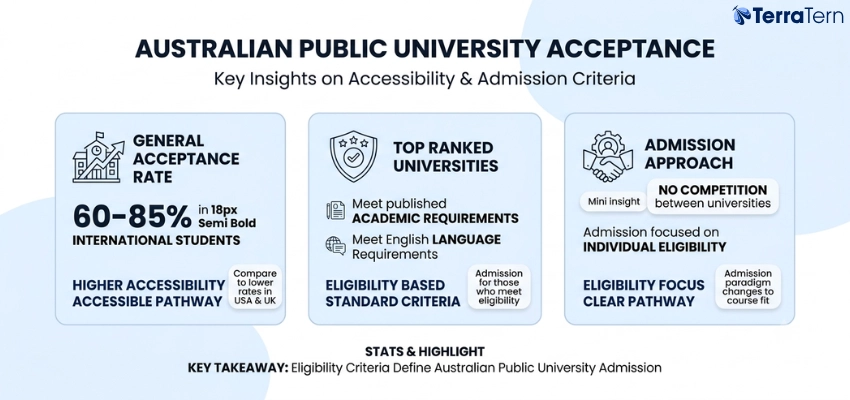
The Australian Admissions Model is explained in the following section.
The threshold-based admissions system is one of the factors that make public universities in Australia highly accepted.
Under this model:
-
Generally, students who have met the minimum academic requirements will be admitted.
-
Universities are interested in meeting the entry requirements and not in comparing applicants with other applicants.
-
Admissions are principally objective and transparent.
-
Extracurricular activities are not emphasized as much as in the United States.
This is a big advantage for Indian students seeking a consistent and straightforward application procedure at public universities in Australia.
Acceptance Rate Context by University Tier:
|
University Group |
Indicative Acceptance Rate |
Entry Model |
Key Threshold |
|
Go8 Universities |
~60–75% for eligible applicants |
Threshold-based (meet minimums = likely accepted) |
CGPA 6.5–7.5+/10; IELTS 6.5–7.0 |
|
ATN Universities |
~70–80% for eligible applicants |
Threshold-based |
CGPA 6.0–7.0/10; IELTS 6.0–6.5 |
|
Regional / IRU Universities |
~80–90%+ for eligible applicants |
Open access (with support) |
CGPA 5.5–6.5/10; IELTS 5.5–6.0 |
|
Medical / Dentistry (any tier) |
10–25% of seats (limited seats) |
Competitive; GAMSAT/UCAT required |
High undergraduate GPA + entrance exam |
|
MBA Programmes (Go8) |
~50–65% |
Competitive; interview stage |
CGPA + GMAT/GRE + work experience |
What "Meeting Requirements" Looks Like for Indian Students:
The majority of public universities in Australia will accept a CGPA of 60-70% (or 6.0-7.0/10 on a 10-point scale) for postgraduate entry.
English: IELTS 6.0-7.0 (programme dependent)
Some institutions look at Indian universities differently – for example, a person who is an IIT/NIT graduate might be more likely to get a more flexible requirement at a Go8 University because of institutional recognition.
Note: Making an application does not secure a place — places may be filled especially on popular IT, engineering and business courses
Also Read: How To Prepare For Australia Immigration Interview: Student Visa
What Are the Current Best Public Universities in Australia for Indian Students — by Discipline?
The top Australian public universities for Indian students are largely dependent on the selected field of study, career goals, budget, and long-term migration plans. Clusters of institutions like the University of Melbourne, UNSW Sydney, and ANU lead the world in the rankings, but many of Australia's public universities perform better than the top universities in specific subject areas.
Instead of just looking at overall university rankings, Indian students should focus on the subject rankings, industry connections, and job prospects.
Best Australian Public Universities by Discipline (QS Subject Rankings 2026):
|
Discipline |
#1 University |
#2 University |
#3 (Value/Regional) |
QS Subject Rank |
|
Engineering |
University of Melbourne |
UNSW Sydney |
Curtin University |
UMelbourne: Top 50 |
|
Computer Science / IT |
UNSW Sydney |
University of Melbourne |
UTS (ATN) |
UNSW: Top 60 |
|
Business / MBA |
Australian School of Business (UNSW) / AGSM |
Melbourne Business School |
Macquarie |
UNSW: Top 75 |
|
Law |
University of Melbourne |
ANU |
University of Sydney |
UMelbourne: Top 15 |
|
Data Science / Analytics |
UNSW Sydney |
University of Melbourne |
QUT |
Emerging ranking category |
|
Medicine (MBBS) |
University of Melbourne |
University of Sydney |
ANU |
UMelbourne: Top 33 |
|
Nursing / Healthcare |
Monash University |
University of Queensland |
La Trobe (IRU) |
Monash: Top 50 |
|
Pharmacy |
Monash University |
University of Queensland |
University of South Australia |
Monash: Top 10 |
|
Architecture / Design |
RMIT University |
University of Melbourne |
UTS |
RMIT: Top 30 |
|
Accounting / Finance |
UNSW Sydney |
University of Melbourne |
Macquarie |
UNSW: Top 60 |
|
Environmental Science |
ANU |
University of Queensland |
University of Wollongong |
ANU: Top 35 |
|
Agriculture |
University of Queensland |
University of Adelaide |
Charles Sturt (Regional) |
UQ: Top 50 |
|
Education / Teaching |
University of Melbourne |
Monash University |
La Trobe (IRU) |
UMelbourne: Top 10 |
Profile-Based Recommendation Matrix:
|
Your Profile |
Recommended University |
Reason |
|
IIT/NIT graduate, targeting tech career |
UNSW Sydney or University of Melbourne |
Go8 + campus recruitment at Big Tech |
|
Strong CGPA 7.0+, targeting consulting |
University of Melbourne or UNSW Business |
Go8 MBA/management; McKinsey/Deloitte recruitment |
|
Mid-CGPA (6.0–6.5), IT background |
RMIT or UTS (ATN) |
Strong applied tech; easier admission; good outcomes |
|
Healthcare/nursing, targeting PR quickly |
La Trobe or CQUniversity (regional) |
Regional = 4-year 485 + 15 extra PR points |
|
Budget-focused, any discipline |
CQU, Charles Sturt, USC |
AUD $18,000–$24,000/year; regional PR incentive |
|
Research ambitions, PhD pathway |
ANU or University of Melbourne |
RTP scholarship; top research funding |
|
Data science / AI specialist |
UNSW or Monash |
Strong industry partnerships; ML/AI clusters |
What Scholarships Are Available at Australian Public Universities for Indian Students in 2026?
The public universities in Australia provide a variety of scholarships to Indian students, which can cover tuition fees, living expenses, and travel costs. Scholarships offered at public universities in Australia can be categorized as follows: Government-funded scholarship, University merit scholarship, Regional study scholarship, Research scholarship.
Scholarships can make a huge difference to the costs of studying at public universities in Australia and to access the best-ranked universities for Indian students.
Key Scholarship Categories for Indian Students at Australian Public Universities:
|
Scholarship |
Provider |
Amount |
Coverage |
Who Qualifies |
|
Australia Awards |
Australian Government (DFAT) |
Full scholarship |
Tuition + living + travel |
Indian nationals with strong leadership/development focus; highly competitive (<5% acceptance) |
|
Destination Australia |
Federal Government |
Up to $15,000/year |
Tuition contribution |
Students enrolling at participating regional institutions; adds value on top of cheaper regional fees |
|
Research Training Programme (RTP) |
Universities (government-funded) |
Full fees offset + $32,500 stipend/year |
Tuition + living |
PhD and research master's students; international eligible |
|
University Merit Scholarship |
Individual universities |
10–50% of fees |
Partial tuition |
Strong CGPA + academic merit; automatic consideration in many cases |
|
Go8 International Scholarship |
Go8 universities individually |
20–50% of fees |
Partial tuition |
Merit-based; early application round preferred |
|
Endeavour Leadership Programme (legacy) |
Government (currently under review) |
Varied |
Varied |
Check current availability |
The Destination Australia Scholarship — Unique and Underused:
A scholarship that is available to study in regional Australia only.
-
Value: Plus AUD $10,000 – $20,000 reduction in regional tuition fee (which is already AUD $10,000 – $20,000 lower than metro Go8) plus up to AUD $15,000/year in value-added (based on the value of tuition fee savings).
-
Students: 1,300+ from 40+ universities and TAFE institutions in regional, non-metro centres.
This comes with regional study PR advantage (15 extra migration points + 4-year 485 visa), making regional public universities the best value for money for budget-conscious Indian students seeking PR.
The RTP Scholarship — Most Valuable, Least Understood:
Research Training Programme fee offsets mean that, if you are a PhD or research master's student, you will not have to pay tuition fees.
-
Further stipend of AUD $32,500/year (INR 17.9 lakh/year 2026) for living expenses.
-
Open to International students (Indians are among the top RTP recipients every year)
-
Requires: good academic record, research proposal, agreement of supervisor
To apply directly, go through the graduate research office of the university. Lead time: 6–12 months is recommended.
Also Read: Australia's Bold Step towards IELTS-Free Enrollment
How Does Studying at a Leading Regional Public University in Australia Benefit Indian Students?
There are several great benefits for Indian students studying at a regional public university in Australia, other than the tuition fees. Graduates from one of the public universities in the region in Australia are awarded 15 points for their skilled visa application, an extended Temporary Graduate Visa (Subclass 485) (up to 4 years), and may also qualify for other scholarships and lower living costs.
When it comes to permanent residency, affordability, and long-term settlement prospects, regional public universities in Australia may offer a more compelling value proposition for Indian students who prioritize these factors.
What is Meant by Regional Australia?
Regional areas are most places in Australia not within Sydney, Melbourne, and Brisbane metropolitan centres.
There are numerous public universities in Australia with campuses in specific regional areas, where international students can benefit from the extra migration benefits without compromising their studies in a recognised university.
Examples include:
-
Newcastle
-
Geelong
-
Gold Coast
-
Bendigo
-
Albury-Wodonga
-
Rockhampton
-
Ballarat
-
Sunshine Coast
-
Toowoomba
Regional Public Universities in Australia — Top Picks for Indian Students:
|
University |
State |
QS Rank |
Best Programmes |
Regional Advantage |
|
University of Newcastle |
NSW |
#258 |
Engineering, Medicine, Education |
Regional EOI + longer 485 |
|
Deakin University |
VIC |
#287 |
Healthcare, Business, IT |
Regional campuses (Geelong, Burwood) qualify |
|
Griffith University |
QLD |
#374 |
Health Sciences, Business, Criminology |
Gold Coast campus = regional |
|
La Trobe University |
VIC |
#388 |
Health Sciences, Business, Social Work |
Bendigo/Albury campuses = regional |
|
CQUniversity |
QLD |
Unranked |
Engineering, IT, Nursing, Business |
Rockhampton = strongly regional |
|
Charles Sturt University |
NSW |
Unranked |
Agriculture, Nursing, Policing |
Rural focus; strong nursing outcomes |
|
University of the Sunshine Coast (UniSC) |
QLD |
Unranked |
Nursing, Business, IT, Education |
Sunshine Coast = regional; growing campus |
|
Federation University Australia |
VIC |
Unranked |
Engineering, IT, Education |
Ballarat = regional; low fees |
The Regional Study Advantage — Summary:
|
Advantage |
Detail |
|
Extra PR points |
+15 points on skilled migration EOI — the equivalent of 3 extra years of skilled work experience |
|
Extended 485 visa |
4 years (regional study) vs 2 years (metro study) of open work permission |
|
Lower tuition |
AUD $18,000–$28,000/year vs AUD $32,000–$55,000 at Go8 |
|
Destination Australia scholarship |
Up to AUD $15,000/year additional scholarship for regional study |
|
Lower housing costs |
Regional cities: AUD $800–$1,200/month 1BHK vs AUD $2,000–$3,200 in Sydney/Melbourne |
|
State nomination advantage |
Regional states (SA, TAS, WA, NT) actively nominate regional university graduates |
How Do You Apply to Current Public Universities in Australia as an Indian Student?
Researching universities, eligibility check, preparing documents, application submission, accepting offer, and getting the Confirmation of Enrolment (CoE) to start the visa application process.
The application process to public universities in Australia is typically simple, clear, and significantly less involved than the application process for universities in the United States or the United Kingdom.
Application Step Guide
Step 1: Research and Shortlist (3-4 Months Before Intake)
Research and shortlist universities (3-5) based on the discipline, QS ranking, budget, and PR goals. Use the profile matrix in the previous section.
Step 2: Check Eligibility Requirements
Ensure the minimum CGPA requirement (usually 6.0–7.5/10 for postgraduate), English proficiency (usually IELTS 6.0–7.0 depending on the university and course), and any specific prerequisite subjects for your course or programme.
Step 3: Prepare Documents
All academic transcripts (all years, all semesters) — in English or translated into English.
To meet the course requirement, you must have a certificate from IELTS/TOEFL/PTE Academic that has not expired and has achieved the course level.
-
Statement of Purpose (SOP) / Personal Statement
-
Letters of Recommendation (usually 2 – academic or professional)
-
Cover Letter & Resume (Australian style — no photo, no DOB)
-
Passport copy
Step 4: Apply Directly or Through a Representative
Most Australian public universities will accept direct applications via online portals. Others may have alternative pathways to applying, such as IDP Education, Pearson or VTAC (undergraduate in Victoria). An education agent (QEAC registered) can apply on your behalf at no extra cost.
Step 5: Receive and Evaluate Your Offer
A conditional offer requires final year results. Unconditional offer: all requirements are satisfied (unconditional). Check out a comparison of offers before accepting.
Step 6: Accept and Obtain CoE
Pay your deposit (usually one semester's fees or AUD $3000 – $10000) to guarantee your place and to get your Confirmation of Enrolment (CoE). Your student visa application is triggered by the CoE.
Application Timeline:
|
Intake |
Application Deadline |
Visa Application Target |
Course Start |
|
February (Semester 1) |
October–November (prior year) |
November–December |
February |
|
July (Semester 2) |
April–May |
May–June |
July |
|
November (Trimester 3) |
August–September |
September–October |
November |
Also Read: Check Your Australia Visa Status Online Fast and Easy
How Can TerraTern Help You Get into the Best Australian Public University in 2026?
TerraTern provides end-to-end support for Indian students applying to public universities in Australia, helping them navigate everything from university selection and application preparation to student visa approval and long-term PR planning. Whether you are targeting elite Group of Eight institutions or regional public universities in Australia with stronger migration benefits, TerraTern offers personalised guidance tailored to your academic profile and career goals.
-
Helps shortlist the best public universities in Australia based on your profile, budget, career goals, and PR plans.
-
Provides discipline-specific recommendations for engineering, business, IT, healthcare, law, and other fields.
-
Assesses eligibility, CGPA requirements, and English language scores for different public universities in Australia.
-
Assists with SOP writing, LOR review, resume preparation, and document verification.
-
Identifies scholarships available at public universities in Australia, including RTP and Destination Australia scholarships.
-
Supports tuition fee planning, living cost estimation, and education loan guidance.
-
Provides end-to-end student visa assistance, including CoE and Genuine Student (GS) preparation.
-
Helps students plan post-study work visas (Subclass 485) and permanent residency pathways.
-
Advises on regional public universities in Australia for additional PR points and extended work rights.
-
Combines education counselling and immigration expertise to help students make long-term career and migration decisions.
2026 Industry Context
Latest Statistics & Developments:
-
Australia has exactly 40 public universities as of 2026 — this number has been stable since the 2004 closure of the University of New England's autonomous colleges; no new public universities are expected in the near term (TEQSA, 2026)
-
Seven Australian public universities are ranked in the QS World Top 100 in 2026 — University of Melbourne (#13), University of Sydney (#18), ANU (#30), UNSW Sydney (#19), University of Queensland (#40), Monash University (#37), University of Western Australia (#72)
-
India is now Australia's largest international student source country for 2024–25, with 120,000+ new enrolments — surpassing China for the first time (Department of Education, 2025)
-
The Australian government's 2024 international student cap policy primarily affected Group of Eight universities and large private providers — regional public universities and smaller institutions were less impacted and may have stronger 2026 intake availability for Indian students.
-
Australian public universities offer approximately 22,000 CRICOS-registered courses across undergraduate, postgraduate, research, and English language programmes — the most diverse English-medium course offering of any country after the U.K
-
Tuition fees at Australian public universities for international students range from AUD $18,000/year (regional public universities, some undergraduate programmes) to AUD $100,000+/year (elite medical and dentistry programmes at Go8 institutions)
-
The regional study advantage — studying at a public university outside major metro areas — adds 15 extra points to a student's skilled migration EOI score and extends the post-study 485 visa from 2 to 4 years (Department of Home Affairs, 2026)
CONCLUSION
Indian students in Australia receive globally recognised education, high opportunities, post-study work options and various PR pathways from public universities. Students study at 40 government-funded and CRICOS-approved institutions, which offer both prestigious Group of Eight universities for employer recognition around the world and regional public universities in Australia, offering lower costs and better migration opportunities.
The correct option will be decided by your job aspirations, budget, course preference, and plans in Australia. Choosing the right public universities in Australia can ensure that you get the best value for your money and boost your career prospects in the nation.
Contact TerraTern for more information on public universities in Australia.