
Key Highlights
- What is the IELTS Exam?
- What Is the IELTS Exam and Why Is It Important for Indians?
- What Are the Different Types of IELTS Exams Available in India?
- What Is the IELTS Exam Pattern and Format in 2026?
- What Is the IELTS Band Score System and What Score Do You Need?
- What Are the IELTS Exam Fees in India for 2026?
- How Can You Register for the IELTS Exam in India?
- What Is the IELTS Preparation Strategy That Works Best in 2026?
- When and Where Can You Take the IELTS Exam in India?
- How Does IELTS Compare to TOEFL, PTE, and Duolingo in 2026?
- What Are the Most Common Mistakes Indian IELTS Test-Takers Make?
- 2026 Industry Context Section
- Conclusion
The IELTS exam is the world's most prominent English language proficiency test, which is crucial for Indian test-takers who wish to study, work, or migrate from India to other countries in 2026. Recognised by over 11000 organisations in 140+ countries, it measures listening, reading, writing and speaking skills using Academic or General Training formats. With 4 million+ candidates appearing every year, India has been one of the top testing nations. This blog will cover IELTS overview, IELTS exam preparation online, Mistakes to avoid, and more.
What is the IELTS Exam?

IELTS (International English Language Testing System) is an English language proficiency test for people who are not native English speakers, which is standardised and measures real-life language skills.
| Detail | Information |
| Skills Tested | Listening, Reading, Writing, Speaking |
| Band Score Range | 0–9 (0 = non-user, 9 = expert) |
| Indian Administration | IDP IELTS (sole distributor since July 2021), 75+ centres across India |
| Exam Fee | INR 18,000 (2026) |
| Total Duration | 2 hours 45 minutes |
| Results Timeline |
|
| Versions Available |
Also Read: Understanding IELTS Exam
What Is the IELTS Exam and Why Is It Important for Indians?
IELTS Full Form and Definition: The IELTS exam, or International English Language Testing System (IELTS full form), is a globally standardised English language proficiency test that certifies skills for study, work, and immigration to English-speaking countries.
-
Conducting Organisations: Jointly managed by Cambridge Assessment English, IDP: IELTS Australia, and British Council, ensuring credibility and consistency worldwide.
-
India-Specific Context: Lakhs of Indians take the IELTS exam annually; IDP has been the sole distributor in India since July 2021, operating at 75+ test centres.
-
Global Acceptance: Recognised by universities, employers, immigration authorities (e.g., Canada PR, Australia skilled migration, UK student visas), and professional bodies in medicine, nursing, and engineering.
-
Unique Advantage for Indians: The IELTS exam is the English test accepted by many countries for immigration purposes, unlike TOEFL or PTE, making it essential for Indian migration goals.
As per TerraTern Expert, Divyansh, IELTS is the English proficiency test accepted by all major English-speaking immigration authorities worldwide, making it the most versatile and future-proof choice for Indian test-takers planning to move abroad for any purpose.
What Are the Different Types of IELTS Exams Available in India?
IELTS Exam types in India include academic, general training, UKVI, and life skills, each serving specific objectives such as study, work, or UK visa applications.
What Is IELTS Academic and Who Should Take It?
IELTS Academic is for undergraduate/graduate/ postgraduate admissions, as well as professional registration for doctors, nurses, and engineers. It has Reading and Writing sections with complicated academic texts and writing. It's accepted into universities in the US, UK, Australia and Canada, with top universities looking for 6.5-7.5+ bands.
What Is IELTS General Training and When Is It Used?
IELTS General Training is set to meet immigration (immigration to Canada PR/Express Entry, immigration to New Zealand skilled migration, immigration to the UK work visa) purposes, vocational training, and secondary education programs. It uses everyday texts in its Reading part, which is found in the workplace or social situations, and Writing Task 1 requires the candidate to write a letter and not to describe a graph or chart. It is mandatory to Canada express entry and is also acceptable to a number of Australian skilled migration pathways.
What Is IELTS for UKVI, and Is It Different from Regular IELTS?
IELTS for UKVI is a government-recognised Secure English Language Test (SELT) particularly for UK visas, including family, settlement and health/care worker applications. Standard IELTS Academic is accepted for UK university admissions and does not require the UKVI version.
What Is IELTS Life Skills and Who Needs It?
IELTS Life Skills, which includes only Speaking and Listening at either A1 (family visas) or B1 (citizenship/settlement) level. It does not include Reading or Writing sections.
|
IELTS Exam Type |
Purpose |
Format Differences |
Typical Score Required |
|
University admissions, professional registration |
Academic Reading/Writing (texts, graphs, essays) |
6.5–7.5+ |
|
|
Immigration, work, vocational training |
Everyday Reading: letter in Writing Task 1 |
Varies by visa (e.g., 6.0–7.0) |
|
|
UK family/settlement visas |
Identical to standard IELTS |
As per UKVI visa rules |
|
|
Life Skills |
UK visas (A1/B1 Speaking/Listening only) |
No Reading/Writing |
A1 or B1 level |
Important Note: One of the most costly mistakes Indian test-takers make is registering for the wrong IELTS type. If you're applying for Canada PR through Express Entry, you need IELTS General Training, not Academic. Always confirm with your immigration pathway before booking.
What Is the IELTS Exam Pattern and Format in 2026?
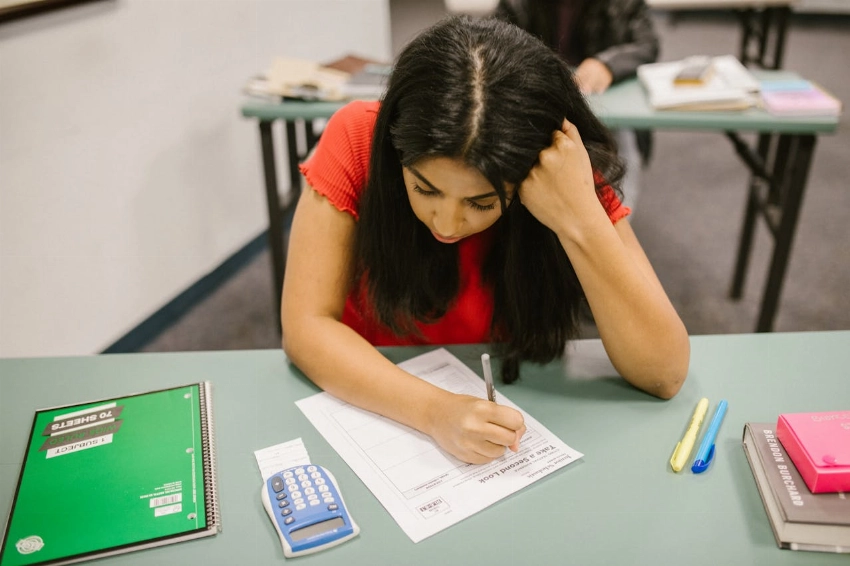
The IELTS exam consists of four sections: Listening (30 mins), Reading (60 mins), Writing (60 mins), and Speaking (11–14 mins), totalling about 2 hours 45 minutes. Listening, Reading, and Writing occur in one sitting; Speaking may follow the same day or within 7 days.
How Is the IELTS Listening Section Structured?
The IELTS listening section is structured as:
-
Duration: 30 minutes + 10 minutes transfer time (paper) or 2 minutes review (computer).
-
Questions: 40 questions (1 mark each).
-
Format: 4 recordings (2 monologues, 2 conversations) in British, Australian, North American, or New Zealand accents.
-
Parts 1–4: Part 1 (social conversation), Part 2 (social monologue), Part 3 (academic discussion), Part 4 (academic lecture).
-
Question Types: Multiple choice, matching, labelling, form/note/table/flowchart completion.
How Is the IELTS Reading Section Structured?
The IELTS reading section is structured as:
-
Duration: 60 minutes.
-
Questions: 40 questions (1 mark each).
-
Academic: 3 long passages from books, journals, newspapers (complex academic texts).
-
General Training: 3 sections, notices/ads, workplace documents, and general interest articles.
-
Question Types: MCQ, True/False/Not Given, matching headings, sentence completion, summary completion.
How Is the IELTS Writing Section Structured?
The IELTS writing section is structured as:
-
Duration: 60 minutes.
-
Academic Task 1: Describe a visual (graph, chart, diagram, map) in 150+ words.
-
Academic/General Task 2: Essay on argument/viewpoint in 250+ words.
-
General Task 1: Formal/semi-formal/informal letter in 150+ words.
-
Marking Criteria: Task Achievement, Coherence & Cohesion, Lexical Resource, Grammatical Range & Accuracy.
How Is the IELTS Speaking Section Conducted?
The IELTS speaking section is structured as:
-
Duration: 11–14 minutes; face-to-face with certified examiner (or video for IELTS Online).
-
Part 1 (4–5 mins): Personal questions on familiar topics.
-
Part 2 (3–4 mins): 1-minute prep + 2-minute monologue on cue card.
-
Part 3 (4–5 mins): Abstract discussion linked to Part 2.
-
Marking Criteria: Fluency & Coherence, Lexical Resource, Grammatical Range & Accuracy, Pronunciation.
Expert Advice: Time management is the #1 differentiator in IELTS. In the Reading section, many Indian test-takers spend too long on early passages and run out of time. Practice completing each passage in under 20 minutes using timed mock tests from Cambridge IELTS Books 15–19.
Also Read: IELTS Exam Full Form: New Guide, Facts & How to Fill Form?
What Is the IELTS Band Score System and What Score Do You Need?
IELTS uses a 9-band scale in which the overall score averages the four sections, rounded to the nearest 0.5; Band 6.0 is the common minimum for immigration, while top universities require 6.5–7.5. A good IELTS score for Indians is typically Band 6.5–7.0, competitive for study and migration goals.
How Is the IELTS Band Score Calculated?
Each of the four sections (Listening, Reading, Writing, Speaking) receives a band score from 1 to 9.
-
Listening and Reading convert raw scores to bands (e.g., 39–40 correct, Band 9 in Listening).
-
Writing and Speaking use holistic marking by trained examiners.
-
Overall band is the average of all four, rounded to the nearest 0.5 or whole band.
|
Band |
Skill Level |
Description |
|
9 |
Expert |
Complete operational command |
|
8 |
Very Good |
Fully operational with minor inaccuracies |
|
7 |
Good |
Operational command with occasional errors |
|
6 |
Competent |
Generally effective, some inaccuracies |
|
5 |
Modest |
Partial command, frequent problems |
|
4 |
Limited |
Basic competence in familiar situations |
|
3 |
Extremely limited user |
No real ability |
|
2 |
Intermittent user |
No real ability |
|
1 |
Non-user |
No real ability |
What IELTS Score Is Required for Canada PR, Australia, the UK and the USA?
The following IELTS score is required for Canada PR, Australia, the UK, and the USA:
|
Country/Purpose |
Minimum Band Score Required |
|
Canada Express Entry (Federal Skilled Worker) |
Overall 6.0 (CLB 7) |
|
Australia Skilled Migration (189/190) |
Overall 6.0 (minimum per band) |
|
UK Tier 2 / Skilled Worker Visa |
Band 6.0–6.5 per component |
|
UK Student Visa |
Band 6.0–7.0 (university-specific) |
|
USA Graduate Schools (top) |
Band 7.0–7.5 |
|
Germany Study/Work |
Band 6.0–7.0 |
What Is a Good IELTS Score for Indians?
A good IELTS score for Indians is Band 6.5–7.0, opening most university and visa pathways. Band 7.5+ unlocks QS Top 100 institutions, while 7.0+ across sections boosts Canada's CRS points significantly. Indian averages hover at Band 6.5 (Listening) and 6.0 (Writing).
Expert Tip: Many Indian candidates focus solely on meeting the overall band minimum and overlook sectional minimums. Australia's skilled migration, for instance, requires each section to meet a separate threshold; missing even one section by 0.5 can disqualify your application entirely.
What Are the IELTS Exam Fees in India for 2026?
The IELTS exam fee in India is INR 18,000 for both Academic and General Training (paper-based and computer-delivered), with IELTS for UKVI at INR 18,250 and Life Skills at INR 17,000. Payments are accepted by credit/debit cards, net banking, or PayTM online.
What Is the IELTS Registration Fee in India in 2026?
The standard IELTS registration fee in India for 2026 is INR 18,000 across both Academic and General Training formats, whether paper-based or computer-delivered.
|
Test Type |
Fee (INR) |
|
IELTS Academic (Paper/Computer) |
INR 18,000 |
|
IELTS General Training (Paper/Computer) |
INR 18,000 |
|
IELTS for UKVI |
INR 18,250 |
|
IELTS Life Skills (A1/B1) |
INR 17,000 |
Are There Any Additional Charges or Hidden Fees with IELTS?
Yes, IELTS involves several additional charges beyond the base registration fee.
-
Rescheduling: Allowed 5+ weeks prior; admin fee applies.
-
Cancellation: Partial refund if 5+ weeks before; none within 5 weeks unless medical grounds.
-
Enquiry on Results (Re-marking): ~INR 12,000; refunded if score changes.
-
One Skill Retake: INR 9450.
-
Additional TRF Copy: A separate fee applies per extra copy.
Important Tip: Book your IELTS slot at least 6–8 weeks in advance, especially between January and April (peak season for university deadlines). Computer-delivered slots in metro cities like Mumbai and Delhi fill up within days of opening. Set a calendar reminder for IDP's monthly slot release.
How Can You Register for the IELTS Exam in India?

In India, IELTS Exam registration is handled exclusively by IDP (the sole distributor since July 2021); book online at idp.com/india or offline at IDP branches with a valid passport and an INR 18,000 fee.
What Are the Steps to Register for the IELTS Exam Online?
The steps to register for the IELTS exam online are:
-
Visit idp.com/india and select "Register for IELTS."
-
Choose test type (Academic/General Training) and format (paper/computer).
-
Pick the nearest test centre (50+ cities) and preferred date/Speaking slot.
-
Fill in the application with passport details exactly as they appear on the passport.
-
Pay INR 18,000 via card/net banking/PayTM.
-
Receive confirmation email with details 5–7 days prior.
What Documents Are Required for IELTS Registration in India?
The documents required for IELTS registration in india are:
-
Valid international passport (scanned copy for online; original on test day), Aadhaar/PAN not accepted.
-
For minors under 18, Parent/guardian consent/assistance.
-
Passport must remain valid through test day; details must match exactly.
What Is the Difference Between IELTS on Paper, Computer, and Online?
IELTS offers Paper-Based, Computer-Delivered, and Online formats with identical content, difficulty, and scoring, but they differ in delivery, availability, and results timing.
|
Mode |
Availability |
Results |
Speaking |
|
Paper-Based |
2–4 times/month (Thu/Sat) |
13 days |
Face-to-face (same/nearby day) |
|
Computer-Delivered |
Up to 7 days/week |
3–5 days |
Face-to-face (flexible slot) |
|
IELTS Online |
From home |
6–8 days |
Video call with the examiner |
As per TerraTern Expert: When selecting your speaking slot during booking, always opt for the same day as your Listening/Reading/Writing test if you tend to get anxious. Having all sections on one day reduces travel, reduces re-acclimatisation stress, and ensures you're in exam mode throughout.
Also Read: IELTS Exam Requirements: Latest Guide for Aspirants
What Is the IELTS Preparation Strategy That Works Best in 2026?
The best IELTS preparation in 2026 features a 6–8 week plan starting with a level assessment, using Cambridge Books 15–19 for practice, and 3–4 timed mocks.
How Long Does It Take to Prepare for the IELTS Exam?
IELTS Exam preparation time varies depending on your current English level and target band score.
-
Beginners (Band 4–5): 3–6 months intensive study.
-
Intermediate (Band 5.5–6): 6–8 weeks structured plan.
-
Advanced (Band 6.5+): 2–4 weeks targeted practice.
-
Key principle: Quality practice over duration; focus on weaknesses.
-
Consistent: daily 2-hour sessions yield better results than cramming.
What Are the Best Resources for IELTS Preparation in India?
Top IELTS resources in India emphasise official materials from IDP, British Council, and Cambridge for authentic practice.
-
Official: Cambridge IELTS Books 15–19 (real past papers), IDP/IELTS.org practice tests.
-
Apps/Online: British Council IELTS Ready (free), IDP Masterclass app.
-
YouTube: E2 IELTS, IELTS Liz, IELTS Simon (limit to 2–3 for focus).
-
AI Tools: Grammarly for Writing, AI apps for speaking feedback.
-
Mocks: Cambridge full tests timed; review errors with scripts.
What Are the Section-Wise Preparation Tips for IELTS?
Effective IELTS preparation targets each section's unique demands with focused strategies.
1. Listening
- Regularly listen to BBC, CNN, and TED Talks to get comfortable with British, Australian, and North American accents.
- Never leave a blank; each correct answer carries 1 mark, and there is no negative marking, so always attempt every question.
- If appearing for the computer-delivered test, practise with headphones to simulate the actual test environment.
2. Reading
-
Use skimming and scanning techniques instead of reading every word. Aim to complete each passage in no more than 20 minutes.
-
For True/False/Not Given questions, mark "Not Given" only when the information is completely absent from the passage; do not make assumptions based on general knowledge.
-
Train yourself to identify paraphrased ideas, as questions rarely use the exact wording from the passage.
3. Writing
-
Prioritise Task 2 over Task 1, as it carries more marks (2/3 of the Writing band score).
-
Use cohesive linking words such as "furthermore," "however," and "in contrast" to improve the flow of your response.
-
Always meet the minimum word counts of 250+ words for Task 2 and 150+ words for Task 1, as falling short directly impacts your Task Achievement score.
4. Speaking
-
Record yourself daily and compare your responses against the official IELTS band descriptors to self-assess accurately.
-
Structure your answers using the P.E.E. method (Point, Explain, Example) to give well-developed, natural responses.
-
Avoid memorised or scripted answers; IELTS examiners are trained to detect and penalise rehearsed responses.
5. General
-
Complete 3–4 full-time mock tests using Cambridge IELTS Books 15–19 before your test date.
-
After every mock, review every incorrect answer immediately; understanding why you got it wrong is more valuable than the practice itself.
-
Identify your weakest section early and allocate extra preparation time to it rather than studying all sections equally.
What Is the IELTS One Skill Retake and Should You Use It?
IELTS One Skill Retake lets you retake just one weak section after your full test, saving time and money if three sections went well.
-
Launched 2023: Retake one section (Listening/Reading/Writing/Speaking) only.
-
Eligibility: Computer-Delivered IELTS; within 60 days of original test.
-
Cost: ~INR 9450 (cheaper than the full INR 18,000 re-sit).
-
Ideal for: Strong 3 sections, one weak; keeps other scores.
-
Limits: Not for UKVI/Life Skills; one per original test; 3–5 day results
Pro Tip: The single biggest writing mistake Indian test-takers make is translating thought patterns from Hindi or regional languages directly into English, leading to incorrect sentence structure and loss of coherence marks. Write in English from day one of preparation, even when thinking through ideas.
When and Where Can You Take the IELTS Exam in India?
IELTS computer-delivered tests run 7 days a week (excluding holidays) at 75+ IDP centres across India, while paper-based tests occur up to 4 times monthly on Thursdays/Saturdays. Major hubs include Delhi, Mumbai, Bangalore, Hyderabad, Chennai, Pune, and Chandigarh.
What Are the IELTS Test Dates in India for 2026?
IELTS test dates in India for 2026 vary by format and location, with computer-delivered tests offering the most flexibility.
-
Computer-delivered: Daily year-round (minus national holidays).
-
Paper-based Academic: ~48 dates annually.
-
Paper-based General: ~24 dates annually.
-
Peak seasons: Jan–Apr (university deadlines), Aug–Oct (immigration).
-
Book 6–8 weeks ahead in metros to secure slots.
Where Are the IELTS Test Centres Located in India?
India hosts over 75 official IDP IELTS test centres across major and tier-2 cities.
-
75+ official IDP centres nationwide.
-
Key Cities: Delhi/Noida/Gurugram, Mumbai/Navi Mumbai, Bangalore, Hyderabad, Chennai/Coimbatore, Pune, Ahmedabad, Chandigarh, Jaipur, Kochi, Kolkata.
-
Find Yours: idp.com/india → "Find a Test Centre."
-
Tip: Computer tests offer more dates/cities for flexibility.
How Long Are IELTS Results Valid?
IELTS results remain valid for 2 years from the test date worldwide. Australia allows up to 3 years for skilled migration. Some UK universities prefer scores under 12–18 months at the time of application. No extensions are granted under any circumstances. If your score expires before your application is processed, you must retake the exam. You can verify your Test Report Form (TRF) at any time on ielts.org.
Key Note: If you need IELTS for Canadian immigration, time your test so results arrive at least 3–4 weeks before your Express Entry application deadline. IRCC's processing windows leave no room for "score pending" situations.
How Does IELTS Compare to TOEFL, PTE, and Duolingo in 2026?
IELTS stands out as the sole test universally accepted for immigration, while TOEFL suits US academia, PTE excels in speed for Australia, and Duolingo is well-suited for limited university use.
IELTS vs PTE - Which Is Better for Indian Candidates?
IELTS and PTE both assess English proficiency, but PTE edges out for Indian candidates needing fast results and computer comfort, while IELTS wins for universal immigration acceptance.
|
Factor |
IELTS |
PTE Academic |
|
Format |
Paper or Computer |
Computer-only |
|
Results |
3–13 days |
1–5 days |
|
Speaking |
Face-to-face |
AI-scored |
|
Immigration |
All countries |
Australia, Canada, UK, NZ |
|
Test Fee (India) |
INR 18,000 |
~INR 16,900 |
|
USA Universities |
Yes |
Limited |
IELTS vs TOEFL — Which Should You Choose?
IELTS suits immigration and UK/Australia/Canada goals, while TOEFL dominates US university admissions with integrated tasks.
|
Factor |
IELTS |
TOEFL iBT |
|
Format |
4 separate sections |
Integrated tasks |
|
Immigration |
All countries |
Not accepted |
|
Test Duration |
~2h 45m |
~3 hours |
|
Best For |
UK/Australia/Canada/immigration |
US universities |
As per TerraTern Expert: If your immigration pathway involves Australia, Canada, or the UK, IELTS is the safer choice; it's accepted everywhere, whereas PTE is accepted but not the reverse. If speed of results is your priority, PTE Academic (results in 1–5 days) has an edge over paper-based IELTS.
Also Read: Types of IELTS: Explore All Exams, Changes & Tips
What Are the Most Common Mistakes Indian IELTS Test-Takers Make?
Indian candidates often struggle with time management, spelling, test type selection, and the use of unofficial materials.
What Mistakes Should You Avoid in the IELTS Listening Section?
Avoid these frequent errors to maximise your band scores across IELTS sections.
-
Spelling errors (zero marks for misspelt words).
-
Panicking over missed answers (audio plays once only).
-
Last-minute answer changes without certainty.
-
Skipping headphones in computer tests.
What Are Common IELTS Reading Mistakes to Avoid?
The IELTS listening section mistakes to avoid are:
-
Word-for-word reading (use skim/scan instead).
-
Mixing "False" (contradicts) with "Not Given" (absent info).
-
Over 30 min on one passage.
-
Obsessing over unknown vocabulary.
What Are the Biggest Writing Mistakes in IELTS?
The IELTS writing section mistakes are:
-
Paraphrasing the prompt as an intro (too obvious).
-
Under word count (150+/250+ required).
-
Informal tone in formal tasks.
-
Complex words over clear coherence.
What Speaking Mistakes Hurt IELTS Scores the Most?
IELTS speaking section mistakes are:
-
Memorised scripts (examiners detect/penalise).
-
One-word answers across parts.
-
Excessive fillers ("umm," "aah").
-
Arguing with or dodging the examiner's topics.
Pro Tip: The #1 reason Indian test-takers fall short in IELTS Writing isn't grammar, it's coherence. Examiners assess whether your argument flows logically from one idea to the next. Practise outlining your essay structure in 5 minutes before writing to dramatically improve Task 2 scores.
2026 Industry Context Section
Key IELTS Statistics & Trends (India + Global):
-
Over 4 million IELTS tests were conducted globally in 2024; demand is expected to rise in 2026.
-
India is among the top 3 IELTS-taking nations globally, driven by Canada, Australia, and the UK immigration demand.
-
Computer-delivered IELTS now dominates India, available 7 days/week vs. paper (4 dates/month).
-
IELTS One Skill Retake, launched in 2023, is now available at all IDP centres in India. It allows candidates to retake just one failed section.
-
The average IELTS band score globally sits at Band 6.0; most Canadian and Australian immigration pathways require Band 6.0–7.0.
-
IELTS Ready Premium, the official free preparation platform by British Council and IDP, has seen a 60% increase in Indian sign-ups.
-
IELTS Online (Academic only, from home) is now accepted by 1,000+ universities, but NOT for immigration purposes
Conclusion
Mastering the IELTS exam is crucial for Indian aspirants seeking to study, work, or migrate to English-speaking nations such as Canada, Australia, and the UK in 2026. This guide covers IELTS formats (Academic/General), INR 18,000 fees, registration via IDP, section strategies, band scoring (6.5+ ideal), IELTS exam preparation online, and pitfalls to avoid. With daily practice using Cambridge books and mocks, achieve your dream score efficiently. Start today for global success!
Contact TerraTern for more information on the IELTS Exam: The Complete 2026 Guide for Indian Test-Takers.

