Key Highlights
- Which Are the Best Regional Areas in Australia for PR? Top 10 Cities & Towns
- What Is Considered a Regional Area in Australia?
- Regional Visa Pathways to Permanent Residency
- Top 10 Regional Areas in Australia for PR in 2026
- Regional Areas in NSW for PR
- How to Choose the Best Regional Area for PR?
- What Are the Benefits of Living in Regional Australia for PR?
- Conclusion
Regional areas in Australia may be some of the most promising places to live in 2026 if you are looking to migrate to Australia on a skilled visa. These areas are not only small towns. They are home to cities such as Adelaide and Perth but also have expanding locations like Geelong and Newcastle. The selection of the right regional areas in Australia can also increase your odds of securing an invitation for PR.
Here’s a quick overview of the 10 regional areas in Australia that currently have the best combination of jobs, affordability and state nomination pathways for PR in 2026, how the points bonus works and which parts of NSW are considered regional despite being near Sydney.
Which Are the Best Regional Areas in Australia for PR? Top 10 Cities & Towns
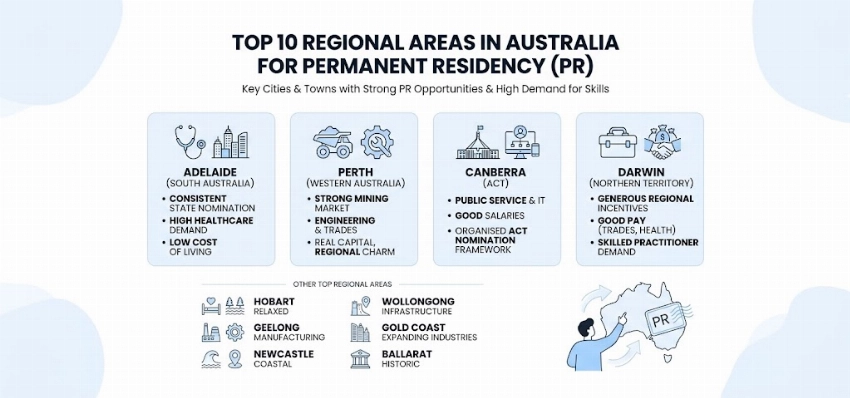
Answering the most asked question, which areas in Australia are the best for PR? Here's a list of the top 10 cities & towns in Australia:
-
Adelaide (South Australia): Low cost of living and consistent state nomination and high demand for healthcare.
-
Perth (Western Australia): Is a real capital and, despite its regional charms, has still got a mining, engineering and trades market that is quite strong.
-
Canberra (ACT): Public service and IT salaries are good and supported by an organised ACT nomination framework.
-
Hobart (Tasmania): Relaxed lifestyle, easy access to state nomination avenues open to graduates and skilled migrants.
-
Geelong (Victoria): Near Melbourne and has good demand in advanced manufacturing, health and education.
-
Newcastle (New South Wales): a large NSW regional city that includes coastal communities, hospitals and universities.
-
Wollongong (New South Wales): close to Sydney, good infrastructure, good diversity in work opportunities.
-
Gold Coast (Queensland): Big city living with full regional visa classification and expanding industries.
-
Darwin (Northern Territory): good pay for trades and health care, generous regional incentives.
-
Ballarat (Victoria): a historic and expanding regional centre close to Melbourne, where there is a genuine need for skilled practitioners.
The three regional cities in Australia, Adelaide, Perth and Canberra, continue to be the top three regional cities in Australia for people applying for PR, a result of their combination of high levels of state nomination programmes with diversified high-paying job opportunities.
Note: Each of these cities has the same basic visa benefits, such as any additional points available for the Subclass 491 visa and any state-specific nomination streams.
Also Read: Australia PR Visa Fees: All Costs Breakdown for Indians
What Is Considered a Regional Area in Australia?
For migration purposes, a regional area in Australia is any place that is outside Greater Sydney, Greater Melbourne and Greater Brisbane. All other capital cities, such as Perth, Adelaide, Canberra, Hobart and Darwin, are deemed to be a designated regional area.
-
Regional Area: The region is defined for migration as anywhere other than Greater Sydney, Greater Melbourne and Greater Brisbane. Perth, Adelaide, Canberra, Hobart and Darwin are also classified as regional areas.
-
Category 2: Major regional centres and cities include Perth, Adelaide, Gold Coast, Sunshine Coast, Canberra, Newcastle, Wollongong, Geelong and Hobart.
-
Category 3: Smaller regional or rural areas (e.g., Ballarat, Bendigo, Cairns, Townsville, Darwin).
-
Regional Visas: There are various visas available for regional areas, including categories 2 and 3, such as visa 491, visa 494, and visa 191.
-
Whole-State Regional Areas: South Australia, Tasmania, Western Australia, Northern Territory and the ACT (all capital cities, excluding South Australia).
-
Postcode Check: Regional status is determined by postcode, not distance from city centre, please refer to the Department of Home Affairs regional postcode list before assuming an area is regional.
Also Read: Australia Work Visa Fees: Guide on Costs, Categories & Tips
Regional Visa Pathways to Permanent Residency
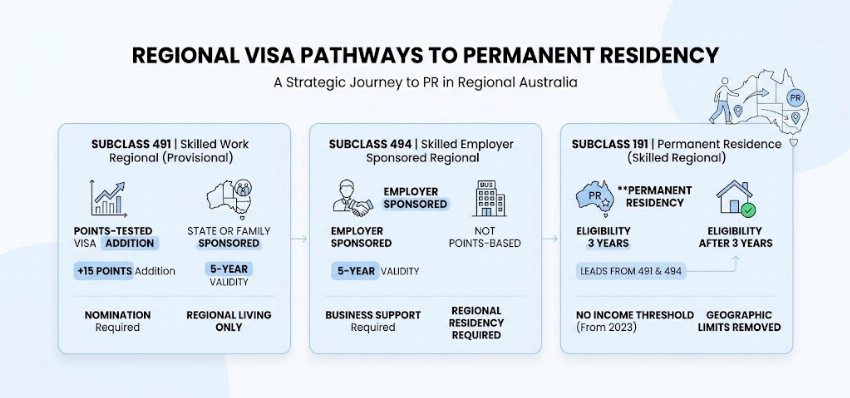
The regional PR pathway consists of three visas:
-
Subclass 491 (points-tested visa – state or family sponsored visa),
-
Subclass 494 (employer-sponsored visa) and
-
Subclass 191 (the permanent visa that both the subclass 191 and subclass 491 visas lead to after three years).
1. Subclass 491
-
The most popular visa to enter is the Subclass 491 visa, the Skilled Work Regional – Provisional visa.
-
A five-year visa is based on points with a straight 15-point addition to the points test, which is often all it takes to secure an invitation against another round being missed.
-
It requires nomination from a state or territory government or sponsorship by a ‘family member’ who is already living in a regional area.
2. Subclass 494
-
The Subclass 494 (Skilled Employer Sponsored Regional) is similar but is based on an employer in a regional area instead of a points-based application.
-
These are all provisional, both last for 5 years, and both mean you'll only be allowed to live, work and study in a specific regional area for the entire 5 years.
-
It's not like you can move to Sydney, Melbourne or Brisbane while you're invited to apply for the visa, which could actually ruin your PR future.
3. Subclass 191
-
After three years of compliant regional living, holders of either visa become eligible for the Subclass 191 (Permanent Residence – Skilled Regional).
-
Note: The formal minimum income threshold for the 191 was dropped from legislation in 2023, meaning there's no number you need to reach, but many advisers are still using the now obsolete benchmark of AUD 53,900 for that reason.
-
After you receive the 191 visa, all geographic limitations are removed, meaning that you are allowed to live and work anywhere in Australia as a permanent resident.
Also Read: Best City In Australia For Jobs, Students & Visitors
Top 10 Regional Areas in Australia for PR in 2026
Australia offers a mix of fast-paced city life and slower green living in the countryside, and you'll know from where you're coming where you'll go. By choosing to live in a particular region, other factors, beyond access to visas, can lead to increased Immigration Points Test marks, lower competition for jobs, and a sense of community that you won't find if you target Sydney, Melbourne or Brisbane.
Let's take a closer look at the top 10 regional areas in Australia for PR this time.
1. Adelaide (South Australia)
With a state-wide programme that is consistently active as few other states in Australia, a developing tech and startup sector, and a genuinely lower cost of living, it's no wonder that Adelaide is one amongst the list of top 10 regional areas in Australia for PR in 2026.
-
Job Opportunities: A booming startup community and large companies such as the University of Adelaide and the South Australian Health and Medical Research Institute.
-
Cost of Living: Reasonable, lower than Sydney and Melbourne and in line with housing.
-
Lifestyle and Amenities: Festivals, Beaches and the Barossa Valley wine region are right on the doorstep.
-
Education and Healthcare: Home of the University of Adelaide and world-class facilities such as The Royal Adelaide Hospital.
-
Other Benefits for PR Applicants: state nomination in South Australia, less competition for jobs in South Australia than Sydney & Melbourne.
2. Perth (Western Australia)
Perth is a full capital city that's still one of the designated regional areas in Australia. Its mining, engineering and trade sectors are well-developed, and there is a high standard of living.
-
Job Opportunities: Mining, energy, healthcare and finance, including Rio Tinto and Woodside Energy.
-
Cost of Living: Lower than Sydney and more affordable housing.
-
Lifestyle and Amenities: Beaches, parks and a Mediterranean-style climate.
-
Education and Healthcare: Home to the University of Western Australia and a well-established public health system.
-
Additional Benefits for PR Applicants: Category 2 regional status and generous state nomination allocation every programme year.
Also Read: Why Study in Australia ? Latest Updated Guide
3. Canberra (ACT)
Canberra is Australia's capital and features government, IT and policy employment as well as an organised and structured ACT nomination system, and the whole of the territory is regional.
-
Job Opportunities: Government, policymaking, media and an expanding tech industry.
-
Cost of Living: Lower than in Sydney or Melbourne, and housing is more affordable.
-
Lifestyle and Amenities: Good living in the community, parks and cultural facilities, such as the National Museum of Australia.
-
Education and Healthcare: Home to the Australian National University, with a high quality of public healthcare.
-
Additional Benefits for PR Applicants: a dedicated, clear ACT nomination system which many applicants can plan around.
4. Hobart (Tasmania)
Hobart offers a laid-back island way of life with a genuinely accessible state nomination: The state of Tasmania has become known as a welcoming place for international graduates and skilled migrants, compared to capitals.
-
Job Opportunities: Opportunities in tourism, education, healthcare and government.
-
Cost of Living: Cheap in comparison to the mainland capital cities.
-
Lifestyle and Amenities: History, food culture, MONA and easy access to the wilderness areas.
-
Education and Healthcare: The University of Tasmania and the Royal Hobart Hospital dominate the city's services in the field of education and healthcare.
-
Additional Benefits for PR Applicants: Tasmania's state nomination programme is always one of the more accessible in the country.
5. Geelong (Victoria)
Geelong is located close enough to Melbourne to retain city access but is well within Victoria's regional zone, where there is real demand in health, education and manufacturing.
-
Job Opportunities: Health, education, advanced manufacturing, a growing tech and logistics presence.
-
Cost of Living: Low & Lifestyle is the same as Melbourne.
-
Lifestyle and Amenities: Bay-side living, Bellarine Peninsula and easy access to the Great Ocean Road for weekend adventures.
-
Education and Healthcare: Deakin University's Geelong campus and University Hospital Geelong.
-
Other Benefits for PR Applicants: Category 2 regional status (as part of Victoria's nomination programme).
Also Read: Navigating Victoria's Skilled Visa Nomination Program
6. Newcastle (New South Wales)
Newcastle no longer enjoys its industrial-era reputation. Now it's one of NSW's two category 2 regional centres, where its real growth is in renewable energy, healthcare and education.
-
Job Opportunities: University of Newcastle and anchor employer John Hunter Hospital, in renewable energy, health, education and advanced manufacturing.
-
Cost of Living: It is lower than Sydney, but home prices have increased over the last few years.
-
Lifestyle and Amenities: Beaches, a rapidly developing arts scene, and infrastructure supportive of cycling.
-
Education and Healthcare: Good medical and engineering courses at the University of Newcastle.
-
Additional Benefits for PR Applicants: Despite being only about an hour from Sydney, they are eligible for full NSW regional nomination.
7. Wollongong (New South Wales)
Wollongong has the coastline on one side and the Illawarra escarpment on the other and, like Newcastle, is a Category 2 regional centre with good NSW nomination access.
-
Job Opportunities: Advanced manufacturing, engineering, health, education and IT (UWollongong).
-
Cost of Living: It is cheaper than Sydney but has convenient day travel to the city.
-
Lifestyle and Amenities: Beaches, walking trails along the escarpment and a very relaxed way of life.
-
Education and Healthcare: The University of Wollongong and Wollongong Hospital.
-
Additional Benefits for PR Applicants: Regional visa points and less competition than positions in Sydney.
8. Gold Coast (Queensland)
The Gold Coast blends big-city amenities with full regional visa classification: a combination that's hard to find anywhere else on this list.
-
Job Opportunities: tourism, hospitality, health care, education and an expanding film industry.
-
Cost of Living: Lower than Sydney or Melbourne, and more affordable housing.
-
Lifestyle and Amenities: Beaches, theme parks and a true outdoor lifestyle.
-
Education and Healthcare: Griffith University, Bond University, Gold Coast University Hospital.
-
Additional Benefits for PR Applicants: Queensland Nomination Program, Category 2 Regional Status.
Also Read: Australia Employer-Sponsored Regional Work Visa Guide
9. Darwin (Northern Territory)
Genuine multicultural communities, strong pay in trades, healthcare and the resources industry and some of the nation's most generous regional incentives make Darwin a great place to live.
-
Job Opportunities: Major employers include Charles Darwin University and the NT Government, and other employers include the Government, defence, tourism and resources.
-
Cost of Living: This is somewhat more expensive due to its remote location, but housing is still less expensive than in the major capitals.
-
Lifestyle and Amenities: Tropical climate, national parks and proximity to Southeast Asia.
-
Education and Healthcare: Charles Darwin University and Royal Darwin Hospital.
-
Additional Benefits for PR Applicants: Access to nomination streams that are specific to the NT as well as high demand in skilled trades.
10. Ballarat (Victoria)
Ballarat completes the list of the best regional areas in Australia for PR. It is a historic, steadily growing regional centre with real demand for skilled workers and a significantly lower cost of entry than Melbourne.
-
Job Opportunities: Health care, education and manufacturing, particularly Federation University.
-
Cost of Living: Much lower than Melbourne, and some of the cheapest homes on this list of best regional areas in Australia for PR.
-
Lifestyle and Amenities: Heritage architecture, lakeside parks, and a close-knit community feel.
-
Education and Healthcare: Federation University and Ballarat Base Hospital.
-
Additional Benefits for PR Applicants: Lower competition than Geelong is given the category 3 status attribute to the nomination programme in Victoria.
Also Read: How to Find a Job in Australia from India: New Guide?
Regional Areas in NSW for PR
The regional areas in NSW for PR are:
-
Regional is all locations outside Greater Sydney in NSW.
-
Category 2 (major regional centres) includes Newcastle/Lake Macquarie and Wollongong/Illawarra.
-
Category 3 (Major regional centres) includes the Central Coast/Coffs Harbour, Port Macquarie, Tamworth, Orange, Dubbo, Wagga Wagga, and Albury.
NSW is one of the trickier states to travel to, as its two largest regional centres, Newcastle and Wollongong, are less than 2 hours from Sydney by car. Both are still perfectly regional for migration purposes, as the boundary is not drawn around commuting distance but around Greater Sydney.
The Central Coast is the thing that gets most applicants right out of the gate, and it is almost a Sydney commuter belt; however, it is designated regional (Category 3) and opens the 491 pathway up to individuals who may presume they should take a major step further afield.
In addition, regional NSW offers a wide range of Category 3 centres such as Coffs Harbour, Port Macquarie, Tamworth, Orange, Dubbo, Wagga Wagga and Albury, all of which have a different kind of demand for occupations and in some cases, a quicker turnaround for nominations than Newcastle or Wollongong due to a smaller number of applicants.
Note: Unlike in most states, it is important to regularly consult the NSW Skills List, as competition is generally higher than in South Australia or Tasmania; it also helps to submit early applications to your target occupations as they become available on the NSW Skills List.
Also Read: Group 8 University in Australia: Experts Latest Guide
How to Choose the Best Regional Area for PR?
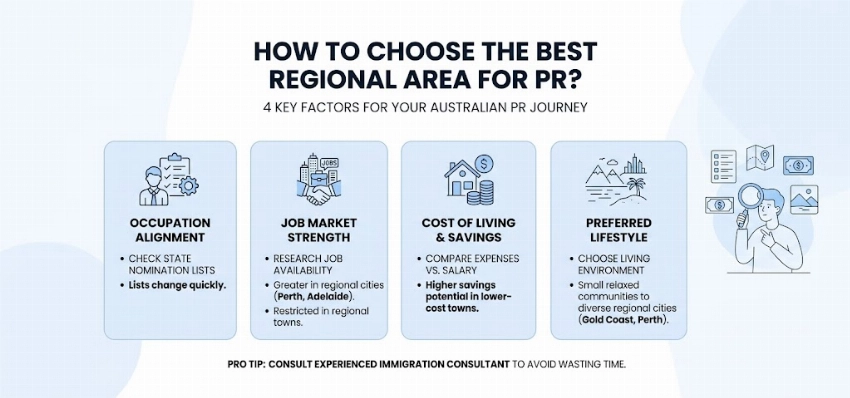
Choosing the best regional area for PR in Australia depends on the following four factors:
-
Occupation: Check if the occupation is on the current state nomination list, and if your occupation doesn't appear on these lists, the best regional area may not be available because of the quick opening and closing of these lists.
-
Job Market: Check out what jobs are currently available in your chosen area. Job markets are greater in Perth and Adelaide but are more restricted in regional towns.
-
Cost of Living: Calculate the expenses of rent or daily living in relation to your expected salary. If your salary is lower in Ballarat or Bundaberg, you might have more money in your pocket than if you had a higher salary in a high-cost regional city.
-
Lifestyle: Consider what kind of living environment you would prefer. Some people like the smaller, more relaxed towns and communities in the region, and others like the Gold Coast or Perth, which is bigger and more diverse.
Pro Tip: You may want to get a comparison of the process in each state or each city from an experienced immigration consultant beforehand to prevent you from wasting time later.
Also Read: Australia Work Permit from India: Latest Guide
What Are the Benefits of Living in Regional Australia for PR?
There are real and practical benefits for anyone pursuing a PR pathway who chooses to live in regional Australia:
-
A significantly low cost of living compared to Sydney, Melbourne or Brisbane.
-
More of a community feel and a much more relaxed approach to life.
-
More availability of natural environments, coasts and outdoor lifestyles.
-
A bonus of 15 points on the points test for the Subclass 491 visa.
-
Chances to access state-specific skilled migration and nomination programs.
-
Fewer jobs are in competition in most industries than in the main capitals.
-
Increased opportunities for natural integration into a community and professional network building early in life.
These combine to make regional areas in Australia a truly appealing place for a long-term future, rather than just a second option for those who didn't qualify for a Sydney or Melbourne visa.
Also Read: How to Settle in Australia from India Complete Guide
Conclusion
Regional areas in Australia cover a variety of locations, including major cities, such as Perth and Adelaide, expanding cities, such as Geelong and Ballarat, and rapidly expanding cities in NSW, including Newcastle, Wollongong and the Central Coast.
Whichever one you select, you can receive the same benefits: a 15-point regional bonus, a true track to permanent residency with a subclass 191 visa and, for most of them, a lower cost of living and lesser competition for jobs than in Sydney, Melbourne and Brisbane. It's not necessarily about which city sounds like the most familiar city to you; it's about which city is the right one for you, your budget, and your lifestyle.
State nomination lists and postcode regions are subject to change, and so is a pathway, so it is advisable to get a second opinion before committing to a pathway. Contact TerraTern and discuss which regional area and which visa is really suitable for you.




 AI Summary