

Key Highlights
- Which are the Best Courses of Masters in Europe for Indian Students?
- Why Should Indian Students Consider a Masters in Europe in 2026?
- Which Countries in Europe Are Best for a Masters for Indian Students?
- What Are the Eligibility Requirements for a Masters in Europe for Indian Students?
- Can Indian Students Study a Masters in Europe Without IELTS?
- How Much Does a Masters in Europe Cost for Indian Students?
- What Scholarships Are Available for Indian Students Pursuing a Masters in Europe?
- Which Masters Courses Are Most in Demand Among Indian Students in Europe?
- What Are the Top Universities in Europe for a Masters for Indian Students?
- What Is the Step-by-Step Application Process and Timeline for a Masters in Europe?
- What Are the Post-Study Work Visa and Career Opportunities After a Masters in Europe?
- What Common Mistakes Should Indian Students Avoid While Applying for a Masters in Europe?
- Masters in Europe vs USA vs Canada vs Australia: Which Is Better for Indian Students?
- 2026 Industry Context Section
- Conclusion
The masters in Europe for Indian students is an increasing trend owing to the low tuition fees, high standard of English-taught courses, and lucrative post-study work visas. Germany, France, and Ireland are among the countries providing excellent educational facilities and a variety of cultural experiences. From the best places to go to the requirements to go, to budgeting and career pathways overseas, this extensive 2026 guide has everything covered.
Which are the Best Courses of Masters in Europe for Indian Students?

Masters in Europe for Indian students are 1-2 year English-medium postgraduate courses offered by prestigious public and private universities.
-
Popular course options are: Data Science, Artificial Intelligence, Engineering, Business Analytics, Finance, Renewable Energy, and Public Health.
-
Germany, the Netherlands, France, and Ireland are all great places to pursue graduate studies with low tuition fees and robust employment prospects.
-
Here are the topics that will be covered in this guide: Course selection, Top Universities, Tuition fees, Living costs, Scholarships, Eligibility, Application process, Pathways to a study visa, and Graduate prospects.
Also Read: Best Countries to Study in Europe for Indian Students
Why Should Indian Students Consider a Masters in Europe in 2026?
Indian students around the globe have access to world-class universities in Europe, study programs from 1 to 2 years in duration, tuition fees from €0 to €25,000 and a favourable option for post-study work visas at a much lower cost of destination as compared to other destinations. When considering masters in Europe for Indian students, it is important to understand that there are several European benefits to these degrees.
-
World-Class Academic Excellence: Admission to leading public and private universities from around the world, which are ranked by QS and THE.
-
Affordable Tuition: In some countries, such as Germany, education is free or has very low tuition fees, which makes it more affordable.
-
Shorter Program Duration: Master's degrees are usually designed as intensive, 1-2-year programs, which allow for a faster route into the profession.
-
Strong Industry Connections: Proximity to key global corporate hubs and EU-funded innovation initiatives offers parallel internship and networking experiences.
How Is a Masters in Europe Different From the USA, UK, Canada, or Australia?
A masters in Europe for indian students usually has lower tuition fees and a shorter duration of study than a master's from the US, UK, Canada, or Australia, along with favourable post-study work visa terms. Countries such as Canada and Australia have traditionally provided more efficient permanent residency procedures ,and Europe's tuition-free or low tuition options, along with multicultural exposure, make the region another popular destination for students applying for permanent residency.
As per TerraTern Expert Divyansh, Europe isn't automatically "cheaper for everyone"; the true cost advantage depends heavily on the specific country chosen, which is why the country-by-country breakdown matters more than a single blanket claim.
Which Countries in Europe Are Best for a Masters for Indian Students?
The best countries to pursue a masters in Europe for Indian students are Germany, the Netherlands, France, Ireland, and Sweden, where the tuition fees are low, the courses are offered in English, and careers post-master's offer good opportunities for students.
Important Note: Don't rank countries by "best" in the abstract; rank by student profile (budget-conscious vs. tech-career-focused vs. fastest-PR-pathway), since that's how real applicants actually decide.
Is Germany a Good Option for a Masters for Indian Students?
Germany would be the best place to pursue a masters in Europe for Indian students, as there is the lowest tuition at public universities and good prospects following the master's.
-
Tuition Fees: Free at public universities (nominal contributions for the semester range from €250 to €350 apply).
-
APS Certificate: All academic credentials from India must have administrative clearance in order to be used for a visa application.
-
Programs: areas of emphasis include Mechanical Engineering, Automotive Systems, and Computer Science.
-
Post-Study Work Visa: An 18-month work-seeker visa to get a job.
-
Resource: Learn more via TerraTern's Germany student visa service.
Why Do Indian Students Choose the Netherlands for a Masters?
Both English-taught courses and approaches to learning are rather innovatively incorporated in the learning society of the Netherlands.
-
Tuition Fees: Non-EU intl students (€) 8,000 – 20,000 per annum.
-
The Academic Style: is a highly interactive, problem-based learning approach in collaboration with global industries.
-
Scholarship Eligibility: Holland Schools and Institution Scholarships are available.
-
Post-Study Visa: 1-year O orientation visa to get a job.
-
Relevance: Ideal for students seeking a masters in Europe for indian students with a focus on business and logistics.
Is France a Good Choice for a Masters for Indian Students?
France has a variety of top-tier, specialised private schools and some of the world's most affordable public schools.
-
Tuition Fees: French public-university tuition for non-EU students depends on the institution’s fee policy, exemptions, programme, and academic year.
-
Key Distinctions: Two great divides between research-oriented public universities and top-down business schools tied to corporations.
-
Scholarship Tip: The Eiffel Excellence Scholarship is awarded to outstanding foreign national students.
-
Post-Study Visa: Post-study residence options in France depend on the qualification, employment plans, and current prefecture rules. Verify the current post-study residence route through official French sources.
-
Disadvantage: Ideal for a masters in Europe for indian students inclined towards luxury management or finance.
What Makes Ireland Attractive for Indian Postgraduate Students?
The reason Ireland's jobs are highly valued has a lot to do with its 100% English-speaking population as well as being a European tech hotspot.
-
Tuition Fees: Tuition fees range from €12,000 to €25,000 per annum, depending on the institution and course.
-
Top Universities: The selection of the top universities is Trinity College Dublin, University College Dublin (UCD), and Dublin City University.
-
Industry Proximity: European headquarters of large multinationals such as Google, Meta, and Pfizer.
-
Post Study Visa (PSV): Eligible Irish master’s graduates may qualify for the Third Level Graduate Programme, subject to the current Stamp 1G rules.
-
Fit: Fits well in masters in Europe for indian students in the computing and data analytics pathway.
Are the Nordic Countries (Sweden, Finland, Denmark) Worth Considering?
Nordic countries deliver innovation- and sustainability-focused, research-based education at a world-class level.
-
Main institutions: KTH Royal Institute of Technology, Lund Univ, and Technical Univ. of Denmark (DTU).
-
Scholarships: Swedish Institute Scholarships for Global Professionals - full tuition and living expenses scholarships.
-
Living Costs: Elevated living costs when compared with other European counterparts in the Southern and Eastern parts of the European Union.
-
Post-Study Visa: Sweden, Finland, and Denmark each have separate post-study residence rules and durations. Present them in separate country rows with official citations.
-
Application: Suitable for Masters in Europe for Indian students who are pursuing a Master's in engineering.
Which Are the Most Affordable Countries in Europe for a Masters?
Central and Eastern European countries are the best price-to-value for the cheapest masters in Europe for indian students
|
Country |
Average Annual Tuition (EUR) |
Average Monthly Living Cost (EUR) |
|
Poland |
€2,000 – €4,000 |
€400 – €600 |
|
Hungary |
€2,500 – €5,000 |
€350 – €500 |
|
Latvia |
€3,000 – €5,500 |
€350 – €500 |
|
Lithuania |
€2,500 – €5,000 |
€400 – €600 |
What Are the Eligibility Requirements for a Masters in Europe for Indian Students?
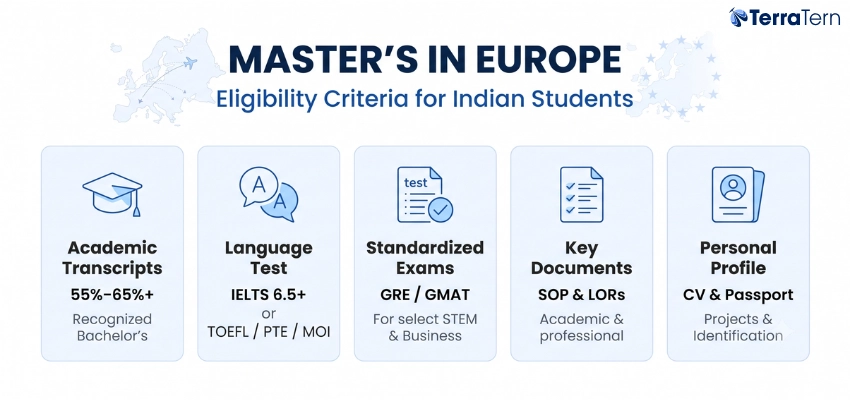
Meeting the general criteria for masters in Europe eligibility involves a mix of academic, linguistic, and administrative prerequisites. While specific criteria vary by institution, applicants targeting a master's in Europe for indian students must prepare the following core credentials:
-
Academic Transcripts: A recognized undergraduate degree with competitive grades (typically 55% to 65% or higher, depending on the tier of the university).
-
English Language Proficiency: Valid scores from tests like IELTS (usually 6.5+), TOEFL, or PTE. Some universities accept a Medium of Instruction (MOI) certificate from your previous Indian institution.
-
Standardized Testing: GRE or GMAT scores only if explicitly requested by competitive STEM or business programs.
-
Statement of Purpose (SOP): A compelling essay outlining your academic background, career goals, and reasons for choosing the specific program.
-
Letters of Recommendation (LORs): Typically 2 academic or professional recommendations.
-
Curriculum Vitae (CV): An updated resume detailing academic projects, internships, or professional experience.
-
Passport Copy: A valid international passport for identification and visa processing.
Can Indian Students With a 3-Year Bachelor's Degree Apply for a Masters in Europe?
Yes, many universities in France, Ireland, the Netherlands, Spain, and select German public institutions accept a 3-year Indian bachelor's degree (such as B.Sc., B.Com., or B.A.), though acceptance is determined on a university- and program-specific basis under the European Bologna Process credit framework (targeting 180 to 240 ECTS credits).
-
Flexible Destinations: Ireland and the Netherlands frequently accept 3-year degrees for various master's paths. Certain French and Spanish universities also accommodate them directly.
-
Strict Destinations: German universities assess whether the prior degree is academically equivalent and sufficiently related to the intended master’s programme; requirements vary by institution.
-
Bridging Options: If a program falls short of the credit threshold, students can enrol in a foundation course, a pre-master's program, or gain relevant work experience to bridge the gap.
Expert Tip: Never assume a 3-year degree automatically disqualifies or qualifies a student. University-by-university credit evaluation is mandatory, and this is exactly the kind of check a consultant like TerraTern performs before a student applies.
Do Indian Students Need GRE or GMAT for a Masters in Europe?
No, the majority of European universities do not mandate GRE or GMAT scores, contrasting sharply with the near-universal requirement found in the United States.
-
When It Is Required: Standardised tests may still be requested by elite business schools for management programs (GMAT) or highly selective, impacted engineering and data science programs at top-tier technical institutes (GRE).
-
Advantage for Indian Applicants: The absence of a mandatory test requirement simplifies the application roadmap, allowing students to focus instead on their academic grades, SOP, and language certifications.
Also Read: MS in Germany for Indian Students: Scholarships, Fees & Scope
Can Indian Students Study a Masters in Europe Without IELTS?
Yes, many universities in Germany, France, Italy, Sweden, and the Netherlands offer pathways to a masters in Europe without IELTS by accepting a Medium of Instruction (MOI) certificate. This document, issued by your previous Indian university, proves that your bachelor's degree was taught exclusively in English, serving as a valid language proficiency alternative for your masters in Europe for indian students' application.
-
What is an MOI Certificate? An official letter from your college registrar confirming that English was the language of instruction for your entire undergraduate program.
-
Country Flexibility: UK universities and Student visa routes have different English-evidence options. Check the university’s admissions policy and current UKVI rules.
|
Country |
IELTS Waiver Available |
Accepted Alternative |
|
Germany |
Often |
MOI Certificate / Online University Interview |
|
France |
Yes |
MOI / Internal French University English Test |
|
Sweden |
Yes |
English Proficiency proof from the University |
|
Netherlands |
Case-by-case |
Institutional English Language Test |
|
UK |
Rare |
Mandatory IELTS/PTE/TOEFL |
Expert Advice: An MOI certificate waiver is never automatic it must be requested from the student's Indian university registrar and explicitly accepted by the destination university's admissions office before an offer is finalized.
How Much Does a Masters in Europe Cost for Indian Students?
The total masters in europe cost for indian students typically ranges from INR 8 lakh to INR 35 lakh (covering both tuition and 1–2 years of living expenses), varying extensively based on your destination country and lifestyle choices. A masters in Europe for indian students can be exceptionally affordable—especially in countries offering low public university tuition.
1. Estimated Tuition Fee Range by Country
|
Country |
Average Annual Tuition (EUR) |
Approximate Annual Tuition (INR) |
|
Germany (Public) |
€0 – €500 (Semester fees) |
INR 0 – INR 45,000 |
|
France (Public) |
€170 – €3,770 |
INR 15,000 – INR 3.4 Lakh |
|
Ireland |
€12,000 – €25,000+ |
INR 11 Lakh – INR 23 Lakh |
|
Netherlands |
€8,000 – €20,000 |
INR 7.4 Lakh – INR 18.5 Lakh |
|
Poland / Hungary |
€2,000 – €5,000 |
INR 1.8 Lakh – INR 4.6 Lakh |
2. Estimated Living Cost Range by Region
|
Region |
Monthly Living Cost (EUR) |
Approximate Monthly Cost (INR) |
|
Eastern / Southern Europe |
€500 – €800 |
INR 46,000 – INR 74,000 |
|
Central Europe / Germany |
€850 – €1,100 |
INR 78,000 – INR 1 Lakh |
|
Western Europe / Scandinavia |
€1,200 – €1,800 |
INR 1.1 Lakh – INR 1.6 Lakh |
What Is the Cost of Living in Europe for Indian Students?
Monthly living expenses for a masters in europe cost for indian students span from €500–€800 in Eastern or Southern Europe to €1,200–€1,800 in Western Europe and Scandinavia. Expenses generally distribute across several core categories:
-
Accommodation: Usually the largest expense (€300–€800/month depending on student halls vs. private rentals).
-
Food & Groceries: €200–€350/month if cooking at home.
-
Health Insurance: Mandatory public or private coverage (€80–€120/month).
-
Transport: Discounted student transit passes (€30–€80/month).
-
Utilities & Miscellaneous: Internet, phone plans, and study materials (€50–€100/month).
What Is an APS Certificate and Why Does Germany Require It?
The APS (Akademische Prüfstelle) certificate is a mandatory document verification process administered by the German Embassy in India. It checks the authenticity of an Indian student's school and university credentials before they can apply for a German university admission or a student visa. Processing times fluctuate seasonally, so applicants should factor this into their timeline.CBS
- Resource Tease: Look out for our upcoming dedicated cluster guide: "APS Certificate for Germany: Complete Guide."
What Is a Blocked Account and How Much Money Must Indian Students Show for a Germany Visa?
A blocked account (Sperrkonto) is a specialized German bank account that proves you have adequate financial resources for your visa.
-
Required Amount: For 2026, the minimum mandatory deposit is €11,904 per year (approximately INR 10.6 Lakh), which ensures a permissible monthly withdrawal limit of €992.
IELTS exam -
Approved Providers: Popular digital platforms facilitating this process seamlessly for Indian applicants include Fintiba, Expatrio, and Coracle.
What Scholarships Are Available for Indian Students Pursuing a Masters in Europe?
Securing funding is a priority for many, and there are numerous masters in europe scholarships for indian students designed to alleviate financial burdens. These range from merit-based tuition waivers to fully funded programs that cover living expenses, helping make a masters in Europe for indian students more accessible.
Top Scholarships for Indian Students
|
Scholarship |
Country |
Coverage |
Best For |
|
Erasmus Mundus |
EU-Wide |
Full (Tuition + Stipend) |
High-achievers seeking multi-country degrees |
|
DAAD (EPOS/Others) |
Germany |
Full/Partial Stipend |
Research & development-oriented profiles |
|
Eiffel Excellence |
France |
Monthly Stipend |
High-potential masters/PhD candidates |
|
Holland Scholarship |
Netherlands |
€5,000 (First year) |
Students applying to Dutch universities |
|
Stipendium Hungaricum |
Hungary |
Full (Tuition + Housing) |
Students seeking low-cost, high-value degrees |
Important Tip: Scholarship deadlines typically fall 6–10 months before the intake; students researching "masters in Europe" in mid-year are often already too late for that year's flagship scholarships, so urgency messaging here is factually justified, not manufactured.
Also Read: Masters in Germany for International Students Guide
Which Masters Courses Are Most in Demand Among Indian Students in Europe?
When planning a masters in Europe for indian students, choosing a high-demand field significantly improves your ROI, employability, and ability to secure a post study work visa europe. These specializations often attract the highest interest due to their alignment with the EU labor market's critical skill shortages. Many of these programs allow you to apply for a masters in Europe without IELTS if you hold an MOI. Additionally, while the masters in europe cost for indian students varies, these sectors often have the highest access to industry-funded masters in europe scholarships for indian students.
|
Specialization |
Popular Countries |
Typical Career Outcome |
|
Computer Science & AI |
Germany, Ireland, Netherlands |
Software Architect, AI Researcher |
|
Data Science & Analytics |
Ireland, France, Germany |
Data Scientist, Business Analyst |
|
Mechanical/Auto Engineering |
Germany, Sweden |
Automotive Design Engineer, R&D |
|
Cybersecurity |
Ireland, Netherlands, Germany |
Security Consultant, Network Analyst |
|
International Management |
France, UK, Netherlands |
Business Consultant, Strategy Manager |
What Are the Top Universities in Europe for a Masters for Indian Students?
Top-tier institutions in Europe offer world-class research facilities and strong industry networks. Prospective applicants researching a masters in Europe for indian students should consider these globally ranked powerhouses, which provide robust support for international integration and post study work visa europe pathways. While these universities are prestigious, remember that the masters in Europe cost for indian students at private business schools may differ from public technical universities. Always check for specific masters in Europe scholarships for indian students and verify if your target program accepts a masters in Europe without IELTS via MOI certification before finalizing your shortlist.
|
University |
Country |
QS Europe Ranking (2026) |
Notable Programs |
|
ETH Zurich |
Switzerland |
2 |
Engineering, Computer Science, Physics |
|
TU Munich |
Germany |
=22 |
Informatics, Mechanical Engineering, Management |
|
Imperial College London |
UK |
=2 |
Business, Data Science, Biotechnology |
|
TU Delft |
Netherlands |
47 |
Aerospace, Civil Engineering, Tech |
|
Université PSL |
France |
8 |
Economics, AI, Sustainable Development |
What Is the Step-by-Step Application Process and Timeline for a Masters in Europe?
Navigating the application process for a masters in Europe for indian students requires careful planning. While considering the masters in europe cost for indian students, planning ahead ensures you don't miss out on important application cycles or masters in Europe scholarships for indian students.
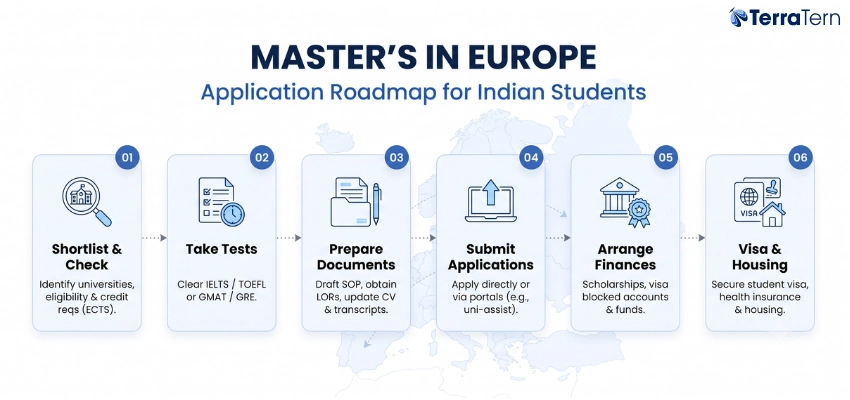
Here is the step-by-step roadmap:
-
Step 1: Shortlist Programs & Universities: Research courses that align with your career goals, checking if you can qualify for a masters in Europe without IELTS via an MOI.
-
Step 2: Check Eligibility & Academic Requirements: Verify credit requirements (like the ECTS system for 3-year degrees) and specific prerequisite coursework.
-
Step 3: Take Required Tests: Complete your IELTS/TOEFL or GMAT/GRE if mandated by your target program.
-
Step 4: Prepare Document Dossier: Draft your Statement of Purpose (SOP), secure 2 Letters of Recommendation (LORs), update your CV, and gather academic transcripts.
-
Step 5: Apply via Portals: Submit applications directly through university websites or centralised platforms like uni-assist (common in Germany).
-
Step 6: Secure Admission Offers: Review university acceptances and confirm your enrollment by paying any initial deposit fees.
-
Step 7: Arrange Finances & Scholarships: Apply for external funding, open a blocked account (if heading to Germany), and finalise your budget.
-
Step 8: Apply for Visa & Accommodation: Book your visa appointment, secure health insurance, and arrange student housing well before departure.
When Should Indian Students Apply for the September/Winter Intake?
Most European universities operate primarily on a September/Winter intake, with some institutions offering a smaller Spring/Summer intake. Applications generally open 6 to 9 months before classes begin.
Typical Application Deadlines by Country (Winter Intake)
|
Country |
Priority / Scholarship Deadline |
General Application Deadline |
|
Germany |
January – March |
May – July |
|
Netherlands |
January – April |
May – June |
|
France |
December – February |
April – May |
|
Ireland |
November – February |
June – July |
Also Read: DAAD Scholarship for Masters in Germany for Indian Students
What Are the Post-Study Work Visa and Career Opportunities After a Masters in Europe?
Securing a post study work visa Europe is one of the primary drivers for international candidates. Post-graduation work rights vary significantly by nation, dictating how long you can stay to look for employment or transition into permanent residency.
1. Post-Study Work Visa Options by Country
|
Country |
Visa Name |
Duration |
Path to Permanent Residency? |
|
Germany |
Job-Seeker / Residence Permit |
18 Months |
Yes (after 2–5 years of employment) |
|
Ireland |
Third Level Graduate Scheme (Stamp 1G) |
24 Months |
Yes (via Critical Skills/Work Permits) |
|
France |
APS / Temporary Residence Permit |
12 Months (Renewable) |
Yes (upon securing a permanent contract) |
|
Netherlands |
Orientation Year (Zoekjaar) |
12 Months |
Yes (via Highly Skilled Migrant route) |
2. Estimated Average Salary by Sector for Masters Graduates
|
Industry Sector |
Average Annual Salary Range (EUR) |
Average Annual Salary Range (INR) |
|
Tech & Software Engineering |
€50,000 – €75,000 |
INR 46 Lakh – INR 69 Lakh |
|
Data Science & AI |
€55,000 – €80,000 |
INR 50 Lakh – INR 74 Lakh |
|
Core Engineering |
€45,000 – €65,000 |
INR 41 Lakh – INR 60 Lakh |
|
Finance & Consulting |
€55,000 – €90,000 |
INR 50 Lakh – INR 83 Lakh |
What Common Mistakes Should Indian Students Avoid While Applying for a Masters in Europe?
Applying for a masters in Europe for indian students involves multiple country-specific regulations, admission criteria, and visa protocols. Drawing from patterns TerraTern's counselors see repeatedly across hundreds of applications, here are the most critical mistakes Indian applicants make and how to avoid them:
1. Selecting Programs Solely on Low Tuition: Choosing a university purely to minimize the masters in europe cost for indian students without assessing local industry presence often limits post-graduation job prospects.
-
Fix: Align your target destination with active industry clusters (e.g., tech in Ireland/Netherlands, automotive in Germany).
2. Missing Early Funding Windows: Many students apply for admission first and search for masters in Europe scholarships for indian students later, missing strict early deadlines (November–January).
-
Fix: Finalize scholarship applications simultaneously with or prior to university submissions.
3. Overlooking the 3-Year Degree ECTS Credit Gap: Assuming a 3-year Indian bachelor's degree qualifies across all European institutions without checking ECTS equivalence.
-
Fix: Have your academic credits pre-evaluated for Bologna compliance to determine if a bridge course or pre-master's is required.
4. Underestimating the APS and Blocked Account Timeline: Waiting for an admission offer before starting the German APS verification or arranging blocked account funds leads to visa deferrals.
-
Fix: Initiate APS document verification at least 4–6 months before admission deadlines.
5. Assuming All EU Countries Share the Same Work Visa Rules: Believing a Schengen visa grants identical stay-back rights everywhere rather than checking specific post study work visa europe regulations.
-
Fix: Review individual national policies (e.g., 24 months in Ireland vs. 12 months in the Netherlands).
6. Relying Blindly on MOI Waivers: Applying for a masters in Europe without IELTS without verifying if your specific department or visa consulate accepts a Medium of Instruction certificate.
-
Fix: Confirm department-level language criteria directly before skipping standardised tests.
Pro Tip: The single most expensive mistake is starting the application in the same year as the intended intake, as scholarship and visa timelines in Europe require most students to begin 10–12 months ahead.
Masters in Europe vs USA vs Canada vs Australia: Which Is Better for Indian Students?
Choosing the right study abroad destination depends on your budget, academic timeline, career aspirations, and long-term immigration plans. While a master's in Europe for indian students stands out for affordability, competitive post-study work visa options in Europe, and opportunities to study a master's in Europe without IELTS, traditional English-speaking destinations offer alternative advantages.
The overall masters in europe cost for indian students is significantly lower than in the US, Canada, or Australia, and access to prestigious masters in europe scholarships for indian students makes it the most financially viable choice for high ROI without heavy education loan burdens.
|
Comparison Factor |
Continental Europe |
United States |
Canada |
Australia |
|
Average Program Duration |
1 to 2 Years |
2 Years |
1.5 to 2 Years |
1.5 to 2 Years |
|
Annual Tuition Range (INR) |
INR 0 to INR 18 Lakh |
INR 25 to INR 55 Lakh |
INR 15 to INR 30 Lakh |
INR 18 to INR 35 Lakh |
|
Total Estimated Cost (INR) |
INR 8 to INR 35 Lakh |
INR 50 to INR 90 Lakh |
INR 30 to INR 50 Lakh |
INR 35 to INR 55 Lakh |
|
English Language Requirement |
IELTS/PTE or MOI waiver |
IELTS/TOEFL strictly required |
IELTS/PTE mandatory |
IELTS/PTE mandatory |
|
Post-Study Work Visa Duration |
12 to 24 Months |
12 to 36 Months (OPT/STEM) |
Up to 3 Years (PGWP) |
2 to 4 Years (PSW) |
|
Permanent Residency Pathway |
Moderate (Country-specific) |
Highly Competitive / Complex |
Points-based (CRS system) |
Points-based (GSM system) |
|
Scholarship Accessibility |
High (State/EU funded) |
High (Institutional/RA/TA) |
Moderate (Institutional) |
Moderate (Merit-based) |
Also Read: Best Courses to Study Abroad for Indian Students
2026 Industry Context Section
Some of the industry context sections are:
-
Scholarship Leadership: India was the largest global recipient of Erasmus Mundus scholarships in the 2024–25 cycle, with 146 students selected; over 2,000 Indian students have received the scholarship since 2004. (Source: EU Delegation to India / Erudera, June 2024)
-
Scale: Over 80,000 Indian students are currently studying in Europe, per the EU Ambassador to India. (Source: Erudera, 2024)
-
Germany is Now the Top Single Destination: Germany enrolled 402,000+ international students in 2024/25 (+6% YoY), with India as the single largest source country at ~59,000 students, and is projected to reach 500,000 international students by 2028.
-
Netherlands Growth: ~131,000 international students were enrolled in Dutch degree programs in 2024/25, including ~51,800 new entrants.
-
UK Scale (for Comparison): The UK hosted 732,285 international students in 2024/25; international students make up 51% of all UK postgraduate enrollments.
-
Affordability Ranking: Independent database Study.eu ranks Germany, France, and Poland among the top 10 most affordable study destinations in Europe for international students.
-
Growth Forecast: Spain forecasts reaching 200,000 international students by 2030, a 79% increase driven partly by lower tuition costs.
Key Note: Recency stamps (exact intake year, "as of [month] 2026") on every statistic are what separate a page that gets cited by AI systems from one that gets ignored. Never present a 2024 figure as if it were current without an explicit year tag.
Conclusion
Embarking on a masters in Europe for indian students offers an exceptional blend of world-class academics, low tuition rates, and lucrative career paths. By carefully managing the overall masters in Europe cost for indian students, leveraging available masters in Europe scholarships for indian students, exploring options for a masters in Europe without IELTS, and planning your timeline to secure a reliable post study work visa Europe, you can build a transformative global career.
Contact TerraTern for more information on Masters in Europe for Indian Students: Complete 2026 Guide.




 AI Summary