Key Highlights
- What Is the IELTS Exam Pattern? - A Quick Overview
- What Are the Two Types of IELTS Exam Patterns? (Academic vs General Training)
- What Is the Section-Wise IELTS Exam Paper Pattern? (Complete Breakdown)
- What Is the IELTS Exam Pattern 2026 — What Has Changed This Year?
- How Does the IELTS Scoring System Work in the Exam Pattern?
- What is the Difference Between the Paper-Based and Computer-Based IELTS Exam Patterns?
- How Should Indian Students Prepare Based on the IELTS Exam Syllabus and Pattern?
- What Are the Common Mistakes Indian Students Make in Each IELTS Section?
- What Are the IELTS Exam Dates, Fees, and Registration Process in India (2026)?
- Conclusion
The IELTS exam pattern 2026 is standardised, and it measures the Listening, Reading, Writing, and Speaking testing skills, which are required for studying, working, or migrating. Understanding the IELTS exam pattern and preparing accordingly is key to achieving the band score you need. The total time for the IELTS exam is 2 hours and 45 minutes.
What Is the IELTS Exam Pattern? - A Quick Overview

The IELTS exam pattern consists of four different sections to test the proficiency of the English language, namely Listening, Reading, Writing and the Speaking section for the study, work, and migration purposes of individuals.
-
IELTS (International English Language Testing System) established the listening and reading skills, writing and speaking skills to be used in real life in English-speaking countries.
-
Over 3.5 million candidates appear for it each year worldwide. India tops the list of test-takers, including students, professionals, and people who are looking to apply for Australia/UK or US visas.
-
The academic version is for university admissions; the General Training is for Job/Training migration - both have 0-9 band, no negative marking.
-
The 2026 pattern remains stable at a structural level, bringing on board one skill retake and fine-tuned questions, such as complex maps.
-
Total approx. 2h 45 min(+11-14min Speaking, often separate day)
As per TerraTern Expert, Divyansh, Most Indian students score lower than their potential, not because of poor English, but because they begin preparing without fully understanding the IELTS exam structure. Pattern clarity is your first competitive advantage.
Also Read: IELTS Exam Pattern: New Format, Syllabus & Scoring Guide
What Are the Two Types of IELTS Exam Patterns? (Academic vs General Training)
The two patterns of the IELTS exam are
-
There are two IELTS Exam Patterns: Academic for university admission and professional registration, and General Training for migration, work, and secondary education.
-
Listening and Speaking are identical in both versions; Reading and Writing differ to suit the purpose.
-
IELTS Academic Targets Students and universities in Canada, the UK, Australia, and NZ; professionals like doctors, nurses, and engineers.
-
IELTS General Training: Skilled migration, work visas, PR: The best option for those Indians from Srinagar who aim at global employment.
-
IELTS UKVI: Patterns are the same as IELTS UK visa.
-
IELTS Life Skills: A short Speaking and Listening test for UK family or settlement visa applicants.
|
Feature |
IELTS Academic |
IELTS General Training |
|
Purpose |
University / Professional Registration |
Migration / Work / Secondary Education |
|
Listening |
Same |
Same |
|
Speaking |
Same |
Same |
|
Reading |
Complex academic texts |
Every day, texts, notices, and ads |
|
Writing Task 1 |
Describe graph/chart/diagram |
Write a formal/informal letter |
|
Writing Task 2 |
Essay (same as General) |
Essay (same as Academic) |
|
Who should take it |
Students, doctors, nurses, and engineers |
Skilled workers, PR applicants |
Important Note: Choosing the wrong IELTS type can invalidate your score for a visa or university application. Always verify with your target institution or immigration consultant before registering.
What Is the Section-Wise IELTS Exam Paper Pattern? (Complete Breakdown)
The IELTS exam paper pattern features four sections: Listening (30 min), Reading (60 min), Writing (60 min), Speaking (11–14 min), totalling ~2 hours 45 minutes with no negative marking.
|
Section |
Duration |
Questions/Tasks |
Marks |
|
Listening |
30 min +10 min transfer (paper) |
40 questions |
40 |
|
Reading |
60 min |
40 questions |
40 |
|
Writing |
60 min |
2 tasks |
Band descriptors |
|
Speaking |
11–14 min |
3 parts |
Band descriptors |
What Is the IELTS Listening Section Pattern?
The IELTS listening section pattern is:
-
IELTS Exam Paper Pattern for Listening: 30 min, 40 questions across 4 recordings (social convo, monologue, academic discussion, lecture).
-
Question Types: multiple choice, matching, map/plan labelling, form/sentence completion; 2026 adds complex maps, mixed types, diverse accents (Indian, Asian).
-
Paper-based: +10 min transfer; raw score converts to 0-9 band.
Expert Tip: In 2026, IELTS Listening now features accents from non-native but fluent speakers, including Indian English. Practising with diverse audio sources is no longer optional.
What Is the IELTS Reading Section Pattern?
The IELTS reading section pattern is:
-
IELTS Exam Paper Pattern: 60 min, 40 questions from 3 passages; Academic: academic texts (journals/books); General: everyday (notices/ads/work).
-
Types: True/False/Not Given, matching headings/info, sentence completion, multiple choice, short answer; aim 20 min/passage, no transfer time.
-
2026: More matching info/sentence endings.
Expert Advice: The biggest Reading mistake is spending too long on one passage. If a question is taking more than 2 minutes, move on and return, time discipline is non-negotiable.
What Is the IELTS Writing Section Pattern?
The IELTS writing section pattern is:
-
IELTS Exam Paper Pattern Writing: 60 min, Task 1 (150+ words, 20 min), Task 2 (250+ words, 40 min, double weight).
-
Academic Task 1: Describe charts/graphs/maps/process (2026: mixed charts common); General Task 1: Letter (formal/informal).
-
Task 2 (both): Essay (opinion/argument); criteria: task response, coherence, vocab, grammar; 2026 penalises memorised templates.
Important Tip: Writing Task 2 carries more band weight than Task 1. Spending at least 3 minutes planning your essay structure before writing is the single highest-ROI preparation habit.
What Is the IELTS Speaking Section Pattern?
The IELTS speaking section pattern is:
-
IELTS exam pattern Speaking: 11–14 min, identical for both types; face-to-face or VCS (2026: on-screen cue cards).
-
Part 1 (4-5 min): Intro questions (home/work/hobbies).
-
Part 2 (3-4 min): 1-min prep, 2-min cue card talk.
-
Part 3 (4-5 min): Abstract discussion; criteria: fluency, vocab, grammar, pronunciation; 2026 rewards spontaneous answers.
As per TerraTern Expert: Pronunciation in IELTS does NOT mean a British or American accent, it means clarity and intelligibility. Indian students can score Band 8–9 in Speaking with their natural accent, provided speech is clear and fluent.
What Is the IELTS Exam Pattern 2026 — What Has Changed This Year?
The IELTS exam pattern 2026 maintains its core four-section structure but introduces key updates, including One Skill Retake for computer-based tests, mixed charts in Writing Task 1, and stricter penalties for memorised responses.
2026 Changes Summary:
-
One Skill Retake (OSR): Computer-delivered only; retake one section within 60 days at IDP India centres, which is huge for Indian students, avoiding full retakes.
-
Writing Task 1 Mixed Charts: Academic sees pie + bar charts combined, testing synthesis skills.
-
Writing Task 2 Nuanced Prompts: Specific topics (e.g., tech privacy) penalise generic templates per IDP/British Council guidelines.
-
Speaking VCS Expansion: Video Call Speaking at select India centres; on-screen cue cards, same scoring.
-
Listening to diverse accents: More Indian/European/Asian fluent speakers.
-
Computer Test Growth: More slots, better security.
Pro Tip: The single most impactful 2026 change for Indian students is the One Skill Retake; it eliminates the need to retake the full 3-hour test if you fall short in one section. Always opt for computer-based IELTS in India to access this feature.
Also Read: New IELTS Syllabus, Exam Pattern, Changes & Preparation Guide
How Does the IELTS Scoring System Work in the Exam Pattern?
The IELTS exam pattern 2026 uses a 0-9 band scale per section (Listening, Reading, Writing, Speaking); the overall score is the average of these sections, rounded to the nearest 0.5, with no negative marking.
-
Band 9 means expert user; Band 6 operational command. Listening/Reading convert raw/40 scores to bands; Writing/Speaking use four descriptors (task response, coherence, vocab, grammar).
-
Indian Targets: Canada PR (6.0-7.0), UK visa (4.0), Australia migration (6.0+), US unis (6.5-7.5).
|
Raw Score (out of 40) |
Listening/Reading Band |
|
39-40 |
9.0 |
|
37-38 |
8.5 |
|
35-36 |
8.0 |
|
32-34 |
7.5 |
|
30-31 |
7.0 |
|
26-29 |
6.5 |
|
23-25 |
6.0 |
Key Note: Many Indian test-takers overlook that the overall band score is rounded; a score of 6.625 becomes 6.5, not 7. Targeting at least 0.5 higher than your required score is a smart strategy to account for this rounding.
What is the Difference Between the Paper-Based and Computer-Based IELTS Exam Patterns?
The IELTS exam pattern structure remains identical across paper-based and computer-based formats, with the same content, difficulty, and scoring. Key differences lie in answer input, Listening timing, and exclusive computer access to One Skill Retake (OSR).
-
Paper-based uses handwritten answers with extra Listening transfer time; computer-based offers typing, real-time entry, and on-screen tools. This is ideal for Indian students targeting 2026 tests with OSR for single-section retakes.
-
Speaking stays face-to-face (or VCS at select IDP/British Council centres); computer format dominates availability in major Indian cities.
|
Feature |
Paper-Based |
Computer-Based |
|
Content |
Identical |
Identical |
|
Scoring |
Identical |
Identical |
|
Listening transfer time |
10 minutes extra |
No separate entry time needed |
|
Writing |
Pen/pencil |
Typed |
|
One Skill Retake |
Not available |
Available |
|
Screen tools |
None |
Highlighting, notes |
As per TerraTern Expert, Shreya, if you are taking the IELTS in India in 2026, opt for computer-based delivery. The One Skill Retake feature is a game-changer; it gives you a second chance on just one section without repeating the entire exam.
How Should Indian Students Prepare Based on the IELTS Exam Syllabus and Pattern?
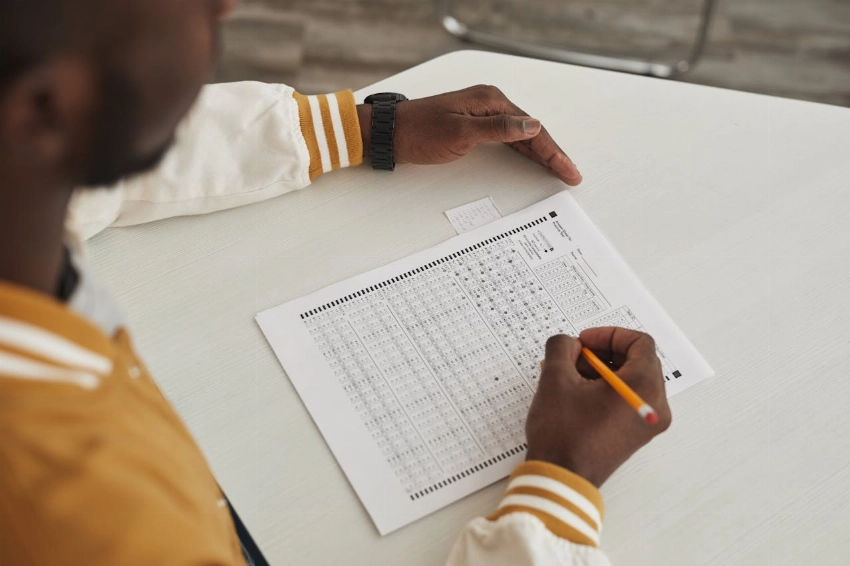
Indian students excel in mastering the IELTS exam syllabus and pattern by focusing on section-specific strategies, prioritising time management, spelling accuracy, structured responses, and natural fluency over rote learning.
How Should You Prepare for the IELTS Listening Pattern?
IELTS exam syllabus and pattern prep daily practice with British Council free audios, Cambridge IELTS Books 14–19 for authentic 4-part recordings.
-
Master spelling during 10-min paper transfer; scan for keywords amid diverse accents (2026 includes Indian/Asian fluency).
-
Tip: Simulate test—note real-time on a computer format.
How Should You Prepare for the IELTS Reading Pattern?
IELTS exam syllabus and pattern strategy allocate 20 min/passage; skim first, scan for answers (Academic: journals; General: notices).
-
Build vocab via IELTS Liz lessons; practice True/False/Not Given and matching—Indian students often trip over academic terms.
-
Use the Cambridge Official Guide for timed full tests.
How Should You Prepare for the IELTS Writing Pattern?
IELTS exam syllabus and pattern approach plan 3–5 min; ID question type (opinion/discussion); Task 1: 150–180 words; Task 2: 260–290 (double weight).
-
2026 tip: Ditch templates—tailor to nuanced prompts (e.g., mixed charts Academic Task 1).
-
Get feedback from TerraTern evaluators for band-boosting coherence/vocab.
How Should You Prepare for the IELTS Speaking Pattern?
IELTS exam syllabus and pattern daily drill 10–15 min recordings on cue-card topics; self-review fluency/coherence.
-
Part 3: Practice abstract reasoning; 2026 VCS—screen-read prompts at IDP centres.
-
Avoid memorised answers, prioritise natural responses over accent fix.
Free preview limit reached. Now using basic search.
Pro Tip: A 30-day structured IELTS preparation plan that spends 45–60 minutes daily on section-specific practice is sufficient for most Indian students to improve their band score by 0.5-1.0 bands. Blind practice without pattern awareness is the most common and most avoidable mistake.
Also Read: What Is the IELTS Exam? Fees, Uses, Format & Scoring Guide
What Are the Common Mistakes Indian Students Make in Each IELTS Section?
Indian students often lose bands in the IELTS exam pattern structure due to predictable errors. Some of the most common mistakes are:
|
Section |
Most Common Mistake |
How to Fix It? |
|
Listening |
Spelling errors during answer transfer |
|
|
Reading |
Spending too long on one question |
|
|
Writing |
Using memorised templates |
|
|
Writing |
Going under the word count |
|
|
Speaking |
Memorised/robotic opening answers |
|
|
Speaking |
Short answers in Part 1 |
Expert tip: The two most impactful fixes for Indian test-takers are: (1) practising Listening with strict spelling discipline, and (2) moving away from template Writing — these two changes alone can add 0.5 to the overall band score.
What Are the IELTS Exam Dates, Fees, and Registration Process in India (2026)?
IELTS runs year-round in India with frequent IELTS exam pattern structure slots, computer tests more often than paper, and fees at ₹19,000.
-
Exam dates 2026: Multiple weekly slots; check britishcouncil.in or ielts.idpindia.com for availability in Srinagar/Delhi.
-
Registration: Online only—create account, select IELTS exam pattern structure (Academic/General), pay via card/net banking.
-
Fee India 2026: ₹19,000(varies by IDP/British Council centre; confirm latest).
-
Key cities: Delhi, Mumbai, Bangalore, Hyderabad, Chennai, Kolkata, Pune, Chandigarh—Srinagar options growing.
-
ID required: Valid passport only (no Aadhaar).
-
Results: Online in 3-5 days (computer), 13 days physical TRF.
-
Retakes: Unlimited; One Skill Retake (computer-only) within 60 days.
Key Note: Book your IELTS exam slot at least 4–6 weeks in advance, especially in high-demand months (March–May and October–November) when seats fill quickly in major Indian cities.l
Conclusion
Understanding the IELTS exam pattern structure is the foundation of every successful test-preparation journey for Indian students pursuing global opportunities. Key takeaways include its four-section structure (Listening, Reading, Writing, Speaking); Academic/General differences only in Reading/Writing; 2026 updates such as One Skill Retake, VCS, mixed charts, and a natural language focus; 9-band averaging with no negative marking; and a computer-based preference for OSR access.
Contact TerraTern for more information on IELTS Exam Pattern 2026: Complete Guide & Structure.