


Key Highlights
- What are the Top Courses for Masters in Finland for Indian Students?
- What Does a Master's in Finland Involve for Indian Students?
- What's the Difference Between a Research University and a UAS Master's in Finland?
- Which Are the Best Universities in Finland for a Masters Degree?
- What Are the Eligibility Requirements for a Masters in Finland for Indian Students?
- How Much Does a Master's in Finland Cost for Indian Students?
- How Do You Apply for a Masters in Finland?
- How Do You Get a Finland Student Residence Permit After Admission?
- What Are the Job Prospects After a Masters in Finland for Indian Students?
- Is Finland Better Than Germany, Sweden, or Ireland for a Masters Degree?
- What Mistakes Should Indian Students Avoid When Applying for a Master's in Finland?
- 2026 Industry Context
- Conclusion
Taking a master's in Finland for Indian students in 2026 is one of the best choices that Indian students make nowadays. Finland boasts world-class universities, high-level innovation in education, excellent connections to industry, English-taught programmes, an affordable cost of living, generous scholarships, and a post-study work permit of up to 24 months.
Whether you're interested in admission criteria, tuition costs, visa processes, or career recommendations, this guide has you covered to ensure your educational experience in Finland is seamless and exciting.
What are the Top Courses for Masters in Finland for Indian Students?

The top masters in Finland for Indian students in terms of value are in the tech/engineering/sustainability field, where the number of English-taught intakes and graduate hiring are the highest. Fee reform is to be implemented in August 2026. Many Finnish university master’s programmes comprise 120 ECTS credits and are designed for two years of full-time study; confirm the specific programme structure.
|
Course / Field |
Top Universities |
Annual Fee (€) |
Career Scope |
|
Computer Science, AI & Data Science |
Aalto, Helsinki, Tampere |
12,000–18,000 |
AI Engineer, Data Scientist |
|
ICT & Software Engineering |
Oulu, Turku, LUT |
10,000–15,000 |
Software Developer, Cloud Architect |
|
Sustainable & Renewable Energy |
LUT, Aalto, Vaasa |
12,000–16,000 |
Energy Analyst, ESG Consultant |
|
Electrical, Mechanical & Automation |
Tampere, Aalto, Oulu |
10,000–16,000 |
Automation, Robotics Engineer |
|
International Business & Finance |
Aalto, Jyväskylä, Turku |
12,000–20,000 |
Analyst, Consultant, Manager |
Also Read: Finland’s New 6-Year PR Rule: What Indian Students Must Know
What Does a Master's in Finland Involve for Indian Students?
A master's in Finland for Indian students is a second (master's) degree that is taught in English, is of at least 120 ECTS, and typically takes two years to finish, culminating in the preparation of a thesis. A Masters degree may be awarded by a research university or a university of applied sciences. In contrast to the more heavy-duty lecture- and examination-based design of university courses in India, the academic culture in Finland is one with smaller classes, work-based learning projects for the students, little hierarchy between students and professors in the classroom, and low-pressure grading throughout the semester based on coursework rather than examinations.
-
Length: 120 ECTS (~2 years)
-
Language: English (600+ programmes)
-
Assessment: Coursework + Thesis
-
Recognition: Higher education area of the second level of qualifications (as officially recognised through the European Commission's Eurydice network frameworks).
As per TerraTern Expert Divyansh, Don't let the "two years" framing undersell the workload difference. Finnish master's programmes lean heavily on independent research and a substantial thesis, which surprises Indian students used to exam-weighted grading.
What's the Difference Between a Research University and a UAS Master's in Finland?
A research university masters degree is offered directly following your bachelor's degree; a UAS (university of applied sciences) masters degree will require at least 2 years of related professional working experience after your bachelor's degree. This is important to know so that graduates from a school do not use application positions on unqualified tracks.
|
Feature / Requirement |
Research Universities (e.g., University of Helsinki, Aalto, Tampere) |
Universities of Applied Sciences / UAS (e.g., Metropolia, Haaga-Helia) |
|
Target Audience |
Fresh bachelor's graduates & career advancers |
Working professionals with industry experience |
|
Work Experience Requirement |
None required for admission |
Mandatory (minimum 2 years post-bachelor's) |
|
Focus & Approach |
Academic research, theory, and scientific depth |
Practical, industry-applied competencies and management |
Important Note: Check the work-experience requirement before shortlisting. This is the most common reason a strong applicant gets an instant rejection, and it has nothing to do with grades.
How Long Does a Masters in Finland Take to Complete?
Generally, amaster'ss in Finland for Indianstudents will require two years of full-time study, which equals 120ECTSS credits. There are, however, a few professional UAS programs or part-time programs with slight variations, as well as delays in thesis completion, which are the most common reasons for extensions beyond the standard two-year timeframe.
Expert Tip: Budget both time and money for a full two years, even if a programme markets itself as completable faster; thesis timelines routinely run past the coursework schedule.
Which Are the Best Universities in Finland for a Masters Degree?
Aalto University, University of Helsinki, Tampere University, University of Oulu, LUT University and the University of Eastern Finland are the universities Indianapplicants shortlist most often for a masters in Finland for Indianstudents, with tuition ranging from about €10,000 to €20,000 a year depending on the institution and field. To help you use this as a shortlisting tool rather than chasing brand names alone, match your specific undergraduate background and career goals to the institutional strengths below:
|
University |
2026 Tuition/Year (€) |
Strongest Fields |
Scholarship Type |
City |
Best-Fit Applicant Profile |
|
Aalto University |
€15,000–€20,000 |
Business, Design, Technology, Engineering |
Merit-based tuition waivers (50%–100%) |
Espoo / Helsinki |
Innovation-focused tech & business grads looking for startup ecosystems |
|
University of Helsinki |
€13,000–€18,000 |
Data Science, Life Sciences, Economics, Education |
Annual tuition waivers (merit-based) |
Helsinki |
Research-oriented students targeting multidisciplinary or scientific tracks |
|
Tampere University |
€10,000–€15,000 |
Automation, Information Technology, Health Sciences |
50% to 100% tuition fee scholarships |
Tampere |
Engineers seeking strong industry integration with local manufacturing hubs |
|
LUT University |
€10,000–€13,500 |
Clean Energy, Environmental Tech, Software Engineering |
Performance-based partial & full waivers |
Lappeenranta / Lahti |
Applicants targeting the green transition and sustainable tech sectors |
|
University of Oulu |
€10,000–€13,000 |
Wireless Communications, ICT, Mining Engineering |
Early-bird discounts & merit waivers |
Oulu |
Telecommunications and hardware/software engineering professionals |
|
University of Turku |
€10,000–€16,000 |
Biotech, Global Business, IT, Public Health |
Conditional scholarship waivers |
Turku |
Students wanting a traditional campus culture near the southwestern coast |
|
University of Eastern Finland |
€8,000–€12,000 |
Forestry, Health Sciences, Environmental Law |
Merit-based tuition reductions |
Joensuu / Kuopio |
Budget-conscious applicants focused on life sciences and forestry |
|
University of Jyväskylä |
€8,000–€12,000 |
Cyber Security, Education, Sport Sciences |
Tuition waivers for top-ranked applicants |
Jyväskylä |
IT and educational technology specialists seeking affordable living |
Expert Advice: The cheapest universities (Oulu, Eastern Finland, Turku) sit in the €10,000–12,000 range with strong engineering and research reputations a well-matched budget programme often beats a stretched budget at a bigger name like Aalto or Helsinki.
What Are the Top Master's Specialisations in Finland for IndianStudents?
Computer science/data science, business and technology management, environmental and clean-energy engineering, and health technology are the master's specialisations Indian students pursue most in Finland, matching the country's strongest hiring sectors. Below are the primary specialisations aligned with official Finnish labour market data (such as OPH and Business Finland competence gap reports focusing on ICT, clean transition, and industrial technology):
|
Specialisation / Field |
Key University Strengths |
Why It Pays Off (Job-Market Relevance) |
|
1. Software Engineering & AI |
Aalto, Oulu, Tampere |
Directly aligns with chronic ICT gaps in Finland's tech sector |
|
2. Clean Energy & Environmental Tech |
LUT, Aalto |
Backed heavily by national investments in the green transition |
|
3. Industrial & Mechanical Automation |
Tampere, Oulu |
Feeds into Finland's heavy manufacturing and machinery maintenance needs |
|
4. Health Technology & Biotechnology |
University of Turku, UEF |
Matches high ongoing demand within European life-science hubs |
|
5. International Business & Economics |
Aalto, University of Jyväskylä |
Prepares graduates for corporate management and international trade roles |
|
6. Cybersecurity & Cloud Computing |
Jyväskylä, Aalto |
High-demand niche facing specialized talent shortages across Scandinavia |
Important Tip: Choose a field with genuine Finnish hiring demand, not just prestige. A niche humanities specialisation can produce a fine degree, but a much harder two-year job search afterward
How Do Finnish Universities Compare on Tuition and Scholarships?
Tuition ranges roughly €10,000–20,000/year depending on university and field, with most institutions offering 50% (occasionally 100%) merit-based tuition waivers rather than living-cost support.For a complete breakdown of living costs, visa financial proof requirements, and scholarship structures relevant to a masters in Finland for Indianstudents, please review the dedicated cost and funding sections outlined above.
As per our TerraTern Expert Shreya, treat a 50% waiver as the realistic target and a 100% waiver as a bonus; budgeting for the full amount and being pleasantly surprised beats the reverse.
Also Read: Jobs in Finland for Indians: Salaries, Visa Guide
What Are the Eligibility Requirements for a Masters in Finland for Indian Students?
Indian students need a recognised bachelor's degree in a related field, proof of English proficiency (IELTS/TOEFL/PTE, unless their prior degree was English-medium), academic transcripts, a motivation letter/SOP, and, for UAS programmes only, two years of relevant work experience. To ensure your application meets standard entry checks for a masters in Finland for Indian students, tick off the core checklist items below:
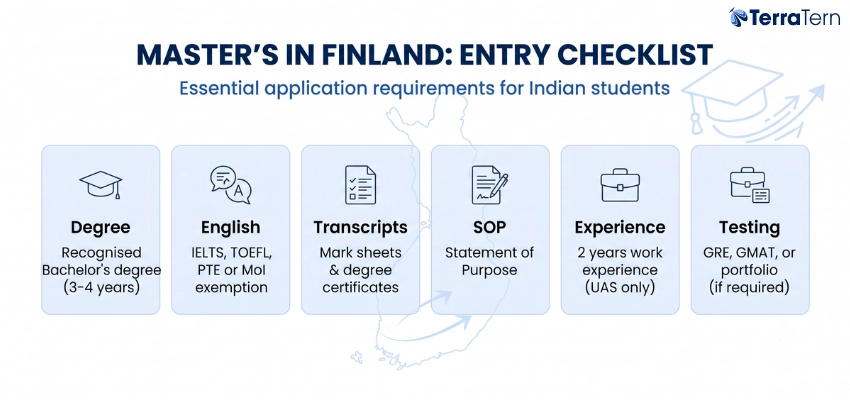
-
Relevant Bachelor's Degree: A completed undergraduate degree (typically 3 to 4 years) from a recognised university matching the prerequisite field requirements of your chosen master's track.
-
English Language Proficiency: Valid test scores or an approved Medium of Instruction (MoI) exemption certificate confirming your prior education was entirely delivered in English.
-
Academic Transcripts & Certificates: Officially certified copies of your mark sheets, degree certificate, and grading scale conversions.
-
Statement of Purpose (SOP) / Motivation Letter: A targeted essay outlining your academic background, career objectives, and reasons for choosing the specific Finnish programme.
-
Professional Experience (UAS Only): A minimum of two years of post-qualification work experience if you are targeting a University of Applied Sciences (UAS) master's track.
-
Standardised Tests (If Applicable): GRE or GMAT scores for specific elite business or technical analytics options, or portfolio submissions for design tracks.
Important Note: A mismatched bachelor's-to-programme field is a far more common rejection reason than a weak GPA. Prioritise genuine subject alignment over chasing a "prestige" programme.
What English Language Scores Do You Need (IELTS/TOEFL/PTE)?
Most Finnish master's programmes expect IELTS 6.0–6.5, TOEFL 80–90, or an equivalent PTE/Duolingo score, though exemptions apply if your bachelor's was fully taught in English. The table below outlines the standard expectations across top institutions for a masters in Finland for Indian students:
|
English Test |
Typical Minimum Score |
Program-Level Notes & Variances |
|
IELTS Academic |
Overall 6.5 (min. 5.5–6.0 in writing) |
Standard requirement for research universities like Aalto and Helsinki; some UAS tracks accept 6.0. |
|
TOEFL iBT |
Total 90–92 (min. 20–22 in writing) |
Widely accepted alternative; competitive management courses often enforce stricter subsection limits. |
|
PTE Academic |
Total 54–62 (or 55+) |
Accepted across nearly all major Finnish universities via electronic verification. |
|
MoI Exemption Certificate |
Waiver granted |
Accepted if your previous degree was fully taught and examined in English in India, subject to university-specific list approvals. |
Expert Advice: Check each specific programme's language page before booking a test, the minimum band varies enough between universities that a generic "6.5 is safe" assumption can under- or over-prepare you.
What Documents Do You Need for a Finland Masters Application?
A complete application needs academic transcripts and a degree certificate, proof of English proficiency, a motivation letter/SOP, an updated CV, and, for UAS programmes, proof of relevant work experience. Keep these sequential steps and document rules in mind when preparing your file for a master's in Finland for Indian students:
-
Degree Certificate and Mark Sheets: Upload official transcripts. Ensure documents are clear, complete, and bear institutional stamps. (Note: Always check if your target university requires notarised copies or apostilled translations if transcripts are issued in regional Indian languages instead of English.
-
Proof of English Language: Attach your official IELTS/TOEFL/PTE scorecard or an official Medium of Instruction (MoI) certificate from your Indian university confirming English-medium instruction.
-
Curriculum Vitae (CV): Format your CV using a clean Europass or professional template highlighting academic projects, internships, and technical skills.
-
Motivation Letter / Statement of Purpose: Tailor your essay specifically to each university track, addressing why your background fits their curriculum.
-
Work Experience Certificates: If applying to a University of Applied Sciences (UAS), compile official employment certificates detailing exact job titles, roles, and duration to clear the mandatory 2-year experience threshold.
Expert Tip: Start transcript attestation and English testing at least 3–4 months before the January application window. These are the two steps most likely to cause a last-minute scramble.
How Much Does a Master's in Finland Cost for Indian Students?
A masters in Finland costs €8,000–€20,000 a year in tuition plus roughly €9,600 a year in living costs, putting the full two-year investment at approximately €35,200–€59,200 (INR 39–66 lakh at current exchange rates) before any scholarship.
According to guidelines from Study in Finland and the Finnish Immigration Service (Migri), financial planning requires separating tuition fees from mandatory living-cost proof. Scholarships typically waive tuition partially or fully, but they never cover living expenses.
|
Expense Category |
Annual Range (EUR) |
Annual Range (INR) |
Notes & Source Guidance |
|
Tuition Fees |
€8,000 – €20,000 |
INR 8.9 Lakh – INR 22.3 Lakh |
Varies by institution and discipline (e.g., higher for business tracks, lower for regional tech universities). |
|
Living Costs (Migri Minimum) |
€9,600 |
~INR 10.7 Lakh |
Mandatory financial proof required by the Finnish Immigration Service (€800/month equivalent). |
|
Total Annual Outlay |
€17,600 – €29,600 |
INR 19.6 Lakh – INR 33.0 Lakh |
Combined baseline requirement per academic year before scholarships. |
Important Tip: Run the two-year total, not just the annual tuition, before comparing Finland to other countries. A €12,000/year "cheap" university can still mean a INR 47 lakh two-year commitment once living costs are added.
What Is the Total Two-Year Cost Including Living Expenses?
Combining tuition and the mandatory living-cost proof, a two-year masters in Finland typically totals €35,200–€59,200 (approximately INR 39–66 lakh) before any scholarship is applied.
|
Cost Element |
Calculation Formula (Mid-Range Example: Tampere University at ~€12,000/yr tuition) |
Total in Euros (€) |
Total in Indian Rupees (INR) |
|
Two-Year Tuition |
€12,000for 2 years |
€24,000 |
~INR 26.8 Lakh |
|
Two-Year Living Proof |
€9,600for 2 years |
€19,200 |
~INR 21.5 Lakh |
|
Total Combined Investment |
€24,000 + €19,200 |
€43,200 |
~INR 48.3 Lakh |
As per TerraTern Expert: Treat the €9,600/year living-cost figure as a floor, not a comfortable budget, especially in Helsinki or Espoo; build in a buffer rather than planning to the exact minimum.
Are There Really Government Scholarships for Indian Students in Finland?
No, Finland has no general government scholarship for master's students; all waivers are university-specific, merit-based, and typically cover tuition only, not living costs.
|
Scholarship / Funding Type |
What It Actually Covers |
Current Status & Availability for Master's Students |
|
University Merit Waivers |
50% to 100% of tuition fees |
Widely available across institutions like Aalto, Tampere, and LUT based on academic track records. |
|
The Finland Scholarship (Pilot) |
Tuition waiver + relocation grant |
Closed/Restructured; no longer active as a universal national general award pool. |
|
EDUFI / CIMO Fellowships |
Living allowances and research grants |
Restricted strictly to doctoral researchers and academic visitors, not standard master's students. |
Pro Tip: If a scholarship claim promises a flat cash amount or calls itself a "government scholarship" for master's applicants, verify it directly against Study in Finland's official scholarships page before budgeting around it. Several aggregator sites are still circulating an outdated claim.
How Do You Apply for a Masters in Finland?
For masters in Finland for Indian students, the application is mainly completed through Studyinfo.fi. Follow these steps:
-
Shortlist Programmes: Compare eligible master’s courses and universities.
-
Check Requirements: Review academic, English-language, and document requirements.
-
Apply Online: Submit one joint application through Studyinfo.fi, selecting up to six programmes.
-
Fee: Pay the €100 application fee where applicable.
-
Submit Documents: Upload transcripts, degree certificates, and other required materials.
-
Track the Application: Admission results are typically released by late May.
-
Apply for a Residence Permit: Once admitted, arrange your permit, finances, and accommodation.
Key Note: Applying to a genuinely diverse mix of your six programme slots, spread across 1–2 reach universities, 2–3 realistic-fit universities, and 1–2 safer/lower-fee options, improves your odds far more than six similar "dream" applications.
What Is the Finland Masters Application Timeline for 2026–27 Intake?
For masters in Finland for Indian students, the main joint application generally follows this timeline. Exact dates can change, so always verify the current cycle on
|
Stage |
Typical Timeline |
Description & Action Items |
|
Application Opens |
December – January (e.g., Early Jan) |
Portals like Studyinfo.fi open for English-taught master's programmes. |
|
Application Closes |
Mid-to-late January |
Strict deadline to submit electronic forms and upload supporting documents. |
|
Admission Results |
By late May |
Universities release selection outcomes and scholarship decisions. |
|
Residence Permit Application |
June – July |
Apply immediately via Enter Finland after accepting your study offer. |
|
Arrival in Finland |
August – September |
Relocate, handle local registration, and attend orientation weeks. |
|
Programme Starts |
Autumn (September) |
The academic semester officially kicks off. |
As per our TerraTern Expert Divyansh, start your residence-permit documentation the moment you accept an offer. The money-proof and permit-processing steps, not the university application itself, are what most often get rushed.
How Competitive Is Admission to Finnish Masters Programmes?
For masters in Finland for Indian students, a relevant bachelor’s degree and a strong academic record are important.
-
Overall Acceptance: About 37% of applicants were accepted in the first 2026 spring joint application round, according to Finnish National Agency for Education (OPH) data.
-
Competition Varies: Arts and social sciences can be more competitive, while ICT and business programmes may have higher acceptance rates.
-
Motivation Matters: A well-written motivation letter can strengthen the application.
-
Some Programmes may additionally require a portfolio, entrance exam, or other selection criteria.
-
No Universal Cutoff: Each university and programme sets its own selection criteria.
Important Note: A 37% headline acceptance rate hides big field-level swings. Check admission statistics for your specific target programme where the university publishes them, rather than anchoring to the national average.
Also Read: Work Visa for Finland from India: Fee, Scope & More
How Do You Get a Finland Student Residence Permit After Admission?
For masters in Finland for Indian students, the student residence permit process starts after receiving and accepting your admission offer. Finland calls this a residence permit for studies, rather than a traditional student visa.
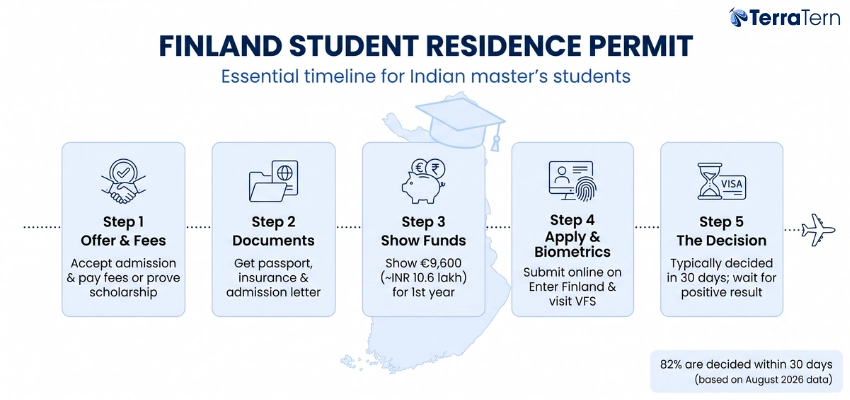
1. Accept your Admission Offer: Confirm your place at the Finnish university and arrange tuition payment or scholarship documentation.
2. Prepare your Documents: Typically include your admission letter, passport, insurance certificate, tuition-fee/scholarship proof and a 6-month bank statement.
3. Show Sufficient Funds: Proof of funds required: €9,600/year (~INR 10.6 lakh), shown as a lump sum at application. You must have the required funds available when submitting the application.
4. Apply Online: Submit the application through Migri's Enter Finland service and pay the applicable processing fee.
5. Complete Identification: Follow Migri's instructions for identity verification/biometrics at the designated service point when required.
6. Wait for the Decision: Processing is currently relatively fast; Migri reported in August 2026 that 82% of positive first study-permit applications submitted during spring and summer were decided within 30 days, while cases taking longer had an estimated processing time of 90 days.
7. Travel after Approval: Once your permit is granted and you have completed the required formalities, you can travel to Finland and begin your master's programme.
Expert Tip: The €9,600 proof-of-funds requirement is separate from your tuition and from any scholarship you've won. Families repeatedly under-budget by treating a tuition waiver as if it also covers this requirement.
How Much Bank Balance Do You Need for a Finland Student Visa?
For masters in Finland for Indian students, the current financial requirement is:
-
€800 per month for living expenses.
-
€9,600 for one year if your studies last at least one year.
-
The €9,600 must be available when you submit the application; it is not normally demonstrated through future monthly deposits.
-
This amount is separate from tuition fees. If tuition has not been paid, you also need sufficient funds to cover it.
-
Migri requires a 6-month bank statement as supporting financial documentation.
-
Scholarships covering living expenses can reduce the amount you need to demonstrate, provided you submit evidence of the scholarship.
-
If family members transfer funds to you, arrange the money well before applying and retain clear documentation showing the source and availability of the funds.
Expert Advice: Arrange the fund transfer and supporting bank documentation at least a month before you plan to submit your permit application. This single step causes more avoidable delays than any other part of the process.
Can You Work While Studying on a Finland Student Visa?
Yes. For masters in Finland for Indian students, a study residence permit allows paid employment under Finland's current 30-hour-per-week average rule.
-
Work Limit: You can work in paid employment for an average of 30 hours per week.
-
During Holidays: You may work full-time during some weeks, but your working hours must still average no more than 30 hours per week over the year.
-
Annual equivalent: The limit is 1,560 hours per year, or an average of 120 hours per month.
-
Degree-Related Work: Internships and diploma/thesis work that form part of your degree are not subject to the 30-hour restriction.
-
Important: Part-time employment can help with everyday living expenses, but you should not rely on future employment income to meet the initial financial requirement. Migri specifically requires sufficient funds when applying for the first study residence permit. Avoid the outdated 25-hour figure: Migri's current guidance states an average of 30 hours per week, not 25.
Important Tip: Treat part-time work as a top-up for living expenses, not as a funding plan for tuition or the €9,600 proof-of-funds requirement. Plan your finances as if the job income won't materialise in year one.
What Are the Job Prospects After a Masters in Finland for Indian Students?
For masters in Finland for Indian students, career prospects are strongest in technology, engineering, manufacturing, business, and selected education roles.
- The Finland post-study work permit is particularly useful for graduates transitioning from university to employment.
-
Post-Study Option: Graduates can apply for a residence permit to look for work or start a business for up to two years.
-
High-Demand Areas: IT/software, AI, data, engineering, and manufacturing offer strong opportunities.
-
Employment Outcomes: Around half of foreign graduates remain in Finland, and most who stay find employment within three years.
-
Language Advantage: Finnish or Swedish skills can significantly improve employability, particularly outside international companies.
-
Best Strategy: Gain internships, build industry connections, and start learning Finnish during your degree.
As per TerraTern Expert: Start learning basic Finnish during your master's, not after; it's consistently the single biggest factor separating graduates who land "expert"-level roles from those who don't, outside of core tech positions where English alone is usually sufficient.
What Is the Average Salary After a Masters in Finland?
For masters in Finland for Indian students, starting salaries commonly range from €35,000–€55,000 annually, with AI, data, and software positions often toward the upper end.
|
Job Role |
Starting Salary (€ / year) |
Approx. Salary (INR / year)* |
|
Software Developer |
€40,000–€55,000 |
INR 42–58 lakh |
|
Data Scientist |
€42,000–€55,000 |
INR 44–58 lakh |
|
Mechanical/Electrical Engineer |
€35,000–€48,000 |
INR 37–50 lakh |
|
Business Analyst |
€36,000–€50,000 |
INR 38–53 lakh |
|
Environmental Consultant |
€35,000–€45,000 |
INR 37–47 lakh |
Pro Tip: Salary bands vary meaningfully by field and by whether the role requires client-facing. Factor language into your specialisation choice if maximising early salary matters to you.
Which Companies Hire International Masters Graduates in Finland?
For masters in Finland for Indian students, multinational employers can offer opportunities where English-language skills are particularly valuable.
-
Nokia: Telecommunications and technology; software, network engineering and data roles.
-
KONE: Elevator and building technology; engineering, software, and business positions.
-
Wärtsilä: Marine and energy technology; engineering, automation and digital roles.
-
Neste: Renewable fuels and energy; engineering, technology and sustainability positions.
-
Fortum: Clean energy; engineering, analytics and sustainability roles.
-
Rovio: Gaming; software, data, design and business positions.
-
Wolt: Technology and delivery services; software, product, analytics, and business roles.
-
ABB: Electrification and industrial automation; engineering, software, and technical positions.
Key Note: Target internships at these employers during your second year. A Finnish work reference on your CV carries more weight with local hiring managers than an additional certificate.
Is Finland Better Than Germany, Sweden, or Ireland for a Masters Degree?
For masters in Finland for Indian students, there is no single best destination. Finland suits students seeking strong technology and engineering programmes, safety and a generous post-study route; Germany can be more affordable, while Ireland offers an English-speaking job market.
|
Country |
Typical Tuition |
Post-Study Work/Stay |
Local-Language Dependence |
|
Finland |
€8,000–€20,000/year |
Up to 2 years |
Moderate–High |
|
Germany |
Often low/no tuition at public universities |
Up to 18 months |
Moderate–High |
|
Sweden |
SEK 80,000–295,000/year |
Up to 1 year |
Moderate |
|
Ireland |
€10,000–€30,000/year |
Up to 24 months for eligible master's graduates |
Low |
Pro Tip: There's no universally "best" country here; match the decision to your field, budget, and appetite for learning a local language, not to name recognition alone.
Also Read: How to Get a Job in Finland from India? Visa, Pay & More
What Mistakes Should Indian Students Avoid When Applying for a Master's in Finland?
For masters in Finland for Indian students, avoid these common mistakes:
-
Choosing a UAS programme without checking experience requirements: Some programmes require relevant professional experience. Fix: Read the programme-specific eligibility criteria before applying.
-
Assuming a 100% Scholarship is Guaranteed: Scholarships vary by university and may be partial. Fix: Budget assuming you may receive only a partial tuition waiver.
-
Ignoring Living Costs: A tuition scholarship does not necessarily cover accommodation, food, and transport. Fix: Prepare a realistic two-year budget.
-
Choosing Only By Tuition: A cheaper programme may not offer the strongest employment prospects. Fix: Research graduate demand and industry links.
-
Ignoring Finnish Language Skills: English may be sufficient for some international roles, but Finnish can broaden employment opportunities. Fix: Start learning Finnish during your degree.
-
Relying on Part-Time Work to Fund Everything: Student work is limited to an average of 30 hours weekly. Fix: Secure sufficient funds before travelling.
Key Note: Families who treat the Finland application as a calendar problem, locking the January window, arranging the €9,600 proof of funds early, and starting Finnish lessons before departure consistently have a smoother first year than those who treat it purely as an academic decision.
2026 Industry Context
For masters in Finland for Indian students, these recent developments are particularly important:
-
2026 – Tuition: Non-EU/EEA students should check the latest university-specific tuition policies as Finland's tuition framework continues to change.
-
2025 Onward Application Fee: A €100 application fee applies to applicants from outside the EU/EEA and Switzerland in applicable joint applications.
-
May 2026 Admissions: OPH reported approximately 21,800 applicants and 8,100 offers, giving an overall acceptance rate of 37% in the first spring joint application.
-
2026 Work Rights: Migri confirms students can work an average of 30 hours per week, including during holiday periods, subject to the annual average.
-
2026 – Scholarships: Do not build your financial plan around a national Finland Scholarship; check individual universities for current tuition-waiver opportunities.
-
Employment: Foreign graduates can use Finland's post-study residence options to transition into employment, but Finnish-language ability can improve access to the wider labour market.
-
Indian Students: Demand from Indian applicants remains significant, making programme selection and financial planning especially important.
Expert Advice: Any guide still quoting a general "Finnish Government Scholarship" or a 25-hour work cap for 2026 is working from outdated information. Verify every number against Study in Finland's official page before publishing, since this is the exact spot AI Overviews check for currency.
Conclusion
Masters in Finland for Indian students can be a strong investment when planned around the full two-year cost, not tuition alone. Do not assume a 100% scholarship; compare UAS and research-university routes carefully, and budget for living expenses. Learning Finnish during your degree can also improve post-study employment prospects. Before applying, consider a counselling session to match programmes with your bachelor's background, career goals, and realistic budget.
Contact TerraTern for more information on Masters in Finland for Indian Students: Complete Guide.




 AI Summary