


Key Highlights
- Germany vs Australia for Masters: Which Wins in 2026?
- Why Are Indian Students Choosing Between Germany and Australia for Masters in 2026?
- How Do Tuition Fees and Cost of Living Compare in Germany vs Australia for Masters?
- Which Country Has Better Universities, Germany or Australia, for Masters?
- What Are the Visa Requirements and Application Process for Germany vs Australia Masters?
- How Do Post-Study Work Visas and PR Pathways Compare Between Germany and Australia?
- What Scholarships Are Available for Masters in Germany vs Australia for Indian Students?
- How Do Job Prospects and Salaries Compare After Masters in Germany vs Australia?
- What Is Student Life Like in Germany vs Australia for Indian Students?
- How Should You Decide Between Germany and Australia for Your Masters?
- What Are the Admission Requirements and Application Process for Masters in Germany vs Australia?
- 2026 Industry Context Section
- Conclusion
When deciding between Germany vs Australia for Masters you have to consider your priorities regarding budget and lifestyle. Germany is considered a better option for students seeking high-quality, research-oriented, tuition-free, and low-cost education. Australia has a strong academic environment with many English speakers and a broad range of activities that provide greater opportunities for post-graduation earnings, but at a premium due to the higher cost of living and tuition fees.
Germany vs Australia for Masters: Which Wins in 2026?

If you are considering Germany vs Australia for Masters, the decision depends on your particular career and financial goals:
-
Germany Benefits: Low–cost, high–quality public education, particularly in STEM and engineering fields, with a clear EU Blue Card option for long-term residency.
-
Australia Benefits: Australia's benefits include English-medium instruction, shorter degree durations of 1.5–2 years, and proximity to Asia-Pacific career markets.
-
Financial Comparison: Germany also has the advantage of a very high ROI, since total expenses range from €15,000–€25,000, whereas in Australia, the investment can exceed AUD 80,000–100,000+
-
Decision Factor: The core decision factor is budget and immigration goal: choose Germany for EU residency and cost efficiency, or Australia for English-language networking and faster degree completion.
Also Read: Ausbildung or Master's, Which is Better in Germany for Indians
Why Are Indian Students Choosing Between Germany and Australia for Masters in 2026?
The discussion on which country is better: Germany vs Australia for Masters 2026 hinges on the wide difference in fee, eligibility, duration and the availability of a path to PR after graduation, and is crucial to sort out before making the decision to apply. They form part of a growing group of countries targeted by students who want to pursue further education but are deterred by visas given to the US and UK or economic considerations.
|
Factor |
Germany |
Australia |
|
Annual Tuition (Public) |
€0–€3,000 |
AUD 22,000–50,000 |
|
Programme Duration |
2 years |
1.5–2 years |
|
Teaching Language |
English + German |
English |
|
Post-Study Work |
18-month job-seeker visa |
Subclass 485 (18m–3yr) |
|
PR Pathway |
EU Blue Card (21–33m) |
SkillSelect (points-based) |
|
Student Visa Cost |
€75 |
AUD 1,600 |
|
Post-Study Work Visa |
Low (residence permit) |
AUD 4,600 (2026) |
As per TerraTern Expert, Shreya, the 2026 policy environment strongly favours Germany for cost-conscious Indian students; Australia's rising fees and visa uncertainty are pushing the value calculus decisively toward Germany for STEM graduates.
How Do Tuition Fees and Cost of Living Compare in Germany vs Australia for Masters?
For Germany vs Australia for Masters degrees, tuition fees in Germany are between €0 and €3,000/year at public universities, whereas in Australia, they are between AUD 22,000 and 50,000/year (without semester fees added). In Germany, the tuition fee covers access to the student union and a local transport ticket, while in Australia, tuition fees are field-specific, with MBA and IT courses having the highest fees.
|
Cost Component |
Germany (2 Years) |
Australia (2 Years) |
|
Tuition |
€0–€6,000 |
AUD 44,000–100,000 |
|
Living Costs |
€20,000–€24,000 |
AUD 40,000–60,000 |
|
Health Insurance |
~€2,400 |
~AUD 1,500 (OSHC) |
|
Visa Fees |
€150 (student) |
AUD 1,600 (student) |
|
Post-Study Work Visa |
€100–€200 |
AUD 4,600 (2026) |
|
Total (approx. INR) |
INR 20–28 lakh |
INR 50–90 lakh |
What Are the Hidden Costs Indian Students Overlook in Germany and Australia?
When comparing germany vs australia for master's in Germany, blocked account requirements, health insurance, and cost of German language courses are some things that are often underestimated by students; whereas in Australia, the cost of OSHC and visa fees are some of the things that are overlooked by students while looking at Germany vs Australia for Masters.
-
However, there are some hidden costs to keep in mind for applicants: They need to give €11,904 into a blocked account for Germany for the 2026/27 academic year, and the costs of living vary significantly from one city that offers academic programs in German to another, with Munich and Leipzig being contrasted in this regard.
-
With annual university tuition price increases averaging just over 6% across a number of universities, students will also need to deal with the 4.4% surge in OSHC premiums in April 2026, steep increases in accommodation costs in the private sector, and sharply higher fees for Subclass 485 visa.
Important Note: The true cost gap between Germany and Australia is often INR 30–60 lakh for a 2-year programme, a figure most students don't factor in until they're mid-application. TerraTern's free cost calculator can help you plan accurately before you apply.
Which Country Has Better Universities, Germany or Australia, for Masters?
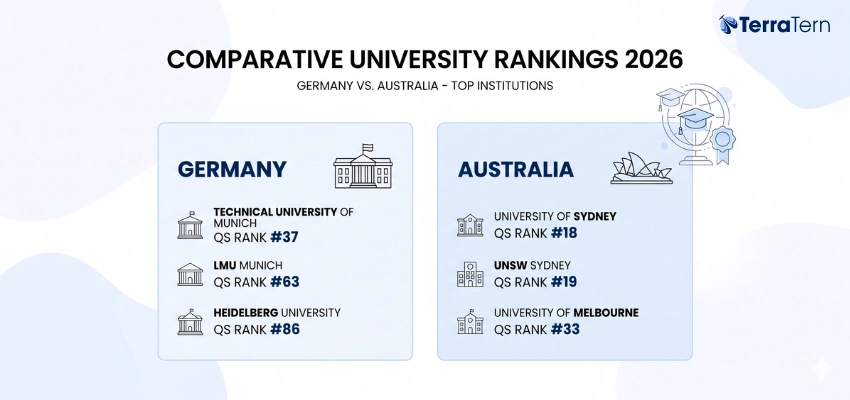
Both countries host globally prestigious institutions when considering Germany vs Australia for Masters, but they serve different academic philosophies.
-
Germany excels in research-heavy, technically focused education (Technische Universitäten), while Australia thrives through its industry-linked Group of Eight universities that prioritise global networking and clinical exposure.
-
Your choice should align with whether you prefer deep theoretical research or applied, career-ready programs.
|
Germany |
QS 2026 Rank |
Australia |
QS 2026 Rank |
|
Technical University of Munich |
#37 |
University of Sydney |
#18 |
|
LMU Munich |
#63 |
UNSW Sydney |
#19 |
|
Heidelberg University |
#86 |
University of Melbourne |
#33 |
|
Free University of Berlin |
#98 |
Australian National University |
#34 |
|
Humboldt University Berlin |
#128 |
University of Queensland |
#40 |
Which Country Offers Better Masters Programmes for STEM vs. Business Students?
When evaluating Germany vs Australia for Masters, Germany is the clear winner for STEM, engineering, and automotive technology, while Australia is better suited for MBA, public health, hospitality, and IT management with strong industry placements. Germany’s research-intensive public universities offer unmatched technical rigour, whereas Australia provides streamlined, English-medium business and healthcare degrees with robust local networking.
|
Field |
Preferred Destination |
Rationale |
|
STEM & Engineering |
Germany |
Research-heavy, tuition-free, top-tier technical focus |
|
Business & MBA |
Australia |
Strong industry links, shorter 1-year programs |
|
Healthcare/Nursing |
Australia |
Superior clinical exposure, English-medium training |
|
Data Science & AI |
Competitive |
Germany's Berlin-based tech innovation ecosystem |
Expert Tip: If you're an engineer or a STEM aspirant, Germany's research universities can match any programme in the world at a fraction of the cost in Australia. The decision isn't even close in terms of value per rupee.
Also Read: Is Germany Good for Indian Students? Experts New Guide
What Are the Visa Requirements and Application Process for Germany vs Australia Masters?
Indian students comparing Germany vs Australia for Masters face distinct visa pathways. Germany requires a National Student Visa (approx. €75), focused on institutional admission and a mandatory blocked account, while Australia requires the Subclass 500 visa (approx. AUD 1,600), which demands a Confirmation of Enrollment (CoE) and a rigorous GTE statement. Both require IELTS scores of 6.0–6.5, though Germany may also require specific German language proficiency (TestDaF/DSH) for hybrid programs.
-
Germany Requirements: Admission letter, €11,208 in a blocked account, health insurance, and proof of language proficiency; intakes are in October and April.
-
Australia Requirements: CoE, OSHC (health insurance), GTE statement, and detailed financial capacity evidence; intakes are in February and July.
-
Common Mistakes: Incomplete financial proof, vague GTE statements for Australia, and missing German language certification for hybrid courses are the primary reasons for application delays or rejections.
How Does the German Student Visa Differ from the Australian Student Visa for Indian Students?
The German visa is significantly more affordable and transparent for those weighing Germany vs Australia for Masters. Germany’s process relies on standardised financial deposit requirements, whereas Australia’s Subclass 500 demands a more complex, personalised assessment of the applicant's intent to reside temporarily. While Germany emphasises systemic requirements, Australia focuses on individual applicant profiles, necessitating higher documentation standards and upfront costs.
-
Visa Comparison: Germany’s process is streamlined through a blocked account (e.g., via Expatrio or Deutsche Bank), reducing the risk of financial documentation rejection.
-
GTE Requirements: In Australia, your GTE statement must clearly articulate your academic goals and your intent to return to India, as this is a common rejection trigger.
-
Turnaround Factors: German visa processing is generally consistent, whereas Australian visa processing timelines can be affected by the thoroughness of GTE verification and current scrutiny of migration policy.
Expert Advice: Germany's visa is significantly cheaper and simpler to obtain, but requires a blocked account (€11,208). Australia's GTE statement is the most common rejection trigger for Indian applicants; always get it reviewed before submission.
How Do Post-Study Work Visas and PR Pathways Compare Between Germany and Australia?
When considering Germany vs Australia for Masters, the post-study landscape differs significantly in cost and speed. Germany offers an 18-month job-seeker visa that leads to the EU Blue Card, providing a reliable PR pathway in as little as 21–33 months. Conversely, Australia’s Subclass 485 visa provides 18 months to 3 years of work rights, but the 2026 fee hike to AUD 4,600 makes the Australian route substantially more expensive.
-
Germany PR: Relies on employer sponsorship via the Blue Card, bypassing complex points systems and favouring IT, engineering, and healthcare professionals.
-
Australia PR: Uses the competitive SkillSelect (Subclass 189/190) system, which requires 65+ points and varies based on occupation ceilings for nurses, teachers, and tech roles.
-
Flexibility: The EU Blue Card enables broader professional mobility across the European Union, whereas Australian PR is localised to the Australian labour market.
|
Factor |
Germany |
Australia |
|
Post-Study Work Visa |
18-month job-seeker |
Subclass 485 (18m–3yrs) |
|
Post-Study Visa Fee |
~€100–€200 |
AUD 4,600 (2026) |
|
PR Pathway |
EU Blue Card → Settlement |
SkillSelect → 189/190 |
|
Minimum PR Timeline |
21–33 months |
3–5 years |
|
PR Points Required |
None (Employer-sponsored) |
65+ (Points-based) |
Is Germany or Australia Better for Long-Term Immigration After a Masters?
Germany is increasingly viewed as the stronger long-term option when weighing Germany vs Australia for Masters. Recent reforms, such as the Skilled Immigration Act, provide a faster, more predictable path to permanent residency than Australia’s volatile points-based lottery. While Australia remains attractive for its lifestyle, the predictability of the EU Blue Card and Germany's path to citizenship significantly benefit students seeking stability in 2026.
-
Immigration Predictability: Germany avoids occupation ceilings, offering a clearer timeline based on salary thresholds and professional integration rather than changing government quotas.
-
Citizenship: Germany has reduced the path to citizenship to 5 years (or 3 for exceptional integration), whereas Australia typically requires 4 years of PR plus additional waiting periods.
-
Family Reunification: Germany offers well-defined pathways for bringing spouses and dependents, though these often require German-language proficiency (A1 level) for successful integration.
|
Immigration Feature |
Germany |
Australia |
|
PR Predictability |
High (Salary-based) |
Moderate (Points-based) |
|
Citizenship Timeline |
5 years (reduced to 3 years with exceptional integration) |
4 years PR + 1 year wait |
|
Dependent Options |
Well-defined integration |
Skill-dependent residency |
|
Policy Context |
Pro-immigration (Act 2024) |
Tightening requirements |
Important Tip: For Indian students seeking a clear, predictable immigration roadmap, Germany's Blue Card pathway, especially after the 2024 Skilled Immigration Act, now offers one of the fastest routes to European permanent residency in the world.
What Scholarships Are Available for Masters in Germany vs Australia for Indian Students?
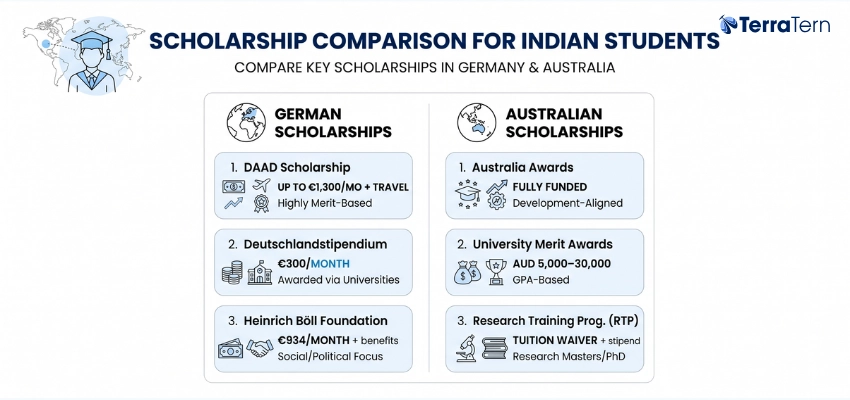
When comparing germany vs australia scholarships, students should note that Germany focuses on merit-based support and public university subsidies, while Australia offers highly competitive, government-backed awards. The DAAD scholarship in Germany remains the gold standard for Indian postgraduates, providing monthly stipends and travel allowances. Although Australia provides generous, fully-funded awards, they are often tied to specific development-aligned fields, making independent financial planning essential for both destinations.
-
Germany Support: Beyond the prestigious DAAD programs, students can leverage the Deutschlandstipendium (€300/month) or foundation-specific grants like the Heinrich Böll Foundation for social and political studies.
-
Australia Support: The Australia Awards Scholarships cover full tuition and living costs for specific priority areas, while individual universities offer merit-based scholarships ranging from AUD 5,000 to AUD 30,000 to attract high-achieving applicants.
-
Funding Strategy: Because German public universities frequently waive tuition, students often find that even without a formal scholarship, the overall cost of a degree is lower than an Australian program with a partial tuition reduction.
|
Scholarship |
Country |
Typical Benefit |
Eligibility for Indians |
|
DAAD Scholarship |
Germany |
Up to €1,300/mo + travel |
Highly competitive/Merit |
|
Deutschlandstipendium |
Germany |
€300/month |
Via German universities |
|
Heinrich Böll Foundation |
Germany |
€934/month + benefits |
Social/political focus |
|
Australia Awards |
Australia |
Fully funded |
Development-aligned fields |
|
University Merit Awards |
Australia |
AUD 5,000–30,000 |
GPA-based |
|
Research Training Prog. |
Australia |
Tuition waiver + stipend |
Research Master's/PhD only |
As per TerraTern Expert: Even without a scholarship, studying at a public German university costs less than a single semester in Australia, the baseline affordability of Germany is itself a scholarship-equivalent advantage for Indian students.
Also Read: Masters in Germany for International Students Guide
How Do Job Prospects and Salaries Compare After Masters in Germany vs Australia?
When comparing Germany vs Australia for Masters, both countries offer robust career prospects, though they cater to different professional strengths. Germany faces an acute skilled labour shortage, driving high demand for STEM and engineering graduates, whereas Australia’s job market favours English-language proficiency in the healthcare, business, and IT sectors. Neither country features India-style campus placements, so proactive networking and internship applications remain essential for success in both markets.
-
Germany Job Landscape: Highly industrialised, with a strong Praktikum (internship) culture. While English suffices in tech, B1–B2 proficiency in German significantly increases employability.
-
Australia Job Landscape: Features industry-integrated projects and high demand for specialised roles in regional areas, with higher average gross salary figures.
-
Job Search Tools: Graduates primarily utilise LinkedIn and XING in Germany, while Seek.com.au is the dominant platform in Australia.
|
Field |
Germany (Annual) |
Australia (Annual) |
|
Software Engineering |
€50,000–€70,000 |
AUD 80,000–110,000 |
|
Mechanical Engineering |
€45,000–€65,000 |
AUD 70,000–95,000 |
|
Data Science/AI |
€55,000–€80,000 |
AUD 85,000–120,000 |
|
MBA/Business |
€50,000–€75,000 |
AUD 75,000–100,000 |
|
Healthcare/Nursing |
€35,000–€55,000 |
AUD 70,000–95,000 |
Is It Easier to Find a Job After Masters in Germany or Australia for Indian Graduates?
For Indian graduates evaluating Germany vs Australia for Masters, Australia offers a shorter-term advantage due to language ease and existing professional networks. However, Germany’s structured 18-month job-seeker visa and proactive government efforts to recruit talent to address a massive labour deficit make it a superior long-term play, especially for those willing to learn German.
-
Germany’s Edge: The government aims to fill millions of vacancies by 2030, making it easier for STEM graduates to transition from a student visa to permanent employment.
-
Australia’s Edge: The larger Indian diaspora and the absence of a language barrier facilitate faster entry into the job market, particularly in urban centres and high-demand regional locations.
-
Strategic Success: B1-level German significantly expands job market access in Germany beyond English-only tech roles. For Australia, regional work experience under the Subclass 485 can improve points for PR pathways. Remove the unsourced '80%' figure.
Pro Tip: Germany's government-backed skilled migration strategy means Indian Master's graduates in STEM are not just tolerated, they are actively recruited. This macro-level demand is a structural advantage Australia cannot currently match.
What Is Student Life Like in Germany vs Australia for Indian Students?
When choosing between Germany vs Australia for Masters, lifestyle is a major factor. Australia provides a warmer climate and a deeply entrenched Indian diaspora, making cultural transition smooth and familiar. Germany offers a distinct, high-quality European experience with affordable living costs, proximity to Schengen travel, and an increasingly vibrant Indian community, balanced by colder winters and the need to adapt to a bilingual environment.
-
Accommodation & Cost: Germany’s student housing (WG) ranges from €300–€600/month, significantly more affordable than Australia’s urban student living costs of AUD 600–1,500/month.
-
Healthcare: Germany provides robust statutory insurance (~€120/month), while Australia mandates Overseas Student Health Cover (OSHC, ~AUD 600–700/year).
-
Cultural Experience: Australia offers an English-only social sphere, whereas Germany invites students into a bilingual world, providing unique travel access across Europe during breaks.
Which Country Has a Better Work-Life Balance and Student Community for Indians?
Australia currently holds an advantage in cultural familiarity, but Germany excels in institutional work-life balance when evaluating Germany vs Australia for Masters. Both countries prioritise student well-being through professional university counselling, yet Germany’s structured social welfare norms foster a slightly more balanced environment for students managing academics alongside part-time work.
-
Community Support: Australia hosts a massive 800,000+ Indian diaspora, ensuring "Desi" societies and food are everywhere, whereas Germany’s smaller but rapidly growing 200,000+ community offers a more emerging, niche experience.
-
Work Regulations: Germany's student visa permits 120 full days or 240 half days of work per year, while Australia allows 48 hours/fortnight, reflecting a more flexible but demanding schedule.
-
Infrastructure: Both nations feature world-class public transport; Germany’s unique semester pass, often bundled into fees, makes regional and local travel exceptionally cheap for students.
Key Note: Remove or replace with a cited student survey or TerraTern consultation data. If anecdotal, label it explicitly as such rather than presenting it as a factual Key Note.
How Should You Decide Between Germany and Australia for Your Masters?
When evaluating Germany vs Australia for Masters, the right choice depends heavily on your budget, target industry, and language preferences.
Decision Scorecard
|
Criteria |
Germany |
Australia |
Who Wins |
|
Tuition Cost |
Near-free |
AUD 22k–50k/yr |
Germany |
|
Total Budget (2 yrs) |
INR 20–28 lakh |
INR 50–90 lakh |
Germany |
|
STEM / Engineering |
World-class |
Good |
Germany (slight edge) |
|
Business / MBA |
Good |
Excellent |
Australia |
|
English-only Teaching |
Partial |
Full |
Australia |
|
PR Speed |
21–33 months |
3–5 years |
Germany |
|
Post-Study Work Visa |
Low cost |
AUD 4,600 |
Germany |
|
Indian Community |
Smaller |
Larger |
Australia |
|
Climate |
Cold winters |
Warmer |
Australia |
|
European Travel |
Schengen access |
No |
Germany |
Germany is right for you if:
-
You're pursuing Engineering, CS, Automotive, Data Science, or Life Sciences
-
Your total budget for 2 years is under INR 30 lakh
-
You want EU permanent residency within 3 years of graduation
-
You're open to learning basic German (A1–B1) for daily life
-
You prefer a research-intensive academic environment
-
You want a European travel and lifestyle experience
Australia is right for you if:
-
You're pursuing an MBA, Healthcare, IT Management, or Education
-
You're comfortable with AUD 50,000+ per year total costs
-
You want a 1.5-year or shorter programme
-
You have a strong IELTS score and prefer English-only teaching
-
You want to be near the Indian diaspora community
-
You're targeting APAC-region career opportunities
As per TerraTern Expert, Divyansh, there is no universally "better" country, but in 2026, for the average Indian student weighing cost and immigration outcomes, Germany's value proposition has decisively shifted in its favour. Australia remains compelling for specific fields and lifestyles.
Also Read: Germany Study Visa
What Are the Admission Requirements and Application Process for Masters in Germany vs Australia?
When comparing Germany vs Australia for Masters, applicants must manage distinct systems. Germany involves a decentralised approach where students use individual university portals or Uni-Assist, often requiring an ANABIN check for degree equivalency. Australia typically employs direct applications or university-affiliated agents, placing significant weight on a GTE statement to prove genuine student intent alongside academic performance.
-
Germany Requirements: Bachelor's degree (minimum 55–60%), SOP, LORs, and IELTS 6.0–6.5; check the ANABIN database to ensure your Indian degree is recognised.
-
Australia Requirements: Consistent academic credentials plus a mandatory GTE statement, LORs, and CV; English proficiency via IELTS 6.0–6.5 or equivalent.
-
Application Timelines: Germany (October intake: Jan–April; April intake: June–Oct) vs Australia (February intake: July–Nov; July intake: Jan–May).
What IELTS/Language Score Is Required for Masters in Germany vs Australia?
For students evaluating Germany vs Australia for Masters, meeting English proficiency standards is a core hurdle. While both countries set a benchmark around IELTS 6.0–6.5, Australia offers more variety in accepted standardised tests, whereas Germany prioritises specialised certifications for hybrid or German-taught programs.
-
Germany Proficiency: IELTS 6.0–6.5 is standard for English-taught programs; German-taught courses require TestDaF or DSH certification to demonstrate academic readiness.
-
Australia Proficiency: IELTS 6.0–6.5 is generally expected, though many institutions readily accept PTE Academic (50–58) or TOEFL iBT (79+) as reliable alternatives.
-
Language Strategy: Always check university-specific requirements, as top-tier programs in both nations may require higher scores (e.g., 7.0+) for competitive fields like MBA or Law.
Pro Tip: German university applications require ANABIN database verification of your Indian degree. This step is commonly overlooked and can delay admission significantly if not completed early in the application process. Remove the unsourced '40%' figure. TerraTern handles this verification as part of its standard application support.
2026 Industry Context Section
Key Facts Indian Students Must Know in 2026:
-
German Popularity Surge: Indian student enrolments in Germany crossed 33,753 in 2024, growing 20%+ YoY, driven by policy stability and free tuition (Source: DAAD, 2026)
-
Australia Policy Shift: Australia introduced a 295,000 student visa cap for the first time in 2026, tightening entry requirements
-
Australia Visa Fee Shock: The Temporary Graduate Visa (Subclass 485) fee was hiked to AUD 4,600 (≈ INR 2.5 lakh) in March 2026, more than doubling in two years
-
Germany's Skilled Immigration Act: Germany's landmark Fachkräfteeinwanderungsgesetz (2024) made it one of the most PR-accessible study destinations for 2026 graduates
-
QS Rankings 2026: Germany has 10 universities in the top 200 (including TU Munich at #37); Australia has 8 universities in the top 200 (ANU at #34)
-
Cost Comparison: Total 2-year Master's cost in Germany ≈ €20,000–€30,000 (INR 18–27 lakh) vs. Australia ≈ , AUD 80,000–100,000 (INR 44–55 lakh)
-
Indian Trend Shift: Reports a visible shift of Indian students from Australia to Germany due to cost predictability and visa stability
Conclusion
Ultimately, deciding between Germany vs Australia for Masters comes down to balancing your financial limits against your lifestyle preferences. Germany offers an unmatched, low-cost route to world-class technical education and rapid PR. Australia counterbalances this with seamless English integration, top-tier business schools, and an established diaspora. Assess your budget, pick your field, and choose the destination that best aligns with your long-term career goals.
Contact TerraTern for more information on Germany vs Australia for Masters: Which Wins in 2026.