


Key Highlights
- Why Choose Masters in Germany for International Students in 2026?
- What Are the Key Requirements for a Master Degree in Germany for International Students?
- How Much Does It Cost to Study a Master's in Germany for International Students?
- APS Certificate for Indian Students
- What Are the Best Universities for a Master's in Germany for International Students in 2026?
- How Do You Apply for a Masters in Germany for International Students?
- What Visa Requirements Apply to International Postgraduate Students in 2026?
- Which Career Opportunities Await After Masters in Germany for International Students in 2026-26?
- How TerraTern Can Help You Solve This Problem
- Conclusion
Germany remains one of the strongest study abroad options for Indian and other international students because it combines lower tuition costs, a large number of English-taught programs, and strong job prospects after graduation. Official data and university guides continue to show that public universities charge only a small semester fee in many cases, while living costs are still lower than in countries like the UK or the US. Germany also continues to attract huge international student numbers, which helps create a more global campus environment and better networking opportunities.
Why Choose Masters in Germany for International Students in 2026?
The straight-up answer is that Germany is a country with the best education, the lowest prices, and the best employment.

-
There are 46 ranked universities in Germany in the QS World University Rankings 2026.
-
The number of Indian students studying in Germany (2023/ 24) has already reached 49,008, demonstrating high demand.
Key Benefits:
Here are the key benefits of a master's in Germany for international students:
-
Free or extremely cheap government education.
-
More than 1,000 Master's degrees in English.
-
Low cost of living as compared to the UK, USA, and Canada.
-
Promising global career in the biggest economy in Europe.
-
No aggressive behaviour.Student-friendly and multicultural.
-
Quote: DAAD (2026) emphasises that Germany is one of the best destinations for studying cheaply and at a high academic level.
|
Benefit |
Germany Advantage |
Compared to Other Countries |
|
Tuition fees (public) |
Free/low (€100-€350 per semester) |
Higher in the UK/USA/Canada |
|
English-taught Masters |
1,000+ Programs Available |
Fewer in non-English countries |
|
Cost of Living |
€934/month average |
Higher in Western Europe/North America |
|
Post-study Work Permit |
18 months (full-time work allowed) |
1-3 years elsewhere, more regulated |
|
Ranked Universities |
46 in QS Top 100 (2026) |
Strong global rankings |
|
Multicultural, Student-friendly Environment |
Yes |
Varies by country |
Also Read: Best Universities in Germany for Master's in Computer Science
What Are the Key Requirements for a Master Degree in Germany for International Students?
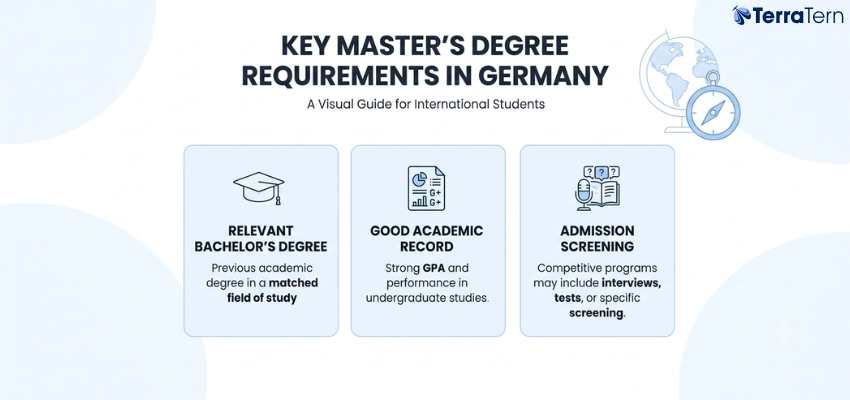
Admission rules for a master degree in Germany for international students usually depend on the university, the program type, and the language of instruction. In most cases, students need a relevant bachelor’s degree, good academic records, and proof that their previous degree matches the new field of study. Competitive programs may also use admission limits or subject-specific screening.
|
Requirements |
Typical Expectation |
Notes |
|
Bachelors degree |
Relevant and recognised |
Must match the master’s field in many cases |
|
Language proof |
IELTS AND TOEFL |
Depends on program language |
|
APS certificate |
Often required for Indian students |
Important for visa and document review |
|
SOP and CV |
Usually required |
Format matters |
|
LORs |
Often required |
More common in selective programs |
What Academic Qualifications Do You Need?
Here are details on the academic qualifications you need for a master degree in Germany for international students:
-
A bachelor's degree from a reputable university.
-
Successive program subject-specific knowledge.
-
Minimal GPA level of 2.5 German grade (B average).
-
The minimum required is 180-240 credits in undergraduate studies.
-
DAAD database recognition verification.
Definition box:
-
Numerus Clausus (NC) is a type of admission requirement, by grade, used in high-demand programs.
-
Sequential Programs: Need the same or a similar bachelor's background.
-
Non-Consecutive Programs: Open to various fields, but not as selective as the prevalent ones.
What Language Proficiency Requirements Must You Meet?
These are the language proficiency requirements you must meet for a master's in Germany for international students:
1. German proficiency (for German-taught programs):
- B2–C1 level required.
- Accepted tests: DSH 2, TestDaF (4x4), Goethe C1.
2. English proficiency (for English-taught programs):
- IELTS 7.0 or above.
- TOEFL iBT 95+.
- TOEIC 945+.
3. Exemptions apply to native speakers or if a bachelor’s degree was taught entirely in English.
4. Some universities may set higher or program-specific requirements.
Which Documents Are Essential for Your Application?
These are the documents essential for your application for master's in Germany for international students:
-
Education records and a bachelor's degree certificate.
-
Statement of Purpose (SOP).
-
Two Recommendations ( Letters of Recommendation ).
-
Updated Curriculum Vitae (CV).
-
APS Certificate (India, China, Vietnam).
-
Copy of a valid passport.
-
Evidence of language proficiency (German or English).
|
Requirement |
Public/Private Universities |
Notes / Detail |
|
Bachelor’s Degree |
Required |
Subject-specific for consecutive programs |
|
Minimum GPA |
2.5 (German) / B average |
May vary per university |
|
Credits Required |
180-240 ECTS |
|
|
APS Certificate |
India, China, Vietnam |
Mandatory for Indian students |
|
English Taught: IELTS/TOEFL |
IELTS 7.0+, TOEFL iBT 95+ |
Higher for some programs/universities |
|
German Taught: TestDaF/DSH/Goethe |
B2–C1, DSH2/TestDaF 4x4/Goethe C1 |
As per the course language |
|
SOP, LORs, CV |
Yes |
In specified format (Europass CV suggested) |
Also Read: Master's in Economics in Germany For Indian Students
How Much Does It Cost to Study a Master's in Germany for International Students?

Education in Germany is not entirely free, but public universities remain highly affordable compared to global standards.
What Are Public University fees?
These are the public university fees for pursuing masters in Germany for international students:
-
Semester Fees: between 100 and 350 euros a semester.
-
Pays Student Union, transport pass, and admin fees.
-
Exceptions:
-
Baden-Wurttemberg: non-EU students pay 1,500 per semester.
-
Bavaria (TUM): between 2000 and 6000 Euros per semester (master).
-
Saxony: Tuition is applicable in chosen universities.
-
Sample: University of Stuttgart will cost non-EU students 1500 euros per semester.
How Do Private University Costs Compare?
These are details for pursuing masters in Germany for international students at private universities:
-
Average Annual Tuition: €8,000–€20,000.
-
MBA and Business Degrees: €2,000 2,00010,000 a semester.
-
Examples:
-
Frankfurt School of Finance: 20,000 to 30,000 euros annually.
-
GISMA Business School: 12,000 -18,000 per year.
-
Scholarships are available through DAAD, Erasmus+ +, and university scholarships.
What Living Expenses Should You Budget For?
These are the living expenses that you should budget for if you’re looking to pursue masters in Germany for international students:
-
Minimum Financial Documents Required to get a Visa (2026): 11904/year.
-
Average Monthly Living Cost: €934.
-
Breakdown:
-
Rent: between 300 and 600 (shared accommodation is less expensive).
-
Food: €200–€300.
-
Transport: €50-100 (depending on the city, it will be less with a student pass).
-
Health Insurance: €120 per month.
-
Miscellaneous: €100–€150.
-
Munich, Frankfurt, and Hamburg are more expensive than smaller cities with students.
|
Expense Category |
Public Universities |
Private Universities |
|
Semester Fees |
€100–€350 |
€8,000–€20,000/year |
|
Exceptions (Baden-Württemberg) |
€1,500/semester (non-EU) |
N/A |
|
MBA/Business |
N/A |
€2,000–€10,000/semester |
|
Living Expenses |
€934/month (avg) |
Same as public |
|
Tuition Example (per year) |
Mostly free/low |
€12,000–€30,000 |
APS Certificate for Indian Students
Indian applicants need special attention here because APS has become a major step for many Germany study cases. The Academic Evaluation Centre verifies educational documents and is often required for visa processing, especially for Indian degree holders. This is not just a formality. It can directly affect how quickly a student moves from university admission to visa filing.
-
APS is a key step for many Indian students applying to Germany.
-
It verifies your academic documents before admission or visa filing.
-
A completed APS process can help you move faster from university offer to visa application.
-
For Indian degree holders, it is often a required part of the Germany study process.
-
Starting early can save time and reduce last-minute delays.
What Are the Best Universities for a Master's in Germany for International Students in 2026?
These are the best universities for masters in Germany for international students:

|
Category |
University Name |
Strength/Ranking |
|
Technical/Engg |
Technical University of Munich (TUM) |
QS Top 50, STEM leader |
|
Technical/Engg |
Karlsruhe Institute of Technology (KIT) |
Innovation, computer science leader |
|
All-Purpose |
LMU Munich |
QS 40th, science, arts, law |
|
All-Purpose |
Heidelberg University |
Oldest, top in medicine/science |
|
Business |
Frankfurt School of Finance |
Leading for MBA/Finance |
|
Business |
WHU Otto Beisheim Sch. of Mgmt |
Top-100, entrepreneurship/leadership |
|
Business |
ESCP Europe Berlin Campus |
International exposure/network |
Best Technical Universities for Engineering Programs
These are the best technical universities for masters in Germany for international students for engineering programs:
-
Technical University of Munich (TUM): Global top 50 (QS 2026) STEM and research powerhouse.
-
RWB Barnabas Health University: Strong industry connections, known for mechanical and industrial engineering.
-
Karlsruhe Institute of Technology (KIT) is a well-known institution innovating computer science, engineering, and technology.
Best All-Purpose Universities
These are the best all-purpose universities for masters in Germany for international students:
-
Ludwig-Maximilians-Universitätt München (LMU Munich): 40th world ranking, good at sciences, arts, and law.
-
Ruprecht-Karls-Universität Heidelberg: The oldest University in Germany, with an excellent reputation in medicine and science.
-
Humboldt-Universität zu Berlin: Humanities, social sciences, and natural sciences excellence.
Best Universities in Business and Management Programmes
These are the best universities in business and management programmes for masters in Germany for international students:
-
Frankfurt School of Finance and Management: The Best school for MBA and finance.
-
ESCP Europe Berlin Campus is characterised by international exposure and a global alumni network.
-
WHU Otto Beisheim School of Management: Strong in leadership and entrepreneurship, ranked in the top 100 in the world.
Also Read: Guide to Master's in Business Analytics in Germany
How Do You Apply for a Masters in Germany for International Students?
Here’s how to apply for masters in Germany for international students:
What Application Platforms Should You Use?
Use these application platforms to apply for masters in Germany for international students:
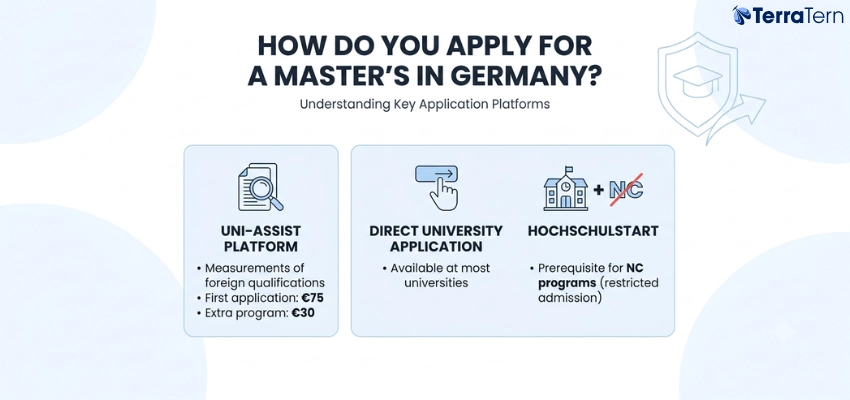
-
Uni-assist platform:
-
Measures the foreign qualifications.
-
Fees: The first application costs 75 euros, and the extra program costs 30 euros.
-
Direct university applications: In most universities, it is possible to apply directly.
-
Hochschulstart: prerequisite of NC (restricted admission) programs.
When Are the Critical Application Deadlines?
These are the critical application deadlines for masters in Germany for international students:
-
Winter semester (starts in October): Deadline is July 15.
-
Summer semester (April start): Release date January 15.
-
Certain universities have earlier closures (March, when it would be in the US) of popular programs.
-
DAAD suggests that to prevent delays, one should apply at least 6-9 months in advance.
How Should You Structure Your Application Documents?
Structure your application documents in this manner for masters in Germany for international students:
-
Every document has to be certified and translated into German or English.
-
SOP: 1- 2 pages, academic goals, and program fit.
-
LORs: Detailed references should be provided by the professors or employers.
-
CV: In Europass format, ideally with academic and work experience being pointed out.
-
Other documents: Passport copy, recent photo, and language certificates.
|
Document Type |
Needed for Application |
Needed for Visa |
Notes |
|
Bachelor’s Degree Certificate |
Yes |
Yes |
With transcripts |
|
SOP |
Yes |
Academics/goals fit |
|
|
Letters of Recommendation |
Yes (2) |
Professors/employers |
|
|
Curriculum Vitae (CV) |
Yes |
Europass format recommended |
|
|
APS Certificate |
Yes (India, China, Vietnam) |
For Indians |
|
|
Proof of Language |
Yes |
IELTS/TOEFL/TestDaF/DSH/Goethe |
|
|
Passport |
Yes |
Yes |
Valid, with a photocopy |
|
Health Insurance Proof |
Yes |
Needed at the visa stage |
|
|
Proof of Finances |
Yes |
€11,904/year (blocked account) |
What Visa Requirements Apply to International Postgraduate Students in 2026?

These are the visa requirements you need to keep in mind when applying for masters in Germany for international students:
Who Needs a Student Visa for Germany?
These categories need a student visa for masters in Germany for international students:
-
EU/EEA/Switzerland students: Visa-free.
-
Visa-exempt countries (e.g., Australia, Canada, Japan, UK, USA, etc.): Can first enter, and make an application for a residence permit afterwards
-
Other international students must seek a visa before coming to Germany.
Also Read: Masters in Engineering Management in Germany: Complete Guide
What Documents Are Required for a German Student Visa?
These are the documents required for a student visa:
-
Valid passport.
-
Official letter of admission to a University.
-
Proof of finances: 11,904 Euros per year (blocked account or sponsor).
-
Valid certificate of health insurance.
-
Academic transcripts and diplomas.
-
Filled out the visa application form and biometrics
How Long Does the Visa Application Process Take?
This section covers the processing time of the visa:
-
Embassy appointments need to be taken at least 3 months beforehand.
-
Average processing time: 6 - 12 weeks (varies by country).
-
The visa interview concerns motivation, study plan, financial stability, and career goals.
Which Career Opportunities Await After Masters in Germany for International Students in 2026-26?
These are the best career opportunities that await you after completing masters in Germany for international students:
What Are the Highest-Paying Masters Specialisations?
These are the highest-paying specialisations for masters in Germany for international students:
-
Engineering: Annual salaries are between EUR50,000 and EUR70,000, particularly in mechanical, automotive, and electrical engineering.
-
Computer Science & IT: Graduates earn between $45,000 and $65,000 with high demand in AI, Cybersecurity, and software development.
-
Business & Management: Salaries average 45,000-60,000 euros, with much more in consulting, finance, and international trade.
-
Medicine and Natural Sciences: Professionals earn from 50 to 75 thousand Euros, especially in biotech, pharmaceuticals, and research.
How Does the Post-Study Work Permit Function?
These are all the details about the post-study work permit, which you can get after masters in Germany for international students:
-
Graduates are given an 18-month residence permit to seek appropriate work.
-
They can work full-time while looking for a job.
-
Once a relevant job is obtained, they can apply for a long-term residence permit or an EU Blue Card.
-
Permanent residency can be applied for after 33 months of employment, or 21 months with German language skills at the B1 level.
What Industries Actively Recruit International Graduates?
These industries actively recruit students from masters in Germany for international students once they graduate:
-
STEM Fields: (science, technology, engineering, mathematics) remain the best source of recruits.
-
Automotive Industry: Automotive companies such as BMW, Mercedes-Benz, Audi, Volkswagen, etc, employ large numbers of qualified graduates.
-
IT and Digitalisation: High demand for software developers, data analysts, and cybersecurity experts;
-
Renewable Energy: Rising wind and solar energy projects and sustainable energy development create jobs for engineers and scientists.
-
Healthcare and Pharmaceuticals: High demand for researchers, medical professionals, and biotechnologists.
|
Specialisation |
Average Starting Salary (€/year) |
Sectors/Employers |
|
Engineering (Mech/Auto/EE) |
€50,000–€70,000 |
BMW, Mercedes, Volkswagen, etc. |
|
Computer Science & IT |
€45,000–€65,000 |
IT, software, AI, cybersecurity |
|
Business & Management |
€45,000–€60,000+ |
Consulting, finance, trade |
|
Medicine & Life Sciences |
€50,000–€75,000 |
Pharma, research, biotech |
|
Renewable Energy/Green Tech |
€45,000–€65,000 |
Wind, solar, energy companies |
Also Read: Germany Study Visa Requirements: Latest Checklist
How TerraTern Can Help You Solve This Problem
TerraTern can guide you through each step of your Germany master’s journey, from choosing the right university to preparing documents for visa filing. It helps students compare course options, check eligibility, and understand what they need for admission, APS, and proof of funds.
-
Helps you choose the right university and course based on your profile, budget, and career goals.
-
Guides you on admission documents like SOP, LOR, CV, APS, and language proof.
-
Supports you with the visa process, including blocked accounts and other funding requirements.
-
Shares updated information on deadlines, eligibility, and application steps.
-
Reduces confusion by giving clear, step-by-step guidance from admission to visa filing.
Conclusion
Masters in Germany for international students is becoming more and more popular, attracting thousands with its special advantages yearly. The most important benefits are free education at most public universities, more than 1000 English-taught programs in various areas, low living expenses compared to other European countries, and favourable post-study working possibilities to help with career development. With the right amount of planning and preparation, it is possible to take on a Masters in Germany, as this can lead to global career opportunities and success in the long run. Contact TerraTern for more information.




 AI Summary