Key Highlights
- What Is the Real Cost of Studying MBBS in Australia?
- How Can Indian Students Study MBBS in Australia at Low Cost?
- What Are the Top Medical Universities Offering Affordable MBBS in Australia?
- What Are the Eligibility Requirements for MBBS in Australia for Indian Students?
- What Is the Step-by-Step Admission Process for MBBS in Australia?
- Is a Low-Cost MBBS in Australia Worth It for Indian Students?
- What Career Opportunities Await After Completing MBBS in Australia?
- What's New for MBBS in Australia?
- Conclusion
While not necessarily “cheap”, low-cost MBBS in Australia can be more affordable than many students may think of in 2026, primarily by targeting more of the relatively lower-cost public universities, by selecting cities with more affordable living expenses, and by aggressively utilising scholarships, bursaries and education loans to reduce a total tuition that is typically around AUD 70,000 to over AUD 100,000 per year for international students. This guide focuses on practical tips for Indian students to manage their overall budgets effectively, such as researching the difference between the two pathways (direct entry MBBS vs graduate entry MD), and planning for study and living costs, as well as understanding scholarship and visa eligibility requirements, so that you can consider whether Australia is a viable and cost-effective destination for your medical studies and career, rather than simply the numbers.
What Is the Real Cost of Studying MBBS in Australia?
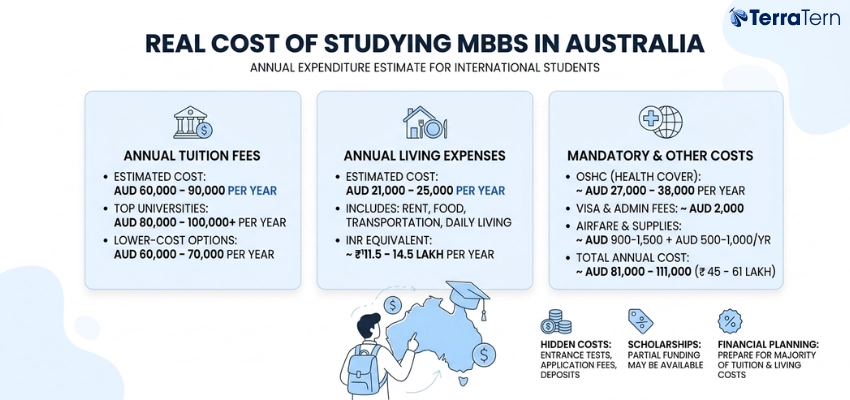
Let's put it this way, the actual cost of studying medicine (MBBS) in Australia is as follows: On an annual basis, tuition fees are approximately AUD 60,000–90,000 per year for most of the international MBBS/MD courses, depending on the university.
-
Annual living expenses: Allocate approximately INR 11.5–14.5 lakh or AUD 21,000-25,000 for annual living expenses, including rent, food, transportation and daily living.
-
Overseas Student Health Cover (OSHC): Overseas Student Health Cover is required for the student visa and costs approximately USD 500-700 (about AUD INR 27,000-38,000) per year.
-
Admin fees: A visa application cost for a subclass 190 visa is approximately AUD 2,000, and AUD 900-1,500 per single-way ticket to Australia, plus AUD 500-1,000 per year for books and supplies.
-
The total annual expenditure is about AUD 81000 – 111000(around INR 45 – 61 lakh) for most Indian students when you consider tuition fees and the cost of living.
-
Price – There are cheaper options available, around AUD 60,000 – 70,000 per year in tuition, as well as more expensive options, around AUD 80,000 – 100,000+ per year in tuition, at top-ranked universities in the top cities.
-
There are additional hidden/extra costs that will be incurred over the entire duration, including entrance tests (UCAT, ISAT/ GAMSAT/ MCAT), application fees, initial accommodation deposits, and currency fluctuations, which will add several thousand AUD to the total costs.
-
Scholarships and discounts: There may be some scholarships and discounts available that will bring down the tuition by a few thousand AUD per year, but it is unlikely that the entire cost will be covered, so it is better to plan as if you are likely to have to pay most of the tuition yourself.
Expert Advice: The University of Sydney offers the most affordable MBBS fees among top-ranked institutions at ~AUD 57,700/year - making it the primary low-cost MBBS option in Australia for Indian students.
Also Read: Top 10+ Best Countries for MBBS for Indian Students: Guide
Which Is the Cheapest University for MBBS in Australia?
-
So, it is not possible to specify the “cheapest” MBBS university as the tuition charges vary with the year and intake.
-
Lower-fee options (among major medical schools) tend to range from, say, the universities of Tasmania and Adelaide, and some regional campuses, and cover tuition closer to the bottom of the AUD 60,000-70,000 yearly range.
Pro Tip: Always verify fee structures directly on the university's official website, as fees can increase by 3–8% annually for international students.
What Are the Hidden Costs of MBBS in Australia That Indian Students Miss?
-
The additional thousands of AUD are added to the course through clinical placement fees, lab fees, graduation fees and compulsory student services fees.
-
The actual cost of studying the course, including UCAT/GAMSAT exam fees and preparation, travel costs, interstate clinical rotations, higher city rent, currency fluctuations and more, often adds up to more than the tuition plus the basic living expense estimates.
Key Note: Overlooking Overseas Student Health Cover (OSHC) and FMGE preparation costs can add INR 2–4 lakhs to your total MBBS budget - always account for these upfront.
How Can Indian Students Study MBBS in Australia at Low Cost?
Seek out less expensive universities, like Deakin University, Griffith University and Notre Dame University, which typically offer tuition closer to the low end of the AUD 60,000-70,000/year range and are located in lower-cost cities.
-
Consider living in a place with a lower cost of living, like Adelaide, Perth, Hobart or a regional location, which generally has lower rent and daily expenses than Sydney or Melbourne, cutting the annual living expenses down to ~AUD 20,000/year or less.
-
Seek scholarships and/or bursaries for Indian students, including:
-
The Deakin Warrnambool Residential International Scholarship is offered at Deakin Warrnambool. Deakin Warrnambool has a Residential International Scholarship available.
-
India Global Leaders Scholarship (University of Queensland)
-
Monash International Merit Award
-
ANU Study Canberra India Scholarship
-
A variety of Global Citizens, Sydney Achievers and Chancellor's International Scholarships are available, which include fee waivers of 15-50% or up to AUD 50,000+.
-
If you already have a Bachelor's degree, you might want to explore graduate-entry MD programs instead, as some are shorter, more affordable, or offer the perception of being a more affordable option than direct-entry 5–6-year MBBS, depending on your university.
-
Work while studying – international students are allowed to work up to 48 hours a fortnight during the academic term and full-time during term breaks to assist foreign students with living expenses and some tuition fees, particularly in urban areas with high employment levels.
-
Reduce the up-front and hidden costs of moving by:
-
The costs of the UCAT/GAMSAT exam and coaching can be compared.
-
Selecting cheap lodging (shared housing, college dormitory)
-
Reducing travel time and opting for locations with lower rent/accommodation costs in the region.
-
Work out your finances carefully, take out competitive education loans with favourable terms and conditions, and factor in your costs of OSHC, visa application and flights, as you do not want any shortage of money at the halfway mark.
Advice by our Expert: Combining the University of Sydney's lower tuition with Australia's 48-hour/fortnight student work rights can realistically offset AUD 8,000–12,000 in living costs annually.
Also Read: MBBS in Australia for Indian Students: Fees- Latest Update
What Scholarships Are Available for Low-Cost MBBS in Australia?
-
The University of Sydney offers Scholarships for High Achievers: Sydney International Student Award (20% tuition discount), Sydney Scholars India Equity Scholarship (up to AUD 100,000 for postgraduate studies), and Vice-Chancellor’s International Scholarship (up to AUD 40,000).
-
Merit-based international awards for medical/health students at the University of Queensland, India, Global Leaders.
-
Scholarships at Monash University: Fee discount of 15-50% for tuition fees for Monash International merit scholarships and faculty-specific medicine/health scholarships.
-
ANU: Scholarships for Postgraduate and Undergraduate students based on merit for international students - Study Canberra India Scholarship.
-
Deakin University: Deakin Warrnambool Residential International Scholarship and other faculty-specific scholarships for medicine/health in lower-cost regional settings.
-
Global scholarships: Australia Awards Scholarships (very competitive, government-funded), state scholarships (Adelaide, Tasmania, WA, Northern Territory) and Destination Australia scholarships for regional study.
-
Partial fee waivers: Many universities provide smaller medicine course material, placement or bursary scholarships (AUD 500–1,500) that help cover the costs of additional expenses, but not tuition.
Expert Advice: The Australia Awards Scholarship is the most competitive but fully funds tuition and living - start preparing 12–18 months before your intended intake.
What Are the Top Medical Universities Offering Affordable MBBS in Australia?
Here is a list of the top medical universities in Australia that provide affordable MBBS programs. This list includes the top medical universities in Australia that offer cheap MBBS courses.
|
Rank |
University |
Location |
Program Type |
Approx. Annual Tuition (AUD) |
Why It’s Considered Affordable |
|
1 |
Australian National University (ANU) |
Canberra |
MD (graduate-entry) |
~60,000–70,000 |
Lower tuition among top-tier medical schools; strong scholarships |
|
2 |
Western Sydney University |
Sydney |
Undergraduate MBBS |
~60,000–65,000 |
Cheapest for undergraduate entry vs. Sydney/Melbourne peers |
|
3 |
Deakin University |
Warrnambool/Geelong |
MD |
~60,000–70,000 |
Regional campus lowers living costs; good scholarships |
|
4 |
University of Adelaide |
Adelaide |
MD/MBBS |
~65,000–75,000 |
Mid-cost city + lower fees than Sydney/Melbourne |
|
5 |
University of Tasmania |
Hobart |
MD |
~60,000–70,000 |
Very low living costs; regional university benefits |
|
6 |
Curtin Medical School |
Perth |
MD |
~65,000–75,000 |
Listed among the cheapest for international students |
|
7 |
Bond University |
Gold Coast |
Accelerated MD |
~65,000–80,000 |
Smaller private uni with competitive fees & faster program |
|
8 |
University of Newcastle |
Newcastle |
MD/MBBS |
~65,000–75,000 |
Regional location, lower fees than top Sydney/Melbourne schools |
|
9 |
University of Queensland |
Brisbane |
MD |
~70,000–85,000 |
Higher base fees but strong India scholarships reduce net cost |
|
10 |
Monash University |
Melbourne (also regional) |
MD |
~70,000–90,000 |
High merit scholarships can significantly lower effective fees |
Pro Tip: AMC accreditation is non-negotiable - only degrees from AMC-accredited institutions are recognised in Australia and most international jurisdictions, including for FMGE eligibility in India.
Also Read: Low-Cost MBBS in Australia: Affordable Medical Education
What Are the Eligibility Requirements for MBBS in Australia for Indian Students?
Indian students who want to study MBBS in Australia will have to meet the following requirements. The following requirements need to be fulfilled by an Indian student for pursuing MBBS in Australia.
|
Category |
Requirement |
Details |
|
Age |
Minimum 17 years |
Must be at least 17 at the time of admission |
|
Academic Qualification |
10+2 (Higher Secondary) |
From a recognised board/institute |
|
Subjects |
Physics, Chemistry, Biology (PCB) |
Students must take PCBs as compulsory subjects in their 12th grade. |
|
Board Exam Marks |
High percentage |
Often 90%+ in 12th-grade board exams for competitive entry |
|
NEET |
Mandatory qualification |
Required for Indian students to study MBBS abroad and return to India |
|
English Proficiency |
IELTS (or equivalent) |
Minimum IELTS 7.0; some accept PTE/TOEFL |
|
Undergraduate Entrance Exam |
UCAT (most common) |
University Clinical Aptitude Test for direct-entry MBBS/medicine programs |
|
Alternative Undergraduate Exam |
ISAT/UMAT |
Some universities may accept ISAT or older UMAT scores |
|
Graduate Entry (MD) |
Bachelor's degree + GAMSAT/MCAT |
For graduate-entry Doctor of Medicine programs after a bachelor's degree |
|
Interview |
MMI or university interview |
Short-listed candidates will undergo Multiple Mini Interviews or other university-specific tests. |
|
Documents Required |
Academic & test scores |
A 10th/12th mark sheet, a NEET score, a UCAT/GAMSAT/MCAT score, IELTS, a transcript and a passport. |
Key Note: Indian students must note that a NEET qualification is now required for MBBS in Australia - this policy change affects applications from 2024 onwards. Verify current requirements with your chosen university before applying.
Is NEET Required for MBBS in Australia?
Yes, NEET is mandatory for Indian students to study MBBS in Australia, but mainly when they wish to go back to India and practice medicine in India.
-
If the student from India is planning to practice in India after completing his studies overseas, NEET is a mandatory requirement for him.
-
The requirement for NEET to be a compulsory requirement for admission to an Australian university is not applicable; however, it applies to Indian law and the NMC rule.
-
To practice in India after completion of graduation, one must qualify for NEET, and if not, he/she can not sit for FMGE/NExT.
-
The NEET scorecard is an essential document during the admission process for Indian students.
-
NEET is not required for a local practice role for people who choose to stay in Australia, as they will require AMC exams and an internship.
Advice by our Expert: Prepare for both NEET and UCAT simultaneously - while NEET validates your Indian regulatory compliance, UCAT is what Australian universities actually assess you on for admission.
What Is the Step-by-Step Admission Process for MBBS in Australia?
The following is a step-by-Step Admission Process for Indian Students to get admission to MBBS in Australia.
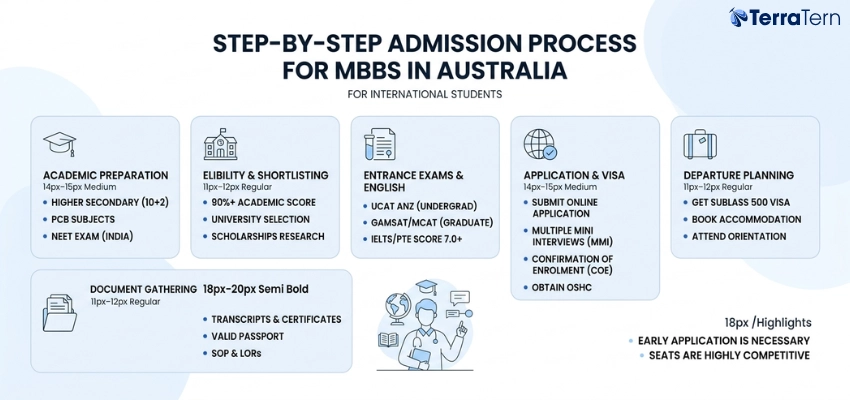
Get 10+2 with PCB and become a NEET.
-
Get higher secondary with Physics, Chemistry and Biology.
-
Take NEET Exams (Indian students must do later to practice in India).
Find out if the university is eligible and compile a list of universities. Determine eligibility and shortlist universities.
-
Check age (17+), academic (90%+ in 12th) and subject requirement.
-
Identify the universities you can afford, where you can go, what are the scholarships and what are the tests required.
Take the necessary entrance exams and prepare for them.
-
If you are applying at the undergraduate level, complete UCAT ANZ (most popular).
-
To attend the University as a graduate (MD): After a Bachelor's degree, take GAMSAT or MCAT.
Get a score of 7.0+ in English (IELTS or PTE/TOEFL).
-
Gather required documents
-
Mark sheets/certificates will be sent home with the 10th and 12th.
-
Valid passport.
-
NEET scorecard.
-
UCAT/GAMSAT/MCAT scorecard.
-
English test score (IELTS/PTE/TOEFL).
Academic Transcripts, Statement of Purpose, and Letters of Recommendation.
-
Submit applications to Universities (up to 6–12 months ahead of time)
-
Apply online via the University's website or via agents.
Early application is necessary as seats for medical studies tend to fill up promptly and entry is extremely competitive.
-
Go for jobs (if necessary)
-
Several universities have Multiple Mini Interviews (MMI) or panel interviews.
-
Get ready to answer for communication, ethics and scenarios.
-
Be interviewed and accepted.
-
You will receive either a conditional or an unconditional offer letter if you are selected.
Take the offer and pay the acceptance fee (if applicable) and/or the first instalment.
-
Obtain Overseas Student Health Cover (OSHC)
-
Get international students' health insurance.
Subclass 500 Australian Student visa is required.
-
Send visa application along with:
-
Confirmation of Enrolment (CoE)
Evidence of financial, OSHC and English results
-
Documents related to NEET and entrance exams.NEET and Entrance Exam documents.
-
Meet Genuine Student (GS) requirements.
Schedule a trip and book a room. Plan a trip and make a hotel booking.
-
Plan travel and in/off campus accommodations.
-
Take part in orientation and start your MBBS/MD.
Expert Advice: The MMI (Multiple Mini Interview) is the most decisive step in Australian medical admissions - begin preparing 3–4 months in advance with mock scenarios focused on ethics, empathy, and situational judgement.
Also Read: MBBS in Finland for Indian Students: Complete Guide
What Documents Are Required to Apply for MBBS in Australia?
-
10th and 12th mark sheets/certificates (HSE/SSLC/PCB)
-
Passport (must be valid for at least 6 months)
-
NEET scorecard (required for Indian students)
-
The University of Canberra Assessment Test (UCAT ANZ) scorecard (for undergraduate entry) or the GAMSAT/MCAT (for graduate-entry MD)
-
English proficiency test score (IELTS 7.0+, or PTE/TOEFL)
-
The academic transcript of the 10+2, and if applying for MD, all the bachelor's degree academic transcripts.
-
Statement of Purpose (SOP) and Letters of Recommendation (LORs).
-
Copies of the Migration certificate and admission form/admit card
-
Passport-size photos and photocopies of documents signed and dated by the applicant.
Pro Tip: Your SOP is as important as your UCAT score - medical schools in Australia assess your motivation, clinical awareness, and cultural sensitivity. Invest time in crafting a compelling narrative.
Is a Low-Cost MBBS in Australia Worth It for Indian Students?
|
Aspect |
Advantages of It (Pros) |
Why It May Not Be Worth It (Cons) |
|
Total Cost |
The cost can be lowered by a scholarship or a university in the region, which can range as low as 55000–80000 Australian dollars per year (tuition). |
Even “low-cost” MBBS comes at a whopping INR 2.2–2.8 crore per course (tuition + living), which is much more expensive even in India and many other countries. |
|
Quality of Education |
Highly ranked degrees from internationally recognised universities (e.g. Melbourne, Sydney, Monash) |
It is not a “budget” destination like the Philippines, Russia, and Bangladesh, and high fees are associated with high quality. |
|
Clinical Training |
Focusing on practical and hands-on clinical experience, with the use of modern facilities. |
If you wish to go back to India, you will need to get prepared for the FMGE/NExT on your own, or hospital exposure will differ from university to university. |
|
Career Pathway |
The graduates are being offered AUD 120,000-360,000 per year in Australia and post-study work rights and PR. |
For students who aim to practise in India only, the high cost may not be the most appropriate ROI compared to some private Indian colleges or lower-cost foreign colleges. |
|
Eligibility & Competition |
Structured admission process; Clear pathways with UCAT/NEET/IELTS. |
Very competitive: 90%+ in 12th, high UCAT/GAMSAT scores, IELTS 7.0+, and typically interviews |
|
Living Environment |
The safety, quality of life, size of the Indian community and infrastructure are all good. |
High cost of living: AUD 20,000-27,000 per year for housing, food, transportation, etc. |
|
Financial Risk |
If you remain in Australia or pursue high-paying employment in a foreign country upon graduating, then ROI may be high. |
The financial loss is substantial if you fail to finish the course, fail the licensing exams or don't get the job. |
Key Note: Students who secure even a partial scholarship (AUD 10,000–15,000/year) and leverage student work rights can reduce their net MBBS cost in Australia by 20–30%, dramatically improving the ROI equation.
Also Read: MBBS in the UK for Indian Students: The Complete Guide
What Career Opportunities Await After Completing MBBS in Australia?
General Practitioner (GP) in Australia
-
Average GP salary: A$250,000–350,000/year; rural GPs can earn up to A$700,000/year
-
With 70-75% net profit, practice owners can expect to earn A$1-2M in revenue.
-
Must pass the AMC exams and the 18-month training period post basic hospital duties
A Resident Medical Officer (RMO) or Hospital Medical Officer (HMO) is an early-career doctor. A Resident Medical Officer (RMO) or Hospital Medical Officer (HMO) is an early-career doctor.
-
A$70k to A$110k per year entry-level positions in a hospital for fresh graduates.
-
Gives clinical experience before specialisation or GP training
After PG/specialization, you can become a medical specialist.
-
Surgeon: ~A$395,000/year
-
Anaesthetist: ~A$386,100/year
-
Doctors: Internal Medicine Specialists make an average of ~A$305,000 a year.
There are many other specialities, like cardiology, radiology, paediatrics, etc., that pay well and are in high demand as well.
-
Rural and Regional Doctor
-
A higher demand for rural/regional jobs that offer higher wages and salaries, lower cost of living, and quicker pathways toward permanent residency status.
Can be exempted from regional work with a 10-year moratorium (Section 19AB) for financial benefit and exemptions.
-
Postgraduate Medical Training (RMO, Registrar, Fellow)
-
Progressive qualifications: Medical Registrar → Specialty Registrar → Specialist/Fellow
The range of salaries for Registrars is A$79,000-102,000/year, plus locum pay.
-
Locum Doctor / Casual GP
-
Flexible work; hours are competitive.
Great for getting experience, income and testing the waters at various locations before committing.
-
Non-Clinical Careers
-
Medical writing, Healthcare consulting, Medical education, Research, Public health, Healthcare administration
Opportunities are available in the fields of pharma, health tech, NGOs and Government Health Agencies.
-
Pathway to Permanent Residency (PR)
-
Doctors typically make the cut on skilled occupation lists, and they always boost your PR prospects, particularly in regional areas.
A work visa, after the study visa is granted, will allow you to work and gain experience to proceed with PR applications.
-
Go back to India or other countries
-
Pass FMGE/NExT and get to practice in India.
Australian MBBS is accepted worldwide; If you are looking for further studies/exam,s then you can go for PG in the UK, US, Canada, etc., depending on your plans.
Advice by our Expert: Before applying, confirm whether your target university's degree is recognised by the Australian Medical Council (AMC) - only AMC-recognised degrees qualify for Australian medical registration and FMGE eligibility in India.
What's New for MBBS in Australia?
High concentration of the AMC pathway among Indian MBBS graduates
-
It is now time to provide a clear, structured pathway for Indian MBBS graduates to pursue PG/MD in Australia without having to sit for the NEET-PG or a residency match in India, with Australia offering this opportunity through the AMC route.
New eligibility and exam specifications
-
Registration: Computer-based (AMC MCQ) exam and either AMC Clinical Exam (16 OSCE stations) or Workplace-Based Assessment (WBA).
-
English proficiency: IELTS 7.0+ (no band <7) or OET Grade B or PTE 65+ required.
New visa and registration routes
-
Placement in Subclass 482, 491 or TSS visa for doctors for better PR prospects, particularly in regional areas.
-
Pass the AMC requirements and the Professional Development Program (PDP) and be registered with AHPRA (Medical Board of Australia).
Greater focus on whole child development
-
The emphasis is now not just on studies but on the overall development of students, including clinical exposure, research, and community health as part of MBBS programs.
Improved infrastructure and technology
-
Medical schools in Australia provide state-of-the-art facilities, up-to-date laboratories, and the latest technologies, equipping students with the opportunity for practical clinical learning using state-of-the-art equipment.
A more transparent fee structure for 2026.
-
New tuition fee ranges for MBBS/MD: AUD 64,000 to 92,000 annually (tuition fees), with the total cost of the course estimated at around 2.2–2.8 crore INR for overseas students, including living expenses.
Incentives for regional study and PR.
-
Increasing regional university (e.g. Tasmania, Adelaide, Newcastle) emphasis on lower costs, better PR opportunities and rural service exemptions.
New entrance exam requirements.
-
Requirements for undergraduate entry: UCAT ANZ; Requirements for graduate entry: GAMSAT/MCAT (Guidance for 2026 intakes is clearer).
Expert Advice: Policy changes (especially NEET requirements and student visa work-hour limits) can affect your plans mid-preparation - always cross-check with the official Australian Department of Home Affairs and your chosen university.
Also Read: MBBS in Austria: Top Universities, Expenses, Benefits & More
Conclusion
If you’re looking for a cheap MBBS in Australia, the answer is not actually “low cost” – rather, it is achieving the low cost attributes of such a program by making smart selections such as attending universities with relatively lower tuition rates, enrolling in regional cities where living expenses are lower, and diligently securing scholarships that can lower by 10–50% the tuition you’ll pay for your studies. The total investment is still around the INR 2.2-3 crore mark for the entire course, much higher than that in India or many other countries, but it pays to study in Australia as there is ample provision for medical education and training with good clinical exposure, substantial remuneration (particularly for GPs and specialists) and a clear pathway for employment and ultimately the opportunity for PR in Australia. If the plan for Indian student is to practice mostly in India with minimal risk of investment then the option of studying MBBS in Australia may not be the most cost-effective; however, if the student is highly motivated and able to invest a small amount of money (or a substantial scholarship), and is willing to practice in Australia or in one of the high earning countries, studying MBBS in Australia can be a very cost-effective option and may be a high value investment for his/her medical career.
If you are looking to find options for studying a low-cost MBBS in Australia, then you must contact TerraTern right away. With years of experience and an expert team, TerraTern is there to help you with all your immigration needs!




 AI Summary