

Key Highlights
- What Is the Key Difference Between Ausbildung and a Master's Degree in Germany?
- What Are the Eligibility Requirements for Ausbildung vs Masters in Germany for Indian Students?
- How Do Costs and Finances Compare Between Ausbildung and Masters in Germany?
- What Salaries Can Indian Students Expect After Ausbildung vs Masters in Germany?
- What Are the German Language Requirements for Ausbildung vs a Master's Degree?
- How Do PR and Visa Pathways Compare for Ausbildung vs Masters in Germany?
- Which Is Better for Indian Students Ausbildung or Masters in Germany?
- What Are the Top Programs to Consider for Ausbildung and Masters in Germany in 2026?
- How Do I Apply for Ausbildung or a Master's Degree in Germany from India?
- Conclusion
Ausbildung or Master's which is better in Germany, hinges on individual goals, but this introduction explores key factors like cost, duration, and career fit to clarify the choice. Ausbildung or Master's which is better in Germany, often favours Ausbildung for hands-on trades such as mechatronics or truck driving, offering paid training without a prior degree, unlike the academic demands of Master's programs.
Ausbildung or Master's which is better in Germany, becomes evident when considering quicker entry for Indians post-12th, bypassing Bachelor's requirements and high living costs during Master's studies. Ultimately, Ausbildung or Master's which is better in Germany, aligns with practical, debt-free paths in industrial hubs like Stuttgart.
What Is the Key Difference Between Ausbildung and a Master's Degree in Germany?
There are three key points of difference
-
Germany's dual vocational training system, a combination of 70% practical on-the-job learning with theory lessons at Berufsschule, 30% (vocational school), lasts 2-3.5 years.
-
A master's program is an academic postgraduate program after graduating from a Bachelor's degree program at a university, with concentrated research studies for 1-2 academic year.
-
Duales Studium is the ideal intermediate solution: You can actively participate in corporate training and, in parallel, complete structured study at the university.
-
It can't be determined whether Ausbildung or Master's which is better in Germany without knowing your academic background, budget, and career aspirations.
|
Factor |
Ausbildung (Vocational) |
Master's Degree (Academic) |
Duales Studium (Hybrid) |
|
Duration |
2 – 3.5 years |
1 – 2 years |
3 – 4 years |
|
Eligibility |
Class 12 (High School) |
Bachelor's Degree |
Class 12 / Bachelor's |
|
German Required |
B1 – B2 level mandatory |
B1 – C1 (Many English tracks) |
B2 – C1 level mandatory |
|
Monthly Income |
₹72,000 – ₹1,35,000 stipend |
None (Self-funded) |
₹90,000 – ₹1,60,000 stipend |
|
Tuition Cost |
Zero |
Zero at public universities |
Zero (Paid by employer) |
|
PR Timeline |
2 years after graduation |
21 months via EU Blue Card |
21–24 months after graduation |
|
Starting Salary |
₹1.8 – ₹4.1 lakh/month |
₹3.7 – ₹6.1 lakh/month |
₹3.2 – ₹5.2 lakh/month |
Pro Tip: Most Indian students overlook the Duales Studium option, it combines a university degree with a paid employer contract, giving you the best of both worlds: income during studies and an academic credential that unlocks senior roles.
Also Read: Ausbildung or Master's Which is Better in Germany for Indians 2026
What Are the Eligibility Requirements for Ausbildung vs Masters in Germany for Indian Students?
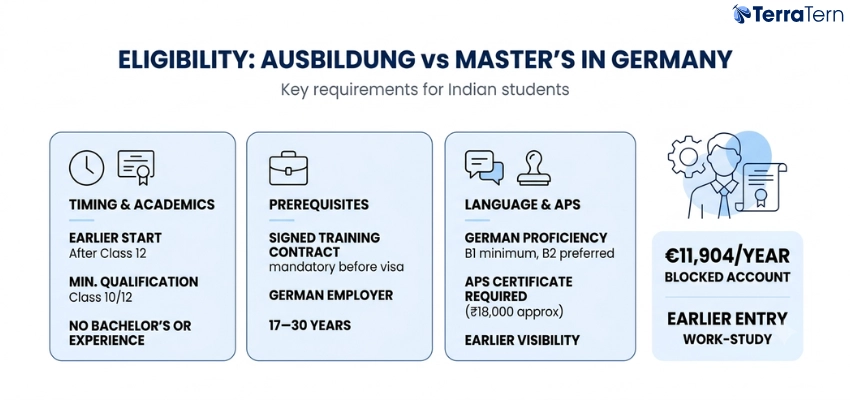
When evaluating Ausbildung or Master's which is better in Germany, Ausbildung can be started 2–3 years earlier after Class 12, while a Master's requires completing a Bachelor's degree first.
-
Ausbildung eligibility class 10/12 qualification; typically aged 17–30; B1 German proficiency (B2 preferred). No Bachelor's degree or prior work experience is required.
-
A signed training contract (Ausbildungsvertrag) from a German employer is mandatory before applying for an Ausbildung visa.
-
Master's eligibility requires a 3–4 year Bachelor's degree, university-specific GPA requirements, and language proficiency (IELTS/TOEFL for English-taught programs or TestDaF/C1 German for German-taught programs).
-
Indian applicants must obtain an APS certificate (Academic Evaluation Centre verification), costing approximately ₹18,000.
-
Master's students must show a blocked account of €11,904 per year (around ₹10.6 lakh in 2026) for living expenses
What Documents Does an Indian Student Need for Ausbildung in Germany?
Signed training contract (Ausbildungsvertrag) from a German employer.
-
B1 German language certificate (Goethe-Institut or TELC; B2 preferred).
-
Class 12 mark sheet and certificates with the required legalisation/apostille.
-
Valid passport, biometric photographs, and completed visa application forms.
-
Proof of health insurance and financial evidence (a blocked account or an employer stipend letter).
-
For students comparing Ausbildung or Master's which is better in Germany, Ausbildung documentation is generally simpler and focused on employment-based training requirements.
What Documents Does an Indian Student Need for a Master's in Germany?
APS certificate (mandatory for Indian applicants; approximately ₹18,000).
-
Bachelor's degree certificate, transcripts, and apostille/legalisation where required.
-
Official university admission letter from a German higher education institution.
-
Proof of a blocked account containing €11,904 (around ₹10.6 lakh per year in 2026).
-
Language proficiency scores, such as IELTS, TOEFL, or TestDaF, depending on the program.
-
Motivation letter and CV; for those deciding between Ausbildung or Master's which is better in Germany, Master's applications require more academic and financial documentation.
Expert Tip: Indian students who begin German language training (A1 → B1) at least 8–12 months before applying for Ausbildung significantly improve their chances of securing contracts with larger companies like Siemens, Bosch, or BMW, which offer better stipends and direct PR pathways.
How Do Costs and Finances Compare Between Ausbildung and Masters in Germany?
Ausbildung costs almost nothing because there are no tuition fees, and trainees earn a monthly stipend of approximately ₹72,000–₹1,35,000 (€800–€1,500) from the first day.
-
Over a typical 3-year Ausbildung, students can earn roughly ₹36–48 lakh, generating positive cash flow rather than incurring student expenses.
-
A Master's degree at most public German universities is tuition-free, but students must cover living expenses of about ₹89,000/month (€992) and maintain a blocked account of €11,904 (around ₹10.6 lakh per year).
-
The total living cost for a 2-year Master's program is typically ₹21–25 lakh, excluding travel and personal expenses.
-
Master's students can work 120 full days or 240 half days annually, potentially earning ₹35,000–₹60,000 per month through part-time jobs.
-
When deciding Ausbildung or Master's which is better in Germany, Ausbildung offers immediate earnings and Day-1 financial returns, while a Master's generally delivers a strong ROI within the first year after graduation through salaries exceeding €50,000 annually.
Is a Master's Degree in Germany Really Free for Indian Students?
Most public universities in Germany charge no tuition fees, making higher education highly affordable for Indian students.
-
Students must still pay a semester contribution fee of €150–€350, which often includes administrative services and public transport benefits.
-
Bavaria is a notable exception: institutions such as the Technical University of Munich and other Bavarian universities charge tuition fees to non-EU students.
-
Indian students must show proof of funds through a blocked account of €11,904 (approximately ₹10.6 lakh per year in 2026).
-
Major scholarship options include the DAAD, the Heinrich Böll Foundation, and the Deutschlandstipendium.
-
For students evaluating Ausbildung or Master's which is better in Germany, public university education remains low-cost, but Ausbildung remains the more financially self-sustaining pathway during the study period.
Key Note:The financial advantage of Ausbildung is most pronounced in the first 3 years ,an Ausbildung student can save ₹15–25 lakh over their training period while a Master's student spends ₹20–25 lakh on living costs. However, the Master's graduate's salary premium of 35–45% means the investment is recovered within the first year of employment.
What Salaries Can Indian Students Expect After Ausbildung vs Masters in Germany?
When deciding between an Ausbildung and a Master's in Germany, understanding the immediate and long-term financial payoff is key. A university postgraduate degree leads to a significantly higher initial salary, but the vocational route offers quick entry into the labour market with completely steady, independent returns.
|
Sector / Field |
Post-Ausbildung Monthly Salary |
Post-Master's Annual Starting Salary |
|
IT, Computer Science & AI |
₹2.7 – ₹4.1 lakh (€3,000–€4,500) |
₹49.5 – ₹61.2 lakh (€55,000–€68,000) |
|
Mechanical & Mechatronics Eng. |
₹2.5 – ₹3.4 lakh (€2,800–€3,800) |
₹45.0 – ₹55.8 lakh (€50,000–€62,000) |
|
Healthcare & Nursing (Pflege) |
₹2.3 – ₹3.2 lakh (€2,500–€3,500) |
₹37.8 – ₹49.5 lakh (€42,000–€55,000)* |
|
Business, Management & Finance |
₹2.4 – ₹3.2 lakh (€2,700–€3,500) |
₹36.0 – ₹45.0 lakh (€40,000–€50,000) |
Long-Term Trajectory and Minimum Wage Rules
-
The 5-Year Outlook: Experienced Ausbildung professionals in specialised technical fields often scale up to €4,500–€6,000 per month. Meanwhile, Master's graduates entering corporate management or senior engineering roles frequently earn €70,000–€90,000 per year (approx. ₹63–₹81 lakh).
-
The 2026 Wage Floor: As of January 1, 2026, Germany's statutory national minimum wage has risen to €13.90/hour (approx. ₹1,251/hour). This strong economic floor protects all workers, making even entry-level part-time shifts financially viable compared to global averages.
-
Geographic Advantage: Choosing up-and-coming tech hubs like Leipzig or Dresden ("Silicon Saxony") allows international professionals to command premium tech salaries while paying up to 50% less in rent than in cities like Munich or Frankfurt.
How Does Salary After Ausbildung in Germany Compare to an Engineering Degree in India?
For many Indian students, checking Ausbildung or Master's which is better in Germany involves weighing a German vocational qualification against a traditional engineering degree back home. In terms of immediate absolute income and purchasing power, the dual-training system holds a distinct economic advantage.
|
Metric |
Post-Ausbildung Graduate (Germany) |
Entry-Level Engineer (India) |
|
Absolute Monthly Income |
₹1.8 to ₹4.1 lakh (€2,000–€4,500) |
₹35,000 to ₹80,000 (Average tier-2/3) |
|
Income Multiple |
2.5x to 3x higher in absolute terms |
Baseline baseline |
|
Purchasing Power & Savings |
Retains 3x to 5x higher absolute disposable savings after expenses |
High domestic cost-of-living relative to low starter pay |
Important Note: Indian students in IT and Engineering who choose a Master's at TUM or RWTH Aachen command starting salaries 35–45% higher than Ausbildung graduates in the same field, but Ausbildung IT specialists at companies like SAP or Siemens often match those figures within 3–5 years, especially if they pursue post-training certifications.
What Are the German Language Requirements for Ausbildung vs a Master's Degree?
Ausbildung requires at least B1 German proficiency, although B2 is strongly preferred by many employers, especially in nursing, healthcare, and technical training occupations.
-
The typical Ausbildung language pathway is A1 → A2 → B1 → B2, which usually takes 6–18 months of consistent study. Accepted certifications include Goethe-Institut and TELC exams.
-
Many competitive Ausbildung positions, particularly in nursing and skilled trades, require B2 proficiency in German, making language preparation a critical factor in admission.
-
A Master's degree can be pursued in either German-medium programs (C1 level via TestDaF or DSH) or English-medium programs (IELTS 6.5–7.5 or TOEFL 90–100).
-
English-taught Master's programs offer a major advantage because students can begin their studies without advanced German skills, although German proficiency significantly improves internship, job, and PR opportunities after graduation.
-
When comparing Ausbildung or Master's which is better in Germany, language requirements are often easier for Master's applicants due to the availability of English-taught programs, whereas Ausbildung generally requires stronger German skills before arrival.
Expert Advice: Indian students who reach B2 German before beginning Ausbildung have access to 3x more training company options, including Bosch, Daimler, and Deutsche Bank, which offer ₹30,000–₹40,000 higher monthly stipends and significantly better post-training job conversion rates.
How Do PR and Visa Pathways Compare for Ausbildung vs Masters in Germany?
Both Ausbildung and Master's graduates can obtain German permanent residency (Niederlassungserlaubnis), but the route and timeline differ significantly.
-
Ausbildung pathway: Complete vocational training (2–3.5 years), gain a recognised Berufsabschluss, secure full-time employment (many trainees are retained by their training company), and typically become eligible for PR after 2 years of post-training skilled employment.
-
Master's pathway: Complete the degree, use the 18-month job-seeker residence permit to find employment, and qualify for the EU Blue Card if salary requirements are met (generally around €45,934+ for shortage occupations or €50,700+ for other occupations, subject to annual updates).
-
EU Blue Card holders can apply for PR after 21 months with B1 German proficiency or 33 months with A1 German proficiency, making it one of Germany's fastest residency routes.
-
When evaluating Ausbildung or Master's which is better in Germany, Germany's Skilled Immigration Act (Fachkräfteeinwanderungsgesetz) has strengthened pathways for both vocational and academic graduates, while citizenship generally becomes possible after several years of legal residence and successful integration.
Which Path Leads to German PR Faster Ausbildung or Masters?
A Master's degree followed by an EU Blue Card is usually the fastest route, allowing eligible graduates to obtain PR in as little as 21 months after securing a qualifying job.
-
The Ausbildung route typically takes around 5–6 years overall, including vocational training (2–3.5 years) and the required period of skilled employment before PR eligibility.
-
Ausbildung offers strong employment security, with many graduates receiving job offers from their training employer immediately after qualification.
-
For students deciding between Ausbildung or Master's which is better in Germany, a Master's generally provides the quickest PR pathway, while Ausbildung offers a more predictable transition into the German labour market.
Important Tip: If your goal is German PR as quickly as possible, a Master's in a shortage field (IT, engineering) with a salary above €45,934 leads to EU Blue Card eligibility and PR in just 21 months, roughly 3 years faster than the typical Ausbildung-to-PR timeline.
Which Is Better for Indian Students Ausbildung or Masters in Germany?
Deciding between an Ausbildung or Master's which is better in Germany comes down to matching your current educational profile, upfront budget, and career goals against Germany's 2026 labour framework.
1. Choose an Ausbildung if:
-
You want to bypass university: You have completed Class 12 (10+2) and prefer to start your career immediately rather than spending 3 to 4 years earning a standard Bachelor's degree.
-
You need financial independence from Day 1: You want to earn a steady monthly stipend of ₹72,000–₹1,35,000 (€900–€1,500) from your very first year.
-
You want to skip the Blocked Account: You do not have the financial backing to deposit the mandatory €11,904 upfront; an Ausbildung training contract generally waives this student visa requirement.
-
You are ready to master German: your target field is healthcare (Nursing), IT, mechatronics, logistics, or automotive technology, and you are willing to invest 6–12 months to achieve a strong B1/B2 level in German.
-
You value job security over a high salary cap: You want a near-guaranteed job straight out of training (85–92% of trainees are retained by their employers).
2. Choose a Master's Degree if:
-
You already hold a Bachelor's degree: you have completed a 3- or 4-year undergraduate degree in India (Engineering, Science, or Business) and want an advanced specialisation.
-
You are targeting corporate leadership: high-salary white-collar roles, management positions, or corporate R&D in multinational organisations.
-
You want an English-taught pathway: Your English is strong, and you prefer to study in English initially while learning conversational German on the side.
-
You want the absolute fastest Permanent Residency (PR): You can afford the €11,904 (approx. ₹10.6 lakh) annual blocked account requirement because your ultimate goal is hitting the high EU Blue Card salary thresholds (€50,700/year standard, or €45,934.20 for STEM shortage roles) to qualify for a German PR in just 21 months.
3. Choose a Duales Studium if:
-
You want the ultimate hybrid model: a full university Bachelor’s or Master’s degree alongside structured, paid corporate training.
-
You have competitive credentials: a stellar academic record and a strong B2/C1 level in German, positioning you to win over highly selective corporate sponsors who will pay your tuition and a premium stipend of ₹90,000–₹1,60,000/month.
As per TerraTern Expert Divyansh, there is no universally "better" path, but there is a better path for your profile. Indian students who completed an engineering degree in India and have 1–3 years of work experience typically see the highest ROI from a Master's degree at TU Munich, RWTH Aachen, or KIT, where the starting-salary premium pays back the full cost of living within 8–12 months.
What Are the Top Programs to Consider for Ausbildung and Masters in Germany in 2026?
Choosing the right specialisation is just as critical as selecting the path itself. When deciding between Ausbildung or Master's which is better in Germany, your field of choice directly determines your job security, visa approval speed, and starting salary.
Top Ausbildung Programs in 2026 (High Demand & Stipends)
|
Program Title (German Name) |
Open Vacancies (Approx.) |
Average Monthly Post-Training Salary |
Key Sector Focus |
|
IT Specialist (Fachinformatiker) |
700,000+ |
₹2.7 – ₹4.1 lakh (€3,000–€4,500) |
Software development, cloud systems, cyber security |
|
Mechatronics Technician (Mechatroniker) |
120,000+ |
₹2.5 – ₹3.4 lakh (€2,800–€3,800) |
Automotive automation, robotics, smart manufacturing |
|
Nursing Professional (Pflegefachmann/frau) |
150,000+ |
₹2.3 – ₹3.2 lakh (€2,500–€3,500) |
Clinical nursing, geriatric care, hospital logistics |
|
Bank Clerk (Bankkaufmann/frau) |
45,000+ |
₹2.4 – ₹3.2 lakh (€2,700–€3,500) |
Retail banking, investment consulting, fintech |
|
Industrial Mechanic (Industriemechaniker) |
80,000+ |
₹2.3 – ₹2.9 lakh (€2,500–€3,200) |
Heavy machinery production, assembly line operations |
Top Master's Programs in 2026 (Employability & Starting Salaries)
|
Master's Program / Specialisation |
Top Recommended Universities |
Average Annual Starting Salary |
Career Pathways |
|
Computer Science, AI & Data Science |
TU Munich (TUM), Karlsruhe Institute of Technology (KIT) |
₹49.5 – ₹61.2 lakh (€55,000–€68,000) |
AI Engineer, Data Architect, Enterprise IT Consultant |
|
Mechanical, Automotive & Robotics |
RWTH Aachen, TU Munich (TUM), TU Berlin |
₹45.0 – ₹55.8 lakh (€50,000–€62,000) |
R&D Engineer, Automation Specialist, EV Designer |
|
MBA, International Business & Finance |
University of Mannheim, WHU Otto Beisheim School |
₹36.0 – ₹49.5 lakh (€40,000–€55,000) |
Corporate Strategist, Investment Analyst, Project Lead |
|
Biotech, Life Sciences & Pharma |
Heidelberg University, University of Freiburg |
₹37.8 – ₹49.5 lakh (€42,000–€55,000) |
Research Scientist, Clinical Data Analyst, Lab Director |
Pro Tip: Germany has 700,000+ unfilled skilled vacancies as of 2026 (Destatis/IAB), making 2026 one of the strongest years in history for both Ausbildung trainees and Master's graduates to enter the German labour market with strong negotiating power.
How Do I Apply for Ausbildung or a Master's Degree in Germany from India?
For Ausbildung, the first step is securing a training contract from a German employer through platforms such as the German Federal Employment Agency, Make it in Germany, or LinkedIn.
-
After receiving the training contract, candidates apply for an Ausbildung visa and complete document verification and consular procedures.
-
The overall Ausbildung application and visa process can take 8–12 months, including German language preparation.
-
For a Master's degree, applications are submitted directly to German universities, usually for winter (October) or summer (April) intakes.
-
Indian students must obtain an APS certificate, arrange a blocked account, and secure university admission before applying for a national student visa.
-
When deciding Ausbildung or Master's which is better in Germany, the application process differs significantly: Ausbildung is employer-led, while Master's admissions are university-led.
Step-by-Step Ausbildung Application Process from India
Start learning German and progress from A1 to B1 level (typically 6–9 months of preparation).
-
Research suitable training programs through official German vocational training and employment portals.
-
Apply to German employers with a German-style CV and cover letter.
-
Secure an Ausbildungsvertrag (training contract) from a sponsoring employer.
-
Book a visa appointment at the German consulate and prepare all required documents.
-
Receive the visa, travel to Germany, complete Anmeldung (residence registration), and begin training in the March or September intake. For students evaluating Ausbildung or Master's which is better in Germany, this pathway focuses on employment before arrival.
Step-by-Step Master's Application Process from India
Obtain an APS certificate (approximately ₹18,000; processing usually takes 8–12 weeks).
-
Research universities and submit applications directly or, where applicable, through centralised admission platforms.
-
Prepare essential documents, including a motivation letter, CV, academic transcripts, and recommendation letters.
-
Complete required language tests such as IELTS, TOEFL, or TestDaF, depending on program requirements.
-
Submit applications before major deadlines (January 15 for summer intake and July 15 for winter intake at many universities).
-
After receiving admission, open a blocked account (around ₹10.6 lakh/year) and apply for a German national student visa. For those comparing Ausbildung or Master's which is better in Germany, this route emphasises academic qualifications and long-term career advancement.
Key Note: The single biggest mistake Indian students make is underestimating lead time; both the Ausbildung and Master's application processes take 12–18 months from language preparation to arrival in Germany. Start planning at least 18 months before your target intake date.
Conclusion
When evaluating Ausbildung or Master's which is better in Germany, the right choice depends on your education level, career goals, language readiness, and financial situation. Ausbildung is ideal for Class 12 graduates seeking early employment, practical training, and income from day one. A Master's degree suits Bachelor's holders targeting higher salaries, corporate careers, research opportunities, and faster EU Blue Card pathways. Both routes offer excellent job prospects, permanent residency opportunities, and a strong future in Germany.
To learn more about Ausbildung or Master's which is better in Germany, contact TerraTern right away!




 AI Summary