
Key Highlights
- What Is a Study Permit for Minors in Canada?
- Who Is Considered a Minor for a Canadian Study Permit?
- Does My Child Need a Study Permit to Study in Canada?
- What Are the Eligibility Requirements for a Minor's Study Permit?
- When Does My Child Need a Custodian in Canada?
- How Do You Apply for a Study Permit for a Minor, Step by Step?
- Is a Minor’s Study Permit Affected by Canada’s 2026 Study Permit Cap?
- How Long Is a Study Permit for a Minor Valid, and How Do You Renew It?
- What Happens When a Minor Turns 18 or 19 During Their Studies?
- Can a Minor Work in Canada on a Study Permit?
- How Much Does It Cost to Send a Minor to Study in Canada?
- What Are Common Reasons Minor Study Permit Applications Get Refused?
- How Can TerraTern Help With Your Child's Canada Study Permit?
- 2026 Industry Context Section
- Conclusion
Planning education abroad for your child involves careful preparations and, in particular, dealing with Canada's immigration rules. This guide for 2026 clarifies the process for a study permit for minors in Canada and includes information on eligibility, documents required, custodianship, application procedure, fees, and parental responsibilities.
No matter where your child chooses to go to school in primary or secondary school, or another designated school, knowing what to expect in advance will help minimise delays and ensure a smooth and compliant transition to Canadian study.
What Is a Study Permit for Minors in Canada?

A study permit for minors in Canada authorises a foreign national below the provincial or territorial age of majority to study at a Canadian school or designated learning institution, where required.
-
It is a permit, not an entry visa.
-
IRCC usually issues the required visitor visa or eTA automatically upon initial approval.
-
It generally covers elementary, secondary, and primary, secondary, or other eligible studies.
-
Confirm the school’s admission and study-permit requirements before applying; care, funding, and custodianship requirements may apply.
As per TerraTern Expert Divyansh, IRCC's "minor" definition depends on the province of study, not the child's home-country age of majority, a common point of confusion for Indian parents used to 18 being the universal legal adult age.
Also Read: Canada International Students Visa Guide: Requirements & Process
Who Is Considered a Minor for a Canadian Study Permit?
IRCC considers minors to be those who arrive in the delivery province or territory under the age of majority at that time. It's a nuance at the time of arrival
-
IRCC and related guidance refer to a “minor child” as a person who enters Canada to study at a time he/she is under the age of majority, at which time the rules and definitions set out in the IRCC guidance for minor children shall apply.
-
While in practice an 18-year-old at time of application and 18 before arriving in province is deemed an adult on arrival, on the other hand a 18 year old/19 at the time of arrival, regardless of when he or she turns 18/19, is still considered to be treated as a minor.
Why this Matters
-
Custodianship: If Canadian citizens or permanent residents (age 19 and older) are travelling with a Canadian minor, the minor does not need to use a custodianship, but if not, a non-notarised custodianship declaration must be provided.
-
Study Permit & Enrolment Rules: rules for consent, enrolment and work eligibility of minors (such as cannot work on a study permit for programmes >6 months) are set at a provincial/school level based on the minor/adult status.
|
Province / Territory |
Age of majority |
|
Alberta |
18 |
|
Manitoba |
18 |
|
Ontario |
18 |
|
Prince Edward Island |
18 |
|
Quebec |
18 |
|
Saskatchewan |
18 |
|
British Columbia |
19 |
|
New Brunswick |
19 |
|
Newfoundland and Labrador |
19 |
|
Northwest Territories |
19 |
|
Nova Scotia |
19 |
|
Nunavut |
19 |
|
Yukon |
19 |
Important Note: A 17-year-old heading to a Vancouver boarding school (BC, age of majority 19) faces different custodianship rules than a same-age sibling heading to a Toronto school (Ontario,
Does My Child Need a Study Permit to Study in Canada?
Most of the time, a study permit for minors in Canada is a requirement for studies of more than six months' duration if a study permit is applied for from abroad.
-
If the child finishes the programs within the authorised period of stay in Canada, the programs of 6 months or less will be exempt.
-
Minors who have a refugee claim or their parents who have a refugee claim, or are refugee claimants, are exempt.
-
Under certain circumstances, a child may also be exempt if the child has citizenship or is a permanent resident, or if the parents were already in Canada as Canadian citizens or permanent residents, or if one parent is authorized to work or study in Canada or is a qualifying permit-exempt worker.
-
In cases where social services are available at the provincial/territorial level, and for continuity after the majority, access for secondary-school co-op eligibility, applying anyway will help.
Expert Tip: Being exempt from needing a permit isn't the same as being better off without one a study permit unlocks co-op eligibility and a smoother status transition once your child ages out of the exemption.
What Are the Eligibility Requirements for a Minor's Study Permit?
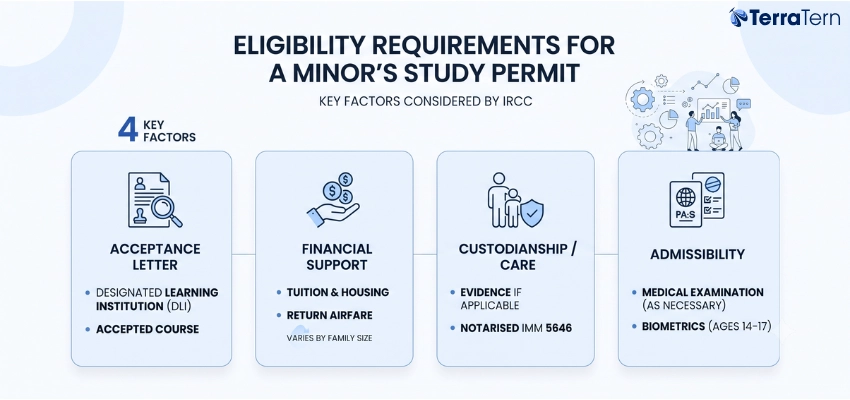
In the case of children, IRCC considers four factors for a study permit for minors in Canada: application, acceptance, funding, care, and admissibility.
-
Acceptance letter issued by a Designated Learning Institution (DLI) for the course of choice.
-
Documentation of financial support for tuition, housing (Cost of Attendance), and airfare returns (depends on the size of the family and years).
-
If applicable, evidence of custodianship/care, including a notarised IMM 5646 in the instances specified.
-
Admissibility checks comprise medical examination (as necessary) and biometrics for many applicants aged between 14 and 17 years.
-
All documents must be consistent (names, dates, relationships) in order to avoid further review of the study permit for minors in Canada.
Expert Advice: Officers assess minor applications against the same four pillars adult applicants face, plus one more: proof that someone in Canada is actually responsible for the child day-to-day.
How Much Money Do You Need to Prove for a Minor's Study Permit?
The living expenses for the first year (September 1, 2025) for a single applicant outside Quebec are CAD 22,895, in addition to the first-year tuition fees and return airfares.
-
Applicants may use one or more forms of acceptable financial evidence, following IRCC’s current proof-of-funds instructions.
-
The numbers are for living expenses only and will need to be supplemented with sufficient funds for first-year tuition and return travel if you apply for a study permit for minors in Canada
|
Period |
Single applicant |
Family of 2 |
Family of 3 |
|
Pre‑2024 (old flat rule) |
$10,000 |
— |
— |
|
Jan 1, 2024 – Aug 31, 2025 |
$20,635 |
$25,690 |
$31,583 |
|
Sept 1, 2025 – present |
$22,895 |
$28,502 |
$35,040 |
|
Quebec (from Jan 1, 2026) |
$24,617 |
— |
— |
Important Tip: Budget above the published minimum; officers expect funds that plausibly cover a minor's actual costs, including custodian or homestay fees, not just the bare regulatory floor.
What Documents Are Required for a Minor's Study Permit Application?
In addition to the standard A.D. set, minor applications include a birth certificate, parental consent/custodianship documents, a Custodianship Declaration (IMM 5646) (non-notarised, IMM 5646 is used where a Canadian custodian is required; it is not a form appointing the parent as custodian.), and (only in Quebec) a CAQ.
-
Letter of Acceptance from DLI, valid passport, and proof of funds (tuition + living + travel).
-
Copy of birth certificate with parents' names to establish the minor, parent/guardian’s relationship.
-
Parental consent or custody order (plus notarised IMM 5646 if the minor is less than 17 years old and not accompanied by a parent or legal guardian.
-
Applicants aged 14 to 79 generally need biometrics unless exempt.
-
Consider providing Indian families with clear affidavits/consent letters to support the study permit for minors in Canada in joint families or single-parent families.
As per TerraTern Expert: Inconsistent names, dates, or relationships across your child's documents is one of the most common and entirely avoidable reasons minor applications get flagged for extra review. Build one master family information sheet before filling out any forms.
Also Read: Family Information Form Canada: Guide, Tips & Download
When Does My Child Need a Custodian in Canada?
For a study permit for minors in Canada, custodianship depends on age and parental accompaniment.
Pro Tip: Even when custodianship is only discretionary (age 17+), officers reviewing a secondary-school applicant will often expect one anyway; proactively including a custodian avoids a returned or delayed application.
How Do You Fill Out the Custodianship Declaration (IMM 5646)?
For a study permit for minors in Canada, complete both pages of IMM 564s.
-
The custodian completes Page 1 and has it notarised in Canada.
-
Parents or legal guardians complete Page 2; Indian applicants notarise it in India.
-
Submit both pages together; match names, school and residence details exactly.
-
Avoid missing signatures or an ineligible custodian; complete both notarizations close together.
Key Note: The single most common IMM 5646 rejection reason isn't eligibility; it's a page notarised in the wrong country. Confirm both notarizations line up before you submit.
Who Can Act as a Custodian for an International Student in Canada?
For a study permit for minors in Canada, the custodian must reside in Canada.
-
They must be a Canadian citizen or permanent resident aged 19 or older.
-
Visitor, work-permit, or study-permit status alone does not qualify.
-
Relatives may serve; when using paid or homestay services, verify that the named individual meets IRCC rules.
-
Custodians provide care and support, act for parents when appropriate and remain available during emergencies.
As per our TerraTern Expert Shreya, if no relative in Canada can serve, a professional custodianship service is a legitimate option IRCC accepts. Just confirm in writing that the assigned custodian meets the citizenship/PR requirement before you notarise anything.
How Do You Apply for a Study Permit for a Minor, Step by Step?
Secure the DLI acceptance letter for the study permit for minors in Canada.
- Arrange custodianship and parental consent, if required.
- Gather identity, custody, and financial documents.
- Apply online through IRCC and pay the fees.
- Complete biometrics at ages 14–17, unless exempt.
- Await approval of the POE letter and automatic eTA or TRV.
- Apply to extend the study permit at least 30 days before it expires.
Important Note: Apply the moment your child has a Letter of Acceptance. Minor applications involving custodianship notarised across two countries routinely take longer to assemble than adult applications, even before IRCC's own processing clock starts.
Is a Minor’s Study Permit Affected by Canada’s 2026 Study Permit Cap?
No. Primary and secondary school applicants are generally exempt from the PAL/TAL requirement. Verify the current rule on IRCC’s PAL/TAL page before applying.
-
A PAL/TAL confirms space within a province’s or territory’s allocation.
-
IRCC forecasts 115,000 K–12 permits within 408,000 total 2026 issuances.
-
Other exemptions cover public-DLI master’s and doctoral students, priority or vulnerable cohorts, and qualifying same-DLI, same-level extensions.
-
Pre-university or foundation students should confirm their program level and PAL/TAL status with the DLI.
Expert Tip: The cap headlines make Canadian study permits sound harder to get in 2026, but if your child is applying for K-12, the cap and PAL requirement simply don't apply to them.
Also Read: Canada PR Family Visa Requirements: Complete Guide
How Long Is a Study Permit for a Minor Valid, and How Do You Renew It?
A study permit for minors in Canada generally lasts one year for primary school.
-
Secondary-school permits may cover the intended study period, up to four years.
-
A new Letter of Acceptance is required for an in-Canada extension.
-
Apply at least 90 days before expiry; restoration is available within 90 days after status expires.
-
Check the current permit’s conditions and expiry date when moving to post-secondary study. An extension may be required, but it is not automatic in every case.”
Expert Advice: Moving from a K-12 program to college or university always requires a brand-new study permit application even if your child's current permit hasn't expired yet.
What Happens When a Minor Turns 18 or 19 During Their Studies?
A study permit for minors in Canada does not automatically expire when the student reaches adulthood.
-
It generally remains valid until the printed expiry date, provided its conditions are met.
-
IRCC custodianship no longer applies after the provincial age of majority.
-
Notify the school and custodian and update emergency contacts.
-
Reapply only when required for expiry or certain post-secondary DLI changes.
Important Tip: Turning 18 doesn't trigger a new application on its own, but it's the right moment to review whether your child still needs (or wants) the custodianship arrangement in place.
Can a Minor Work in Canada on a Study Permit?
A study permit for minors in Canada generally provides no automatic off-campus work rights at the K–12 level.
-
Standard off-campus rights mainly cover eligible post-secondary or Quebec secondary vocational students.
-
Secondary students can apply for a co-op work permit.
-
The placement must be compulsory, supported by a school letter and no more than 50% of the program.
-
For later stages, see TerraTern’s post-secondary student work-rights guide.
As per TerraTern Expert: If part-time work is a priority, that typically becomes possible once your child transitions to a post-secondary study permit, not while on a K-12 minor permit.
Also Read: Canada PR Visa: Eligibility, Fees, Processing Time & More
How Much Does It Cost to Send a Minor to Study in Canada?
Budgeting for a study permit for minors in Canada includes the following indicative costs:
|
Cost item |
Approximate amount (CAD) |
Notes |
|
Study permit application fee |
150 (per person) |
IRCC fee; same for extensions. |
|
Biometrics fee |
85 (per individual) / 170 (family max) |
Required for most applicants; valid 10 years. |
|
Tuition (K–12, indicative) |
10,000–17,000 (public) 15,000–30,000 (private day) 63,000–83,000 (private boarding) |
Varies by province, board, and grade; these are broad market ranges. |
|
Health insurance |
700–1,500 per year |
Provincial/private plans for international students; dependon province and coverage. |
|
Custodian / homestay fees |
~1,000–2,500+ per year (custodian) ~1,000–2,000+ per month (homestay, incl. meals) |
Custodian often a fixed annual fee; homestay costs depend on city and package. |
Pro Tip: Treat the CAD 22,895 figure as a compliance minimum, not a real-world budget private K-12 tuition and custodian fees alone often exceed it before living costs are even added.
What Are Common Reasons Minor Study Permit Applications Get Refused?
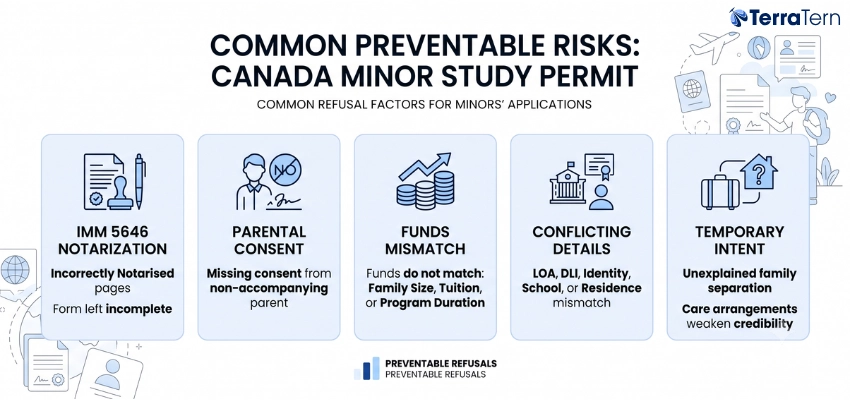
IRCC does not publish ranked refusal data for a study permit for minors in Canada; common preventable risks include:
-
IMM 5646 pages were not notarised correctly or were left incomplete.
-
Missing consent from a non-accompanying parent.
-
Funds mismatched to family size, tuition, or program duration.
-
Conflicting LOA, DLI, identity, school, or residence details.
-
Unexplained family separation or care arrangements weaken credibility and temporary intent.
Key Note: A refused minor application isn't necessarily a weak case it's very often a paperwork-consistency problem that a document review before submission would have caught.
How Can TerraTern Help With Your Child's Canada Study Permit?
TerraTern assesses eligibility for a study permit for minors in Canada.
-
Its team helps sequence Indian and Canadian notarizations correctly.
-
Specialists cross-check names, dates, consent letters, custody records, and IMM 5646.
-
They can help evaluate custodian options, assemble financial evidence, and organise timelines.
-
Book a free eligibility consultation through TerraTern’s Canada study-abroad hub before final submission.
Pro Tip: A specific list of what TerraTern's team checks, custodian eligibility, notarization sequencing, and fund-to-family-size match, reads as expertise. Generic "we can help" copy reads as an ad, and both readers and AI summarizers tend to skip past it.
Also Read: SX-1 Visa Canada: 2026 Expert'ss Guide to Short-Term Study
2026 Industry Context Section
Explanation & best practice: Present as a scannable list with inline source attribution this is prime AI-citation real estate.
-
IRCC targets roughly 408,000 total study permits for 2026, of which 115,000 (over 28%) are reserved for K-12 students a category exempt from both the cap and the PAL/TAL requirement. (Source: IRCC, 2026 provincial and territorial allocations notice, Nov 25, 2025)
-
Proof-of-funds for a single applicant outside Quebec rose to CAD 22,895 effective September 1, 2025, up from CAD 20,635 (set Jan 1, 2024) and more than double the flat CAD 10,000 requirement that stood unchanged for roughly two decades. (Source: IRCC / canada.ca)
-
K-12 students remain exempt from the Provincial/Territorial Attestation Letter (PAL/TAL) requirement under the 2026 Ministerial Instructions, alongside a new exemption for master's/doctoral students at public DLIs (effective Jan 1, 2026). (Source: IRCC)
-
Total international student numbers in Canada fell roughly 33% between 2023 and 2025, per the Canadian Bureau for International Education though the K-12/minor category runs on a separate, uncapped allocation and hasn't seen the same contraction. (Source: CBIE, 2025)
-
Custodianship remains mandatory for any applicant under 17 arriving without a parent or legal guardian (via the notarised MM 5646), while it becomes discretionary and assessed case-by-case from age 17 through the provincial age of majority. (Source: IRCC operational guidelines)
-
Overall, Indian study permit approvals dropped sharply in 2025, even as industry commentary suggests demand for K-12 and boarding-school pathways among Indian families has held comparatively steady. (Source: industry reporting, 2025)
-
Quebec runs its own higher proof-of-funds threshold (CAD 24,617 for a single applicant as of January 1, 2026) and requires a Certificat d'acceptation du Québec (CAQ) in addition to the federal study permit. (Source: MIFI / canada.ca)
Conclusion
Study permit for minors in Canada depend on the province’s age of majority, suitable care, sufficient funds, and consistent documents. Unaccompanied children under 17 need a custodian, while K–12 applicants are PAL/TAL-exempt in 2026. Outside Quebec, the living-cost threshold is CAD 22,895 as of August 10, 2026, plus tuition and transportation. Apply early, coordinate notarizations carefully, and consider a TerraTern review before submitting your child’s application to IRCC online.
Contact TerraTern for more information on the Study Permit for Minors in Canada: 2026 Guide for Parents.




 AI Summary