


Key Highlights
- What are the Canada PR Family Visa Requirements?
- What Is the Canada PR Family Visa and Who Is It For?
- Who Qualifies as a Sponsor for Canada PR Family Visa Requirements?
- Who Can Be Sponsored for Canada PR Under Family Class?
- What Are the Canada PR Family Visa Requirements for Documents?
- What Is the Step-by-Step Canada PR Family Visa Application Process?
- How Long Does Canada Family Visa Processing Take in 2026?
- How Much Does Canada Family Sponsorship Cost From India in 2026?
- What Is the Canada Super Visa and How Does It Differ From Family Sponsorship?
- What are Common Reasons Canada Family Sponsorship Applications Get Rejected?
- What Are the Canada PR Family Visa Requirements for 2026 Updates?
- Conclusion
The Canada PR family visa requirements for 2026 enable permanent residents and citizens to bring family members to Canada based on specific financial, family and health-clearance criteria. This article outlines who is eligible for sponsorship, key eligibility requirements, required documents, costs, and the Canada PR family visa application process so you can be prepared.
What are the Canada PR Family Visa Requirements?
Here are the core Canada PR family visa requirements you must meet to sponsor a family member for permanent residence in 2026. You must be a Canadian citizen or a permanent resident (or an Indian registered under the Indian Act).
-
You must be at least 18 years of age.
-
You must be living in Canada (or an outside Canada citizen who proves you will be in Canada when the sponsored person becomes a permanent resident).
-
You must be earning the low-income cut-off (LICO) for your family and region to demonstrate your ability to support the person you are sponsoring.
-
You must commit to an "undertaking" to support the family member you are sponsoring (usually 3-20 years, depending on the family member being sponsored).
-
You cannot be inadmissible (such as having a criminal conviction, going through bankruptcy or having a previous immigration offence), and you cannot be on social assistance (except if it's for disability).
Also Read: Canada PR Visa: Eligibility, Fees, Processing Time & More
What Is the Canada PR Family Visa and Who Is It For?
The Canada PR family visa (family class sponsorship) allows Canadians and PRs to sponsor family members for Canadian PR status, promoting family reunification in the long run.
-
IRCC officially calls the family-based PR the "Canada family class", which includes spouses, children, parents and a small number of other relatives.
-
It establishes two categories: the Sponsor (a Canadian citizen or PR) and the Sponsored Person (a family member, typically living outside Canada, who becomes a Canada PR).
-
"Canada PR family visa" is not a visitor visa, but the name of the sponsorship program itself.
-
The sponsored person becomes a full Permanent Resident (PR) with all the rights to live, study and work in Canada.
-
For Indian families, where over 1.8 million people of Indian origin live in Canada, understanding Canada PR family visa requirements is essential for family-class sponsorship.
As per TerraTern Expert, Shreya, the Canada family class visa grants full Permanent Residence — not a temporary status,making it one of the most secure pathways for Indian families seeking long-term reunion in Canada.
Who Qualifies as a Sponsor for Canada PR Family Visa Requirements?
You must be a Canadian citizen or permanent resident (PR) aged 18 years or above living in Canada to sponsor your family member for Canadian PR, and also demonstrate your ability to support them. These are some of the fundamental Canada PR family visa requirements for sponsoring members of the family class.
What Are the Income Requirements for Sponsoring Family Members?
The income required to sponsor family members is
-
Spouse/child: No minimum income level, but family relationship and admissibility are primarily considered, unless the eligible child has other dependent children.
-
Parents/Grandparents (PGP sponsorship): The sponsor must demonstrate Minimum Necessary Income (MNI) for 3 consecutive years; for example, approximately CAD 43,082 for a family of 2 (sponsor + 1 sponsored person).
-
Co-Signer: Sponsor's spouse or common-law partner can co-sign to meet the MNI requirement.
-
For Readers in INR: CAD 43,082 is approximately INR 26-28 lakh (depending on the exchange rate), which can provide a reference for Indian families applying for Canada PR family visa requirements..
|
Category |
Typical Income Requirement |
|
Spouse or dependent child |
No minimum income (unless the child has their own children) |
|
Parents / Grandparents (PGP) |
Must meet MNI for 3 years, e.g., ~CAD 43,082 for a family of 2 |
What Is a Sponsorship Undertaking and Why Does It Matter?
A sponsorship undertaking is a binding agreement to support the immigrant so that they are not on social assistance for a period of time.
-
Undertaking periods
-
3 years for a spouse or partner.
-
10 years OR until the child turns 25, whichever comes first.
-
20 years for parents or grandparents.
-
During this period, the sponsor is legally required to repay any government social assistance benefits received by the sponsored person.
-
This should be important for Indian families because the Canada PR family visa requirements include the undertaking as part of their sponsorship.
Important Note: Many Indian applicants overlook the income requirement for parent/grandparent sponsorship. Ensure your Canadian relative has filed CRA tax returns for the past 3 years before beginning the application.
Who Can Be Sponsored for Canada PR Under Family Class?
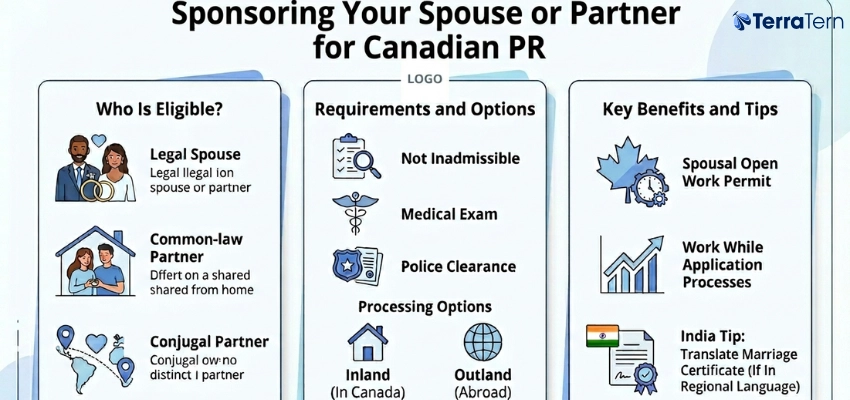
To sponsor a spouse or partner for Canadian PR, the following conditions must be met:
-
Eligible: Legally married spouse; common-law partner (1+ year cohabitation); conjugal partner (1+ year committed relationship with barriers to living together).
-
Requirements: The sponsored person must not be inadmissible; must undergo a medical exam and provide police clearance.
-
Options: Inland (spouse in Canada); Outland (abroad).
-
Benefit: Inland applicants get a Spousal Open Work Permit during processing.
-
India Tip: Certify/translate the marriage certificate if in a regional language.
Can You Sponsor Your Children for Canadian PR?
Sponsor your children for canada pr are
-
Dependent child under 22 and unmarried; or 22+ but financially dependent due to physical/mental condition.
-
Must list child as a dependent, even if not coming to Canada.
-
No income requirement if the child has no dependents of their own.
-
Processing varies by country of residence.
Can You Sponsor Parents and Grandparents for Canada PR?
Sponsor your parents or grandparents for canada pr are
-
PGP program: Paused for new apps; only 2024 submissions processed in 2026 (15,000 cap). No 2026 intake confirmed as of April 2026.
-
Financial: Meet MNI for 3 tax years.
-
Undertaking: 20 years (10 in Quebec).
-
Alternative: Super Visa (see dedicated section).
Who Cannot Be Sponsored Under Canadian Family Class?
Siblings (except orphaned under 18).
-
Aunts, uncles, nieces, nephews (unless "Lonely Canadian" applies).
-
Friends or distant relatives.
-
Anyone inadmissible to Canada.
Expert Tip: Indian families hoping to bring parents to Canada as PRs must wait for the PGP to reopen, but the Super Visa offers a 5-year stay per entry as a practical alternative while waiting.
Also Read: Spouse Visa Canada: Complete Guide to Requirements, Processing Time & Application
What Are the Canada PR Family Visa Requirements for Documents?
Both the sponsor and the sponsored person must submit identity documents, proof of relationship, financial evidence, medical exam results, and police certificates as part of the family sponsorship application under Canada PR family visa requirements.
What Documents Does the Sponsor Need to Submit?
Valid Canadian passport or PR card as proof of status.
-
Proof of citizenship or permanent residence (birth certificate, citizenship certificate, or PR confirmation).
-
CRA Notices of Assessment for the last 3 years (for parent/grandparent sponsorship).
-
Recent pay stubs or employment letter to show financial capacity.
-
Birth certificate (to prove parent–child relationship when needed).
-
Marriage/divorce certificate if sponsoring a spouse or ex-spouse.
-
Completed IRCC sponsorship forms such as IMM 1344 (Sponsorship Agreement), IMM 5481, and IMM 5540.
-
Proof of address in Canada (utility bill, rental agreement, or similar).
-
These documents are core Canada PR family visa requirements for the sponsor’s part of the application.
What Documents Does the Sponsored Person (From India) Need?
Valid passport with at least 6 months' validity beyond the planned travel date.
-
Birth certificate, and marriage certificate (if applicable), apostilled and translated if in Hindi or another regional language.
-
Police Clearance Certificate (PCC) from India issued via Passport Seva Portal or VFS.
-
Medical exam completed by an IRCC-designated physician in India (Delhi, Mumbai, Chennai, etc.).
-
Biometrics submitted at the nearest VFS Canada centre in India.
-
IMM 5645 / IMM 5707 (Family Information Form) and other required IRCC questionnaires.
-
Proof of relationship (photos, communication screenshots, joint bills, shared travel records).
-
Two passport-sized photos that meet IRCC specifications.
-
This packet is essential to meet Canada PR family visa requirements for an Indian-based applicant.
|
Document |
Where to Get It (India) |
Cost (Approx.) |
|
Police Clearance Certificate (PCC) |
Passport Seva Portal / VFS |
INR 500–INR 1,000 |
|
Medical Exam |
IRCC-designated physician |
INR 7,000–INR 12,000 |
|
Biometrics |
VFS Canada Centre |
CAD 85 (~INR 5,100) |
|
Document Translation (per page) |
Certified legal translator |
INR 500–INR 1,500/page |
Expert Advice: A missing or incorrectly translated marriage or birth certificate is among the top reasons Canadian family sponsorship applications are delayed. Always use a certified translator for regional-language documents.
What Is the Step-by-Step Canada PR Family Visa Application Process?
The Canada family sponsorship process involves the sponsor applying to IRCC, followed by the sponsored person submitting their PR application. These are typically submitted together online via the PR Portal as part of the Canada PR family visa application process.
How Does the Sponsor Apply for Family Sponsorship in Canada?
The sponsor who applies for family sponsorship in Canada is
-
Check Eligibility: Confirm you are 18+, a Canadian citizen or PR, residing in Canada or returning, and not inadmissible or bankrupt.
-
Download Application Package: Get the correct forms from IRCC’s portal (ircc.canada.ca) for your category (spouse, child, parent, etc.).
-
Gather Documents: Collect identity, financial, and relationship documents as per the Canada PR family visa application process.
-
Submit Application: Apply online through the PR Portal and pay the sponsorship fee (CAD 75 for most categories).
-
Acknowledgement of Receipt (AOR): IRCC confirms receipt, and processing begins.
How Does the Sponsored Person in India Apply?
Receive sponsorship approval (or apply together): Some streams allow both the sponsor and the sponsored person to submit at the same time.
-
Complete Medical Exam: Visit an IRCC-designated physician in India (Delhi, Mumbai, Chennai, etc.).
-
Collect Police Clearance Certificate: Obtain from Passport Seva Kendra or VFS India.
-
Submit Biometrics: Attend an appointment at a VFS Canada Application Centre.
-
Upload Documents: Submit all required supporting documents via the IRCC PR Portal as part of the Canada PR family visa application process
-
Await Decision: Track application status through IRCC’s online system.
Important Note: Inland and outland applications follow different timelines. If your spouse is already in Canada on a visitor visa, apply inland and request a Spousal Open Work Permit simultaneously, so they can work while they wait for PR.
How Long Does Canada Family Visa Processing Take in 2026?
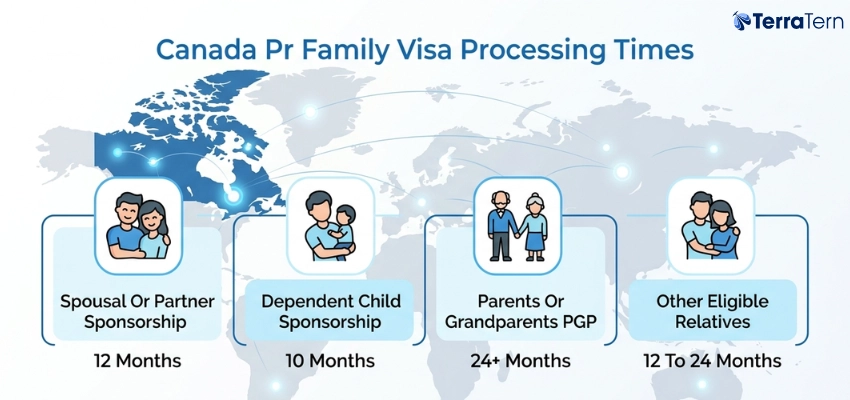
Processing times vary by category: approximately 12 months for spousal/partner sponsorship, 12–24 months for dependent children, 24+ months for parent/grandparent cases, and 12–24 months for other eligible relatives, all under Canada PR family visa requirements.
|
Sponsorship Category |
Approximate Processing Time (2026) |
|
Spouse/Partner (Outland) |
12 months |
|
Spouse/Partner (Inland) |
10-32 months |
|
Dependent Child |
10 months (varies by country) |
|
Parents/Grandparents (PGP) |
24+ months (2024 applicants only) |
|
Other Relatives (Lonely Canadian category) |
12–24 months |
As per TerraTern Expert: Processing times listed by IRCC are targets, not guarantees. Indian applicants should submit complete, error-free applications and respond to any IRCC requests within 30 days to avoid unnecessary delays.
Also Read: Family Information Form Canada: Guide, Tips, Download
How Much Does Canada Family Sponsorship Cost From India in 2026?
The total cost of Canada family sponsorship includes IRCC fees, biometrics, medical exams, and ancillary charges, typically ranging from CAD 1,500–2,500+ (INR 90,000–INR 1,50,000+) per application under Canada PR family visa requirements. Costs scale with the number of family members and translation or courier services.
|
Fee Item |
Amount (CAD) |
Approx. INR |
|
Sponsorship Application Fee |
CAD 75 |
INR 4,500 |
|
Principal Applicant PR Fee |
CAD 475 |
INR 29,500 |
|
Right of Permanent Residence Fee (RPRF) |
CAD 490 |
INR 30,000 |
|
Biometrics (per person) |
CAD 85 |
INR 5,100 |
|
Medical Exam (India, per person) |
CAD 200–350 |
INR 12,000–INR 21,000 |
|
Police Clearance Certificate (India) |
Included in service fee |
INR 500–INR 1,000 |
|
Document Translation (total, multiple pages) |
Variable |
INR 5,000–INR 15,000 |
|
Total (per typical family application) |
CAD 1,500–2,500+ |
INR 90,000–INR 1,50,000+ |
Pro Tip: While IRCC fees are fixed, the highest hidden costs for Indian applicants are document preparation, translation, and multiple VFS visits. Budget at least INR 15,000–INR 30,000 for these ancillary expenses.
What Is the Canada Super Visa and How Does It Differ From Family Sponsorship?
The Super Visa is a temporary multi-entry visa letting parents and grandparents of Canadian citizens and PRs stay in Canada for up to 5 years per entry, while family sponsorship leads to full permanent residence; in 2026–27, the Super Visa is a convenient alternative that still fits within broader Canada PR family visa requirements-related planning for Indian families.
|
Feature |
Super Visa |
PGP (Family Sponsorship) |
|
Status granted |
Temporary Resident |
Permanent Resident |
|
Stay duration |
Up to 5 years per visit |
Indefinite (with PR status) |
|
Validity |
Up to 10 years, multiple entries |
Permanent (no expiry as long as PR is maintained) |
|
Processing time |
Faster (~8–12 weeks) |
24+ months (for PGP 2024 applicants) |
|
Income requirement |
Yes (must meet LICO with sponsor) |
Yes (MNI for 3 years) |
|
Health insurance |
Must have CAD 100,000+ coverage |
Not required |
|
Currently available (2026–27) |
Yes |
PGP paused (only 2024 intake being processed) |
|
Path to citizenship |
No |
Yes (after 3 years of PR residency) |
As per TerraTern Expert Divyansh, for Indian families hoping to bring parents right now, the Super Visa is the fastest and most certain option. It doesn't grant PR but allows your parents to live in Canada for 5 continuous years while you await PGP reopening.
What are Common Reasons Canada Family Sponsorship Applications Get Rejected?
Common rejection reasons for Canada PR family visa requirements include failing income tests, incomplete docs, unproven relationships, inadmissibility, or sponsor defaults.
-
Insufficient Income: Miss MNI, common for parents/grandparents.
-
Incomplete Docs: Missing translations, expired medicals, and unsigned forms.
-
Ungenuine Relationship: Weak spousal/partner proof.
-
Inadmissible Sponsored Person: Medical, criminal, and misrepresentation issues.
-
Disqualified Sponsor: Prior default, bankruptcy, or removal order.
-
Misrepresentation: False info anywhere.
-
IRCC Non-Response: Missed doc request deadlines.
-
India Pitfall: Common India-specific pitfalls include using uncertified regional-language translations, submitting an incomplete PCC, or submitting medical exam results that have passed their 12-month validity.
Pro Tip: Relationship genuineness is the most scrutinised factor in spousal sponsorship. Indian couples should prepare extensive evidence: photos across years, communication records, joint financial documents, and a personal statement explaining the relationship timeline.
Also Read: Spouse Visa Canada Requirements & Process
What Are the Canada PR Family Visa Requirements for 2026 Updates?
Key 2026 updates for Canada PR family visa requirements: PGP paused, 15,000 from 2024 cap processed, Super Visa primary for parents. (26 words)
-
PGP Paused (2026): No new apps; 2024 only (Canada Gazette, Jan 2026).
-
15,000 Cap: Processed in 2026 (immigration.ca, Jan 2026).
-
2026 Invites: 17,860 from 2020 pool, July 28 start (canadavisa.com, July 2025.
-
Super Visa Open: The Super Visa remains open in 2026, allowing parents and grandparents to stay for up to 5 years per visit, with extensions of up to 2 additional years available.
-
Levels Plan: Canada's 2026 Immigration Levels Plan allocates approximately 24,500 places for the Parents and Grandparents Program, decreasing to approximately 21,500 in 2027. Canada's total immigration target across all programs remains approximately 395,000 in 2026.
-
Spousal Time: ~12 months outland; stricter checks.
-
India Trend: 1.8M+ Indians; top family category.
Conclusion
Navigating Canada PR family visa requirements requires proof of a genuine relationship, MNI compliance, and full documentation, including translations/PCC, for Indians. PGP paused; Super Visa key alternative. Spousal processing ~12 months amid stricter scrutiny. Track IRCC for 2026 invites. Consult experts to avoid rejections and successfully reunite families
Contact TerraTern for more information on Canada PR Family Visa Requirements: Complete 2026 Guide.




 AI Summary