


Key Highlights
- What Is a Canada International Students Visa?
- What Are the International Student Visa Requirements for Canada?
- How Much Bank Balance Is Required for a Canada Student Visa
- How to Get a Canada International Student Visa? Step-by-Step Process
- How Long Does a Canada Student Visa Take to Process from India?
- Why Do Canada Student Visas Get Rejected for Indian Students?
- What Happens After You Get Your Canada International Students Visa?
- 2026 Industry Context Section
- Conclusion
The most common steps for obtaining a Canadian international student visa are related to the study plan, proof of funds, a Letter of Acceptance (LOA), and a passport. Other requirements for the international student visa for Canada include an online application and proof of funds, at least the cost of tuition and living expenses. To begin how to get Canada international students visa, the first step that you need to take is to determine your eligibility for your program and then compile all the documents accordingly and fill out the study permit application carefully.
What Is a Canada International Students Visa?

The Canada international students visa is:
-
The official IRCC document that allows International students (or students of Indian origin) to pursue studies at a Canadian Designated Learning Institution (DLI).
-
A Temporary Resident Visa (TRV) or Electronic Travel Authorization (eTA) may be required in addition to your Study Permit, depending on your passport-issuing country.
-
A TRV or an eTA is a temporary visa to enter Canada, and may be required in addition to an SPP depending on whether your country requires a TRV or is eTA-eligible , depending on your passport country.
-
Most Indian students receive a combined Study Permit and TRV, which together authorize both study status and entry into Canada.
-
A Designated Learning Institution (DLI) is a school, college, or university that is authorized to accept students from any country other than Canada.
Pro Tip: A confirmed university admission doesn't guarantee visa approval; the Study Permit and the TRV/eTA are separate approvals, and missing either one prevents legal entry to Canada.
Also Read: Does Canada Accept PTE for Student Visa? Latest Guide
What Are the International Student Visa Requirements for Canada?
The main international student visa requirements for Canada are a Letter of Acceptance from a DLI, proof of funds to cover tuition and living expenses (2 people CAD 28,502; 3 people CAD 35,040; 4 people CAD 42,543, for living expenses, a Provincial Attestation Letter, a spoken and written language test, and a character and health test. Meeting these requirements will result in a successful Canadian international student visa.
What Documents Do You Need for a Canada Student Visa?
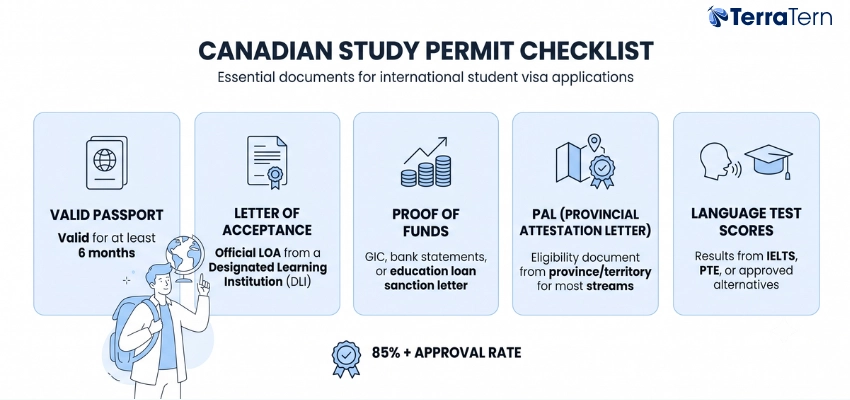
Documents required are a Letter of Acceptance (LOA), valid passport, proof of funds, PAL, language test results, a Statement of Purpose (SOP), medical examination (if needed), and Police Clearance Certificate. For international students to obtain a Canadian visa, have these prepared for your Canadian visa application:
-
Valid Passport: Must be valid for at least 6 months.
-
Letter of Acceptance: Letter of acceptance from a DLI.
-
Proof of Funds: With the GIC/Hooked up bank statements or an education loan sanction letter.
-
Study Permit: Denotes a document issued by a province or territory confirming eligibility to study in that province or territory, which would be required for most study permit streams.
-
Language Test Scores: IELTS or PTE results, or results from an approved 'alternative to IELTS' system.
- Passport Photos: Recent, appropriate photographs that meet IRCC visa requirements.
-
Medical Exam Report: Must have if holding a visa granted by a “designated” country and living there for six months or more.
-
Police Certificate: Issued by the police authority if specified by the processing officer for the visa.
How Much Bank Balance Is Required for a Canada Student Visa
As per the IRCC requirement for students as of 2026, Indian students are required to prove the tuition fees for the first year along with a minimum of 2 people CAD 28,502; 3 people CAD 35,040; 4 people CAD 42,543, as living expenses (as of 2026). Securing this bank balance is one of the most critical international student visa requirements for Canada to finalize your international student visa for Canada.
Accepted Sources of Funds:
-
Guaranteed Investment Certificate (GIC): Highly recommended and necessary for SDS applications.
-
Personal Savings: Should be kept in the account for at least 3- 6 months.
-
Education Loan: A sanction letter from a recognized financial institution.
-
Parent/Sponsor Income: Evidence that parents/sponsors have been consistently earning income and saving money (official records).
Note: The living expense threshold has been significantly increased, with the plan to make the new regulations almost double the previous year's (pre-2024) living expense threshold, effective from September 2025. The cost of living for 2026 is currently at a minimum of:
|
Location |
Minimum Funds Required (1 Student) |
Additional Notes |
|
Outside Quebec |
2 people CAD 28,502; 3 people CAD 35,040; 4 people CAD 42,543, |
Increases significantly per accompanying family member. |
|
Within Quebec |
CAD 15,508 |
Requires a CAQ first, plus an extra CAD 500 in settlement funds. |
Is IELTS Mandatory for a Canadian International Student Visa?
IRCC does not mandate a minimum IELTS score for the Study Permit, but nearly all Canadian universities and colleges require an IELTS score of 6.0-7.0, depending on the program level. Navigating this distinction is a vital part of the international student visa requirements for Canada for your Canada international students visa.
Typical IELTS Requirements by Program Level:
|
Program Level |
Minimum Overall Band |
Minimum Section Score |
|
College Diplomas |
6.0 |
No band less than 5.5 |
|
Undergraduate (UG) Degrees |
6.0 - 6.5 |
No band less than 6.0 |
|
Master's & Post-Grad Degrees |
6.5 - 7.0 |
No band less than 6.0 |
What Is a Provincial Attestation Letter (PAL) and Do You Need One?
A PAL is a mandatory provincial confirmation letter required for most study permit applications since 2024, with a 2026 exemption for Master's and PhD students at public universities. Obtaining this letter has become one of the most strictly enforced international student visa requirements for Canada to secure a Canada international students visa.
Key PAL Guidelines:
-
Who Needs It: Undergraduates, college diploma seekers, and certificate students must secure a PAL.
-
Who Is Exempt: Graduate degree students (Master's and PhDs) attending public universities are exempt. Private college students or those pursuing post-graduate diplomas generally still require one.
-
Timing Implications: You cannot apply directly to the province; your Designated Learning Institution (DLI) submits the application on your behalf. This process can add 2 to 6 weeks to your overall timeline, making early application planning essential.
Key Note: The PAL exemption applies only to genuine degree-granting graduate programs at public universities; graduate diplomas and certificates at private colleges still require a PAL, a distinction many students overlook until their application stalls.
Also Read: Architecture Universities in Canada: Programs, Fees & Admission
How to Get a Canada International Student Visa? Step-by-Step Process
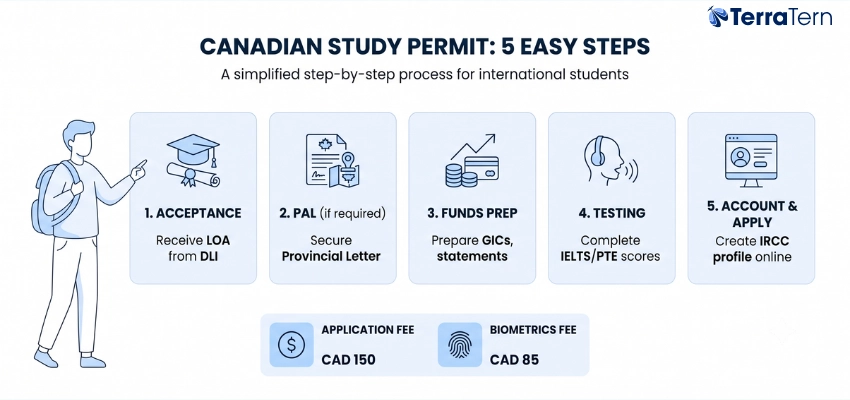
To get a Canadian international student visa, secure a DLI offer letter, obtain a PAL if required, arrange proof of funds, complete the IRCC online application, provide biometrics, and await processing through the standard stream. Following a clear timeline is critical, especially when planning how to get a Canada international students visa for a competitive fall start.
1. Step-by-Step Process
-
Get accepted by a DLI: Receive your Letter of Acceptance from an approved Canadian school.
-
Secure Your PAL If Required: Some students need a Provincial Attestation Letter before applying.
-
Prepare Proof of Funds: Use GICs, bank statements, loan letters, or sponsor documents.
-
Complete Language Testing: Take IELTS, PTE, TOEFL, or another accepted test.
-
Create Your IRCC Account: Carefully fill out the study permit application online.
-
Pay the Required Fees: The study permit fee is CAD 150, and the biometrics fee is CAD 85.
-
Give Biometrics: Visit your nearest Visa Application Center when instructed.
-
Track Your File: Respond quickly to any extra document requests.
-
Receive Your Approval Letter: You will get a Port of Entry Letter of Introduction.
-
Get Your Study Permit in Canada: The physical permit is issued upon arrival at the port of entry.
2. September Intake Timeline
-
January to March: Shortlist programs, take IELTS/PTE/TOEFL, and apply to DLIs.
-
March to May: Receive LOAs, secure PAL if needed, and organize finances.
-
May to June: Submit the study permit application and complete biometrics.
-
June to August: Monitor processing and respond to any IRCC requests.
-
August to September: Travel after approval and collect your study permit on arrival.
As per TerraTern Expert: Begin gathering financial documents the moment you receive your LOA. The most common cause of delay isn't the IRCC queue; it's incomplete proof-of-funds documentation submitted at the last minute.
How Long Does a Canada Student Visa Take to Process from India?
Multiple April 2026 IRCC updates show processing has dropped dramatically to approximately 3 weeks (down from 4 weeks) for Indian study permit applicants, with longer waits during the peak November-January application season. If you are researching how to get a Canada international students visa quickly, it is important to know that the fast-track Student Direct Stream (SDS), which once promised 20-day processing, was officially closed in late 2024. Today, all applications go through the standard stream. To avoid intake deferrals, you should submit your application 3 to 4 months before your intended start date.
|
Application Type |
Average Processing Time (2026) |
Important Notes |
|
Standard Study Permit (from India) |
8 - 12 Weeks |
High volume during summer pushes timelines toward 12 weeks. |
|
Study Permit Extensions (In-Canada) |
4 - 6 Weeks |
Must be filed before your current permit expires. |
|
Biometrics Update |
1 - 2 Weeks |
Processing does not begin until biometrics are submitted. |
Expert Advice: With SDS gone, the only real lever students have over processing speed is application completeness; a flawless first submission avoids the multi-week delays caused by document requests.
Why Do Canada Student Visas Get Rejected for Indian Students?
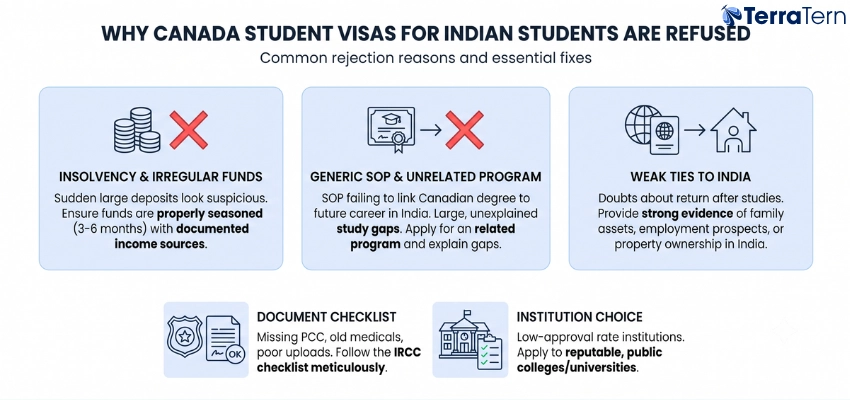
The most common reasons for rejection are insufficient proof of funds, a weak Statement of Purpose, unclear ties to India, and applications to unrecognized or low-approval-rate institutions. Understanding these pitfalls is essential when figuring out how to get a Canada international student visa approved on the first try. Here is what triggers a refusal and how to fix it:
-
Insufficient or Inconsistent Funds: Sudden, unexplained large deposits look suspicious. Fix: Ensure funds are properly seasoned for 3-6 months and provide clear documentation of the income source.
-
Generic Statement of Purpose (SOP): Failing to explain why this specific program in Canada makes sense for your career. Fix: Write a customized, highly specific SOP linking the Canadian degree to distinct job opportunities back home.
-
Weak Ties to Home Country: The officer doubts you will leave Canada after your studies. Fix: Provide strong evidence of family assets, future employment prospects in India, or ongoing property ownership.
-
Inconsistent Academic History: Large study gaps without a valid explanation, or applying for a program unrelated to past studies. Fix: Address gaps head-on in your SOP with evidence of work experience or skill-building during that time.
-
Incomplete Documentation: Missing police clearances, out-of-date medical exams, or unreadable PDFs. Fix: Follow the IRCC document checklist meticulously and ensure all uploads are clear.
-
Choice of High-Risk DLI: Applying to institutions with historically low approval rates under the new cap system. Fix: Stick to reputable, public universities or well-established colleges with transparent graduation outcomes.
Important Note: A rejection is rarely about a single fatal flaw; it's usually two or three minor inconsistencies across funds, SOP, and academic history that compound into a refusal that officers can point to.
What Happens After You Get Your Canada International Students Visa?
Once approved, students can work up to 24 hours per week off campus during their studies, apply for a Post-Graduation Work Permit (PGWP) after completing an eligible program, and pursue Permanent Residency pathways such as Express Entry. Knowing how to get a Canada international students visa is just the beginning of a broader immigration journey. Your study permit unlocks several long-term benefits:
-
Work Rights During Study: You are legally allowed to work off-campus for up to 24 hours per week during regular academic terms and full-time during scheduled breaks (like summer holidays).
-
Post-Graduation Work Permit (PGWP): Upon graduation from an eligible DLI program (minimum 8 months), you can apply for an open work permit. A 2-year academic program typically qualifies you for a 3-year PGWP.
-
Pathways to PR: Canadian education and work experience grant significant points in the Express Entry pool, especially under the Canadian Experience Class (CEC) or targeted Provincial Nominee Programs (PNPs).
Expert Tip: Choosing a PGWP-eligible program from the outset isn't optional if PR is part of your plan. Verify your program's PGWP eligibility before accepting any offer, not after.
2026 Industry Context Section
Canada has tightened its 2026 international student visa policy by lowering the national study permit cap, closing the fast-track stream, and raising financial proof requirements.
-
Study permit cap set at 408,000 for 2026, down from 437,000 in 2025 and 485,000 in 2024
-
Student Direct Stream (SDS) permanently closed in November 2024; all Indian applicants now use the Regular Stream
-
Minimum proof of funds raised to 2 people CAD 28,502; 3 people CAD 35,040; 4 people CAD 42,543 (effective September 2025), more than double pre-2024 levels
-
Provincial Attestation Letter (PAL) is now mandatory for most applicants, with a new exemption for Master's/PhD students at public universities (2026 update)
-
Off-campus work hours are permanently set at 24 hours/week (made permanent in late 2024, no longer a temporary pandemic-era rule)
-
Standard processing time currently running 8-12 weeks from India, with seasonal slowdowns Nov-Jan
-
Visa application centre/biometric fees remain CAD 150 (study permit) + CAD 85 (biometrics)
Important Tip: Students relying on guidance from before late 2024 are working from outdated assumptions about SDS eligibility and fund requirements; always verify against IRCC's current published figures before applying.
Conclusion
A Canadian international student visa is best understood as a study permit backed by the right documents, financial proof, and timely application steps. For Indian students, success depends on choosing a DLI, securing a PAL if needed, and submitting a strong file well before intake. With careful planning, the process becomes manageable and opens a clear path from studying in Canada to work opportunities and future immigration.
Contact TerraTern for more information on the Canada International Students Visa Guide 2026: Requirements & Process.




 AI Summary