


Key Highlights
- What Is a Spouse Visitor Visa Canada?
- Who Is Eligible for a Latest Spouse Visitor Visa Canada from India?
- What Current Documents Are Required for Spouse Visitor Visa Canada?
- How to Apply for the Latest Spouse Visitor Visa Canada from India: Step-by-Step Process
- What Is the Spouse Visitor Visa Canada Processing Time from India in 2026?
- How Much Does a Current Spouse Visitor Visa Canada Cost?
- What Is the Difference Between Spouse Visitor Visa and a Spousal Sponsorship in 2026?
- How to Write a Current Invitation Letter for Spouse Visitor Visa Canada?
- What Is Dual Intent, and How Does It Affect a Spouse Visitor Visa Canada Application?
- What Are the Current Common Reasons for Spouse Visitor Visa Canada Rejection?
- Can My Spouse Work on a Visitor Visa in Canada?
- How Long Can My Spouse Stay in Canada on a Visitor Visa?
- What Is Dual Intent for Spouse Visitor Visa Canada?
- What Are the Latest Changes to Spouse Visitor Visa Canada Rules in 2026?
- Current Tips for Increasing Your Spouse's Visitor Visa Canada Approval Chances
- How Can TerraTern Help With a Spouse Visitor Visa Canada?
- What Are the Visa Fees for a Spouse Visitor Visa Canada from India?
- How Long Can a Spouse Stay in Canada on a Visitor Visa?
- 2026/2026 Industry Context Section
- Conclusion
A spouse visa for Canada in 2026 is a temporary regular visitor visa granted to a spouse of a person currently residing in Canada (PR, work permit, study permit or citizenship) who has strong ties to India and will return to India after the trip. In the case of Indian applicants, it involves a temporary resident visa (TRV) application to Canada, proof of a genuine marriage, proof of financial capacity (of either you or your spouse in Canada), of a short term family visit, a marriage certificate, photos, a sponsorship invitation letter, proof of work in Canada or PR, and proof of work and financial status in India and evidence of family ties in India.
Applications to the 2026 rules are challenging and must take into account both emotional considerations for reunion and the fact that you may be considered 'at risk' of being refused due to weak ties to your home country, where your spouse is planning or has applied for PR sponsorship.
What Is a Spouse Visitor Visa Canada?
Let's take a closer look at the meaning of a “Spouse Visitor Visa Canada", step-by-step:
-
This is a Canada visitor visa (temporary resident visa), not a PR visa or “spouse sponsorship” visa, if the husband or wife wishes to visit the husband/wife in Canada (as a citizen, PR, worker, or student).
-
The purpose is not to settle here permanently, but rather to "temporarily reunite" as in a family visit or short-term stay, typically not more than six months duration at any given time.
-
The spouse will still be required to be at least a normal visitor visa applicant; that is, they would be able to depart Canada at the end of their visit, having enough funds and posing no security or immigration threat.
-
The documents submitted in the application (status proof, job, income, and invitation letter) are from the Canadian-based spouse, and the application is made for a VISITOR visa, not for PR.
-
In certain cases (such as when a spouse is already a PR applicant), the spouse's visa may be processed sooner or granted if they apply for an open work permit from within Canada, which depends on IRCC's current policies.
Expert Advice: A spouse visitor visa is not a path to permanent residence, Indian applicants often conflate TRV with spousal sponsorship. Clarifying this distinction upfront reduces refusals caused by poorly framed applications.
Who Is Eligible for a Latest Spouse Visitor Visa Canada from India?
The applicant and the sponsor should be eligible, and they should satisfy the IRCC requirements regarding identity, authentic relationship, financial dependability,y and adherence to the immigration laws in Canada.
Applicant (Spouse) Eligibility Requirements
Your husband or wife should satisfy them.
They must have:
-
A valid passport
-
Definite intention to abandon Canada during the visit.
-
Adequate financial resources.
-
No criminal record
-
No immigration violations
-
Evidence of an authentic relationship.
They may also need:
-
Medical exam (in some cases)
-
Certificate of police clearance.
Sponsor (Canadian Citizen/PR) Requirements
The sponsor should be able to satisfy the minimum requirements.
They must:
-
Be a permanent resident of Canada or a citizen.
-
Be at least 18 years old.
-
Demonstrate the capacity to assist the visiting spouse.
-
Issue an invitation letter.
-
Show evidence of legality in Canada.
Also Read: Spouse Open Work Permit Canada: Latest Experts Guide
What Current Documents Are Required for Spouse Visitor Visa Canada?
The most important aspect of Canada visitor visa for a spouse from India approval is in the documents. Prior to submitting, make it clear and accurate, and make all the files in a logical order, to avoid postponement or rejection.
Applicant (Spouse) Document Checklist
You should not leave out the following.
-
Valid passport
-
IMM 5257 application form
-
IMM 5645 family information form
-
Passport-size photographs
-
Marriage certificate
-
Proof of relationship
-
Bank statements (last 6 months)
-
Granting of employment or income documentation.
-
Travel history documents
-
Biometrics receipt
-
Cover letter (highly recommended)
Sponsor (Canadian Spouse/PR) Document Checklist
Your Canadian husband or wife must supply:
-
PR card or citizenship certificate.
-
Government-issued ID
-
Invitation letter
-
Proof of income
-
Pay slips or Notice of Assessment.
-
Bank statements
-
Proof of residence in Canada
-
Relationship proof
How to Prove Your Relationship for Spouse Visitor Visa Canada
IRCC ensures relationship authenticity is checked. There is one thing to keep in mind before listing the Canada visitor visa for a spouse from India documents. Quality is better than quantity.
Strong proof includes:
-
Marriage certificate
-
Wedding photographs
-
Photos from the various years.
-
Joint bank accounts
-
Insurance policies
-
Travel tickets together
-
WhatsApp or call logs (20–30 pages)
-
Social media screenshots
-
Affidavits from family
-
Gift acknowledgements or parties.
It is better not to send hundreds of similar photos.
Also Read: Canada IELTS Band Requirements for Indians: Updated
How to Apply for the Latest Spouse Visitor Visa Canada from India: Step-by-Step Process
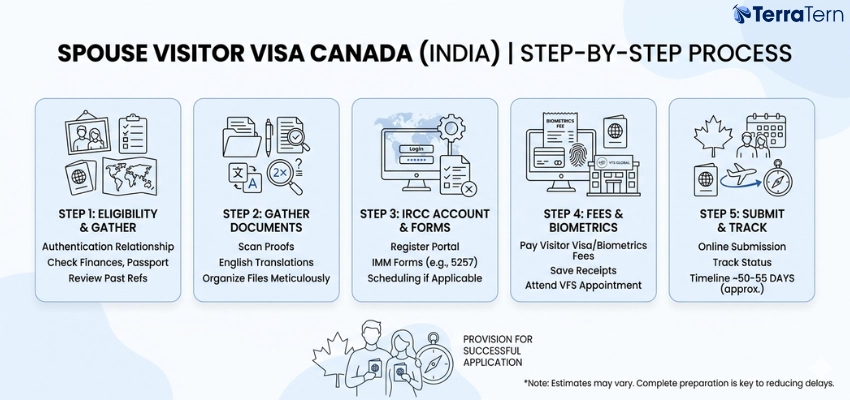
Application to the spouse visitor visa Canada from India is largely done online using the IRCC portal. The process to be applied successfully is summarised below and is incredibly straightforward.
Step 1 – Verify Eligibility and Gather Information
Before applying:
-
Authenticate relationship status
-
Review finances
-
Check passport validity
-
Identify any past refusals.
Step 2 – Collect and Organise All Required Documents
Prepare all the documents ahead of time.
Ensure:
-
Clear scans
-
In case of need, the English translations.
-
Proper file names
-
Logical order
Step 3 – Create an IRCC Online Account
Use the IRCC portal.
You will:
-
Register with email
-
Create login credentials
-
Open the application dashboard.
Step 4 – Complete Online Application Forms
Forms include:
-
IMM 5257
-
IMM 5645
-
Schedule 1 (if applicable)
-
Double-check every answer.
Step 5 – Pay Application Fees and Biometrics Fee
Fees are paid online:
-
Visitor Visa Fee: CAD 100
-
Biometrics Fee: CAD 85
Save the payment receipt.
Step 6 – Submit Biometrics at VFS Global Centre
After submission:
-
Book an appointment at VFS
-
Give fingerprints and a photograph.
-
Biometrics are valid for 10 years.
Step 7 – Submit Application and Track Status
You can track via:
-
IRCC account
-
Email notifications
-
Processing normally requires between 50 and 55 days.
What Is the IRCC Application Process for Indian Spouses?
-
Sign up for an IRCC account and begin an application for a visitor visa. Open an IRCC account and begin to apply for a visitor visa online.
-
Complete forms, upload documents and pay visa + biometrics fees.
-
Get the biometrics instruction letter (BIL) via e-mail.
-
Give biometrics at a VAC in India within 30 days.
-
Monitor status and provide a passport upon approval.
Where can Indian Applicants Give Biometrics for a Canadian visa?
-
Biometrics are given at VFS‑run Visa Application Centres (VACs).
-
Usually, these are markets at the major locations, such as Delhi, Mumbai, Ahmedabad, Bengaluru, Chandigarh, Jalandhar, Chennai, Hyderabad, Kolkata and Pune (Check the latest list).
-
Appointments are required; bring BIL, passport and fee receipt.
What Is the Spouse Visitor Visa Canada Processing Time from India in 2026?
What is the spouse visitor visa Canada processing time? The time required to process is dependent on the method.
Here is the latest data.
-
Online Applications: 50–55 days
-
Paper Applications: 60–65 days
-
Peak Season: +7–10 days
Factors affecting spouse visitor visa Canada processing time:
-
Document completeness
-
Background checks
-
Relationship verification
-
Travel history
-
Seasonal volume
Processing Time by Application Method (2026)
Processing of the spouse visitor visa Canada takes different times based on the type of application and the season of the year. The fastest and most reliable is online applications.
Online Application: 50–55 days
Recommended and quickest option.
Paper Application: 60-65 days.
Manually processed and, therefore, slower.
Fast-Track Pilot Program: 25-30 days.
Only eligible applicants are allowed.
Peak Season (May- August): Bonus 7-10 days.
The increased application volume brings about delays.
Current Factors That Affect Your Processing Time
The decision on your Canada visitor visa for your spouse from India can be accelerated or slowed down by a number of factors.
Key factors include:
-
Wholeness and integrity of application.
-
Validity and transparency of required papers.
-
Security checks and background checks.
-
Application volume on a seasonal basis.
-
Availability of biometrics appointment at VFS.
-
IRCC demand of other documents.
-
History of travelling or visiting visas.
-
India-specific verification requirements.
How to Track Your Latest Spouse Visitor Visa Application Status
Once your spouse's visitor visa Canada application is submitted, you can monitor the application.
Steps to track:
-
Log in using your IRCC / GCKey account.
-
Use your application number.
-
Status updates: Check submitted, in progress, decision made.
-
Allow e-mail notifications on updates.
-
Only contact IRCC when the processing is beyond the normal timelines.
How Much Does a Current Spouse Visitor Visa Canada Cost?
The approximate cost of a spouse visitor visa Canada 2026 India is CAD 185 per person, which comprises CAD 100 visa fee + CAD 85 biometrics. There are optional VFS and service fees.
Cost Overview (Mandatory vs Optional)
-
Compulsory Government Charges: Visa + biometrics.
-
Additional Charges: VFS services, courier, translations, medicals (when requested)
Also Read: Canada Unveils New Rules for Canada Immigration to Welcome Diverse Talent
Complete Fee Structure for Spouse Visitor Visa in 2026
|
Fee Type |
Amount (CAD) |
Amount (INR approx.) |
Notes |
|
Visitor Visa Fee |
$100 |
₹6,200 |
Per person |
|
Biometrics Fee |
$85 |
₹5,270 |
Valid 10 years |
|
VFS Service Charge |
Variable |
₹2,000-3,500 |
India-specific |
|
Document Translation |
Variable |
₹500-2,000 per doc |
If needed |
|
Medical Exam |
Variable |
₹8,000-12,000 |
If required |
|
Police Certificate |
Variable |
₹500-1,500 |
If required |
|
Courier Service |
Variable |
₹500-1,000 |
Optional |
Payment Methods and Processing
Payment methods are:
-
Available Methods: Credit/debit card, international.
-
Currency: Payments made in CAD; the bank will convert to INR.
-
Check: When submitting the application online
-
Receipt: IRCC generated- save-except records.
-
Payment Failure: Application not submitted until successful.
-
Refund Policy: Government fees cannot be refunded in case of rejection.
What Is the Difference Between Spouse Visitor Visa and a Spousal Sponsorship in 2026?
A spouse visitor visa Canada gives a temporary visa of up to 6 months without work rights, whereas spousal sponsorship is a pathway to permanent residence with PR status, work rights, and health facilities upon approval.
Key Difference at a Glance
-
Visitor visa = short-term reunion.
-
Permanent settlement = spousal sponsorship.
Visitor Visa vs. Spousal Sponsorship: Latest Complete Comparison
|
Aspect |
Spouse Visitor Visa |
Spousal Sponsorship |
|
Purpose |
Temporary visit |
Permanent immigration |
|
Processing Time |
50-55 days |
8-12 months |
|
Cost |
CAD $185 |
CAD $1,080+ |
|
Stay Duration |
Up to 6 months |
Permanent |
|
Work Rights |
Not allowed |
Allowed upon approval |
|
Healthcare |
Not covered (insurance needed) |
Covered after PR |
|
Intent to Stay |
Must leave Canada |
Intent to remain permanently |
|
Renewal |
Can extend/reapply |
Not needed (PR status) |
|
Best For |
Short visits, testing life in Canada |
Long-term immigration goals |
Can You Apply for Both a Visitor Visa and a Spousal Sponsorship?
IRCC does permit dual intent.
-
A visitor visa assists spouses to rein reunitinge the PR is being processed.
-
Must is obviously ready to walk out of Canada in case of a visitor status lapse.
-
Report abuse or intention to abuse the PR application.
-
Time balance to prevent conflicts or rejections.
How to Write a Current Invitation Letter for Spouse Visitor Visa Canada?
A letter of invitation is a letter signed by the Canadian spouse that states what the visit is about, where the stay will be, how the visit will be financed, and that he or she will be adhering to the visa regulations.
Essential Elements of a Strong Invitation Letter
Elements of a strong invitation letter are:
-
Full name, address, and status of the sponsor in Canada.
-
Full particulars of spouse (according to the passport)
-
Relationship and marriage information.
-
Clear purpose of visit
-
Precise dates and times of travel.
-
Accommodation details
-
Financial support statement.
-
Details of the job and the income of the sponsor.
-
Assurance of return to India
-
Contact information, date, and signature.
Invitation Letter Format and Tone Guidelines
Write in the formal format of a business letter.
-
Professional, clear, and factual tone.
-
The first person (from the sponsor) has been used.
-
1–2 pages maximum
-
Signed (digital signature accepted) typed.
-
Include a copy of the status, employment, and address.
Common Invitation Letter Mistakes to Avoid
Invitation letter mistakes to avoid are:
-
Generic or vague wording
-
Missing travel dates
-
None of the financial support explanations.
-
Informal or emotional tone
-
Unrealistic stay duration
-
No proof of ties to India
-
Typos, omission of date, and signature.
What Is Dual Intent, and How Does It Affect a Spouse Visitor Visa Canada Application?
-
If you are looking to visit Canada for a short period, you may also want to apply for permanent residency.
-
This is acceptable with spouse visa applications to Canada, so the refusal of a visa application for a spouse does not mean that PR plans are also rejected.
-
Even if it isn't approved or is delayed, the officer still needs to be sure that you will leave Canada on time.
-
It is important to have strong ties to India: employment, business, property, family commitments, studies, or other commitments.
-
An explicit temporary reason is helpful, for example, short visits to your spouse, family visits, etc., while you are waiting for PR.
-
Even if dual intent is permitted, poor documentation, poor plans or poor proof of tie may result in refusal.
-
The dual intent alone does not confer work rights or study rights.
How Should Indian Applicants Address Dual Intent in Their Visa Application?
-
There is dual intent, which is being able to have two plans: temporarily stay in Canada and also apply for permanent residence at the same time.
-
Make it clear in your application that the visit is temporary and that you will leave Canada if you are refused or your application for PR is not ready.
-
Demonstrate a very strong connection with India, including employment, business, property, family obligations, or current studies.
-
Consistency of documents and explanation; don't imply you will remain in Canada regardless of the situation.
-
Write a brief letter, giving information about your situation, your spouse in Canada and understandings about Canadian visa requirements.
-
If you are already sponsored by a PR, say so, as you would be, but still demonstrate that you are a real visitor.
Pro Tip: Dual intent is not a loophole - it's a legal right. Indian applicants with pending spousal sponsorship should proactively disclose it in their cover letter rather than hoping officers won't notice; transparency strengthens credibility.
What Are the Current Common Reasons for Spouse Visitor Visa Canada Rejection?
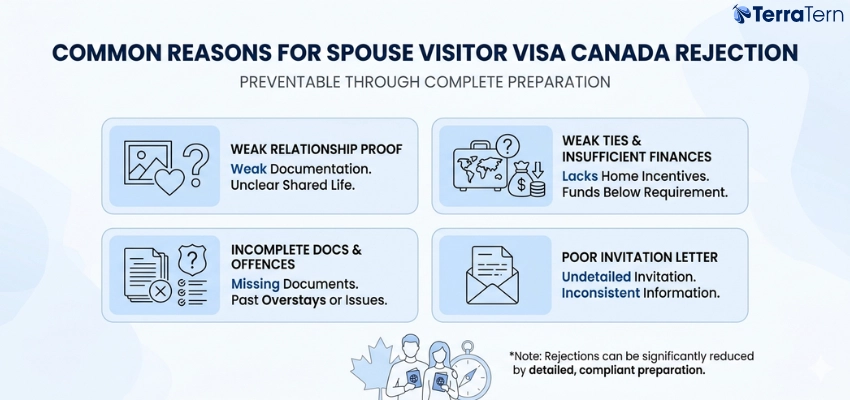
Rejections can be avoided by preparation. Common reasons include:
-
Weak proof of the relationship
-
Weak ties to India
-
Insufficient finances
-
Incomplete documents
-
Past immigration offences.
-
Poor invitation letter
-
Inconsistent information
Insufficient Proof of Relationship
Arises where there is scanty evidence of marriage or relationship.
-
Essential missing is marriage certificate, a limited number of photos, and no history of communication.
-
It is more of quality than quantity- documents must be similar and verifiable.
-
The red flags comprise recent marriages that lack any history.
-
Enhance evidence using images, conversations, call history, shared accounts, and history.
-
The chronological arrangement of evidence is used to demonstrate the progression of relationships.
Weak Ties to Home Country (India)
Ties refer to reasons the applicant is going back to India.
-
Strong relationships comprise work, ownership of a business, or study obligations.
-
Ownership of property or renting further provides credibility.
-
Family issues (parents, children) are significant pointers.
-
Financial connections: bank accounts, investments, and EMIs that are still running.
-
Clarify the current connections with the use of letters, documents, and explanations.
Inadequate Financial Resources
No strict minimum; however, funds should be enough to travel and stay.
-
The finances of the applicant and sponsor are both taken into consideration.
-
Constant bank balance and a history of income are more than one-time deposits.
-
Bank statements, salary slips, and ITRs are necessary.
-
The case is fortified with the financial support letterfrom they sponsor.
-
Be clear on how things will be managed in terms of expenses.
Previous Immigration Violations or Overstay
Credibility can be influenced by past refusals or overstays.
-
Some of the violations are overstaying, illegal working, or misrepresentation.
-
Never conceal past rejections.
-
Provide supporting documents, where necessary, to expound on past problems.
-
Time is a factor in adherence to post-violations.
-
The possibility of refusal is minimised by transparency.
Incomplete or Inaccurate Application
Absence of forms or documents is likely to result in rejection.
-
Disagreement in the information in the form and documents is a warning sign.
-
Other frequent errors: blank forms, inaccurate dates, and passport information.
-
Proofread each part on submission.
-
Finally check-list to ensure completeness.
-
Check uploaded documents to make sure that they are clear and accurate.
Can My Spouse Work on a Visitor Visa in Canada?
No. A spouse visitor visa for Canada is non-work-based.
Illegal employment may result in:
-
Visa cancellation
-
Future refusals
-
Removal orders
Alternative options:
-
Spousal open work permit
-
Employer-specific work permit.
-
Temporary work permit authorisation.
Latest Alternative Work Authorisation Options for Spouses
Work on a visitor visa is not possible, although the spouse can legally work:
-
Spousal Open Work Permit: Apply when an inland spousal sponsorship; no employment offer; any workplace; approximately 4 -5 months.
-
Employer-Specific Work Permit: Job offer (LMIA or exempt); one employer.
-
Board of Study Permit with Work Permit: Study and work no more than 20 hours per week; more expensive.
-
International Experience Canada: Age restricted; quota encouraged; short-term opportunity.
-
Provincial Nominee Programs: Employment opportunity needs; work permit + PR pathway.
How Long Can My Spouse Stay in Canada on a Visitor Visa?
Typically up to 6 months per visit
The border officer is the one who will make the final decision.
If needed, your spouse can:
-
Request an extension of the visitor record.
-
Apply not less than 30 days before expiry.
-
Wait while in an implied status.
How to Extend Your Spouse's Visitor Status in Canada
Make an application online through IRCC not less than 30 days before expiry.
-
Please provide a passport, evidence of funds, an extension reason, and evidence of relations.
-
Fee is CAD $100
-
Processing time is4–6 months
-
An implied status (legal stay pending) is obtained by applying before expiry.
-
Extensions are based on money, requirements, and intention.
-
Several extensions may be done, although not certain.
-
The alternative is to leave Canada and come back (dangerous, at his own will)
What Happens If Your Spouse Overstays Their Visitor Visa?
What happens if a spouse visitor visa for Canada is overstayed?
-
Has the ability to damage future visa and PR applications.
-
Danger of cancellation of order or illegitimacy.
-
The status can be restored within 90 days (an additional fee is required).
-
When it comes to restoration, there is no certainty.
-
Overstays provoke credibility problems in the long term.
-
Most effective prevention: monitor expiry dates and put them into practice.
What Is Dual Intent for Spouse Visitor Visa Canada?
Dual intent indicates that your spouse is legally allowed to visit Canada on the temporary visa and at the same time intends on permanent residence based on spousal sponsorship, without the refusal of the visitor visa being issued based on PR intent.
Also Read: Spouse Visa Canada
How to Properly Demonstrate Dual Intent in Your Application
How to demonstrate dual intent in your spouse visitor visa Canada application?
-
Be truthful regarding temporary visit plans and future PR plans.
-
Reasons why a visitor visa is required now.
-
Display readiness to go when the status of a visitor runs out.
-
Demonstrate good relationships with India (job, family, property)
-
Included PR application evidence in case already received.
-
Check whether the visa conditions are met.
Common Dual Intent Scenarios for Spouses
Meanwhile, visitation on spousal sponsorship.
-
Briefly hand in the PR application.
-
Pre-PR emergency in the family.
-
Waiting before permanent transfer.
-
Time delay between the expiry of the permit and PR.
What Are the Latest Changes to Spouse Visitor Visa Canada Rules in 2026?
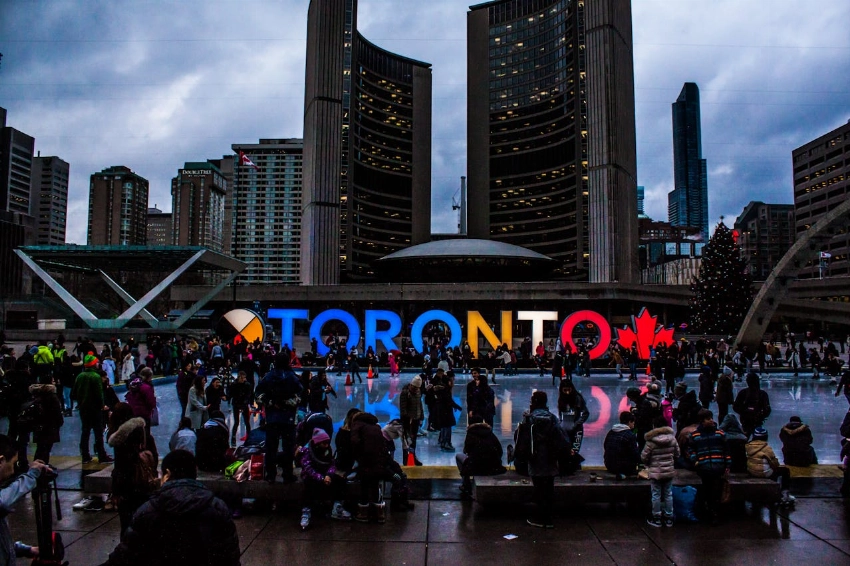
Canada revised spouse visitor visa regulations in 2026, whereby the system operates faster online, with reduced processing times (50-55 days), relationship checks, biometrics, and digital versions of the visa in place of physical stickers.
What’s New in 2026 (At a Glance)
-
Completely automated online application portal.
-
Processing time decreased to 60+ to 50-55 days.
-
Greater examination of the relationship and financial evidence.
-
Improved biometric information exchange on visa categories.
-
Online issuance of a visa connected to a passport.
-
Exemptions of the COVID-era were eliminated.
-
Greater background and authenticity checks.
-
Further emphasis on consistency among indian applicants.
New IRCC Portal Features for 2026
New features for 2026 are:
-
Smoother, quicker, and mobile-based interface.
-
Better uploading of documents and document size.
-
Status monitoring in real time of applications.
-
Automated form error checks
-
Electronic issue of a visa.
-
Automation means shorter processing time.
-
Combined with GCKey and other services of IRCC.
Stricter Verification Requirements
Relationship proofing needed to be more detailed.
-
In-depth analysis of financial ability.
-
There was an increase in the verifications to third parties and the database.
-
No interviews are requested in selected cases.
-
Background and security checks are improved.
The documents should be clear, consistent, well-organised, and submitted by the applicants.
Current Tips for Increasing Your Spouse's Visitor Visa Canada Approval Chances
An organised application is remarkable.
Top strategies:
-
Apply early
-
Give full evidence ofthe relationship.
-
Show strong finances
-
Prepare an effective invitation letter.
-
Demonstrate ties to India.
-
Use a clear cover letter.
-
Avoid errors
-
Keep documents organised
-
Be honest about dual intent.
-
Seek expert review if needed.
Top 10 Success Strategies from Immigration Experts
Strategies for immigration are:
-
Apply in Advance: 2-3 months before travelling.
-
Good Relationship Evidence: 20-30 pages of diverse evidence.
-
Good Finances: Present the money of the sponsor and the applicant.
-
Comprehensive Invitation Letter: Support, purpose, dates.
-
Good Relations with India: Job, property, family responsibilities.
-
Zero Errors: Article-correct form.
-
Cover Letter Contained: Risks: Address upfront.
-
Good Order in the Documents: Labels, index, good order.
-
Return Tickets: Money back guarantees: Prove intent to depart.
-
Checking by Experts: Checking before submission.
Documentation Quality Standards
Documentation quality standards are:
-
Inkjet scan at 300 or more DPI.
-
Make sure all text is clear/readable.
-
Provide certified translations in case not in English.
-
Store similar files using the same names and formats.
-
Include a document checklist or index.
-
Do not have edited or non-readable pictures.
-
Add problem and expiry dates.
-
Organise documents in chronological order.
When to Seek Professional Immigration Consultation
When should one seek professional consultation for immigration?
-
Short/long-distance relationships.
-
Previous visa refusals
-
Controversies in admissibility or overstay.
-
Weak ties to India
-
Dual intent cases
-
Financial complexity
-
Urgent travel timelines
-
The services of expert spots might assist (e.g., TerraTern).
How Can TerraTern Help With a Spouse Visitor Visa Canada?
TerraTern has complete support.
They help with:
-
Eligibility assessment
-
Document checklist
-
Strategies of relationship proof.
-
Invitation letter drafting
-
Application review
-
Refusal analysis and reapplied.
-
Dual intent guidance
Their experience enhances the level of approval greatly.
What Are the Visa Fees for a Spouse Visitor Visa Canada from India?
-
Visitor visa fee: CAD 100 per person for a visa to visit Canada from India.
-
Biometrics fee - CAD 85 per person, if biometrics are required.
-
Family cap: CAD 500 for a family applying for visitor visas together for up to 5 members of the family.
-
Biometrics family cap: CAD 170 for a family biometrics submission (if applicable).
-
No special fee for spouse visa: A spouse visa is not a special category visa based on marriage but is the regular visa for visitors.
What Are the Total Costs for a Spouse Visitor Visa Canada Application from India?
|
Cost item |
Amount |
Notes |
|---|---|---|
|
Visitor visa fee |
CAD 100 |
Per applicant |
|
Biometrics fee |
CAD 85 |
Per applicant, if required |
|
Total government fee |
CAD 185 |
Per person |
|
Family visitor visa cap |
CAD 500 |
For up to 5 family members |
|
Family biometrics cap |
CAD 170 |
If a family submits biometrics together |
|
Extra expenses |
Varies |
Photos and translations, notarization, courier, travel to VAC, and optional insurance. |
The Government fee for a spouse visitor visa for India is approximately CAD 185 per person. That's usually CAD 370 for a couple, before service charges and document costs.
Advice by our expert: Many Indian applicants forget to budget for VAC service fees and certified translations. Plan for a total out-of-pocket cost of approximately INR 15,000 - INR 30,000 for a complete application, excluding medical exam.
How Long Can a Spouse Stay in Canada on a Visitor Visa?
-
Visitors with visitor visas are allowed to stay in Canada for up to 6 months.
-
The length of stay at entry is determined by the border officer and could be less and/or more than 6 months.
-
For a stamp/visitor record, the document is your approved leave by date.
-
When there is no date stamped, you should generally be able to remain in Canada for 6 months from the date you arrive.
-
Your passport or biometrics may expire at any time before your stay, which may also be brought to an end.
-
An extension should be applied for at least 30 days before the end of the authorised stay, if one is desired.
Expert Advice: The 6-month stay is not automatic – the CBSA officer decides at the border. Always carry the full application package, invitation letter, return flight booking, and proof of ties to India when your spouse lands in Canada.
2026/2026 Industry Context Section
-
As of March 2026, the visitor visa processing time for India is 57 days (down from 75 days in October 2026)
-
Spousal sponsorship (outside Canada) processing time stands at 15 months as of March 2026
-
The standard visitor visa fee is CAD 100 per person + CAD 85 biometrics fee
-
IRCC has indicated a target of ~30 days for family reunification priority TRV cases where sponsorship AOR is included
-
Indian applicants must visit a Visa Application Centre (VAC) for biometrics if not previously enrolled
-
Canada explicitly recognises dual intent - applicants can hold temporary and permanent immigration plans simultaneously
-
Visitor visa applications from India were processed in 7 weeks for work/study permits as of early 2026
Conclusion
The latest guidance from the experts for 2026 places emphasis on the importance of presenting a spouse visa for Canada as a genuine short-term visit with strong ties to India and adequate financial resources to support the family, supported by evidence of a good relationship. Your forms, invitation letter, travel plan and financial documents should all be consistent; consistency is what officers are looking for! Dual intent is fine but needs to be explained carefully: you can plan on immigrating to Canada in the future but also demonstrate that you would leave Canada if necessary. The best pupils are complete and structured and are honest about the aim of travel. The truth is that success is more about actions and less about promises and about stability, credibility and a limited plan of action that can be easily proven with a document.
Contact TerraTern for more information on spouse visitor visa Canada.


 AI Summary