


Key Highlights
- What is a Spouse Open Work Permit in Canada?
- Eligibility Criteria for Spouse Open Work Permit Canada
- Does the Spouse Open Work Permit Still Apply If You're Being Sponsored as a Family Class Spouse?
- What Changed for Spouses of Students and Workers Since January 2025?
- What Is the Spouse Open Work Permit Canada Processing Time?
- How Do You Apply for a Spouse Open Work Permit in Canada?
- What Happens If Your Spouse's Open Work Permit Application Is Refused?
- Conclusion
For many years, Canada has been popular with immigrants who come to pursue education opportunities and find employment while uniting their families, as they have many visa options to work and study.
In 2026, the Spousal Open Work Permit (SOWP) in Canada will be a significant opportunity for couples looking to establish their future careers and lives in Canada, providing their spouses with the ability to work for nearly any employer in the country while the student, qualified foreign worker, or in-Canada sponsored spouse is attending school or working or seeking permanent residence.
What is a Spouse Open Work Permit in Canada?
Below are the main points describing what a Spouse Open Work Permit (SOWP) is and why it's so important:
-
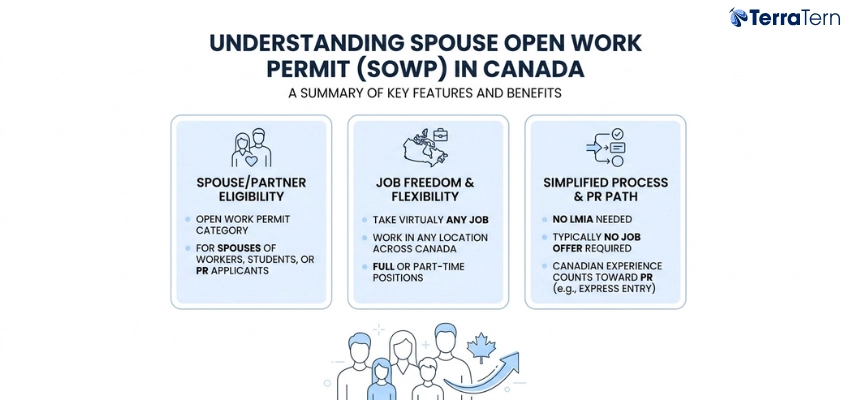
It is an open category of working permit that allows the spouse or common-law partner of a person who is already eligible to work, study, or apply for permanent residence in Canada.
-
The holder of an open work permit can take up virtually any job, position, or location in Canada that is open and is an open permit.
-
Does not need a Labour Market Impact Assessment (LMIA) and typically does not require a pre-arranged job offer, making it easier than Employer-Specific Work Permits.
-
If the principal applicant is studying, working, or waiting for permanent residence, the main purpose of the visa is to enable the spouse to study or work and help them support themselves financially.
-
Typically, the validity of the spouse's open work permit will mirror the status or permit length of the principal applicant (worker, student, or sponsored spouse).
The following are some of the substreams:
-
Husband/wife of a temporary foreign worker
-
An eligible international student's spouse
-
Sponsorship for spouse from within Canada.
-
The permit can be used for full-time or part-time employment, and the work experience in Canada can count towards permanent residence application programs, such as Express Entry or other economic programs.
Expert Advice: Remember that your eligibility is entirely tied to your partner's status, not your own — if your partner's situation changes (a different job, a program switch, or a status lapse), it can directly affect your open work permit eligibility, even if nothing about your own circumstances has changed.
Also Read: Latest Canada Spouse Visa Processing Time for Indians in 2026
Eligibility Criteria for Spouse Open Work Permit Canada
The following are the key factors to consider for a Spouse Open Work Permit (SOWP) in Canada for 2026:
-
The principal worker or student in Canada must be married or have cohabited with you for at least 12 months (cohabitation), and the relationship must be genuine and ongoing.
-
The principal applicant in Canada must have a valid work or study permit and legal status and be physically residing (or intending to reside) in Canada while working or studying.
-
In the “spouse of worker” stream, the principal worker typically needs to be in a TEER 0 or 1 occupation, or a few in-demand TEER 2 or 3 occupations (such as trades, construction, healthcare, etc.) and not a TEER 4–5 occupation like most retail or basic labour occupations.
-
Generally, the principal worker's permit should have at least approximately 16 months remaining on it when the spouse applies for the SOWP, so work permits that are about to expire or have an expiration date that is not far away do not qualify for the SOWP.
-
For the “spouse of student” stream, the principal student needs to be in full-time studies at a Designated Learning Institution (usually a master's or PhD program or a professional degree program such as medicine, dentistry, law, pharmacy, veterinary medicine, engineering, etc.).
-
For in‑Canada spousal sponsorship cases, the spouse must be living in Canada, be sponsored for permanent residence by a Canadian citizen or permanent resident, and can then qualify for an optional open work permit while the PR application is in process.
-
The spouse applying for SOWP must meet admissibility requirements to Canada (no serious criminal, medical, or security issues) and typically must be either already in Canada lawfully on temporary status or apply with proper documentation from outside of Canada.
Pro Tip: Before assuming you're ineligible based on general news about "spousal work permit cuts," identify exactly which of these three categories applies to your specific situation, the restrictions genuinely don't apply equally across all of them.
Also Read: Spouse Visa Canada Requirements 2026 Complete Guide
Does the Spouse Open Work Permit Still Apply If You're Being Sponsored as a Family Class Spouse?
These are the points that will be important to your question:
-
Yes, there is an open work permit available for sponsored spouses. Even if sponsored as a spouse or common law partner in Spouse or Common-Law Partner in Canada Class (inland) or Family Class (overseas), there are certain situations in which you might be eligible to apply for an open work permit.
-
For most sponsored spouses who are physically in Canada and living with their sponsor, an in Canada open work permit pilot/public policy allows you to work. While your permanent residence (PR) application is pending (and your PR application is complete and accepted for processing), your visa application is considered pending. Your visa application is pending while your permanent residence (PR) application is pending. You currently have or can obtain valid temporary status (visitor, worker or student).
-
Recent public policies also may permit an open work permit for those already in Canada with valid temporary status but living at the same address as their sponsor while their PR application is complete and being considered.
-
In all these situations, the open work permit will be tied to your PR application and not to your spouse's status as a worker or student and will generally be issued for up to two years at a time or until you have a decision on your PR application.
-
Generally, it is needed to have an Acknowledgement of Receipt (AOR) for your PR application, or you will need to be in an “urgent expiry” category (e.g., your current status is due to expire in 14 days or less).
Key Note: If you've been putting off your spousal sponsorship application out of fear that the open work permit "doesn't exist anymore," that fear is very likely misplaced, the restrictions target student and worker sponsor categories specifically, not Family Class spousal sponsorship.
Also Read: New Rules for Work Permit in Canada - Experts Guide
What Changed for Spouses of Students and Workers Since January 2025?
The following are the principal changes that impact spouses of students and workers from January 21, 2025 forward:
-
The visa is now limited to certain programs only for spouses of international students. To be eligible for an open work permit, your partner must be enrolled in a master's degree program of 16 months or more that is offered in Canada, a PhD program, or a listed professional program (medicine, dentistry, law, pharmacy, veterinary medicine, or engineering, or other regulated professions).
-
While the SOWP is still available for short master's programs, most undergraduate, college diploma, and certificate programs have lost SOWP eligibility since January 21, 2025. Most undergraduate, college diploma, and certificate programs no longer qualify for a family open work permit because SOWP eligibility largely ceased for these study levels since January 21, 2025.
-
The only people who qualify are spouses of foreign workers who are "high skilled" or working in certain “shortage” occupations. The principal worker must work in a TEER 0 or 1 occupation (management and specialized occupations) or in one of the following TEER 2-3 occupations in priority sectors: natural and applied sciences, construction, healthcare, natural resources, education, sports, or military.
-
The foreign worker's permit should be valid for a period of no less than 16 months at the time IRCC receives the spouse's open work permit application, even if the foreign worker's permit is soon to expire or has a short duration of validity.
-
Dependent children of foreign workers no longer qualify for family open work permits under these rules; the focus is now mainly on spouses and common law partners.
-
However, workers who are married to foreign nationals who are under specific free trade agreements (such as CUSMA/NAFTA, CETA, CPTPP) and workers changing their status to permanent residence can continue to use spousal OWPs and not be fully affected by the more restrictive landscape in January 2025.
Advice by our Expert: If your open work permit was issued under the pre-January 2025 rules, you can generally still renew it under those original terms — don't assume a renewal automatically subjects you to the newer, stricter eligibility criteria, provided your core circumstances (same principal applicant, no extension beyond original terms) haven't changed.
What Is the Spouse Open Work Permit Canada Processing Time?
Let's dive into the essential details around the processing time for Spouse Open Work Permit (SOWP) in Canada (2026):
-
An estimated processing time does not exist, it will depend on the stream of application (worker, student, sponsored spouse) and where the application is made (Inside or outside Canada), as well as on the workload of IRCC. Most guides stress that IRCC time is not guaranteed; it is an estimate.
-
Typical estimates by practitioners and consultants for the processing of SOWPs in 2026 are estimated at approximately 3–8 months overall, with a typical “normal” time of 3–5 months for typical, complete applications.
-
For those who follow work permits processed inside Canada, the average wait time in 2026 is now approximately 259 days (or 8.5 months), which is an average of 9-11 months for some spouses to receive their work permits, longer than expected, particularly if a case has any delays or applications for additional documents.
-
In good conditions, the typical waiting time is between 3–6 months for those who file applications from inside Canada (inland); however, recent statistics indicate a waiting time of 8–9 months when the volume of IRCC applications is high.
-
For outland applications (out of Canada), a published range is typically between 4–8 months, sometimes as long as 10 months for some visa offices, and some firms have indicated that it is generally estimated to be 20 weeks (approx. 5 months).
-
For spousal sponsorship and open work permit cases, some trackers estimate that the open work permit takes about 2-6 months to process after you receive Acknowledgement of Receipt (AOR) for PR, with a majority of cases taking around 3-4 months, but this can be subject to variation based on the case itself.
-
These ranges are only indicative of the length of individual cases and may vary based on: completeness of applications, medicals and background checks, biometrics timing, country of residence, if IRCC has additional requirements, and any changes to the policy/volume for that year.
Expert Advice: Don't plan your finances or job search around any specific processing-time figure you read online — including the ones in this article — since this estimate has swung by months within 2026 alone; check IRCC's live tool close to your actual application date instead.
Also Read: Everything About UK Spouse Visa Refusal Letter
How Do You Apply for a Spouse Open Work Permit in Canada?
In simple points, here are the main steps you should follow to apply for a Spouse Open Work Permit (SOWP) in Canada:
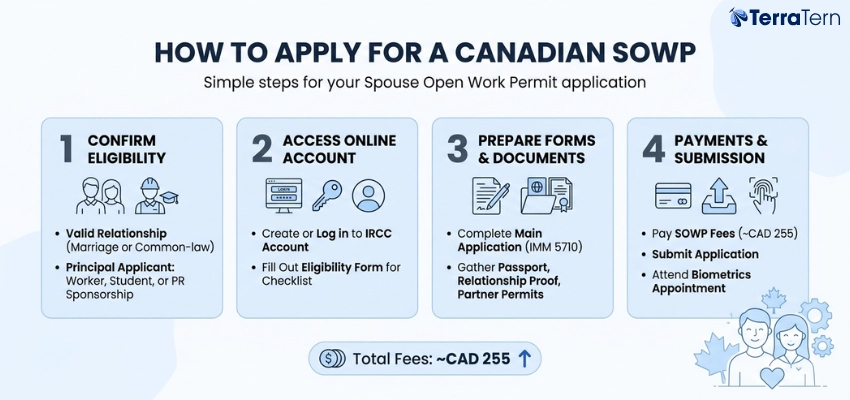
Confirm eligibility first
-
Ensure you are in a marriage (legal marriage or common law union).
-
Ensure that you have one of the acceptable streams: spouse of a qualifying worker, spouse of an eligible student, or sponsored spouse in Canada (PR application in process).
Determine the location of the application (Canada or overseas)
-
You typically apply for a class of temporary status online from within Canada using the “change conditions / extend stay / remain in Canada as a worker” form (IMM 5710).
-
When applying from outside Canada, apply online from outside Canada according to the instructions for the work permit for your country/region and indicate “open work permit” as the type of permit.
Make or log into your IRCC online account
-
Create your secure online IRCC account (GCKey or sign on partner).
-
Fill out the eligibility form to create a customized form checklist for a spouse open work permit.
Fill out the primary application form.
-
For in Canada applications, fill out IMM 5710 (Application to Change Conditions, Extend my Stay or Remain in Canada as a Worker).
-
Click on Open work permit under the section “Type of work permit.”
-
In some of the streams (e.g., certain worker or sponsored spouse policies), the specific code or description of the occupation may be required in the “Job title” and “Duties” sections (these are included in the instructions provided by IRCC for that stream).
Create and submit the necessary documents (standard package)
-
Passport (all stamped/marked pages in one PDF).
-
Marriage certificate or common law union declaration (IMM 5409) and evidence of cohabitation/relationship.
Principal applicant’s documents:
-
Work permit or study permit and proof of current job or full time enrollment (offer letter, pay stubs, enrollment letter, admission letter).
-
For Sponsored Spouses: PR sponsorship Acknowledgement of Receipt (AOR) and proof of living with sponsor in Canada.
-
Family information form (IMM 5707), digital photo, and medical exam proof (if required).
Make the necessary payments via the internet.
-
The standard work permit fee (approx. CAD 155) and the open work permit holder fee (approx. CAD 100) equal the total work permit fee (approx. CAD 255), paid via card through IRCC account.
Apply for the application and fill out biometrics.
-
Upload the forms and documents and then submit the application via the online account.
-
For those who seek an appointment with VAC, book and attend an appointment; NO file will advance without biometrics completed.
You will need to wait for IRCC to make a decision and then accept your permit.
-
Eligibility, relationship, and your spouse's status/occupation or study program will be considered.
-
Once approved, you are given an online approval notice and either the actual work permit (if in Canada) or a letter of introduction to present at the port of entry for the actual permit to be printed (depending on where you live).
Pro Tip: Build your document checklist around your specific eligibility category early — missing proof of your partner's qualifying program level or TEER classification is now the single most common reason these applications stumble, according to multiple current sources.
What Happens If Your Spouse's Open Work Permit Application Is Refused?
In general, if a Spouse Open Work Permit (SOWP) is denied, here's what will happen:
You will be sent a letter of refusal stating the reasons.
-
IRCC will provide a written decision (either in your online account or by email) explaining the reasons the officer could not accept your application (for example, if the principal worker/student is not eligible, if the relationship proof is of poor quality, if the required documents are missing, or if the principal worker/student's status is an issue).
-
In most cases, you will not be able to work in Canada, and you will need to cease work as a result of that application.
You are not permitted to work in Canada on that basis if you are not in Canada.
-
If you had ‘maintained status' (this means that you were already in Canada when you applied, but your current permit was about to expire), your maintained status and work authorization automatically cease on the date of refusal, and you are not permitted to work on the day the application is refused.
An application for a linked family visa may also be denied.
-
If an application by a principal worker or a student is rejected, then an application by a family member (as a family member) will typically be rejected.
-
IRCC also claims that if your own work permit is denied, you won't be able to apply for a work permit for your family members on your work permit application.
Partial refund of fees.
-
IRCC will normally return the open work permit fee (CAD 100 additional) if the family-member open work permit is refused.
-
Even if the work permit is rejected, the main processing fee for the work permit is not refunded.
It may impact your temporary status in Canada.
-
If you are in Canada and the refusal will result in the loss of your status, you might be required to apply to restore your status within 90 days (if eligible).
-
Normally, the status cannot be restored until the restoration period is over, and a new work permit is issued.
-
Most work permit refusals do not have a formal appeal process.
-
Regular work permit refusals do not have a built‑in appeal like some PR decisions.
-
Typically, you can choose between:
Submit a more compelling paper and explanation.
-
If you feel the officer is making a clear mistake (for example, stating that a document was not submitted when it was actually submitted), request reconsideration.
-
Consider judicial review in the Federal Court with very tight deadlines (15 days for decisions made in Canada, 60 days for decisions made outside of Canada).
It is not unusual to reapply, but the issues need to be addressed first.
-
Numerous guidance resources suggest reviewing the rejection letter carefully, gathering additional relationship evidence, and having an in-depth discussion with your spouse about their job/TEER level or study program, and then resubmitting a better application.
-
Usually there is no set waiting period, but if you re-apply without making any changes to the reasons for the refusal, then you can guarantee another refusal.
Advice by our Expert: If your spouse is nearing the final term of their study program, submit any work permit renewal well before the program ends — applications submitted too close to a student's final term have been refused on this basis alone, even for otherwise straightforward renewals.
Also Read: UK Spouse Visa Refusal: Reasons, Appeals & Solutions
Conclusion
In 2026, applicants must meet the requirements to get a spouse open work permit. The main applicant must be eligible to work in Canada, study at a university or professional programme, or be sponsored for PR by their spouse in Canada. The spouse or common-law partner must prove that the relationship is genuine and ongoing. They should also provide clear documents showing their job, TEER level, study programme, PR sponsorship, and relationship to avoid common refusal reasons.
You can avoid making mistakes while applying for a spouse open work permit to Canada with an expert like TerraTern, who provides support throughout the process and post-landing.




 AI Summary