
Key Highlights
- What Are the New Rules for Work Permit in Canada 2026?
- What Is Bill C-12 and How Does It Affect Work Permits?
- How Have Post-Graduation Work Permit (PGWP) Rules Changed for 2026?
- What Are the New Rules for Spousal Open Work Permits in Canada 2026?
- What Are the Current Canada Work Visa Requirements in 2026?
- What Do the New Immigration Targets Mean for Work Permit Holders?
- What Are the New Rules for PNP Applicants Seeking a Work Permit?
- Conclusion
The new rules for work permit in Canada 2025 still apply to work permit applicants in 2026, and will continue to impact them in a variety of ways, including changes to post-graduation work permits, spousal open work permits, LMIA-based applications, and provincial nominee applications. It's really important, however, before you apply to understand the Canada work visa requirements and the list of criteria that determines if you're eligible or not, including your job, your employer, your occupation, the type of immigration you're applying under, and your status. This update for 2026 to the rules governing work permit in Canada 2025 outlines the most crucial changes in the rules and regulations for foreign workers in 2025, identifies who will be impacted, and points to potential avenues for improved opportunities to work and settle in Canada.
What Are the New Rules for Work Permit in Canada 2026?
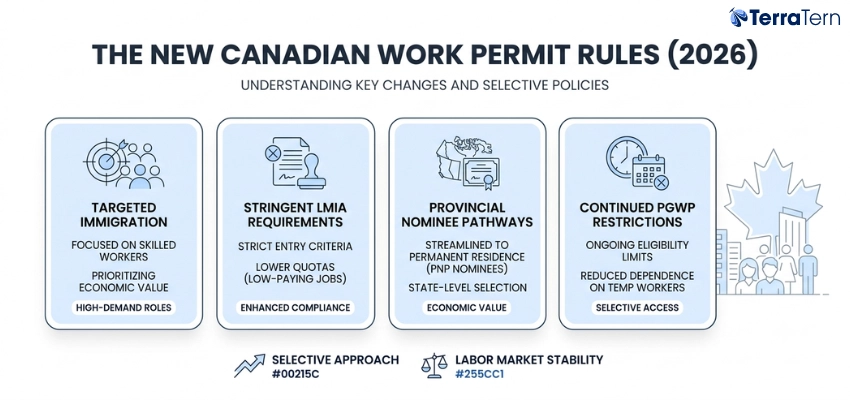
In 2026, the new rules for work permit in Canada 2025 will continue to shape the Canadian work-permit system, emphasizing more targeted immigration and the demands of the labor market.
-
Key changes range from Bill C-12 to ongoing restrictions on PGWP eligibility and the introduction of more stringent requirements on the LMIA, as well as the changes to work-permit pathways of eligible PNP applicants.
-
Canada is lowering its dependence on temporary worker programs at the provincial level and is now more focused on skilled workers and those candidates who are already providing economic value to the Canadian economy.
-
Some LMIA streams have more stringent entry criteria and quotas, especially for low-paying jobs.
-
For those who are eligible, the provincial nomination to permanent residence process can be streamlined for PNP nominees.
-
Canada work visa requirements remain dependent on the applicant's work permit category, occupation, employer and individual circumstances.
-
In summary, the revised guidelines on work permit in Canada 2025 reflect a more stringent and selective approach to work permits, emphasizing a stronger commitment to uphold compliance standards and safeguard the stability of the Canadian labor market
-
the new regulations for work permit in Canada 2025 indicate a more selective and stringent system for work permits, aimed at improving compliance and ensuring the stability of the Canadian labor market.
Important Tip: The direction of travel in 2026 is clear: fewer new temporary permits overall, but faster, clearer pathways for people already established in Canada. Positioning yourself in an in-demand sector or provincial nomination stream matters more now than it did even a year ago.
Also Read: New Rules for Work Permit in Canada 2025 - Experts Guide
What Is Bill C-12 and How Does It Affect Work Permits?
On March 26, 2026, Bill C-12 is set to come into force, granting wider powers to the government with respect to certain applications and documents for immigration.
-
The law provides for the halting or suspension of application processing during situations stipulated by the law.
-
It may also authorize to suspend or revoke some documents or permits if the statutory conditions are fulfilled.
-
Conditions on applications can be imposed and changed type by type by the government where necessary.
-
The measures are intended to facilitate the response of Canada in cases of concerns related to fraud, administrative integrity, public health, public safety or national security.
-
Additionally, Bill C-12 includes regulations on refugee claims and increases provisions on how information can be shared amongst government institutions.
-
The implications for those who apply and hold permits is deeper government flexibility on responding to large numbers of serious issues.
-
The applicants must also ensure that they maintain all the conditions stipulated on their permits and that they give only true and correct details in the immigration procedure.
-
The new rules for work permit in Canada 2025 therefore, should be weighed against other powers added in the 2026 regulations.
-
Ensure paragraph 7 of the Bill C-12 is applied correctly and accurately before publication and especially when cancelling or suspending a previously issued work permit;
Expert Advice: Increased government authority to pause or cancel permits raises the stakes on clean, well-documented applications. This isn't the year to cut corners on paperwork accuracy or file consistency.
How Have Post-Graduation Work Permit (PGWP) Rules Changed for 2026?
With the new rules for work permit in Canada 2025 still in effect, study permit holders (and thus PGWP hopefuls) whose applications were submitted on or after November 1, 2024, will continue to be impacted.
-
One can generally assume that graduates of bachelor's, masters and doctoral degree programs will not need to meet newer requirement field of study.
-
Often, graduates of colleges or other non-degree programs are required to earn a degree from an appropriate program of study related to business activities important to the Canadian job market.
-
Because of the obligatory field-of-study requirement, it is crucial for students applying for eligible non-degree programs who have missed the November 1, 2024 deadline to ensure they submit their applications with their planned major when applying.
-
Applicants for PGWP must also have the required language proficiency.
-
Graduates typically require an approval by foreign language test for English or French for the newer rules applications.
-
Students may have access to the approved English options for use, such as IELTS General Training, CELPIP-General, and PTE Core as needed by the IRCC.
-
Other conditions for PGWP are also related to the designated learning institution, the program, the length of program and study history of the applicant.
-
The flagpoling process for applying for a PGWP at a Canadian port of entry has ended, and eligible applicants must apply for a PGWP via the proper process.
-
Students are advised to check their eligibility to a PGWP with respect to the courses they are interested in participating in, as eligibility for each course may vary due to changes in immigration policy.
Expert Tip: If you're choosing a program specifically to maximise PGWP eligibility, a bachelor's degree or higher currently offers more certainty than a shorter diploma tied to the labour-shortage list, which remains subject to future policy changes.
What Are the New Rules for Spousal Open Work Permits in Canada 2026?
The new rules for work permit in canada 2025 continue to affect family members seeking open work permits in 2026.
-
Since January 21, 2025, eligibility has been restricted mainly to spouses or common-law partners of certain international students and foreign workers.
-
Spouses of international students may qualify when the student is enrolled in an eligible master’s program lasting at least 16 months, a doctoral program, or certain professional degree programs.
-
Spouses of students in most undergraduate and shorter programs generally do not qualify for a spousal open work permit under the revised rules.
-
For foreign workers, eligibility is primarily focused on spouses of workers employed in select TEER 0 or 1 occupations and certain TEER 2 or 3 occupations.
-
Dependent children of foreign workers are no longer eligible for family open work permits under the general measure introduced in 2025.
-
Eligible family members may instead need to consider study permits or other immigration options.
-
Language requirements can apply to some specific work-permit categories, but a blanket CLB 5 requirement for every spousal open work permit applicant should not be stated without checking the applicant’s exact category.
-
Applicants should review the latest IRCC eligibility rules before applying because eligibility depends on the student's program or the worker's occupation and permit validity.
Important Note: Families planning a move together should map out each family member's individual pathway early. A spouse's open work permit eligibility now depends heavily on the specific program and duration the primary applicant is enrolled in, not just their status as a student or worker.
Also Read: New Rules for Canada Immigration: Experts' Latest Update
What Are the Current Canada Work Visa Requirements in 2026?
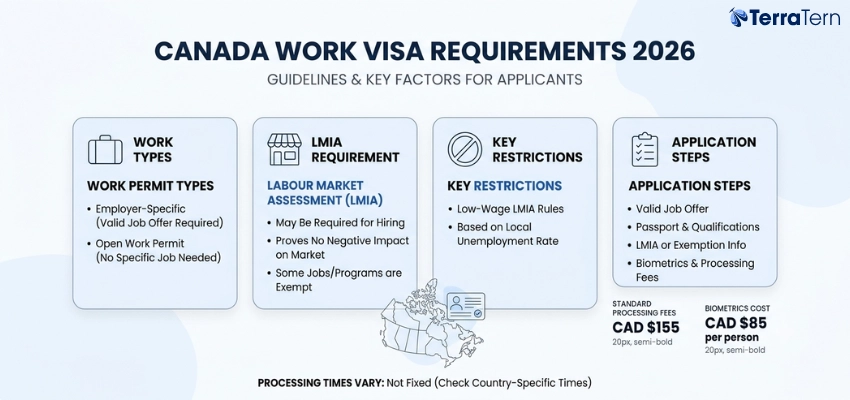
The Canada work visa requirements depend on whether you are applying for an employer-specific work permit or an open work permit.
-
For an employer-specific permit, applicants generally need a valid job offer from a Canadian employer and must satisfy the requirements of the applicable work permit category.
-
An LMIA may be required to demonstrate that hiring a foreign worker will not negatively affect Canada's labour market. Some jobs and immigration programs are LMIA-exempt.
-
Low-wage LMIA applications are subject to additional restrictions, including rules connected to the unemployment rate in the relevant census metropolitan area.
-
Applicants must provide required documents such as a valid passport, employment documents, proof of qualifications, and, where applicable, an LMIA or LMIA-exemption information.
-
The standard work permit processing fee is generally CAD $155, while biometrics normally cost CAD $85 per person, where required.
-
Applications are generally submitted online, although IRCC provides limited exceptions.
-
Processing times vary according to the applicant's country, application type and other factors, so a fixed 93-day processing time should not be presented as universal.
-
Applicants should check the latest Canada work visa requirements on IRCC before submitting an application.
-
The new rules for work permit in Canada 2025 remain relevant because several restrictions introduced in 2025 continue into 2026.
As per our TerraTern Expert Divyansh, the low-wage LMIA refusal policy quietly rules out an entire category of jobs in Canada's biggest cities. Check current unemployment data for your target metro area before assuming a specific role or employer will qualify.
What Do the New Immigration Targets Mean for Work Permit Holders?
The new rules for work permit in canada 2025 should be viewed alongside Canada's broader 2026–2028 immigration planning.
-
Canada's immigration strategy is placing greater emphasis on economic immigration and transitioning people already in Canada to permanent residence.
-
Existing temporary residents with Canadian work experience may have opportunities through programs such as Express Entry and Provincial Nominee Programs (PNPs), depending on their eligibility.
-
Priority areas include workers with skills needed in sectors such as healthcare, skilled trades and STEM, although eligibility depends on the specific immigration stream.
-
French-language ability can provide additional opportunities through dedicated French-language and economic immigration pathways.
-
At the same time, Canada is reducing the number of new temporary residents admitted compared with previous plans.
-
This means prospective temporary workers may face a more selective environment, particularly where their occupation, wage level or immigration category does not align with Canada's current priorities.
-
Work permit holders should therefore consider whether they can transition to permanent residence rather than relying only on temporary status.
-
The exact number of people prioritized through specific transition measures can change, so applicants should verify the latest Immigration Levels Plan and IRCC announcements before publishing or relying on a fixed figure such as 33,000.
Pro Tip: If you're already in Canada on a work permit in a priority sector, the 2026 policy direction favours you more than it favours new applicants. Focus energy on strengthening your PR pathway rather than assuming the rules will loosen for new entrants.
What Are the New Rules for PNP Applicants Seeking a Work Permit?
Under the new rules for work permit in canada 2025, PNP nominees have gained a more streamlined route to obtaining a work permit while their permanent residence application is being processed.
-
From June 9, 2026, eligible PNP applicants may be able to apply for a work permit after submitting their PR application and paying the required fees.
-
Applicants do not need to wait for an Acknowledgment of Receipt (AOR) before becoming eligible under this measure.
-
This can reduce the gap between submitting a permanent residence application and obtaining authorization to continue working in Canada.
-
Eligible applicants must still provide evidence that their PR application was submitted and that the applicable processing fees were paid.
-
The change can be particularly useful for nominees whose existing work permits are expiring while their PR application is being processed.
-
Eligible spouses or common-law partners may also benefit from simplified access to open work permits, subject to the applicable eligibility conditions.
-
Applicants should not assume that nomination alone automatically guarantees a work permit; they must still satisfy the relevant IRCC requirements.
-
The Canada work visa requirements can differ according to the applicant's PNP stream, current status, and type of work permit requested.
-
Expert takeaway: If you are a PNP nominee who previously expected to wait for an AOR, check the latest IRCC rules before delaying your work permit application.
-
These changes are another important development under the new rules for work permit in Canada in 2025 that continue to affect Canada's work-permit system in 2026.
Key Note: If you're a PNP nominee who's been waiting on an AOR before applying for a work permit, this change means you may already be eligible to apply now; don't assume you still need to wait.
Also Read: How to Apply for a Work Permit in Canada? Rules, Steps, & Tips
Conclusion
The new rules for work permit in Canada 2025 continue to shape Canada’s work-permit landscape in 2026, creating both tighter restrictions and new opportunities for eligible foreign workers. Changes involving Bill C-12, PGWP eligibility, spousal open work permits, LMIA requirements, and Provincial Nominee Program pathways mean applicants need to understand which rules apply to their individual circumstances. The Canada work visa requirements can vary depending on your occupation, employer, work permit category, qualifications, and current immigration status.
Contact TerraTern for more information on New Rules for Work Permit in Canada.