
Key Highlights
- What Is the Current Canada Spouse Visa Processing Time from India?
- What Is Canada Spouse Visa Processing and How Does It Work?
- What Are the Eligibility Requirements for Canada Spouse Visa Processing?
- What Documents Are Required for Canada Spouse Visa Processing?
- What Are the Step-by-Step Stages of Canada Spouse Visa Processing?
- What Factors Affect Canada Spouse Visa Processing Time from India?
- What Is the Spouse Open Work Permit and How Does It Affect Processing?
- How Much Does a Canadian Spouse Visa Cost to Process in 2026?
- How Can You Track Your Canada Spouse Visa Processing Status?
- What Are the Common Reasons for Canada Spouse Visa Rejection and How Can You Avoid Them?
- 2026 Industry Context Section
- Conclusion
One of the most crucial factors that Indian applicants consider in 2026 is the Canada spouse visa processing time, as it plays a significant role in determining when they can be reunited with their spouse in Canada.
Generally, IRCC expects most spousal permanent residence sponsorship applications to take about 12 months to process in 2026, though there are some guides that cite that many applications filed from India will be processed a bit quicker or slower depending on the visa office, the documents submitted, background checks and medicals.
What Is the Current Canada Spouse Visa Processing Time from India?
Canada's spousal sponsorship processing time depends on whether you apply through the outland (spouse living outside Canada) or inland (spouse already in Canada) stream, and as of mid-to-late 2026, both have been trending upward from IRCC's official 12-month service standard.
How Long Does Outland Spousal Sponsorship Take for Indian Applicants?
-
The processing time for an outland application is typically between 10 and 16 months, depending on documents and background checks, but it can take longer or shorter.
-
Processing consists of sponsor eligibility, application completeness, biometrics, medicals, security/criminal review and final decision.
-
Outland applicants are allowed to travel and may receive a TRV decision separately while awaiting PR processing.
-
The timeline depends on the workload of a particular visa office, requests for additional documentation, and the complexity of the case (such as security clearance).
-
Please check current IRCC processing times before planning; averages are subject to change.
How Long Does Inland Spousal Sponsorship Take?
-
It takes 25-27 months normally to process inland sponsorship (sponsored spouse is in Canada with a valid status), but longer if checks or requests cause delays.
-
For inland applicants, an open work permit application is also submitted at the time of sponsorship and is typically approved within ~4–6 months.
-
Processing steps are similar to Outland (Sponsor check, Medicals, Biometrics, Security), except that the sponsored individual must stay in Canada while being processed.
-
If the application is complete and further documents and interviews are not required, timelines will be reduced.
-
Before applying, review IRCC's live processing tool to see the current processing times.
How Does Canada Spouse Visa Processing Time Compare: Inland vs. Outland?
The table below lists key processing times and other differences between Inland and Outland spousal sponsorship (general 2025-2026 processing patterns) – treat processing times as a guide and consult the IRCC for up-to-date information.
The processing time comparison between Inland and Outland is the following:
Inland vs Outland, processing time comparison
|
Topic |
Inland sponsorship (inside Canada) |
Outland sponsorship (outside of Canada) |
|
The time required for typical processing (recent 2026 patterns) |
Tends to be longer, typically 12-24 months (many guides say 14-24 months); may vary depending on the complexity of the case. |
On average, generally quicker , many recent reports put this at 10-16 months, but it depends on the visa post. |
|
Work permit/ability to work while waiting. |
A sponsored person may apply for an open work permit, and they typically work in Canada while the application is being processed. |
In general, an open work permit cannot be issued on arrival; a work permit or TRV may be required to obtain an open work permit. |
|
Appealing a refusal.The right to challenge a refusal. |
The right of appeal for refusals of applications for sponsorship is normally NOT available in inland applications. |
Generally, there is a right of appeal for outland applicants following refusal (sponsorship appeals). |
|
Allowing travellers the flexibility to travel during processing. |
The sponsored person must continue to be in Canada to maintain status for the purpose of obtaining inland stream benefits (work permit); travel may make status more complicated. |
Most outland applicants are eligible to travel and attend interviews at the visa office in their home country, and are eligible to get a TRV to enter Canada. |
Key Note: Indian applicants should choose outland sponsorship when possible; it's faster (15–16 months vs 21+ months inland) and preserves your right to appeal if the application is refused.
Also Read: Spouse Open Work Permit Canada: Latest Experts Guide
What Is Canada Spouse Visa Processing and How Does It Work?
The easiest way to remember this is with these points:
-
Spousal sponsorship PR: Canada spouse visa is the process whereby a Canadian citizen or permanent resident sponsors their legally married spouse/partner to become a permanent resident of Canada and live with them in Canada.
-
Two parts of one package: The file contains a sponsorship component (about your spouse's eligibility and his or her commitment to sponsor you) and a permanent residence component (about you, your background, and your relationship). Typically, both are submitted simultaneously, online, in a single application.
-
Basic eligibility check first: immigration officers do basic eligibility checks (sponsor must be in Canada, sponsor must have no serious sponsorship bans; sponsor's income history) and then ask to check if it is a genuine relationship and not just for immigration purposes.
-
Online forms and documents: You and your spouse fill out the forms online, pay the fees, and upload documents such as marriage certificate, photos, chat/call history, financial documents, police files and medical exam results.
-
Biometrics and background checks: You submit biometrics at a VAC, and IRCC does background checks, criminality checks, and medical checks to make sure you are admissible to Canada.
-
Evaluation of relationship authenticity: An officer will check your story, documents, and timelines and determine whether the marriage/relationship is authentic or not, depending on other documents or a telephone interview with the officer.
-
Final decision and COPR: Once all the approvals are received, you'll get a Confirmation of Permanent Residence (COPR), and if you are outside Canada, a visa will be issued in your passport to “land” as a permanent resident, or if you are in Canada, your status will be updated, and then a PR card will be sent in the mail.
-
After approval: The rights of a PR include that they are able to live, work and study in any part of Canada whilst the sponsor is financially responsible for them for 3 years, even if the relationship ends.
Expert Advice: Canada spouse visa processing is not a single application; it's a two-stage process where both the sponsor and the sponsored spouse must meet separate eligibility criteria before IRCC approves permanent residence.
What Are the Eligibility Requirements for Canada Spouse Visa Processing?
The following are the primary eligibility criteria that will be considered when an application for a Canadian spouse visa (aka spousal sponsorship) is made, both by the Canadian sponsor and the spouse seeking admission:
On the sponsor's (Canadian spouse/partner) side:
-
Must be 18 years or older.
-
Must be a Canadian citizen, a person who is a Canadian permanent resident or a person registered as an Indian under the Canadian Indian Act.
-
Should be a resident of Canada or, for those who are citizens but reside outside Canada, plan to return to Canada upon the spouse's Canadian PR.
-
Must not be on social assistance (welfare) for any other purpose.
-
Should not be an undischarged bankrupt (except in Quebec).
-
Not be incarcerated in jail, prison or an equivalent facility.
-
Should not owe court-ordered family support payments (such as child support, spousal support, etc.) or immigration loans or performance bonds (with some exceptions in Quebec).
-
Must not have specific serious convictions (including violent, sexual and offences against family convictions), unless rehabilitated and permitted to sponsor.
-
Must not have been the subject of a sponsorship undertaking by another spouse or partner in the previous 3 years, nor have been granted PR through sponsoring a spouse or partner in the past 5 years.
Applicant (Spouse being sponsored):
-
Should be 18 years of age or older.
-
Must be the legal spouse (or IRCC common-law or conjugal partner) of the sponsor.
-
Properly demonstrate that the relationship is not an immigration scheme by presenting evidence such as a marriage certificate, photographs, communications, shared bills, etc.
-
Accept medical examinations to demonstrate that they have no serious health-related conditions that would indicate they are medically inadmissible.
-
Must have police clearance certificates with no serious criminal records, which would make them criminally inadmissible.
-
Must give biometrics (fingerprints and photo) and pass security checks.
Money/financial conditions:
-
With most regular spouse sponsorship cases, there's no minimum income requirement, but you must demonstrate that you can support the spouse without the need for social assistance.
-
A formal income cap only exists in special circumstances (e.g. dependent children who have children of their own also apply).
Extra notes for Quebec sponsors:
-
Additionally, if the sponsor lives in Quebec, they are required to adhere to Quebec's eligibility and income requirements and sign another “undertaking” with the Quebec government.
Who Can Sponsor a Spouse for Canada Visa Processing?
-
Must be at least 18 years old, not under a removal order and be a Canadian citizen or permanent resident.
-
Should not be incarcerated, bankrupt or on social assistance (disability)
-
Fails to have any major convictions for violence or sex crimes, or is currently banned from sponsoring.
What Qualifies as an Eligible Relationship for Canada Spousal Sponsorship?
-
Marriage is registered in the jurisdiction where it took place, and under Canadian law, both spouses are at least 18 years old.
-
Common-law partner: lived together continuously in a marriage-like relationship for at least 12 months.
-
Conjugal partner: 1+ year relationship with an individual, but not together or able to marry because of legal or other significant obstacles.
Pro Tip: Even if all documents are in order, IRCC can request an in-person interview if the relationship appears non-genuine , ensure your application includes strong proof of cohabitation, photos, communication records, and financial interdependence.
What Documents Are Required for Canada Spouse Visa Processing?
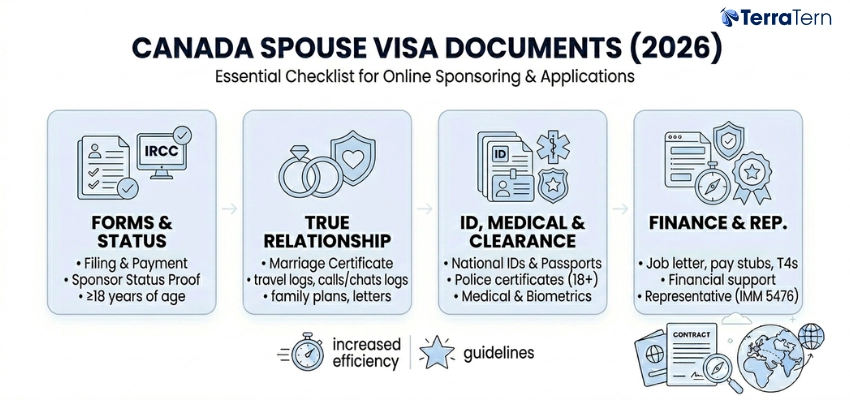
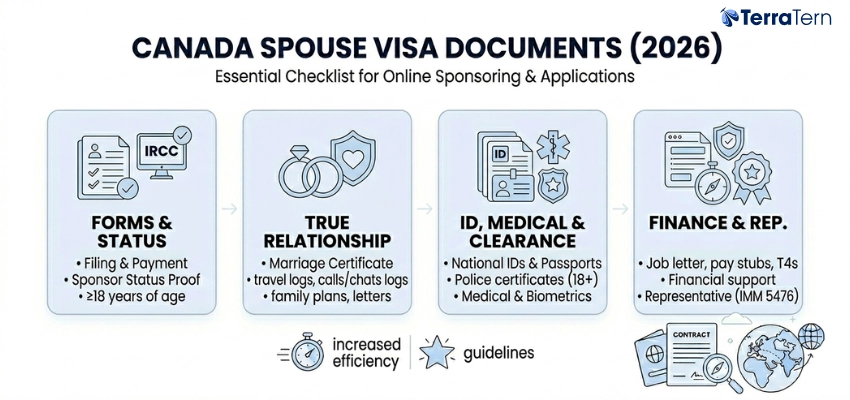
These are the typical documents for sponsoring a spouse in Canada (for the sponsor and sponsored person). This is a checklist, and it is always best to check with the most recent document checklist on IRCC's website prior to submitting it.
-
Filled out the application and received payment (sponsorship form and PR form signed).
-
Proof of sponsor's status: Canadian passport, proof of PR card or proof of being registered under the Indian Act and that they are ≥18 years of age.
-
Sponsor's evidence of residence in Canada or intention to return (if a citizen elsewhere).
-
Marriage certificate or proof of legal union. If this is not available, provide an explanation and evidence to explain this.
-
Evidence of true relationship: Pictures with each other, travel logs, call/chat logs, affidavits, family plans, letters, etc.
-
Evidence of cohabitation or common-law living (lease, joint bills, joint bank accounts) for common-law claims.
-
Applicants' and accompanying family members' national IDs and passports.
-
Birth certificates of the applicant and any dependent children.
-
Police certificates / criminal record checks (one for each person 18+ years old).
-
Immigration medical exam: Report from a physician on an approved IRCC panel.
-
Biometrics (fingerprints and photo): Biometrics fee paid; VAC appointment confirmed.
-
Financial support/sponsor's employment/income documentation (job letter, pay stubs, T4s, bank statements) as appropriate.
-
Marriage Record(s) to document the date(s) of previous marriages (if applicable).
-
Photos that meet IRCC requirements for each person applying to the program.
-
A representative form (IMM 5476) is to be used if a representative is filing on your behalf.
-
English and French versions of any documents other than English and French.
What Documents Does the Sponsor Need to Submit?
-
Sponsor application forms (IMM 1344 and related forms), signed, and a fee receipt.
-
Proof of Canadian status: passport, PR card or under the Indian Act.
-
Sponsor's ID (Driver's Licence / Provincial ID) and proof of age (18 years or older).
-
Canadian address and/or return intention (lease, utility bill, etc.).
-
Evidence of employment and income: job letter, pay stubs, T4S, bank statements as appropriate.
-
Oath of allegiance/commitment to support the sponsored spouse.
-
Police or court records if previously convicted, and bankruptcy records if applicable.
-
A certificate of marriage termination (divorce certificate/death certificate) if applicable.
-
If using a representative, use the representative form (IMM 5476); translation of any non-English/French docs.
What Documents Does the Sponsored Spouse Need from India?
-
Completed application form (IMM 0008, IMM 5669, IMM 5406, etc.) and receipt of payment.
-
Copy of passport (photo page and visas/stamps) and national identification.
-
Birth certificates and all children's birth certificates, plus a marriage certificate (proof of marital status).
-
Police clearance certificate from India (and other countries that you have lived in for 6+ months).
-
Results of the IRCC-approved physician's immigration medical examination.
-
Evidence of authenticity: photos, messages, travel records, joint finances, and an affidavit.
-
Copies of the divorce certificate, annulment or death certificate of previous marriages (if any).
-
2 passport-size photographs according to IRCC requirements, a receipt for the IRCC biometrics, and certified translations, if applicable.
Advice by our Expert: Incomplete or inconsistent documentation is the #1 reason for Canada spouse visa delays from India; double-check that your relationship evidence (photos, messages, travel records) spans the entire duration of your relationship.
What Are the Step-by-Step Stages of Canada Spouse Visa Processing?
The following is a breakdown of the steps for Canada's spousal sponsorship visa process in the form of simple steps you can take from submission to landing.
-
Application Preparation: The sponsor and the sponsored person collect the forms, IDs, marriage record, pictures, cops record, medical exam instructions, translations, and the payment receipt.
-
Submit Application: The principal applicant submits a sponsorship + permanent residence application online (or on paper if allowed) and pays the fees; IRCC sends an Acknowledgement of Receipt (AOR) or file number.
-
Initial Completeness Check: IRCC will review the application, and if documents are missing, the application may be rejected or put on hold, and the applicant will be contacted to provide any missing documents.
-
Biometrics Request & Appointment: applicants are requested to submit their biometrics (fingerprints and photo), book and attend a VAC/VFS appointment, and submit the biometrics fee if not paying at the appointment.
-
Sponsor Eligibility Assessment: IRCC checks the sponsor's eligibility, including age, criminal, and financial eligibility (undertaking), to determine whether they can sponsor.
-
Security, criminality and identity checks (police certificates, background screening) by IRCC (admissibility).
-
IRCC receives and reviews the results of an applicant's medical exam from an IRCC-approved physician to establish medical admissibility.
-
Relationship genuineness review: An officer will review evidence of the relationship (marriage certificate, photographs, messages, finances, etc.) and may request additional documents or an interview to establish genuineness.
-
IRCC can request other information or documents (RFE/ATIP): If IRCC requests additional information and/or documents, it would be appreciated if these are provided promptly and completely to minimise delays.
-
Decision stage: If eligibility and admissibility are met, IRCC will make a decision on whether to approve or refuse the sponsorship and PR application and notify the applicants in the portal or by email.
-
Visa / COPR issued (outland): Visa is issued in the passport, and a Conf of PR (COPR) is issued; (inland): e-COPR / PR card process is initiated.
-
Permanent residency: Applicant arrives in Canada (or lands while in Canada) and becomes a permanent resident of Canada; a permanent resident card is mailed later.
-
Post-landing obligations and undertaking: The financial undertaking period (usually 3 years) begins from the date of landing (for immediate family members), and the sponsored person gets PR rights (work, study, healthcare eligibility).
How Does the Canadian Spouse Visa Application Process Begin?
-
Authorisation and application are gathered by the sponsor and the applicant. The sponsor and applicant pick up required forms, IDs, marriage proof, police certificates, medical exam instructions, translations and fees.
-
The principal applicant registers an IRCC account, fills out both IRCC sponsorship and permanent residence forms, signs them, uploads documents and pays fees to submit the package.
-
After receiving the application, IRCC will provide an acknowledgement of receipt (AOR) or a file number.
What Happens After Submitting a Canada Spouse Visa Application?
-
IRCC will conduct a completeness check; incomplete files may be returned or paused.
-
The applicant also gets requests for his/her biometrics, makes appointments for VAC, and IRCC conducts medical, security and police checks.
-
Eligibility for sponsorship and authenticity of the relationship are evaluated; IRCC may ask for additional documents or an interview.
-
Approval - a COPR/visa is issued, or a PR status update is received; refusal - reasons for the refusal are provided, along with next steps.
Expert Advice: Biometrics are one of the most time-sensitive steps. Submit your biometrics request response within the 30-day window provided by IRCC, or your application will be closed and you'll need to start over.
What Factors Affect Canada Spouse Visa Processing Time from India?
Here are the key factors influencing the processing time for Canada spouse visa from India, presented in bullet points:
-
Application completeness: If the application is not complete, is missing documents, copies are not readable, or there are errors, it will delay or cause the application to be rejected, which may lead to weeks or months of waiting for the IRCC correction.
-
The processing time for Inland vs. Outland spousal sponsorship differs, as do other categories (parent/grandparent sponsorship, student, work).
-
Visa office workload (country): Number of cases in the backlog, staffing, and volume of cases in the visa office in the country affect the speed of visa applications; pre-pandemic, India's visa office backlog was around 18 months, but this varies.
-
Background/security checks may add time as the depth and complexity of security, criminality and identity checks (including multiple countries lived in).
-
Exam timing & results: medicals must be obtained from an IRCC-approved physician. Medicals are delayed when they are not booked, results are delayed, and extra tests are required to finish medicals.
-
The overall time can be longer as a result of waiting for VAC appointment slots or delays in submitting biometrics.
-
Applicant's response speed: If IRCC sends a request for additional documents or information (RFE), how quickly the applicant responds will affect the processing time.
-
Immigration policy & demand changes: New policies, caps on processing numbers or unexpected increases in immigration applications (e.g., PGP, family class) alter processing priorities and timelines.
-
Extra review and evidence requests may be delayed if the marriage is recent, previous marriages exist, or cohabitation is hard to prove.
-
Sponsor's issues of eligibility: Issues that could delay processing if they are related to the sponsor's criminal record, financial undertaking, status or residency.
Can Application Completeness Speed Up Canada Spouse Visa Processing?
-
A complete application does not result in any rejection or correction by IRCC, and hence, processing is started immediately after a complete application is submitted.
-
Applying with incomplete forms, illegible documents, or non-payment of fees can delay the process for days or weeks.
-
Getting all the proofs ahead of time helps to ensure that the process is on track and approval goes much faster.
How Does Country of Residence Impact Processing Time?
-
Outland applications are dealt with by the visa office of the place of intended permanent residence of the sponsored person – that office's caseload and rules are relevant.
-
Countries or regions with large volumes of applications might experience longer queues in case of high demand or a high number of applications in the queue.
-
If some nationalities are subjected to more stringent security/background checks, this may influence processing time.
What Other Factors Delay Canada Spouse Visa Processing?
-
If there is not enough evidence of a genuine relationship (e.g. pictures, messages, etc. or insufficient cohabitation evidence), additional enquiries or investigations are conducted.
-
Long delays or refusal can result from criminal inadmissibility (e.g., DUI, convictions), health inadmissibility or misrepresentation (false info).
-
The lack of medical exam certificates, police certificates, financial support proof, declaration of dependents or the choice of the wrong sponsorship stream (inland vs outland) can slow or even stall or refuse the case.
Pro Tip: The single biggest controllable factor is application completeness , a perfectly assembled application with thorough relationship evidence can shave weeks off the processing timeline by avoiding follow-up requests.
What Is the Spouse Open Work Permit and How Does It Affect Processing?
In brief, let's look at some of the main points regarding the Spousal Open Work Permit (SOWP) and its impact on processing:
-
It's a Spousal Open Work Permit (SOWP) that allows a foreign spouse/common-law partner of a Canadian citizen or PR to work for nearly any employer in Canada without having to secure a job offer from one employer.
-
Who can be sponsored (inland stream): Must be the principal applicant on a spousal sponsorship application under the Spouse or Common-Law Partner in Canada class and have a PR application accepted for processing after completion.
-
Eligibility requirements must be met: Must reside at the same address in Canada as the sponsor; Must have a valid temporary status (or regain) and must comply with basic eligibility requirements for spousal sponsorship.
-
When to apply: The open work permit application can be made along with your PR application or once your sponsorship application is confirmed as complete by IRCC.
-
Work rights: it is an ‘open' permit, which means you can apply for work in a variety of jobs with any eligible employer to earn money while waiting for PR.
-
Application for an SOWP will NOT directly affect the spousal PR processing time; PR processing time will not be affected by the SOWP application.
-
Pilot purpose: The SOWP pilot is designed to alleviate economic and emotional stress during the extended PR wait (expected to be ~12 months) without having to sacrifice the time spent with your partner in order to find work.
-
SOWP processing time: SOWPs are processed more quickly from the SOWP itself and can be processed before the PR decision is made (generally several months).
-
Practical impact: Although it doesn't reduce the time for processing, an SOWP makes the overall process easier for inland applicants as they can work and earn while waiting for PR to be processed.
If you're interested in Canadian choices, has your future husband or wife already been granted status in Canada, or will you be filing from India? That will be the deciding factor as to whether or not you can get SOWP.
Who Is Eligible for a Spouse Open Work Permit During Canada PR Processing?
-
Must be a spouse/common-law (or conjugal) partner of a sponsor who is a Canadian citizen or a permanent resident of Canada and be conjugally living together in Canada.
-
Must be a Temporary Resident (visitor, student or worker) of Canada, or re-establish the temporary status, and must have a PR application accepted for processing after an online completeness check.
How Long Does the Spouse Open Work Permit Take to Process?
-
The processing time for inland sponsorship OWP inside Canada is approximately 4-7 months (according to some guides, 4-6 months), and for outside Canada, it may take 6-10 months.
-
The overall average is approximately 240 days, but it depends on the workload at the IRCC, the security check, whether documents are complete or not, and the province (Quebec takes longer).
Key Note: Apply for the Spouse Open Work Permit simultaneously with the inland PR application; this ensures your spouse can start working in Canada within months rather than waiting the full 21+ month PR timeline.
How Much Does a Canadian Spouse Visa Cost to Process in 2026?
Here are the Canada spousal visa (spousal sponsorship) processing costs in 2026, in points:
-
Sponsorship Fee: CAD $85 (for the sponsor).
-
Processing Fee (sponsored spouse/partner): CAD $545.
-
Right of Permanent Residence Fee (RPRF): CAD $575 (refundable if PR is not awarded; the sponsored spouse must pay this fee).
-
Total Core Government Fees for one Spouse: CAD $1,205 per partner ($85 + $545 + $575).
-
Biometrics Fee: CAD $85 per person, family maximum CAD $170 (if biometrics are already valid on file, there is no fee).
-
Child Fees: CAD $175 per dependent child (this is the total cost for child processing; children are not charged for RPRF).
-
For Spouse (inland applicants): separate fee CAD $255 (CAD $155 processing fee + CAD $100 open work permit holder fee).
-
Medical Exam: depending on the clinic/country, in India, this is usually on the higher end, CAD $200-$450 per person.
-
Police Certificates: variable cost; some countries do not charge for this, and some do.
-
Other Expenses: certified translations, notarizations, passport photos, printing, courier/mailing and courier of documents typically run anywhere from a few hundred dollars.
-
QUEBEC Extra Fees: Quebec applicants should also note that there are extra fees (several hundred dollars) for Quebec.
-
Total Realistic Budget: including biometrics, medicals, certificates, and translations, most couples budget somewhere in the range of CAD $1,600–$2,500 total (biometrics, medicals, certificates, and translations inside the province and other costs could be higher).
Are There Any Additional Costs for Indian Applicants?
Yes, Indian applicants have to pay an additional fee in addition to IRCC fees:
-
Medical Exam: Approx INR 5,000 to 7,000 (INR) from IRCC-approved Panel Doctors in India.
-
Police Clearance Certificate (PCC) of about INR 1,000+ (state/state-specific) plus courier.
-
Hindi/regional language to English or French translations (certified).
-
Notarizations, passport photos, and postal/courier charges to send original docs.
-
There is an opportunity for a separate biometric appointment fee to VFS (which is commonly a nominal fee in addition to the CAD $85 fee).
-
Immigration consultant/representative fees (if employed) are not required but often included.
-
Settlement funds: If you have savings, they will count towards proving your arrival costs for spousal PR but there is no minimum amount required.
Advice by our Expert: Budget for the full cost, not just IRCC fees; medical exams, translations, and courier charges from India can add CAD 500–800+ to your total expense, so plan accordingly.
How Can You Track Your Canada Spouse Visa Processing Status?
Let's take a look at the steps by which you can monitor your Canada spouse visa (spousal sponsorship) status:
-
IRCC Online Account: (GCKey or PR portal) When you receive your Acknowledgement of Receipt (AOR) and file number, link your case to your secure IRCC online account to follow up for detailed, up-to-date information and messages.
-
Client Application Status (CAS) Tool: Check the status of spousal sponsorships online 24 hours a day, from any place, using the CAS tool; enter personal/Application information to find out how your application progresses.
-
IRCC Application Status Tracker (new tool): IRCC's newer Application Status Tracker allows you to register and track the status of some categories of applications, such as the Sponsor spousal category; it is likely not to always provide accurate information, but it may.
-
If you are Applying on Paper: Once your paper application has been mailed, you must send your application to the IRCC via your courier service before linking to an online account, and you must wait for your AOR/file number to know that your application has been received.
-
If you Applied Through a VAC (Visa Application Centre), use the VFS/VAC tracking to check the status of your application to IRCC, and then check the further status of your application through IRCC online tools.
-
IRCC Web Form: Request status with the IRCC web form – you will receive an email within 3–5 business days.
-
Phone (within Canada): If you are in Canada, you can call IRCC customer service, give a file number and your personal information and ask for simple information regarding your status; agents can tell you if there are recent messages.
-
IRCC Correspondence & Email: Always look at the emails and portal messages associated with your IRCC account. IRCC will communicate status updates, document requests and decisions via email and portal in this way.
-
Use the IRCC Processing Times Check: IRCC has created a Check Processing Times tool to give you an estimate of the average processing times for your stream and to compare your case with the service standard.
What Tools Does IRCC Provide to Check Spouse Visa Processing Status?
-
Client Application Status (CAS) tool: IRCC's official online tool to check the status of your spousal sponsorship application securely, anytime and from anywhere.
-
IRCC online account (GCKey/PR portal): After your AOR, connect your file to view detailed updates, messages and documents related to your application.
-
IRCC web form: Make a “check status” inquiry; an email reply will be received within 3–5 business days.
What Should You Do If Your Canadian Spouse Visa Processing Is Delayed?
-
Firstly, check the wait time to ensure it is not a typical wait time, as determined by the processing times tool provided on IRCC's website.
-
Look in your online account or email for messages or missing documents and reply in a timely fashion.
-
If it is beyond the typical time, submit an IRCC web form inquiry; If it is not resolved, submit a GCMS/CAIPS notes request through an ATIP application, and involve a lawyer or MP to push.
Important Tip: If your application has exceeded the published processing time by more than 30 days, you can contact IRCC via the official web form; avoid calling the IRCC contact centre, as it cannot expedite applications.
What Are the Common Reasons for Canada Spouse Visa Rejection and How Can You Avoid Them?
Here are the most frequent causes of Canada spouse visa (spousal sponsorship) denials, along with easy ways to prevent them:
-
Ineligibility of sponsor and/or applicant: If the sponsor or applicant has been convicted of a serious crime, if the applicant is a social assistance recipient (except for those receiving disability payments), or if the applicant has failed to pay past support payments, then the sponsor is not eligible.
-
Don't: Make sure you're eligible to be a sponsor, get rid of any defaults in the past, and determine which is the right stream (inland vs outland) for you.
-
The sponsored spouse may be rendered inadmissible by reason of a serious criminal record (such as DUI), health problems, or security/human-rights concerns.
-
Do not: Get police certificates too early in the game, discuss serious offences (rehabilitation/deemed rehabilitation), and be dishonest about the immigration medical examination.
-
Inadequate evidence of a real relationship: The officer does not believe there is a real relationship or a real relationship for immigration (marriage of convenience).
-
Do not include vague evidence, such as ambiguous marriage records or financial statements, photos, emails, travel logs, chat histories, affidavits, cohabitation documents, or unclear relationship timelines.
-
Incomplete, missing or incorrect documentation: Forms not submitted, forms not signed, missing IDs, or not declaring all family members.
-
Don't do: Do not use the official checklist for IRCC, read the guide without taking your time, don't double-check all forms, don't sign/date anything, and don't declare any member of your family.
-
Errors or inaccuracies on any form, document or statement, including those that are unintentional, may constitute misrepresentation and lead to refusal and a 5-year ban.
-
Don't be consistent with dates, names, addresses, and previous marriages; fix the errors before turning in.
-
Lack of financial support or a weak settlement plan: The officer has concerns that the sponsor has the means to support the spouse or that the applicant has a weak settlement plan in Canada.
-
Do not send employment letters from sponsors, pay stubs, bank statements or a realistic settlement plan; Quebec applicants must have a sustainable income.
-
Not waiting the required 5 years after previous sponsorship: If you yourself were sponsored as a PR, you will not be able to sponsor a spouse for 5 years.
-
Do not: Take the 5-year rule for granted and don't rush to reapply.
-
Sponsor who resides outside Canada (PR, not a citizen): Permanent Residents must reside in Canada to sponsor; if residing abroad, they should prove their intention to return to Canada when the sponsor becomes a PR.
-
Do not include: Citizens who are abroad must present clear plans for return to Canada on approval.
Also Read: Spouse Visa Canada: Complete Guide to Requirements, Processing Time & Application
What Are the Top Reasons Canada Spouse Visa Applications Get Refused?
-
Relationship not Genuine: Officer is not sure the marriage is genuine or was entered for PR (marriage of convenience).
-
Don't Provide Compelling Evidence: Dates, pictures, chats, travel, shared finances, affidavits and cohabitation evidence.
-
Sponsored Person Inadmissible: Criminal, medical, security issues, or misrepresentation (lying) on the application.
-
Don't get police certificates; be truthful and get medicals from panel doctors.
-
Unauthorised or Improper Use: Forms that are not provided, are not signed, have the wrong fees, or do not include family members.
-
Do not: Use the IRCC checklist, double-check forms, signatures and fees.
Can You Appeal a Canadian Spouse Visa Refusal?
-
Unless the refusal was for the sponsor being outside Canada, in which case the sponsor has 30 days to appeal to the Immigration Appeal Division (IAD).
-
Exceptions: No appeal when spouse is inadmissible for serious crime (6+ months), organised crime, security, human rights or sometimes misrepresentation.
-
Other options: You can also reapply for a stronger document addressing the reasons for your refusal, or apply to the Federal Court for a review of the decision if it was found to be incorrect in law/fact.
Advice by our Expert: The most preventable cause of refusal is weak relationship evidence; submit at least 3 categories of proof (photos, communication logs, financial ties, travel records, and statutory declarations from family/friends) to build an airtight case.
2026 Industry Context Section
Some of the latetst facts are:
-
Latest Statistics (2026): As of March 2026, outland spousal sponsorship (non-Quebec) takes 15 months; inland sponsorship takes 21 months.
-
India-Specific Processing Time: Indian applicants face a spousal PR wait of approximately 16 months for outland applications as of February 2026.
-
Quebec Delay Factor: Quebec-bound spousal applications can take up to 35–36 months due to provincial processing requirements.
-
Spouse Open Work Permit (SOWP) Timeline: Inland spousal applicants may receive an open work permit within 1–4 months of submitting their application.
-
IRCC Service Standard vs. Reality: IRCC's stated service standard for outside-Canada spousal sponsorship is 12 months, but actual timelines significantly exceed this.
-
Improvement Trend: Processing times for inland sponsorships improved from 24 months (Oct 2026) to 21 months (Mar 2026), showing a positive trend.
-
Application Volume Impact: IRCC is aiming to process 80% of applications within stated service standards, but volumes from India remain high.
Conclusion
The processing times for spousal permanent residence applications in 2026 vary depending on the circumstances, the processing volume at the visa offices, the documents, and whether the application is submitted from abroad or in Canada. In 2026, it can take approximately 12 months on average for most spousal permanent residence applications submitted overseas to be processed by IRCC; on average, spousal permanent residence applications submitted in Canada may take longer than those submitted from abroad and may be processed in less time for applications that are complete and free of errors.
To learn more about the Canada spouse visa processing time, contact TerraTern right now!


 AI Summary