
Key Highlights
- What Are the New Rules for Canada Immigration Under the 2026–2028 Levels Plan?
- What Are the New Rules for Canada Immigration Through Express Entry in 2026?
- What Are the New Rules for Canada Immigration Affecting International Students in 2026?
- What Are the New Rules for Canada Immigration Regarding the Post-Graduation Work Permit (PGWP)?
- What Are the New Rules for Canada Immigration Through Provincial Nominee Programs (PNPs)?
- What Are the New Rules for Canada Immigration for Family Sponsorship and the Super Visa?
- What Are the New Rules for Canada Immigration for Entrepreneurs and the Start-Up Visa?
- What Other New Rules for Canada Immigration Should Applicants Know About in 2026?
- What Is Driving the New Rules for Canada Immigration in 2026?
- Conclusion
The Canadian government is making significant changes in 2026 to ensure sustainable economic development and housing and infrastructure capacity. The new rules for canada immigration will impose more stringent restrictions, and international students and foreign workers will make up less than 5% of the total population. The approach, however, is a radical overhaul to prioritise internal transitions such as a one-off plan to issue permanent residency to more than 148,000 temporary residents who are already in the country.
What Are the New Rules for Canada Immigration Under the 2026–2028 Levels Plan?
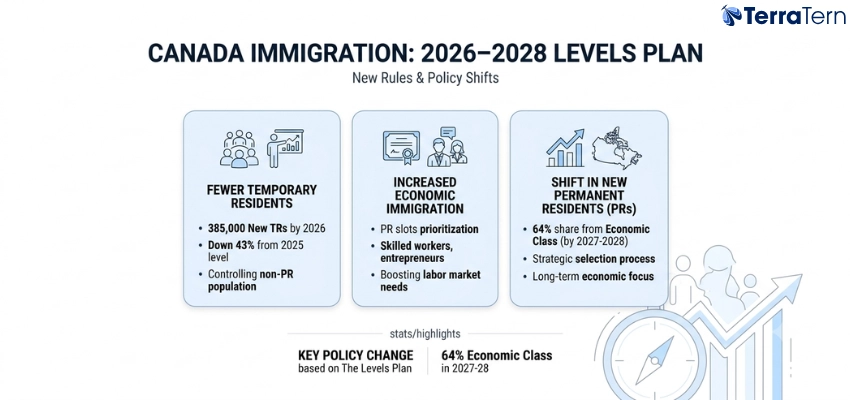
The new rules for Canada immigration2026-2028 Levels Plan, which is a new policy, respectively lowers the number of new temporary residents to 385,000 in 2026 (down 43% compared with 2025) and raises the share of new permanent residents who come from the economic class to 64% in 2027-2028. These regulatory changes are based on The Levels Plan, the document that underpinned the regulatory shift.
|
Metric |
2025 Target |
2026 Target |
Change |
|
Permanent Resident admissions |
~395,000 (2025 plan) |
380,000 |
Stabilized/slightly reduced |
|
New temporary residents (workers + students) |
673,650 |
385,000 |
-43% |
|
Economic-class share of PR admissions |
59% |
Rising to 64% by 2027 |
+5 pts by 2027 |
Pro Tip: The headline PR number (380,000) hasn't dropped dramatically the real story is the temporary resident cut, which affects study permits and work permits far more directly than most applicants realise.
Also Read: New Rules for Canada Immigration: Experts' Latest Update
What Are the New Rules for Canada Immigration Through Express Entry in 2026?
The new rules for canada immigration through Express Entry are
-
IRCC introduced additional priority categories for 2026, such as those for researchers and senior managers who have worked in Canada, transport occupations and skilled military occupations.
-
Canada also maintains draws for certain priority categories such as foreign medical doctors with Canadian experience, healthcare, trades, STEM, education, agriculture and French language.
-
Some categories of Express Entry had their minimum work-experience requirement increased, making the rules tougher for some Express Entry profiles.
-
IRCC is also conducting a review of a future reform that may combine all three classifications (Federal Skilled Worker, Canadian Experience Class and Federal Skilled Trades) into a Federal High-Skilled Class.
-
This offer is not final, however, so Express Entry applicants should abide by existing rules until IRCC confirms that the rules have changed.
Key Note: Don't confuse the Federal High-Skilled Class proposal with a live rule it's still in public consultation as of mid-2026. Base your application strategy on the current, confirmed Express Entry categories, not on a reform that may not take effect for some time.
What Are the New Rules for Canada Immigration Affecting International Students in 2026?
The new rules for Canada immigration 2026 study permit cap Important: No longer need to have a provincial attestation letter (PAL/TAL) for master students and doctoral students at public institutions.
-
Issuance Target: Canada has set a cap of 408,000 total permits (155,000 new and 253,000 extensions
-
Application Cap: National strict cap on application spaces that require PAL/TAL of 309,670.
-
Massive cuts in the "high demand" provinces such as Ontario and BC, and comparatively generous cuts in Alberta and Saskatchewan, via "provincial quotas. The early application is a valuable real-life benefit.
-
The most significant difference in the PAL/TAL process in 2026 is that all master's and doctoral students at public DLIs are completely exempted from the PAL/TAL process. The exemption is also for K-12 students and current permit holders continuing in the same level at the same institution.
|
Year |
Total Study Permits Issued (Target) |
Change |
|
2024 |
~485,000 |
— |
|
2025 |
~437,000 |
-10% vs. 2024 |
|
2026 |
~408,000 (155k new + 253k extensions) |
-7% vs. 2025, -16% vs. 2024 |
As per TerraTern Expert: if you're pursuing a master's or PhD at a public Canadian university, the removal of the PAL/TAL requirement in 2026 is a genuine advantage; it means your application isn't subject to the same provincial cap competition facing undergraduate and college applicants.
Also Read: Top Jobs in Canada: The Latest Guide for the year
What Are the New Rules for Canada Immigration Regarding the Post-Graduation Work Permit (PGWP)?
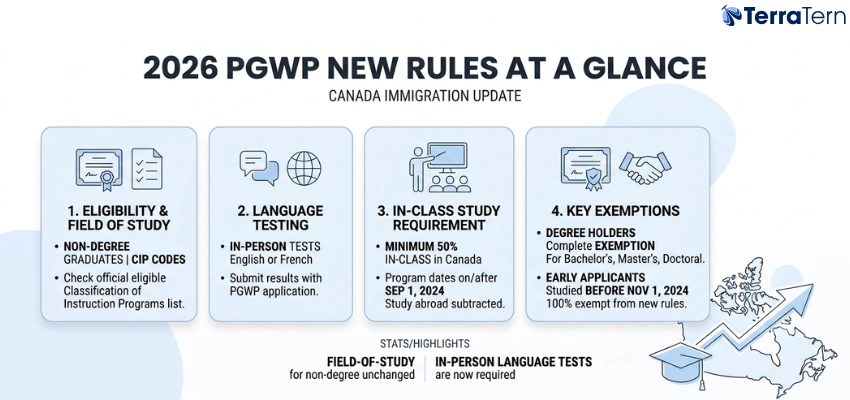
Under the new rules for canada immigration,2026 Post-Graduation Work Permit (PGWP) changes to immigration to Canada maintain the same field-of-study list for non-degree graduates, require candidates to take language tests in person and require 50% in-class study for recent applicants.
2026 PGWP Eligibility Checklist:
-
The list of eligible Classification of Instruction Programs (CIP) codes for non-degree graduates is still in place for 2026. Please check your official CIP code before applying.
-
In-person Language Testing: Now you will be required to undergo an English or French language test in person and submit results directly with your PGWP application.
-
For in-class dates of September 1, 2024 and later, a minimum of 50% of your program shall be in-class in Canada. All study periods abroad will be subtracted from the total length of PGWP.
-
Degree-Holder & Grandfathered Exemptions
-
Bachelor's, master's or doctoral graduates are completely exempt from the restrictions on the field of study.
-
Also, students who applied for a study permit / PGWP prior to November 1, 2024 are 100% exempt from these new rules.
Important Note: Don't rely on what your college told you about PGWP eligibility; verify your program's exact CIP code directly against IRCC's published list, since program titles can be misleading and the consequences of a mismatch (no PGWP at all) are severe.
What Are the New Rules for Canada Immigration Through Provincial Nominee Programs (PNPs)?
Under the new rules for Canada immigration, provinces and territories gained sole authority, effective March 30, 2026, to assess a PNP candidate's intent to reside and ability to become economically established
-
IRCC officers can no longer independently override these two factors once a province issues a nomination
-
Before March 30, 2026: IRCC could re-assess intent and economic establishment even after provincial nomination, sometimes refusing valid nominees
-
After March 30, 2026: a nomination certificate stands as conclusive evidence; IRCC must consult the province if concerns arise, and the province decides whether to uphold or revoke
-
Change applies to both new PNP applications and existing files not yet past the eligibility stage
-
Individual streams (e.g., BC PNP's June 1, 2026 Skills Immigration guides) continue evolving separately, sharpening focus on healthcare, childcare, and construction trades
Expert Tip: Because provinces now carry full responsibility for assessing your intent to reside and economic prospects, a generic PNP application is riskier than ever; tailor your application specifically to the nominating province's current priority list, which can change (as BC's did in June 2026) with little advance notice.
What Are the New Rules for Canada Immigration for Family Sponsorship and the Super Visa?
Under the new rules for Canada immigration, effective March 31, 2026, Super Visa hosts gained two new ways to meet the minimum income (LICO) requirement
-
Extended income assessment: hosts (and co-signer, if applicable) can now qualify using either of the two taxation years preceding the application — not just the most recent one
-
Income supplementing: the visiting parent's or grandparent's own income can now be added to top up the host's income, once the host independently meets a minimum base percentage of the threshold
-
Example: a host whose 2025 income fell short can still qualify if their 2024 income met the threshold
-
Changes apply to both new applications and those already in processing as of March 31, 2026
-
Super Visa itself remains unchanged: up to 5 consecutive years per stay (extendable by 2 more), valid up to 10 years total
Expert Advice: If your most recent tax year's income was lower than usual, check whether your income from the prior taxation year meets the Super Visa threshold instead ,the new extended assessment window could make your application viable without waiting for another full tax year to pass.
What Are the New Rules for Canada Immigration for Entrepreneurs and the Start-Up Visa?
New rules for Canada immigration closed the Start-Up Visa (SUV) work permit to new applicants from December 19, 2025, except those extending an existing SUV work permit
-
From December 31, 2025 (11:59 pm), IRCC stopped accepting new SUV program applications entirely
-
Exception: applicants holding a valid 2025 commitment certificate can still apply, but only until June 30, 2026
-
These changes signal a transition toward a new, targeted entrepreneur pilot program, with details expected later in 2026
-
Priority PR processing continues for entrepreneurs already in Canada on SUV work permits
Important Tip: If you hold a 2025 commitment certificate from a designated SUV organisation, don't miss the June 30, 2026 deadline; this narrow exception is the only remaining door into the old Start-Up Visa program before the new pilot program replaces it.
What Other New Rules for Canada Immigration Should Applicants Know About in 2026?
Under the broader new rules for Canada immigration, IRCC's May 1, 2026 guidance update now lets out-of-status workers and students restore directly to visitor status, without needing to leave Canada ,the standard 90-day restoration window still applies
-
Restoration requires staying in Canada throughout processing, with no work or study permitted until approval
-
IRCC issued updated guidance clarifying resettlement travel coordination for government-assisted and privately sponsored refugees, covering how travel arrangements are handled before arrival
-
Ontario's "As of Right" framework, effective January 1, 2026, lets professionals certified in another Canadian province begin working in Ontario within 10 business days, for up to 6 months while completing full registration
-
Covers 50+ regulatory authorities and 300+ certifications, including engineering, architecture, skilled trades, and healthcare roles like physicians and nurses
-
A standard 10-year adult passport rose to $163.50 as of April 1, 2026, up from $160
Key Note: If you're a regulated professional (nurse, engineer, tradesperson) already certified in another Canadian province and considering a move to Ontario, the new "As of Right" framework could meaningfully shorten your path to working there , check whether your specific profession is covered.
What Is Driving the New Rules for Canada Immigration in 2026?
Canada's 2026 immigration updates are part of a broader strategy to build a more balanced and sustainable system. Key drivers behind the new rules for Canada immigration:
-
380,000 permanent resident target: the 2026–2028 Levels Plan stabilises PR admissions at 380,000 annually through 2028
-
Sharp cut to temporary residents: the new temporary resident target drops from 673,650 (2025) to 385,000 (2026) a 43% reduction to ease housing and population pressure
-
Bigger economic-class share: economic immigration rises from 59% to 64% of total admissions by 2027–2028, the highest share in decades
-
Skills-based selection: stronger emphasis on applicants matching high-demand sectors through targeted programs
-
More provincial authority: provinces and territories now play a larger role in PNPs and student permit allocations to meet local labour needs
-
Sustainable system goal: IRCC's 2026–27 Departmental Plan prioritises a well-managed, sustainable immigration system supporting economic growth
-
Long-term workforce planning: policies aim to fill labour shortages while balancing housing, healthcare, and infrastructure capacity
Pro Tip: Every major 2026 update supports one of two objectives: reducing temporary resident numbers or growing economic immigration pathways, a useful lens for spotting where future opportunities will emerge.
Read More: Immigration To Canada From India: The Ultimate Guide
Conclusion
The new rules for Canada immigration in 2026 reflect a major policy shift, sharply reducing temporary resident intake while stabilising permanent resident admissions and tilting further toward economic-class selection. The Levels Plan's underlying logic prioritises sustainability over volume, reshaping outcomes differently across applicant types: tighter pathways for students and entrepreneurs, more provincial control for skilled workers, and modest flexibility for sponsoring families. For personalised guidance navigating these changes, consider booking a consultation with TerraTern's immigration specialist
To learn more about new rules for Canada immigration and some of the prominent ways to settle in Canada, you must contact TerraTern right away. With an expert team and some of the leading well-known subject matter experts, TerraTern is one of the leading organizations in the immigration field!