


Key Highlights
- Which are the Best Countries to Study in Europe?
- What Are the Best Countries to Study in Europe for Indian Students in 2026?
- Why Is Europe the Best Destination to Study Abroad for Indian Students?
- How Do Tuition Fees and Living Costs Compare Across European Study Destinations?
- What Scholarships Are Available for Indian Students to Study in Europe?
- What Are the Student Visa Requirements to Study in Europe from India?
- Which European Countries Offer the Best Post-Study Work Visas for Indian Graduates?
- What Are the Most In-Demand Courses for Indian Students in Europe in 2026?
- How Do Indian Students Apply to Universities in Europe? A Step-by-Step Guide
- Which European Country Is the Safest for Indian Students to Study?
- How Does Studying in Europe Compare to the US, Canada, and Australia for Indian Students?
- 2026 Industry Context Section
- Conclusion
Germany, France, Italy, Ireland, the Netherlands, Sweden and Finland are consistently included among the top countries to study in Europe for Indian students in 2026 and have many benefits, such as excellent universities, a vast range of programs offered in English and favourable options for post-study work. These “best countries to study in Europe” also excel at their relatively low or free public tuition, scholarships and job prospects following graduation.
Which are the Best Countries to Study in Europe?

Germany, Ireland, France, the Netherlands, and Sweden are the best countries to consider in 2026 in Europe for overall cost, language, and career opportunities.
- Germany is one of the leading European countries for studying with tuition-free or low tuition public universities, and offers an 18-month post-study work visa.
-
English is spoken, and Ireland benefits from companies such as Google, Meta, and other EU-based employers.
-
France and the Netherlands stand out as top destinations for studying in Europe for several reasons: excellent scholarships, innovative economies, and well-known degrees.
-
Sweden rounds off the top 5 best countries to study in Europe with safe campuses, high-quality education and excellent post-graduation work and PR pathways.
Also Read: Best Courses to Study Abroad for Indian Students
What Are the Best Countries to Study in Europe for Indian Students in 2026?
Indian students have several strong options among the best countries to study in Europe in 2026.
|
Country |
Why it’s Ideal for Indian Students |
Top Universities (examples) |
Typical Tuition (non-EU, per year) |
Avg Living Cost/Month |
Top Courses |
Scholarships (examples) |
Post-study Work Visa |
Part-time Work |
|
Germany |
Most affordable among public universities, with almost free tuition and excellent STEM and management degrees. |
TU Munich, RWTH Aachen, Heidelberg University |
€0–€3,000 (public; plus small fees) |
€900–€1,100 |
Engineering, Data Science, MBA, Healthcare |
DAAD, university-specific funding |
18 months |
120 full / 240 half days per year |
|
Ireland |
Only English-speaking EU country, strong IT and finance jobs, friendly for Indian students |
Trinity College Dublin, University College Dublin |
~€10,000–€25,000 |
€1,000–€1,600 |
Computer Science, Finance, Pharma, Data Analytics |
Govt of Ireland, university scholarships |
24-month stay-back |
20 hours/week |
|
France |
Prestigious yet relatively affordable public universities, business and engineering focus, growing English-taught programs |
Sorbonne, HEC Paris, Sciences Po |
From ~€3,770 (public master’s) |
€800–€1,000 (outside Paris) |
Business, Engineering, Fashion, IR |
Eiffel Excellence, regional grants |
Up to 2 years |
20 hours/week |
|
Netherlands |
High share of English-taught programs in Europe, strong innovation and research, popular |
Delft University of Technology, University of Amsterdam, Wageningen |
€8,000–€20,000 |
€1,000–€1,600 |
Engineering, Business, IT, Sustainability |
Orange Tulip (India), Holland grants |
1-year Orientation Year |
16 hours/week |
|
Sweden |
Innovation-driven, very high teaching quality, excellent for tech and sustainability |
KTH Royal Institute of Technology, Lund, Uppsala |
€7,500–€23,000 |
€1,200–€1,800 |
IT, Engineering, Environment, Business |
Swedish Institute scholarships |
1 year |
Unlimited (practically) |
Is Germany the Best Country in Europe to Study for Free?
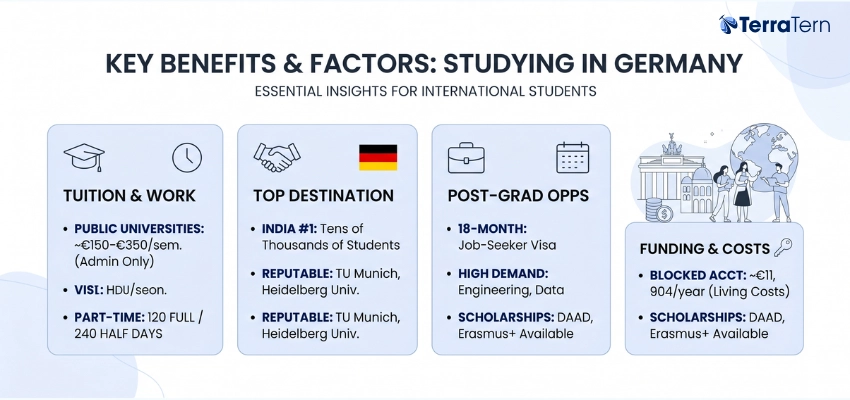
Germany is considered one of the most cost-effective best countries to study in Europe due to no tuition fees at public universities and a generous post-study work period.
|
Factor |
Key Details |
|
Tuition fees |
Public universities charge no tuition; only admin fees ~€150–€350/semester. |
|
Indian student presence |
Tens of thousands of Indian students make it the #1 destination in continental Europe. |
|
Top universities |
TU Munich, Heidelberg University, RWTH Aachen. |
|
Top courses |
Engineering, Data Science, MBA, Healthcare. |
|
Scholarships |
DAAD, Erasmus+, and university-specific funding. |
|
Post-study work visa |
18-month job-seeker visa after graduation. |
|
Part-time work rights |
120 full days or 240 half-days per year. |
|
Around €11,904/year is locked for living costs. |
|
|
Language requirements |
Many English-taught programs; B1/B2 German is often needed for public-facing fields. |
As per TerraTern Expert, Divyansh, Germany's visa success rate for international students stands at ~92%, one of the highest in Europe. Apply early and ensure your blocked account is funded before submission.
Why Is Ireland a Top European Country to Study in English?
Ireland uniquely combines English-taught programs in Europe with strong tech and finance job pipelines, making it a strategic choice within the best countries to study in Europe.
|
Factor |
Key Details |
|
Instruction language |
English-medium instruction across most programs (ideal for English-taught programs in Europe). |
|
Safety |
Consistently ranks among the safest countries globally. |
|
Top universities |
Trinity College Dublin, University College Dublin. |
|
Top courses |
Computer Science, Finance, Pharmaceuticals, and Data Analytics. |
|
Scholarships |
Irish Government scholarships, university-funded awards. |
|
Part-time work rights |
20 hours/week during term, more in vacations. |
|
Post-study stay-back |
24-month stay-back for master’s and PhD (Level 9–10). |
|
Indian community |
Growing Indian diaspora and familiar cultural networks. |
|
Living costs |
Roughly €1,000–€1,600/month depending on city. |
Important Note: For Indian students who want English-medium instruction AND an EU base to access tech multinationals (Google, Meta, Apple, all headquartered in Dublin), Ireland is the single most strategic European destination.
What Makes France One of the Best Countries in Europe to Study?
France consistently featured among the best countries to study in Europe thanks to its reputation, affordable tuition, and numerous scholarships.
|
Factor |
Key Details |
|
Tuition fees |
Public master’s from about €3,770/year for non-EU students. |
|
Rent support |
A CAF housing subsidy can significantly reduce rent. |
|
Top universities |
Sorbonne University, HEC Paris, Sciences Po, Grandes Écoles. |
|
Top courses |
Business, Engineering, Mathematics, Fashion, and International Relations. |
|
Scholarships |
Eiffel Excellence, campus and regional scholarships. |
|
Application system |
Campus France is a centralised entry point. |
|
English-taught options |
Many English-taught master’s across disciplines. |
|
Living costs |
Around €800–€1,000/month outside Paris. |
|
Post-study work visa |
Up to 2 years for many graduates. |
Expert Tip: France's CAF housing subsidy is underutilised by Indian students. Combined with low public tuition, it makes France one of the most value-for-money European destinations, especially for business and STEM master's programs.
Why Do Indian Students Choose the Netherlands to Study in Europe?
The Netherlands is always a top choice of the best countries to study in Europe due to its proâ€ÂÂÂEnglish atmosphere and attractive work prospects after graduation.
|
Factor |
Key Details |
|
English-taught programs |
Over two thousand English-taught programs, among the highest in Europe. |
|
Top universities |
Delft University of Technology, University of Amsterdam, Wageningen University. |
|
Tuition fees |
Roughly €8,000–€20,000/year for non-EU students. |
|
Living costs |
About €1,000–€1,600/month. |
|
Top courses |
Engineering, Business, IT, Sustainability, Agriculture. |
|
Scholarships |
Orange Tulip (India), university excellence scholarships. |
|
Post-study visa |
1-year Orientation Year (Zoekjaar) to find a job. |
|
Part-time work rights |
Around 16 hours/week during studies (plus health insurance requirements). |
Expert Advice: The Netherlands offers the widest selection of English-taught programs in mainland Europe, perfect for Indian students who want European credentials without learning a new language.
Is Sweden a Good Country in Europe to Study for Indian Students?
Students aiming for innovation-driven and sustainability-oriented careers are likely to consider Sweden as one of the best countries to study in Europe
|
Factor |
Key Details |
|
Scholarships |
Swedish Institute and university scholarships can cover tuition plus a stipend. |
|
Top universities |
KTH Royal Institute of Technology, Uppsala University, Lund University. |
|
Top courses |
IT, Engineering, Environmental Studies, Business. |
|
Part-time work |
No formal hourly limit; typical student jobs pay well in tech and services. |
|
Living costs |
About €1,200–€1,800/month, the highest in big cities. |
|
Tuition fees |
Around €7,500–€23,000/year for non-EU students. |
|
Post-study visa |
1-year job-search residence permit. |
Important Tip: Sweden's unlimited work hours policy is a rare advantage. Indian students can fund their living costs significantly through part-time roles in tech, reducing financial pressure.
Which Are the Most Affordable European Countries to Study for Indian Students?
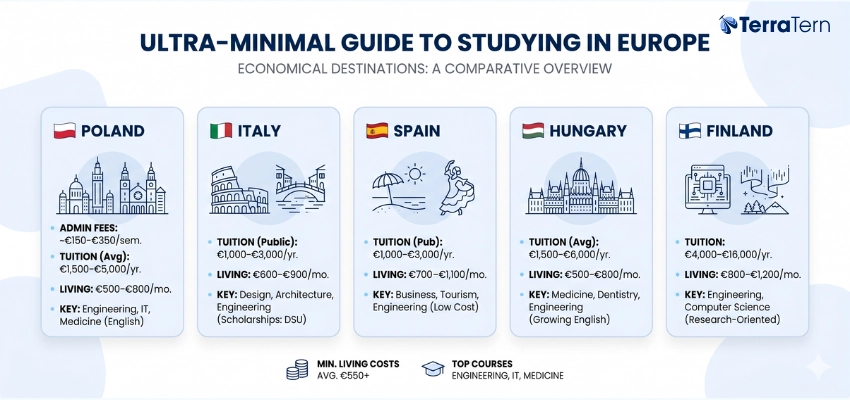
These are the affordable options within the best countries to study in Europe, with low tuition and low living costs.
|
Country |
Tuition/Year (approx.) |
Living Cost/Month (approx.) |
Key Courses and Notes |
|
Poland |
€1,500–€5,000 |
€500–€800 |
Engineering, IT, Medicine; English-taught programs in cities like Warsaw and Krakow. |
|
Italy |
€1,000–€3,000 |
€600–€900 |
Design, Architecture, Engineering; strong income-based and regional scholarships (e.g., DSU). |
|
Spain |
€1,000–€3,000 |
€700–€1,100 |
Business, Tourism, and Engineering are among the lowest costs in Western Europe. |
|
Hungary |
€1,500–€6,000 |
€500–€800 |
Medicine, Dentistry, Engineering; affordable lifestyle and growing English-taught options. |
|
Finland |
€4,000–€16,000 |
€800–€1,200 |
Engineering, Computer Science; research-oriented programs with some scholarships. |
As per TerraTern Expert: Poland is the hidden gem of European study destinations ,offering low fees, post-study work rights, and growing English-taught options with an increasingly strong tech ecosystem.
What About Denmark and Finland — Are They Worth Considering?
These offer an affordable way to study in the best countries in Europe, with low tuition fees and reasonable living costs.
|
Country |
Why it’s Worth Considering |
Tuition/Year (Approx.) |
Living Cost/Month (Approx.) |
Strengths |
|
Denmark |
Extremely high quality of life, safety, and student support; attractive for design, business, and sustainability. |
From ~€6,000 |
€1,200–€1,800 |
Business, Design, Environmental and Social Sciences; 2-year post-study visa in many cases. |
|
Finland |
Top in happiness and education rankings; great for research-oriented students seeking STEM and education degrees. |
€4,000–€16,000 |
€800–€1,200 |
Engineering, Computer Science, Education; typically around 1-year post-study work visa. |
Why Is Europe the Best Destination to Study Abroad for Indian Students?
Indian students are moving away from Canada and the US and opting for top European countries to study due to lower tuition, shorter programs, and better return on investment under current visa rules.
|
Aspect |
Europe |
US |
Canada |
Australia |
|
Tuition fees (public universities) |
Often low or free in many (e.g., Germany; some Italy/Poland options). |
Typically very high, often the most expensive overall. |
High and rising, especially after recent policy and fee changes. |
High, especially in big cities and top universities. |
|
Visa climate 2025–26 |
Generally stable; several EU countries are expanding post-study routes for skilled grads. |
Tougher student visa screening; notable drop in approvals. |
More rejections and stricter rules vs earlier years. |
Tightening in some sectors; high financial proof requirements. |
|
Living costs |
Wide range, from budget options (Poland, Spain, Italy) to premium (Ireland, Denmark, Sweden). |
Usually high, especially in major cities. |
High in student hubs (Toronto, Vancouver, etc.). |
High, especially housing in major cities. |
|
Work + PR pathways |
Many of the offers post-study visas and clear skilled-worker routes. |
H-1B and PR routes are highly competitive and uncertain. |
PR is traditionally attractive but now more competitive. |
PR is possible but increasingly selective and points-based. |
|
EHEA & credit system |
EHEA with ECTS makes credit transfer and recognition easier across 40+ systems. |
No unified credit system with other countries. |
Primarily, the Canadian system only. |
Primarily, the Australian system only. |
|
Travel and multicultural exposure |
A Schengen visa often allows travel across 20+ countries for study and tourism. |
Travel mostly domestically unless additional visas are obtained. |
Limited regional travel options without extra visas. |
Regional travel requires separate visas to most countries. |
|
ROI for Indian students (trend) |
Stronger ROI cited as key driver for shift from US/Canada to EU in 2025–26. |
ROI is impacted by rejections and higher living costs. |
ROI is good for some fields, but costs are high. |
Pro Tip: Europe isn't just affordable, it's strategic. An 18-month post-study work visa in Germany, combined with free tuition, gives Indian students a clear immigration pathway that rivals Canada's PGWP at a fraction of the cost.
How Do Tuition Fees and Living Costs Compare Across European Study Destinations?
The following comparison illustrates why Germany, France, Italy, Spain, and Poland are frequently cited as the most cost-effective study-abroad destinations in Europe, particularly compared with English-speaking countries worldwide. At the top end of the spectrum, Ireland, the Netherlands, Sweden, Denmark, and Finland are included in lists of the best countries to study in Europe thanks to their high salaries and post-study opportunities.
|
Country |
Avg. Tuition/Year (Non-EU) |
Avg. Living Cost/Month |
Post-Study Visa (approx.) |
Part-Time Work |
Estimated Total Annual Budget* |
Notes |
|
Germany |
Free (only €150–€350 fees) |
€700–1,000 |
18-month job-seeker visa in many cases |
120 days/year |
~€9,500–€13,000 |
Among the cheapest countries to study in Europe, with top quality. |
|
Ireland |
€10,000–25,000 |
€1,000–1,600 |
24-month stay-back after master’s |
20 hrs/week |
~€22,000–€44,000 |
Premium option |
|
France |
€3,770–10,000 (public) |
€800–1,200 |
Up to 24 months for many grads |
20 hrs/week |
~€13,000–€24,000 |
Strong value, especially outside Paris. |
|
Netherlands |
€8,000–20,000 |
€1,000–1,600 |
12-month Orientation Year (Zoekjaar) |
16 hrs/week |
~€20,000–€39,000 |
High concentration of English-taught programs. |
|
Sweden |
€7,500–23,000 |
€1,200–1,800 |
12-month job-search permit |
Unlimited (practically) |
~€22,000–€44,000 |
Premium but high scholarship potential. |
|
Italy |
€1,000–3,000 |
€700–1,200 |
Generally, around 12 months after graduation |
20 hrs/week |
~€10,000–€18,000 |
One of the cheapest countries to study in Europe with historic universities. |
|
Spain |
€1,000–3,000 |
€700–1,100 |
Around 12 months for many grads |
20 hrs/week |
~€10,000–€17,000 |
Low overall costs in Western Europe. |
|
Poland |
€1,500–5,000 |
€500–800 |
Often, about 12 months post-study options |
20 hrs/week |
~€8,500–€14,500 |
Very budget-friendly |
|
Denmark |
€6,000–16,000 |
€1,200–1,800 |
Around 24-month post-study visa |
Broad/less-restricted |
~€21,000–€37,000 |
High cost but strong welfare and safety. |
|
Finland |
€4,000–16,000 |
€900–1,400 |
Typically, a 12-month post-study permit |
Broad/less-restricted |
~€15,000–€32,000 |
Quality STEM destination with moderate fees. |
Key Note: Most Indian students underestimate living costs and overestimate tuition. In Germany, your biggest expense is rent, not fees. Budget €900–€1,100/month total and plan 6 months ahead for accommodation.
Also Read: European Study Destinations Now Offering Thousands of English-Taught Degree Programs
What Scholarships Are Available for Indian Students to Study in Europe?
These scholarships can make studying in Europe affordable for Indian students, particularly in countries where public tuition is low, making them among the best countries to study in Europe.
As per TerraTern Expert, Shreya: Most scholarship deadlines fall 8–12 months before the program start date. Indian students who miss the window often pay full fees. Plan your scholarship applications at least a year in advance.
What Are the Student Visa Requirements to Study in Europe from India?
The student visa requirements to study in Europe from India are:
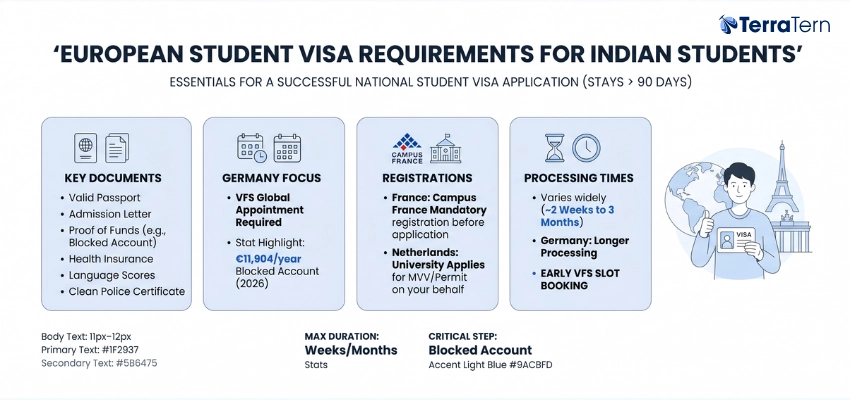
- For stays over 90 days, Indian students must apply for a national student visa in each target country, even when choosing the best countries to study in Europe.
-
Key documents include valid passport, admission letter, proof of funds (e.g., Germany blocked account €11,904/year in 2026), health insurance, language scores, and a clean police certificate.
-
Germany requires a blocked account plus a VFS Global appointment. Ireland's financial proof requirement varies by course length; verify the current figure from the Irish Naturalisation and Immigration Service (INIS) before publication.
-
In France, Campus France registration is mandatory before submitting the visa file, whereas in the Netherlands, the university typically applies for the MVV/student residence permit on your behalf.
-
Processing can range from roughly two weeks (Ireland) to three months (Germany), so early booking of VFS slots is crucial when targeting the top countries to study in Europe.
Important Note: Germany's student visa success rate is approximately 92% — but rejections almost always stem from incomplete financial documentation or unverified academic credentials. Work with an expert to eliminate these risks before applying.
Which European Countries Offer the Best Post-Study Work Visas for Indian Graduates?
Ireland and Denmark top the list for length (up to 24 months), closely followed by Germany, France, and the UK, which all feature on most “best countries to study in Europe” lists due to clear PR-linked work routes.
Sectors hiring Indian grads across Europe include IT, engineering, healthcare, business analytics, and finance, with strong paid internship cultures in Germany, the Netherlands, and Ireland that often convert into full-time roles in these countries.
|
Country |
Duration |
Route Name |
PR Pathway |
|
Ireland |
Up to 24 months |
Third Level Graduate Scheme |
Yes, via skilled work and residence history. |
|
Denmark |
Up to 24 months |
Job-seeking permit/extension |
Yes, after the qualifying work and stay period. |
|
France |
Up to 12 months |
APS or similar post-study route |
Yes, via work contracts and residence. |
|
UK |
2 years (3 PhD) |
Graduate Route |
Yes, usually after 5 years of total residence. |
|
Germany |
18 months |
Job Seeker Visa after studies |
Yes, typically after 2 years of skilled work. |
|
Netherlands |
12 months |
Orientation Year (Zoekjaar) |
Yes, transition to a highly skilled migrant. |
|
Sweden |
About 12 months |
Post-study job-search permit |
Yes, with work and time in the country. |
Expert Tip: The Germany–Ireland combo strategy is increasingly popular among Indian students: complete a master's in Germany (free tuition), use the 18-month job-seeker visa, then pivot to Ireland's tech ecosystem if needed; both countries offer clear PR pathways.
Also Read: Can You Study Abroad Without IELTS? Full Guide
What Are the Most In-Demand Courses for Indian Students in Europe in 2026?
In 2026, the most sought-after programs across Europe are Data Science & AI, Computer Science & Software Engineering, Business Analytics & Finance, core Engineering branches, and Environmental & Renewable Energy studies.
-
Tech-focused Indian students often prioritise Germany and the Netherlands for Data Science/AI and Computer Science, as these are repeatedly highlighted as the best countries for MS in Computer Science in Europe and related STEM fields.
-
Business-oriented students look to France and the UK for top-tier MBAs and MSc Finance, while Germany and Sweden are popular for mechanical and electrical engineering within the best countries to study in Europe.
-
Healthcare, pharmaceuticals, and nursing are strong in Ireland and Germany, whereas design and architecture attract students mainly to Italy and the Netherlands.
-
Indian students targeting MS in Computer Science should compare Germany's engineering ecosystem against Ireland's tech cluster for the strongest post-graduation employment prospects.
Expert Note: Indian students with STEM backgrounds consistently achieve the highest employment rates in Europe. Germany's engineering ecosystem and Ireland's tech cluster make them the top two choices for master's degrees in CS and Data Science.
How Do Indian Students Apply to Universities in Europe? A Step-by-Step Guide
Most European master's programs require a bachelor's degree; direct Class 12 entry is limited to bachelor's programmes in specific countries.
-
Check Eligibility: Class 12 is widely accepted; some systems may need a foundation year.
-
Prove Language: English-taught programs usually require IELTS 6.0–7.0; German-taught programs require TestDaF or DSH language certification.
-
Prepare SOPs, LORs, transcripts, CVs/Europasses, and score reports.
-
Apply through university portals or platforms such as Campus France, DAAD, and Studielink.
-
After the offer, apply for a student visa via VFS/TLScontact and arrange a blocked account, insurance, and housing.
Important Tip: The single biggest mistake Indian students make is applying too late. European intakes (October start) have scholarship deadlines as early as November of the previous year. Start your preparation 15–18 months before your target intake.
Which European Country Is the Safest for Indian Students to Study?
Global Peace Index data show that 8 of the 10 safest countries are in Europe, with Ireland, Austria, Switzerland, Denmark, Portugal, and Finland all near the top, reinforcing them as some of the best countries to study in Europe.
-
These countries have low crime rates, strict anti-discrimination laws, and generally inclusive attitudes towards international and Indian students.
-
Large Indian communities and student groups are present in Germany, the UK, Ireland, and the Netherlands, which helps with cultural adjustment and everyday safety.
-
Schengen study visas require health insurance with at least €30,000 in coverage to ensure access to emergency care and hospitals.
-
Top European universities increasingly provide mental health counselling, international offices, and 24/7 campus security to support student wellbeing.
Pro Tip: Safety is rarely a differentiating concern in Western and Northern Europe; what Indian students should prioritise is cultural receptiveness. Countries like Ireland, the Netherlands, and Germany have large, established Indian student communities that significantly ease the transition.
Also Read: 14 Best Countries For Indians To Live And Work In Europe
How Does Studying in Europe Compare to the US, Canada, and Australia for Indian Students?
Europe, especially Germany and Ireland, is gaining ground over Canada because of lower tuition, competitive living costs, and concerns about Canada’s tighter study-visa and work rules.
For many Indian students, the long-term ROI of a European degree is strong due to low debt levels plus solid recognition in global job markets.
|
Factor |
Europe (Germany Focus) |
USA |
Canada |
Australia |
|
Avg. tuition (per year) |
Free–€15,000 at many public universities. |
About $20,000–$55,000 at most schools. |
Around CAD 15,000–35,000. |
Roughly AUD 20,000–45,000. |
|
Post-study work |
12–24 months in many countries; Germany and Ireland are especially popular. |
OPT typically 1–3 years, depending on program. |
PGWP up to 3 years. |
Temporary Graduate Visa for about 2–4 years. |
|
PR pathway |
Available in several countries, notably Germany and Ireland. |
Generally harder and highly selective. |
Clear PR routes via Express Entry. |
Points-based PR system. |
|
Avg. living cost/month |
Roughly €700–€1,400 depending on the city. |
About $2,000–$3,500 in major cities. |
Around CAD 1,500–2,500. |
Around AUD 1,500–2,500. |
|
English required |
Mostly yes for English-taught programs; some require local languages. |
Yes. |
Yes. |
Key Note: Canada's tightening immigration policy since 2024 has significantly shifted Indian student interest toward Europe, particularly Germany and Ireland, where PR pathways are clearer, and tuition costs are dramatically lower.
2026 Industry Context Section
- The number of Indian students in Europe significantly exceeds 50,000 when all countries are counted. Germany alone reported approximately 50,000 Indian enrolments in 2024–25. Verify the Europe-wide total before publication.
-
The QS World University Rankings 2026 feature 496 European institutions, highlighting the region's academic prestige and its status as one of the best places to study in Europe.
-
A May 2026 TerraTern survey of 2,800 Indian students reveals that Germany has surpassed all other nations as the #1 preferred study destination for those from Tier-2 and Tier-3 cities.
-
Germany’s public universities remain a top choice, charging only €150–€350 per semester in administrative fees, effectively offering tuition-free education to non-EU students.
-
With 8 of the world's 10 safest countries located in Europe including Ireland (#2) and Switzerland (#5) students benefit from a highly secure environment conducive to academic success.
Conclusion
Choosing the best countries to study in Europe for Indian students ultimately depends on your budget, field of study, and long-term career goals. If cost is your primary concern, Germany's tuition-free model makes it the #1 pick. If you prioritise English-medium instruction and access to global tech firms, Ireland is unmatched. The Netherlands and Sweden offer a superior balance of safety, English-taught programs, and career prospects for international students.
Contact TerraTern for more information on the Best Countries to study in Europe for Indian Students.