Key Highlights
- What Is a Master of Data Analytics in Australia?
- Which Are the Top Universities for Master of Data Analytics in Australia?
- What Is the Master of Data Analytics Cost in Australia for Indian Students?
- Annual Tuition by University Tier
- What Are the Eligibility Criteria for a Master of Data Analytics in Australia?
- How Should You Apply for a Master of Data Analytics in Australia?
- What Scholarships Are Available for a Master of Data Analytics in Australia?
- What Are the Career Outcomes and Salaries After a Master of Data Analytics in Australia?
- What Is the Australia PR Pathway After a Master of Data Analytics?
- Conclusion
For international students seeking to transform big data into lucrative, high–skilled tech and business-oriented careers in diverse industries such as finance, IT, healthcare, consulting, and more, Master of Data Analytics in Australia has become a favoured option. Most typically have a duration of 1.5-2 years and emphasize in learning how to do business problem–solving combined with programming in tandem with statistics and machine learning. The average data analytics tuition cost for overseas students in Australia is about 18-32 lakh INR or 25-45 thousand AUD on average.
What Is a Master of Data Analytics in Australia?
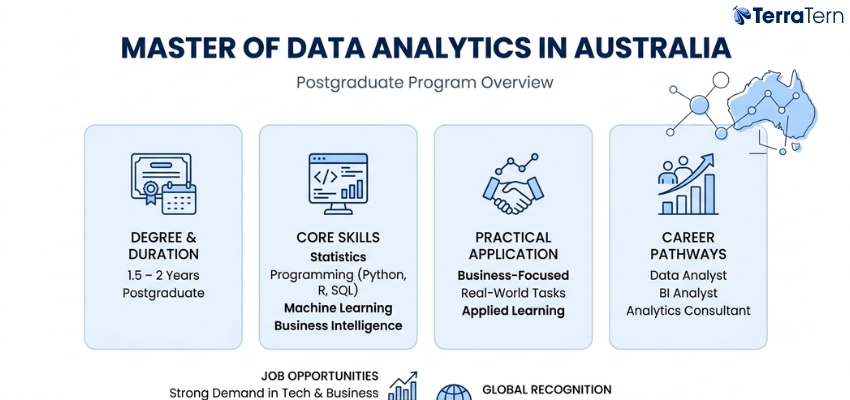
Master of Data Analytics in Australia is a 1.5-2-year degree offered in the postgraduate program and is designed to be focused on the application of statistics, programming (Python, R, SQL), machine learning, and business intelligence to real tasks within the business field, primarily for occupations in the field of data analysts, BI analysts, and analytics. More applied/business focused than a Master of Data Science (more theory and ML/AI) but less management focused than a Master of Business Analytics.
|
Program |
Core focus |
Best for |
Typical duration |
|
Master of Data Analytics in Australia |
Applied analytics, BI, modern data tools |
Industry-oriented analysts |
1.5–2 years |
|
Master of Data Science |
ML, AI, and statistical theory |
Research-oriented careers |
2 years |
|
Master of Business Analytics |
Strategy, management, reporting |
Business/MBA graduates |
1–2 years |
As per TerraTern Expert Divyansh, Many Indian students apply for a Master of Data Science when their background and career goals actually align better with a Master of Data Analytics, which has lower STEM entry requirements, higher admission rates, and equally strong job placement in industry analyst and BI roles. Match the program to your background, not just the name.
Also Read: Master of Data Analytics in Australia: Latest Guide
Which Are the Top Universities for Master of Data Analytics in Australia?
Some of the best universities to pursue a masters in data analytics in Australia are the University of Melbourne, Australian National University (ANU), Monash University, UNSW Sydney, University of Queensland, RMIT University, Deakin University, and University of Technology Sydney (UTS) for their robust analytics programs and connections within the industry These are institutions that have programs closely related to Australia's master of data analytics including great global recognition amongst employers and employability rates with graduates.
|
University |
Closest Program Name (Analytics-focused) |
QS Ranking (World) |
Approx. Annual Tuition (AUD) |
Approx. Annual Tuition (₹, at ₹65/AUD) |
Duration |
IELTS (overall) |
|
University of Melbourne |
Master of Data Science |
#33 |
47,344 |
₹30.8L |
2 years |
6.5–7.0 |
|
Australian National University |
Master of Computing (Data Analytics specialisation) |
#34 |
47,010 |
₹30.6L |
2 years |
6.5 |
|
UNSW Sydney |
Master of Data Science |
#19 |
49,440 |
₹32.1L |
2 years |
7.0 |
|
University of Queensland |
Master of Data Science |
#40 |
48,240 |
₹31.4L |
1.5–2 years |
6.5 |
|
Monash University |
Master of Data Science |
#57 |
42,800 |
₹27.8L |
2 years |
6.5 |
|
RMIT University |
Master of Analytics |
~#250 |
36,480 |
₹23.7L |
2 years |
6.5 |
|
Deakin University |
Master of Data Analytics |
~#351 |
37,200 |
₹24.2L |
2 years |
6.5 |
|
UTS Sydney |
Master of Data Science and Innovation |
~#137 |
34,000 |
₹22.1L |
2 years |
6.5 |
|
La Trobe University |
Master of Data Analytics / Data Science |
~#581 |
33,600 |
₹21.8L |
2 years |
6.5 |
|
Macquarie University |
Master of Data Science |
~#195 |
44,000 |
₹28.6L |
2 years |
6.5 |
Important Note: For most Indian students targeting permanent residency, the 485 visa and PR pathway matter as much as the university's global ranking. Monash, UQ, RMIT, and La Trobe offer programs where data analytics occupations on the Australian Skilled Occupation List provide a realistic PR pathway ,not just a prestigious-sounding degree.
What Is the Master of Data Analytics Cost in Australia for Indian Students?
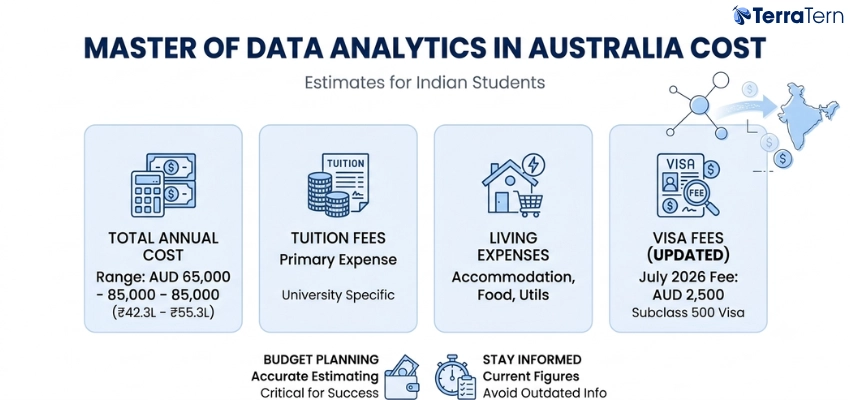
When planning yourmaster of data analytics cost in australia budgeting accurately is just as important as picking the right university.
-
Based on current figures, you can expect the total cost of attendance including tuition, living expenses, health insurance, and visa fees to range from AUD 65,000 to AUD 85,000 per year (₹42.3L–₹55.3L).
-
The Australian government recently increased the Subclass 500 Student Visa fee.
-
While many older resources list it at AUD 1,600, as of July 2026, the fee is actually AUD 2,500. I've updated the breakdowns below to reflect this reality so you aren't caught off guard.
Annual Tuition by University Tier
Tuition will be your largest expense, and it varies significantly depending on the institution's prestige and location
|
University Tier |
Annual Tuition (AUD) |
Annual Tuition (INR) |
|
Group of Eight (Top Tier) |
AUD 42,000 – 49,440 |
₹27.3L – ₹32.1L |
|
Mid-Tier (RMIT, UTS, etc.) |
AUD 34,000 – 44,000 |
₹22.1L – ₹28.6L |
|
Accessible-Tier (Deakin, etc.) |
AUD 33,600 – 37,200 |
₹21.8L – ₹24.2L |
Full Cost of Attendance Breakdown (Annual)
Beyond tuition, you need to prove you can cover your day-to-day life. Here is a realistic breakdown of what a year in master of data analytics in australia, looks like for an international student.
|
Cost Component |
Annual Cost (AUD) |
Annual Cost (INR) |
|
Tuition |
AUD 33,600 – 49,440 |
₹21.8L – ₹32.1L |
|
Accommodation (Shared) |
AUD 12,000 – 18,000 |
₹7.8L – ₹11.7L |
|
Food & Groceries |
AUD 4,800 – 7,200 |
₹3.1L – ₹4.7L |
|
Transport |
AUD 1,500 – 2,500 |
₹97,500 – ₹1.6L |
|
OSHC (Mandatory Insurance) |
AUD 700 – 850 |
₹45,500 – ₹55,000 |
|
Visa (Subclass 500) |
AUD 2,500 (One-time) |
₹1.62L (One-time) |
|
Miscellaneous |
AUD 2,000 – 3,000 |
₹1.3L – ₹2.0L |
|
Annual Total |
AUD 57,100 – 83,490 |
₹37.2L – ₹54.3L |
Expert Tip: The part-time work provisions in Australia are genuinely transformative for Indian students' cost calculations ,a student working 48 hours/fortnight at AUD 25/hour can earn AUD 24,000+ per year, covering most or all of their living costs. Factor this into your total cost calculation: the net out-of-pocket cost for most Indian families is significantly lower than the headline tuition + living figure suggests.
What Are the Eligibility Criteria for a Master of Data Analytics in Australia?
To apply for a master of data analytics in australia, you generally need a bachelor's degree in a relevant field such as IT, computer science, mathematics, statistics, engineering, or quantitative business with a minimum GPA of 5.0/7.0 or 60–65%. You must also demonstrate English proficiency, typically with an IELTS score of 6.5 overall. While relevant work experience is preferred, it is not strictly mandatory for most programs.
Standard Admission Requirements
|
Requirement |
Standard |
Notes |
|
Bachelor's Degree |
Relevant discipline |
IT, CS, Math, Statistics, Engineering, or Physics preferred. |
|
Minimum GPA |
5.0/7.0 or 60–65% |
65%+ for Group of 8 universities; La Trobe/Deakin often accept 60%. |
|
IELTS (Overall) |
6.5 |
UNSW requires 7.0; all others generally accept 6.5. |
|
IELTS (Bands) |
6.0 minimum |
Select universities may require 6.5 in each individual band. |
|
TOEFL iBT |
79–93 |
Widely accepted alternative to IELTS. |
|
58–65 |
Accepted at most Australian universities. |
|
|
Work Experience |
Preferred, not mandatory |
Can sometimes substitute for a slight GPA shortfall. |
|
GRE |
Not required |
Rarely requested; not part of standard Australian admissions. |
Expert Advice: Indian students with commerce or business bachelor's degrees shouldn't rule out a data analytics master's in Australia. Deakin, La Trobe, and RMIT have specifically designed entry pathways for business-background applicants. Completing the bridging semester and then the full master's gives you the same qualification as a CS-background graduate ,but with a unique cross-disciplinary profile that employers in finance, retail analytics, and marketing data value highly.
How Should You Apply for a Master of Data Analytics in Australia?
Applying for a master of data analytics in australia is a structured, seven-step process that requires careful planning around intakes, visa requirements, and the total master of data analytics cost in australia.
-
Step 1: Shortlist Universities (9–12 months before intake): Select institutions aligned with your career goals, budget, and city preferences.
-
Step 2: Prepare Core Documents (8–9 months before intake): Attest academic transcripts and compile your CV, SOP, and LORs.
-
Step 3: Take Language Tests (8–9 months before intake): Sit for the IELTS or PTE exam to meet mandatory English proficiency standards.
-
Step 4: Submit Online Applications (6–8 months before intake): Apply via university portals before the October (February intake) or April (July intake) deadlines.
-
Step 5: Secure Health Cover (OSHC): Purchase mandatory health insurance, an essential component of your overall master of data analytics cost in australia.
-
Step 6: Obtain Confirmation of Enrolment (CoE): Pay your initial tuition deposit to receive the CoE document from your chosen university.
-
Step 7: Apply for the Subclass 500 Visa (2–4 months before intake): Submit your CoE, financial proofs, and visa documents via ImmiAccount.
Important Tip: The 2025 Australian international student cap introduced by the government has created a Semester 1 bottleneck at high-demand universities. Indian students applying for February 2027 intake should submit applications by August–September 2026 ,not the traditional October–November window ,to avoid cap-related rejections that have nothing to do with their academic merit.
What Scholarships Are Available for a Master of Data Analytics in Australia?
Indian students pursuing a master of data analytics in australia can access federal scholarships (like the Australia Awards and Research Training Program) alongside university-specific merit scholarships. Institutions such as Macquarie (AUD 10,000), RMIT (20% tuition waiver), UTS (25% waiver), and Deakin (25% waiver) offer substantial financial aid.For professionals and students in Bangalore mapping out their international education, securing these waivers can significantly reduce the overall master of data analytics cost in australia by AUD 7,000 to AUD 48,000. Navigating these options and preparing applications with guidance from TerraTern ensures you are well-positioned for the upcoming 2026 intakes.
Government Scholarships
|
Scholarship |
Provider |
Amount |
Open To |
IELTS Required? |
|
Australia Awards Scholarships |
Australian Government |
Full tuition + living stipend |
Strong academic record + development impact |
Yes |
|
Research Training Program (RTP) |
Australian Government |
Full tuition + AUD 32,500/year stipend |
Research-based master's only |
Yes |
|
Destination Australia |
Australian Government |
AUD 15,000/year |
Students studying in regional Australia |
Yes |
University Merit Scholarships
|
University |
Scholarship |
Value |
When Applied |
|
Macquarie University |
Early Acceptance Scholarship for Indian Students |
AUD 10,000 |
Automatic with early admission |
|
RMIT |
Future Leaders Scholarship |
20% tuition waiver |
At application |
|
UTS |
Postgraduate Academic Excellence Scholarship |
Up to 25% tuition waiver |
At application |
|
Deakin University |
Deakin International Scholarship |
Up to 25% tuition waiver |
At application |
|
Adelaide University |
Adelaide Emerging Leaders Scholarship |
Up to 25% tuition waiver |
At application |
|
Monash University |
International Merit Scholarship |
AUD 10,000 |
Automatic, merit-based |
|
University of Melbourne |
Melbourne Research Scholarship |
Up to full fees + stipend |
Research pathways only; competitive |
As per TerraTern Expert: Macquarie University's Early Acceptance Scholarship for Indian students an automatic AUD 10,000 award with no separate application is one of the most underutilised scholarship opportunities among Indian data analytics applicants simply because most students don't know it exists. Apply to Macquarie early; the scholarship doesn't require a separate form and makes a meaningful dent in your first-year tuition.
What Are the Career Outcomes and Salaries After a Master of Data Analytics in Australia?
Graduates with a master of data analytics in australia earn AUD 75,000–AUD 130,000 annually (₹48.75L–₹84.5L), with entry-level roles starting at AUD 75,000–AUD 100,000 and senior analytics positions reaching AUD 130,000–AUD 163,476. This earning potential easily offsets the overall master of data analytics cost in australia, supported by a 27.7% rise in data analyst job demand and strong employer recruitment from major firms like Google, Deloitte, Atlassian, Accenture, and EY.
Post-Graduation Career Roles and Salaries
|
Role |
ANZSCO Code |
Average Salary (AUD) |
Average Salary (₹) |
Entry Point |
|
Data Analyst |
225113 |
AUD 95,000–120,000 |
₹61.75L–78L |
Yes |
|
Data Scientist |
262111 |
AUD 110,000–160,000 |
₹71.5L–1.04 Cr |
Mid-level |
|
Business Intelligence Analyst |
225113 |
AUD 90,000–115,000 |
₹58.5L–74.75L |
Yes |
|
Machine Learning Engineer |
261399 |
AUD 115,000–150,000 |
₹74.75L–97.5L |
1–2 years exp. |
|
Data Engineer |
261312 |
AUD 100,000–140,000 |
₹65L–91L |
1–2 years exp. |
|
Analytics Manager |
225113 |
AUD 130,000–163,476 |
₹84.5L–1.06 Cr |
Senior |
Industry Trends and ROI Highlights
-
Top-Paying Locations: Minchinbury (Western Sydney) tops the list at AUD 163,476. Capital city averages range from AUD 105,000–160,000 in Canberra, AUD 95,000–150,000 in Sydney, and AUD 85,000–130,000 in Melbourne.
-
Leading Recruiters: Top employers include Google, Deloitte, Atlassian, Accenture, EY, ANZ Bank, Commonwealth Bank, NAB, Medibank, Woolworths Group, and Suncorp.
-
High-Demand Sectors: The strongest hiring occurs in finance and fintech, healthcare, retail analytics, government, and technology consulting.
-
Industry Growth: Data analyst job demand in Australia rose 27.7% from 2025 to 2026, largely driven by AI adoption creating hybrid roles that blend data analysis with machine learning skills.
-
India Comparison ROI: An entry-level data analyst in India earns ₹6L–₹12L/year, whereas the same qualification in Australia commands AUD 75,000+ (₹48.75L).
Pro Tip: The ANZSCO code for your target role matters enormously for visa purposes, not just salary comparison. Verifying that your target occupation (e.g., Data Analyst, ANZSCO 225113) appears on the relevant skilled occupation list before choosing your degree and university is the single most strategic step an Indian student can take to ensure their Australian master's leads to residency, not just employment.
What Is the Australia PR Pathway After a Master of Data Analytics?
After completing a master of data analytics in australia, apply for the 485 Post-Study Work Visa (2–4 years) to gain local experience. You can then work as a data analyst, transitioning to the 482 Employer-Sponsored Visa or applying for PR through the 189, 190, or 491 Skilled Migration streams. With data analytics roles securely on the Medium and Long-term Strategic Skills List (MLTSSL), this robustly supports your long-term PR eligibility.
Step-by-Step PR Pathway
-
Complete Your Degree: Finish your two-year program while maintaining full-time enrollment, a critical foundation that justifies your initial master of data analytics cost in australia.
-
Apply for the 485 Visa: Secure the Post-Study Work Visa (currently AUD 5,750 as of mid-2026) within six months of graduation to gain open work rights for any employer.
-
Gain Skilled Experience: Accumulate 1–3 years of Australian work experience as a Data Analyst or Data Scientist, aiming for a salary above the TSMIT threshold for sponsored pathways.
-
Target PR Streams: Apply for the Skilled Independent Visa (189), State Nominated Visa (190), or Regional Visa (491) based on your accumulated points.
-
Clear Skills Assessment: Obtain a positive skills assessment from the Australian Computer Society (ACS) or VETASSESS to formally validate your qualifications for permanent residency.
Points System Breakdown for Indian Graduates
|
Factor |
Points Awarded |
Notes |
|
Age (25–32 years) |
30 |
Maximum points bracket. |
|
English Proficiency |
20 |
Requires an IELTS score of 8+ (Superior English). |
|
Skilled Employment |
20 |
Typically 3–5 years overseas plus Australian experience. |
|
Australian Master's Degree |
15 |
Awarded for completing a relevant CRICOS-registered program. |
|
State Nomination (190 Visa) |
5 |
Additional points if nominated by a state like Victoria or Queensland. |
Key Note: A 4-year 485 visa (available if you studied in a regional location or designated institution) vs. the standard 2-year visa is a significant strategic advantage ,it gives you twice the time to accumulate the Australian work experience that pushes your PR points to the invitation-worthy threshold of 85–90. If two universities are roughly equivalent in program quality and cost, choosing the one in a regional area can meaningfully improve your PR timeline.
Read More: Best City In Australia For Jobs, Students & Visitors
Conclusion
Overall, completing a master of data analytics in Australia has numerous benefits and advantages for students. It equips the students with all the skills and knowledge essential for students to become employable. The course's curriculum provides excellent opportunities for students to enhance their learning experience. Also, the top-notch universities in Australia ensure a good career path for students as they have globally recognised degrees. Apart from that, there are numerous work opportunities for students in the country due to Australia's constantly growing market industry. All these factors combined make Australia the best choice for students to pursue a master of data analytics in Australia.
If you want to pursue a master's in data analytics in Australia, then this guide is just for you, and to make your journey easier, TerraTern is right there for you.





 AI Summary