

Key Highlights
- What Is MBBS in UK and Why Should Indian Students Consider It in 2026?
- What Are the 2025–26 Industry Statistics and Trends for MBBS in UK for Indian Students?
- Which Are the Best Universities for MBBS in UK for Indian Students in 2026?
- What Are the Eligibility Criteria for MBBS in UK for Indian Students?
- What Is the Total Cost of MBBS in UK for Indian Students in 2025–26?
- What Is the Admission Process for MBBS in UK for Indian Students Step by Step?
- What Entrance Exams Are Required for MBBS in UK for Indian Students?
- What Is the MBBS Curriculum and Course Structure in UK Universities?
- How Can Indian Students Obtain a UK Student Visa for MBBS?
- What Are the Career Opportunities After MBBS in UK for Indian Students?
- Is MBBS in UK Worth It for Indian Students? A Balanced Assessment
- Conclusion
An MBBS in UK for Indian students will provide an international exposure to the world, great clinical exposure and the best education. In 2026, the need to navigate university options, UCAS applications, and visa policies means that communication must be accurate and up to date. It is a comprehensive handbook that dissects all you need to know about the top medical school, UCAT entry criteria, and even the tuition fees, to help you start your medical career in a foreign country smoothly and successfully.
What Is MBBS in UK and Why Should Indian Students Consider It in 2026?

In the UK, MBBS degrees are normally awarded as MB ChB or MB BCh. It is an Undergraduate degree (in 5-6 years) fully equivalent to the Indian MBBS.
-
Pursuing an MBBS in UK for Indian students will guarantee them a globally recognised MBBS, which is recognised by the GMC, NMC (India) and the WHO.
-
Unparalleled NHS clinical training is provided to students, with a focus on early patient contact and a globally recognised research culture.
-
Recognition of outstanding UK medical degrees promises to offer career flexibility, either to remain in the UK or to return to India.
-
UK MLA is now an obligatory condition, and the BMAT is entirely abolished.
-
According to UCAS statistics this year, there are unprecedented numbers of Indian applicants, solidifying the UK as one of the top-3 destinations in the world for medical education.
As per TerraTern Expert, Shreya, the UK 's medical degree is one of the few globally that is directly recognised by India's NMC without requiring the FMGE, a major advantage that many Indian students and parents are unaware of, making the initial cost-benefit calculation far more favourable than it appears.
What Are the Top Reasons Indian Students Choose MBBS in UK Over Other Countries?
Indian students pursuing MBBS in the UK are assured of internationally standardised, GMC-regulated medical education, without the language barriers or varying accreditation challenges common in some other overseas destinations.
-
The program is not only 100% English-speaking but also has no language barriers when dealing with patients, unlike in Eastern Europe.
-
Firsthand clinical experience is far better, with significantly more hands-on time, than that offered by offshore medical campuses through direct integration with the NHS.
-
The UK also provides a highly regulated, geopolitically stable environment that facilitates continuous education more than UK raine does.
-
UK vs. Top MBBS Alternatives.
|
Feature |
UK |
Russia / UK raine |
Private Indian Colleges |
|
Global Recognition |
Exceptional (GMC, NMC, WHO) |
Moderate |
High (NMC) |
|
Clinical Exposure |
Very High (NHS Training) |
Moderate (Language barriers) |
High |
|
Medium of Instruction |
100% English |
Often Bilingual |
English |
|
Overall Cost |
High |
Low |
Very High |
Important Note: When comparing total 5-year costs, a UK MBBS from a mid-tier university (Leicester, Aberdeen) often costs less than a private medical college in India, when factoring in scholarship opportunities, post-study earning potential in the NHS, and the absence of an FMGE requirement.
Also Read: Top 10+ Best Countries for MBBS for Indian Students: Guide
What Are the 2025–26 Industry Statistics and Trends for MBBS in UK for Indian Students?
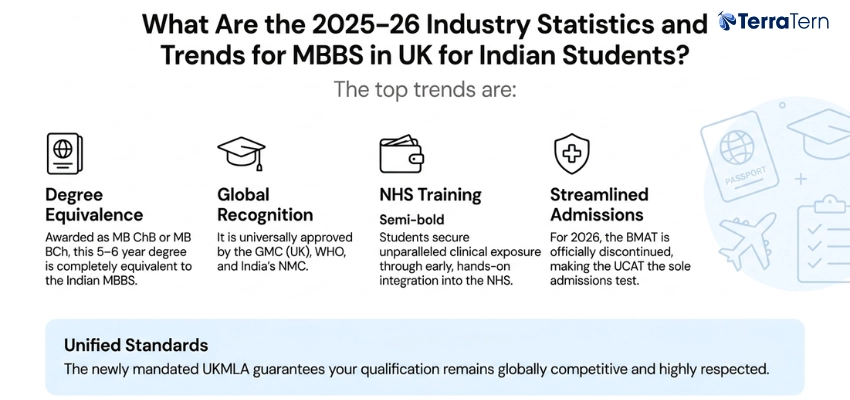
The top trends are:
-
Degree Equivalence: Awarded as MB ChB or MB BCh, this 5–6 year degree is completely equivalent to the Indian MBBS.
-
Global Recognition: It is universally approved by the GMC (UK ), WHO, and India’s NMC.
-
NHS Training: Students secure unparalleled clinical exposure through early, hands-on integration into the NHS.
-
Streamlined Admissions: For 2026, the BMAT is officially discontinued, making the UCAT the sole admissions test.
-
Unified Standards: The newly mandated UK MLA guarantees your qualification remains globally competitive and highly respected.
Expert Advice: The 2024–25 introduction of the UK MLA is the single biggest regulatory change in UK medical education in a decade. Indian students applying for 2026 entry must factor UK MLA preparation into their 5-year plan from Year 1, not just PLAB at the end.
Which Are the Best Universities for MBBS in UK for Indian Students in 2026?
For MBBS in UK for indian students, the strongest options are QS-ranked, NMC-approved medical schools with NHS-linked clinical training. Below is a concise HTML-style table you can drop into your page:
|
University (Tier) |
QS Rank (Medicine 2025) |
Annual Fees (Approx.) |
UCAT Requirement |
NMC Approved? |
|
University of Oxford |
#2 |
INR 44–50L / £37–43K |
UCAT |
Yes |
|
University of Cambridge |
#3 |
INR 44–50L / £37–43K |
UCAT |
Yes |
|
Imperial College London |
#4 |
INR 46–52L / £39–44K |
UCAT |
Yes |
|
UCL |
#8 |
INR 40–48L / £34–41K |
UCAT |
Yes |
|
King's College London |
#12 |
INR 38–46L / £32–39K |
UCAT |
Yes |
|
University of Edinburgh |
#20 |
INR 50–60L / £42–50K |
UCAT |
Yes |
|
University of Manchester |
#25 |
INR 40–45L / £34–38K |
UCAT |
Yes |
|
University of Leicester |
#195 |
INR 30–35L / £26–30K |
UCAT |
Yes |
|
University of Aberdeen |
#194 |
INR 45–54L / £38–46K |
UCAT |
Yes |
|
Queen's University Belfast |
#168 |
INR 38–43L / £32–37K |
UCAT |
Yes |
|
University of East Anglia |
~301–350 |
INR 32–40L / £27–34K |
UCAT |
Yes |
Expert Tip: Indian students often fixate on Oxford and Cambridge, but universities like Leicester and Queen's Belfast offer GMC-regulated, NMC-recognised degrees at 30–40% lower fees with higher acceptance rates, making them a smarter financial decision for most applicants who aren't targeting research academia.
Which UK Medical Universities Have the Highest Acceptance Rates for Indian Students?
For MBBS in UK for indian students, “easier-to-get-into” medical schools typically have higher acceptance rates than Oxford/Cambridge/Imperial and may be slightly more flexible on UCAT. Key options (with comparatively higher acceptance rates) include:
-
University of East Anglia (UEA): Larger cohort size and more generous intake than London/Oxbridge; strong community-based training.
-
Brighton & Sussex Medical School (BSMS): Smaller but growing intake; values contextual and holistic profiles alongside UCAT.
-
Plymouth University Peninsula School of Medicine: Regional focus; often slightly higher acceptance rate than top-20 schools.
-
Hull York Medical School (HYMS): Joint medical school with state-sector focus; more generous intake than elite London schools.
-
University of Chester (Graduate-Entry MBChB): Graduate-entry route with a smaller applicant pool; competitive but more accessible than Oxford/Cambridge.
Important Tip: Applying to a diversified list of 4 UCAS choices, including 1–2 higher-acceptance universities, significantly improves an Indian student's admission odds without sacrificing degree quality or NMC recognition.
What Are the Eligibility Criteria for MBBS in UK for Indian Students?
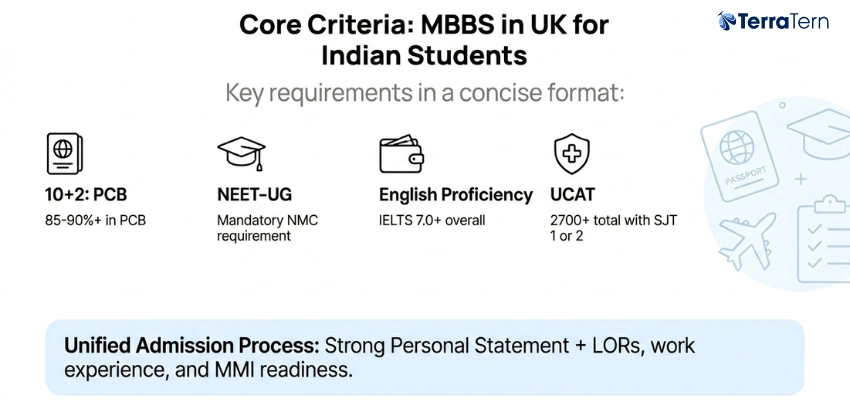
For MBBS in UK for indian students, most UK medical schools require these core criteria in a concise 5–6-point format:
-
10+2 with PCB (Physics, Chemistry, Biology) and minimum 85–90% in PCB, with Oxford/Cambridge-level schools often needing 90%+.
-
The NEET-UG qualification is mandatory for Indian students to ensure NMC recognition of the degree back in India.
-
English proficiency: IELTS 7.0+ overall (no band below 6.5; some universities require 7.5) or equivalent TOEFL score.
-
UCAT score of 2700+ total with SJT Band 1 or 2 for most undergraduate MBBS programmes (BMAT discontinued from 2024).
-
Strong personal statement + 1–2 LORs via UCAS, plus 2–4 weeks hospital shadowing/work experience and readiness for MMI-style interviews.
As per TerraTern Expert: Many Indian students are unaware that the BMAT has been fully discontinued. Oxford, Cambridge, and all other UK medical schools now use only the UCAT. Students preparing for the 2026–27 entry must begin UCAT preparation by May 2026 at the latest.
What Documents Are Required for MBBS Admission in UK from India?
For MBBS in UK for indian students, admissions and UK visa processing rely on a clear checklist:
-
Admission Documents: Class 10 & 12 mark sheets + certificates (attested), NEET scorecard, UCAT result, IELTS/TOEFL, UCAS personal statement, 2 LORs, passport copy, and evidence of hospital shadowing/work experience.
-
Visa Documents: CAS from the university, bank statements showing roughly INR 50–80 lakh (or GBP equivalent), TB test report, IHS health-surcharge proof (INR 90k+ ≈ £776/year), and a valid passport with 6+ months validity beyond the course.
Pro Tip: The CAS (Confirmation of Acceptance for Studies) number is the linchpin of your UK student visa application without it, no visa application can be filed. Accept your university offer promptly and request CAS at least 3 months before your intended travel date.
Also Read: Top 15 Best Countries for Indian Doctors to Migrate
What Is the Total Cost of MBBS in UK for Indian Students in 2025–26?
For MBBS in UK for indian students, the total annual cost usually ranges from roughly INR 45–85 lakh per year, combining tuition (INR 22–52 lakh) and living expenses (INR 12–20 lakh), depending on the university and city.
Tuition Fees by University (2025–26, per year)
|
University |
Tuition (GBP) |
Tuition (INR approx.) |
|
University of Oxford |
£37,000–£43,000 |
INR 43L–INR 50L |
|
Imperial College London |
£39,000–£44,000 |
INR 46L–INR 52L |
|
King's College London |
£32,000–£39,000 |
INR 38L–INR 46L |
|
University of Manchester |
£29,000–£36,000 |
INR 34L–INR 42L |
|
University of Leicester |
£26,000–£30,000 |
INR 30L–INR 35L |
|
Queen's University Belfast |
£32,000–£37,000 |
INR 38L–INR 43L |
|
University of East Anglia |
£27,000–£34,000 |
INR 32L–INR 40L |
Annual Living Expenses (approx.)
|
City/Region |
Monthly (INR ) |
Annual (INR ) |
|
London |
INR 1,20,000–INR 1,75,000 |
INR 14.4–INR 21 lakh |
|
Outside London |
INR 85,000–INR 1,30,000 |
INR 10.2–INR 15.6 lakh |
Key Note: Choosing a mid-tier non-London university (Leicester, Plymouth, UEA) over an elite London school can save INR 70–90 lakhs over the full 5-year course, without sacrificing GMC/NMC recognition or clinical training quality. For most Indian families, this is the most financially rational choice.
What Scholarships Are Available for Indian Students Doing MBBS in UK ?
For MBBS in UK for indian students, fully funded full-MBBS scholarships are rare, but several partial and postgraduate-focused schemes help reduce costs. A compact table is:
|
Scholarship |
Value / Coverage |
Eligibility (Indian-friendly) |
Type |
|
Chevening Scholarship |
Full tuition + living + travel |
For postgraduate (not direct MBBS), Indian nationals |
UK Government |
|
Commonwealth Shared Scholarship |
Tuition + stipend |
Postgraduate only; not UG MBBS |
Commonwealth |
|
UCL Medical School Bursary |
Up to £7,000/year |
Need- and merit-based; UCL medicine students |
University |
|
UEA India Scholarship |
Up to £3,000/year |
Indian nationals admitted to UEA (including health program) |
University |
|
King's College Trust Fund |
Variable financial aid |
Demonstrated financial hardship; King's medical students |
University |
|
British Council GREAT Scholarship |
Typically £10,000 |
For select postgraduate courses, not UG MBBS |
GREAT Programme |
As per TerraTern Expert, Divyansh, very few Indian MBBS students in the UK apply for university-level bursaries because they assume only postgraduate scholarships exist; this is a costly misconception. Every admitted student should contact their university's financial aid office on the day they accept their offer.
What Is the Admission Process for MBBS in UK for Indian Students Step by Step?
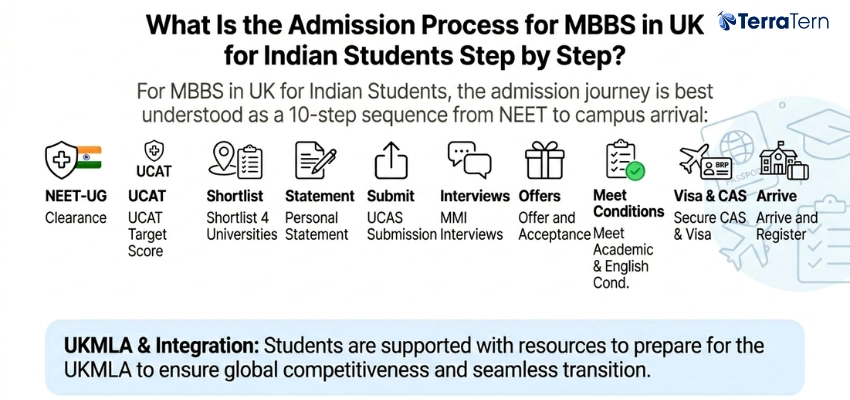
For MBBS in UK for indian students, the admission journey is best understood as a 10-step sequence from NEET to campus arrival:
-
Clear NEET-UG (18–24 months before intake) to satisfy NMC India rules; universities only require qualification, not a specific score.
-
Appear for UCAT (July–September of application year) with a target of 2700+ total and SJT Band 1 or 2; BMAT is now discontinued.
-
Shortlist 4 UK medical schools on UCAS (Oxford/Cambridge count as one choice) based on UCAT range, fees, and clinical-reputation fit.
-
Draft a tight personal statement (4,000 characters) highlighting medical motivation, shadowing, and core skills, usable for all four UCAS choices.
-
Submit UCAS by 15 October, including 10+2 scores, NEET details, UCAT, and 1–2 academic references.
-
Attend MMI interviews (November–March) focused on ethics, communication, and clinical-reasoning stations.
-
Receive offers (conditional or unconditional) and accept one via UCAS Track by the deadline.
-
Meet academic conditions (85–90%+ in PCB) and submit final transcripts before August.
-
Secure CAS from the university, then apply for the UK Student Visa (gov.UK ) with financial proof and IHS health surcharge.
-
Arrive in September, collect BRP within 10 days, register with GP and university services, and start the MBBS programme.
Important Note: The 15 October UCAS deadline for medicine is non-negotiable; it applies to all UK applicants, including international students from India. Missing it means waiting a full year. Begin UCAS preparation by August at the latest and have your personal statement reviewed by a professional consultant before submission.
What Is the UCAS Application Process for Indian Students Applying to UK Medical Schools?
For MBBS in UK for indian students, UCAS is the only gateway to UK undergraduate medicine; these points capture the essentials in a crisp 5–6-bullet format:
-
UCAS is Mandatory: All Indian applicants to UK MBBS must apply via ucas.com; no direct or parallel-portal routes exist for undergraduate medicine.
-
Create An Account: Add personal details, education history, and test scores (NEET, UCAT), then pay the application fee (around £10–£15).
-
Use the 4-Choice Limit Wisely: Medicine allows only 4 school choices; structure them as 1 reach, 2 target, and 1 safety, based on UCAT and academic profile.
-
Submit One Generic Personal Statement: Submit one 4,000-character personal statement across all four choices; focus on medical-specific competencies, not generic “career goals” as in Indian SOPs.
-
Arrange Academic References: Your school/college must provide a reference letter (1–2) describing your academic performance and potential for medicine.
-
Track via UCAS Hub: Monitor interview invitations, offers, and decision deadlines; common mistakes include applying to 5 schools (not allowed), missing the 15 October deadline, and writing a weak or generic personal statement.
Expert Tip: Indian students often write personal statements that read like Indian SOP essays, focused on family inspiration and future goals. UK medical schools want evidence of current medical insight, work experience, and reflection. Rewrite your statement with this in mind before October.
What Entrance Exams Are Required for MBBS in UK for Indian Students?
For MBBS in UK for indian students, you typically need NEET-UG, UCAT, and IELTS; BMAT has been discontinued by all major UK medical schools from 2024, with UCAT now the standard, so all UK medical schools, including Oxford and Cambridge, now rely only on UCAT. Below is an exam-overview table you can use:
|
Exam |
Purpose of MBBS in the UK |
Requirement Level for Indian Students |
2026 Update / Note |
|
NEET-UG |
NMC India recognition is needed to practice or register in India |
Mandatory qualification; no fixed score set by UK universities |
NMC mandates NEET qualification for Indian Students |
|
UCAT |
Primary aptitude test for UK medical admissions |
Required by most schools; competitive score 2700+ total, SJT Band 1–2 |
BMAT scrapped; UCAT is now the only standard aptitude exam |
|
IELTS |
English proficiency for university admission and visa |
7.0+ overall, no band below 6.5 (some universities ask 7.5) |
Widely accepted alternative: TOEFL |
|
TOEFL |
English proficiency (alternative to IELTS) |
Equivalent to IELTS 7.0+; check per-uni cutoff |
Can be used in parallel to IELTS |
|
GAMSAT |
Graduate entry medicine (postgraduate-style MBBS route) |
For Indian graduates aiming at 4-year MBBS/graduate-entry courses |
Separate pathway from standard 5-year UG MBBS |
|
UK MLA |
Final licensing exam for all UK MBBS graduates (incl. IMGs) |
Taken in the final year; must pass to register with the GMC/UK Medical Register |
Replaces traditional finals from 2024–25 onwards |
Expert Advice: Starting UCAT preparation 6–9 months before the test window (July–September) gives Indian students a significant advantage. Unlike NEET, which rewards memorisation, UCAT tests reasoning skills, making structured mock test practice and section-specific strategies essential.
Also Read: UK Visitor Visa Fees Checklist for India Students & Fees
What Is the MBBS Curriculum and Course Structure in UK Universities?
For MBBS in UK for indian students, UK MBBS (usually MB ChB) is a 5–6-year integrated programme combining pre-clinical sciences with NHS-based clinical rotations from early years, culminating in UK MLA and Foundation-year preparation.
|
Year |
Phase |
Key Focus / Modules (Illustrative) |
Clinical Component / Hospitals |
|
1 |
Pre-clinical |
Anatomy, Physiology, Biochemistry, Cell Biology, Intro to Clinical Skills, Communication |
Early patient contact in university-linked hospitals (e.g., regional NHS trusts) |
|
2 |
Pre-clinical |
Pharmacology, Pathology, Medical Sociology, Psychology of Health, Ethics |
More structured bedside teaching, primary-care tasters |
|
3 |
Clinical transition |
Systems-based medicine (Cardiology, Respiratory, GI, Neurology, Haematology) + Clinical Methods |
Hospital-based attachments in medicine & surgery departments |
|
4 |
Clinical rotations |
Surgery, Internal Medicine, Paediatrics, Psychiatry, Obstetrics & Gynaecology, Primary Care |
Rotations across major teaching hospitals within NHS |
|
5 |
Final year |
Specialised attachments, elective (often 6–12 weeks abroad or in India), UK MLA preparation, Clinical Finals |
NHS trust-based rotations + elective placement (many Indian students choose Indian hospitals) |
Important Tip: The shift to Problem-Based Learning (PBL) at most UK universities is a significant adjustment for Indian students trained in rote-based learning. Students who invest in communication and critical-thinking skills before arrival consistently perform better during clinical years and MMI interviews.
How Can Indian Students Obtain a UK Student Visa for MBBS?
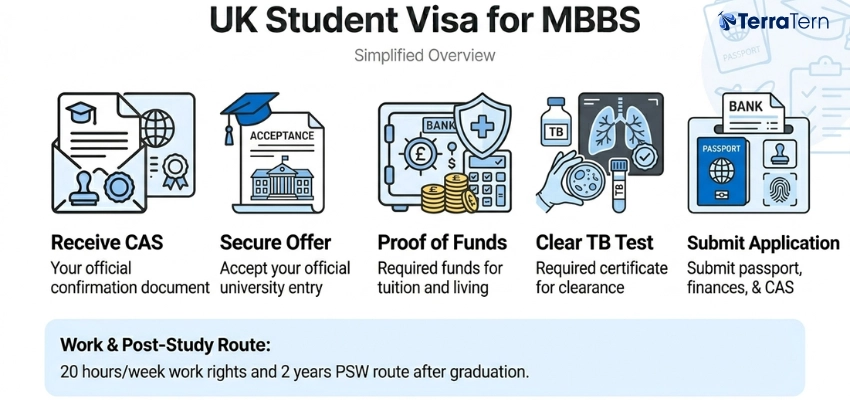
For MBBS in UK for indian students, securing a UK Student Visa (formerly Tier 4) is a 10-step readiness path; below are 5–6 crisp bullets:
-
Apply After CAS: You must first accept an MBBS offer and receive a Confirmation of Acceptance for Studies (CAS) from the university before applying at gov.UK .
-
Pay Current Fees: Visa fee is £558; Immigration Health Surcharge (IHS) is £1,145 per year (≈ INR 90k+); higher-value visas apply for 5-year MBBS.
-
Show Financial Proof: Demonstrate funds for first-year tuition + 9 months of living costs (from 11 November 2025: £1,529/month in London, £1,171/month outside London).
-
Submit Core Documents: CAS information, bank statements, TB-test result, and passport (minimum 6-month validity beyond course start); ATAS is only for sensitive research-heavy subjects, not standard MBBS.
-
Apply 6 Months Before Start: For the September MBBS intake, aim to submit the visa in June–July; processing typically takes around 3 weeks if the documents are complete.
-
Work & Post-Study Rights: You can work up to 20 hours/week during term and full-time in holidays; after graduation, the Post-Study Work (PSW) route grants 2 years, which can be used to pursue the NHS Foundation Programme.
As per TerraTern Expert: Many Indian MBBS applicants underestimate the financial proof requirement you need to demonstrate funds for both the first year's tuition fee AND 9 months of living expenses simultaneously. This can mean showing INR 45–65 lakhs in a bank account, which requires advanced financial planning.
What Are the Career Opportunities After MBBS in UK for Indian Students?
For MBBS in UK for indian students, there are three main career-pathway clusters: practice in the UK , return to India, or pursue global opportunities abroad.
-
Practice in the UK : After UK MBBS, clear UK MLA, join the NHS Foundation Programme (F1/F2), and then GMC-full-registered speciality training; average Foundation-year salary £37,000–£43,000/year, Registrar INR 55,000–INR 80,000/month, Consultant INR 99,000–INR 120,000+/month.
-
Return to India: UK MBBS is NMC-recognised; pass NEXT (replaces FMGE) to register in India and then appear for NEET-PG or work in government/private hospitals; entry-level MBBS doctor salary ~INR 80,000–INR 1.5 lakh/month, senior specialists INR 2–5+ lakh/month.
-
International Options: Prepare for USMLE (USA), MCCQE (Canada), AMC (Australia), or DHA/HAAD (UAE/KSA); UK -trained doctors often secure roles in Middle-East or Commonwealth-aligned systems.
-
Post-Study Work Visa: UK -based MBBS graduates can access the Graduate Route (2 years) for work in NHS or private roles before starting specialisation.
-
Employability Metrics: Around 93% of UK MBBS graduates enter employment or further training within 6 months (GMC-style data), reinforcing strong job-placement value for MBBS in UK .
Pro Tip: The NEXT exam (replacing FMGE) is a significant regulatory change; it is now an exit exam taken at the end of MBBS rather than a separate screening test. UK graduates are well-positioned to pass it, given the clinical rigour of UK training, but they must stay current with India's NMC syllabus throughout their studies.
What Is PLAB and How Do Indian Students Pass It After MBBS in UK ?
For MBBS in UK for indian students, PLAB (Professional and Linguistic Assessments Board) is the GMC-mandated exam that lets non-UK -trained doctors (including Indian MBBS graduates) register to work in the UK , while UK -graduate MBBS holders usually register via UK MLA-based pathways instead.
-
What is PLAB?: A two-part exam: PLAB 1 (180 single best answer (SBA) questions over 3 hours and 10 minutes) assesses clinical-knowledge breadth; PLAB 2 (approximately 8 minutes with 2 minutes reading time between stations) tests clinical skills, communication, and emergency-scenario management.
-
Who Needs PLAB?: Indian MBBS graduates (including those returning after UK training) use PLAB to gain GMC registration and practise in the NHS; UK -MBBS grads with UK MLA generally follow a different, streamlined route.
-
Pass Rate: The PLAB pass rate is around 75–80% on the first attempt for well-prepared candidates who use structured question banks and practice OSCEs.
-
Preparation: Use resources like PLABABLE, Passmedicine, and Amboss; focus on UK clinical guidelines, NICE-based answers, and timed OSCE-style practice.
-
Pathway Recap for MBBS in UK : After UK MBBS, many Indian-born graduates who later return as IMGs still rely on PLAB + English test (IELTS/OET) to secure jobs in the UK , especially if they did not complete UK -specific licensing during their first degree.
Key Note: If you complete your MBBS from a UK university and pass the UK MLA, you may qualify for a direct GMC registration pathway, bypassing PLAB altogether. This is a major advantage of studying MBBS in the UK vs. studying MBBS abroad in countries like Russia or China, where PLAB is mandatory.
Also Read: Most Common Reasons For UK Visa Rejection: Don’t Make These
Is MBBS in UK Worth It for Indian Students? A Balanced Assessment
For MBBS in UK for indian students, the decision largely hinges on budget, career goals, and competitive profile. Below is a concise pros-versus-cons table highlighting key trade-offs versus private MBBS in India.
|
Aspect |
(Pros) |
(Cons) |
|
Degree value |
GMC-approved, NMC-recognised, WHO-listed, highly global |
Very expensive (INR 2–4 crore over 5 years) |
|
Pathway to India |
No FMGE; only NEXT required for NMC registration |
Lower-fee options exist in India (private MBBS ~INR 70L–INR 1.5 crore) |
|
Clinical training |
Early NHS-integrated training, high-quality supervision, and rotations across UK hospitals |
Intense UK -admission competition (5–15% at top schools), UCAT-score pressure |
|
Global opportunities |
2-year Post-Study Work Visa, access to NHS speciality training, and other countries |
High cost of living, cultural adjustment for Indian students |
|
Admission & structure |
English-language-only medium, no management quota |
Fewer seats for international students; limited scholarships |
Quick comparison snapshot (UK MBBS vs Private MBBS India):
|
Factor |
UK MBBS |
Private MBBS India |
|
Total 5-year cost |
INR 2–4 crore |
INR 70–150 lakh |
|
Global recognition |
Yes (GMC, NMC, WHO) |
Primarily India-focused |
|
FMGE/NEXT barrier |
Only NEXT (no FMGE) |
Usually, no FMGE (NMC-recognised institutes) |
|
NHS exposure |
Yes (Foundation-style training) |
No NHS-type training |
|
Post-study options |
UK + other countries |
Mostly India |
|
Admission competition |
Extremely high (UCAT-based) |
High (NEET-based; NRI quota helps) |
As per TerraTern Expert: The financial comparison changes dramatically when you factor in lifetime earning potential. A UK -trained specialist can earn £99,000–£120,000+ as a consultant, often recouping the entire investment within 2–3 years of full employment. The real question isn't cost, but career intent: if you want a global medical career, UK MBBS is among the best ROI decisions you can make.
Conclusion
For MBBS in UK for indian students, UK MBBS is a high-value, globally-oriented path if you can afford the INR 2–4 crore investment and clear UCAT and NEET. With NMC recognition, NHS-integrated training, NEXT-only return, and 2-year post-study work rights, it often outperforms private MBBS in India for those aiming at a global medical career.
Contact TerraTern for more information on MBBS in UK for Indian Students: The 2026 Complete Guide.




 AI Summary