


Key Highlights
- How Much Does It Cost to Study Abroad From India in 2026?
- What 2026 Cost Trends Should Indian Students Consider Before Studying Abroad?
- Which Countries Offer the Lowest and Highest Study Abroad Costs for Indian Students?
- What Expenses Should Indian Students Include in a Study Abroad Budget?
- What Are the Hidden Costs of Studying Abroad From India?
- How Can Indian Students Reduce the Cost of Studying Abroad?
- How Can You Calculate Your Personal Study Abroad Budget From India?
- How Should Students Compare Study Abroad Costs With Career Value?
- Conclusion
For foreign students, studying abroad is an exciting experience, but the first step for each student is to budget. How much does it cost to study abroad from India depends on various aspects, including country, university, course and lifestyle & visa requirements.
In addition to the cost of tuition at the university, housing, food, travel, insurance and living expenses, students must budget for these costs before applying for 2026. Families will benefit from having an exact cost estimate, and this will help them determine the financial implications, compare countries, and make better decisions about studying abroad.
How Much Does It Cost to Study Abroad From India in 2026?

From the table below, it is observed that how much does it cost to study abroad from India ranges from INR 8 lakh to INR 70 lakh or above, depending on the location, university, course, city and lifestyle. Some other countries with different annual budgets, such as the USA, UK, Canada and Australia, may be cheaper, but not every European destination will have such a difference in price.
Finally, there are a few variable costs to consider when calculating the price of studying abroad from India: Institution and Program:
-
Institution and Program: Public universities save money compared to private ones, and clinical and STEM programs tend to be more expensive.
-
Location and Lifestyle: Major hub rents come with a higher charge than regional rents.
-
Mandatory Ancillaries: The required ancillary services, such as visas, health insurance surcharges and escrow accounts (locked accounts, Germany-style) require a specific amount of money.Indicative Annual Cost by Destination
|
Destination |
Estimated Annual Budget (Tuition + Living) |
|
INR 12–16 lakh/year |
|
|
France |
INR 11–22 lakh/year |
|
INR 30–40 lakh/year |
|
|
INR 28–69 lakh/year |
|
|
INR 36–60 lakh/year |
|
|
Ireland |
INR 22–49 lakh/year |
|
USA |
INR 40–70 lakh/year |
As per our TerraTern Expert Shreya, the most useful answer is not a single number; it is a transparent annual and full-programme range based on a student’s destination, course duration, and city.
Also Read: Study Abroad Consulting in Bangalore Cost Guide
What 2026 Cost Trends Should Indian Students Consider Before Studying Abroad?
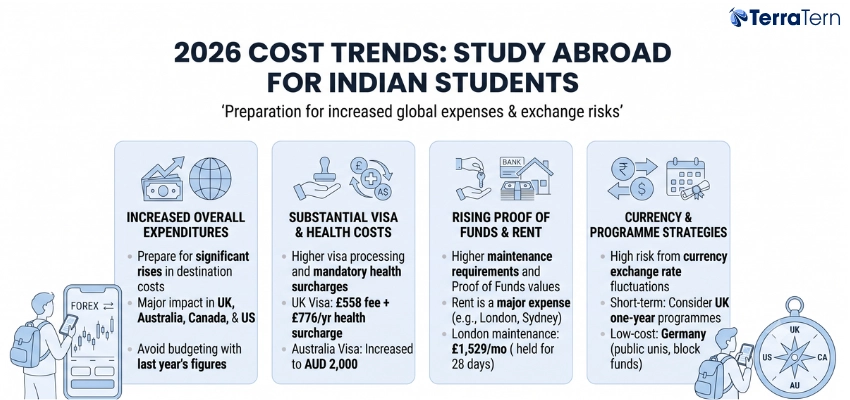
Indian students should be prepared for an increase in the cost of destination places, currency exchange rates, visa costs, and proof-of-funds values.
-
A budget should not be made just using what they paid last year for tuition or the currency rate.
-
While estimating how much does it cost to study abroad from India, students should not only consider tuition fees but also keep in mind mandatory health surcharges along with a substantial increase in processing fees for visas in major study destinations put in place by the governments in the last quarter of 2025.
-
Tuition fees and living expenses remain widely different across countries and universities, and in 2026, the total annual costs were estimated to be significantly higher in the UK, Australia, Canada and the US, and somewhat lower in Germany.
-
However, Germany is still relatively low cost at many public universities, where tuition may be almost nothing, and students must still estimate their living expenses, their semester fees, including health insurance, and their proof of funds, very similar to a blocked account of funds.
-
Although annual costs are high, shorter programmes and shorter programme costs are achievable, with the UK one-year programme being less in terms of both programme one-year programme being me cost on top of the high annual costs.
-
The visa fee is not the only cost of a UK Student visa: visa + application fee is £558, UK Immigration Health Surcharge for places to stay in the UK is £776 (per year). The maintenance requirement also needs to be supported for up to 9 months, £1,529 per month in London and £1,171 per month outside of London, and the funds will need to be held in the account for 28 days.
-
Visa fees for Australia will also be heavily impacted by the increase to AUD 2,000 from 1 July 2025, with these amounts now having a significant impact on the initial visa budgets.
-
Whether this is worked out over a multi-year programme or not, materially different INR costs of the same foreign budget can materially change the INR cost due to currency conversion, so it will be prudent for students not to tie down to a single FX rate.
-
Rent is frequently one of the significant expense items besides tuition in most popular cities for students, such as London, Toronto, Sydney, and Dublin.
Important Note: Build a 5–10% currency and inflation buffer into the total budget, especially for two-year programmes or costs paid in instalments.
Which Countries Offer the Lowest and Highest Study Abroad Costs for Indian Students?
Germany and some European destinations often offer lower total annual costs, particularly where public-university tuition is limited, while the USA and premium programmes in the UK, Australia, and Canada can be much more expensive. Students should compare total programme cost, not country-level averages alone.
When evaluating how much does it cost to study abroad from India, factor in that some high-cost countries offer shorter degree durations, potentially lowering the total investment.
|
Country |
Indicative Tuition Range |
Indicative Annual Living-Cost Range |
Visa / Insurance / Pre-Departure Estimate |
Indicative Total Annual Budget (INR) |
Typical Programme Duration |
Best Fit For |
Lower-Cost Route |
Higher-Cost Route |
|
Germany |
€0 to €3,000 at many public universities; higher at private options |
€10,000 to €15,000+ depending on city |
Blocked-fund / proof-of-funds, health insurance, semester contributions, flights |
INR 8–15 lakh/year (public university cases) |
2 years (many master’s programmes) |
Cost-conscious students seeking strong technical or research options |
Public university + lower-rent city |
Private university or high-rent city |
|
France |
€2,770 to €3,770 at public institutions (non-EU); private schools higher |
€10,000 to €15,000+ |
Visa, health cover, deposit, flights |
INR 12–20 lakh/year depending on city and school |
1–2 years |
Students wanting lower EU costs with an English/French pathway |
Public university outside Paris |
Grande école / Paris-based private programme |
|
Canada |
CAD 15,000 to CAD 35,000+ |
CAD 15,000 to CAD 25,000+ (Toronto/Vancouver trend higher) |
Study permit, provincial health plan / private insurance, biometrics, flights |
INR 14–28 lakh/year |
1–2 years |
Students wanting a balanced cost, work rights, and PR planning |
Smaller city / public university |
Toronto/Vancouver + premium programme |
|
UK |
£15,000 to £35,000+ |
£12,000 to £18,000+ |
Student visa £558, IHS £776/year, maintenance funds |
INR 25–40 lakh/year (total can be lower as many master’s are 1 year) |
1 year (often for master’s) |
Students who want a short, intensive master’s |
One-year master’s in a lower-cost city |
London + expensive programme |
|
Australia |
AUD 20,000 to AUD 45,000+ |
AUD 20,000 to AUD 30,000+ |
Student visa fee AUD 2,000, OSHC, travel, deposits |
INR 22–35 lakh/year |
1–2 years |
Students focused on work rights and strong universities |
Regional campus or lower-rent city |
Sydney/Melbourne + premium course |
|
Ireland |
€10,000 to €25,000+ |
€10,000 to €15,000+ |
Visa, insurance, flights, deposits |
INR 18–30 lakh/year |
1 year (many master’s programmes) |
Students who want an English-speaking EU option |
Public / less expensive college outside Dublin |
Dublin + higher-fee programme |
|
USA |
USD 15,000 to USD 60,000+ |
USD 15,000 to USD 25,000+ (major cities can be higher) |
F-1 visa, SEVIS, insurance, travel, deposits |
INR 30–70 lakh/year (widest spread of all destinations) |
1–2 years |
Students prioritizing school choice and specialisation |
Public / state university in a lower-cost city |
Ivy League / private university in a big city |
|
Japan |
¥535,800 to ¥1,500,000+ |
¥900,000 to ¥1,500,000+ |
Visa, national health insurance, flights, setup costs |
INR 10–18 lakh/year depending on city and school |
1–2 years |
Students open to Japan-focused careers or research |
National / public university |
Private university in Tokyo |
|
South Korea |
KRW 4 million to KRW 12 million+ |
KRW 8 million to KRW 15 million+ |
Visa, insurance, flight, deposit |
INR 9–18 lakh/year depending on city and school |
1–2 years |
Students seeking comparatively moderate costs in East Asia |
Public university outside Seoul |
Seoul-based private programme |
Expert Tip: A lower tuition fee does not automatically mean a lower total budget; programme duration, rent, insurance, and city choice can change the final cost by lakhs.
How Much Does It Cost to Study in the USA From India?
For the USA, the total can range widely, but a realistic planning band is about INR 30–70 lakh per year depending on university, city, and aid.
-
Public universities are usually cheaper than private universities, while community-college or pathway routes can reduce first-year tuition significantly before transferring.
-
Budget separately for tuition, housing, health insurance, flights, visa, and arrival costs; these items can be as important as tuition
-
Add F-1 visa and SEVIS as separate line items, and verify the exact current charges before paying
-
For research-heavy postgraduate programmes, assistantships can cut tuition and sometimes include a stipend, so they are worth targeting early.
Expert Advice: For the USA, compare net cost after scholarships or assistantships—not only the published tuition fee.
How Much Does It Cost to Study in the UK From India?
For the UK, a common planning range is about INR 25–40 lakh per year, with London usually far costlier than regional cities
-
Tuition can be high, but many master’s programmes finish in one year, which can lower total programme cost versus longer degrees elsewhere.
-
Budget for tuition, accommodation, Student visa fee, Immigration Health Surcharge, flights, and deposits.
-
A one-year master’s can still be expensive upfront, but it often reduces the total out-of-pocket amount compared with a two-year degree.
-
London is the highest-cost baseline; regional cities are usually easier on rent and daily spending.
Important Note: A UK master’s may be expensive per year, but its shorter duration can make it cost-competitive over the whole programme.
How Much Does It Cost to Study in Canada From India?
Canada often falls in the middle-to-high cost range, with many students planning around INR 14–28 lakh per year.
-
Costs depend heavily on province, institution, and housing market, so Toronto and Vancouver are usually pricier than smaller cities.
-
Budget separately for tuition, rent, insurance, study-permit expenses, transport, and settlement costs.
-
Confirm immigration and proof-of-funds rules directly with IRCC before applying, because financial requirements can change.
-
Don’t forget practical startup costs like accommodation deposits, winter clothing, and initial local travel.
As per TerraTern Expert: Canada budgets become more accurate when students compare specific provinces and cities rather than relying on a national average.
How Much Does It Cost to Study in Australia From India?
Australia commonly requires about INR 20–30 lakh per year, and some programmes can go much higher.
-
Tuition Varies by Level: Undergraduate, postgraduate, and professional courses can differ a lot
-
Living Costs are City-Based: Sydney and Melbourne usually cost more than regional areas.
-
Include Overseas Student Health Cover: Travel, visa charges, and the visa-related financial-capacity check in your budget.
-
2026 Check Before Applying: Confirm the latest visa fee, OSHC requirement, and evidence-of-funds rules on the Australian Government site before you pay anything.
Pro Tip: Never use an old Australia visa cost estimate; verify the charge and financial-capacity guidance directly before submitting an application.
Also Read: Best Countries to Study in Europe for Indian Students
What Expenses Should Indian Students Include in a Study Abroad Budget?
A complete study-abroad budget goes beyond tuition: accommodation, food, transport, insurance, visa costs, test fees, flights, deposits, study materials, and a buffer for emergencies can add a lot to the cost of studying abroad from India. In 2026, many students should plan for about INR 12 lakh to INR 55 lakh per year, depending on the country and programme.
|
Cost Category |
What to Include |
When Students Usually Pay |
Planning Note |
|
Tuition fees |
Course fee, university charges, lab fees |
Before each term/year |
Check scholarship-adjusted net tuition. |
|
Accommodation |
Rent, security deposit, utilities |
Before arrival and monthly |
Deposits can require a large upfront payment. |
|
Food and essentials |
Groceries, meals, personal care |
Monthly |
Varies by city and lifestyle. |
|
Health insurance |
Mandatory student insurance or health cover |
Before visa/enrolment or annually |
Requirements differ by destination. |
|
Visa and application costs |
Visa fee, biometrics, courier, documentation |
Before departure |
Recheck official fees before applying. |
|
Tests and applications |
IELTS/TOEFL/PTE, university applications, transcript fees |
Before admission |
Include retest and document costs where applicable. |
|
Travel and setup |
Flights, baggage, local transport, SIM, winter clothing |
Before/after arrival |
Set aside an arrival fund. |
|
Emergency reserve |
Medical, laptop replacement, exchange-rate changes |
Throughout programme |
Keep 5–10% of the annual cost separate. |
Key Note: Families should plan for both the annual cost and the large upfront cash requirement before departure, especially tuition deposits, visa-related expenses, insurance, flights, and housing deposits.
What Are the Hidden Costs of Studying Abroad From India?
Hidden study abroad costs often include university application fees, language tests, credential verification, visa biometrics, health checks, housing deposits, forex conversion fees, and first-month settlement expenses. These ancillary expenses significantly impact how much does it cost to study abroad from India, adding INR 1.5 lakh to INR 4 lakh in non-tuition overhead before a student even attends their first class.
-
Before Applying: Application fees, IELTS/TOEFL/GRE retakes, transcript reapplying, credential verification, and courier charges can add up fast.
-
After receiving an Offer, tuition deposit and admission confirmation fees are required before the visa stage.
-
Before Visa Submission: Visa fee, biometrics, medical tests, and any required immigration health cover or mandatory insurance should be budgeted separately.studyabroadcourses+1
-
Before Departure: Foreign exchange conversion, remittance charges, and bank transfer fees can quietly raise the total.
-
After Landing Abroad: Laptop purchase, winterwear, basic furnishings, and local registration can be unavoidable setup costs
-
Throughout the Programme: Medical emergencies, device replacement, and exchange-rate swings are best covered by an emergency reserve.
-
Refundability Varies: Application fees, visa fees, deposits, and insurance may be refundable, partially refundable, or non-refundable, so students must check each provider’s terms before paying.
As per TerraTern Expert Divyansh, the best budget is built from payment timelines, not just annual averages; students need to know what must be paid before they can even travel.
How Can Indian Students Reduce the Cost of Studying Abroad?
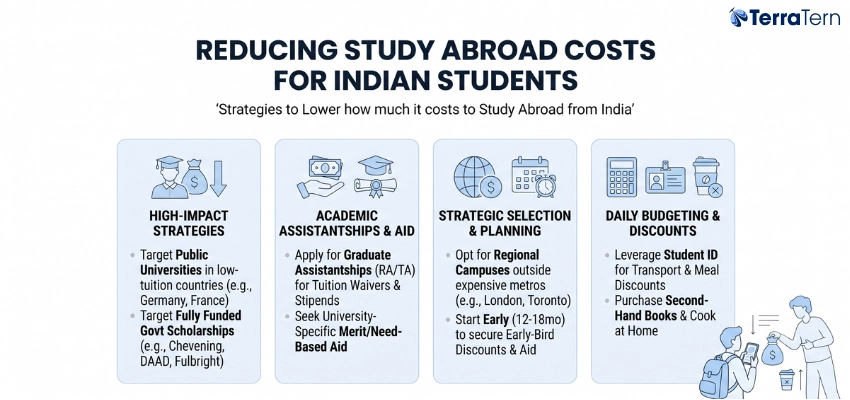
Indian students can reduce study abroad costs through scholarships, assistantships, affordable destinations, public universities, education loans, and realistic lifestyle budgeting.By prioritising high-impact strategies like tuition waivers over lower-impact daily savings, students can significantly alter how much does it cost to study abroad from India:
-
Destination & Institution Selection (High Impact): Opt for public universities in low-tuition or free-tuition countries (e.g., Germany, France) or select regional campuses outside major metropolitan hubs (e.g., London, Toronto) to dramatically lower baseline tuition and rent.
-
Major Scholarships & Waivers (High Impact): Target fully funded government scholarships (e.g., Chevening, Fulbright, DAAD) or university-specific merit/need-based aid to cover substantial portions of tuition and living costs.
-
Graduate Assistantships (High Impact): Apply for Research Assistant (RA) or Teaching Assistant (TA) positions, particularly in the US and Canada, which often provide tuition waivers and monthly stipends in exchange for academic work.
-
Early Planning & Application (Medium Impact): Secure early-bird tuition discounts, lock in cheaper student housing deposits, and access the widest pool of financial aid by strictly following a 12–18-month scholarship application calendar.
-
Strategic Daily Budgeting (Lower Impact): Utilise student ID discounts for public transport passes, purchase second-hand textbooks, cook meals at home, and leverage university-subsidised health insurance plans.
Scholarship Application Calendar (12–18 Months Pre-Intake)
|
Timeline |
Action Required |
|
18 Months Before |
Shortlist affordable destinations, identify major government/university scholarships (DAAD, Chevening, Fulbright), and verify their specific deadlines (often Oct–Jan for the following Fall). |
|
15 Months Before |
Book and prepare for language (IELTS/TOEFL) and aptitude (GRE/GMAT) tests to ensure scores are ready before scholarship windows close. |
|
12 Months Before |
Begin drafting your Statement of Purpose (SOP) and request Letters of Recommendation (LOR). |
|
9–11 Months Before |
Submit early-deadline scholarship applications alongside university admissions. |
Important Note: The most effective savings often happen before application. Selecting the right country, institution, course duration, and city can reduce the budget more than small monthly spending cuts.
Can Part-Time Work Pay for Study Abroad Costs?
Part-time work may help offset some daily living expenses, but Indian students should never depend on it to fund tuition or meet upfront visa and settlement costs. When calculating how much does it cost to study abroad from India, your primary funding must be secured before you depart.
-
Living Costs vs. Tuition: Part-time wages generally cover groceries, local transit, and partial rent. They will not generate enough surplus to pay next semester’s tuition fees.
-
Strict Visa Limits (2026): Your earning potential is capped by law. For instance, Canada restricts off-campus work to 24 hours/week, the UK allows 20 hours/week, Australia permits 48 hours/fortnight, and Germany limits work to 140 full days per year.
-
Academic Workload: Balancing a rigorous full-time degree with maximum part-time hours often leads to burnout and compromised academic performance.
-
Job Availability & Taxes: Finding work is not guaranteed, and student wages are often subject to local income taxes, reducing your actual take-home pay.
Expert Tip: Treat part-time income as a possible buffer for day-to-day expenses, not as the foundation of a tuition-payment plan.
How Can You Calculate Your Personal Study Abroad Budget From India?
Calculate your study abroad budget by adding annual tuition, annual living costs, one-time pre-departure expenses, and a 5–10% contingency buffer; then multiply the recurring annual costs by the programme duration. This approach provides a vastly more reliable financial picture than comparing headline tuition fees alone.
The Budget Formula
Personal Budget = (Annual Tuition + Annual Living Cost) × Programme Years + One-Time Costs + Contingency
-
Tuition: Base tuition minus confirmed scholarships.
-
Living Cost: Rent, groceries, transport, utilities, and insurance (usually INR 12-23 lakh/year for major hubs).
-
One-Time Costs: Flights, visa fees, application charges, and initial setup/deposits (budget INR 3-6 lakh).
-
Contingency: A 7% buffer to protect against currency fluctuations (the INR historically weakens 5-10% annually) and unexpected emergencies.
Fictional Example: 2-Year Master's Programme
|
Budget Component |
Estimated Cost |
|
Annual Tuition |
INR 18,00,000 |
|
Annual Living Costs |
INR 12,00,000 |
|
Subtotal (Per Year) |
INR 30,00,000 |
|
Total for 2 Years |
INR 60,00,000 |
|
One-Time Costs (Visas, Flights, Deposits) |
INR 3,00,000 |
|
7% Contingency |
INR 4,41,000 |
|
Estimated Total Budget |
INR 67,41,000 |
Expert Advice: Calculate the full programme budget after scholarships not merely the first year’s tuition, before deciding whether a destination is affordable.
How Should Students Compare Study Abroad Costs With Career Value?
Students should compare study abroad costs with career value by examining total programme expenditure alongside employability, location, post-study work options, and realistic funding.
When evaluating how much does it cost to study abroad from India, look beyond tuition fees and use this strategic framework:
1. The Cost vs. Value Scorecard:
Total Programme Cost: Factor in tuition, living expenses, hidden fees, and duration.
Course Relevance: Does the curriculum align with the current skill shortages in the host country's job market?
Placement Ecosystem: Does the university offer strong industry partnerships, co-op programs, or dedicated career services?
Location: Is the university situated near industry hubs where internships and networking opportunities are abundant?
2. Post-Study Work Visa (2026 Context):
-
Canada (PGWP): Now structurally tied to field-of-study requirements.
-
UK (Graduate Route): Reducing from 24 to 18 months starting Jan 2027.
-
Australia (Subclass 485): Tighter eligibility and adjusted durations by qualification level.
-
Debt Servicing: Compare your projected monthly loan repayment against the realistic, after-tax starting salary in your field.
Important Tip: A strong study-abroad decision balances affordability with academic fit and a credible post-graduation plan, rather than chasing a country based on a broad cost average.
Also Read: Exams to Study Abroad: Complete Guide for Students
Conclusion
Ultimately, how much does it cost to study abroad from India depends on the country, university, course, and lifestyle you choose. In 2026, students should plan carefully for tuition, accommodation, visas, insurance, and living expenses before making a decision.
Comparing destinations and checking updated university fees and exchange rates can help you build a realistic budget, avoid surprises, and choose the best study abroad option with confidence for your future.
Contact TerraTern for more information on how much does it cost to study abroad from India.




 AI Summary