Key Highlights
- Germany Tax Classes and Their Impact on Income Tax
- How Germany’s Progressive Tax Slab Works
- Germany Income Tax Calculation Example
- What Is the Income Tax Bracket for 2026?
- Online Tax Calculator
- Social Security Contributions
- What Is Solidarity Tax in Germany?
- What Is Corporation Tax?
- How Much Is VAT in Germany?
- Seconded Employees in Germany
- Corporate Income Tax (CIT)
- VAT (Value-Added Tax)
- Withholding Tax (WHT) - on Dividends / Interest / Royalties
- Capital Gains Tax (CGT)
- Inheritance & Gift Tax
- Immigration and work permit
- Individual Income Taxes in Germany
- Conclusion
Understanding the Germany tax slab is the first step to knowing how much of your salary you keep. Germany uses a progressive system, so higher earnings are taxed at higher rates, but only on each slice of income. This guide explains the 2026 brackets, from the €12,348 tax-free allowance to the 45% top rate, along with tax classes, social security contributions, the solidarity surcharge, corporation tax, and VAT. A worked example shows how the Germany tax slab applies to a €50,000 income. Whether you are planning a move or already working in Germany, this helps you estimate your take-home pay.
Germany Tax Classes and Their Impact on Income Tax
The German tax slabs and their effect on income taxes
-
Tax Class I: Applies to single, divorced, separated, or widowed employees.
-
Tax Class II: Designated for single parents eligible for the single-parent allowance.
-
Tax Class III: Assigned to married employees whose partner earns little or nothing (paired with Class V).
-
Tax Class IV: The standard model for married couples earning similar income levels.
-
Tax Class V: Given to the lower-earning partner when the other holds Class III, resulting in higher monthly deductions.
-
Tax Class VI: Used for secondary jobs or concurrent employment without tax-free allowances.
-
Tax classes determine monthly payroll withholdings only and do not alter total annual tax liability under the Germany tax slab. Adjustments are settled when filing yearly returns.
-
Historical Reference: Reviewing prior structures shows that the fundamental mechanics remained consistent even when comparing against income tax rates in Germany 2025.
-
Modern payroll processing maps each tax class to the Germany tax slab and the updated income tax rates in Germany 2025 to determine correct monthly deductions.
Also Read: Germany Income Tax: Latest Rates, Filing, Benefits & More
How Germany’s Progressive Tax Slab Works

The Germany tax slab operates progressively, so rates rise as taxable income rises.
-
Tax-Free Allowance: The baseline tax slab in Germany starts with a 0% bracket up to €12,348 for single filers.
-
Modern payroll processing maps each tax class to the Germany tax slab and the updated income tax rates in Germany 2025 to determine correct monthly deductions.
-
Progressive Zones: The active tax slab Germany utilizes mathematical formulas instead of flat steps between €12,349 and €69,878 to ensure smooth tax scaling.
TaxRep -
Proportional Rate: Higher tax slabs in Germany enforce a flat 42% marginal rate for taxable income stretching from €69,879 to €277,825.
Expatrio -
Top Bracket: The upper limit of the tax slabs in Germany 2026 imposes a 45% wealth tax rate (Reichensteuer) on income exceeding €277,826.
Norman Finance -
Marginal Mechanics: Rates apply strictly to specific income slices, meaning effective tax rates stay lower than top marginal thresholds.
Germany Income Tax Calculation Example
The German income tax example
-
Scenario: Evaluated using standard German tax slabs for a single filer with a taxable income of €50,000 using the Germany tax slab for a single filer with a taxable income of €50,000.
-
Tax-Free Slice: The initial portion up to €12,348 is taxed at 0% under current Germany tax slab 2026 parameters. This is your existing use (“current Germany tax slab 2026 parameters”).
-
Progressive Calculation: Income slices above the basic allowance scale upward through the entry progression formulas.
-
Estimated Liability: Total annual income tax evaluates to roughly €6,550, producing an effective tax rate of approximately 13.1%. Financemate
What Is the Income Tax Bracket for 2026?
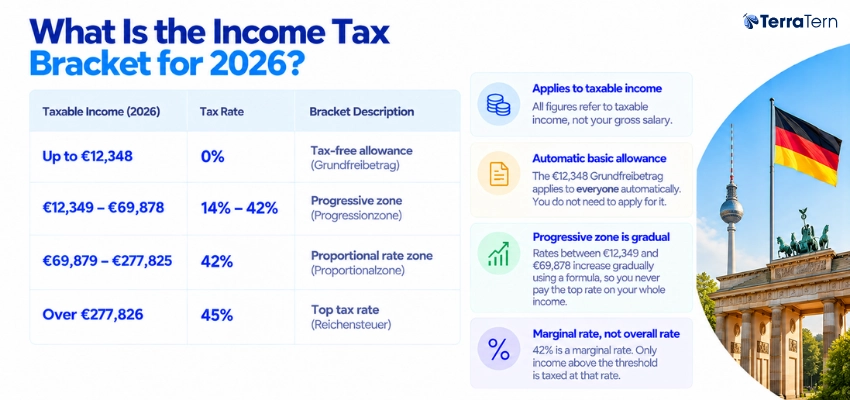
For the 2026 tax year, the Germany tax slab brackets are:
|
Taxable Income (2026) |
Tax Rate |
Bracket Description |
|
Up to €12,348 |
0% |
Tax-free allowance (Grundfreibetrag) |
|
€12,349 – €69,878 |
14% – 42% |
Progressive zone (Progressionzone) |
|
€69,879 – €277,825 |
42% |
Proportional rate zone (Proportionalzone) |
|
Over €277,826 |
45% |
Top tax rate (Reichensteuer) |
A few important things to understand:
-
Every figure in the Germany tax slab applies to taxable income, not gross salary.
-
The €12,348 basic allowance (Grundfreibetrag) applies to everyone automatically. You do not need to apply for it.
-
The rates between €12,349 and €69,878 are not a flat rate. They increase gradually using a formula, so you never pay the top rate on your whole income.
-
42% is a marginal rate, not your overall tax rate. Only income above the threshold is taxed at that rate.
Online Tax Calculator
If you want to find out how much you will take home after taxes in Germany, an online calculator can help. You enter your gross salary and a few details, and it estimates your net income after taxes and social security contributions. Good calculators factor in your tax class, the solidarity surcharge, church tax, and social security, so you get a clear breakdown of your take-home pay. Use an online German income tax calculator to apply the Germany tax slab and estimate your take-home pay after tax and social security contributions. To see how deductions apply to real pay, check the average monthly salary in Germany.
Also Read: Germany Salary Tax: Brackets, Deductions & Net Pay
Social Security Contributions
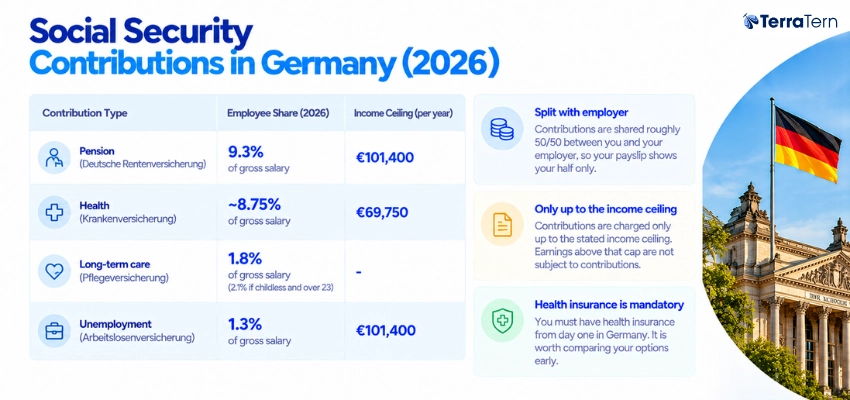
On top of income tax, employees pay mandatory social security contributions. These cover pension, health, long-term care, and unemployment insurance. They are split roughly 50/50 between you and your employer, so your payslip shows your half only.
As an employee in 2026, your share is approximately:
-
Pension: 9.3% of gross salary (up to €101,400/year)
-
Health: about 8.75% of gross salary (up to €69,750/year)
-
Long-term care: 1.8%, or 2.1% if you are childless and over 23
-
Unemployment: 1.3% of gross salary (up to €101,400/year)
Contributions are only charged up to the income ceiling. Earnings above that cap are not subject to contributions. Health Insurance is mandatory from day one in Germany, so it is worth comparing your options early. See our guide to Health Insurance in Germany.
What Is Solidarity Tax in Germany?
This tax was introduced in 1991 to rebuild and invest in Eastern Germany after reunification. It stays in place to help finance the ongoing costs of a unified Germany. In 2021, the solidarity surcharge (Solidaritätszuschlag) was abolished for most taxpayers after 30 years. Only those above the annual exemption limit (Freigrenze) still pay it.
In 2026, singles do not pay Soli unless their annual income tax bill exceeds €20,350, which affects roughly the top 10% of earners. So if you earn above this level, you must pay the solidarity surcharge.
What Is Corporation Tax?
Corporation tax in Germany is charged on the profits of companies operating in the country. The standard rate is 15%, plus a 5.5% solidarity surcharge on the corporation tax. Companies also pay a municipal trade tax, which varies between 7% and 17% depending on location.
How Much Is VAT in Germany?
Value-added tax, or VAT (Mehrwertsteuer), is charged on most goods and services in Germany. The standard VAT rate is 19%. Some items, such as books, food, and flowers, have a reduced VAT rate of 7%.
Seconded Employees in Germany
What should you consider when working as a seconded employee? Many people move to Germany for work because they are seconded, either at their own request or their employer's. A seconded worker stays employed by the same company. This means they remain on the payroll of their home country and keep paying taxes there.
As a result, they do not need to pay tax in Germany. Those paid by their employer in the country where they pay tax are also not required to make social security contributions in Germany. This applies across all EEA countries, and many other countries have similar bilateral agreements with Germany. The secondment rule usually applies to secondments of up to two years, though it can extend to five years.
Also Read: Tax Class Germany: Latest Complete Guide For Indians
Corporate Income Tax (CIT)
Combined corporate income tax + solidarity surcharge: 15.825%
-
Trade tax (municipal, varies by location): 8.75% – 20.3%
-
Return due date: 31 July following the tax year (extended to end of February if a professional tax adviser is used; COVID-era extensions applied to 2019–2024 filings)
-
Final payment due: as stated on the assessment notice
-
Estimated quarterly instalments: due 10 March, 10 June, 10 September, 10 December
VAT (Value-Added Tax)
-
Standard rate: 19%
-
(Not in the PwC snippet, but Doc 3 adds a reduced 7% rate for items like books, food, and flowers - worth folding in if you want this section complete)
Withholding Tax (WHT) - on Dividends / Interest / Royalties
-
Residents: 25% / 25% / 0%
-
Non-residents: 25% / 0% / 15% (or a reduced rate if an EU directive, double tax treaty, or domestic law applies)
-
Note: interest WHT generally only applies to interest paid by banks to a resident; interest from convertible/profit-sharing bonds and over-the-counter transactions is also subject to WHT
Capital Gains Tax (CGT)
-
Corporate: taxed at the normal corporation tax rate (no separate CGT rate)
-
Individual: 25%, plus a 5.5% solidarity surcharge on the tax paid - 26.375% total, plus church tax if applicable
Inheritance & Gift Tax
-
Headline inheritance tax rate: 50%
-
Headline gift tax rate: 50%
(These are top-end rates - worth flagging in the outline that actual rates are tiered by relationship to the deceased/donor and value of the estate, since a flat "50%" without that context could read as misleading or alarmist to readers)
Immigration and work permit
If foreign nationals shall become employed with or assigned to a German branch or subsidiary, German immigration law requirements have to be observed.
-
The requirements have to be checked in each individual case by an immigration expert.
-
Generally, EU nationals do not need a German work permit.
-
Foreign nationals of non-EU member states intending to work in Germany need a work and residence permit, which is regularly granted as an electronic permit (so-called ‘elektronischer Aufenthaltstitel’).
-
Some nationals are privileged (US, Canada, Australia, New Zealand, Korea, Japan, Israel), and they do not need to apply for a visa when entering Germany for work purposes.
-
They can directly apply for their German work and residence permit in Germany within a certain time after entry.
-
However, they are not allowed to start working before they have registered their German address and at least a preliminary permit is issued by the immigration office.
-
All other nationalities (Visa-nationals) have to apply for an entry visa for working purposes (D-Visa) at the German embassy/consulate in the country where one officially resides abroad.
-
German immigration law provides various work permit types, depending on the type of employment (assignment vs. local hire), salary level, qualification of the employee, nationality, etc.
-
Germany also implemented the EU Blue Card for highly qualified individuals and the ICT (Intra-Corporate Transfer) Card for third-country nationals.
-
Job seekers without an offer can also explore the Germany Opportunity Card.
Also Read: Investment Visa in Germany: Latest Complete Guide
Individual Income Taxes in Germany
Anyone who lives and works in Germany pays income tax on their earnings. Germany tax slab. Germany uses a progressive tax system, meaning the more you earn, the higher the rate on each additional euro. Your employer deducts income tax directly from your salary each month. This system is called Lohnsteuer (wage tax). To see what your gross salary becomes after tax, read our guide to the average salary in Germany.
Conclusion
The Germany tax slab works progressively, so only the income within each bracket is taxed at that bracket’s rate. In 2026, the first €12,348 is tax-free, rates then climb to 42%, and the 45% top rate applies above €277,825. Your tax class changes monthly withholding, not your annual liability, and social security adds over 20% in employee contributions. Before moving, use an online calculator to estimate net pay and compare health insurance options early. Understanding the Germany tax slab helps you negotiate salaries, plan budgets, and avoid surprises on your first payslip. Check your visa pathway and plan with confidence.




 AI Summary