Key Highlights
- What Makes Agriculture Jobs in Germany a Top Choice for Indians in 2026?
- What Types of Agriculture Jobs in Germany Are Available for Indians?
- What Are the Eligibility Criteria for Agriculture Jobs in Germany for Indians?
- What Visa Options Are Available for Agriculture Jobs in Germany for Indians?
- How Do You Apply for Agriculture Jobs in Germany from India?
- What Salaries Can Indians Expect from Agriculture Jobs in Germany in 2026?
- What Are the Top Hiring Companies for Agriculture Jobs in Germany?
- What Are the Career Growth Opportunities in Agriculture Jobs in Germany for Indians?
- What Are the Living and Working Conditions for Indians in Germany's Agriculture Sector?
- What are the Latest Opportunities in Agriculture Jobs in Germany 2026?
- What is the Current Scenario of Agriculture Jobs in Germany in 2026?
- What Qualifications and Skills are Required for Agriculture Jobs in Germany in 2026?
- What is the Diversity in Agricultural Roles in Germany for Indians in 2026?
- What are the Salary Trends in Agriculture Jobs in Germany in 2026?
- What are the Eligibility Criteria for Agriculture Jobs in Germany in 2026?
- How to Apply for Agriculture Jobs in Germany from India in 2026?
- Conclusion
What Makes Agriculture Jobs in Germany a Top Choice for Indians in 2026?
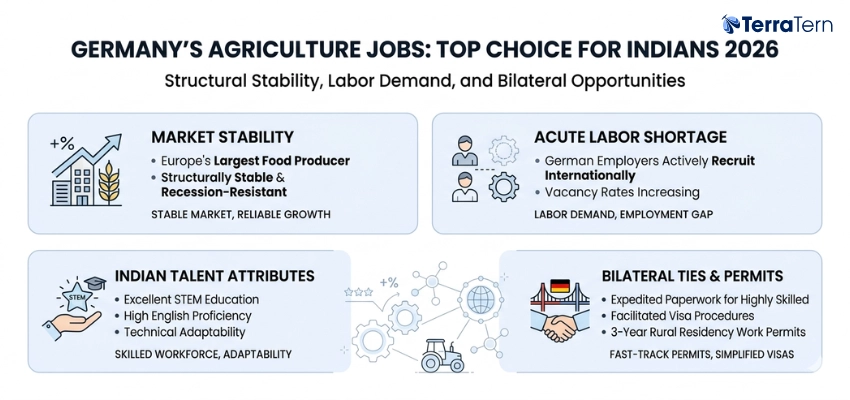
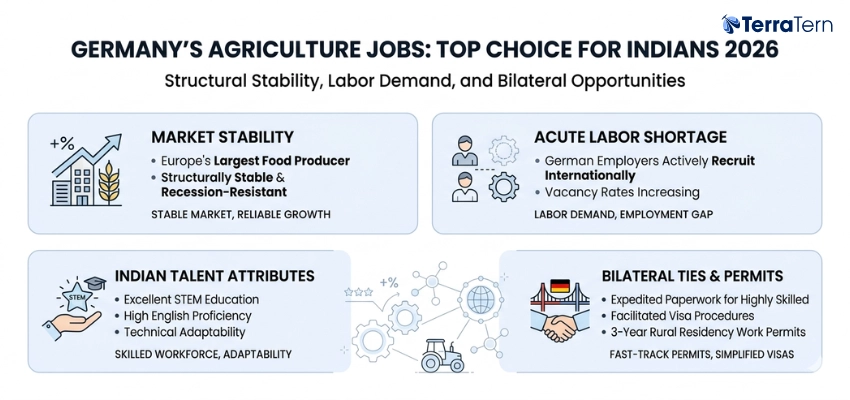
Germany is Europe's largest food producer, making agriculture jobs in Germany structurally stable and recession-resistant
-
An acute domestic labour shortage is pushing German employers to actively recruit internationally.
-
Indians possess excellent STEM education, great proficiency in English and good technical adaptability – all highly sought-after attributes
-
Paperwork are expedited for highly skilled agricultural labourers as part of strengthening India - Germany bilateral ties.
-
People from outside the EU who have resided in rural areas for at least 3 years may now be eligible to obtain a work permit under new proposals.
What Is the Current Demand for Agricultural Workers in Germany?
Germany has around 940,000 agricultural employees (Destatis 2024), which is one of the largest rural employment sectors in Europe.
-
The sector accounts for an estimated 1% of GDP and supports 13% of the food supply chain.
-
Overall, there is a shortage of ~26,000 agricultural specialists every year in Germany (Make It in Germany portal, 2026).
-
Minimum wage in agricultural jobs in Germany rose to €13.90/hour gross in January 2026 (Faire Mobilität)
-
As of May 2026, there are more than 250 interior jobs in Agriculture that are actively seeking applications on Glassdoor Germany. According to Glassdoor Germany, there are over 250 interior Agriculture job postings currently seeking applications as of May 2026.
-
The 2024 investments in agri-tech exceeded €400 million, and Farmworkers sought tech-savvy agricultural staff.
-
Seasonal farm jobs in Ireland pay €2,200–€3,500 per month, with employer-sponsored visas for non-EU workers.
As per TerraTern Expert, Shreya, Germany's agricultural labour shortage is structural, not cyclical, meaning demand for skilled international workers will remain high well into the 2030s, making this an excellent long-term immigration pathway.
Also Read: Agriculture Jobs in Germany: Benefits, Salary & More
What Types of Agriculture Jobs in Germany Are Available for Indians?
Agriculture jobs in Germany for Indians span three tiers - professional/white-collar, skilled trades, and hands-on field roles.
-
Roles range from PhD-level research positions to entry-level greenhouse and livestock work.
-
Urban agri-tech firms, rural farms, food processing plants, and environmental agencies all actively hire
-
Qualification, German language level, and visa pathway determine which category best suits Indian applicants.
What Are the Top Professional Agriculture Roles in Germany?
High-demand agriculture roles in Germany for Indians are concentrated in research, engineering, and farm management.
-
Most professional roles require recognised degrees, with German language (B1–B2) increasingly preferred by employers.
-
Recognition of credentials through the Anabin database or KMK is mandatory before applying.
|
Role |
Annual Salary (€) |
Qualification Required |
|
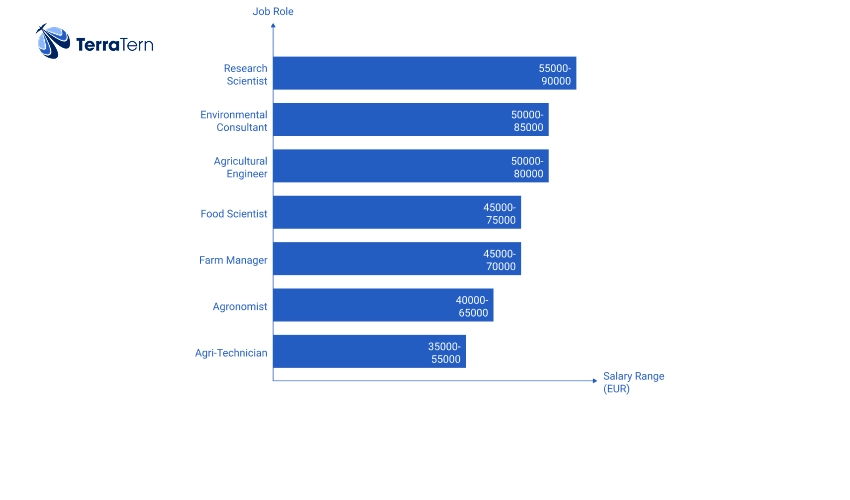
Research Scientist |
€55,000 – €90,000 |
Master's/PhD in Agriculture or Life Sciences |
|
Agricultural Engineer |
€50,000 – €80,000 |
B.E./B.Tech in Agricultural Engineering |
|
Environmental Consultant |
€50,000 – €85,000 |
Degree in Environmental Science |
|
Farm Manager |
€45,000 – €70,000 |
Agri Degree + Field Experience |
|
Food Scientist |
€45,000 – €75,000 |
Food Technology/Science Degree |
|
Agronomist |
€40,000 – €65,000 |
B.Sc./M.Sc Agriculture |
|
Agri-Technician |
€35,000 – €55,000 |
Diploma or Ausbildung Certificate |
What Seasonal and Entry-Level Agriculture Jobs Exist for Indians in Germany?
Entry-level roles include fruit picking, crop harvesting, livestock care, greenhouse operations, and food packaging.
1. Critical fact competitors miss: Indians cannot directly access Germany's seasonal work visa — the Federal Employment Agency currently reserves seasonal permits for citizens of EU/EFTA states, Georgia, and Moldova only
2. Three legal pathways available for Indians seeking agriculture in Germany for Indians at the entry level:
-
Employer-Sponsored Work Visa: employer files labour market approval; most reliable route
-
Ausbildung (Vocational Training): 2–3-year paid agricultural training programme with visa eligibility
-
Opportunity Card (Chancenkarte):points-based visa allowing Indians to enter Germany and conduct a job search on the ground
3. Typical earnings for these roles: €1,800–€2,800/month, depending on region and employer
4. Basic German language skills: (A2–B1) significantly improve hiring chances, even for field-level roles
Important Note: Many blogs incorrectly claim Indians can get seasonal farm visas directly — this is inaccurate. Indians should pursue the Germany Work Visa or Opportunity Card route, which TerraTern specialises in facilitating.
What Are the Eligibility Criteria for Agriculture Jobs in Germany for Indians?
Eligibility for agriculture jobs in Germany varies by role type, professional, Ausbildung, or Opportunity Card pathway
-
Requirements are governed by the German Skilled Immigration Act (Fachkräfteeinwanderungsgesetz) and verified through the Bundesagentur für Arbeit (Federal Employment Agency)
-
Universal Eligibility Checklist:
|
Criteria |
Requirement |
|
Education |
Recognised degree or 10+2 for Ausbildung |
|
Language |
A2–B2 German depending on role |
|
Age |
18–45 years (optimal for visa approval) |
|
Valid Passport |
Minimum 18 months validity |
|
Credential Recognition |
Via the Anabin database or KMK |
|
Health Insurance |
Mandatory before visa application |
|
Clean Criminal Record |
Background check required |
|
Employment Contract/Offer |
Required for work visa category |
What Educational Qualifications Do You Need for Agriculture Jobs in Germany?
A professional route with a bachelor's or master's in agriculture, agricultural engineering, food science, or Environmental Science is required for agriculture jobs in Germany
-
Ausbildung (vocational) route: 10+2 Senior Secondary pass is sufficient, no degree needed
-
All Indian degrees must be recognised via the Anabin database at anabin.kmk.org before application.
-
Degrees from ICAR-affiliated universities (e.g., IARI, PAU, TNAU) are typically recognised by German authorities.
-
Additional certifications in precision farming, GIS mapping, drone agri-tech, or organic farming provide a strong competitive advantage.
How Important Is German Language for Agriculture Jobs in Germany?
Language proficiency is a decisive factor in securing agriculture jobs in Germany, the level required varies by role type.
1. Required levels by pathway:
|
Role Type |
Required Level |
Notes |
|
Professional/Engineer |
B1 – B2 |
Some research roles accept English |
|
Ausbildung Training |
A2 – B1 |
Training is fully conducted in German |
|
Seasonal/Manual Work |
A1 – A2 |
Basic communication sufficient |
2. Recommended learning platforms:
-
Goethe Institut is globally recognised, India centres in Mumbai, Delhi & Chennai
-
DW Learn German free, self-paced online resource
-
TerraTern tailored German prep for Indian agriculture visa applicants
3. Higher German Proficiency: directly improves visa approval odds and significantly increases employer interest in your application
Expert Tip: Investing 6–12 months in German-language preparation before applying dramatically improves both visa approval rates and salary-negotiation power for Indian applicants.
What Visa Options Are Available for Agriculture Jobs in Germany for Indians?
Indian nationals cannot access seasonal work permits, making structured pathways essential. To secure agricultural jobs in Germany, applicants typically use three main visa routes tailored to their qualifications, language skills, and employment timelines.
|
Feature |
Germany Work Visa |
Opportunity Card (Chancenkarte) |
Ausbildung Visa |
|
Primary Purpose |
Direct employment |
Job-seeking in Germany |
Vocational training & work |
|
Job Offer Needed? |
Yes |
No |
Yes (Training contract) |
|
Ideal For |
Skilled professionals |
Qualified job-seekers |
10+2 graduates / Freshers |
Which German Visa Is Best for Agriculture Jobs — Work Visa vs Opportunity Card?
When targeting agriculture jobs, choosing between these two paths depends entirely on your current employment status:
|
Feature |
Germany Work Visa |
Opportunity Card (Chancenkarte) |
|
Job offer required? |
Yes |
No |
|
Age limit |
18–65 |
18–45 |
|
Education required |
Recognised degree |
Degree or 2-year vocational training |
|
German language |
B1 minimum recommended |
A2 German or B2 English |
|
Duration |
Contract duration |
1 year (extendable) |
|
Best for |
Those with a direct job offer |
Those who are job-seeking in Germany |
|
PR pathway |
Yes (after 3–5 years) |
Yes (if a qualifying job is found) |
What Is the Germany Ausbildung Visa for Agriculture, and Is It Right for Indians?
The Ausbildung program is an excellent alternative for securing long-term agriculture jobs in Germany without a prior university degree.
-
Dual Training System: Combines practical on-farm work with vocational school classes over 2–3 years.
-
Eligibility: Open to Indian applicants with a 10+2 education; age eligibility is generally 18–35 years.
-
Language Requirement: A2-B1 level German proficiency is required, as training is conducted in German.
-
Earn While You Learn: Monthly stipends range from €800 to €1,300 during the training period.
-
Career Growth: Leads to a certified German qualification, an immediate work permit, and a permanent residency (PR) pathway.
-
Proven Track Record: TerraTern has successfully placed Indian candidates in specialised agricultural Ausbildung programs.
Expert Advice: The Ausbildung route is one of the most underutilised pathways for Indians seeking agriculture jobs in Germany. It requires no prior work experience, provides income from Day 1, and creates a direct pathway to German PR.
Also Read: Explore Jobs in Germany for Foreigners: Career Guide
How Do You Apply for Agriculture Jobs in Germany from India?
Applying for agriculture jobs in Germany is a structured, multi-step process that covers both job hunting and visa processing.
-
The process integrates career preparation, credential verification, language certification, and immigration compliance.
-
The total timeline from preparation to arrival typically ranges from 4 to 9 months, depending on the visa type and employer responsiveness.
What Is the Step-by-Step Process to Get Agriculture Jobs in Germany for Indians?
The step-by-step process is
-
Step 1:Research & Shortlist Roles: Browse Make It in Germany (make-it-in-germany.com), LinkedIn, Glassdoor, and GoAusbildung for active agriculture jobs in Germany listings tailored to Indian applicants
-
Step 2: Check Degree Recognition: Verify your Indian agricultural degree on the Anabin database (anabin.kmk.org) or apply for a formal Statement of Comparability through KMK
-
Step 3: Learn German: Achieve minimum A2–B1 for Ausbildung route or B1–B2 for professional roles at a Goethe Institut-certified centre in India
-
Step 4:Prepare Your Application: Build a German-format CV (Lebenslauf), write a motivation letter, and arrange certified degree translations plus employer reference letters
-
Step 5: Apply for Jobs: Submit applications directly to German farms, agri-tech companies, or research institutes, or engage specialist recruitment agencies handling Indian candidates
-
Step 6:Secure a Job Offer: A confirmed job offer is mandatory for the Work Visa pathway and optional if applying via the Opportunity Card (Chancenkarte)
-
Step 7: Apply for the Visa: Submit your complete visa application at VFS Global India; standard processing takes 4–12 weeks, depending on consulate workload
-
Step 8: Complete Pre-Departure Preparation: Open a blocked account (€934/month proof), secure health insurance, and confirm accommodation before departure
-
Step 9: Land in Germany & Register: Register your residence (Anmeldung) at your local Bürgeramt within 2 weeks of arrival, legally mandatory for all foreign workers
-
Step 10: Begin Work & Track PR Pathway: Work continuously for 5 years to qualify for Permanent Residency (Niederlassungserlaubnis), your long-term settlement milestone in Germany
Important Tip: The most common reason Indian applicants face delays is unrecognised degrees. Always verify your qualification on the Anabin database before applying, as this single step can save 3–6 months of processing time.
What Salaries Can Indians Expect from Agriculture Jobs in Germany in 2026?
The minimum wage for agriculture jobs in Germany rose to €13.90/hour gross from January 2026 (Faire Mobilität)
-
Annual salaries range from €35,000 (entry-level) to €90,000+ (senior research roles) (Glassdoor Germany, 2026)
-
Regional variation is significant. Bavaria, Baden-Württemberg, and North Rhine-Westphalia pay 12–18% above the national agricultural average (Destatis, 2025)
How Do Agriculture Salaries in Germany Compare to India?
Comparing jobs in Germany to local opportunities reveals a substantial financial advantage for Indian applicants. This table breaks down annual compensation, highlighting how moving to Germany drastically elevates earning potential across various agricultural specialisations.
|
Role |
India (₹/year approx.) |
Germany (€/year) |
Germany (₹ equivalent) |
|
Farm Manager |
₹4–8 LPA |
€45,000–70,000 |
₹40–62 LPA |
|
Agricultural Engineer |
₹5–10 LPA |
€50,000–80,000 |
₹44–71 LPA |
|
Agronomist |
₹3–7 LPA |
€40,000–65,000 |
₹35–58 LPA |
|
Research Scientist |
₹6–12 LPA |
€55,000–90,000 |
₹49–80 LPA |
|
Agri-Technician |
₹2–5 LPA |
€35,000–55,000 |
₹31–49 LPA |
As per TerraTern Expert: Even entry-level agriculture roles in Germany pay 6–10x more than equivalent Indian positions, and that figure rises further when accounting for Germany's subsidised healthcare, pension contributions, and work-life balance standards.
What Are the Top Hiring Companies for Agriculture Jobs in Germany?
Agriculture jobs in Germany are offered across multinationals, federal research institutes, agri-tech startups, and large farming cooperatives
-
Research institutes and public bodies frequently sponsor visas and welcome international applicants with English proficiency
Which Companies and Platforms Should Indians Use to Find Agriculture Jobs in Germany?
To successfully secure agriculture jobs in Germany, Indian candidates must strategically utilise verified employment portals and directly target industry-leading organisations. Leveraging these specific platforms and applying to these top-tier employers will maximise your visibility to German recruiters.
Top Job Portals for Indian Applicants
|
Platform |
Description / Best For |
|
Make It in Germany |
Official German government portal for skilled workers |
|
Bundesagentur für Arbeit |
Federal Employment Agency official job board |
|
Glassdoor Germany |
Salary insights and company reviews |
|
|
Professional networking (Use Germany filter + Agriculture/Farming) |
|
Indeed Germany |
Broad aggregate of active job listings |
|
GoAusbildung.com |
Specifically tailored for finding Ausbildung roles |
Top Hiring Employers in the Agricultural Sector
|
Employer |
Category / Specialisation |
|
BASF SE |
Multinational (Crop Science Division) |
|
Bayer AG |
Multinational (Agricultural Science) |
|
KWS SAAT SE & Co. KGaA |
Agri-Business (Plant Breeding) |
|
Südzucker AG |
Agri-Business (Sugar Beet/Food Production) |
|
Deutsche Landwirtschafts-Gesellschaft (DLG) |
Agricultural Society & Standards |
|
Max Planck Institute |
Research (Plant Breeding Research) |
|
Leibniz Institute (ATB) |
Research (Agricultural Engineering & Bioeconomy) |
|
Thünen Institute |
Federal Research (Rural Areas & Forestry) |
Pro Tip: Research institutes like Max Planck and Thünen are often overlooked by Indian applicants but regularly hire international scientists with English-only language requirements, making them ideal targets for Indian M.Sc. and PhD holders.
Also Read: Unskilled Jobs in Germany for Foreigners: Latest Guide
What Are the Career Growth Opportunities in Agriculture Jobs in Germany for Indians?
Agriculture jobs in Germany offer Indians a structured progression from entry-level roles to senior positions, supported by professional development programs and a clear PR and citizenship pathway for long-term settlement.
Can Agriculture Jobs in Germany Lead to Permanent Residency for Indians?
Yes. Indians working in agriculture jobs in Germany can apply for Permanent Residency (Niederlassungserlaubnis) after 5 years of continuous legal employment, reduced to 3 years for highly skilled workers holding an EU Blue Card.
-
Year 0 — Arrive on a Work Visa, Opportunity Card, or Ausbildung (Vocational Training) Visa
-
Year 1–2 — Secure stable agricultural employment and build German language skills to B1 level or above
-
Year 3 — EU Blue Card holders become eligible to apply for Permanent Residency
-
Year 5 — Standard Work Visa holders become eligible for Permanent Residency
-
Year 8 — Eligible for German Citizenship (naturalisation); reduced to 5 years for those with outstanding contributions to society or the workforce
Key Note: Indian agriculture professionals who arrive via the Ausbildung pathway effectively "restart" with a German qualification, which not only accelerates PR timelines but also significantly increases lifetime earning potential.
What Are the Living and Working Conditions for Indians in Germany's Agriculture Sector?
Here is what to expect day-to-day:
-
Housing & Living: Many farms provide accommodation, helping balance the cost of living against your salary.
-
Work Structure: Expect demanding hours during harvest; both seasonal and year-round contracts are available.
-
Adaptation: Cultural integration takes time.
Which Regions in Germany Have the Most Agriculture Job Opportunities?
Germany’s diverse climate supports a wide variety of farming sectors across the country. For Indian professionals and seasonal workers, job availability often depends on the specific type of agriculture you pursue.
|
Region |
Agricultural Specialty |
Why It's Good for Indians |
|
Bavaria (Bayern) |
Dairy, hops, grain |
Large Indian expat community nearby |
|
Lower Saxony |
Potatoes, sugar beets, livestock |
Major agricultural research hubs |
|
Brandenburg |
Organic farming, vegetables |
Growing agri-tech sector |
|
Rhineland-Palatinate |
Wine, fruits |
Seasonal and permanent roles |
|
Baden-Württemberg |
Orchards, precision farming |
High-tech agri companies |
As per TerraTern Expert Divyansh, Lower Saxony and Bavaria offer the best combination of job availability, established Indian communities, and proximity to major cities, making them ideal for Indian agricultural workers relocating with their families.
What are the Latest Opportunities in Agriculture Jobs in Germany 2026?
Germany’s agricultural sector covers many areas, including farming, agribusiness, research and agro-engineering. Some of the hotspots are:
-
Crop and Livestock Production: Old school farming – growing crops and raising animals.
-
Agricultural Engineering: Designing and improving agricultural machines and buildings.
-
Agri-Technology: Working with the latest technology to farm better.
-
Research and Development: Developing new agricultural methods and products.
-
Sustainability and Environmental Management: Farming sustainably and managing the environmental impact.
What is the Current Scenario of Agriculture Jobs in Germany in 2026?
The German agricultural job market is moving, old and new. Key drivers are:
-
Technologie: AI, drones, Automation
-
Nachhaltigkeit: More focus on sustainable farming
-
Regierung: Strong government support for agriculture and sustainability
-
Global Market: Export-oriented markets create many jobs.
Also Read: Germany Work Visa: Types, Fees, Eligibility & Benefits
What Qualifications and Skills are Required for Agriculture Jobs in Germany in 2026?
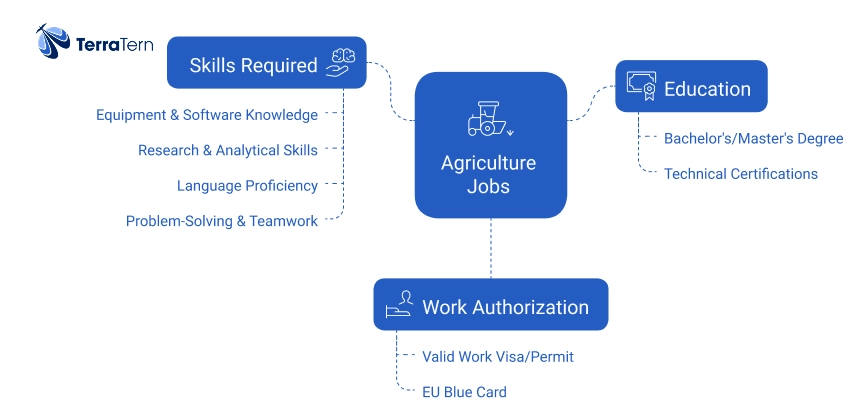
To be good in agriculture jobs in Germany for Indians, you need:
-
Education: Degree in agriculture, agribusiness, agricultural engineering or related fields.
-
Technical skills: Knowledge of modern agricultural machinery, software and techniques.
-
Research skills: For R&D roles, strong analytical and research skills.
-
Language: German is often required, but some roles accept English.
-
Soft skills: Problem-solving, teamwork, and communication skills.
What is the Diversity in Agricultural Roles in Germany for Indians in 2026?
The agricultural sector in Germany offers a plethora of roles across various specialisations:
|
Role |
Description |
|
Farm Manager |
Oversees day-to-day operations of a farm, including crop and livestock management. |
|
Agricultural Engineer |
Designs and improves agricultural machinery and systems. |
|
Agronomist |
Studies soil, crops, and plants to improve agricultural productivity. |
|
Food Scientist |
Develops and improves food products and safety standards. |
|
Environmental Consultant |
Advises on sustainable practices and the environmental impact of agricultural activities. |
|
Agri-Technician |
Works with technology to enhance agricultural processes. |
|
Research Scientist |
Conducts experiments and research to innovate agricultural practices. |
What are the Top Hiring Companies for Agriculture Jobs in Germany 2026?
Here are some of the big players in Germany that should be taken note of if you’re looking for agriculture jobs in Germany for Indians:
-
Multinationals: Big global companies with a presence in Germany.
- Agribusiness: German companies in different agricultural sectors.
-
Research Institutes: Institutions for agricultural research.
-
Startups: Agri-tech companies.
Also Read: Top Agriculture Jobs in Australia - High Pay & Growth!
What are the Salary Trends in Agriculture Jobs in Germany in 2026?
Salaries for agriculture jobs in Germany can vary widely based on the role, experience, and location. Here is an overview of typical salary ranges for agriculture jobs in Germany for Indians:
|
Job Role |
Average Salary (EUR) |
|
Farm Manager |
45,000 - 70,000 |
|
Agricultural Engineer |
50,000 - 80,000 |
|
Agronomist |
40,000 - 65,000 |
|
Food Scientist |
45,000 - 75,000 |
|
Environmental Consultant |
50,000 - 85,000 |
|
Agri-Technician |
35,000 - 55,000 |
|
Research Scientist |
55,000 - 90,000 |
What are the Career Growth and Development Paths For Agriculture Jobs in Germany in 2026?
Agriculture jobs in Germany for Indians offer substantial growth opportunities:
-
Professional Development: Continuous learning through workshops, courses, and certifications.
-
Career Progression: Clear pathways from entry-level to senior management roles.
-
Networking: Opportunities to connect with professionals and experts in the field.
-
Innovation: Involvement in cutting-edge projects and technologies.
Also Read: Germany Immigration- Benefits, Fees, Time and Jobs
What are the Eligibility Criteria for Agriculture Jobs in Germany in 2026?
To work in agricultural jobs in Germany, candidates typically need:
-
Relevant Degree: Bachelor's or Master's in a related field.
-
Experience: Practical experience through internships or previous employment.
-
Language Skills: Proficiency in German; English may suffice in some roles.
-
Work Permit: Non-EU nationals require a valid work visa.
Getting agricultural jobs in Germany is much smoother with an Opportunity Card. If you want to apply for a Germany Opportunity Card, then you should calculate your eligibility points using the Germany Immigration Calculator for free.
Resume Format for Agriculture Jobs in Germany
An effective resume for agriculture jobs should include:
-
Contact Information: Name, address, phone number, and email.
-
Professional Summary: Brief overview of qualifications and career goals.
-
Education: Relevant degrees and certifications.
-
Work Experience: Detailed descriptions of previous roles and responsibilities.
-
Skills: Technical, research, and soft skills.
-
Certifications: Relevant courses and certifications.
-
Languages: Proficiency in German and other languages.
How to Apply for Agriculture Jobs in Germany from India in 2026?
Applying for agriculture jobs in Germany from India involves several steps:
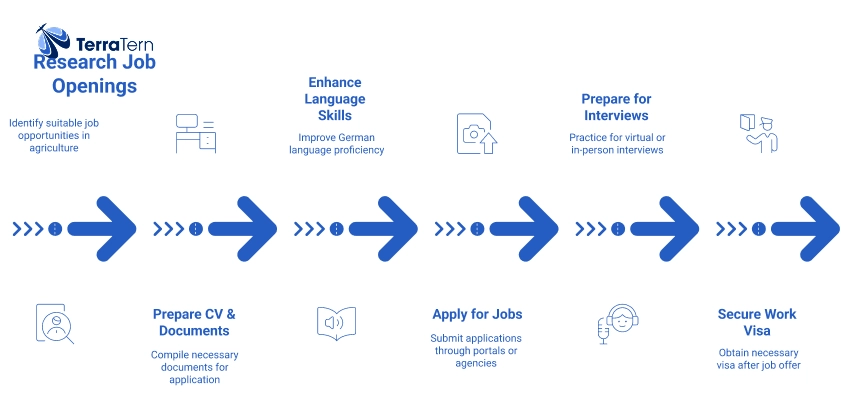
1. Research: Identify suitable job openings and employers.
2. Prepare Documents: Update resume and gather necessary documents (e.g., degree certificates).
3. Language Preparation: Improve German language skills if necessary.
4. Application: Submit applications through job portals, company websites, or recruitment agencies.
5. Interview Preparation: Prepare for potential interviews, both virtual and in-person.
6. Work Visa: Apply for a work visa once a job offer is secured.
Also Read: Moving to Germany from India: Latest Guide
Conclusion
Germany's agricultural sector in 2026 represents a genuine, life-changing opportunity for Indian professionals and skilled workers ready to leap. From competitive salaries and structured visa pathways to permanent residency and eventual citizenship, agriculture jobs in Germany offer far more than just employment; they offer a complete career and life transformation.
Contact TerraTern for more information on Agriculture Jobs in Germany.




 AI Summary