


Key Highlights
- WX 1 Visa Canada
- What Is the WX-1 Visa Canada?
- Who Is Eligible for a WX-1 Visa in Canada? (Eligibility for Indian Applicants)
- What Activities Are Allowed Under a WX-1 Visa Canada? (R186 Examples)
- What Can't You Do on a WX-1 Visa in Canada? (Restrictions Explained)
- How Is the WX-1 Visa Different From a Canada Work Permit?
- How Does the WX-1 Visa Compare to V-1, B-1, and SX-1 Codes?
- How Long Can You Stay in Canada on a WX-1 Visa?
- What Is the Application Process for a WX-1 Visa Canada in 2026?
- Can a WX-1 Visa Be Switched to a Work Permit or Another Category?
- Does WX-1 Work Experience Count Toward Canadian Experience Class or PR?
- What Happens If You Overstay or Misuse a WX-1 Visa Canada?
- What Are the Most Common Mistakes Indian Applicants Make With the WX-1 Visa?
- 2026 Industry Context Section
- Conclusion
The WX 1 visa Canada refers to a visa category that is a temporary work visa designed for foreign professionals who wish to work in Canada on a short-term, specific basis. Eligibility depends on the exact activity and the applicable exemption, such as business-visitor activity, certain public-speaking engagements, or certain performing-artist circumstances.
WX 1 Visa Canada
Some foreign nationals may be allowed to perform narrowly defined activities in Canada without a work permit, if they meet a specific IRPR exemption with a WX 1 visa.
- Enables access to undertake certain very specific work processes without having to obtain a full work permit, under IRPR Section 186.
- Certain guest speakers and commercial seminar leaders may be exempt only where they meet the applicable time and activity limits under IRPR.
- “WX-1” is not a visa that is applied for to be officially issued by the IRCC, but is rather a visa code given to you by the IRCC after you state your purpose.
- The default authorised stay lasts only 6 months; it is not valid for regular Canadian employment.
Also Read: Canada V1 Visa: What It Is and How to Apply From India?
What Is the WX-1 Visa Canada?
If the foreign national has been granted permission to work in Canada without a work permit under Section 186 of the Immigration and Refugee Protection Regulations (IRPR), the foreign national's Temporary Resident Visa is granted with a WX-1 visa code stamped on it by IRCC.
- WX 1 visa Canada is a category code on the TRV counterfoil (also known as the official visa sticker from Canada).
- A counterfoil is the IRCC's secure adhesive label that they issue once they've approved a Temporary Resident Visa application, which carries details such as photo, validity dates, the number of entries permitted, and the category code (WX-1).
- The legal basis follows a generic paragraph (a) through (x) of IRPR R186, which lists narrow items for stay and permit exemptions, and a more specific paragraph for ‘business visitor’ (R187).
- You do not apply for or are not issued the "WX-1" visa: Canada code. The officer places this code if you state your purpose.
- Informal names for practitioner: “W” = work, “X” = exempt (to aid in memorising work-permit-exempt authorisation).
- The underlying Visa is still a standard Temporary Resident Visa; this just advises an exemption to Border Officers.
- A border services officer determines the period of authorised stay. If no different period is imposed, a visitor is generally authorised for up to six months.
As per our TerraTern Expert Shreya, if your visa shows "WX-1," you have not been given a special new visa type; you've been given permission for one narrow work activity. Treat it as narrowly as it's written.
Is WX-1 an Actual Visa Type or a Category Code?
It is a category code and not a visa product in itself; the classification underlying this product will still be a standard Temporary Resident Visa.
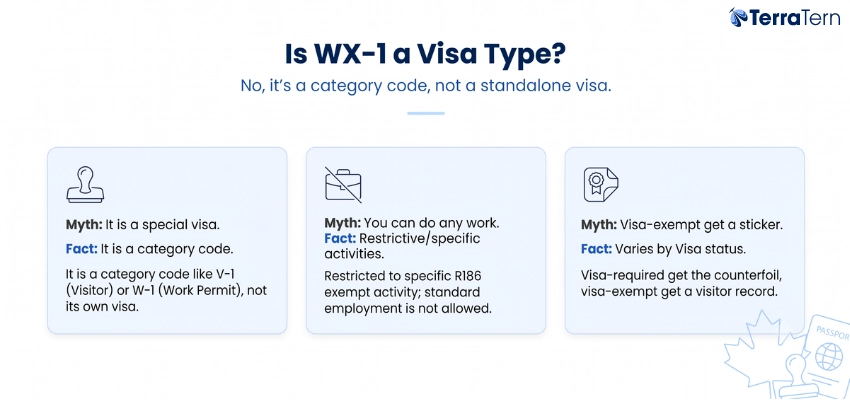
1. Myth: “I can apply for a special visa called WX-1.”
- First fact: The WX 1 visa Canada is a counterfoil like V-1 (Visitor visa), V-5 (Business visa), W-1 (Work-permit holder visa), etc.
2. Myth: If one carries a WX-1, he/she will be able to get any work in Canada.
- Fact: It allows only the specific and narrow activity defined in the matching R186 paragraph – regular employment is not allowed.
3. Fakemyths: Visa-exempt travellers receive a physical WX-1 sticker.
- Fact: Visa-required nationals get the counterfoil, while visa-exempt nationals could get a visitor record with the R186 exemption.
Important Note: Don't search for a "WX-1 application form" it doesn't exist. You apply for a standard TRV and explain your work purpose.
Where Does the WX-1 Code Come From? (Section 186 Explained)
The IRPR outlines approximately two dozen narrow classifications of work activities (classified as lettered from R186(a) to R186(x) that will not require a work permit, and WX-1 is the counterfoil marker that the officers use in several of these cases.
- The complete list of work-permit exemptions is in IRPR R186; officers affix the qualifying cases with the WX 1 visa canada code on the TRV.
- The full official text of these laws is on the Justice Laws website (laws-lois.justice.gc.ca).
- Here is a short list of the most frequently referenced subsections of WX-1:
|
Subsection |
Category |
One-line Description |
|
R186(a) + R187 |
Business visitors |
International business activities (meetings, after-sales service, procurement) without entering the Canadian labour market; primary remuneration outside Canada. |
|
R186(g) |
Performing artists |
Time-limited live artistic performances (not primarily film/TV/radio) by foreign productions/groups or guest artists; no employment relationship with a Canadian contractor. |
|
R186(j) |
Public speakers |
Guest speakers or commercial seminar leaders delivering speeches/papers or seminars lasting no longer than five days. |
|
R186(o) |
Expert witnesses/investigators |
Experts conducting surveys/analyses for evidence or appearing as expert witnesses before courts, tribunals, or regulatory bodies. |
|
R186(q) |
Civil aviation inspectors |
National aeronautical authority inspectors checking flight operations or cabin safety of international commercial carriers. |
|
R186(r) |
Aviation accident investigators |
Accredited representatives/advisers in investigations under the Canadian Transportation Accident Investigation and Safety Board Act. |
Expert Advice: Ask your consultant which specific R186 letter applies to your case. "WX-1" alone doesn't tell you your exact rights; the subsection does.
Who Is Eligible for a WX-1 Visa in Canada? (Eligibility for Indian Applicants)
Eligibility for a WX-1 visa in Canada depends entirely on the specific work-permit-exempt activity you are undertaking under Section 186 of the IRPR, such as travelling as a business visitor, an after-sales technical specialist, a guest speaker, or a performing artist.
- Foreign Employment & Remuneration: You must remain on the payroll of your employer outside Canada. For business visitors, the traveller’s primary source of remuneration and principal place of business generally must remain outside Canada. Other exemptions have their own requirements.
- Principal Place of Business: Your primary workplace, business operations, and economic ties must remain firmly anchored outside of Canada.
- No Labour Market Competition: The intended activities must not enter into or actively compete with the Canadian domestic labour market (e.g., no filling open local job vacancies).
- Genuine Temporary Intent: Your stay must be strictly time-limited, supported by a clear itinerary and an explicit plan to depart Canada immediately upon task completion.
- Common Indian Applicant Scenarios: Most frequently applies to Indian IT professionals handling short-term after-sales installations, corporate delegates attending strategy meetings under R186(a). After-sales service can be work-permit exempt only in defined circumstances. Review the purchase agreement, warranty or service contract, employer relationship, and the actual tasks before travelling.
- Ties to Home Country: Strong economic, familial, and professional ties to India (such as active employment contracts, property deeds, or immediate family responsibilities) remain vital for securing the underlying Temporary Resident Visa approval.
- Mandatory Post-Guidance Documentation: You must provide comprehensive proof satisfying strict documentary burdens, including an official foreign employer verification letter, a detailed Canadian host invitation, and verifiable proof of foreign-source income.
Expert Tip: Even though a WX-1 visa to Canada bypasses the lengthy Labour Market Impact Assessment (LMIA) process, your application will face rigorous scrutiny regarding your ties to India and the verifiable temporary nature of your assignment.
What Documents Do Indian Applicants Need for a WX-1 Visa Canada Application?
To successfully secure a WX 1 visa Canada counterfoil, Indian applicants must submit a robust document package that clearly establishes both general TRV admissibility and specific eligibility under the Section 186 work exemption.
|
Document Type |
Description & Purpose |
|
Valid Indian Passport |
Must be valid for the entire intended duration of your stay in Canada, complete with clean pages for counterfoil stamping. |
|
Foreign Employer Letter |
Official letterhead document detailing your role, confirming ongoing employment in India, stating you remain on their payroll, and outlining the purpose/duration of the Canada trip. |
|
Canadian Host Invitation Letter |
A formal invitation from the Canadian business partner, event organiser, or client detailing the exact itinerary, scope of work, and meeting locations. |
|
Proof of Financial Support |
Recent bank statements, tax records, or corporate sponsorship letters proving you have adequate funds for travel and subsistence. |
|
Standard TRV Biometrics & Forms |
Completed IMM application forms, digital photographs, and biometric collection confirmation receipts. |
Important Tip: A vague purpose-of-travel letter is the single most common reason officers default an applicant to a plain V-1 (tourist) code instead of the WX-1 they actually needed be specific about dates, activity, and payer.
What Activities Are Allowed Under a WX-1 Visa Canada? (R186 Examples)
Allowed activities under a WX 1 visa Canada designation are strictly narrow, temporary, and non-competitive with the domestic job market, such as conducting after-sales machinery repairs, performing in brief cultural events, or delivering short-term conference speeches. To visualise how IRCC applies these rules, consider these common scenarios tailored for international travellers
- The IT Technical Specialist: An engineer employed by a multinational technology firm travels to Canada to train client staff on proprietary enterprise software purchased under an international sales contract.
- The Cultural Performing Artist: A musician or traditional artist enters Canada as part of a foreign troupe for a time-limited festival engagement, maintaining an independent employment relationship abroad.
- The Conference Keynote Speaker: A startup founder or industry expert invited to deliver a keynote speech or seminar lasting under five days at a corporate convention.
As per TerraTern Expert: If your planned activity isn't a close match to one of the R186 examples, don't assume you'll get WX-1; get a professional opinion before you travel rather than after a refusal.
Also Read: Canada Visa for Indians: Types, Process & Requirements
What Can't You Do on a WX-1 Visa in Canada? (Restrictions Explained)
You cannot take up regular, ongoing employment with a Canadian corporate entity, accept Canadian-sourced salaries for general labor, or engage in any tasks that directly compete with the Canadian workforce.
|
Category |
Permitted Activities (WX-1 Profile) |
Restricted / Prohibited Activities |
|
Employment Source |
Receiving salary strictly from a foreign employer outside Canada. |
Joining a Canadian company payroll or receiving local hourly/salary wages. |
|
Market Impact |
After-sales servicing, specialised auditing, or attending high-level corporate meetings. |
Filling active local job openings or providing ongoing operational services to clients. |
|
Job Searching |
Attending industry networking events or looking at structural market trends. |
Actively searching the Canadian local job market for employment or converting status from within without qualifying pathways. |
|
Part-Time Work |
None outside the designated narrow exemption task. |
Taking side jobs, gig work, or part-time local employment. |
Pro Tip: "I'll just look for a job while I'm there" is the most common and most damaging misunderstanding of the WX-1 code. It authorizes one activity, not a foot in the Canadian job market.
How Is the WX-1 Visa Different From a Canada Work Permit?
A standard work permit authorises ongoing, long-term employment within the local economy, whereas a WX 1 visa Canada counterfoil code only confirms your exemption from needing a work permit for a single, highly specific temporary assignment.
|
Feature |
WX-1 Coded TRV (Work Permit Exempt) |
Standard Canada Work Permit (Employer-Specific / Open) |
|
Primary Purpose |
Short-term business visits, specialized training, or brief expert tasks. |
Long-term employment, career building, or open labor market integration. |
|
Maximum Duration |
Typically up to 6 months per entry (set by border officers). |
Tied to employment contract length, open work permit expiry, or LMIA validity (1 to 3+ years). |
|
LMIA Requirement |
No LMIA required (exempt under IRPR Section 186). |
Often requires a Labour Market Impact Assessment (unless an IMP exemption applies). |
|
Processing Fees |
Standard TRV application fee only (no separate work permit holder processing fee). |
Standard TRV fee plus work permit processing and employer compliance fees. |
|
PR Pathway Potential |
Direct work experience gained under a business visitor code cannot count toward the Canadian Experience Class (CEC). |
Eligible work experience can build points for Express Entry and permanent residency pathways. |
|
Issuing Authority |
IRCC Visa Office / Border Services Officer. |
IRCC Processing Centre / Port of Entry. |
Key Note: If your Canadian work will last more than a few days or weeks, or involves an ongoing role with a Canadian company, you almost certainly need a work permit, not a WX-1 exemption. When in doubt, apply for the permit.
How Does the WX-1 Visa Compare to V-1, B-1, and SX-1 Codes?
V-1 is for standard tourism with zero work or study rights; B-1 handles broader business visitor trips. A study permit is generally not required for a programme of six months or less, but short study has separate conditions and does not automatically authorise work
|
Visa Code |
Meaning & Purpose |
Typical Duration |
Can You Work? |
Can You Study? |
|
V-1 |
Pure visitor or tourist entry. |
Up to 6 months per entry. |
No. |
No. |
|
B-1 |
Broader business visitor activities. |
Up to 6 months. |
Limited, non-competitive business activity only. |
No. |
|
WX-1 |
Specific R186 work-permit exemption. |
Matches activity length (often days to weeks; default cap 6 months). |
Only the exact approved professional activity. |
No. |
|
SX-1 |
Short-term study exemption. |
Matches course duration, up to 6 months. |
No. |
Yes, courses under 6 months without a study permit. |
As per TerraTern Expert Divyansh, Don't fixate on the letter code itself; focus on which single activity (visiting, working, studying, or a narrow work exemption) it authorizes, because that's what a border officer will actually check.
Also Read SX1 Visa Canada for Indians: Guide to Rules & Success
How Long Can You Stay in Canada on a WX-1 Visa?
Your authorised duration on a WX 1 visa Canada entry generally aligns with the verified length of your specific assignment, though Border Services Officers apply a regulatory default cap of six months under standard visitor rules.
- The 6-Month Default Rule: Under IRPR Section 183(2), standard visitor entries carry an initial six-month limit, though stay is typically tailored tightly to the actual length of your conference, repair contract, or training schedule.
- Shorter Practical Windows: Unlike a V-1 tourist stay that often runs the full six months, business-related WX-1 entries usually span only a few days to several weeks based on the verified itinerary.
- Extension Mechanics: A visitor record can extend temporary-resident status, but it does not convert an activity into authorised work or expand a work-permit exemption.
- Medical Exam Triggers: Stays exceeding six months or involving specific high-risk fields may trigger requirements for a Canadian immigration medical examination.
- Overstay Consequences: Remaining in Canada past your authorised date without a valid extension constitutes a serious immigration violation, leading to potential removal orders and re-entry bans.
Important Note: Don't assume "6 months"; your WX-1 stay is usually only as long as your approved activity requires. A 3-day speaking engagement will not typically get a 6-month stay.
What Is the Application Process for a WX-1 Visa Canada in 2026?
You apply for a WX 1 visa Canada by submitting a standard Temporary Resident Visa application online through the IRCC portal, clearly detailing your specialized work activity so officers can assign the correct Section 186 exemption code.
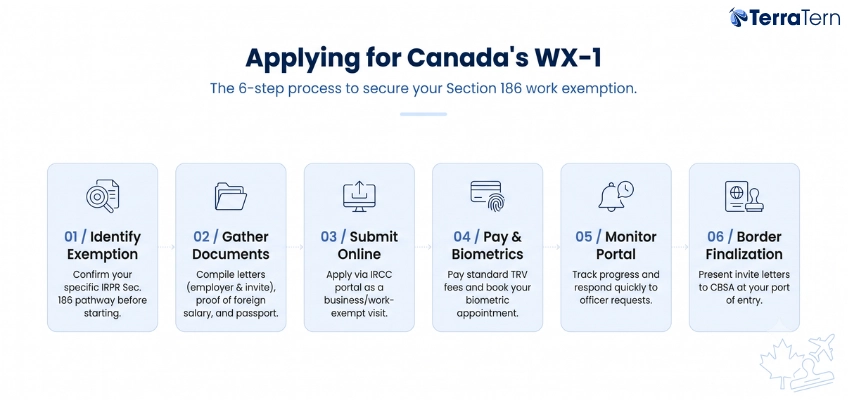
- Step 1: Identify Your Exemption Pathway: Confirm precisely which subsection of IRPR Section 186 governs your upcoming professional activities before starting your paperwork.
- Step 2: Compile Mandatory Documents: Gather your foreign employer verification letter, Canadian corporate invitation letter, proof of foreign-source salary, and valid passport.
- Step 3: Submit via the IRCC Portal: Create a secure IRCC account, complete the standard TRV application forms, and explicitly describe your trip as a business/work-exempt visit rather than general tourism.
- Step 4: Pay Fees & Complete Biometrics: Pay the standard TRV and biometric processing fees, then book and complete your biometric collection appointment if required.
- Step 5: Monitor and Respond: Track application progress via your portal account and reply immediately to any requests for secondary documents from visa officers.
- Step 6: Border Finalisation: Prepare to present your invitation letters clearly to the CBSA officer upon arrival, as the counterfoil and entry conditions are finalised at the port of entry.
Expert Tip: The single biggest process mistake is writing "visit" instead of describing the specific work activity; that's what causes officers to default you to a V-1 instead of the WX-1 you actually need.
Can a WX-1 Visa Be Switched to a Work Permit or Another Category?
A person who later needs a work permit must meet the applicable work-permit requirements and confirm whether they are eligible to apply from inside Canada or must apply from abroad.
- Genuine Intent & Purpose Evaluation: IRCC evaluates whether your underlying situation genuinely changed or if your initial application misrepresented your true intentions.
- Applying From Within Canada: Eligible applicants can apply for a formal work permit from inside Canada under appropriate provisions (such as employer-specific IMP streams or supported pathways), ensuring status continuity.
Canada.ca - Misrepresentation Warning: Attempting to alter your professional scope on-site without authorisation or concealing long-term employment intentions risks a finding of misrepresentation, carrying a severe five-year ban from Canada.
Expert Advice: Transparency is cheaper than convenience. Declare a genuine change in plans to IRCC/CBSA proactively rather than hoping no one notices; the downside of misrepresentation (a 5-year ban) is far worse than any delay from doing it properly.
Also Read: A guide to Canada Visitor Visa from India
Does WX-1 Work Experience Count Toward Canadian Experience Class or PR?
Generally, no. Work performed under a work-permit exemption should not be assumed to count toward Canadian Experience Class eligibility. Applicants should assess the exact exemption, occupation, authorisation, and CEC requirements.
- The Design Bar: CEC requires skilled, authorised work experience meeting specific TEER standards, whereas WX-1 assignments are short, non-competitive activities explicitly structured to bypass local labour market integration.
My Personal Mentors - Out-of-Date Claims: Disregard older online forums suggesting short-term business visitor days accumulate toward permanent residency points; recent policy updates explicitly close this route.
Immigratic - Exploring Pathways: If your ultimate objective is permanent residency, standard visitor or WX-1 entries will not build your CRS score. Consider transitioning your planning toward dedicated economic immigration streams.
Immigratic
Important Tip: If your real goal is Canadian PR, don't rely on a short WX-1-authorized visit to build your case; talk to a licensed consultant about Express Entry or PNP pathways that are actually built for that purpose.
What Happens If You Overstay or Misuse a WX-1 Visa Canada?
Overstaying or working without authorisation can affect future immigration applications and may lead to enforcement action.
- Two Distinct Infractions: Simple overstays (remaining past your authorised date) and unauthorised work (performing tasks outside your narrow R186 exemption) are handled separately by CBSA but carry equally serious consequences.
Sobirovs Law Firm - The 90-Day Restoration Cutoff: If your status expires, you have a strict 90-day window to apply for Restoration of Status from within Canada; missing this window requires immediate departure or a Temporary Resident Permit.
- Misrepresentation vs Overstay: Routine overstays differ legally from intentional misrepresentation; however, concealing unauthorised local employment acts as a dual violation that frequently triggers a five-year inadmissibility ban.
- As per TerraTern Expert: If your circumstances change and you're at risk of overstaying, act before day 90, not after, as your options narrow sharply once that window closes.
What Are the Most Common Mistakes Indian Applicants Make With the WX-1 Visa?
The most common mistakes Indian applicants make with the WX 1 visa Canada are describing the trip vaguely as a “visit” instead of naming the specific R186 work activity, assuming the code allows any paid work, and not carrying enough documentation of the foreign employer relationship at the port of entry. These errors lead to refusals or entry issues.
|
Common Mistake |
Consequence |
Correct Approach |
|
Vague Purpose Declaration |
Triggers application delays or outright refusals due to unclear intent. |
Explicitly outline the exact R186 activity, conference, or training itinerary in your application letter. |
|
Assuming Any Paid Work is Permitted |
Results in unauthorised work charges and immediate border enforcement action. |
Restrict activities strictly to the narrow, approved task outlined under your scope. |
|
Thin Employer Documentation |
Causes CBSA officers to question your status at the port of entry. |
Carry a detailed corporate letter from your foreign employer confirming payroll continuity and role specifics. |
|
Misunderstanding the CEC Rule Change |
Distorts long-term expectations regarding permanent residency planning. |
Recognise that short business visits do not build Canadian Experience Class points; consult official guidelines. |
|
Informal Purpose Switching |
Violates visa terms if activities change mid-stream without authorisation. |
Formally reapply or declare structural changes through official channels rather than guessing. |
Pro Tip: Every mistake on this list is preventable with one honest, specific sentence about your real purpose of travel. Vagueness, not dishonesty, is what trips up most genuine Indian applicants.
Also Read: Work Permit: All You Need To Know To Work Abroad
2026 Industry Context Section
IRCC tightened business-visitor documentation standards in March 2026 and clarified that this type of work generally does not count toward the Canadian Experience Class, while overall Temporary Resident Visa approval rates for applicants globally, including India, remain historically tight.
Some facts to include are:
-
March 19, 2026: IRCC issued updated program-delivery instructions clarifying R186(a) business-visitor eligibility, emphasising the activity must be non-competitive with the Canadian labour market, international in scope, and remunerated from outside Canada, with a higher documentary burden on applicants.
-
March 2026 Policy Clarification: Business-visitor work performed under this exemption is confirmed to not count toward Canadian Experience Class eligibility, a reversal of the looser guidance some older blog posts (2022–2023) still repeat.
- In-Canada Renewals Tell a Different Story: once inside Canada with valid status, visitor-visa renewal approval rates run much higher (~89% as of the same reporting period), relevant context for anyone wondering whether to extend a WX-1-coded stay from within Canada.
-
No Dedicated WX-1 Statistics Exist: IRCC reports TRV data in aggregate, not broken out by counterfoil code, so any "WX-1 approval rate" claim you see elsewhere is not something IRCC actually publishes; be sceptical of invented statistics.
-
Expert-Quotable Line: RCIC practitioners consistently note that switching purpose mid-stay (e.g., from tourism to WX-1-type work) without informing IRCC/CBSA is one of the fastest routes to a misrepresentation finding and a 5-year inadmissibility risk.
Key Note: Don't let outdated 2022-era blog posts convince you WX-1 work automatically helps your PR case. As of the March 2026 clarification, most business-visitor work explicitly does not count toward the Canadian Experience Class. Verify your specific R186 subsection before assuming otherwise.
Conclusion
Choosing a WX 1 visa Canada pathway is ideal for professionals undertaking brief, specialised, work-permit-exempt assignments like technical training or business meetings. Remember that WX-1 is a Section 186 category code rather than a standalone visa, carries a six-month default stay, restricts you from local labour, and does not count toward Canadian Experience Class points. Before you travel, contact TerraTern for a professional documentation review and eligibility consultation.
Contact TerraTern for more information on WX-1 Visa Canada: Meaning, Eligibility & Rules Explained (2026).




 AI Summary