

Key Highlights
- What Is a Switzerland Work Permit from India?
- What Types of Switzerland Work Permits Are Available for Indians?
- How Does the Switzerland Work Permit Quota System Work in 2026?
- Who Is Eligible for a Swiss Work Permit from India?
- What Documents Are Required for a Switzerland Work Permit Application?
- How to Apply for a Work Permit in Switzerland from India? (Step-by-Step)
- What Is the Switzerland Work Permit Processing Time from India?
- How Much Does a Switzerland Work Permit Cost for Indian Applicants?
- What Salary Can Indian Professionals Expect on a Switzerland Work Permit?
- Can a Switzerland Work Permit Lead to Permanent Residency or Citizenship?
- What Common Mistakes Should Indian Applicants Avoid?
- How Can TerraTern Help You Get a Switzerland Work Permit from India?
- 2026 Industry Context Section
- Conclusion
Successful applications for a work permit to work in Switzerland from India must be submitted by a sponsor and must be compliant with the very limited number of non-EU work permits allowed. In Switzerland, they are limited to 8,500 permits per year, 4,500 of which are long-term visas (B), and 4,000 are short-term visas (L).
The processing schedule is 3-5 months for the entire process, which includes an end-to-end processing journey that includes a mandatory Swiss job offer, generating high-paying specialist jobs, and a laid-out roadmap to permanent settlement.
What Is a Switzerland Work Permit from India?

The Switzerland work permit details are:
-
Authorisation: A combination authorisation from a Swiss canton and the State Secretariat for Migration (SEM) to allow Indian citizens to legally work and live in Switzerland.
-
Employer-Tied: In terms of work permits for India, there is no independent or self-sponsored work permit, and it is found that it can be granted only with the employer's backing.
-
Non-EU Framework: Switzerland does not belong to the EU, and EU Blue Card rules don't apply to this 3rd Country framework.
As per TerraTern Expert Shreya, Switzerland has no EU-style points system for Indians; every application starts and ends with a genuine Swiss employer willing to sponsor you. Job search comes first; permit paperwork comes second.
Also Read: Switzerland Visa Fees for Indian: New Cost, Tips & Guide
What Types of Switzerland Work Permits Are Available for Indians?
For third-country nationals, a B permit is generally issued for a limited period and is subject to renewal under the applicable cantonal and federal rules. The C permit is a permanent permit, which is offered after 10 years of continuous legal residence.
|
Permit Type |
Duration |
Who is it for |
2026 Quota |
Renewable? |
|
L Permit |
Up to 12 months |
Short-term contracts and project-based workers |
4,000 (Non-EU) |
Occasionally extendable |
|
B Permit |
1 year (initial) |
Professionals with open-ended or long-term contracts |
4,500 (Non-EU) |
Yes, annually |
|
C Permit |
Indefinite |
Residents with 10 years of continuous legal stay |
No quota |
N/A (Permanent) |
|
G Permit |
Varies |
Cross-border commuters living outside Switzerland |
N/A for India |
Yes |
Important Note: The L Permit isn't just a lesser B Permit. Many Indian professionals deliberately start on an L Permit as a "trial" with a Swiss employer, then convert to a B Permit once a longer contract and quota space are confirmed.
What Is the L Permit (Short-Term Work Permit)?
The L Permit was issued for fixed-term Swiss employment contracts of up to 12 months (sometimes longer) and was a result of a non-EU quota of 4,000 permits for 2026. It is exclusive to one employer and canton. An L permit is a short-stay residence permit, generally linked to the authorised employment conditions.
What is a B Permit (Long-Term Work Permit)?
Indian professionals who have a permanent job offer in Switzerland, which is not limited in length of time, are issued the B Permit, which is valid for an initial period of one year and can be renewed on an annual basis, and is drawn from a 4,500-permit quota for non-EU nationals in 2026. It will allow family reunification on the condition that it can be renewed and will allow the possibility of changing one's employer with the consent of the cantonal authorities.
What Is C Permit (Settlement/Permanent Residence)?
A C settlement permit may become available after a qualifying period of lawful residence, subject to integration, language, and other requirements. Confirm the rules with the competent canton. It is the last hurdle on an L or B Permit, and it is designed to eliminate the need to get the permit renewed every year and to offer nearly the same rights to Swiss citizens in accessing the labour market.
Do the G Permit and CI Permit Apply to Indian Applicants?
As individuals who wish to practice in India need to live in a neighbouring country, the G (cross-border commuter) Permit does not apply to them. Only existing B or C Permit holders may be the spouse or family member of another who is already a B or C Permit holder. All those who apply from inside India need not worry about either of the two.
How Does the Switzerland Work Permit Quota System Work in 2026?
Switzerland work permit quota system is:
-
Annual Reset Cycle: The Swiss Federal Council publishes the non-EU quota on a yearly basis, with the complete national allocation resetting on a yearly basis on January 1st.
-
Maximum Approvals for 2026: The government set a 2026 national cap on non-EU approvals for the year as a whole (830 more L permits and 830 more B permits).
-
Quarterly Cantonal Distribution: Switzerland reallocates the national quota among all 26 cantons in quarterly shares, resulting in varying availability of permits in the individual cantons in the course of the year as a function of demand.
-
Queuing & Exhaustion Risk: If your target canton has a maximum allotment limit per quarter, your application will have to wait in a queue until the next quarter, which could potentially result in having your application approved for a start of employment 3 months later.
-
The "Apply Early" Advantage: Official statistics showing that the waitlists of the non-EU quota have already been filled by the end of September 2025 indicate that applying early in the year or in the quarter for a work permit for Switzerland from India is important to avoid such waitlists.
Expert Tip: Don't just check if the national quota has capacity; ask your employer to confirm your specific canton's quarterly allocation before you turn down other offers. A fully qualified candidate can still be declined purely on cantonal quota timing.
Who Is Eligible for a Swiss Work Permit from India?
Eligibility for a Switzerland Work Permit from India:
-
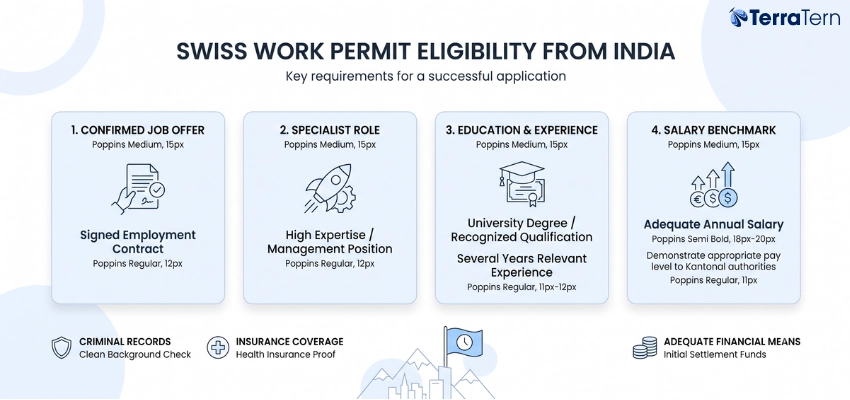
Confirmed Job Offer: The indispensable prerequisite is the employment contract signed by a Swiss employer, and there is no separate visa process to obtain a work permit in Switzerland from India.
-
Specialist Classification: The Swiss system makes a clear distinction between specialist roles, favouring those with a high level of expertise, and management positions and highly skilled roles, and only considers candidate applications that fall into these categories.
-
Education/Experience Requirements: University degree or equivalent recognized professional qualification with several years' work experience in your career type, and of an appropriate nature.
-
The Salary Benchmark Nuance: There is no single national minimum salary in Switzerland, but in cities like Zurich and Geneva, a salary above CHF 85,000/- per year is the reality – the number being used as the bottom line for an employer to demonstrate that their salary is adequate to justify you for the position to the Kantonal authorities.
-
Compliance & Background: Must also be free from criminal records, have insurance coverage, and secure proof of adequate financial means for initial settlement.
Expert Advice: "Highly qualified" is doing a lot of work in Swiss immigration law. A strong degree plus 2–5+ years of directly relevant experience is the practical bar; generalist profiles without sector-specific experience are the most common rejection pattern, regardless of degree prestige.
Also Read: How to Migrate to Switzerland from India? New Guide
What Documents Are Required for a Switzerland Work Permit Application?
Applying for a work permit for Switzerland from India is a coordination process with specific documentation requirements assigned between you and your Employer.
|
Document |
Required For |
Notes |
|
Valid passport (6+ months validity) |
Applicant |
Must be valid well beyond your intended arrival date. |
|
Proof of qualifications |
Applicant |
University degrees, diplomas, and professional credentials. |
|
Work experience letters |
Applicant |
Detailed documentation proving several years of relevant experience. |
|
Police clearance certificate |
Applicant |
Official proof of a clean criminal record from India. |
|
Proof of accommodation |
Applicant |
Temporary housing confirmation or lease agreement in Switzerland. |
|
Valid health insurance |
Applicant |
Proof of adequate coverage compliant with Swiss mandates. |
|
Passport photos |
Applicant |
Recent biometric passport-sized photographs. |
|
Signed employment contract |
Employer |
Must detail the role, terms, and a market-rate Swiss salary. |
|
Recruitment effort proof |
Employer |
Evidence showing no suitable Swiss or EU/EFTA candidate was found. |
|
Written hiring justification |
Employer |
Formal explanation of why your specific non-EU expertise is required. |
|
SERI credential recognition |
Employer / Applicant |
Required primarily for specific regulated professions. |
Important Tip: Get your degree and experience certificates apostilled and translated before your employer starts the cantonal application. Document delays, not eligibility issues, are the most common cause of processing-time overruns.
How to Apply for a Work Permit in Switzerland from India? (Step-by-Step)
Securing your work permit for Switzerland from India is a strictly structured, employer-driven process. The procedure runs in six mandatory stages that must be completed sequentially:
-
Stage 1: Secure a confirmed job offer.
-
Stage 2: Your employer files the cantonal work permit application.
-
Stage 3: Attain cantonal and federal (SEM) approval.
-
Stage 4: Apply for the Type D national visa in India.
-
Stage 5: Travel to Switzerland on your entry visa.
-
Stage 6: Register locally within 14 days to obtain your residence permit card.
As per our TerraTern Divyansh, your employer's cantonal application and your D-visa application are sequential, not parallel. Don't book flights or give notice at your current job until the SEM approval letter is in hand.
Step 1: How Do You Secure a Swiss Job Offer?
To begin the process for a work permit for Switzerland from India, you need a written job offer or a signed employment contract. The Swiss employer must be willing to sponsor your permit and complete the mandatory labour market test. For comprehensive job-search strategies, read our guide on finding a job vacancy in Switzerland for Indians.
Step 2: How Does the Employer Apply for the Work Permit?
Once hired, your employer officially initiates your work permit for Switzerland from India. They submit the application to the cantonal migration authority alongside your contract, qualifications, and proof of the required labour market test. If approved locally, the canton forwards the dossier to the SEM for federal sign-off.
Step 3: What Happens During Cantonal and Federal Approval?
During this phase, your work permit for Switzerland from India undergoes a strict dual-level government review process:
-
Cantonal Review: The local migration authority assesses the application, which typically takes 3 to 8 weeks.
-
Quota Verification: Authorities verify that the canton has sufficient quarterly non-EU quota capacity available.
-
Federal Review: The State Secretariat for Migration (SEM) evaluates the application for national compliance.
-
SEM Timeline: This secondary federal approval step typically adds roughly 1 to 2 more weeks.
-
Final Authorization: Once fully cleared, an electronic visa authorization is forwarded to the Swiss representation in India.
Step 4: How Do You Apply for the Type D National Visa in India?
With your confirmation letter in hand, you must convert your approved work permit for Switzerland from India into an entry visa:
-
Visa Category: Apply for a Type D national long-stay visa.
-
Submission Center: Submit your application through VFS Global to the Swiss Embassy in New Delhi or the Consulate in Mumbai.
-
Core Documentation: Provide your valid passport, the official SEM authorization, and your signed employment contract.
-
Settlement Proof: Submit proof of your Swiss accommodation and valid health insurance.
-
Biometrics Collection: Attend your scheduled VFS appointment to submit your biometric data.
Step 5 – What Happens After You Arrive in Switzerland?
Your work permit for Switzerland from India process concludes only after completing these mandatory post-arrival steps:
-
Local Registration: You must register at your local commune's residents' registration office.
-
Strict Deadline: This registration must occur within exactly 14 days of your arrival.
-
Work Restriction: It is strictly prohibited to begin your new job before completing this local registration.
-
Permit Card: Following registration, your physical L or B residence permit card will be issued.
-
Health Coverage: You must arrange compulsory Swiss health insurance within 3 months of your arrival date.
What Is the Switzerland Work Permit Processing Time from India?
The total realistic Switzerland work permit processing time from a confirmed job offer to your arrival in the country typically ranges from 3 to 5 months. This timeframe is divided across three distinct government phases: local cantonal review (3–8 weeks), federal SEM approval (1–2 weeks), and Swiss Embassy D-visa processing in India (4–6 weeks). The single most common cause of delay when applying for a work permit for Switzerland from India is the submission of incomplete documentation.
|
Processing Stage |
Estimated Timeframe |
|
Cantonal review and quota check |
3 to 8 weeks |
|
Federal (SEM) approval |
1 to 2 weeks |
|
D-Visa application at Swiss Embassy/VFS |
4 to 6 weeks |
|
Total realistic timeline |
3 to 5 months |
Pro Tip: Start the process at least 4 months before your intended start date, and if your role is in a Q1/Q2-heavy hiring canton like Zurich, add a buffer for potential quota timing delays.
Also Read: Switzerland Job Vacancy for Indian: Pay, Visa & More
How Much Does a Switzerland Work Permit Cost for Indian Applicants?
The total realistic cost to secure a work permit for Switzerland from India runs between CHF 400 and CHF 1,100+ (approximately INR 38,000 to INR 1,05,000+). This encompasses the cantonal permit authorization fee, the national D-visa application, post-arrival residence registration, and incidentals like document translation or notarisation.
|
Expense Category |
Estimated Cost |
|
Cantonal Work Permit Approval Fee |
CHF 150 – CHF 500+ |
|
Base D-Visa Application Fee |
~CHF 90 (approx. INR 8,000 – INR 9,000) |
|
VFS Global Service Fee |
~INR 2,690 – INR 3,100 |
|
Residence Registration (Post-Arrival) |
CHF 50 – CHF 150 |
|
Document Translation & Notarisation |
CHF 100 – CHF 300+ |
Key Note: Ask your employer upfront whether they reimburse permit costs. Many Swiss employers in IT and pharma do, but it's rarely offered proactively and needs to be raised during offer negotiation.
What Salary Can Indian Professionals Expect on a Switzerland Work Permit?
To meet the stringent government eligibility criteria for a work permit for Switzerland from India, candidates must secure a salary that strictly aligns with Swiss market rates to prevent wage dumping. Most successful non-EU applications in high-cost cantons like Zurich and Geneva require a base salary of at least CHF 85,000 per year. For highly sought-after specialists in IT, pharmaceuticals, and finance, compensation frequently reaches between CHF 110,000 and CHF 180,000+.
|
Experience Level |
Estimated Annual Salary (CHF) |
|
Junior Specialist (3–5 years) |
CHF 85,000 – CHF 100,000 |
|
Mid-Level Expert (5–10 years) |
CHF 100,000 – CHF 140,000 |
|
Senior / Managerial (10+ years) |
CHF 140,000 – CHF 180,000+ |
Key Note: Your employer must be able to justify your salary as market-rate to cantonal authorities. An unusually low offer isn't just bad for you; it can weaken the permit application itself.
Can a Switzerland Work Permit Lead to Permanent Residency or Citizenship?
Yes, after 10 years of continuous legal residence on an L or B Permit pathway, Indian nationals can apply for the C Permit (permanent settlement). Following this, Swiss citizenship becomes possible on the same residence timeline, provided you meet additional language and integration requirements. When applying for a work permit for Switzerland from India, it is vital to set honest long-term expectations: the Swiss pathway to permanent residency is materially longer and more demanding than competing destinations like Canada or Australia.
|
Milestone |
Timeline |
Key Requirements |
|
L or B Permit |
Year 1 to 10 |
Continuous legal employment, clean criminal record, no reliance on social assistance. |
|
C Permit (Permanent Settlement) |
Year 10 |
10 years of continuous residence. Typically requires B1 spoken German, French, or Italian. |
|
Swiss Citizenship |
Year 10+ |
10 years of residence (3 of the last 5 years). Typically requires B2 spoken language proficiency, plus deep local integration. |
Pro Tip: If long-term settlement is your goal, treat language learning as part of your career plan from year one; it's the single biggest lever you control over an otherwise fixed 10-year timeline.
Also Read: Work Permit: All You Need To Know To Work Abroad
What Common Mistakes Should Indian Applicants Avoid?
The most common avoidable mistakes are applying without a genuinely qualifying job offer, submitting incomplete or untranslated documents, underestimating cantonal quota timing, and assuming German/French fluency isn't needed at any stage. When navigating the complex process for a work permit for Switzerland from India, strictly avoid these documentation and process pitfalls:
-
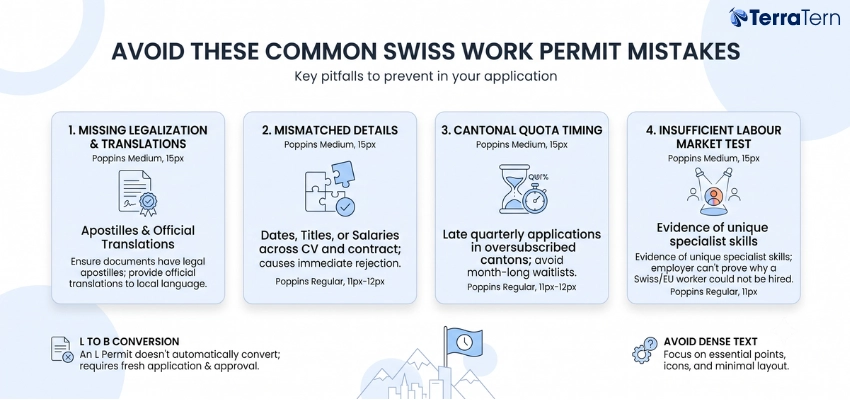
Missing Apostilles and Translations: Submitting civil documents (like degrees or marriage certificates) without proper legal apostilles or official translations into the specific canton's local language.
-
Mismatched Details: Discrepancies in dates, job titles, or salaries across your CV, employment contract, and the formal application form, which can trigger immediate rejections.
-
Cantonal Quota Miscalculations: Applying late in the quarter or to a canton with a heavily oversubscribed quota, causing your application to be waitlisted for months.
-
Underestimating the Labour Market Test: Failing to provide the employer with sufficient evidence of your unique specialist skills, making it impossible for them to legally prove why a Swiss or EU worker could not be hired instead.
-
L to B Conversion Assumptions: Assuming an L Permit automatically converts to a B Permit at the end of the year; upgrading requires a completely fresh application and quota approval.
Key Note: The most preventable rejection cause isn't qualifications; it's inconsistent details across your contract, CV, and application forms. Triple-check that your job title, salary, and dates match exactly across every document before submission.
How Can TerraTern Help You Get a Switzerland Work Permit from India?
TerraTern provides end-to-end support for Switzerland work permit applications from India, ranging from initial eligibility assessment and document preparation to employer-coordination guidance and final D-visa application support. Navigating Swiss immigration requires precision. Our dedicated team ensures every aspect of your work permit for Switzerland from India is handled flawlessly:
-
Eligibility & Profiling: We assess your educational qualifications and salary offer against strict Swiss specialist criteria.
-
Documentation Mastery: We compile, verify, and format your application dossier, ensuring zero mismatched details or missing translations.
-
Employer Coordination: We guide your hiring company on exactly what evidence they need to provide for a successful cantonal labour market test.
-
D-Visa Assistance: We manage your final national visa application paperwork and your VFS appointment in India.
2026 Industry Context Section
Latest facts and news are:
-
Switzerland kept its non-EU/EFTA quota frozen at 8,500 permits for 2026 (4,500 B + 4,000 L), the same as 2025, confirmed by a Federal Council decision effective 1 January 2026 (Source: Fragomen, Newland Chase, November 2025).
-
As of September 2025, roughly 52% of the 2026 annual quota had already been used, a signal that early-year application timing materially affects approval odds.
-
Switzerland's median annual salary reached CHF 84,288 (Swiss Federal Statistical Office, 2024 structural survey), with projected salary growth of ~1.8% for 2026.
-
Switzerland faces a projected shortfall of up to 400,000 unfilled positions by the end of the decade (FSO), concentrated in IT, pharma, engineering, and healthcare.
-
IT talent shortage alone is estimated at ~40,000 unfilled roles by 2030, per industry hiring-outlook data directly relevant to Indian software/data professionals.
-
Approval rates for qualified Indian professionals hold at roughly 65–75%, per SEM-adjacent industry reporting, a useful, realistic expectation-setting absent from most competitor pages.
-
Expert insight (quotable): quota exhaustion is cantonal and quarterly, not a single national cutoff; a canton can run out in Q2 while national numbers still show capacity, which is why professional guidance on timing and canton selection materially changes outcomes.
Also Read: Job Opportunities in Switzerland for Indians: Updated
Conclusion
Securing a work permit for Switzerland from India is a highly rewarding but rigorously structured process that hinges entirely on a confirmed job offer. By understanding the stringent 2026 quota limits, preparing flawless documentation, and meeting Swiss salary standards, Indian professionals can successfully navigate the complex cantonal and federal approvals. While the timeline is demanding, the outcome offers unparalleled career growth and a stable pathway to permanent European settlement.
Contact TerraTern for more information on the Switzerland Work Permit from India: Complete Guide 2026.




 AI Summary