


Key Highlights
- What Is the Complete List of Universities in Malta for International Students?
- What Are the Cheapest Universities in Malta for International Students?
- Why Are Universities in Malta Ideal for International Students in 2026?
- What Programs Are Available at Universities in Malta for International Students?
- What Are the Admission Requirements for Universities in Malta for International Students?
- What Are the Scholarships Available at Universities in Malta for International Students?
- What Is the Total Cost of Studying at Universities in Malta for International Students?
- How Can International Students Apply to Universities in Malta?
- What Are the Work and Post-Study Opportunities After Universities in Malta for International Students?
- What Are the Key Challenges for Indian Students at Universities in Malta?
- Conclusion
One of the most promising destinations for higher education is the Mediterranean hub of Malta, which is fast becoming a popular destination for higher education. Universities in Malta for international students to accommodate international students, and with English-taught programmes and affordable tuition, it is accompanied by the warm Maltese aura of life on the islands.
With the ancient University of Malta, established in 1769, and currently ranked among the world’s 750 best universities, to the low-cost private alternative of the European Graduate School at under 1,900 annually, Malta has a distinctive offer to students with a global spirit. Whether you seek public research excellence or professional training, this guide will help you select from the list of universities in Malta for international students and find the best fit for your goals and budget.
What Is the Complete List of Universities in Malta for International Students?
The complete list of universities in Malta for international students includes 8 MFHEA-accredited institutions University of Malta, MCAST, American University of Malta, European Graduate School, Global College Malta, St. Martin's Institute, Queen Mary University of London Malta, and Malta International Training Centre all offering English-taught programs for international applicants across undergraduate, postgraduate, and vocational levels, with tuition fees ranging from €1,800 to €30,000 annually.

What are the Public Universities in Malta for International Students?
Malta offers two public universities for international students: the University of Malta (UM) and the Malta College of Arts, Science and Technology (MCAST), which also provide the most competitive tuition fees in the country and internationally recognised qualifications. Looking at the full range of universities available to international students in Malta, it is the public institutions that offer the best academic reputation and hands-on industrial training:
|
University |
Campus Location |
Key Program Offerings |
Estimated Annual Tuition (International) |
Admission Highlights & Deadlines |
|
University of Malta (UM) |
Msida |
200+ degrees across Medicine (MD), Law, Engineering, Arts, Sciences, Business |
• Bachelor's: €4,000–€12,000 • Master's: €5,400–€13,400 |
• Top 300 in QS Europe Rankings (2026) • IELTS 6.0–6.5 (Accepts English-medium UG degrees) • Deadlines: Fall: July 1; Spring: November |
|
Malta College of Arts, Science & Technology (MCAST) |
Paola |
Certificates, diplomas, Bachelor's, and Master's in IT, Engineering, Business, Design, Health |
• Certificate to Master's: €1,800–€9,000 (varies by tier) |
• Top choice for technical/vocational paths • Integrated industry internship placements • Lowest cost options available |
As per our TerraTern Experts, Shreya, University of Malta's medical degree (MD) is recognised by the General Medical Council (UK), EU medical councils, and Indian Medical Council equivalency assessors, making it one of the most strategically valuable medical programs in Europe for Indian MBBS aspirants.
Which are the Private Universities in Malta for International Students?
Malta's six private universities for international students are:
-
The remaining private options on the list of universities in Malta for international students provide distinct pathways, specialised global curricula, and smaller class sizes:
-
American University of Malta (AUM): AUM is located in the historic Three Cities district (Cospicua), and offers a semester-based American curriculum in Business, Game Development and IT, with tuition fees ranging from €2,500 to €3,500 yearly for Bachelor's and €2,350 to €4,450 yearly for Master's programs.
-
European Graduate School (EGS) Malta: EGS is one of the most affordable and popular choices for postgraduate studies (€1,900- €5,000 per year), with concentrations primarily in Arts, Philosophy, Media, and Psychotherapy.
-
Grokipedia
-
Global College Malta is a business-focused institution with 8 pathways for the Bachelor's degree and 5 for the Master's degree, as well as professional certificates in Hospitality, IT, and Digital Media. The average tuition fee is between €5,000 and €10,000 per year.
-
St. Martin's Institute of Higher Education: Well known for its strong computing environment, the institute offers specific IT-related courses complemented by strong local employer networks, and costs €4,000 to €8,000 per year.
-
Queen Mary University of London Malta Campus (QMUL Malta): A high-quality institution with a campus on Gozo, it offers an elite medical degree, equivalent to the UK, for €22,000 to €30,000 per year, attracting significant interest from students worldwide.
-
Malta International Training Centre (MITC): MITC is a specialised professional training provider that offers specific vocational frameworks and diplomas in Hospitality, Risk Management and Business at €3,000 – €6,000 per year.
Expert Tip: Indian students considering medicine should seriously evaluate QMUL Malta's MBBS; it grants a UK medical degree at a Mediterranean EU location, with recognition by the General Medical Council and a post-graduation pathway to both UK and EU practice.
What Are the Cheapest Universities in Malta for International Students?
The cheapest universities in Malta for international students are MCAST (€1,800–€9,000/year), European Graduate School (€1,900–€5,000/year for postgraduate), Global College Malta (€5,000–€10,000/year), and the University of Malta (€4,000–€12,000/year) — all MFHEA-accredited and offering EU-recognised degrees in English.
|
University |
Type |
Annual Tuition (UG) |
Annual Tuition (PG) |
Best For |
|
MCAST |
Public |
€1,800–€6,000 |
€5,400–€9,000 |
Vocational/Technical |
|
European Graduate School |
Private |
N/A (PG-focused) |
€1,900–€5,000 |
Arts, Philosophy, Media |
|
University of Malta |
Public |
€4,000–€12,000 |
€5,400–€13,400 |
Medicine, Law, Science |
|
St. Martin's Institute |
Private |
€4,000–€8,000 |
€5,000–€9,000 |
IT, Business |
|
American University of Malta |
Private |
€5,000–€7,000* |
€4,700–€8,900* |
Business, Tech, Engineering |
|
Global College Malta |
Private |
€5,000–€10,000 |
€6,000–€10,000 |
Business, Hospitality, IT |
|
QMUL Malta |
Private |
€22,000–€30,000 |
Variable |
Medicine (UK degree) |
Important Note: MCAST is consistently the cheapest university in Malta for international students, but Indian students must confirm their program's MFHEA recognition before enrolling, as some certificate-level programs may not qualify for the Type D student visa, which requires a degree-level course.
How Do Malta University Fees Compare to UK, Australia, and Canada for Indian Students?
Malta university fees (€4,000–€12,000/year) are 60–70% cheaper than UK fees (£18,000–£38,000/year) and 50–65% cheaper than Australian fees (AUD 20,000–45,000/year), while offering EU-recognised degrees and an English-language environment, making Malta's cheapest universities exceptionally cost-effective for Indian students. Evaluating total expenses alongside global mobility highlights exactly how the cheapest universities in Malta for international students stack up against the traditional "Big Three" destinations:
|
Metric |
Malta |
UK |
Australia |
Canada |
|
Avg. UG Tuition / Year |
€4,000–€12,000 |
£18,000–£38,000 |
AUD 20,000–45,000 |
CAD 15,000–35,000 |
|
Living Costs / Month |
€600–€1,200 |
£1,200–£2,000 |
AUD 1,500–2,500 |
CAD 1,200–2,000 |
|
Total Annual Cost (Approx.) |
€13,000–€23,000 |
£30,000–£55,000 |
AUD 35,000–70,000 |
CAD 27,000–55,000 |
|
Degree Recognition |
EU (27 countries) |
UK + Commonwealth |
Australia + limited |
Canada + limited |
|
Language of Instruction |
English |
English |
English |
English |
|
Post-Study Stay Visa |
9 months |
2 years |
2–4 years |
Up to 3 years |
|
Work During Studies |
20 hours/week |
20 hours/week |
48 hours/fortnight |
20 hours/week |
Expert Advice: Malta's shorter post-study work period (9 months) is its biggest practical disadvantage compared with the UK or Australia, but for Indian students who plan to work in Europe rather than return home, Malta's EU recognition means a degree from Malta can open doors across 27 countries, not just one.
Why Are Universities in Malta Ideal for International Students in 2026?
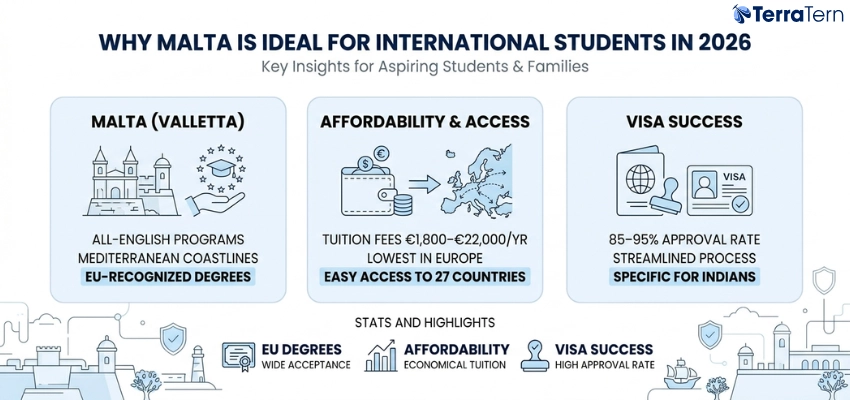
Universities in Malta for international students are ideal because all programs are taught in English, tuition fees are among Europe's lowest (€1,800–€22,000/year), degrees are EU-recognised, and Malta's location offers easy access to 27 European countries, all on a Mediterranean island with an 85–95% student visa approval rate for Indians.
-
English as an Official Language: 89% of the Maltese population speaks English, and all standard higher education courses are taught entirely in English. Indian applicants generally only need an IELTS score, with no complex language barriers to manage.
-
Fully EU-Recognised Qualifications: All degrees from MFHEA-accredited universities align with the European Qualifications Framework (EQF) and use the ECTS credit system, making your qualification valid across all 27 EU member states.
-
Highly Affordable Tuition Alternatives: Pursuing your degree at universities in Malta for international students costs significantly less (€1,800–€22,000/year) than traditional paths in the UK (£18,000–£38,000/year) or Australia (AUD 20,000–45,000/year).
-
Surging Indian Student Community: Rapidly climbing to over 2,300 active enrollments, the Indian student demographic is the largest international learner cohort in Malta, with an annual growth rate exceeding 130%.
-
Europe’s Leading Hub for Diversity: Malta has one of Europe’s highest concentrations of international learners, with international students comprising roughly 37% of the tertiary student population.
-
Strategic Gateway to the Schengen Zone: Situated in the heart of the Mediterranean, your student visa enables seamless, visa-free travel to top European cultural and economic destinations, including Italy, Germany, France, and Spain.
-
Strong Visa Architecture & Student Work Rights: Prepared Indian applicants experience high student visa success rates (85–95%). The framework permits working up to 20 hours per week during the term and includes a 9-month post-study stay visa for career building.
Important Tip: For Indian students weighing Malta against the UK or Australia, the total annual cost (tuition + living) in Malta averages €13,000–€23,000, roughly half the UK figure, while still delivering an EU-recognised degree valid for careers across 27 countries.
What Programs Are Available at Universities in Malta for International Students?
Universities in Malta for international students offer 200+ programs across medicine, business, engineering, IT, law, arts, hospitality, and social sciences at the bachelor's, master's, and doctoral levels, with all instruction delivered in English and degrees recognised across the European Union. The following index outlines the primary educational streams available to global applicants across the country's main higher education options:
|
Academic Field |
Available Degrees |
Key Universities Offering |
|
Medicine & Dentistry |
MBBS, MD, BPharm |
University of Malta, QMUL Malta Campus |
|
Business & Management |
BBA, MBA, MSc, Professional Diplomas |
AUM, Global College Malta, St. Martin's, UM |
|
Computer Science & IT |
BSc (Hons), MSc, PGDip, Software Dev |
St. Martin's, AUM, MCAST |
|
Engineering |
BEng (Res), MEng, Applied Infrastructure |
MCAST, University of Malta, AUM |
|
Law & Criminology |
LLB, LLD, MA in Human Rights |
University of Malta |
|
Education & Social Sciences |
B.Ed, MA, MSc in Social Dynamics |
University of Malta |
|
Arts, Media & Communication |
BA, MA, PhD Research tracks |
European Graduate School, University of Malta |
|
Hospitality & Tourism |
BA, BSc, Vocational Higher Diplomas |
MCAST, Global College Malta |
|
Game Development & Design |
BSc in Game Development, Animation |
American University of Malta (AUM) |
|
Health Sciences & Nursing |
BSc, MSc in Advanced Nursing |
University of Malta |
|
Environmental Studies |
BSc, MSc in Earth Systems |
University of Malta |
|
Psychotherapy & Counselling |
MA, Executive PhD options |
European Graduate School |
As per our TerraTern Expert: Indian MBBS aspirants should know that the University of Malta's Doctor of Medicine (MD), not MBBS, is the local equivalent and IS recognised by EU medical councils and subject to MCI/NMC India equivalency procedures for those returning to India. Research this distinction before enrolling.
What Are the Admission Requirements for Universities in Malta for International Students?
Admission requirements for universities in Malta for international students typically include a 10+2 certificate (or a bachelor's degree for postgraduate programs), IELTS 6.0–6.5 (or proof of English-medium education), relevant academic transcripts, a Statement of Purpose, and a passport, with MFHEA recognition of Indian qualifications applying to most programs.
Navigating the entry gates requires meeting distinct criteria across academic and language thresholds:
-
Undergraduate Academic Entry: Indian applicants need a Class 12/Higher Secondary Certificate from a recognised national or state board (CBSE, ICSE, or State Boards) with an aggregate score typically between 60% and 70%.
-
Postgraduate Academic Entry: Admission to Master’s programs requires a minimum of a 3-year Bachelor’s degree from a UGC-recognised university, with an aggregate score of 55–65% and 1–2 Letters of Recommendation (LORs).
-
Flexible IELTS Waivers: While standard entry requires an IELTS score of 6.0–6.5, many Maltese institutions waive this requirement if you present an official Medium of Instruction (MOI) certificate confirming that your entire previous degree was taught in English.
-
Apostille & Verification: All academic transcripts, degree certificates, and school leaving documents must be formally verified and apostilled by the Ministry of External Affairs (MEA) in India before visa submission.
-
Visa Financial Benchmarks: For the National Long-Stay (Type D) visa application, students must demonstrate financial self-sufficiency, with bank statements showing at least €700–€1,100 per month for the planned stay (roughly ₹10 lakhs total), backed by a minimum €30,000 travel insurance policy.
Pro Tip: Most Indian students studying in CBSE or ICSE English-medium schools qualify for the IELTS waiver at the University of Malta and AUM, but must request a Medium of Instruction certificate from their school or college before applying. This saves both time and the IELTS exam fee.
What Are the Scholarships Available at Universities in Malta for International Students?
Universities in Malta offer international students substantial scholarship support through the Malta Government Scholarship Scheme (covering tuition and maintenance), University of Malta merit scholarships (40–100% tuition waiver), Erasmus+ programs, and TESS/Reaching High grants, with Indian students eligible for most categories. Funding opportunities offered by government bodies and specific universities in Malta for international students help offset overall education costs:
|
Scholarship Scheme |
Funding Provider |
Financial Award Value |
Target Eligibility Criteria |
|
Malta Government Scholarship ("Endeavour") |
Ministry for Education / ESF |
Full or partial tuition fee coverage + annual maintenance allowance |
Non-EU postgraduate applicants applying for high-priority economic sectors |
|
University of Malta Merit Scholarship |
University of Malta |
40% to 100% tuition fee waiver |
Top academic performers from non-EU/EEA backgrounds entering UG or PG tracks |
|
Reaching High Scholarship |
Government of Malta |
Full tuition funding + specialised research resource stipends |
International doctoral candidates entering PhD research programs |
|
Erasmus Mundus Joint Master's |
European Commission |
Full tuition, comprehensive travel allowance, and up to €1,200/month living stipend |
High-achieving international students joining multi-country joint master's programs |
|
AUM Institutional Scholarships |
American University of Malta |
25% to 50% semester tuition reduction |
Merit-based undergraduate and postgraduate applicants at AUM |
|
TESS (Tertiary Education Scholarship Scheme) |
Government of Malta |
Partial tuition fee support bursaries |
International students targeting MQF Level 7 or 8 degrees |
Key Note: University of Malta's merit scholarships offering 40–100% tuition waivers are the most underutilised opportunity for Indian students ,but they are tied to your admission application, not a separate process. Submit your strongest SOP and academic transcripts to the UM faculty for consideration for these awards.
What Is the Total Cost of Studying at Universities in Malta for International Students?
The total annual cost of studying at universities in Malta for international students ranges from €13,000 to €23,000, comprising tuition (€1,800–€22,000), accommodation (€300–€800/month), food (€200–€400/month), transport (€25–€40/month), and health insurance (€300–€500/year).
|
Cost Category |
Average Monthly Cost |
Average Annual Cost |
|
Tuition Fees |
N/A |
€1,800 – €22,000 / year |
|
Accommodation (Shared Apartment) |
€300 – €500 / month |
€3,600 – €6,000 |
|
Accommodation (Private Studio) |
€600 – €800 / month |
€7,200 – €9,600 |
|
Food & Groceries |
€200 – €400 / month |
€2,400 – €4,800 |
|
Public Transport (Tallinja Card) |
Free* (after one-time fee) |
€25 (one-time setup fee) |
|
Compulsory Health Insurance |
N/A |
€300 – €500 / year |
|
Mobile & Home Internet |
€20 – €40 / month |
€240 – €480 |
|
Books & Stationery |
N/A |
€200 – €400 / year |
|
Miscellaneous & Leisure |
€100 – €200 / month |
€1,200 – €2,400 |
|
Total Cost (Excluding Tuition) |
€650 – €1,200 / month |
€8,000 – €14,400 / year |
|
Total Cost (With Lowest Tier Tuition) |
— |
~€10,000 – €16,000 / year |
|
Total Cost (With Average Tier Tuition) |
— |
~€13,000 – €23,000 / year |
As per our TerraTern Expert Divyansh, Indian students at MCAST who work 20 hours/week at €10/hour can earn approximately €800–€900/month, enough to cover food, transport, and most living costs, making the total out-of-pocket study expense as low as ₹5–₹8 lakh/year at the cheapest universities in Malta.
Also Read: Malta Nursing Jobs: Latest Opportunities for Nurses
How Can International Students Apply to Universities in Malta?
International students can apply to universities in Malta for international students by following a structured admissions and visa process. Key steps include:
-
Research universities in Malta compare programs, tuition fees, career outcomes, and verify MFHEA accreditation.
-
Prepare the following documents: transcripts, passport, SOP, LORs, CV (PG applicants), and proof of IELTS/Medium of Instruction.
-
Submit online applications through university portals and pay the applicable application fee.
-
Receive an offer letter, usually within 2–6 weeks; conditional offers may require additional documents.
-
Apply for a Malta Type D Student Visa through VFS Global with financial proof, insurance, and an acceptance letter.
-
Obtain an e-Residence Permit after arrival for courses exceeding three months and student work eligibility.
-
Arrange accommodation, travel, and pre-departure requirements before starting your studies in Malta.
Important Note: Indian students must apostille their documents through MEA India (Ministry of External Affairs) before submitting to Malta universities; un-apostilled documents are the single most common reason for application delays and visa rejections. Start this process at least 2 months before your application deadline.
What Are the Work and Post-Study Opportunities After Universities in Malta for International Students?
International students at universities in Malta benefit from part-time work rights and EU-recognised qualifications that support long-term career opportunities.
-
Work up to 20 hours per week after three months with a Jobsplus permit, earning approximately €8–€12 per hour.
-
Stay in Malta for up to 9 months after graduation to search for employment and secure a work permit.
-
Access opportunities in high-demand sectors, including iGaming, IT, finance, healthcare, tourism, and language services.
-
Use MFHEA-recognised degrees from universities in Malta for international students to strengthen job applications across EU countries.
-
Build a pathway to Maltese permanent residency after 5 years of legal residence, with potential for long-term EU mobility.
Pro Tip: Malta's 9-month post-study period is shorter than in the UK or Australia, but its unique position as the EU's iGaming and financial services hub means Indian IT and business graduates can find employment significantly faster than in larger EU markets. Sector demand is high, and English proficiency is a direct advantage.
What Are the Key Challenges for Indian Students at Universities in Malta?
While universities in Malta for international students offer quality education and EU exposure, Indian students should prepare for several practical challenges.
-
The 9-month post-study job search period is shorter than the options available in countries like the UK or Australia.
-
Malta's relatively small job market can limit opportunities outside sectors such as iGaming, finance, and hospitality.
-
Apostille and document attestation requirements may add time to the university application process.
-
Student visa applications require substantial financial proof, often around ₹10 lakh for study and living expenses.
-
Some universities in Malta have lower brand recognition in India compared with UK, US, or Australian institutions.
Key Note: Malta's greatest hidden strength for Indian students is the iGaming sector, over 300 international gaming companies are headquartered in Malta and actively recruit English-speaking graduates in IT, marketing, and finance. Target this sector from Day 1 of your studies if you plan to work in Malta post-graduation.
Conclusion
Universities in Malta for international students offer an affordable pathway to a globally recognized European education, English-taught programs, and valuable EU career opportunities. With relatively low tuition fees, a welcoming international environment, part-time work rights, and post-study employment options, Malta is becoming an increasingly attractive destination for Indian students. By understanding the admission process, preparing visa requirements early, and planning career goals strategically, students can maximise the academic and professional benefits of studying in Malta.


 AI Summary