


Key Highlights
- What Is the Total Cost of Study in Germany for Indian Students?
- Why Is Germany Still Affordable for Indian Students in 2026?
- What Is the Total Cost of Study in Germany for Indian Students at Public Universities?
- What Are the Tuition Fees at Private Universities in Germany for Indian Students?
- What Are the Pre-Arrival Costs Indian Students Must Pay Before Reaching Germany?
- What Is the Blocked Account Requirement for Germany in 2026?
- What Are the Monthly Living Costs in Germany for Indian Students?
- What Is the Total Annual Budget for Indian Students in Germany? (Year-Wise Breakdown)
- How Can Indian Students Reduce the Total Cost of Studying in Germany?
- What Are the Course-Specific Costs of Studying in Germany for Indian Students?
- Is the Total Cost of Study in Germany Worth It for Indian Students?
- 2026 Industry Context Section
- Conclusion
The total cost of study in Germany for Indian students is important to make good financial planning in 2026. Although tuition is usually free at the public-university level, Indian students will need to allocate their finances towards living costs, health insurance, visa, admission costs, and the mandatory block deposits account. All in all, studying in Germany as an Indian student will cost you between 10 and 20 lakh annually, depending on the type of university you attend (public or a private institution) and your lifestyle.
What Is the Total Cost of Study in Germany for Indian Students?
This table indicates that the total cost of study in Germany for Indian students is dominated by the living-expense requirements and blocked-account requirements at public universities, and at private universities it is primarily determined by tuition and the same structure of living costs.

|
Item |
Public Universities (EUR) |
Public Universities (INR approx.) |
Private Universities (EUR) |
Private Universities (INR approx.) |
|
Tuition + semester fees |
Typically 0 (only €150–€800 semester fee) |
Around INR 13,500–INR 72,000 per year |
€10,000–€25,000+ per year |
Around INR 9–22.8 lakh per year |
|
Living expenses (rent, food, transport, etc.) |
€8,500–€10,000 per year |
Around INR 7.7–INR 9 lakh per year |
Similar living costs, but a higher overall burden due to tuition |
Same EUR range; rises due to fees |
|
Health insurance and miscellaneous |
€800–€1,000 per year |
Around INR 72,000–INR 90,000 per year |
Similar amount, but included in a higher |
|
|
Total annual cost (student budget) |
Approx. €11,000–€13,000 |
INR 11–14 lakh per year |
Approx. €20,000–€45,000 |
INR 21–47 lakh per year |
|
Mandatory blocked-account deposit (one-time) |
€11,904 (≈ €1,000/month proof of funds) |
~INR 12.5 lakh |
Same amount required for visa, but comes on top of higher tuition |
Same deposit; first-year is therefore higher |
Also Read: Study in Germany After 12th Complete Guide for Indians
Why Is Germany Still Affordable for Indian Students in 2026?
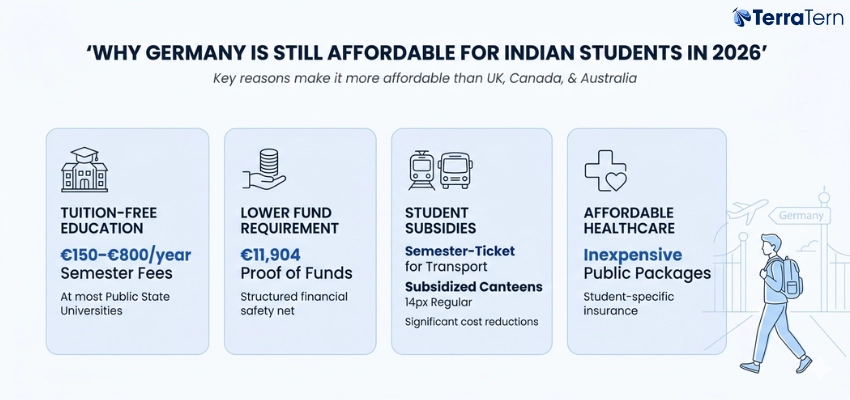
In Germany, the cost of higher education is still among the most affordable because most state universities are tuition-free, and Indian student are subsidised by the state for healthcare, accommodation, and transport.
-
In Indian universities, tuition costs (semester fees) are only 150-800/year, whereas in the UK, Canada, and Australia, tuition costs are 10-25000 or more.
-
Germany, too, limits the proof-of-funds requirement to a total of €11,904, with a blocked-account payout of € 992/month serving as a structured financial safety net.
-
The student-specific subsidies enjoyed by Indian students, such as semester-ticket public transport passes, overly subsidised student canteens, and inexpensive public health insurance packages, make studying in Germany more affordable than in the UK, Canada, and Australia.
Germany vs UK vs Canada (Annual Cost of Indian Students
As per Terra Tern Expert Shreya, Germany's true affordability advantage lies not just in zero tuition but also in the structured blocked account system, which forces financial planning up front, reducing mid-study financial crises for Indian students.
What Is the Total Cost of Study in Germany for Indian Students at Public Universities?
At German public universities, Indian students pay minimal semester fees of €150–€800 per year and spend roughly €9,000–€13,000 annually on living expenses, bringing the total annual budget to about INR 11–14 lakh. This figure represents the total cost of study in Germany for Indian students at public institutions, where tuition is generally free, and the main burden comes from rent, food, health insurance, transport, and semester-ticket charges.
What Are the Semester Fees at Top German Public Universities?
Public universities charge a “semester contribution” (not tuition) that usually covers administration, student services, public-transport passes, and campus-levy costs.
|
University |
Location / State |
Semester Fee (EUR) |
Approx. INR (per semester) |
QS Rank (latest) |
Popular Programs |
|
Technical University of Munich (TUM) |
Munich, Bavaria |
Base ≈ €85; €2,000–€6,000/semester for non-EU from 2024/25 |
Base ≈ INR 7,650; INR 1.8–INR 5.4 lakh/semester |
Top 50 globally |
Computer Science, Mechanical Eng, Data Science, Electrical Eng |
|
Ludwig-Maximilians-Universität München (LMU) |
Munich, Bavaria |
About €85 per semester |
≈ INR 7,650 per semester studying in Germany |
Top 60 globally |
Physics, Economics, Medicine, Data Science |
|
RWTH Aachen University |
Aachen, NRW |
≈ €300 per semester |
≈ INR 27,000 per semester |
Top 200 globally |
Mechanical Eng, Electrical Eng, Computer Science |
|
Freie Universität Berlin (FU Berlin) |
Berlin |
≈ €304 per semester |
≈ INR 27,300 per semester |
Top 150 globally |
Social Sciences, Computer Science, Environmental Science |
|
Heidelberg University |
Heidelberg, Baden-Württemberg |
≈ €161 per semester |
Molecular Life Sciences, Medicine, Physics |
What Is the Cost of MS in Germany for Indian Students?
An MS (Master of Science) in Germany at a public university typically costs Indian students around INR 10–13 lakh per year, mainly because tuition is free at mAt these universities, the “semester contribution” is clearly not tuition; it is a small administrative and mobility-ticket fee, which keeps the total cost of study in Germany for Indian students relatively low compared with private or overseas institutions, and the budget is dominated by living expenses, health insurance, and semester fees.
Breakdown of MS-Level Costs (Public University)
|
Cost component |
Typical range (EUR) |
Approx. INR |
Notes |
|
Application fees |
€0–€75 per university |
INR 0–INR 6,750 |
Some universities charge nothing; others charge per application |
|
APS certificate |
≈ INR 15,000–INR 18,000 leapscholar+1 |
Mandatory for many German-university-bound Indian students |
|
|
Language tests (IELTS/GRE etc.) |
€200–€300 |
INR 18,000–INR 27,000 |
Needed for English-taught MS programs |
|
Semester contribution |
€150–€400 per semestre |
INR 13,500–INR 36,000 per semester studying-in-germany+1 |
Covers admin, transport, and student services; no tuition at most public universities |
|
Living expenses (MS-year) |
€8,500–€10,000 per year |
INR 7.7–INR 9 lakh per year |
Includes rent, food, health insurance, and personal expenses |
|
Blocked-account deposit (first-year proof) |
€11,904 |
≈ INR 10.7–INR 12 lakh |
Not spent fully in year-one; released monthly (≈€992/month) |
|
Total annual student budget (MS at public university) |
≈ €10,000–€13,000 per year |
INR 10–13 lakh per year |
This is effective for an MS at public universities |
Important Note: Indian students pursuing MS in Computer Science or AI at RWTH Aachen or TU Munich can access near-zero tuition while landing in EUR 50,000+ salary roles post-graduation, among the best ROI in global education.
What Are the Tuition Fees at Private Universities in Germany for Indian Students?
Private universities in Germany typically charge €6,000 – €40,000+ per year, with flagship MBA programs at schools such as WHU – Otto Beisheim School of Management and Frankfurt School of Finance & Management reaching up to €49,500 per year (≈INR 52–53 lakh).
Top 5 Private Universities: Tuition Fees (EUR & INR)
|
University |
Location / Type |
Approx. Annual Tuition (EUR) |
Approx. INR (per year, 1 € ≈ INR 90–INR 106) |
Program focus |
|
Frankfurt School of Finance & Management |
Frankfurt, business school |
€42,000/year (MBA) |
≈ INR 44–45 lakh/year |
MBA, Finance, Management |
|
WHU – Otto Beisheim School of Management |
Vallendar/Vienna, business school |
€49,500/year (MBA) |
≈ INR 52–53 lakh/year |
MBA, General Management |
|
IU International University of Applied Sciences |
Nationwide online-blended |
€5,000–€10,000/year (Bachelor’s & Master’s) |
≈ INR 4.5–INR 9–11 lakh/year- |
Business, IT, Data Science, Engineering |
|
GISMA Business School |
Potsdam/Berlin area |
≈ €20,000/year (MBA & specialist programs) |
≈ INR 18–21 lakh/year |
MBA, Management, Digital Transformation |
|
Constructor University (formerly Jacobs University) |
Bremen, liberal-arts & STEM |
≈ €15,000–€25,000/year |
≈ INR 14–23 lakh/year |
Computer Science, Engineering, Interdisciplinary |
Expert Advice: Private universities aren't always a poor financial choice. In fields like finance or MBA, where corporate placements at German firms are common, the ROI can justify the tuition within 2–3 years of employment.
Also Read: MBBS in Germany Fee Structure For Indians Guide
What Are the Pre-Arrival Costs Indian Students Must Pay Before Reaching Germany?
Before flying to Germany, Indian students must budget approximately INR 45,000–75,000 for mandatory pre-arrival expenses, including the APS certificate, student visa fee, IELTS, and university application charges. These upfront payments form a key part of the total cost of study in Germany for Indian students, even though they are much smaller than tuition and living expenses.
What Is the APS Certificate and How Much Does It Cost?
The APS (Akademische Prüfstelle) certificate is an academic evaluation requirement for all Indian applicants to German universities, introduced to verify Indian degrees and transcripts. It helps German institutions assess CBSE/State Board, ICSE, and university degrees under a standardised framework, making the pathway more transparent.
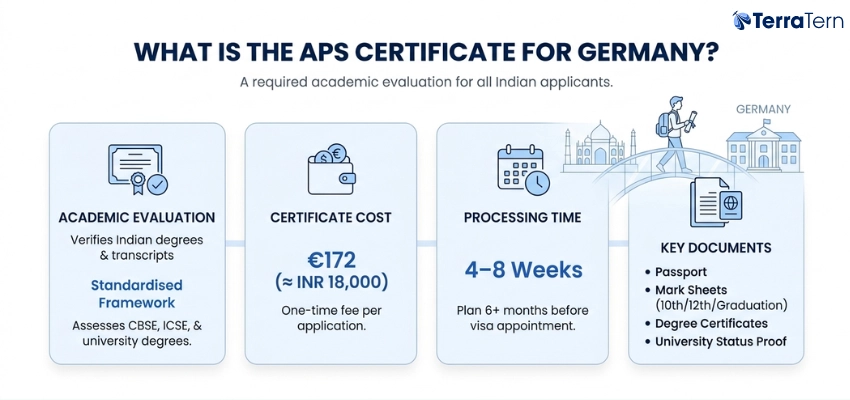
2. APS Cost: €172 (≈ INR 18,000), payable once per application.
3. Typical processing time: 4–8 weeks, so students should apply at least 6 months before the visa appointment date.
4. Key Documents: Passport, mark sheets (10th/12th/graduation), degree certificates, and proof of current university status.
5. Process Flow:
- Register online with APS India.
- Upload scanned documents and pay the fee.
- Attend an interview (if shortlisted) and receive the APS certificate.
6. Missing APS: can delay admission and visa steps, so it must be planned early and factored into the total cost of study in Germany for Indian students' budget.
What Is the Germany Student Visa Fee for Indian Students?
The German student visa fee is €75 (≈ INR 7,875) and is non-refundable, even if the visa is rejected. Most of these charges are one-time and must be factored into the total cost of study in Germany for Indian students before arrival.
|
Cost item |
Amount (EUR) |
Amount (INR approx.) |
Frequency |
|
APS certificate |
€172 |
≈ INR 18,000 |
One-time |
|
IELTS (or equivalent) |
€200–€250 |
≈ INR 18,000–INR 25,000 |
One-time per test |
|
GRE (if applicable) |
€200–€250 |
≈ INR 18,000–INR 25,000 |
One-time |
|
Germany student visa (National D-Visa) |
€75 |
≈ INR 7,875 |
One-time, non-refundable |
|
University application fees (per course) |
€0–€75 |
≈ INR 0–INR 6,750 |
Per application |
|
Travel insurance (required) |
€100–€200 |
≈ INR 9,000–INR 18,000 |
One-time for the first year |
|
Round-trip flight (India–Germany) |
€600–€1,000 |
≈ INR 54,000–INR 90,000 |
One-time movement |
Expert Tip: Budget at least INR 60,000–80,000 purely for pre-departure administrative costs; this figure is consistently underestimated by first-time applicants.
What Is the Blocked Account Requirement for Germany in 2026?
Indian students must deposit €11,904 (≈ INR 12.5 lakh) into a German blocked account (Sperrkonto) to prove financial sufficiency for their student visa, reflecting the new 2026 minimum-living-cost update.
1. A blocked account (Sperrkonto) is a special German bank or fintech account that holds your funds but allows only a fixed monthly withdrawal (€992) after arrival, covering rent, food, insurance, and other living costs.
2. The updated 2026 deposit is €11,904 (€992/month × 12) and must be shown in full for the visa, even if you plan to stay for fewer months initially.
3. Funds are released monthly once you activate the account in Germany (with your residence permit), helping you manage the total cost of study in Germany for Indian students in a structured way.
4. Major blocked-account providers for Indian students include Expatrio and Fintiba, which charge €50–€150 one-time setup fees plus small transfer or maintenance charges.
- How to open a blocked account:
- Choose an approved provider (Expatrio, Fintiba, Orient-Exchange, etc.).
- Fill the online application form, upload your passport, photo, and admission or LOC (if available).
- Receive IBAN and transfer €11,904 via bank-to-bank transfer.
- Get the blocking confirmation letter and submit it with your visa file.
- After landing and getting your residence permit, activate the account so the €992/month payouts start.
Important Tip: The blocked account is not just a visa formality; it's your financial lifeline for the first year. Choose a provider like Expatrio or Fintiba that automatically releases funds monthly; some banks delay payouts, which can affect rent payments.
What Are the Monthly Living Costs in Germany for Indian Students?
Indian students in Germany typically spend €850–€1,200 per month (≈ INR 89,000–INR 1.26 lakh) on rent, food, transport, health insurance, and personal expenses. This range constitutes the core monthly component of the total cost of study in Germany for Indian students, after factoring in tuition-free public-university fees.
How Much Does Accommodation Cost for Indian Students in Germany?
Accommodation is the single largest line item in the total cost of study in Germany for Indian students. Choosing the right housing type can significantly reduce your monthly outflow.
Accommodation Types and Monthly Costs
|
Accommodation type |
Monthly rent (EUR) |
Monthly rent (INR approx.) |
Notes |
|
Student dormitory |
€250–€450 |
INR 22,500–INR 40,500 |
Managed by Studierendenwerk; most budget-friendly option |
|
Shared flat (Wohngemeinschaft / WG) |
€350–€550 |
INR 31,500–INR 49,500 |
Popular among Indian students; shared kitchen/bathroom |
|
Private apartment |
€600–€900+ |
INR 54,000–INR 81,000+ |
Higher comfort, but it adds more to the |
As per TerraTern Expert: Apply for student dormitories at least 6 months before arrival, as waiting lists are notoriously long at cities like Munich and Berlin.
What Is the city-wise cost of Living in Germany for Indian Students?
City choice strongly shapes the total cost of study in Germany for Indian students, both in rent and monthly living expenses. Munich and Frankfurt are the most expensive, while Leipzig, Dresden, and Aachen are often listed among the cheapest cities in Germany for Indian students.
City-Wise Cost of Living (Per Month)
|
City |
Approx. rent (EUR) |
Transport (Euros) |
Total monthly estimate (EUR) |
Total monthly estimate (INR approx.) |
|
Munich (expensive) |
€650–€950 |
€50–€100 |
€1,100–€1,300 |
INR 99,000–INR 1.17 lakh |
|
Frankfurt (expensive) |
€600–€850 |
€50–€90 |
€1,100–€1,300 |
INR 99,000–INR 1.17 lakh |
|
Hamburg |
€550–€750 |
€50–€80 |
€950–€1,150 |
INR 85,500–INR 1.03 lakh |
|
Berlin |
€450–€650 |
€50–€75 |
€850–€1,000 |
INR 76,500–INR 90,000 |
|
Aachen (cheaper university town) |
€350–€500 |
€40–€60 |
€700–€850 |
INR 63,000–INR 76,500 |
|
Leipzig (cheaper) |
€300–€450 |
€40–€60 |
€700–€900 |
INR 63,000–INR 81,000 |
|
Dresden (cheaper) |
€350–€450 |
€40–€60 |
€700–€850 |
INR 63,000–INR 76,500 |
Pro Tip: Indian students at RWTH Aachen consistently report lower living costs than peers in Munich or Berlin, despite attending a world-ranked engineering university — location choice can save INR 2–3 lakh annually.
What Does Health Insurance Cost for Indian Students in Germany?
Statutory health insurance for Indian students under 30 costs €130–€156 per month (≈ INR 13,700–INR 16,400) in 2026 and is mandatory for university enrolment. This expense is a fixed line item in the total cost of studying in Germany for Indian students, as no public university allows you to register without proof of valid German health insurance.
-
German universities require compulsory health insurance for all international students; without it, you cannot enrol or get your residence permit.
-
Indian students usually take statutory (public) health insurance, which covers hospital care, doctor visits, prescriptions, and most routine treatments.
-
Statutory vs private insurance:
- Statutory is cheaper and sufficient for most students; it is strongly recommended unless you have pre-existing employer-linked coverage.
- Private insurance is generally more expensive and complex; it suits some professionals but adds to the total cost of study in Germany for Indian students without a clear benefit for most degree-seekers.
-
Age Cutoff: Statutory health insurance is available only until age 30; after that, students often must switch to private plans at higher rates.
-
Top Statutory Insurers and 2026 Rates (Approx.)
|
Health-insurer |
Typical monthly rate (EUR) |
Approx. INR/month (1 € ≈ INR 105) |
|
Techniker Krankenkasse (TK) |
€130–€140 |
INR 13,650–INR 14,700 |
|
Barmer |
€135–€145 |
INR 14,200–INR 15,200 |
|
DAK-Gesundheit |
€135–€150 |
INR 14,200–INR 15,800 |
|
BKK firmus |
€130–€145 |
INR 13,650–INR 15,200 |
Key Note: Never opt for cheap private travel insurance as a substitute for statutory health insurance. German universities will reject your enrollment without a statutory insurer's confirmation letter.
Also Read: Free Education in Germany for Indian Students & Courses
What Is the Total Annual Budget for Indian Students in Germany? (Year-Wise Breakdown)
The total first-year cost for Indian students at a German public university is roughly INR 22–26 lakh, including the one-time blocked-account deposit and pre-arrival and living expenses. From Year 2 onwards, the total cost of study in Germany for Indian students drops to about INR 11–14 lakh per year, as you no longer repeat the blocked-account payout and major pre-arrival fees.
Public-University Budget Summary (INR)
|
Expense |
Year 1 (INR) |
Recurring Annual (INR) |
Notes |
|
Blocked Account Deposit |
~INR 12.5 lakh (one-time) |
— |
Required for visa: €11,904 |
|
Semester Fees (Public) |
INR 27,000–INR 72,000 |
INR 27,000–INR 72,000 |
Covers admin, transport, and student services |
|
Health Insurance |
INR 1.6–2 lakh |
INR 1.6–2 lakh |
Statutory insurance (≈ €130–€156/month) |
|
Rent & Utilities |
INR 3.8–7.5 lakh |
INR 3.8–7.5 lakh |
Varies by city (dorm/WG/private) |
|
Food & Groceries |
INR 1.5–2.5 lakh |
INR 1.5–2.5 lakh |
Typical student-level spending |
|
Pre-Arrival (APS/Visa/IELTS) |
INR 55,000–INR 75,000 |
— |
One-time: APS, visa, language tests |
|
Transport |
INR 50,000–INR 1 lakh |
INR 50,000–INR 1 lakh |
Semester ticket / local transport |
|
Total (Public University) |
~INR 20–26 lakh |
~INR 11–14 lakh |
Total cost of study in Germany for Indian students, excluding scholarships/part-time income |
As per TerraTern Expert, Divyansh, Most Indian students underestimate Year 1 costs by ignoring the blocked account as a "liquid" cost; it IS your money, but it's inaccessible in bulk, so plan separate liquid funds for your first month's settlement expenses.
How Can Indian Students Reduce the Total Cost of Studying in Germany?
Indian students can significantly reduce the total cost of study in Germany for Indian students by combining public university attendance, scholarships, part-time work, and low-cost living-style choices. Opting for a public university in an affordable city (such as Aachen, Leipzig, or Dresden) and staying in a student dormitory lowers the biggest expense lines—tuition-like risk and rent—making the total annual budget much more manageable.
What Scholarships Are Available for Indian Students in Germany?
The DAAD Scholarship is the most prestigious option, offering €992–€1,300 per month (≈ INR 1.04–1.37 lakh/month) to Indian students, often covering living costs and partially offsetting the total cost of study in Germany for Indian students. Many DAAD programs also include travel allowances, health-insurance support, and German-language courses.
Here is a Snapshot of the Top scholarships for Indian students:
|
Scholarship |
Approx. monthly amount (EUR) |
Approx. INR/month (1 € ≈ INR 105) |
Target group / key criterion |
|
DAAD Scholarship |
€992–€1,300 |
INR 1.04–1.37 lakh/month |
Master’s, PhD, research-oriented candidates; strong academics and work experience in some programs |
|
Deutschlandstipendium |
€300 |
INR 31,500 |
Merit-based; open to both Germans and international students at German universities |
|
Heinrich Böll Foundation |
Up to €1,350 |
≈ INR 1.42 lakh |
Students with a strong political/environmental / social-justice profile |
|
Konrad Adenauer Foundation |
Up to €1,300–€1,350 |
≈ INR 1.37–1.42 lakh |
Young professionals and students with a leadership and policy-oriented outlook |
Important Note: DAAD receives 10x more applications than it can fund. Indian students with a strong research proposal AND work experience have a significantly higher success rate than those applying straight from undergraduate.
Can Indian Students Work Part-Time to Cover Living Costs in Germany?
Yes, Indian students can legally work up to 140 full days or 280 half-days per year in 2026 and earn a gross monthly equivalent of about €1,112 at the current minimum wage of €13.90/hour, often enough to cover most monthly living costs. This income can meaningfully reduce the total cost of study in Germany for Indian students, especially when combined with public-university fees and moderate-cost housing.
1.2026 Part-Time Rules:
- 140 full days (≤8 hours) or 280 half-days (≤4 hours) per calendar year.
- During the term, you can work up to 20 hours per week beyond the day-based limit under the “Werkstudent” category.
- In semester breaks, you can work full-time, but those days still count within your 140-day quota.
2. Common Student-Job Types:
- HiWi (research assistant) at a university chair—often directly relevant and helps preserve your day-count allowance.
- Mini-job: Up to €603/month (≈ INR 520/month earlier-year rules); earnings are tax-free and easy to manage around classes.
- Werkstudent (working student): Better-paid roles (often €12–€18/hour) in IT, engineering, or admin, usually limited to 20 hours/week during term.
3. Tax and Social-Security Notes:
- Mini-jobs are tax-free up to their monthly cap, making them ideal side income while studying.
- Higher-income roles are taxed normally, but students still retain generous personal-income thresholds and exemptions.
Expert Advice: A Werkstudent (working student) role in your field of study is far superior to a generic part-time job. It pays EUR 16–20+/hour, counts as work experience, and often converts to full-time employment post-graduation.
What Are the Course-Specific Costs of Studying in Germany for Indian Students?
While most public-university courses are tuition-free, program-specific costs vary by materials, lab fees, and state-level charges, with MBBS, MBA, and private engineering programs having the highest total budgets. The total cost of study in Germany for Indian students, therefore, depends heavily on course type and whether the university is public or private.
What Is the Cost of Studying Engineering in Germany for Indian Students?
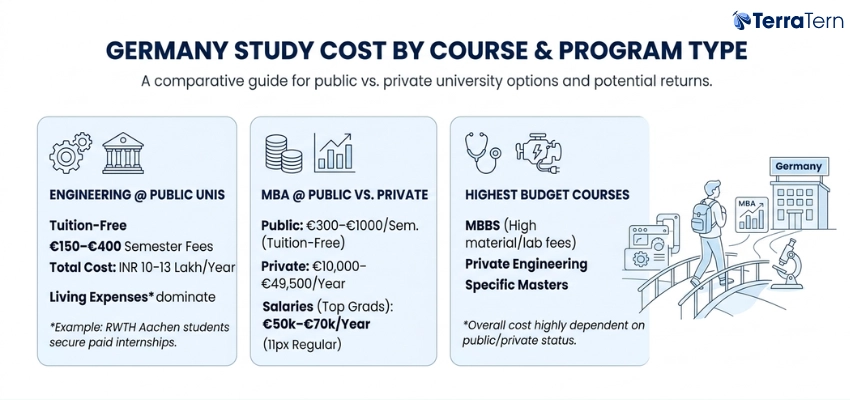
Engineering programs at public universities are tuition-free, with total annual costs of INR 10–INR 13 lakh covering living expenses and semester fees.
-
Popular Branches: Mechanical, Automotive, Electrical, and Computer Science engineering.
-
Top Universities: RWTH Aachen, TU Munich, KIT (Karlsruhe Institute of Technology).
-
Typical Structure: semester fees (€150–€400, ≈ INR 13,500–INR 36,000) plus living costs (€9,000–€13,000, ≈ INR 8–INR 12 lakh), forming the core of the total cost of study in Germany for Indian students.
Key Note: Engineering students at RWTH Aachen benefit from direct industry partnerships with BMW, Bosch, and Siemens, often securing paid internships that partially self-fund their degree.
What Is the Cost of an MBA in Germany for Indian Students?
Public-university MBAs are usually near-tuition-free, with only semester contributions (€300–€1,000/semester ≈ INR 27,000–INR 90,000); total annual cost is dominated by living expenses.
-
Private University: MBAs range from €10,000–€49,500 per year (≈ INR 9–INR 47 lakh), substantially raising the total cost of study in Germany for Indian students.
-
ROI Angle: Top German-MBA grads often reach €50,000–€70,000 annual salaries, so the higher private-MBA investment can pay off if you secure strong post-study roles.
Important Tip: For Indian students seeking an MBA specifically for access to the European job market, a EUR 20,000 MBA at Frankfurt School, with a EUR 65,000+ starting salary, offers one of the best debt-to-salary ratios in global business education.
Also Read: New Germany Embassy Fees for Indians: Updated Guide
Is the Total Cost of Study in Germany Worth It for Indian Students?
For most Indian students, the total cost of study in Germany for Indian students delivers a strong return on investment, combining low tuition at public universities with high-quality degrees and strong job-market access.
-
Germany-Degree ROI: Public-university programs cost roughly INR 11–14 lakh per year, yet graduates often earn €45,000–€70,000 starting salaries, quickly offsetting study-related expenses.
-
Post-Study Work Rights: After graduation, you get an 18-month Job Seeker Visa, giving you time to find a role aligned with your skills and degree.
-
PR Pathway: After a few years of stable employment, many Indian graduates apply for permanent residency, turning it into a long-term career and settlement investment.
-
Vs India’s Private Universities: Many top-tier private-university degrees in India exceed INR 10 lakh per year or more, often with lower global recognition and weaker international-placement pipelines.
-
Visa Context: Germany’s relatively high student-visa success rate supports the calculation, making it a realistic and well-structured pathway.
Pro Tip: Germany's combination of near-zero tuition, strong post-study work rights, and Europe's largest economy makes it the highest ROI study destination for Indian STEM and business students in 2026.
2026 Industry Context Section
Key facts current as of April 2026:
-
Blocked Account Update (Jan 2026): The mandatory deposit has increased to EUR 11,904/year (EUR 992/month), up from the previous EUR 10,332.
-
New Tuition Fees: States like Baden-Württemberg now charge non-EU students EUR 3,000/year, and TU Munich charges EUR 2,000–6,000/semester for international students — ending fully "free" tuition at some top institutions.
-
Minimum Wage Rise: Germany's minimum wage rose to EUR 13.90/hour in January 2026, allowing students to earn ~EUR 1,112/month working part-time.
-
160,306: international master's students were enrolled in Germany in 2023–24, with Indian students among the fastest-growing cohorts.
-
Germany vs UK/Canada: Germany's study costs are 40–60% lower than those in comparable English-speaking destinations, even with 2026 fee changes.
Conclusion
The total cost of study in Germany for Indian students remains highly competitive, especially at public universities where tuition-free education combines with manageable living expenses. When weighed against strong post-study job opportunities, an 18-month job-seeker visa, and a clear path to PR, this investment typically offers better long-term ROI than many expensive private-university routes in India or other high-cost study-abroad destinations.
Contact TerraTern for more information on What Is the total cost of study in Germany for Indian students in 2026.




 AI Summary