Key Highlights
- What Are the Current Opportunities for Nursing Jobs in Sweden for Foreigners?
- What Are the Requirements for Nursing Jobs in Sweden for Foreigners?
- How Can Foreign Nurses Get a Swedish Nursing Licence (Legitimation)?
- What Visa and Work Permit Do Foreign Nurses Need for Sweden?
- What Salary Can Foreign Nurses Expect in Sweden in 2026?
- What Additional Benefits Do Foreign Nurses Receive in Sweden?
- Which Swedish Cities Offer the Best Nursing Jobs for Foreigners?
- How Can Foreign Nurses Find and Apply for Nursing Jobs in Sweden?
- What Is the Career Growth Path for Nurses in Sweden?
- How Does Sweden Compare to Other Countries for Indian Nurses?
- 6 Key Facts About Nursing in Sweden in 2026
- Conclusion
There is a big need for nurses in Sweden in 2026, and hospitals, elderly care homes and regional health care systems are actively looking to recruit international nurses, particularly those willing to learn the Swedish language and undergo the necessary licensing procedures. Sweden offers an average monthly salary of SEK 28,000 to 40,000 or higher, depending on experience.
But before they can work independently, foreign-trained nurses must pass several milestones, such as their nursing degree being recognized by the Swedish National Board of Health and Welfare, their ability to meet language requirements (usually B1–C1 in Swedish for clinical positions), and an offer of employment that enables them to apply for a work permit or residence status.
This guide for 2026 takes international nurses through demand projections, salary expectations, licensing and language processes, and tips on finding a job in Sweden to help them make realistic assessments, avoid common hurdles and plan a smooth transition to their new career.
What Are the Current Opportunities for Nursing Jobs in Sweden for Foreigners?
Following are some of the current opportunities for Nursing Jobs in Sweden for Foreigners (2026):
-
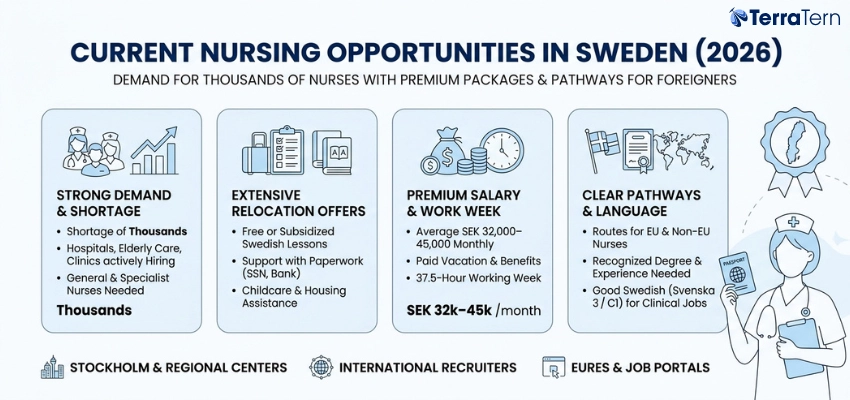
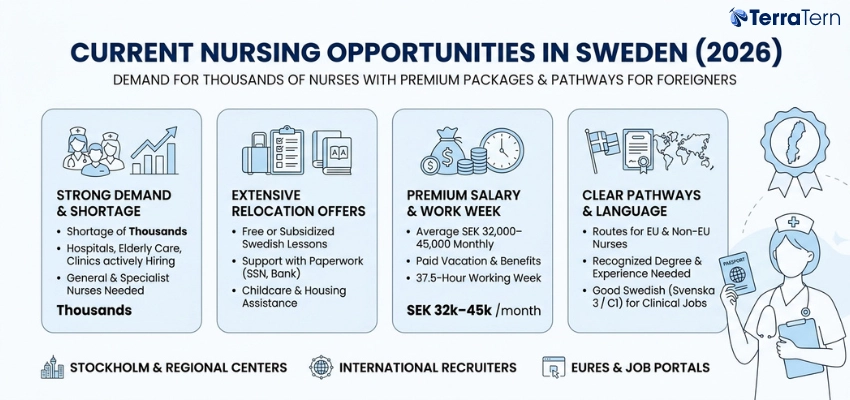
There is a shortage of thousands of nurses in Sweden today, and hospitals, elderly care homes and clinics are actively seeking to hire nurses, both general and specialist.
-
Jobs can be found abroad through international recruitment agencies or hospital regions, such as in emergency care, internal medicine, mental health, orthopedics, or geriatrics.
-
Some offers provide fairly extensive relocation packages including free or subsidized Swedish lessons, support with paperwork (social security number, bank account, etc.), and housing support for children (school/kindergarten).
-
The average registered nurse's salary is SEK 32,000–45,000 a month (with benefits, such as paid vacation and a working week of 37.5 hours).
-
The EU nurses have the clearest way forward, but non-EU nurses can also find opportunities as long as they have a degree recognized in an EU country and also have a few years of experience working in one of those countries, or, as Sweden does, they could take the path to nursing in Sweden through the National Board of Health and Welfare.
-
It is expected that clinical nurse jobs will require good Swedish language skills, which is often the case up to Svenska 3 / approximately C1 level, but some programmes begin with language learning before working full-time.
-
Stockholm and other regional centres have a larger number of nursing jobs available on public employment services ( Arbetsförmedlingen/EURES), global job portals, as well as specialized healthcare recruiters.
Expert Advice: Sweden's 21 regional health authorities all independently hire nurses, meaning there are 21 separate hiring pipelines. Targeting regions facing acute shortages, such as Region Västerbotten (northern Sweden) and smaller municipalities, often results in faster placement and better relocation packages than applying solely to Stockholm.
Also Read: Nursing Jobs in Sweden for Foreigners: Guide & More
What Are the Requirements for Nursing Jobs in Sweden for Foreigners?
Key Requirements for Nursing Jobs in Sweden for Foreigners:
-
Nursing Qualification: A recognized nursing qualification such as a Bachelor's degree in nursing.
-
Swedish Licence: Must be licensed (legitimated) by the Swedish National Board of Health and Welfare; “nurse” is a protected professional title and cannot be used without a licence.
-
Language Proficiency: A good command of the Swedish language, usually Svenska 3 or C1 level, is required; in some programmes, you will need to be at least at level B2 before graduating and will be assisted to reach higher levels.
-
Clinical Experience: Many employers and agencies have a preference for 2-3+ years of hospital or inpatient experience, in some areas such as internal medicine, emergency, geriatrics and/or cardiology.
-
EU/EEA vs Non‑EU Status: For those from the EU/EEA or Nordic countries, the recognition and work-rights process is easier. There are several steps for non-EU nurses to follow to get their qualifications recognized by an EU country, to obtain some EU work experience or to complete Sweden's multi-step recognition and training process.
-
Work or Residence Permit: Non‑EU citizens must have a valid work permit attached to an employment contract or based on other residence before they can go to work.
What Educational Qualifications Do Foreign Nurses Need for Sweden?
Foreign nurses typically require a recognized Bachelor of Science in Nursing (BScN) with a comparable level of study at the university level in Sweden (about 180 ECTS) and a qualification from Socialstyrelsen (the Swedish health and social care authority) to be licensed as a nurse in Sweden. Specialist nurses need an additional 1‑year university specialization equivalent to Swedish specialist-nurse education.
What Experience Is Required for Nursing Jobs in Sweden?
The preferred length of clinical experience is generally 1-2 years of full-time experience in any clinical position or 2+ years of experience in a specialist or hospital position, such as internal medicine, psychiatry, surgery, or geriatrics, for most Swedish employers and relocation programmes. Applications and salary negotiations can be bolstered by more experience.
What Language Level Do Nurses Need to Work in Sweden?
Foreign nurses must demonstrate proficiency in the Swedish language at the CEFR C1 level to be eligible to be granted a Swedish nursing licence, which is frequently achieved through the certificate of the course “Swedish 3/Swedish as a second language 3”. This level is required to communicate safely with patients, comprehend documentation and manage clinical duties.
What Documents Are Required for Swedish Nursing Applications?
Typical sets of documents are: valid passport/card, nursing diploma, course list and transcripts, documents of clinical experience, language certificate C1 in Swedish, clean professional conduct/registration certificate and proof of fee payment. To apply for a work visa: job offer, work permit application confirmation, CV, health insurance and biometrics.
Pro Tip: Start your Swedish language learning at the A1 level the moment you decide Sweden is your goal. Language is almost universally the bottleneck in the India-to-Sweden nursing journey. Waiting until after your degree is assessed will add 6–12 months to your timeline unnecessarily.
Also Read: Sweden Residence Permit for Indians: Fee, Steps & More
How Can Foreign Nurses Get a Swedish Nursing Licence (Legitimation)?
-
Request to have your foreign nursing education evaluated by Socialstyrelsen (National Board of Health and Welfare), present all documents/
-
Pass an assessment in education and complete proficiency tests (theoretical and practical) and a course in Swedish laws and regulations (if required by the Socialstyrelsen), and complete supervised clinical training.
-
Achieve the desired language proficiency (usually in Swedish C1 or “Swedish 3/Swedish as a second language 3”), and show this by supplying evidence in your final licence application, which will be in either written or spoken form at the same level as the test used to assess the chosen language.
-
When all conditions have been fulfilled, and the language and training requirements have been met, submit the application form for a licence (legitimation) to Socialstyrelsen, and you are legally allowed to work as a nurse in Sweden.
What Is the Step-by-Step Process to Get a Swedish Nursing Licence?
-
Step 1: Send your nursing degree to the assessment of Socialstyrelsen.l.
-
Step 2: Demonstrate a certain level of proficiency in the Swedish language, typically C1.
-
Step 3: Pass knowledge & skills test (if applicable).
-
Step 4: Finish Swedish laws, regulations and ethics training.
-
Step 5: Finish supervised clinical training in Sweden.
-
Step 6: Submit final licence application & fee.
Key Note: The most common mistake Indian nurses make is starting the Socialstyrelsen application before their Swedish language skills are at B2. Without B2, you cannot proceed past Step 1, and attempting the application too early resets the timeline. Achieve B2 first, then apply.
What Visa and Work Permit Do Foreign Nurses Need for Sweden?
-
Typically, foreign nurses must have a valid job offer from an employer in Sweden before applying for a work permit.
-
There is, in general, a need for a work permit or residence permit in Sweden if you are not an EU/EEA citizen.
-
Nurses also have to go through the Swedish Licensing process with Socialstyrelsen, which is not sufficient to allow independent nursing practice.
-
Some of the necessary documents are a passport, employment contract, qualification papers, licence-recognition papers, language proof, CV, and certificates of experience.
-
Usually, the work permit is initiated by the employer, and biometrics may be required at a Swedish embassy/consulate.
What Types of Work Permits Are Available for Foreign Nurses in Sweden?
-
Generally, foreign nurses will require an employer-sponsored work permit in Sweden following a job offer from a Swedish employer.
-
Alternatively, other routes may be by EU Blue Card for highly qualified labour or via an ICT permit, if they are transferred within a company.
-
Nursing is also a protected profession in Sweden, meaning that one has to be authorized to work in the profession as a nurse in Sweden.
What Are the Step-by-Step Visa Requirements for Indian Nurses?
-
Obtain a job offer and employment contract from Sweden.
-
You begin the work-permit process with your passport and qualification documents, and the employer finishes the process.
-
Submit salary documentation, experience letters (as applicable), insurance documentation and translations of non-English or Swedish documents.
-
If you are applying for the first time, apply for a permit outside of Sweden and wait for a decision before going.
Can Foreign Nurses Bring Their Families to Sweden?
-
Yes, foreign nurses with a work and residence permit are usually able to sponsor family members.
-
A spouse, cohabiting partner, registered partner and minor children are eligible family members.
-
Family may apply at the same time, but must be maintenance and housing eligible.
-
They are typically granted the same length of time as you are, and children/adult family members may be eligible for work rights.
Advice by our Expert: India-trained nurses should not wait for full Swedish legitimation before applying for jobs. Many Swedish employers especially in shortage regions, will support the recognition process and provide sponsored clinical training, effectively bringing you to Sweden earlier and accelerating your licensing timeline.
Also Read: Nursing Jobs In Luxembourg For Foreigners With Visa Sponsorship
What Salary Can Foreign Nurses Expect in Sweden in 2026?
-
In most occupations, foreign nurses in Sweden in 2026 can earn approximately SEK 32,000–45,000 per month.
-
The average for registered nurses in Sweden is approximately SEK 49,500 per month.
-
On the other hand, nurses in public jobs in Sweden have an average income of approximately SEK 49,200 per month prior to tax.
-
More experience, specialty skills or working in the private sector may bring higher remuneration.
-
Other factors that boost pay include night shifts, weekends and the location of the hospital.
-
The salary threshold for a work permit in Sweden is not the same as a nurse's salary and was announced in 2024 as SEK 225,000 per month.
What Is the Average Nursing Salary in Sweden by Experience Level?
-
0–2 Years: about SEK 275,800 per year, or roughly SEK 23,000 per month.
-
2–5 Years: about SEK 340,000 per year, or around SEK 28,200 per month.
-
5–10 Years: about SEK 478,000 per year, or around SEK 39,900 per month.
-
10+ Years: often SEK 46,600–54,300+ per month.
What Is the Gross vs. Net Salary for Nurses in Sweden?
-
Gross salary is salary before tax, and the average salary for nurses in Sweden is SEK 37,700 - 49,500 gross per month.
-
Net salary is the salary that you receive after tax, depending on the municipality, deductions, and benefits received.
-
Generally, about 70%–75% of gross income is the best estimate of take-home, but the exact amount depends on region and tax status.
What Are the Highest-Paying Nursing Specializations in Sweden?
-
Better-paying and in-demand nursing specializations include ICU, anesthesia, emergency room, surgical, and psychiatric nursing.
-
Geriatric and pediatric nursing also provide good job prospects, particularly in areas with a shortage of nurses.
-
It's possible to earn much more than average in the specialist positions of the large hospitals, particularly in Stockholm.
How Does a Swedish Nursing Salary Compare to India?
-
The salaries are much higher in absolute amounts in Sweden than in India, and the salary of a nurse is often SEK 37,000 to 49,500 per month (before tax).
-
In India, the pay for a nurse is typically significantly less and highly dependent on the city, the kind of hospital and their experience.
-
In addition, Sweden is a stronger country in terms of work-life balance, welfare and long-term career development.
Expert Advice: In Sweden, salary negotiation is expected and culturally accepted. Indian nurses are often offered starting packages at or near the minimum. Having current SEK salary benchmarks from Vårdförbundet (the Swedish nursing union) is your most effective negotiation tool.
Also Read: Top 10 High-Paying Jobs in Sweden for Indians: Update
What Additional Benefits Do Foreign Nurses Receive in Sweden?
-
Paid Leaves: Foreign Nurses usually receive 25 days of paid vacation or more, and some companies may offer 6 weeks.
-
Premium Pay: Night work, weekend work, public holiday work, and additional duties, whichare typicallye paid for separately.
-
Language Support: Some employers offer a free Swedish language course or SFI support to learn the language to communicate with patients and integrate into society.
-
Relocation Support: Assistance in settling into your new home, paperwork and accommodation will be provided in some packages on arrival to Sweden.
-
Education and Orientation: Nurses can take part in internal education, supervised induction and have personal development programs.
-
Opportunities for Career Development: Specialization, research projects, leadership opportunities, mentoring opportunities.
-
Wellness Benefits: These include, for example, reimbursements for joining the gym, yoga, or massage.
-
Pension and Social Benefits: Pensions, parental leave and work-life balance are part of the overall employment model in Sweden.
What Standard Employment Benefits Do Nurses Get in Sweden?
-
Usual permanent full-time contracts are the norm, and there is a mean of 36-38 hours worked per week.
-
Typically, nurses are entitled to 25 days of paid vacation per year.
-
Overtime and night, weekend and holiday work are frequently compensated with additional wages.
-
In Sweden, pension benefits, health insurance and protection against occupational injuries are all regular benefits for employees.
What Integration Support Is Available for Foreign Nurses in Sweden?
-
Foreign nurses may get Swedish language courses to improve clinical communication.
-
Many employers have a 6-month induction or integration period that includes training and support.
-
Bridging programs which support the adaptation of nurses to the Swedish standards of care and clinical practice.
-
Some employers also assist with licensing, papers and settlement at work.
Pro Tip: When evaluating a Swedish nursing job offer, ask specifically about the collective bargaining agreement (kollektivavtal) that applies, the shift differential rates for nights/weekends, and what language training is sponsored. These three factors often differentiate a good offer from a great one more than base salary alone.
Also Read: Top 9 Jobs in Sweden For Indians You Need to Know
Which Swedish Cities Offer the Best Nursing Jobs for Foreigners?
Here are some of the Swedish Cities that offer the Best Nursing Jobs for Foreigners:
-
Stockholm: Biggest job market, numerous hospitals, specialist jobs and good salary prospects for experienced nurses.
-
Gothenburg: High need for nurses in regional hospitals and a wide range of career opportunities, both in general and specialty care.
-
Malmö/Lund: Excellent prospects for nurses willing to work across the border and in the region in southern Sweden.
-
Uppsala: University-hospital setting, suitable for nurses who want to take advanced training and specialize in their career.
-
Örebro: Moderate demand, but only small fluctuations – sometimes quite appealing for nurses looking to work with a more balanced work-life.
-
Kalmar: Smaller city, but official recruitment indicates positions in both general and specialized nursing, and relocation packages/language assistance are available.
-
Best Option Overall: In big cities such as Stockholm, Gothenburg and Malmö, there are almost always more jobs available, and Kalmar and Örebro may be more practical when it comes to relocating and integrating.
Which City in Sweden Is Best for Foreign Nurses?
-
This is typically the most suitable city for foreign nurses, as it offers the most hospitals, specialist units and employment opportunities.
-
Gothenburg is a very good second choice, has well-developed healthcare needs, and offers good prospects in nursing care and special care.
-
Another reason Malmö is appealing is the numerous job opportunities it provides, as well as a well-developed health care system within the city.
-
Kalmar has one of the most active recruitment and language/help services for foreign nurses, making it one of the easiest cities to relocate to.
Key Note: Don't fixate on Stockholm for your first nursing role in Sweden. Shortage regions like northern Sweden often have faster hiring pipelines, better employer support, and equivalent or higher purchasing power after living costs, and after 2–3 years, transferring to Stockholm becomes much easier with Swedish experience.
Also Read: How to Get a Job in the Netherlands from India: Complete Guide
How Can Foreign Nurses Find and Apply for Nursing Jobs in Sweden?
-
Foreign nurses must be recognized by the Swedish health authority in order to work as an independent nurse.
-
Write a Swedish CV: Keep it short, readable and to the point, focusing on nursing experience, licensing, clinical skills and language fluency.
-
Visit Official Job Boards: On regional hospital websites, on the Swedish Public Employment Service and on trusted healthcare recruitment platforms.
-
Learn Swedish: If you are looking for a job, many employers require Swedish skills and language training will help tremendously.
-
Hire Nurses in Regions and Hospitals: Nurse jobs are available in every region in Sweden, at municipalities and private clinics.
-
Consider Engaging in Bridging Programs: These are designed to prepare foreign nurses for the clinical rules, documentation, and work environment in Sweden.
-
Connect with Recruiters: A lot of positions are not advertised online; they're filled by the employer or through a referral.
-
Assist with Full Relocation and Onboarding: If you accept an offer, you might be supported when you start your job, arrange your residence and register, and set up your bank.
What Are the Best Job Portals for Nursing Jobs in Sweden?
-
Nursing jobs in different regions and hospitals are posted by Arbetsförmedlingen, the public job site in Sweden.
-
Yes, indeed, Sweden - Hospital and agency vacancies for aggregates.
-
LinkedinHospital/agency posts and contacts (recruiters).
-
MedicoJobs / MediCarrera Health Care specialized boards for Nordic positions.
-
Vacancies are frequently advertised on local hospital pages, such as Karolinska, Sahlgrenska and Skåne career pages.
How Should Indian Nurses Prepare Their Application for Sweden?
-
Certified and translated nursing diploma, transcripts, and ID documents.
-
Apply for Swedish registration (Socialstyrelsen) or similar recognition.
-
Show English/Swedish abilityIELTS/TOEFL or Swedish (TISUS) scores as needed.
-
Prepare a customized CV & Cover Letter in EU style, highlighting clinical experience.
-
Collect reference letters, work certificates, and proof of vaccinations.
Are Nursing Recruitment Agencies Helpful for Foreign Nurses?
-
They help to speed up placement by matching skills to employers and processing paperwork.
-
They assist with Swedish registration, interview preparation and arrangements (visa, relocation, language courses, etc.).
-
Ensure that agencies have a track record with Nordic/hospital agencies and clear fee structures.
-
Avoid agencies that ask for a huge upfront deposit or promise an uncertain outcome.
Advice by our Expert: Apply directly to regional health authorities (regioner) rather than only through generic portals. Many Swedish nursing vacancies are posted exclusively on regional websites and never appear on national job boards. The Region Skåne, Region Stockholm, and Region Västra Götaland all have dedicated international nursing recruitment pages.
Also Read: Sweden Visa India: Experts' Guide & Latest Requirements
What Is the Career Growth Path for Nurses in Sweden?
-
Entry and Licensing: To enter the profession, Indian nurses typically have to acquire proficiency in the Swedish language, register their qualifications, and then undertake any additional or bridging education that might be necessary for them to be eligible for a license.
-
Starting Careers: After receiving a license, many start in hospital wards, elderly care and community health to gain Swedish clinical experience and work environment.
-
Training: Supervised practice can lead to specialization in areas such as ICU, pediatrics, psychiatry, oncology, emergency care and surgery.
-
Advanced Opportunities for Leadership Development: Nurses can progress in their careers to roles such as mentors, department managers, team leaders, and charge nurses, particularly in the context of the Swedish healthcare system's flatter organizational structure.
-
Advancement in Nursing Practice: Swedish nursing has opportunities for advancement in the areas of research, master's study, and even doctoral study for nurses interested in teaching or academic nursing.
-
Long-term Prospects: Steady progression through ongoing training, more responsibility and higher remuneration in line with progress in skills and integration.
What Specialization Pathways Are Available to Nurses in Sweden?
-
There are many specialties that nurses can choose from, including anesthesia care, pediatric and adolescent care, intensive care, surgical or theatre care, district or primary health care, cardiology, oncology, psychiatry, elderly care, diabetes care, and neurology.
-
Typically, they are specialist postgraduate nursing courses resulting in a specialist diploma and, in many instances, a master's degree.
-
Specialization develops skills for advanced, person-centred and evidence-based practice and improved career progression.
Can Foreign Nurses Get Permanent Residency in Sweden?
-
Yes, foreign nurses can apply for permanent residence after living in Sweden for the stipulated length of time with a valid residence permit.
-
In addition, they must comply with the financial maintenance and good conduct standards.
-
After legally residing or working for a period of approximately 4 years, in many cases, it is possible to obtain permanent residence.
Expert Advice: Specialization is the single most impactful career decision a foreign nurse can make in Sweden within the first 3–5 years. Moving from general RN to ICU or anesthesia specialist adds SEK 10,000–20,000/month to your salary, and Sweden's employer-subsidized university system often makes this transition cost-free.
Also Read: Netherlands Work Visa Without Job Offer: Complete Guide
How Does Sweden Compare to Other Countries for Indian Nurses?
-
Attractive for Long-term Careers: Sweden has predictable shifts, shorter working hours and good labour protections, which makes it attractive for longer-term working.
-
English Language and Registration are more Language-dependent than the Gulf or UK: slower entry than some English-speaking markets, due to Swedish language and registration requirements.
-
Lower Salaries than Norway, but Decent Quality of Life: Norway is often seen to pay more, whereas Sweden is known for being stable, offering benefits and having family-friendly environments.
-
Facilitated Advancement Opportunities: Bridging programs and special nursing channels for internationally trained nurses.
-
Good Prospect for Permanent Residence: If a foreign nurse fulfills Swedish requirements, she can progress from an employment permit to permanent residence.
Pro Tip: For Indian nurses prioritizing long-term settlement and career quality over speed, Sweden edges out Germany and the UAE. For nurses wanting the fastest entry into European healthcare, the UK or Germany with existing English/German skills may be a preferable first step, with a transfer to Sweden possible later.
6 Key Facts About Nursing in Sweden in 2026
Here's an Overview on the key facts about nursing in Sweden in 2026:
-
Critical Shortage: Sweden faces a projected 40% rise in nursing demand by 2030, driven by its ageing population, but supply is only expected to grow by 20%, creating a structural gap of tens of thousands of positions. (Source: Leverage Edu / Statistics Sweden, 2024)
-
Salary Growth: The average registered nurse salary in Sweden has risen from SEK 41,100/month in 2022 to SEK 43,900/month in 2024, approximately a 6.8% increase in three years, driven by demand and union negotiations. (Source: statsskuld.se, 2024)
-
Minimum Salary for Work Permit: Indian nurses applying for a Swedish work permit must receive at least 80% of the median Swedish salary, currently approximately SEK 29,680/month. (Source: Swedish Migration Agency, 2026)
-
Nursing Title is Legally Protected: The Swedish word "sjuksköterska" (nurse) is a protected professional title; you cannot use it or practise nursing without a Swedish legitimation from Socialstyrelsen.
-
Fast-track Pathways Available: The Swedish Migration Agency offers a specific immigration provision for doctors, dentists, and nurses with foreign qualifications who are in the process of obtaining Swedish certification, allowing them to work under supervised conditions before full licensing.
-
WHO Global Context: The WHO projects a global shortage of 13 million nurses by 2030, making international nursing one of the most in-demand career paths globally and Sweden one of the most structured destinations for foreign nurses.
Also Read: Sweden May Pay Foreign-Born Citizens $1000 to Leave: Key Details
Conclusion
For foreign nurses, Sweden 2026 offers a very attractive option due to its high demand, favourable working conditions, clear career pathways, and realistic possibilities for permanent residence. Preparation is the main key: Swedish language skills and credential recognition are more important than speedy application. With careful planning, a nurse can develop a successful career, advance to a higher status, and secure permanent residency eventually.
Contact TerraTern for more information on how to Get Nursing Jobs in Sweden for Foreigners.





 AI Summary