

Key Highlights
- What Exactly Is Mechatronics Ausbildung in Germany and How Does It Work?
- What Are the Mechatronics Ausbildung Requirements for Indian Students?
- What Is the Mechatronics Ausbildung in Germany Salary and Stipend?
- What Are the Mechatronics Ausbildung in Germany Fees and Financial Costs?
- What Does the Mechatronics Ausbildung Curriculum Cover?
- What Are the Top Companies Offering Mechatronics Ausbildung in Germany?
- How Can Indian Students Apply for Mechatronics Ausbildung in Germany?
- What Career Opportunities Are Available After Mechatronics Ausbildung?
- What Is the Pathway to German PR After Mechatronics Ausbildung?
- What Are Common Challenges and How Can Indian Students Overcome Them?
- Is Mechatronics Ausbildung in Germany Worth It for Indian Students?
- How Can TerraTern Help You With Mechatronics Ausbildung in Germany?
- 2026 INDUSTRY CONTEXT SECTION
- Conclusion
If you're a tech enthusiast, you will find that Mechatronics Ausbildung in Germany is a very serious matter. Not all learning is in a classroom; it is hands-on work. Combining mechanical, electronics and computer engineering. The entire goal of these is to teach you how to construct, maintain, and troubleshoot the high-tech systems that run factories, robots and automated machinery. The program takes approximately 3-3.5 years to complete. You attend a vocational school and work in a company in alternate rotations.
What Exactly Is Mechatronics Ausbildung in Germany and How Does It Work?
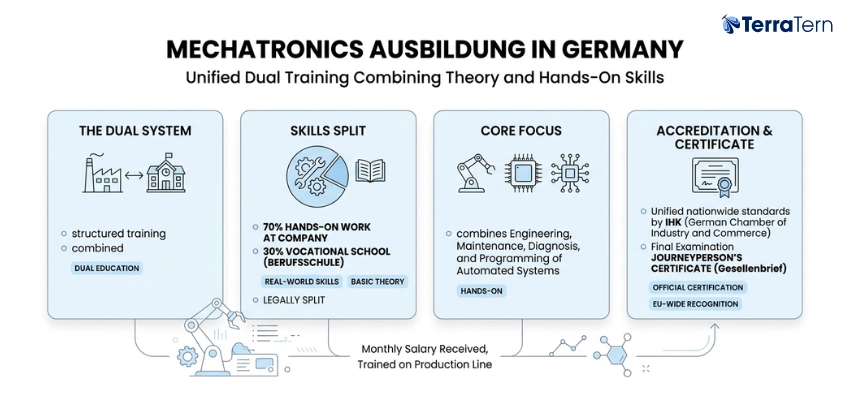
Mechatronics Ausbildung in Germany is a 3-3.5 year dual training course combining structured training at companies, and in school, with mechanical, electronic and computer engineering, culminating in an IHK diploma.
-
Ausbildung vs B.Tech: Not that much theoretical in India. An Ausbildung is an apprenticeship, and requires a tech or B.E. degree. You get to work straight away, receive a monthly salary and are trained directly on the production line.
-
The Dual Education System: Curriculum is legally split. 70% of the time work at the company to train in skills; 30% at a vocational school (Berufsschule) for basic theory.
-
An engineering degree emphasises advanced calculus, research and system design, whereas the focus of Ausbildung is on hands-on work. An Ausbildung is oriented towards the physical installation, maintenance, diagnosis and programming of automated systems.
-
The German Chamber of Industry and Commerce (IHK) creates training standards for the entire country, supervises your final examination and issues your official training certificate to guarantee standards are uniform nationwide.
-
After passing the final exams at the IHK, you are awarded a journeyperson's certificate (Gesellenbrief). As a result, you will become a recognised skilled worker and the qualification is legally recognised and held in high esteem throughout the European Union.
As per TerraTern Expert, Shreya, unlike a B.Tech degree, Mechatronics Ausbildung puts you on a payroll from Day 1, no tuition debt, no waiting 4 years to earn. For Indian students who want a faster, funded route into Germany's job market, the dual system is a structurally superior pathway.
Also Read: Study Mechatronics in Germany: Eligibility, Fees, & Colleges.
What Is the Difference Between Mechatronics and Automotive Mechatronics Ausbildung?
Mechatronics Ausbildung is training across various areas of employment (manufacturing, robotics, aerospace), while the Automotive Mechatronics Ausbildung (Kfz-Mechatroniker) specialises in machine systems, vehicle systems, engine diagnostics, and repair in the automotive industry.
|
Feature |
Mechatronics Ausbildung |
Automotive Mechatronics |
|
Duration |
3.5 years |
3.5 years |
|
Curriculum Focus |
Industrial automation, robotics, PLCs |
Vehicle diagnostics, high-voltage systems, and engines |
|
Industry Scope |
Manufacturing, aerospace, logistics, rail |
Dealerships, OEMs, auto-repair, e-mobility |
|
Top Employers |
Siemens, Bosch, KUKA, Deutsche Bahn |
BMW, Volkswagen, Mercedes-Benz, and local garages |
|
Post-Qualification Salary |
~€2,900 – €3,900 / month |
~€2,800 – €3,500 / month |
-
What is the best thing to do? Select General Mechatronics if: You love the way large factories operate, love programming industrial robotic arms and want to have the flexibility to work in virtually any automated field around the world.
-
If your passion is exclusively to do with cars and motorcycles, then choose Automotive Mechatronics. This course is well-suited for those who want to get their hands dirty with electric vehicles (EVs), hybrid engines and car sensors.
-
German Industry Transition: Due to the immense transition from petrol and diesel engines to electric mobility and a shortage of qualified skilled workers, there are currently 2,000+ unfilled Automotive Mechatronics apprenticeships available across Germany in 2026.
-
So whether you wish to work with the factories' machines or the cars of tomorrow, a mechatronics ausbildung in germany will be a highly rewarding career decision as long as you meet the necessary requirements of the Mechatronics Ausbildung for your desired company.
Important Tip: If you're interested in robotics, automation, and industrial machinery, choose General Mechatronics. If cars are your passion and you want to work with brands like BMW or Mercedes, Automotive Mechatronics is the focused path.
Also Read: Mechatronics Ausbildung in Germany for Indians Guide
What Are the Mechatronics Ausbildung Requirements for Indian Students?
To qualify for mechatronics ausbildung in germany, Indian students generally need a Class 12 qualification with Maths and Physics, B1-level German proficiency, and a signed Ausbildungsvertrag from a German employer. Most companies prefer candidates aged 17–30 with strong technical aptitude and complete visa documentation.
Mechatronics Ausbildung Requirements Checklist
|
Requirement |
Details |
|
Education |
Class 12 (PCM preferred) with 60%+ marks |
|
German Language |
B1 minimum; B2 preferred by top employers |
|
Age Limit |
Preferred: 17–25 years; accepted up to 30 |
|
Training Contract |
Mandatory Ausbildungsvertrag from a German employer |
|
Other Documents |
Passport, health insurance, police clearance, blocked account |
-
Mechatronics ausbildung usually requires Class 12 completion with Maths and Physics for technical training eligibility.
-
B1-level German certification from Goethe or TELC is the minimum, while B2 improves chances of selection at companies like Bosch and Siemens.
-
An Ausbildungsvertrag is mandatory because it confirms your apprenticeship placement, salary, and vocational training details.
-
Employers may conduct aptitude tests covering maths reasoning, mechanical concepts, and basic electrical understanding.
-
Important Mechatronics Ausbildung requirements also include a valid passport, health insurance, a clean criminal record, and, if required, proof of financial support.
Expert Advice: German language proficiency is the single biggest bottleneck for Indian applicants, not academic scores. Start your B1 preparation at least 12–18 months before your target application date to maximise your chances of being selected by employers.
What German Language Level Is Required for Mechatronics Ausbildung?
A minimum of B1-level German proficiency is required for the Ausbildung visa and most training contracts; however, companies like Bosch, Siemens, and BMW typically expect B2 for their mechatronics apprenticeships. To secure a mechatronics ausbildung in germany, your language progression is just as critical as your academic background. Here is a breakdown of the German levels, what they unlock, and the typical timeline for an Indian student starting from zero:
|
CEFR Level |
What It Unlocks for Ausbildung |
Typical Study Time (from Zero) |
|
A1/A2 |
Basic daily interactions. Not sufficient for an apprenticeship or visa. |
2–4 Months |
|
B1 |
The absolute legal minimum. Allows you to secure mid-tier training contracts. |
6–8 Months |
|
B2 |
The golden standard. Grants access to top-tier employers and complex technical training. |
9–12 Months |
The German Embassy and employers strictly require certificates from recognised testing bodies. The accepted certifications are:
-
Goethe-Zertifikat: The most globally recognised and standard credential.
-
TELC (The European Language Certificates): Widely accepted by both visa agencies and employers to fulfil Mechatronics Ausbildung requirements. (Note: For a deep dive into passing this specific exam, refer to TerraTern's existing blog on TELC certification for Ausbildung.
-
ÖSD: The Austrian Language Diploma, which is fully recognised across Germany.
Expert Tip: The APS certificate (Akademische Prüfstelle) is frequently overlooked by Indian applicants. Factor in 4–8 weeks for this evaluation when planning your application timeline.
What Is the Mechatronics Ausbildung in Germany Salary and Stipend?
.After qualification, starting Mechatronics Ausbildung in Germany salary range is from €3,000–€3,800 per month, rising significantly to €4,500–€5,500 with 3–5 years of experience and advanced certifications
Understanding Your Earnings: Stipend vs. Salary
|
Stage |
Expected Monthly Earnings (Gross) |
Status |
|
During Training (Years 1–3.5) |
€800 – €1,400 / month |
Trainee (Stipend) |
|
Post-Qualification (Entry) |
€3,000 – €3,800 / month |
Certified Technician |
|
Mid-Career (3–5 Years) |
€4,000 – €5,500 / month |
Senior / Meister |
-
Net vs. Gross Salary: Note that all quoted figures are "gross" (Brutto). In Germany, approximately 20–25% of your gross income is deducted automatically for social security contributions (health insurance, pension, and unemployment insurance) and income tax.
-
Regional Variations: Your location heavily impacts your pay. States like Bavaria and Baden-Württemberg (home to BMW, Siemens, and Porsche) offer the highest stipends and salaries, while eastern German states typically pay 10–15% less, though this is offset by significantly lower living costs.
-
"The single highest-ROI move is immediate post-Ausbildung Meister pursuit. Most employers offer part-time programmes with costs of €4,000–€6,000, recoverable within 8–12 months through the resulting salary increase." TerraTern Expert
Important Note: Your stipend alone during Mechatronics Ausbildung is often enough to cover basic living expenses in mid-sized German cities, making this programme financially viable from Day 1, unlike self-funded degree programmes.
How Does the Mechatronics Ausbildung Salary Compare Year by Year?
The Mechatronics Ausbildung in germany salary stipend increases annually as your skills become more valuable to the company, typically starting at €950–€1,100/month in Year 1, rising to €1,050–€1,200/month in Year 2, and reaching €1,200–€1,400/month by Year 3.
|
Training Year |
General Mechatronics Stipend |
Automotive Mechatronics Stipend |
|
Year 1 |
€950 – €1,100 |
€900 – €1,050 |
|
Year 2 |
€1,050 – €1,200 |
€1,000 – €1,150 |
|
Year 3 & 3.5 |
€1,200 – €1,400 |
€1,150 – €1,300 |
As per TerraTern Expert: When evaluating training contracts, compare stipend across all 3–3.5 years, not just Year 1. Some SMEs offer lower Year 1 rates but significantly higher Year 3 rates, making total earnings competitive with large-company contracts.
What Is the Post-Qualification Salary After Mechatronics Ausbildung?
The moment you pass your final IHK exams and receive your Gesellenbrief, your earning potential skyrockets. Here is the trajectory of a Mechatronics Ausbildung in Germany salary based on experience and industry:
|
Employer Type / Industry |
Entry-Level Salary (Gross/Month) |
With 3-5 Years Experience |
|
Automotive OEMs (BMW, Mercedes) |
€3,200 – €3,800 |
€4,500 – €5,500 |
|
Industrial Automation (Siemens, KUKA) |
€3,100 – €3,600 |
€4,200 – €5,200 |
|
Aerospace / Rail (Deutsche Bahn) |
€3,000 – €3,500 |
€4,000 – €4,800 |
|
Local SMEs / General Manufacturing |
€2,800 – €3,200 |
€3,500 – €4,200 |
Career Paths That Multiply Earnings:
Your base salary as a technician is just the beginning. The German system rewards further specialisation:
-
PLC Specialist / Automation Programmer: Transitioning from hardware assembly to software programming yields immediate salary bumps.
-
Industriemeister (Master Craftsman): Completing this advanced certification allows you to manage teams, train new apprentices, and push your salary into the €5,000+ bracket.
-
Staatlich geprüfter Techniker (State-Certified Technician): A rigorous 2-year part-time program that elevates your qualifications to bachelor-degree equivalent, opening doors to R&D and engineering management roles.
Pro Tip: Targeting employers in Bavaria (Munich, Nuremberg, Augsburg) and Baden-Württemberg (Stuttgart, Karlsruhe) will consistently deliver the highest post-Ausbildung salaries — up to 25% more than the eastern German average.
What Are the Mechatronics Ausbildung in Germany Fees and Financial Costs?
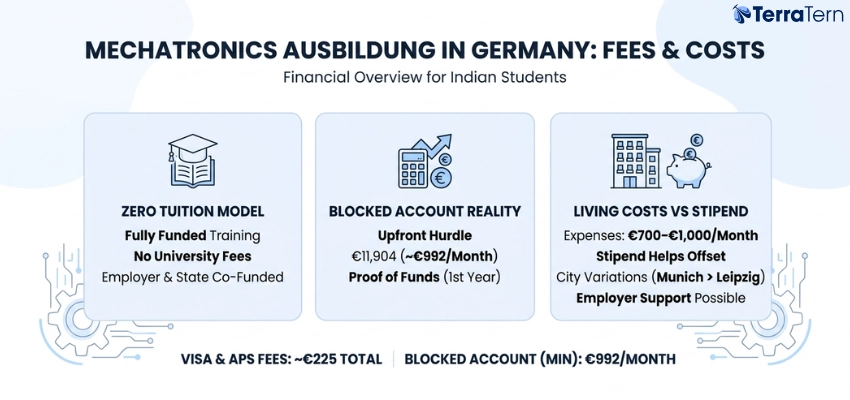
Mechatronics Ausbildung in Germany training is fully funded by the employer. However, Indian students need to budget for living expenses (~€700–€1,000/month), visa fees (~€75), APS certification (~€150), and a blocked account (€992/month minimum).
-
Zero Tuition Model: Because the Ausbildung is a dual vocational system, there are absolutely no university-style tuition fees. Your education is co-funded by your employer and the German state.
-
The Blocked Account Reality: The largest upfront hurdle among Mechatronics ausbildung in germany fees is the legally mandated blocked account (Sperrkonto), requiring €11,904 (€992/month) for the first year to prove you can support yourself.
MyGermanUniversity -
Living Costs vs. Stipend: While your monthly stipend helps immensely, it may not cover 100% of your living costs in expensive cities like Munich (€900–€1,200/month) compared to smaller cities like Leipzig (€600–€800/month). Some employers offer accommodation support or transport allowances to offset this.
|
Cost Category |
Estimated Amount |
Purpose |
|
Ausbildung Visa Fee |
€75 |
Processing by the German Consulate |
|
APS Certificate |
~€150 |
Mandatory validation of Indian academic records |
|
Language Certification |
~€150 – €200 |
Official Goethe or TELC B1/B2 exam fees |
|
Blocked Account (2026) |
€11,904 (€992/month) |
Legal requirement to prove financial stability |
|
Health Insurance |
€80 – €120 / month |
Statutory coverage (partly covered by the employer) |
Key Note: The net financial position of a Mechatronics Ausbildung student in a mid-sized German city can be near-neutral from Year 2 onward. Your stipend (€1,100–€1,200) often covers or nearly covers your living costs (€600–€900), making this truly a debt-free pathway.
Also Read: Mechatronics Ausbildung Requirements in Germany for Indians
What Does the Mechatronics Ausbildung Curriculum Cover?
The Mechatronics Ausbildung in germany fees curriculum covers mechanical systems, electrical circuits, automation technology, PLC programming, CNC machining, pneumatics, hydraulics, IT integration, and diagnostic troubleshooting, split across 3–3.5 years of alternating company and school training.
-
Year-by-Year Progression: Year 1 focuses on foundations (mechanical basics, electrical circuits, workshop safety). Year 2 moves into intermediate skills (automation systems, PLC programming, sensor technology). Year 3 and 3.5 advance to robotics, system integration, and final exam preparation.
-
IHK Examinations: Your competency is tested in two major phases: an intermediate exam midway through and a comprehensive final exam that includes intensive practical troubleshooting to determine your final, recognised grade.
-
Practical Edge: While university degree students worry about textbook theories and associated Mechatronics ausbildung in germany fees for living without a stipend, Ausbildung students graduate debt-free with hands-on skills in problem-solving, technical documentation, and Industry 4.0 tools that employers immediately need.
|
Feature |
Mechatronics Ausbildung |
B.Tech Mechatronics (India) |
|
Environment |
70% Factory Floor / 30% Vocational School |
80% Classroom / 20% Laboratory |
|
Curriculum Focus |
Hands-on assembly, PLC programming, and troubleshooting |
Calculus, system design theory, advanced physics |
|
Exams |
Highly practical, IHK standardised troubleshooting |
Written theory exams and academic projects |
As per TerraTern Expert, Divyansh, the IHK intermediate exam (Zwischenprüfung), taken at the midpoint of training, is often underestimated by international students; treat it as seriously as the final exam, as poor performance can affect your employer's confidence and final evaluation.
What Are the Top Companies Offering Mechatronics Ausbildung in Germany?
Germany's top companies offering Mechatronics Ausbildung include Bosch, Siemens, BMW, Volkswagen, Daimler/Mercedes-Benz, and KUKA Robotics — with stipends ranging from €1,000 to €1,400/month and strong post-training employment rates.
-
Application Timelines: Major industrial corporations open their application windows between September and January for the intake starting the following August/September. Early preparation is critical.
-
Where to Find Vacancies: Do not rely solely on generic job boards. Utilise the Bundesagentur für Arbeit portal, Make it in Germany, company career pages, and specialised placement services like TerraTern.
-
SME vs. Large Corporation: Large companies offer structured training and top-tier stipends that comfortably offset daily Mechatronics ausbildung in germany fees and living costs. Conversely, Small and Medium Enterprises (SMEs) often provide more personalised mentorship and expose trainees to a wider variety of tasks.
|
Company |
Sector |
Location |
Stipend Range (Monthly) |
|
Bosch |
Industrial / Automotive |
Stuttgart |
€1,200 – €1,400 |
|
Siemens |
Automation / Electronics |
Munich, Berlin |
€1,100 – €1,300 |
|
Volkswagen |
Automotive OEM |
Wolfsburg |
€1,100 – €1,300 |
|
Daimler / Mercedes-Benz |
Automotive OEM |
Stuttgart |
€1,100 – €1,300 |
|
BMW Group |
Automotive OEM |
Munich |
€1,000 – €1,250 |
|
KUKA Robotics |
Robotics / Automation |
Augsburg |
€1,000 – €1,200 |
Important Note: Apply to large corporations early (September–November) and simultaneously target mid-sized (Mittelstand) companies. Mittelstand firms in southern Germany often have higher placement rates for international students and are less competitive than Bosch or Siemens.
How Can Indian Students Apply for Mechatronics Ausbildung in Germany?
Indian students can apply for Mechatronics Ausbildung in Germany by securing an Ausbildungsvertrag from a German employer, obtaining a B1 German language certificate, completing APS evaluation, and then applying for the Ausbildung Visa (Section 16a AufenthG) at the German Embassy in India.
Step-by-Step Application Process
To successfully secure a position, follow this exact sequence:
-
Achieve B1 German Proficiency: Pass official Goethe or TELC exams, as this is the legal minimum for the visa.
-
Shortlist Ausbildung Vacancies: Use the Bundesagentur für Arbeit portal, Make it in Germany, or TerraTern to find open positions.
-
Prepare Application Documents: Tailor your CV and cover letter specifically to German standards.
-
Attend Employer Interviews: These are typically conducted via video call or in person if you are already in Germany.
-
Sign the Ausbildungsvertrag: Receive and sign your official training contract from the employer.
-
Complete APS Certification: Obtain the mandatory Academic Evaluation Centre (APS) certificate to verify your Indian academic documents.
-
Open a Blocked Account: Deposit the required funds (minimum €934/month) with a provider like Fintiba or Expatrio.
-
Apply for the Ausbildung Visa: Submit your application at the German Embassy or Consulate in India.
-
Arrange Logistics: Secure health insurance and initial accommodation.
-
Register in Germany: Upon arrival, register your address at the local Einwohnermeldeamt (residents' registration office).
Application Timeline
|
Timeline |
Key Action Required |
|
18 Months Before |
Begin intensive German language courses (aiming for B1/B2). |
|
10–12 Months Before |
Prepare a German-format CV, cover letter, and shortlist companies. |
|
6–8 Months Before |
Submit applications; attend interviews and technical assessments. |
|
4–5 Months Before |
Sign the Ausbildungsvertrag and apply for the APS certificate. |
|
2–3 Months Before |
Open a blocked account, arrange health insurance, and apply for the visa. |
|
1 Month Before |
Arrive in Germany and complete local registration. |
CV and Cover Letter Tips for Indian Applicants
-
Your CV (Lebenslauf) must include a professional headshot, your date of birth, and follow a strict chronological format, which differs significantly from standard Indian resumes.
-
Unlike Indian CVs, avoid listing generic hobbies; focus entirely on practical projects, technical skills, and exact language proficiency levels.
-
Your cover letter (Anschreiben) must explicitly state why you chose that specific company for your mechatronics ausbildung in germany.
-
Highlight any hands-on experience, such as science projects, mechanical repairs, or coding, rather than just listing academic grades.
-
Always draft your CV and cover letter flawlessly in German, not English, to immediately demonstrate your language capability to employers.
Expert Advice: The most common reason Indian applicants get rejected is applying too late. The German Ausbildung calendar runs from September to February for vacancies starting the following August. Begin your search at least 12 months before your intended start.
Also Read: What is Mechatronics Ausbildung? Salary & Updated Guide
What Career Opportunities Are Available After Mechatronics Ausbildung?
After completing Mechatronics Ausbildung in Germany , graduates can work as certified Mechatronics Technicians in automotive, robotics, aerospace, and manufacturing sectors ,and can advance to Meister, Techniker, or even Bachelor's/Master's degrees through further education.
Immediate Job Roles and Hiring Industries
Once you hold your Gesellenbrief, you are eligible for immediate full-time employment. Common starting roles include Automation Specialist, PLC Programmer, Maintenance Engineer, and Production Systems Technician.
Top industries aggressively hiring these technicians include:
-
Automotive: BMW, Volkswagen, Mercedes-Benz
-
Robotics & Automation: KUKA, Fanuc
-
Aerospace: Airbus, MTU Aero Engines
-
Manufacturing & Energy: Siemens, Bosch, Siemens Energy, RWE
Career Progression Ladder
|
Career Stage |
Expected Qualification |
Typical Timeline |
|
Entry Level |
Certified Technician (Gesellenbrief) |
Immediately post-Ausbildung |
|
Advanced Technical |
Staatlich geprüfter Techniker (State-Certified) |
2 years part-time study |
|
Management / Training |
Industriemeister (Master Craftsman) |
1–2 years part-time study |
|
Engineering / R&D |
Bachelor's / Master's Degree (Fachhochschule) |
3–4 years post-Ausbildung |
International Portability and Further Education
-
A mechatronics ausbildung in germany provides an IHK certification that is universally recognised across the entire European Union.
-
German vocational credentials serve as a powerful, highly respected pathway for skilled migration to countries such as Canada or Australia later in your career.
-
Graduates are fully equipped to launch their own automation or maintenance service businesses within Germany through entrepreneurship.
-
Pursuing a part-time Meister program (typically 2 years of evening classes and often funded by your employer) drastically increases your salary and allows you to train future apprentices.
-
Because most companies hire their own apprentices, the transition from trainee to full-time employment is seamless and highly secure.
Expert Tip: The Meister qualification is Germany's most underrated career accelerator. Earned in 2 years, part-time while working, it delivers a 25–35% salary premium and opens pathways to university admission without a traditional Abitur.
What Is the Pathway to German PR After Mechatronics Ausbildung?
After completing Mechatronics Ausbildung in Germany, graduates can apply for a Skilled Worker Visa (Section 18a AufenthG), and after 2 years of skilled employment, can apply for permanent residency (Niederlassungserlaubnis) — making Ausbildung a direct path to long-term settlement in Germany.
Ausbildung PR Pathway vs. Student Visa Pathway
|
Feature |
Ausbildung Pathway |
University Student Pathway |
|
Initial Status |
Earning a salary (€800–€1,400/month) |
Paying living costs via a Blocked Account |
|
Job Search |
Employers usually hire apprentices directly |
18-month Job Seeker Visa required |
|
PR Eligibility |
2 years of skilled employment post-training |
2 years of skilled employment post-graduation |
Step-by-Step Path to Permanent Residency
-
Successfully completing your mechatronics ausbildung in germany grants you the official IHK Gesellenbrief, acting as the foundation of your PR journey.
-
You must then transition to a Skilled Worker Visa (Section 18a of the AufenthG), supported by a full-time job offer in your trained profession.
-
Once you work for 2 years in a skilled position and pay statutory pension contributions, you become legally eligible to apply for the Niederlassungserlaubnis (PR).
-
Achieving B2 German proficiency can help accelerate integration and completely satisfy all language requirements for your PR application.
-
If your post-qualification salary exceeds the required threshold (approx. €45,300/year), you may also qualify for the highly advantageous EU Blue Card.
-
The PR pathway allows for family reunification, meaning your spouse can join you in Germany and will immediately receive unrestricted work permission.
-
After securing PR and accumulating 5 years of total legal residence (which includes your training years), you can apply for German citizenship under the updated Nationality Act.
Important Tip: Choosing Mechatronics Ausbildung over a study visa route to Germany saves you 2–4 years on your PR timeline. Ausbildung graduates clock their "skilled employment" years during training itself, not after a degree.
What Are Common Challenges and How Can Indian Students Overcome Them?
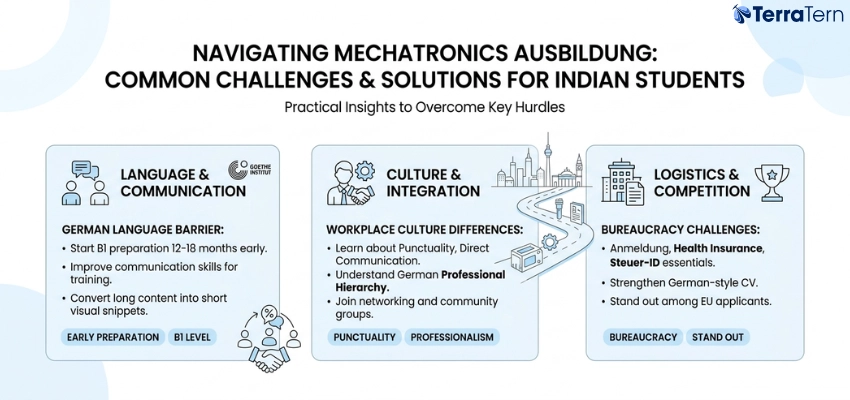
Indian students pursuing mechatronics ausbildung in germany often face language barriers, workplace culture differences, bureaucracy, financial adjustment, and strong competition from EU applicants.
-
German Language Barrier: Start B1 preparation 12–18 months early through institutions like Goethe-Institut and platforms like DW Learn German to improve communication skills for mechatronics ausbildung in germany.
-
Workplace Culture Differences: Learn about German punctuality, direct communication styles, and expectations around professional hierarchy before joining practical training.
-
German Bureaucracy Challenges: Understand essentials like Anmeldung, health insurance registration, and obtaining a Steuer-ID using step-by-step relocation guides.
-
Competition With EU Applicants: Strengthen your German-style CV, optimise your LinkedIn profile, and prepare for technical aptitude tests to stand out.
-
Financial Adjustment in Year 1: Reduce living costs by choosing affordable cities, shared accommodation (WG), and using student discounts for transport and essentials.
-
Homesickness & Social Integration: Join Indian student communities, expat groups, and local networking events to build emotional and professional support systems.
As per TerraTern Expert, the hardest part of the Mechatronics Ausbildung for Indian students is not the technical curriculum; it is the German language. Every week you delay starting your language preparation, you move further from your German career goal.
Also Read: Best Ausbildung Engineering Courses in Germany for Indians
Is Mechatronics Ausbildung in Germany Worth It for Indian Students?
Yes, mechatronics ausbildung in germany is highly valuable for Indian students because it combines zero tuition fees, paid practical training, globally recognised qualifications, strong employment opportunities, and a clear pathway toward long-term settlement in Germany.
-
Strong ROI: germany offers paid training with low financial burden and fast entry into the workforce.
-
Career Stability: Germany has a high demand for professionals in automation, robotics, and industrial maintenance.
-
Best Suited For: Students seeking practical technical careers, early income, and long-term settlement opportunities in Germany.
-
Potential Drawbacks: Requires German language proficiency and adaptation to structured vocational training systems.
-
Who Should Consider Alternatives: Students aiming for research, academia, or engineering specialisation may benefit more from an MS degree.
Pro Tip: If your goal is to live and work permanently in Germany with minimal upfront financial risk, a Mechatronics Ausbildung is objectively the most cost-effective pathway available to Indian students in 2026.
How Can TerraTern Help You With Mechatronics Ausbildung in Germany?
TerraTern supports Indian students throughout the entire mechatronics ausbildung in germany journey, from German language preparation and employer matching to visa guidance and settlement support.
-
German Language Coaching: B1/B2 preparation with certified trainers tailored for ausbildung in germany applicants.
-
Employer Matching Support: Connects candidates with verified German companies offering Ausbildungsvertrag opportunities.
-
Interview & Documentation Assistance: Guidance for German-style interviews, APS documentation, visa filing, and conditional offer letters.
-
Pre-Departure & Financial Guidance: Support with blocked account setup, accommodation planning, and relocation preparation.
-
Post-Arrival Assistance: Continued support network for integration, onboarding, and settling into Germany successfully.
Key Note: Choosing an experienced immigration consultancy like TerraTern eliminates the two most common failure points for Indian Ausbildung applicants: finding a legitimate employer and navigating the German visa documentation process correctly the first time.
2026 INDUSTRY CONTEXT SECTION
Key Facts & Statistics (2026)
-
Skilled Worker Shortage (2026): Germany needs 1.7 million additional skilled workers by 2026 (Federal Employment Agency/BA, 2026); mechatronics is among the top 5 occupations in shortage.
-
International Student Growth: Foreign student participation in technical Ausbildung programs grew by 25% in 2024, with mechatronics among the top three most-chosen fields (BIBB, 2024).
-
Stipend Increase: Average first-year mechatronics stipends rose to €1,000–€1,100/month in 2026, up from €850 in 2022, reflecting new minimum wage regulations.
-
Zero Tuition Advantage: 100% of Ausbildung programs in Germany are tuition-free, funded by training companies — unique globally among industrialised nations.
-
Post-Qualification Demand: 80–90% of Ausbildung graduates in shortage fields receive full-time employment offers from their training companies (BA, 2026).
-
Automation Surge: 67% of German manufacturing facilities plan to increase automation investments by 2026, directly driving demand for mechatronics-trained professionals.
-
PR Pathway: Post-Ausbildung, graduates can apply for permanent residency (Niederlassungserlaubnis) after just 2 years of skilled employment.
Also Read: What is Mechatronics Ausbildung Salary for Indians?
Conclusion
Mechatronics Ausbildung in Germany offers Indian students a low-cost, high-ROI pathway into Germany’s engineering sector with zero tuition fees, monthly stipends, and strong PR opportunities. Understanding Mechatronics ausbildung requirements, such as B1 German proficiency, APS certification, and an Ausbildungsvertrag, is essential before applying. With attractive Mechatronics ausbildung in germany salary prospects ranging from €3,000–€5,500/month after qualification, this vocational pathway creates long-term career stability, global experience, and settlement opportunities in Germany.
To learn more about Mechatronics Ausbildung in Germany: Complete 2026 Guide, contact TerraTern right away!




 AI Summary