

Key Highlights
- Latest List of Ausbildung Courses With Duration in Germany (2025-26)
- Why Choose Ausbildung Courses in Germany for International Students?
- What is the Duration of Ausbildung Programs in Germany for Indians in 2025-26?
- Benefits of Doing an Ausbildung in Germany
- Which Are the Top Ausbildung Courses in Germany by Industry in 2025-26?
- What Are the Complete Eligibility Requirements for Ausbildung Courses in Germany for International Students in 2025-26?
- Required Documents and Language Requirements
- How to Apply for Ausbildung Programs: Complete Step-by-Step Process for Indian & International Students in 2025-26?
- What Are the Visa Requirements and Processing Timeline for Ausbildung Courses in Germany?
- What Career Opportunities and Salaries Await After Ausbildung Completion in Germany?
- How do Ausbildung Courses Compare to University Education in Germany?
- What Are the Common Challenges International Students Face During Ausbildung?
- How Can TerraTern Help You With Ausbildung Courses in Germany?
- What Are the Latest 2025-26 Updates and Policy Changes Affecting Ausbildung?
- Conclusion
Ausbildung is Germany’s nationally regulated, dual vocational training system that combines paid on-the-job training at a company with part-time instruction at a vocational school (Berufsschule). The system is designed to produce work-ready professionals in trades, health, IT, hospitality and business professions through 2–3 years and 5-year programs that include formal assessments and a nationally recognised certificate at completion. Key value: you earn a training stipend while learning, often with strong local hiring pipelines after graduation.
Latest List of Ausbildung Courses With Duration in Germany (2025-26)
The list of 'Ausbildung' courses with duration in Germany is the following:
|
Course/Profession |
Duration |
Monthly Stipend |
Field/Sector |
|
IT Specialist (Fachinformatiker/in) |
3 years |
€800–€1,200 |
Information Technology |
|
Software Developer |
3 years |
€900–€1,200 |
Information Technology |
|
Mechatronics Technician (Mechatroniker/in) |
3.5 years |
€950–€1,200 |
Engineering |
|
Automation Technology Specialist |
3.5 years |
€980–€1,200 |
Engineering |
|
Industrial Mechanic |
3 years |
€900–€1,150 |
Manufacturing |
|
Electrical Technician (Elektroniker/in) |
3 years |
€850–€1,100 |
Engineering |
|
Tool and Die Maker |
3.5 years |
€950–€1,200 |
Manufacturing |
|
Aviation Specialist |
3.5 years |
€1,000–€1,200 |
Aviation |
|
Nursing (Gesundheits- und Krankenpfleger) |
3 years |
€1,000–€1,200 |
Healthcare |
|
Elderly Care (Altenpfleger/in) |
3 years |
€900–€1,150 |
Healthcare |
|
Dental Technician |
3 years |
€700–€1,000 |
Healthcare |
|
Bank Clerk (Bankkaufmann/frau) |
3 years |
€900–€1,100 |
Finance |
|
Business Administration |
3 years |
€800–€1,050 |
Business |
|
Hotel Management |
2.5–3 years |
€750–€1,000 |
Hospitality |
|
Restaurant Service |
2.5–3 years |
€700–€950 |
Hospitality |
|
Retail Sales Assistant |
2–3 years |
€700–€900 |
Retail |
|
Logistics Specialist |
2–3 years |
€800–€1,000 |
Logistics |
|
Warehouse Specialist |
2 years |
€750–€900 |
Logistics |
|
Food Processing Technician |
2–3 years |
€700–€950 |
Food Industry |
|
Automotive Technician |
3.5 years |
€900–€1,150 |
Automotive |
As per the TerraTern expert, unlike traditional university degrees, Ausbildung allows you to earn while you learn, eliminating student debt while building practical skills that German employers actively seek, making it the most financially viable path to career establishment in Germany.
Three Main Types of Ausbildung Programs in Germany
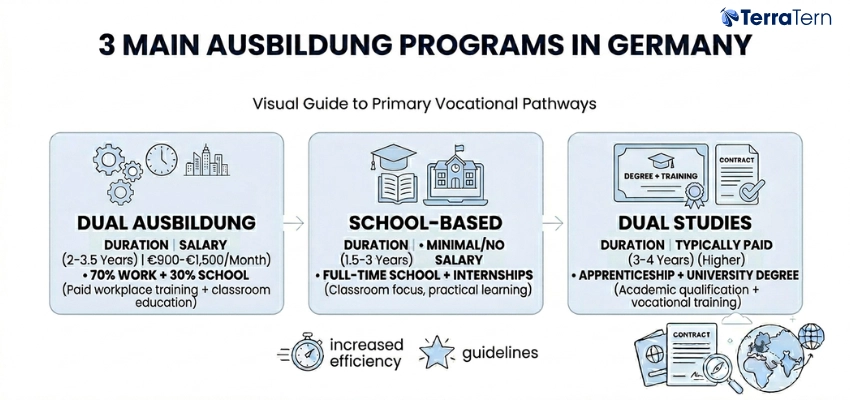
Here is a detailed table breaking down the three primary types of Ausbildung programs in Germany, which includes duration, salary and ideal candidate profiles, provided at your request:
|
Ausbildung Type |
Duration |
Salary Expectation |
Description & Ideal Candidates |
Examples of Professions |
|
Dual Ausbildung |
2 to 3.5 years |
€900 to €1,500/month (paid) |
Combines 70% workplace training and 30% classroom education. Ideal for those seeking hands-on experience with income while studying. |
IT Specialist, Nurse, Mechatronics Technician, Industrial Clerk |
|
School-based Ausbildung |
1.5 to 3 years |
Minimal or no salary |
Full-time vocational school with practical internships. Suitable for those preferring a classroom focus and less workplace immersion. |
Physiotherapist, Social Worker, Technical Assistant |
|
Dual Studies |
3 to 4 years |
Typically paid (varies), higher |
Integrates apprenticeship with a university degree. Suited for candidates aiming for an academic qualification plus vocational training. |
Engineering Management, Business Administration |
Pro Tip: Dual Ausbildung is the most popular choice for international students because it provides immediate income and hands-on experience while eliminating tuition fees—a combination that traditional education pathways cannot match.
Also Read: Ausbildung in Germany: Earn, Learn & Build Your Future
Why Choose Ausbildung Courses in Germany for International Students?
International students opt for Ausbildung courses in Germany for five major benefits: a Monthly income between EUR900 and EUR1500 while training, no tuition fees, 95% employment after completion, permanent residence, and access to the best job market in Europe with held qualifications.
-
Earn While You Learn: Also receive a monthly stipend of EUR900-EUR1,500 during training to help put finances on your plate by covering living expenses during your studies and financially lessen the loss.
-
Zero Tuition Fees: Ausbildung programs are free, which makes them very affordable compared to traditional education at universities.
-
High Job Placement: More than 95% graduate job placement is attributed to these graduates, whereby many contractors get hired in various schools or enterprises for the course and day-to-day job offered, as they succeed!
-
Pathway to Permanent Residency: Successful completion and employment then provides a direct way to permanent residency in Germany.
-
EU-Recognised Qualification: Results in a certification which is recognised in Europe, supporting better career opportunities and mobility
Financial Benefits: How Much Can You Earn During Ausbildung?
Ausbildung trainees receive monthly stipends that may range from EUR900 to EUR1,500, depending on the sector, the year of training, and the location. Here is a detailed breakdown of financial benefits and monthly earnings during Ausbildung in Germany with an international student, including a variation by industry, training year, and main additional benefits.
|
Industry / Course |
Duration (Years) |
1st Year (€) |
2nd Year (€) |
3rd Year (€) |
Average Monthly Stipend (€) |
|
Healthcare / Nursing |
3 |
1,100-1,300 |
1,200-1,400 |
1,300-1,500 |
1,200 - 1,400 |
|
IT & Technical Trades |
3 - 3.5 |
1,000-1,250 |
1,100-1,350 |
1,200-1,450 |
1,100 - 1,350 |
|
Mechatronics / Engineering |
3 - 3.5 |
950-1,150 |
1,050-1,250 |
1,150-1,350 |
1,050 - 1,250 |
|
Hospitality / Hotel Management |
2.5 - 3 |
900-1,100 |
1,000-1,200 |
1,100-1,300 |
1,000 - 1,200 |
|
Commercial / Retail Sales |
3 |
900-1,050 |
950-1,150 |
1,050-1,250 |
950 - 1,150 |
|
Logistics / Warehouse Operations |
3 |
900-950 |
950-1,150 |
1,050-1,250 |
950 - 1,150 |
Important Point: Beyond monthly stipends, Ausbildung trainees receive the same social benefits as full-time German employees—including health insurance, pension contributions, and unemployment protection—making it a financially secure training pathway from day one.
What is the Duration of Ausbildung Programs in Germany for Indians in 2025-26?
Most Ausbildung programs for Germany last anywhere from 2 to 3.5 years, depending on the complexity of the profession, government laws for the federal states, and industry standards from Chambers of Commerce (IHK/HWK).
-
Depending on the type of profession, it will change, but it usually takes from 2 to 2.5 years for simple trades to 3 to 3.5 years for more technical or specialised fields (mechatronics, healthcare, etc.).
-
Students alternate between vocational school (Berufsschule), in which they spend half of the time with the company, roughly 30% of the time in classrooms, divided into blocks or weekly rotations and 70% at the company.
-
Examination and evaluation periods define the progress points of the training, and final exams are awarded once the student has completed the required practical and theoretical elements.
-
Candidates may have accelerated their learning prior to relevant qualifications and/or postgraduates, as employers and chambers welcome it/approve by recognition of prior learning or shortening of training paths.
-
This should be a good framework for understanding the list of Ausbildung courses with duration in Germany. This is also particularly relevant for the list of Ausbildung courses with duration in Germany for international students planning their vocational education timeline.
As per a TerraTern expert, Candidates with relevant prior education or professional experience can often shorten their Ausbildung duration by 6-12 months through equivalency recognition—a pathway TerraTern helps international students navigate effectively.
How is Ausbildung Training Time Divided Between School and Work?
Ausbildung trainees normally spend 70% of their time in practical training in the workplace (usually 3-4 days a week) and in the vocational school classroom (1-2 days a week) in order to balance theoretical knowledge with the experience of working in the profession. There are two general scheduling models, namely:
-
Block release system in which trainees go to school for several weeks at a stretch, followed by weeks in the company.
-
A day release system in which trainees alternate weeks of vocational school days and weeks of working in the workplace.
-
There is a typical number of hours required to work per week, which depends on the type of industry, but means about 35/40 working hours per week, with some vocational schools covering job-related subjects such as driven technology, economics, and languages.
-
Trainees are subjected to intermediate assessments during the duration of the course, and a final examination of the professional qualification by chambers of commerce (IHK/HWK) at the end of their Ausbildung, which certifies their professional qualification.
-
Vacation time, public holidays and working hour regulations follow along with German labour laws to ensure that trainees are granted holiday times and do not exceed working hours with regulated work hours, to facilitate work-life balance.
-
This division of training time is essential to the list of Ausbildung courses with duration in Germany, and important for the list of Ausbildung courses with duration in Germany for international students planning their study-work routines.
As per TerraTern expert Shreya, the dual structure ensures you're never just studying theory—you immediately apply classroom knowledge in real workplace scenarios, accelerating skill development and professional confidence far beyond traditional education models.
Also Read: Ausbildung Courses in Germany: Courses, Duration & Scope
Benefits of Doing an Ausbildung in Germany
An Ausbildung gives practical experience, a steady training salary, and a direct path to employment in Germany’s labour market more than 50% of trainees are retained by their training company after completion in many sectors. Costs are lower than full degree programmes because apprentices earn while training and usually pay little or no tuition, making Ausbildung one of the most cost-efficient routes for international students seeking skilled work in Germany.
-
Gain practical, hands-on experience through a mix of company training and classroom learning.
-
Earn a steady monthly training salary while you learn, instead of paying full tuition.
-
Build job-ready skills that match Germany’s labour market needs.
-
Improve your chances of employment after completion, with many trainees retained by their training company.
-
Lower your overall study costs because tuition is usually minimal or free.
-
Get a cost-effective route to skilled work in Germany, especially for international students.
-
Combine training, work experience, and career development in one pathway.
-
Create a strong foundation for long-term employment or further qualifications in Germany.
Which Are the Top Ausbildung Courses in Germany by Industry in 2025-26?
Below is a table that shows the best Ausbildung courses by industry, including exact time periods, salary progression, key employers, job prospects, and essential skills. It is an essential reference for those reviewing the list of Ausbildung courses with duration in Germany and especially the list of Ausbildung courses with duration in Germany for international students to help them in their career decisions.
|
Industry |
Ausbildung Course (German) |
English Translation |
Duration |
Salary Range (Monthly) |
Top Employers |
Job Titles After Qualification |
Employment Outlook & Demand |
Key Skills Required |
|
Healthcare |
Gesundheits- und Krankenpfleger/in |
Nurse |
3 years |
€1,050 - €1,200 |
Hospitals, Care Homes |
Registered Nurse, Caregiver |
Very high demand due to an aging population |
Patient care, medical knowledge, empathy |
|
IT |
IT-System-Elektroniker/in |
IT Specialist |
3 - 3.5 years |
€1,050 - €1,600 |
Tech firms, IT service providers |
IT Technician, Network Administrator |
Strong demand fueled by digital transformation |
IT troubleshooting, networking, and software skills |
|
Engineering |
Mechatroniker/in |
Mechatronics Technician |
3.5 years |
€1,050 - €1,600 |
Manufacturing, Automotive |
Mechatronics Engineer, Maintenance Technician |
High demand in the automotive and industrial sectors |
Mechanical skills, electronics, programming |
|
Business |
Industriekaufmann/-frau |
Industrial Management |
3 years |
€1,000 - €1,300 |
Manufacturing, Logistics |
Industrial Clerk, Operations Manager |
Consistent demand across industries |
Business administration, logistics, and communication |
|
Banking |
Bankkaufmann/-frau |
Banking Specialist |
2.5 - 3 years |
€1,200 - €1,500 |
Banks, Financial Institutions |
Bank Clerk, Financial Advisor |
Moderate demand, strong career prospects |
Financial literacy, customer service, and analysis |
|
Hospitality |
Hotelkaufmann/-frau |
Hotel Management |
3 years |
€800 - €1,100 |
Hotels, Tourism Companies |
Hotel Manager, Receptionist |
Growing demand with tourism recovery |
Customer service, event management, languages |
Healthcare and Nursing Ausbildung Courses in Germany with Duration
These healthcare Ausbildung courses are of paramount importance in tackling the acute shortage of qualified healthcare workers Germany faces (particularly in nursing and elderly care sectors).
|
Ausbildung Course (German) |
English Translation |
Duration |
Monthly Salary Range |
Qualification Certificates |
Primary Responsibilities |
Work Settings |
Career Progression & Demand Outlook |
Language Requirements |
|
Pflegefachmann/-frau |
Nursing Specialist |
3 years |
€1,050 - €1,200 |
IHK-certified nursing diploma |
Patient care, administering medication, and support |
Hospitals, nursing homes |
High demand due to acute worker shortage; excellent job prospects and immigration benefits for graduates |
Typically B2 (German) |
|
Altenpflegefachkraft |
Elderly Care Specialist |
3 years |
€1,050 - €1,200 |
IHK-certified elder care qualification |
Assisting the elderly with daily activities and medical monitoring |
Nursing homes, residential care |
Increasing demand aligned with an ageing population, positive immigration pathways |
Typically B2 (German) |
|
Medizinisch-technischer Laboratoriumsassistent/in |
Medical Laboratory Technician |
2 - 3 years |
€950 - €1,150 |
IHK diploma |
Collecting and analysing specimens, lab testing |
Medical labs, hospitals |
Steady demand; critical role in diagnostics progression |
Typically B2 (German) |
|
Ergotherapeut/in Assistent/in |
Occupational Therapy Assistant |
2 - 3 years |
€900 - €1,100 |
IHK certification |
Supporting patients with rehabilitation exercises |
Therapy centres, hospitals |
Growing demand with rehabilitation focus; career growth potential |
Typically B2 (German) |
As per TerraTern expert Divyansh, Nursing Ausbildung graduates benefit from Germany's unprecedented healthcare labour shortage, securing immediate permanent employment contracts and fast-tracked residency permits—often within 2-3 years of program completion.
IT and Computer Science Ausbildung Courses in Germany with Duration
These IT and Computer Science Ausbildung programs provide students with industry-relevant technical and programming skills, are certified by Chambers of Commerce (IHK), and have strong partnerships with potential leading industry tech companies like SAP, Siemens, and Deutsche Telekom.
|
Ausbildung Course (German) |
English Translation |
Duration |
Monthly Salary Range |
Specialization Tracks |
Technical Skills & Languages |
Certification & Projects |
Industry Partnerships & Career Trajectories |
|
Fachinformatiker/in für Systemintegration |
IT Specialist (System Integration) |
3 years |
€1,050 - €1,600 |
System integration, network administration |
Networks, servers, and hardware configuration |
IHK certification, hands-on integration projects |
Siemens, Deutsche Telekom, strong demand in corporate IT |
|
Fachinformatiker/in für Anwendungsentwicklung |
IT Specialist (Application Development) |
3 years |
€1,050 - €1,600 |
Software development, application programming |
Java, C#, Python, database management |
Project-based development, coding certifications |
SAP, cloud services, and growing cybersecurity roles |
|
Elektroniker/in für Informations- und Systemtechnik |
Electronics Technician for IT Systems |
3.5 years |
€1,100 - €1,400 |
IT hardware, electronic systems, and debugging |
Circuit design, embedded systems, software |
Practical diagnostics projects |
Telecommunications companies, industrial electronics |
|
Kaufmann/-frau für IT-System-Management |
IT Business Administrator |
3 years |
€1,000 - €1,300 |
IT management, business process analysis |
ITIL, ERP systems, project management |
Business process improvement projects |
Deutsche Telekom, consulting firms, and project leadership roles |
|
Mediengestalter/in Digital und Print |
Digital Media Designer |
3 years |
€900 - €1,200 |
Digital content creation, media design |
Adobe Suite, UX/UI design, web development |
Portfolio-based assessment |
Agencies, media companies, freelance and corporate opportunities |
Engineering and Mechatronics Ausbildung Courses in Germany with Duration
Top German employers of the automotive and industrial industries are strong proponents of these courses, and as a result, they are in great demand on the job market. This is an important listing of Ausbildung courses with duration in Germany, and is relevant for the listing of Ausbildung courses with duration in Germany for those international students seeking technical career paths.
|
Ausbildung Course (German) |
English Translation |
Duration |
Monthly Salary Range |
Technical Competencies |
Major Employers |
Training Focus & Industry Standards |
|
Mechatroniker/in |
Mechatronics Technician |
3.5 years |
€1,050 - €1,600 |
Mechanical systems, electronics, robotics, automation |
Mercedes-Benz, BMW, Siemens, Bosch |
Workshop training in precision engineering, robotics, quality control; DIN/ISO standards compliance |
|
Industriemechaniker/in |
Industrial Mechanic |
3.5 years |
€1,000 - €1,600 |
Mechanical assembly, maintenance, and machine repair |
Automotive and heavy machinery manufacturers |
Hands-on mechanical system assembly, preventive maintenance, and adherence to quality standards |
|
Werkzeugmechaniker/in |
Tool & Die Specialist |
3.5 years |
€1,050 - €1,270 |
Tool making, mould manufacturing, metalworking |
Manufacturing firms, automotive component suppliers |
Precision metalworking, CAD/CAM software use, and tooling for production lines |
|
Automatisierungstechniker/in |
Automation Technology Specialist |
3.5 years |
€1,050 - €1,270 |
Automated systems, robotics, process control |
Siemens, Bosch, and industrial automation companies |
Automation system design, maintenance of robotic production, and Industry 4.0 integration |
Key Note: Engineering Ausbildung in automotive and automation sectors offers the highest training stipends (up to €1,600 monthly) and strongest job security, as Germany's export-driven manufacturing economy continuously seeks qualified technical specialists.
Business and Administration Ausbildung Courses in Germany with Duration
These business and administration Ausbildung courses prepare students for valuable, commercially and financially important activities in Germany's major industries. With the support of leading companies such as Siemens, Deutsche Bank and logistics companies, graduates enjoy good employment opportunities and a good stipend during the training.
|
Ausbildung Course (German) |
English Translation |
Duration |
Monthly Salary Range |
Key Commercial Skills |
Major Employers |
Career Paths & Demand |
|
Industriekaufmann/-frau |
Industrial Business Administrator |
3 years |
€1,000 - €1,300 |
Accounting, procurement, HR, marketing |
Siemens, BASF, Mercedes-Benz |
Strong demand in the manufacturing & logistics sectors |
|
Bankkaufmann/-frau |
Banking Specialist |
2.5 - 3 years |
€1,200 - €1,500 |
Financial products, investment advisory |
Deutsche Bank, Commerzbank, local banks |
High growth in the financial and banking industries |
|
Einzelhandelskaufmann/-frau |
Retail Salesperson |
2 - 3 years |
€800 - €1,100 |
Customer service, sales, and inventory management |
Metro, Lidl, and E-commerce companies |
Growing demand due to the retail and e-commerce boom |
|
Logistiker/in |
Logistics Specialist |
3 years |
€950 - €1,250 |
Supply chain management, transport planning |
DHL, DB Schenker, logistics providers |
High demand with global trade and e-commerce |
Hospitality and Tourism Ausbildung Courses in Germany with Duration
Hospitality Ausbildung programs concentrate on customer service excellence, multilingual communication and operational and event management skills while teaching through the use of real-life experiences within hotels, restaurants and travel businesses.
|
Ausbildung Course (German) |
English Translation |
Duration |
Monthly Salary Range |
Training Settings |
Career Progression & Demand |
Language Skills Required |
|
Hotelfachmann/-frau |
Hotel Management Specialist |
3 years |
€800 - €1,100 |
Luxury hotels, resorts, international chains |
Strong career prospects with global hotel brands |
English plus additional languages is beneficial |
|
Restaurantfachmann/-frau |
Restaurant Professional |
3 years |
€750 - €950 |
Upscale restaurants, hotel dining venues |
Growing demand with tourism rebound |
Multilingual communication skills are needed |
|
Veranstaltungskaufmann/-frau |
Event Management Specialist |
3 years |
€850 - €1,150 |
Event venues, conference centres |
Expanding the event industry with management roles |
Strong organisational and language skills |
|
Tourismuskaufmann/-frau |
Travel Agency Specialist |
3 years |
€800 - €1,050 |
Travel agencies, tour operators |
Increasing opportunities in the tourism sector |
Multilingual competency important |
As per a TerraTern expert, Hospitality Ausbildung offers unique advantages for Indian students: multilingual skills are highly valued, training stipends support comfortable living in smaller German cities, and international career mobility opens positions across Europe and globally.
What Are the Complete Eligibility Requirements for Ausbildung Courses in Germany for International Students in 2025-26?
These criteria serve as the basis for the list of Ausbildung courses with duration in Germany and are an important criterion for the list of Ausbildung courses with duration in Germany for international students wishing to start vocational training.
-
Age Requirement: Generally speaking, workers to enter DW would range from 18 to 28 years old, although some programs are looser and between 18-30 for individuals with specific program requirements. People must be at least 17 in order to apply for a visa.
-
Educational Qualification: To hold a degree of 12 years of formal education, Class 12 or Equivalent, is generally required. Indian qualifications, i.e. CBSE / ICSE / State Board, need to be recognised as equivalent by German authorities.
-
German Language Proficiency: Minimum level B1 of German Language as per the CEFR is required for most programs; many nursing and healthcare programs require level B2. Accepted certifications are Goethe-Institut, telc and OSD.
-
Documentation: Mandatory documents are a valid passport, a signed training contract (Ausbildungsvertrag), proof of health insurance, a motivation letter, an Europass CV, reference letters and translated educational certificates.
-
Health and Financial Requirements: Applicants must have valid health insurance and be medically fit (especially for healthcare jobs).
Important Note: Most Indian students focus solely on German language preparation, but document authentication and educational equivalency recognition often cause application delays—starting the credential evaluation process 6-8 months before application submission prevents timeline disruptions.
German Language Requirements: B1 vs. B2 Level for Different Programs
The Common European Framework of Reference (CEFR) has the following language proficiency levels, where B1 refers to the intermediate ability to communicate in the context of pre-arranged workplace situations, understand instructions, and write straightforward reports. B2 denotes upper-intermediate level with the ability to maintain professional correspondence, hold complex discussions and command the technical terminology.
-
Most Ausbildung programs require a minimum of a B1 level of knowledge of German, adequate for good working language skills. However, some fields such as healthcare, social service and customer-facing jobs require B2 level because of the precision of language skills and medical vocabulary.
-
Certification exams that are available include Goethe-Institut, telc and OSD. Preparation normally takes 6-12 months, depending on intensity and knowledge, and its costs lie between EUR500 and 3000.
-
Language learning paths involving intensive courses in India, online courses and language schools in Germany. Some programs, like the ones from GoAusbildung, use a hybrid approach of sector-specific vocabulary with interactive practice for fast learning.
-
This delineation of the language requirements forms an important part of understanding the list of Ausbildung courses with duration in Germany and their requirements for international students.
Also Read: Germany Work Visa
Required Documents and Language Requirements
To apply for an Ausbildung in Germany, you need to prepare both the correct documents and the right language level. Having everything ready in advance helps you avoid delays during the application and visa process, especially if you are applying as an international student.
-
Passport with sufficient validity for your visa application.
-
Updated CV in German format.
-
German-language certificates such as B1 or B2 proof.
-
School diplomas and transcripts, translated into German if required.
-
Signed Ausbildungsvertrag from the training employer.
-
Proof of health insurance coverage.
-
Proof of accommodation in Germany for the visa process.
-
Language level is usually B1 minimum for application.
-
Many employers prefer or require B2 by the time the training starts.
-
If your German is still at B1, plan to improve to B2 before arrival.
How to Apply for Ausbildung Programs: Complete Step-by-Step Process for Indian & International Students in 2025-26?
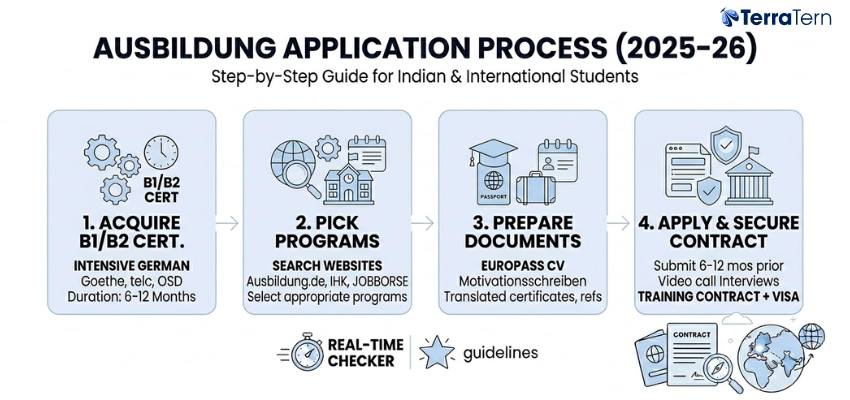
Acquire Certification B1 / B2 Language Course in German by accredited institutions, e.g. Goethe-Institut, telc or OSD. Intensive language courses, depending on your starting level, are normally 6-12 months.
-
To pick appropriate Ausbildung Programs: Research and find GFP durations that suit your interests and your career objectives, utilising websites like Ausbildung.de, IHK-Lehrstellenborse, JOBBORSE and also business websites.
-
Prepare Application Set of Documents: Compile your application package including Europass format CV, motivation letter in German (Motivationsschreiben), translated and certified education certificates, German language certificate and references.
-
Apply and Interview: Submit applications for 6-12 months prior to the beginning of programs. Most interviews are conducted by video calls; they are focused on your motivation and your skills, as well as your language proficiency.
-
Secure Training Contract and Visa Application: Once you receive an Ausbildung contract (Ausbildungsvertrag) use it to apply for your visa. Visa processing takes about 4-6 weeks and involves health insurance confirmation, financial proof, and embassy appointments.
Where to Find Ausbildung Positions: Top Job Portals and Resources?
This approach encompasses the entire picture, supporting international students moving through the list of ausbildung courses with duration in Germany, and helps identify opportunities to compete in international paperwork in the list of ausbildung courses with duration in Germany for international students.
-
Chamber of Commerce Exchange: Official portal handled by the chambers (IHKfiliations) with complete listings from the training companies in the region. Provides detailed filters by region, industry and start date; easy-to-use interface with the ability to submit an application directly.
-
Federal Employment Agency: The government jobs website of Germany lists more than 100,000 job openings for Ausbildung all across the country.
-
Company Career Websites: Major employers such as Siemens, BMW, and Deutsche Bank have dedicated career portals with vacancies for Ausbildung, including a timeline of specific recruitment processes as well as systematic pathways leading to hiring after an internship.
-
Other Possible Networking Strategies: Utilising LinkedIn outreach, the use of virtual and/or physical career fairs in Germany, and university and industry collaborations can provide boosts in visibility and improve the odds of obtaining offers.
As per a TerraTern expert, while job portals list thousands of positions, directly approaching companies in your target industry with speculative applications often yields better results, particularly for international candidates who can demonstrate strong motivation and German language skills.
What Are the Visa Requirements and Processing Timeline for Ausbildung Courses in Germany?

Requirements for Visa Documentation
-
Health Insurance Requirements: Health insurance is mandatory and may be either public or private. Coverage shall meet German legal minimums ("medical treatment and hospital admission"). Depending on the provider and plan, costs differ between EUR80 and EUR160 per month.
-
Things to Know About Application for Visa Processing: Visa applications will have to be made with supporting documents to the German Embassy or consulates in India. Scheduling of an appointment, biometric data collection, possible interview and document verification form a part.
-
Requirements after arrival in Germany: When they arrive, trainees will need to register their place of residence at the local authorities (Einwohnermeldeamt), apply for a residence permit (to extend the visa during the period in Ausbildung) and register with the German social security system.
How Much Money Do You Need for Ausbildung in Germany?
This cost breakdown is important to international students looking at the list of Ausbildung courses with duration in Germany and comparing it with other education paths outside of Germany.
|
Expense Category |
Specific Costs |
Amount (Approx.) |
Notes |
|
Pre-Departure Expenses |
Language Courses |
INR 1,00,000 - INR 2,00,000 |
Intensive German B1/B2 preparation in India |
|
Document Authentication & Translation |
INR 10,000 - INR 20,000 |
Education certificates, CV, motivation letter |
|
|
Visa Fees |
€75 (INR 7,000 approx.) |
German Embassy visa fee |
|
|
Flight Tickets |
INR 40,000 - INR 60,000 |
One-way ticket to Germany |
|
|
Arrival Expenses |
Accommodation Deposit |
€500 - €1,000 (INR 45,000 - INR 90,000) |
Typically, 1-3 months' rent as a deposit |
|
Initial Furnishings/Setup |
€300 - €600 (INR 27,000 - INR 54,000) |
Bedding, kitchen basics, etc. |
|
|
Transportation Pass |
€50 - €90 monthly (INR 4,500 - INR 8,100) |
Regional monthly pass for public transport |
|
|
Monthly Living Expenses |
Rent |
€300 - €600 (INR 27,000 - INR 54,000) |
Varies by city and accommodation type |
|
Food |
€200 - €300 (INR 18,000 - INR 27,000) |
Groceries and eating out |
|
|
Health Insurance |
€110 - €120 (INR 10,000 approx.) |
Mandatory, public or private plans |
|
|
Phone/Internet |
€20 - €40 (INR 1,800 - INR 3,600) |
Mobile and broadband services |
|
|
Blocked Account Deposit |
Required for Visa and Living Expenses |
€11,208 (INR 10,00,000 approx.) |
Must be deposited before arrival; frozen funds for 12 months |
Expert Advice: While initial investment appears substantial (INR 10-11 lakhs), Ausbildung becomes cost-neutral within 2-3 months as your monthly stipend covers all living expenses, unlike university programs where you continuously pay tuition and living costs for 3-4 years.
Also Read: Ausbildung German Language Requirements New Guide
What Career Opportunities and Salaries Await After Ausbildung Completion in Germany?
This extensive career outlook is indispensable for international students who are exploring the list of Ausbildung courses with duration in Germany and are striving for sustainable career prospects in the German labour market.
|
Industry Sector |
Employment Rate Post-Auszubildende (%) |
Starting Monthly Salary Range (€) |
Typical Employers |
Career Progression & Opportunities |
|
IT & Digital |
95% within 3 months |
€3,500 - €4,500 |
Siemens, Deutsche Telekom, SAP, Tech firms |
Specialist roles, project management, senior IT consultant, further studies (Techniker, Meister) |
|
Healthcare & Nursing |
95% within 3 months |
€3,200 - €3,800 |
University hospitals, Charité, Helios, Asklepios |
Registered nurse, specialist care positions, pathway to advanced qualifications, and management |
|
Engineering & Mechatronics |
94-96% within 3 months |
€3,000 - €4,200 |
Mercedes-Benz, BMW, Bosch, Siemens |
Senior technician, team lead, master craftsman, transition to engineering degree programs |
|
Business & Administration |
90-95% within 3 months |
€2,500 - €3,500 |
BASF, Deutsche Bank, Commerzbank, logistics companies |
Operations manager, department supervisor, further education in business administration |
|
Hospitality & Tourism |
88-92% within 3 months |
€2,400 - €2,900 |
Hotels, event management firms, travel companies |
Hotel manager, event coordinator, self-employment, international career opportunities |
Permanent Residency Pathway After Ausbildung: Timeline and Requirements
This way, it provides a structured pathway for clarity for international pupils taking the list of Ausbildung courses with duration in Germany, as it is a stepping stone to long-term residence and career stability in Germany.
-
Progress in Progression of Residence Permit: Starts with an Ausbildung visa (valid for the duration of the program, 2-3.5 years) followed by a post-graduation work permit, which is valid for an 18-month job-seeking period.
-
Employment specifications: Continuous full-time employment in the trained profession with income in accordance with minimum thresholds (approximately 1,200 Euro net/month, depending on family situation).
-
Language and Stereotype of Germany: A minimum of B1 German is a must; B2 would be the better choice for easier integration. Integration of applicants may have to be demonstrated by civic tests or participation in integration courses.
-
Family Reunification: Spouses and children of practitioners who are undergoing Ausbildung or are engaged in the profession afterwards are able to apply for family reunification visas. Spouses often are given the immediate right to work, and family members get access to healthcare and education benefits.
-
Citizenship Timeline: Upon acquisition of permanent residence, eligibility for German citizenship may be established after 5 years (with integration measures) or 8 years of normal residence. This faster path incorporates language level (normally C1) as well as social integration.
As per a TerraTern expert, Divyansh, Germany's 2026 immigration reforms make the Ausbildung pathway one of the fastest routes to permanent residency—graduates can achieve PR status within 4-5 years total (including the training period), compared to 7-8 years for traditional skilled worker visa routes.
How do Ausbildung Courses Compare to University Education in Germany?

This comparison is critical to being able to make an informed choice about the list of Ausbildung courses with duration in Germany vs university pathways, especially for those students abroad who are trying to plan their careers.
|
Aspect |
Ausbildung |
University Education |
|
Duration |
2 to 3.5 years |
3 to 5 years (Bachelor’s), plus Master's |
|
Costs |
Mostly free; monthly stipend (€900–€1,500) |
Tuition fees (typically €15,000–€40,000 total); no salary during study |
|
Earning During Study |
Yes, paid monthly stipend |
No regular income; part-time work possible |
|
Employment Rate After Study |
95% within 3 months |
70-80% within 6-12 months |
|
Starting Salary Range |
€2,500 - €4,500 |
€2,500 - €4,500 (varies by field) |
|
Career Progression |
Practical experience-based opportunities for Meister, Techniker, and university bridging |
Academic and research-focused; postgraduate education possible |
|
Focus |
Hands-on, practical training with the company |
Theoretical, research-intensive academic study |
|
Qualification Recognition |
Recognised vocational diplomas, EU-acknowledged |
Globally recognised academic degrees |
|
Suitability |
Ideal for practical careers, quick workforce entry |
Preferred for research, academia, specialised fields |
|
Bridging Opportunities |
Can pursue university degrees post-Ausbildung with credit for vocational experience |
N/A |
As per a TerraTern expert, for international students prioritising financial sustainability and guaranteed employment, Ausbildung provides superior ROI—you invest INR 10-11 lakhs initially and earn it back within the first year, while university pathways require continuous investment of INR 25-40 lakhs across 3-4 years with uncertain employment outcomes.
Also Read: Jena University, Germany: Rankings, Courses & Admissions
What Are the Common Challenges International Students Face During Ausbildung?
These challenges are important considerations for international students enrolling for an Ausbildung of a certain duration in Germany and demonstrate the importance of preparation beyond the academic for the success of the training experience.
-
German Language Barriers: In spite of B1/B2 proficiency, international students often have to struggle with regional dialects, fast-paced conversation at work and technical terminology, which affects communication with their colleagues and clients.
-
Cultural Accommodation to Work Environment Norms: German work culture focuses on punctuality, direct communication, strict hierarchy and high levels of discipline, which may be very different from the culture of students in their home countries, meaning students need to adapt to fit in.
-
Social Erasures: Homesickness and Social Isolation: A long time away from family for training can cause emotional stress.
-
Accommodation Challenges: It is hard to find affordable housing in competitive markets, especially in large cities.
-
Bureaucratic Complexity: Time and navigating German bureaucracy for residence permits, registering for insurance, filing taxes, and banking are time-consuming and often bewildering, with language barriers thrown in.
How Can TerraTern Help You With Ausbildung Courses in Germany?

TerraTern can assist you towards the Ausbidding courses in Germany in the following key ways:
-
Expert Counselling and Eligibility Assessment: TerraTern offers customised counselling to check for your eligibility, assuming you are interested in education, language, and career interests, to decide the appropriate Ausbildung courses.
-
End-to-End Application Support: They help you to prepare, verify and submit documents, such as writing your Europass CV and motivation letters in the German language and optimise your application quality.
-
Language Training: TerraTern provides certified language training up to B1/B2 standard, tailored to specific conditions, including German as needed by the Schnell aid, specifically designed Polizeidienst training, etc. Eines Anlegungs, which can strengthen your communication skills, can be made available for success in training or work.
-
Job Placement Assistance and Interview Preparation: They help you to establish contacts with German employers, prepare you for cultural and technical interviews and help you to acquire a conditional training contract (Ausbildungsvertrag).
As per a TerraTern expert, this full-service approach helps in making the entry and training experience of international students successful and seamless with the help of TerraTern, with the list of Ausbildung courses duration in Germany courses provided.
Also Read: Navigating Immigration With Terratern
What Are the Latest 2025-26 Updates and Policy Changes Affecting Ausbildung?
These updates move forward Germany's goal of attracting global talent with enhanced financial advantages, simpler paths for immigration, and updating vocational training systems in the benefit of international students pursuing the list of Ausbildung courses with a duration in Germany.
-
Increased Training Stipends: Minimum monthly training stipends have been increased by about 8-12% across industries, providing better financial support for the trainees from 2026 onwards.
-
Streamlined Access to Visa Processing: Visa processing time for shortage occupations, including many Ausbildung professions, has been cut down to 4-6 weeks.
-
Digital Application Platforms: The introduction of the IHK Digital Portal and similar opportunities allows for a modernisation of the application process for an apprenticeship, including the submission of documents, tracking of their status, as well as communications to the training companies and the chambers.
-
Expanded English-Language Training Alternatives: New programs in IT, engineering, and other technological fields incorporate elements of English-language instruction, helping less qualified international students with lower German proficiency while still ensuring quality standards.
-
Extended Post Graduate Work Permit Extensions: The post-Ausbildung job search visa period has been extended from 12 to 18 months in order to give graduates more time for employment to transition to skilled worker visas.
Conclusion
The list of Ausbildung courses with duration in Germany offers international students a practical, cost-effective pathway to skilled employment and permanent residency. With competitive monthly stipends, high job placement rates, and streamlined visa processes, Ausbildung is a compelling alternative to traditional university education. This comprehensive approach ensures international students accessing the list of Ausbildung courses with duration in Germany for international students have clear, viable routes to success and long-term residency.
Contact TerraTern for more information on the Complete List of Ausbildung Courses with Duration in Germany 2025.




 AI Summary