Key Highlights
- What Are the Best Jobs in Japan for Indians in 2026?
- What Job Opportunities in Japan Are Available for Indian Freshers?
- What Job Vacancies Exist in Japan for Indian Graduates?
- What Visa Do You Need for Job Vacancies in Japan?
- What Is the Average Salary for Jobs in Japan for Indians?
- Do You Need Japanese Language Skills for Jobs in Japan?
- How Can Indians Find and Apply for Job Vacancies in Japan?
- Conclusion
In 2026, there is more demand for Indian professionals and skilled workers seeking options for international careers in Japan, especially in the fields of IT, engineering, healthcare, hospitality, manufacturing, and caregiving. You might be able to apply for a work visa like the Engineer/Specialist in Humanities/International Services visa or the Specified Skilled Worker (SSW) visa, depending on your qualifications, experience, Japanese-language skills, and visa category.
This 2026 guide provides you with the best job prospects for Indians in Japan, salary expectations, key work visa types, and other eligibility requirements. The guide also covers how to get started on your career in Japan.
What Are the Best Jobs in Japan for Indians in 2026?
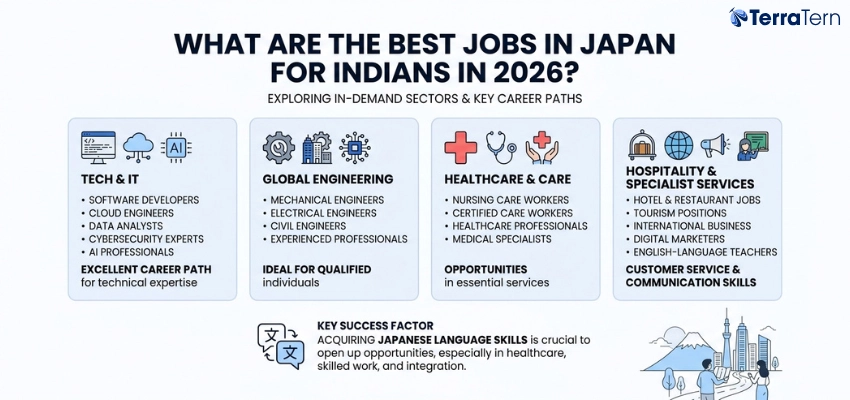
- Software Jobs: Software developers, cloud engineers, data analysts, cybersecurity experts, and AI professionals are excellent career paths for Indians who have the right technical expertise for IT & software jobs.
- Engineering Jobs: Mechanical, electrical, civil, and other engineering positions are ideal for the qualified professional, especially those with experience in the field.
- Healthcare & Nursing Jobs: There are opportunities available in Japan for qualified healthcare professionals or certified care workers, such as nursing care.
- Specified Skilled Worker: This is for certain positions like manufacturing, construction, agriculture, accommodation, food service, automobile maintenance, nursing care, etc.
- Hospitality & Tourism Jobs: There are jobs in the hotel, restaurant, and tourism industry, particularly for candidates with Japanese language skills and relevant experience.
- Teaching Jobs: For candidates with good communication skills and relevant qualifications, teaching-related jobs, especially English-language teaching, might be a good option.
- Marketing & Business Jobs: Depending on the position and qualifications, marketing jobs, business jobs, and humanities jobs (such as digital marketing, sales, international business, design, translation, etc.) may be classified as Engineer/Specialist in Humanities/International Services in Japan.
- Highly Skilled Jobs: Experienced researchers, technical specialists, and highly qualified professionals might have the opportunity to apply for Japan's Highly Skilled Professional route through a points-based evaluation.
- Japanese Language Skills Matter: Students will hear that acquiring Japanese will open up more opportunities for them to find jobs, especially in customer service, healthcare, skilled worker, and workplace integration jobs.
Expert Advice: Don't limit your search to IT roles just because they're most frequently discussed; healthcare, caregiving, and manufacturing roles under the SSW programme are often significantly more accessible for candidates without an engineering or IT background.
Also Read: Japan Visa for Indians: Types, Fees & Processing Time
What Job Opportunities in Japan Are Available for Indian Freshers?
- IT & Software: Candidates who have a degree or proficiency in computer science, software development, web development, data analysis, or IT support may find entry-level roles in the IT & Software sector.
- Professional Work: Mechanical, electrical, electronics, civil, and related engineering graduates might be able to apply to Japanese firms under professional work.
- Job Opportunities in Hospitality & Hotels: Hotel front-desk, guest services, restaurant and hospitality positions are suitable for freshers, especially those proficient in the Japanese language.
- Food Service: Restaurant and food service jobs welcome me withJapan'ss Specified Skilled Worker (SSW) system (based on requirements and tests. Jobs in manufacturing, machinery, electronics, assembly, machining, and other factory work in specified skilled-worker fields are all considered to be manufacturing and can be considered for positions for freshers.
- Nursing Care: If you're interested in working in elderly care, you can pursue a nursing-care role on the SSW track, as long as you have the necessary skills and Japanese-language requirements.
- Agriculture: Farm and agricultural jobs, such as growing crops and working with animals, are included in the SSW system.
- Construction & Skilled Trades: Entry into this field is possible in construction, welding, electrical/electronics, automobile maintenance, and related technical occupations, depending on the field requirements.
- Language & International Services: Freshers who are equipped with good English or other foreign language skills can consider a career in translation and interpretation, design, marketing, and other related fields where their skills and responsibilities align with the requirements of the Engineer/Specialist in Language & International Services category.
- Japanese Language Skills: Employability of freshers can be improved a lot in Japanese Language Skills: Learning Japanese. Certain jobs require confirmation of Japanese skills via an exam for SSW.
- Important: Indian freshers typically require a suitable offer of employment along with a residence status that allows the type of work they intend to carry out – visiting Japan as a tourist does not give general work permission.
Pro Tip: If you're a fresher without a degree, don't assume Japan is out of reach, the SSW visa's JLPT N4 requirement is genuinely achievable within a few months of focused study, making it one of the most accessible international job pathways available to non-graduate Indian candidates.
Also Read: Family Visa Japan: Experts Latest Guide
What Job Vacancies Exist in Japan for Indian Graduates?
- IT & Software Development: Computer science graduates and IT graduates can pursue various positions like software developer, web developer, systems engineer, cloud engineer, and IT support specialist.
- Engineering: Mechanical, Electrical, Electronics, Civil, and Industrial engineering graduates can pursue engineering-related positions with Japanese companies.
- Data & AI: Data analytics, AI, and ML graduates can now aim for burgeoning technology positions.
- Research & Technical Roles: Candidates possessing higher qualifications and specialized skills might be able to secure positions with research institutes, laboratories, and technical institutes. Researchers and engineers are considered work statuses in Japan.
- Manufacturing: Graduates may be able to work in industrial manufacturing, machinery, electronics, component manufacturing, and other industrial technical fields. These fields are also mentioned in the list of fields for Specified Skilled Worker in Japan.
- Construction & Infrastructure: Civil & related engineering graduates can look at construction, infrastructure, equipment, and maintenance positions.
- Hospitality & Tourism: Students who are interested in the hotel and tourism industry can apply for accommodation-related opportunities, like guest services, hotel operation, etc.
- Automobile Industry: Enlist for vehicle maintenance, repair, manufacturing, and technical-related occupations.
- Healthcare & Nursing Care: Qualified graduates may pursue a career in healthcare or nursing care, but some healthcare professions will require Japanese licensing or a specific qualification.
- Business & International Services: BBA graduates with a background in business, marketing, languages, design, and related areas can find employment as international business staff, marketing specialists, translators/interpretation, or designers, depending on their qualifications and responsibilities.
- Agriculture & Food Manufacturing: Agriculture and food-and-beverage manufacturing are two industries that are included in the Specified Skilled Worker system and are suitable for graduates interested in practical jobs in the industry.
- Japanese Language Advantage: Although the proficiency level required depends on the job, many positions can significantly open up your job market if you know Japanese, especially customer service and office or work-related positions. In certain cases, the Specified Skilled Worker program involves Japanese language exams.
- Visa Requirement: Indian graduates must have the right type of visa for employment in Japan. Professional graduates may be eligible to apply for a skilled worker visa in categories like Engineer/Specialist (Humanities/International Services), and eligible skilled workers may apply through the Specified Skilled Worker route.
Key Note: If you're a graduate of an IIT, IIM, or IISc, the J-Find visa is worth serious consideration even without a confirmed job offer yet — it's specifically designed to let you search for roles inside Japan for up to two years without requiring Japanese language proficiency upfront.
Also Read: Get Japan Work Visa For Indians In 5 Steps: Latest Guide
What Visa Do You Need for Job Vacancies in Japan?
One of the primary work visas for foreign professionals is the Engineer/Specialist in Humanities/International Services Visa. It applies to IT engineering, technical jobs, marketing, interpreting, language instruction, copywriting, and designing.
A work visa called a Specified Skilled Worker (SSW) visa: For people with certain skills in certain industries. There are two types of SSW, one being SSW1, where the maximum period of stay is five years, and the other being SSW2 with more opportunities for long-term stay.
-
Highly Skilled Professional Visa: For those who have a high level of qualifications, including work experience and salary.
-
Intra-company Transferee Visa: The visa is available for someone who has been transferred from an eligible company in another country to a branch or related organisation of that company in Japan.
-
Skilled Labour Visa: For some skilled jobs, for example, a GN-cuisine chef, etc. For those who are planning to enter Japan for eligible research or teaching positions, a worker under these specific work statuses may be required.
-
Medical Services/Nursing Care: The following qualifications and/or certifications are normally required for medical services/nursing care: Japanese medical qualifications or certification and certified nursing care status for care workers.
- For those Seeking Employment in Japan: The way to go depends on the type of work you will do, your Japanese-language skills, your qualifications and experience, and your job offer.
Note: the visa and the status of residence are two different documents. The visa allows for entry to Japan, and the status of residence will dictate the activities you can engage in after entering the country.
Advice by our Expert: Always confirm your employer has actually initiated your Certificate of Eligibility before finalising relocation plans — without a COE, no Japan work visa application can proceed, regardless of how strong your job offer or qualifications are.l
Also Read: Step-by-Step Process of Obtaining a Japan Tourist Visa for Indians
What Is the Average Salary for Jobs in Japan for Indians?
The Japanese do not have a fixed official “Indian salary”; it varies depending on the occupation, experience, qualifications, location, and the employer.
-
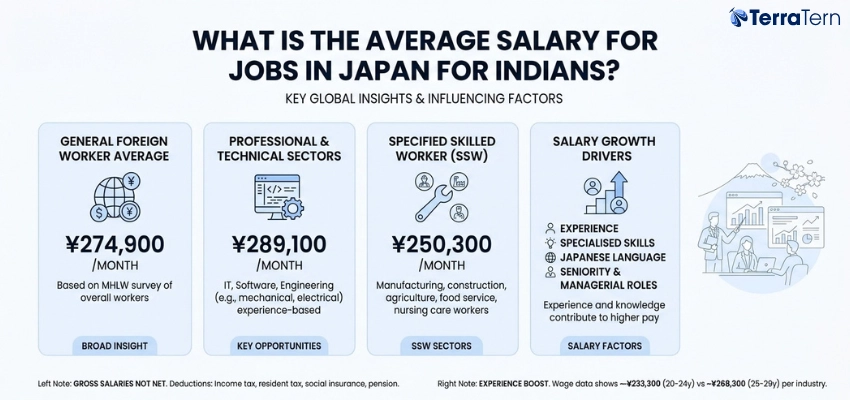
The latest survey on foreign employment in Japan's Ministry of Health, Labour and Welfare showed the average monthly cash salary of foreign workers in general employment was around ¥274,900.
-
Professional/technical Foreign workers in professional/technical occupations earned approximately ¥289,100 per month (or about ¥3.47 million per year, before bonuses and deductions).
-
Workers in the SSW category earn an average of about ¥250,300 per month or about ¥3.0 million per year.
-
The IT & Software sector tends to offer attractive salaries for software engineers, software developers, cloud professionals, and AI specialists, depending on their experience and skills.
-
Excluding job titles in the construction industry, engineering positions, especially mechanical, electrical, electronics, and other engineering roles, tend to pay higher as they gain experience and expertise.
-
Hospitality, food service & entry-level jobs are often paid at a lower level than IT or engineering career paths but may include overtime compensation, allowances, bonuses, and location, which can impact overall compensation.
-
Entry-level employees tend to be paid less than experienced employees. The official wage data indicates average monthly scheduled earnings of approximately ¥233,300 for all workers 20 to 24 years old and ¥268,300 for all workers 25 to 29 years old by industry.
-
Experience, specialised skills and knowledge, Japanese language skills, seniority, or managerial roles all contribute to salary growth in Japan.
-
Please note that these are gross salaries, not net after-tax pay. You can have income tax, resident tax, social insurance, pension contributions, and more deducted from the amount you receive.
Expert Advice: Treat JLPT N2 as a direct salary investment, not just a language milestone — the reported 15-25% salary premium it commands means the time spent reaching this level often pays for itself quickly once you're working in Japan.
Also Read: Step-by-Step Process of Obtaining a Japan Tourist Visa for Indians
Do You Need Japanese Language Skills for Jobs in Japan?
- Japanese Language Skills: Japanese language skills are not always needed for all jobs in Japan. Requirements are unique to each employer, position, industry, and visa/status of residence. Japan has several categories for professionals such as IT engineers, engineers, foreign-language teachers, interpreters, designers, and others.
- IT and Tech Jobs: Certain international companies and positions involving technology might accept applicants capable of working primarily in English, but proficiency in the Japanese language can enhance opportunities.
- Engineering Jobs: Japanese may not always be required in specialised engineering fields, especially those in the multinational or English-speaking workplace, but it may be beneficial if co-communicating in the workplace.
- Specified Skilled Worker (SSW): Applicants for many SSW positions need to pass an approved Japanese exam to prove their proficiency in the language.
- Customer-Facing Careers: Japanese is especially essential for careers in hospitality, restaurants, retail, customer service, and other roles that require frequent interaction with Japanese customers.
- Translation and Interpretation: Proficiency in Japanese is a must-have task that requires knowledge of the Japanese language as part of the job. The present immigration advice also provides that certain language-based jobs require language-ability criteria.
- Japanese Language Levels: In terms of Japanese levels, JLPT N5–N4 is adequate to provide students with basic communication skills, and JLPT N3–N2 is more useful for employment, and JLPT N1 is more useful for advanced communication in the workplace. This does vary according to the job.
- Better Opportunities with the Knowledge of Japanese: Although some jobs do not legally require Japanese, it can be easier to communicate with coworkers, understand workplace customs and culture, and qualify for certain jobs.
- Best Advice for Indians: Learn Japanese first if intending to work in Japan. If you have a career in mind where English + Japanese + the skills required for said field is the desired combination, then you can make your profile quite a bit more robust.
Pro Tip: Match your JLPT target level to your specific visa route before you start studying — N4 for SSW roles, N3 as the practical floor for most private-sector jobs, and N2 if you're targeting mainstream Japanese companies or want the documented salary premium.
How Can Indians Find and Apply for Job Vacancies in Japan?
- Use Reputable Job Search Sites: Use Japanese job search websites, company career pages, and official job services. Hello Work is a job-finding program in Japan where job seekers are able to post on Joonline and apply for the ones they are eligible for.
- Utilise Employment Services for Foreign Workers in Japan: The Ministry of Health, Labour and Welfare of Japan has employment service centres which offer information on job counselling, career guidance and foreign worker recruitment, as well as information on foreign workers' job placement.
- Spend Your Time in Multinational Companies: if English is spoken in the workplace, check out Japanese and international companies, specifically in the IT, engineering, manufacturing, finance, and international business fields.
- Create a CV That Is Appealing to a Japanese Employer: emphasize education, work experience, technical skills, certifications, level of Japanese language fluency, and relevant accomplishments. Be careful to maintain a concise and targeted CV.
- Japanese Skills: Even if Japanese is not required, having knowledge of the Japanese language may be helpful in finding work and may make it easier to communicate in the workplace.
- Check the Eligibility Before Applying: Ensure that your skills and the job you are looking for are suitable for the appropriate Japanese work status. Foreign nationals are allowed to work under their conditions of residence.
- Apply Directly to Employers: Apply to an employer directly through the company's application process, and send your cover letter, educational documents, and other documents requested.
- Interviews: Interviews can be conducted online during the application process in India. Be ready to talk about your abilities, experience, level of Japanese, and,your expectations, and your desire to relocate.
- Get Offered a Job: After your selection, be given a formal employment contract or job offer that outlines your job, salary, working conditions, and employer information.
- Finish Visa Processing: Many of the visa categories for long-term employment require a Certificate of Eligibility (COE) to be received in Japan prior to the application for a visa with the Embassy or Consulate of Japan.
- Be Wary of Recruitment Fraud: don't pay any strange charges to secure a job. The Employment Ministry of Japan has also recommended foreign job seekers to search for companies that provide services that are reliable and that their recruiters are registered.
- Best Approach for Indian Candidates: The best approach for the In candidates is to develop all the necessary skills or qualifications that are relevant to the job, develop some skills in the Japanese language and make a good CV, and finally apply their skills to employers who are interested in them and to get a job in Japan.
Key Note: Preparing a proper Japanese-style resume (rirekisho), even for English-language roles, signals genuine cultural preparation to Japanese employers, a small extra effort that consistently differentiates serious candidates from generic international applicants.
Also Read: Japan Visa Rejection Rate for Indians: Causes & Fixes
Conclusion
Japan is a great place to work for Indian professionals, graduates, and skilled workers in sectors like IT, engineering, manufacturing, healthcare, hospitality, and other dynamic sectors. The key ingredients for success in having a career in Japan in 2026 entail the right combination of qualifications, skills, Japanese language skills, and a suitable job offer. Work routes can be Engineer/Specialist in Humanities/International Services, Specified Skilled Worker or Highly Skilled Professional, or others according to occupation and eligibility.
Before applying, check the job requirements and the visa or status of residence you need. TerraTern can help you check your eligibility and understand the right visa options for working in Japan.