

Key Highlights
- What Is the Japan Visa Rejection Rate for Indians in 2025?
- Why Does Japan Reject Visa Applications from Indians? (Top Reasons)
- How Does Japan Visa Rejection Rate Differ by Visa Type?
- What Documents Do Indians Need to Avoid Japan Visa Rejection?
- How Can Indians Improve Their Japan Visa Approval Chances?
- What Happens After Japan Visa Rejection — Can Indians Reapply?
- Is Japan Visa Rejection Rate Higher for Specific Indian Cities or Consulates?
- How Does Japan eVisa Affect Rejection Risk for Indians?
- Conclusion
The rejection rate for visas to Japan among Indians typically ranged between 2 per cent and 15 per cent, depending on the type of visa, such as a tourist or business visa, with tourist visas being highly scrutinised. This low-to-moderate rate of Japanese visa rejections can be attributed to the stringent scrutiny by the Japanese embassy of both documentation and intent to return home. Even cases of rejection could be prevented with the right preparation; the chances of approval on multiple attempts increase to 90 per cent or higher with the help of an expert.
What Is the Japan Visa Rejection Rate for Indians in 2025?
The Japanese visa rejection rates of Indians are estimated at between 5 -15% on tourist and business visa applications and 1020 percent on student visa applications.
-
The official data for FY2024 show an overall non-immigrant visa refusal rate of about 5.8 per cent, making Japan one of the most accessible Asian destinations for Indian travellers.
-
No country-specific Japan visa rejection rate figures are published by Japan and confirmed by MoFA; thus, estimates are based on expert sources, such as BTW Visas, using JNTO statistics.
-
This is in sharp contrast to Schengen visas (157020%) and US B-visas (1632% of Indians on B-visas, as per FY24 State Dept data).
-
In 2025, there was an increase in the number of Indian tourist arrivals by 64% YoY, surpassing 150,000 Indian tourist arrivals between January and May 2025, as well as the 12-month average.
|
Visa Type |
Estimated Rejection Rate (Indians) |
Primary Reason |
|
Tourist Visa |
5–10% |
Insufficient financials, incomplete docs japanvisawithchetan+1 |
|
Business Visa |
8–12% |
Missing company seal, unclear invite japanvisawithchetan+1 |
|
Student Visa |
10–20% |
|
|
eVisa (post-Apr 2024) |
Data emerging |
As per TerraTern Expert Shreya, Japan's overall rejection rate is low, but student visa applicants face twice the risk of refusal as tourist applicants. Always check visa-type-specific requirements, not just general guidelines.
Also Read: Japan Multiple Entry Visa for Indian Complete
Why Does Japan Reject Visa Applications from Indians? (Top Reasons)
The Japan visa rejection rate for Indians is mainly due to incomplete documents, insufficient financial evidence, ambiguous travel purpose, and document mismatches, contributing to a 5-15% overall refusal rate. These issues may lead visa officers to question whether the applicant intends to return home after the trip.
-
Missing Application Form: Incomplete applications are automatically rejected. Use A4 print, block letters, and type the exact passport name.
-
Inadequate Financial Evidence: He has less than 10 days of 1.52 lakhs of financial testimony, or an infusion of money, will not hold water. Applicants should usually provide 3–6 months of bank statements, salary slips, and ITRs.
-
Vague Itinerary: Generic plans where day-wise hotels or transportation are not specified will raise doubts; make sure to include the booking references.
-
Weak Home Ties: No employer NOC, business documents, or family/property documentation concerns overstay.
-
Document mismatches: Name/date mismatches among the passport, tickets, and hotel will lead to automatic rejection.
-
Mixed-up Tourist and Business: Mixing visitor and business purposes is not accepted; the purpose of the match must be accurate.
-
Prior Violations: Approval is blocked due to overstays or unspecified rejections.
-
Fraudulent Docs: Fraudulent ITRs or statements are punishable by capable stamps.
-
NON-Compliant Photos: Non-compliant photos will lead to rejection if they do not meet the required size, background, or resolution specifications.
-
Early Application: Applying too early or resubmitting unchanged documents can weaken the application and delay approval.
Important Note: The single biggest preventable reason for Japan visa rejection for Indians is a sudden large deposit in bank statements. Maintain consistent funds for at least 3 months before applying, not 3 days.
What Financial Proof Does Japan Visa Require from Indians?
It only takes an average of INR 1.52 lakhs in the bank balance for a 10-day trip to Japan, which is required by Indians, and recent bank statements, salary slips, and tax documents are commonly used to demonstrate financial stability are the key to avoiding all the pitfalls of sudden top-ups like importing high-tech electronics, purchasing luxury items like cars, and similar products, since all these products require a considerably high level of sophistication.
|
Trip Duration |
Recommended Balance (INR) |
Supporting Documents |
|
5–7 days |
INR 75,000–INR 1 lakh |
3-month statements + salary slip |
|
10–14 days |
INR 1.5–2 lakhs |
6-month statements + ITR |
|
15–20 days |
INR 2–3 lakhs |
6-month statements + ITR + FD |
|
21–30 days |
INR 3–4 lakhs |
Statements + ITR + property |
Expert Advice: Fixed deposit receipts alongside regular bank statements dramatically improve financial credibility; they demonstrate savings behaviour, not just a high balance.
What Does a Japan Visa Rejection Stamp Mean (B vs C)?
Japan's visa rejection rate marks B and C as having different levels of severity, without detailed explanations of the rejections, as mandated by the MoFA.
-
Stamp B: Stamp B usually points to fixable administrative issues, so applicants should correct the errors before reapplying.
-
Stamp C: Fraud or security flags or misrepresentation are long-term consequences to future visa or consult with advisers.
Expert Tip: If you receive a Stamp C, do not reapply without professional consultation; reapplying with corrected documents still risks refusal if the C-stamp reason was a fraud flag.
How Does Japan Visa Rejection Rate Differ by Visa Type?
Japan's visa rejection rate varies significantly by type for Indians, with tourist visas at 5–10% due to easier requirements, while student visas hit 10–20% due to academic scrutiny.
-
Tourist Visa: Japan's lowest visa rejection rate is 5–10%; rejections occur due to financial issues, itinerary issues, and eVisa upload errors post-2024.
-
Business Visa: 8–12% rate; unsigned invites or missing seals are common, as in the Pune IT case.
-
Student Visa: Highest 10–20%; lacks JLPT N5 or COE, like the Kolkata rejection example.
-
Work/Long-Term Visa: Rare if COE valid; mismatches still risk refusal.
Important Tip: Student visa applicants who include JLPT certification even at entry level (N5) report significantly higher approval rates; treat it as a tie-breaker document, not an optional extra.
What Documents Do Indians Need to Avoid Japan Visa Rejection?
Key to dodging Japan visa rejection rate spikes: complete, signed forms, bank statements, and NOC letters tailored by applicant type.
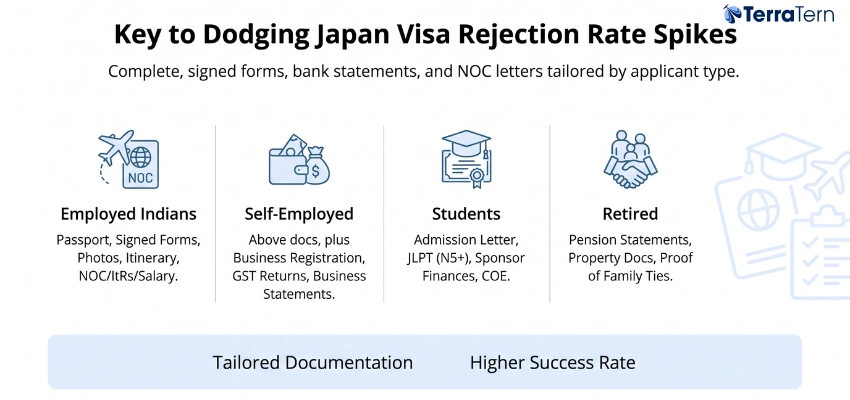
1. Employed Indians
-
Valid passport (6+ months, 2 blank pages).
-
Signed the latest application form (A4, block letters).
-
45 mm × 45 mm photo (white background).
-
Return tickets, hotel bookings, and day-wise itinerary.
-
3–6 months stamped bank statements, ITRs, salary slips, and employer NOC/cover letter.
2. Self-Employed: Above, plus business registration, GST returns, and business statements.
3. Students: Admission letter, JLPT (N5+ recommended), sponsor finances, and COE.
4. Retired: Pension statements, property docs, and proof of family ties.
As per TerraTern Expert: The NOC/leave letter is the single most overlooked document among employed Indian applicants; its absence is interpreted by visa officers as weak ties to India, directly raising suspicions of overstay.
Also Read: Japan Visa for Indians: Types, Fees & Processing Time
How Can Indians Improve Their Japan Visa Approval Chances?
Boost approval rates over Japan visa rejections by timing applications right, proving finances/ties, and providing precise docs.
-
Apply 3–4 weeks early (1–3 months ideal).
-
Show consistent INR 1.5–2 lakhs via 3–6 month statements (no sudden deposits).
-
Detail day-wise itinerary with bookings/references.
-
Attach NOC, ITR, or business proofs for home ties.
-
Select the exact visa category.
-
Use the latest embassy form.
-
Ensure photo specs (45mm×45mm, white, no smile).
-
Submit via VFS Global centres.
-
For eVisa: <120KB photo, 600dpi.
-
Disclose all prior rejections.
Pro Tip: A visa officer's primary question is "Will this person return to India?" Every document you submit should answer YES as clearly as possible, from the employer NOC to family property to active ITR filings.
What Happens After Japan Visa Rejection — Can Indians Reapply?
Indians can reapply for a Japan visa after rejection, but must wait 6 months for the same purpose unless circumstances change significantly, helping to avoid repeated Japan visa rejection issues. No formal appeal exists.
-
Understand Policy: MoFA provides no rejection reasons, just a stamp/letter.
-
Decode Stamp: B for admin fixes; C for serious issues needing expert review.
-
Wait Period: 6 months, same purpose; sooner if changed (check embassy).
-
Analyse Errors: Match docs to MoFA checklist; avoid resubmitting identical sets.
-
Rebuild Docs: Fresh statements, NOC, itinerary, cover letter addressing weaknesses.
-
Resubmit: Via VFS; fees non-refundable (INR 510–1,020).
Key Note: Japan's 6-month reapplication rule is not a punishment; it is designed to give circumstances time to change. Use that window to strengthen your financial profile, update documents, and consider professional guidance.
Is Japan Visa Rejection Rate Higher for Specific Indian Cities or Consulates?
Japan doesn't release city-specific Japan visa rejection rate data, but postal routes add scrutiny/delays vs. in-person VFS centres.
-
In-Person VFS: Delhi, Mumbai, Chennai (4–5 days), Kolkata, Hyderabad, Bengaluru, Ahmedabad, Pune, Chandigarh, Cochin, Jaipur, Lucknow, Surat, Trichy.
-
Postal (Blue Dart): Other cities; +2 days processing.
-
Jurisdictions: Delhi Embassy, Mumbai/Chennai consulates; verify with address proof; no cross-submission.
As per TerraTern Expert Divyansh, always verify your consulate jurisdiction before applying. Submitting to the wrong VFS location can result in your application being returned unprocessed, adding weeks to your timeline
Also Read: Visa Cost for Japan from India: Experts' Latest Guide
How Does Japan eVisa Affect Rejection Risk for Indians?
Japan introduced an eVisa option for eligible Indian travellers, and applicants should follow the current official process for the latest eligibility and submission rules. While it serves as a convenient digital alternative to submitting physical applications via VFS Global, applicants must now navigate technical pitfalls that do not exist in the traditional process. Issues such as photo file errors, document format mismatches, and system-level upload failures are now common causes of rejections for Japan eVisas.
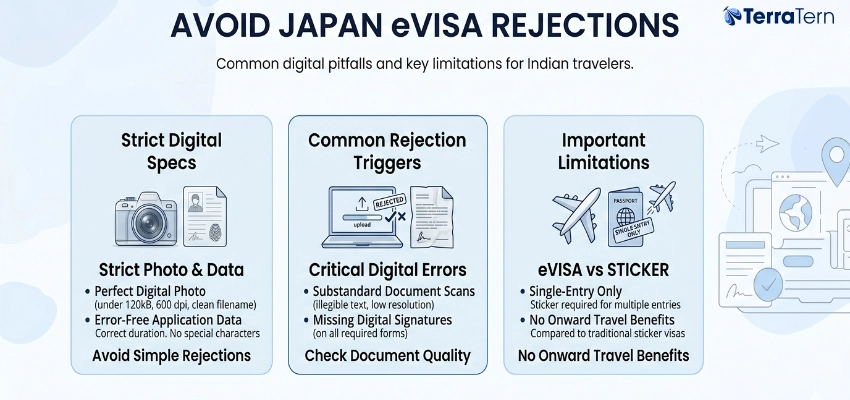
Common eVisa-Specific Rejection Triggers
Because the process is entirely online, the automated and manual checks on digital files are incredibly strict. A Japan eVisa rejection is often triggered by the following digital errors:
-
Strict Photo Requirements: Digital photos must be under 120KB, have a minimum resolution of 600 dpi, and have filenames that do not contain any special characters. Even a slight deviation in file size or quality can result in immediate system rejection.
-
Poor Document Quality: Uploading PDF documents that are scanned crookedly, are illegible, or have a low resolution will cause the application to bounce back.
-
Missing Digital Signatures: Failing to properly digitally sign the required forms.
-
Input Errors: Accidentally selecting the incorrect visa duration from the portal's dropdown menu.
Important Limitations of the eVisa
While the eVisa is excellent for single-trip tourists, it comes with specific limitations compared to the traditional sticker visa:
-
No Onward Travel Benefits: A traditional sticker visa often allows for visa-free onward travel to select countries (such as Georgia or Montenegro). The digital eVisa does not provide this benefit.
-
Single-Entry Only: If you require a multiple-entry visa for your itinerary, the eVisa is not an option. You must apply for a traditional sticker visa through VFS Global.
-
The "Visa Issuance Notice": If approved, you will not get a sticker in your passport. Instead, you will receive a "Visa Issuance Notice" as a PDF. You are required to print this document and carry it alongside your original passport when travelling.
Japan eVisa vs. VFS (Sticker Visa) Comparison
To determine which route minimises your risk and best suits your travel needs, compare the two options below:
|
Feature |
Japan eVisa |
VFS (Sticker Visa) |
|
Processing Time |
Same (5–10 working days) |
Same (5–10 working days) |
|
Submission Method |
Online portal |
In-person or Blue Dart |
|
Photo Format |
Digital (120KB max, 600 dpi) |
Physical 45mm × 45mm print |
|
Onward Travel Benefit |
No |
Yes (select countries) |
|
Multiple Entry |
Not available |
Available |
|
Best For |
Single-trip tourists |
Frequent travellers / multi-entry |
Important Note: eVisa applicants should never assume the digital format is more forgiving; Japan's embassy scrutiny of documents is identical regardless of submission channel. Errors in digital uploads are harder to correct after submission than physical documents.
Conclusion
Japan visa rejection rate for Indians stays manageable at 5–15% for tourist/business visas and up to 20% for students, far better than Schengen (15–20%) or US B-visas (16%). Success hinges on avoiding top pitfalls: incomplete forms, weak financials (show INR 1.5–2 lakhs consistently over 3–6 months), vague itineraries, and document mismatches. Beat the odds by submitting precise documents, passport-aligned photos (45mm×45mm), employer NOC, day-wise plans with bookings via VFS Global 3–4 weeks early. eVisa introduces digital risks, such as upload errors. Post-rejection (Stamp B/C), wait 6 months or fix issues thoroughly before reapplying. With preparation, approvals exceed 90% on serious second attempts.
Contact TerraTern for more information on Japan Visa Rejection Rate for Indians: Causes & Fixes.




 AI Summary