Key Highlights
- What Is the Fastest Way to Learn the German Language?
- How to Learn the German Language for Free?
- How to Learn the German Language Online?
- How to Learn the German Language at Home?
- What Is the German Alphabet and Pronunciation System?
- How Long Does It Take to Learn the German Language?
- What Are the Top Resources to Learn German in India?
- Latest Market Update
- Conclusion
How to learn the German language effectively is what you probably ask yourself at the moment. Fortunately, thanks to educational technology advancements, the process of learning languages has become very convenient and flexible now. It all starts with finding out how to learn the German language at home, using well-planned daily schedules, listening to educational podcasts, and using advanced flashcards.
For those who prefer the structured environment of a computer, it can be beneficial to find out how to learn the German language online by means of attending virtual classes, talking with native tutors, and watching video lessons.
What Is the Fastest Way to Learn the German Language?
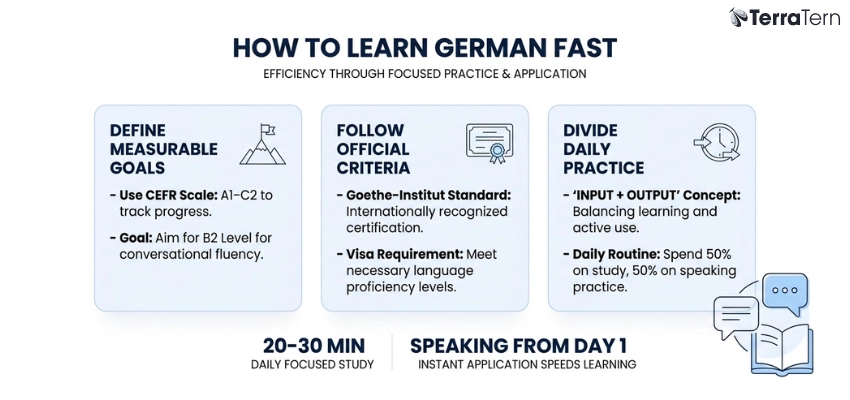
Pairing 20–30-minute daily structured lessons with instant application through speaking practice; passive learning delays the process drastically. In order to master learning the language in Germany efficiently, one has to implement the "input + output" concept. It requires daily consumption of grammar rules and vocabulary (input) along with actively speaking (output) on the first day of studying.
-
Define your Measurable Goal: Employ the scale of the Common European Framework of Reference for Languages (CEFR) (A1 - beginner; C2 - mastery) to express what fluency means.
-
Aim at the B2 Level: B2 level is considered a conversationally fluent level for any workplace or social environment.
-
Follow Official Criteria: Measure your achievement in terms of the CEFR scale, as it is the same criteria used in Goethe-Institut exams and for obtaining a German visa.
-
Divide Your Daily Practice Equally: Spend half of your daily studying time on learning new stuff and the other half on applying what you have learned through speaking.
As per our TerraTern Expert Divyansh, speaking practice from week one even builds fluency faster than months of silent grammar study.
Also Read: How to Learn German Language? Tips, Tricks for Beginners
How to Learn the German Language for Free?
Goethe-Institut's free "Deutsch für dich" online community, open grammar and vocabulary portals, and free tiers of major language apps can take a beginner to the A2 level without spending money. If you want to understand how to learn the German language for free, a zero-cost path is completely achievable with high self-discipline. Use these structured resources to master how to learn the German language on a budget:
-
Official Authoritative Platforms: Subscribe to the community of Deutsch für dich of Goethe-Institut for interactive exercises, games, and forums. As the leading cultural body in India, working through Max Mueller Bhavan centres (Delhi, Bangalore, Chennai, Kolkata, and Mumbai), their free learning materials offer reliable curriculum support in a standardised form.
-
Language Gamified Apps: Practice using the free versions of the apps like Duolingo, Busuu, or Babbel to gain foundational vocabulary and syntax skills.
-
Immersive Channels & Podcasts: Watch structured YouTube channels like Easy German and Deutsche Welle’s Nicos Weg with beginner-friendly podcasts like Coffee Break German for audio understanding and natural pronunciation.
-
Language Exchange (Tandem) Communities: Get connected with native German speakers through the free language exchange apps like Tandem and HelloTalk, in which you practice conversation in return for teaching them your language.
-
Self-Study Note: Gaining proficiency at the A2 level for free demands stringent self-discipline in organising your syllabus, whereas paid structured classes come with an in-built discipline system.
Important Note: Free resources work best when paired with one committed output habit, a weekly speaking exchange, since free tools rarely correct spoken mistakes.
Also Read: Germany Visa Free Transit for Indians
How to Learn the German Language Online?
There are structured options available online, including self-paced software programmes, tutor-based websites, and even online lessons from Goethe-Institut, which offers recognised certification. In drawing up a strategy on how to learn the German language online, one should ensure that the platform selected suits one's ultimate objective. There is a huge difference between the strategy used by a casual learner and the one planning for a study abroad or Ausbildung in 2026.
|
Online Route |
Best For |
Visa/Academic Certification |
|
Self-Paced Apps |
Hobby learners build daily vocabulary and grammar habits. |
None |
|
Live 1:1 Tutoring Platforms |
Learners needing immediate speaking practice and conversational feedback. |
None (generally) |
|
Goethe-Institut Online Courses |
Visa-track learners require official, globally accepted proof of proficiency. |
Yes (Globally recognised) |
Expert Tip: If your German is for a study or work visa, confirm early which certificate (Goethe, TestDaF, or telc) your target institution or employer actually accepts; course choice should follow that, not the reverse.
How to Learn the German Language at Home?
A consistent home routine of daily short sessions, a fixed weekly speaking slot, and German media immersion can replace a classroom for motivated self-learners. When learning the German language at home, building a sustainable, habit-driven routine is your highest priority. For professionals or students figuring out how to learn the German language independently, the two biggest failure points are a lack of accountability and zero actual speaking practice.
You can avoid these traps by following a structured weekly blueprint: To replace the built-in accountability of a physical classroom, track your daily study streaks visually and treat your weekly speaking sessions as immovable appointments.
-
The Daily Minimum (20 Minutes): Use spaced repetition apps or grammar workbooks for focused vocabulary and syntax drills. Short, daily exposure builds retention much faster than a single weekend cram session.
-
Passive Immersion (Commute & Chores): Swap your regular background media for beginner-friendly German podcasts or music. This ambient listening tunes your ear to native pronunciation and rhythm without taking extra time out of your busy schedule.
-
The Non-Negotiable Speaking Slot (30 Minutes, Weekly): Lock in at least one dedicated session per week with a language exchange partner or an online tutor. This forces you out of "silent study" mode and actively tests your conversational recall.
Expert Advice: The single biggest home-study failure point is skipping speaking practice and scheduling it like an appointment, not an optional extra.
Also Read: Learn German Language Free | Master German Without Cost
What Is the German Alphabet and Pronunciation System?
German uses the Latin alphabet plus four extra characters (ä, ö, ü, ß) with largely consistent, phonetic pronunciation rules. When mapping out how to learn the German language, the alphabet is a highly encouraging starting point. For anyone figuring out how to learn the German language for free, it is genuinely reassuring to know that German pronunciation is deeply predictable.
Unlike English, where spelling often defies logic, German is remarkably phonetic - meaning words are pronounced exactly as they are written once you learn the core sounds.
-
The Familiar Base: The German alphabet starts with the exact same 26 letters as English, so you already know the foundation.
-
The Three Umlauts (ä, ö, ü): These are standard vowels modified by two dots, which shift the sound forward in your mouth. 'Ä' Sounds like the 'e' in "bed". 'Ö' sounds similar to the 'ir' in "bird," and 'ü' requires you to say "ee" while pursing your lips tightly.
-
The Eszett (ß): Often mistaken for a capital 'B', the scharfes S (sharp S) is a unique consonant that produces a strong, hissing double-s sound, similar to the 's' in 'see'.
-
Phonetic Consistency: Because there are no hidden or "silent" letters like in English, mastering these four extra characters allows you to confidently read and pronounce almost any new word you encounter
Important Tip: Because German spelling is phonetic, mastering pronunciation early makes every future vocabulary word easier to read correctly on sight.
How Long Does It Take to Learn the German Language?
With consistent daily practice, most learners reach A1 in 8–10 weeks, A2–B1 (conversational) in 4–6 months, and B2 (visa/academic-ready for many programmes) in 8–12 months. Structuring a realistic timeline is critical when planning how to learn the German language. Your actual speed depends heavily on your daily practice consistency, prior experience with second languages, and whether you include active speaking practice from day one.
For those managing how to learn the German language at home, benchmarking your progress against the official CEFR scale keeps your goals measurable and realistic:
|
CEFR Level |
Realistic Timeline |
What You Can Do |
|
A1 (Beginner) |
8–10 weeks |
Introduce yourself, ask basic questions, and navigate simple daily situations. |
|
A2–B1 (Intermediate) |
4–6 months |
Hold conversational exchanges, express opinions, and handle travel interactions. |
|
B2 (Upper Intermediate) |
8–12 months |
Visa/academic-ready; fluently discuss complex topics and work in a German-speaking environment. |
As per our TerraTern expert, treat timeline estimates as a floor, not a guarantee; consistency matters more than any single method.
What Are the Top Resources to Learn German in India?
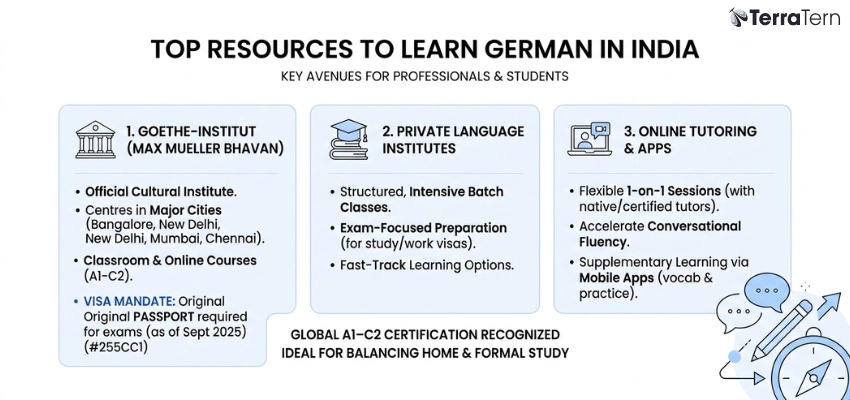
Goethe-Institut/Max Mueller Bhavan centres in Indian cities offer both classroom and online courses with globally recognised A1–C2 certification, alongside app-based and tutor-based options. For Indian professionals and students, mapping out how to learn german language requires utilizing the local educational infrastructure.
Whether you are aiming for admission in German Universities, an Ausbildung program, or corporate relocation, here are the most effective avenues for learning in India, especially if you are balancing formal study with how to learn german language at home:
-
Max Mueller Bhavan (Goethe-Institut): The official cultural institute of Germany operates in major hubs like Bangalore, New Delhi, Mumbai, and Chennai. They offer the gold standard for both classroom and digital learning. Crucial update for visa applicants: Since September 1, 2025, a valid original passport is the absolutely mandatory and only accepted form of identification for taking A1–C2 certification exams at these centres.
Goethe-Institut -
Private Language Institutes: Regional and local institutes offer highly structured, intensive batch classes geared specifically towards passing certification exams for study visas or work permits.
-
Online Tutoring Platforms: Platforms connecting you to native speakers or certified Indian tutors are ideal for flexible, 1-on-1 speaking practice to accelerate conversational fluency outside of standard business hours.
-
Self-Study Apps & Portals: Mobile apps are excellent supplementary tools to build vocabulary during your daily commute, keeping you immersed between formal classes.
Pro Tip: If you're learning German for a study or work move to Germany, start at a Goethe-Institut-affiliated centre or its recognised online course; the certificate carries weight that app-only study doesn't.
Also Read: Best German Language Classes Online: Free & Paid Choice
Latest Market Update
Demand for German language proficiency among Indian professionals surged rapidly following expanded skilled immigration pathways and Opportunity Card (Chancenkarte) quotas. (Source: German Federal Ministry of the Interior)
-
Mandatory Passport Rule (September 2025): Since September 1, 2025, Goethe-Institut/Max Mueller Bhavan centres across India mandate a valid original passport as the sole acceptable identification for all A1–C2 certification exam candidates. (Source: Goethe-Institut India)
-
Expansion of Digital Learning (2025–2026): Exploring how to learn the German language online has become the primary route for working professionals, leading Max Mueller Bhavan to expand virtual and blended learning formats across India. (Source: Max Mueller Bhavan)
-
Free Community Access (2025–2026): Goethe-Institut’s free "Deutsch für dich" online platform continues to support self-learners globally with open-access exercises, learning forums, and interactive study tools. (Source: Goethe-Institut)
-
Healthcare & STEM Inflow (2026): Indian nurses, IT professionals, and engineers are increasingly focusing on how to learn the German language to meet mandatory B1 and B2 licensing thresholds for German employment visas. (Source: German Federal Employment Agency)
-
Standardized Visa Benchmarks (2026): CEFR-aligned certifications from recognized institutions remain the strict prerequisite for university admissions, student visas, and vocational training (Ausbildung) permits. (Source: German Federal Foreign Office)
Also Read: Is German Language Compulsory to Study in Germany?
Conclusion
Learning the German language doesn't require a fixed formula; it requires consistency, according to your personal timeline. Whether you prefer premium institutes or want to figure out how to learn the German language for free through self-study, realistic progress takes anywhere from six to eighteen months.
For Indian candidates, combining Goethe-Institut (Max Mueller Bhavan) certifications with insights on how to learn the German language for free creates an ideal blend of affordability and official credibility. Ultimately, if your linguistic efforts are tied to higher education or employment abroad, TerraTern’s dedicated Germany study and work visa services can effortlessly turn your fluency into a successful migration reality.
Contact TerraTern for more information on how to learn the German language.




 AI Summary