

Key Highlights
- What Is Germany Visa-Free Transit and How Does It Affect Indian Travellers?
- Germany Visa Free Transit India: Do Indian Nationals Still Need a Visa in 2026?
- How Does Visa Free Transit Germany Work — What Are the Conditions?
- When Do Indian travellers Still Need a Visa to Pass Through Germany?
- How Do the New Visa-Free Transit Rules Compare to the Old Airport Transit Visa?
- How Can You Confirm You Qualify for Germany's Visa-Free Transit Before You Fly?
- What If You Still Need a Visa for your Route Through Germany?
- Why Did Germany Remove the Transit Visa Requirement for India
- What Mistakes Should Indian Travellers Avoid Under the New Rules?
- 2026 Industry Context Section
- Conclusion
Germany’s move to introduce visa-free airport transit has significantly simplified how Indian travellers connect through German hub airports on their way to non-Schengen destinations. The new visa-free transit rules make it much easier for Indian travellers to connect through German hub airports, specifically Frankfurt, Munich, Berlin Brandenburg, Hamburg, and Düsseldorf, provided they remain airside and meet the other conditions.
What Is Germany Visa-Free Transit and How Does It Affect Indian Travellers?

Germany visa-free transit is an exemption from the Schengen Airport Transit Visa (Type A) that allows Indian nationals to pass through the international transit zone of certain German airports without needing an airport transit visa. Germany’s visa-free transit exemption for Indian nationals was announced in January 2026 and took legal effect on 3 June 2026, allowing eligible travellers to transit airside through five German airports (Frankfurt, Munich, Berlin Brandenburg, Hamburg and Düsseldorf) without an airport transit visa.
-
This privilege of transit brings relief and improved convenience for International travellers.
-
Clearly, it implies that you will be able to change planes in Germany and board another non-Schengen onward flight without needing any visa papers, as long as you remain in an airside terminal.
-
You are an Indian passport holder transiting through one of the five German airports with an international transit zone: Frankfurt/Main, Munich, Berlin Brandenburg, Hamburg, or Düsseldorf. Many nationalities already had this under their terms and conditions, with India coming on board with this regime rather than a new kind of permit.
-
A "transit visa" (Type A) has been introduced as a short-stay visa for airside transit if necessary, and the "transit privilege" eliminates the requirement for a visa altogether under certain conditions.
As per Terra Tern Expert Divyansh, Most Indian travellers already assume "transit means no visa needed." This section should validate that this instinct is now correct, while the next section handles the conditions.
Also Read: Germany Transit Visa for Indian s: Latest Expert Guide
Germany Visa Free Transit India: Do Indian Nationals Still Need a Visa in 2026?
No, Indian nationals are required to obtain an Airport Transit Visa for Germany if they remain in the international transit area, and their next destination is outside the Schengen Area. This Germany visa free transit India update pertains only to airside layovers, not entry to the Schengen area.
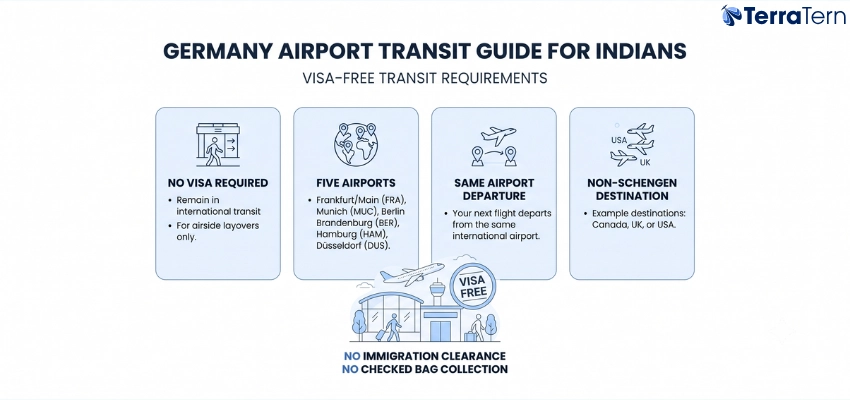
You qualify for visa-free transit if all of the following apply:
-
You are an Indian passport holder transiting through one of the five German airports with an international transit zone: Frankfurt/Main, Munich, Berlin Brandenburg, Hamburg or Düsseldorf.
-
The next plane departing for the country departs from the same international airport.
-
You are going to travel to a non-Schengen country (such as Canada, the UK, or the USA).
-
There is no need to go in for clearance at German immigration or to collect your checked bags.
When Did Germany Remove the Airport Transit Visa Requirement for India?
The exemption was announced on 12 January 2026 during Chancellor Merz’s visit to India, but airport transit visas remained necessary until the change was formally implemented and took effect on 3 June 2026, following publication in Germany’s Federal Law Gazette. This Germany visa free transit India timeline is important since the two dates are different: one was a diplomatic one and the other a legal change.
-
The announcement was made during a joint press conference between Chancellor Merz and Prime Minister Modi in Ahmedabad in January 2026, as part of a broader set of India–Germany mobility and cooperation agreements.
-
Published in the Federal Law Gazette by the FFO on the 3rd of June 2026 (formally implemented)
Announcement vs Implementation: What's the Real Timeline?
There was a nearly five-month gap between the policy announcement and legal implementation.
-
That gap mattered because travellers booking flights between January and early June 2026 still technically needed the old transit visa rule to follow the law.
-
In practical terms, January headlines did not equal immediate visa-free transit for Indian passengers.
-
They should keep in mind that any queries regarding Germany visa free transit India would be governed by whether the individual was granted a visa to be exempt or not on 3 June 2026 –and not 12 January.
As per TerraTern Expert Divyansh, if you or a client booked travel through Germany between January and early June 2026 based on "news that Indian s don't need a transit visa anymore," double-check the exact travel date against the 3 June 2026 implementation date.
Also Read: Hospitality Jobs in Germany: Full Complete Guide
How Does Visa Free Transit Germany Work — What Are the Conditions?
Germany visa-free transit applies only when all of the following are true: you remain in the airport’s international transit area, do not pass through immigration, your onward destination is outside the Schengen Area, your transit is completed within the permitted time window (generally within 24 hours), and you hold a confirmed onward ticket. Miss any one of these, and visa free transit Germany doesn't apply; you'll need a regular Schengen visa instead.
Which German Airports Have International Transit Zones?
Five German airports have international transit zones: Frankfurt, Munich, Berlin (Brandenburg), Hamburg, and Düsseldorf, though Hamburg and Düsseldorf have restricted operating hours that affect whether Germany visa free transit actually applies to your layover.
|
Airport |
Transit Zone Hours |
|
Frankfurt |
24 hours |
|
Munich |
24 hours |
|
Berlin (Brandenburg) |
24 hours |
|
Hamburg |
4:30 AM – 11:30 PM |
|
Düsseldorf |
6:00 AM – 9:00 PM (airline must pre-arrange with Federal Police) |
Important Note: If your layover at Hamburg or Düsseldorf falls outside these windows, visa free transit Germany rules won't cover you; you'll be routed through immigration and need a Schengen visa instead.
What Counts as "Staying Airside" Under the Transit Privilege?
"Staying airside" means never passing through German immigration or passport control; this rules out collecting checked baggage, changing terminals via landside routes, or exiting the airport for any reason. Under Germany visa free transit, even a brief immigration crossing cancels the exemption. Common ways travellers accidentally break visa free transit Germany conditions:
-
“Staying airside” means you do not pass through immigration or passport control.
-
You should not need to collect checked baggage and re-enter via landside areas.
-
Separate-ticket itineraries, terminal transfers that require immigration, and overnight layovers outside transit-zone hours can break the transit privilege.
-
The safest rule is: if your journey forces you into the public side of the airport, you are no longer airside.
Expert Tip: A single connected booking (one PNR through to your final destination) is the simplest way to guarantee your bags, and you never technically "enter" Germany.
When Do Indian travellers Still Need a Visa to Pass Through Germany?
You still need a Schengen visa if you leave the transit zone, connect to another Schengen country, have separate tickets that require baggage reclaim, or have a layover that exceeds transit-zone operating hours. Germany visa free transit does not cover any of these scenarios; a standard Type C Schengen visa becomes mandatory instead.
Transit vs Entry: What's the Difference?
Transit means staying within the airport's international zone; entry means crossing German immigration and legally being in the Schengen area. The June 2026 exemption under Germany visa-free transit only covers transit, not entry.
|
Transit (No Visa Needed) |
Entry (Schengen Visa Required) |
|
Landing in Frankfurt to connect to New York, staying airside |
Landing in Frankfurt to attend a conference in Berlin |
|
Munich layover before a Toronto-bound flight, same terminal, single ticket |
Exiting Düsseldorf airport to visit family nearby |
|
Berlin transit zone stopover en route to Dubai |
Overnight stay in a Hamburg hotel between flights |
Do Separate Tickets or Terminal Changes Require a Schengen Visa?
Yes, in most cases, if your itinerary is booked as two independent tickets, you'll typically need to reclaim baggage and re-check in, which means crossing immigration and needing a Schengen visa. Germany visa free transit only applies to single through-bookings that keep you airside.
-
Always confirm your flights share a single ticket or PNR before assuming visa-free transit applies
-
Separate bookings almost always mean baggage reclaim → immigration crossing → Schengen visa required
-
Terminal changes involving a landside shuttle (not an airside connector) also trigger immigration crossing
-
When in doubt, ask your airline whether your specific routing keeps you airside end-to-end
-
If unsure, apply for a Schengen visa as a safety measure rather than risk boarding denial
Expert Advice: The exemption concerns your routing, not your nationality alone; the same Indian traveller can be visa-free on one itinerary and visa-required on another, depending solely on ticketing and terminal logistics.
How Do the New Visa-Free Transit Rules Compare to the Old Airport Transit Visa?
Before June 2026, Indian nationals needed an ATV costing €90 (adults) with roughly 15 working days' processing time. Today, that requirement is eliminated for qualifying airside connections. Here is how the new Germany visa free transit rules compare to the old system:
|
Feature |
Before 3 June 2026 |
After 3 June 2026 |
|
ATV required for airside transit |
Yes |
No |
|
Fee |
€90 (adult), €45 (child 6–12), free (under 6) |
N/A |
|
Processing time |
~15 working days |
N/A |
|
Entry into Germany/Schengen |
Still needs a Schengen visa |
Still needs a Schengen visa |
|
Applicable airports |
Same 5 airports |
Same 5 airports |
Important Tip: If you're referencing older articles (including some still live today) that describe the ATV process for Indian s, check the publication date; anything written before June 2026 now describes a requirement that no longer applies to qualifying transit.
How Can You Confirm You Qualify for Germany's Visa-Free Transit Before You Fly?
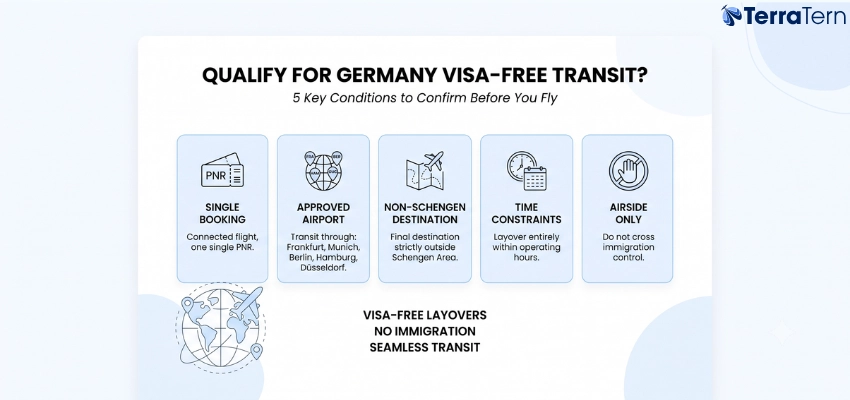
To ensure your itinerary qualifies for Germany visa free transit, verify that your trip meets these five exact conditions:
-
Single Booking: Your flight is one connected booking (a single PNR).
-
Approved Airport: You are transiting through Frankfurt, Munich, Berlin, Hamburg, or Düsseldorf.
-
Non-Schengen Destination: Your final destination is strictly outside the Schengen Area.
-
Time Constraints: Your layover occurs entirely within the transit zone's operating hours.
-
Airside Only: You will not cross immigration control at any point.
As per TerraTern Expert: Airlines don't always double-check visa-exemption eligibility at check-in in India; the responsibility to confirm you qualify sits with the traveller, not the airline counter.
Also Read: What Is the Total Cost of Study in Germany for Indian Students?
What If You Still Need a Visa for your Route Through Germany?
If your itinerary doesn't meet all the transit-privilege conditions, you'll need a Schengen Type C visa, and Germany visa free transit won't apply to your route. TerraTern can help you apply well ahead of your travel dates.
-
Schengen Type C visa processing typically takes 15+ working days, sometimes longer during peak season
-
Appointment backlogs at visa centres are a common industry-wide bottleneck — apply early to avoid last-minute stress
-
TerraTern can guide you through document checklists, appointment scheduling, and application review
-
Even if your onward destination is outside Schengen, incorrect assumptions about airside transit can mean missed flights
-
When unsure whether your routing qualifies, it's safer to start a Schengen visa application in parallel
Pro Tip: Apply for a Schengen visa as soon as your travel dates are confirmed; appointment slots at Indian visa centres for Germany are a known bottleneck, exemption or not.
Why Did Germany Remove the Transit Visa Requirement for India
The change reflects deepening India–Germany relations, growing air traffic between the two countries, and Germany's broader push to attract Indian skilled workers and students under its Skilled-Worker Immigration Act. Germany visa free transit is as much an economic signal as a travel convenience.
-
Strengthening Bilateral Ties: The move followed Chancellor Merz's January 2026 visit to India and direct talks with PM Modi
-
Rising Indian Outbound Travel: airlines and German airports cited growing Indian passenger volumes as a key driver
-
Talent-Attraction Strategy: Germany's push to draw skilled workers and students makes smoother transit routes a competitive advantage
-
Commercial Pressure: Indian carriers and travel-trade bodies had lobbied for years against the added cost and friction of the old ATV
-
Regional Positioning: The change puts Germany closer to transit-friendly hubs like Dubai and Doha in attracting connecting traffic
Key Note: This isn't an isolated travel-convenience tweak; it's one part of a wider set of India-Germany mobility agreements, which is worth knowing if you're also exploring longer-term study or work options in Germany.
What Mistakes Should Indian Travellers Avoid Under the New Rules?
The most common mistakes are assuming the exemption covers entry into Germany, booking separate tickets without checking baggage transfer rules, and relying on outdated articles that predate the June 2026 change. Getting Germany visa free transit conditions wrong can mean denied boarding, not just an inconvenience.
-
Assuming "visa-free transit" means "visa-free Germany" it doesn't; entering Germany still requires a Schengen visa
-
Booking two separate tickets and assuming the same visa-free rule applies, separate bookings usually mean baggage reclaim and immigration crossing
-
Not checking which of the five airports and their transit-zone hours apply to a specific layover, Hamburg and Düsseldorf have restricted windows
-
Trusting pre-June-2026 articles (including some still ranking) that describe the old ATV requirement as current
-
Skipping travel insurance because a visa isn't required, insurance and visa requirements are unrelated, and insurance may still be needed for other legs
Pro Tip: No visa required" doesn't mean "no preparation required"; confirm your routing and keep proof of your onward ticket and final-destination visa (if any) handy regardless.
2026 Industry Context Section
Adapted from the brief's "2025 Industry Context" requirement, since this topic is a live 2026 development, 2026 facts are more accurate and more citation-worthy than backdated 2025 facts.
-
Policy Announcement: Announced 12 January 2026 during Chancellor Merz's state visit to India, at a joint press conference with PM Modi in Ahmedabad.
-
Formal Implementation: Took legal effect on 3 June 2026 per the Federal Foreign Office.
-
Diplomatic Context: Coincided with the 75th anniversary of India–Germany diplomatic relations and 19 MoUs signed during the summit.
-
Airlines and corporate travel analysts expect a noticeable increase in India–Germany transit traffic and significant savings in visa-related costs and administration, with Lufthansa estimating annual corporate savings of around €3 million for Indian companies routing staff via German hubs.
-
Cost Impact Estimate: Corporate travel estimates put savings at roughly INR 5,500–7,000 per trip in visa fees, courier costs, and lost processing time.
-
Business-Side Estimate: Lufthansa estimated that the waiver could save Indian corporates that use German hubs for staff travel up to €3 million annually in administrative costs.
Key Note: Don't just state the rule changed; quantify it. Numbers with sources are what separate a citable authority page from a generic rules recap.
Conclusion
Germany visa free transit marks a genuine simplification for Indian travellers, but it comes with real conditions, not a blanket exemption. Since 3 June 2026, Germany visa-free transit India rules mean qualifying passengers skip the ATV entirely, provided they stay airside, hold a single through-ticket, and connect to a non-Schengen destination within transit-zone hours. Before booking, always verify that your specific itinerary meets every condition for visa free transit Germany, rather than assuming the exemption applies automatically.
Contact TerraTern for more information on Germany Visa Free Transit for Indians: Complete 2026 Guide.




 AI Summary