Key Highlights
- France Visa Fees: 2026 Updates
- What are the France Visa Fees for Indians in 2026?
- How Much Are the Latest France Tourist Visa Fees for Indian Citizens?
- What Are the Current France Student Visa Fees in Indian Rupees?
- Total France Visa Cost from India: Everything You'll Actually Pay
- France Tourist Visa Fees in Indian Rupees (2026)
- How Much Are France Work Visa Fees in Indian Rupees in 2026?
- What Latest Additional Costs Are Involved in France Visa Application?
- How Can You Pay Current France Visa Fees from India?
- Are There Any Fee Exemptions for France Visa Applications in 2026?
- When Should You Pay the Latest France Visa Fees and Processing Time?
- What Is the Current Refund Policy for France Visa Fees?
- How Do France Visa Fees Compare to Other Schengen Countries in 2026?
- What Are the Recent Changes in France Visa Fees for 2026?
- Latest Tips to Minimise Your France Visa Application Costs
- How Can TerraTern Help With France Visa for Indians?
- Common Mistakes When Budgeting for a France Visa from India
- Conclusion
- Making Your France Visa Application Cost-Effective
If you're an Indian national and heading to France for a holiday, stay or work in 2016, be aware of the latest visa fees (tourist, student and work related). Short stay Schengen visa (tourist or business) fees for adults in 2026 will be around INR 3,700-INR 4,000 (official consular fee) and INR 1,100-INR 1,200 (VFS Global service fee), giving a typical total of around INR 5,000. The consular fee for children is typically lower at INR 2,900. Long stay student visas are more expensive, with consular fees ranging from INR 9,500 to INR 11,500 and a VFS service charge close to INR 12,000 - INR 13,000. Work visas can vary depending on contract length and terms, but consular fees may range from INR 3,500 to INR 11,500, with service and insurance fees adding a few more thousand. Budget for mandatory travel/health insurance, courier and optional premium service charges when applying for a France visa in 2016.
France Visa Fees: 2026 Updates
In 2026, France visa fees are between 8200 and 9200 INR in the case of regular visa applications. But this is not the last you pay. Another cost that you should include is VFS service fees, documentation fees, and additional services. This guide describes all the costs in simplistic terms.
Here is a brief overview prior to getting deeper:
-
Tourist Visa: €90 (INR 8,200) + VFS charges
-
Student Visa: €99 (INR 92000) + Campus France fee.
-
Work Visa: €99 (INR 9,200) + VFS charges
-
Children below 6: No fee on visas.
-
Turnaround Time: 15-30 working days.
A key update to note
In June 2024, Schengen Visa costs went up to 90, and in April 2025, some of the long-stay visa costs also rose.
The blog decomposes the France visa fees in 2026 among Indians, in terms of new INR values, payment modes, exemptions, and cost-cutting ideas.
What are the France Visa Fees for Indians in 2026?
France visa fees for Indians have a two-part format. This structure is needed to comprehend prior to application.
To begin with, the direct answer is the following.
-
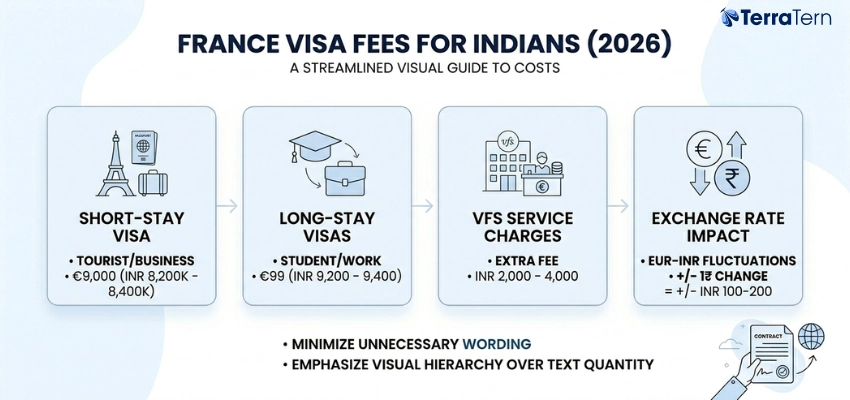
Short-Stay Visa (Tourist/Business): €9000 (INR 820000- INR 8400)
-
Long-Stay Visas (Student/Work): €99 (INR 9,200–9,400)
-
VFS Service Charges: INR 2,000–4,000 (extra)
The France visa fees are paid to the French government and also to VFS Global. These two payments are obligatory.
This is because of the simplicity of the reasons why fees vary.
-
Short- term visas last a maximum of 90 days.
-
Long stay visa permits a stay of more than 90 days.
-
The requirements in processing and documentation are different.
Exchange rates also matter
A 1 rupee change in EUR-INR can influence your overall cost by INR 100-200.
How Much Are the Latest France Tourist Visa Fees for Indian Citizens?
The France tourist visa fees are uniform according to Schengen provisions. Single-entry costs do not differ from multiple-entry costs.
The official breakdown is as follows.
-
Consular fee: €90 (INR 8,200–8,400)
-
VFS Service Charges: INR 2,200–2,500
-
Total Cost: INR 10,200–12,200
Up to 90 days of travel can be done within 180 days using this visa. It includes tourism, visiting relatives, and short business trips.
The France tourist visa fees are lower among children.
-
Children Under 6: No visa fee
-
Children Aged 6–12: €45 (INR 4,100)
Additional services would add to the final figure
-
Courier service
-
Premium lounge
-
SMS updates
-
Prime-time appointment
Also Read: France Visa Photo Size: Latest Expert Guide & Rules
What Are the Current France Student Visa Fees in Indian Rupees?
There are several elements in France's student visa fees. This is the reason why it is more expensive than tourist visas.
The complete France student visa fee structure in Indian rupees is as shown here.
-
Visa Fee: €99 (INR 9,200)
-
Campus France Fee: INR 16,500–18,000
-
VFS Service Charges: INR 2,000–2,500
-
OFII Validation (After Arrival): 5400 (not compulsory, but required subsequently)
Overall, the cost of the France student visa fees is between 27,000 and 30,000. Indian students are required to be registered in Campus France. It authenticates your confession and learning qualifications.
There are France student visa fee exemptions in Indian rupees that some are entitled to.
-
French government scholarship recipients.
-
The participants of the Erasmus+ program.
-
Some bilateral/students of exchange.
Total France Visa Cost from India: Everything You'll Actually Pay
Here's a handy, pointwise total cost of a France visa from India in 2026 – how much you need to pay for each applicant (approximate, in INR):
-
Visa fee (government)
-
Short‑stay Schengen (tourist/business/work stay ≤ 90 days): ~₹8,100–9,400 (90 EUR) for adults.
-
Child (6–12 years): ~₹4,200–4,500 (45 EUR).
-
Child (under 6): ~free at the embassy.
-
Long‑stay (work, study, family ≥ 90 days): ~₹8,800–10,300 (99 EUR).
-
VFS‑Global service charges
-
Short‑stay: ~₹1,900–2,300 per applicant.
-
Long‑stay work/study: ~₹2,000 - 3,000 depending on service location and option.
-
Travel/health insurance (mandatory)
-
Short‑stay Schengen: ~₹500-2,000 depending on duration of stay and coverage.
-
Long‑stay: Health‑insurance‑linked insurance may add ~₹3,000-8,000 in annual fees.
-
Campus France / EEF‑type fees (for students)
-
EEF‑Campus France fee: ~₹18,000-20,000 as a one‑time fee.
-
Optional add‑ons (per applicant)
-
Premium‑lane / fast‑track at VFS: ~₹500–1,500 extra.
-
Document‑assistance / courier / photo‑studio: ~₹500-1,500 per agency.
-
Refundable vs non‑refundable
-
The visa fee, VFS fee and insurance are almost always non‑refundable, even if a visa is refused.
So a 2026 budget (as an Indian applicant) would be:
-
Tourist (adult): ~₹11,000–13,500 all‑in.
-
Student (long‑stay): ~₹20,000-35,000 including Campus France, insurance and service charges.
Embassy Fee
-
Consular (visa) fee is the charge set by France for your visa, per applicant.
-
Short‑stay Schengen (tourist/business): about ₹8,000–9,400 (90 EUR) for adults, ~₹4,200–4,500 for children 6–12, and free under 6.
-
Long‑stay (work, study, family): typically ₹8,800–10,300 (99 EUR).
VFS France Service Charge
-
VFS service charge is the non‑refundable charge for VFS‑Global to process your biometrics and documents.
-
For France, it costs about ₹1,900-2300 per applicant for short‑stay and ₹2,000‑3,000 for long‑stay applications.
-
It is non‑refundable, even in case of a visa refusal.
Mandatory Travel Insurance
-
All Schengen short‑stay visas, including those for France, require travel insurance.
-
It should provide at least €30,000 cover against medical treatment, hospitalisation and emergency repatriation within the Schengen area.
-
Insurance costs ₹500-2,000 for a short stay, depending on plan and length of stay.
Optional Add-Ons
-
Add-ons include premium lane/fast track, SMS, courier and photo-studio/document assistance at VFS.
-
These may cost ₹500-1,500 per applicant, more for courier and premium.
-
These are optional but enhance the experience and efficiency in document management.
France Tourist Visa Fees in Indian Rupees (2026)
France Tourist Visa Fees in Indian Rupees (2026) - Table
|
Applicant category |
Embassy/visa fee (EUR) |
Approx. INR (visa fee) |
VFS service charge (approx.) |
Typical total (INR) |
|
Adult (12+ years) |
90 EUR |
₹8,100–8,500 |
₹2,000–2,500 |
₹10,100–11,000 |
|
Child (6–12 years) |
45 EUR |
₹3,900–4,300 |
₹2,000–2,500 |
₹5,900–6,800 |
|
Child (under 6 years) |
0 EUR (free) |
0 |
₹2,000–2,500 |
₹2,000–2,500 |
Notes:
-
The Schengen tourist visa fee (embassy side) is based on the Schengen fee schedule (adult: 90 EUR) and is converted to INR at the prevailing rate.
-
The VFS service fee is fixed and non-refundable, charged per applicant at the France-VFS centre in India.
-
You can expect to additionally pay for travel insurance (1,500-2,000) and optional extras like courier/fast track.
How Much Are France Work Visa Fees in Indian Rupees in 2026?
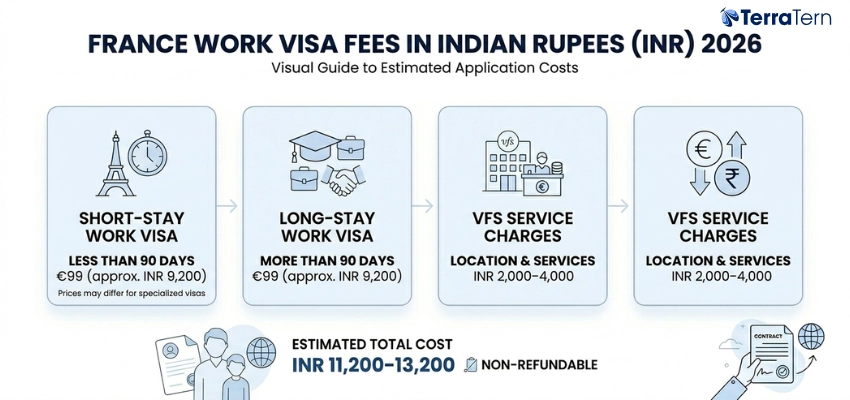
The France work visa fees in Indian rupees differ according to the nature of work and duration of stay. Applicants may be classified as short-stay work visa (less than 90 days) or long-stay work visa (more than 90 days), and the prices get higher in case of specialised work visa or long-term work visa.
Standard cost breakdown
-
Long-Stay Work Visa: €99 (approx. INR 9,200)
-
VFS Service Fee: 2000-4000, according to the place and additional services.
-
Estimated Total: INR 11,200–13,200
The France work visa fees in Indian rupees include the visa processing fee and the application handling fee, and cannot be refunded even in case of visa rejection. More expensive work visa classes.
There are other types of employment-related visas with extra or increased fees:
-
EU Blue Card: 130150, according to job position and salary cap.
-
OFII Registration Fee: €60 (approximately INR 5,400) that one has to pay upon arrival in France to validate residence.
-
Renewal of Residence Permit: €80 (approximately 7100 rupees) can be used to extend or carry on working.
Note: The employer-sponsored positions can reimburse some of the expenses, depending on the contract. Never apply without always confirming the fees to be paid by you or those to be paid by your employer.
What Latest Additional Costs Are Involved in France Visa Application?
The France visa fees do not consist only of expenses to consider. The majority of applicants have to bear extra compulsory and non-compulsory expenses in the process of application that act as a great impact on the overall budget.
Compulsory and Non-Compulsory Additional Expenses
-
Travel insurance: INR 500–1,500
Schengen visas require it, which includes medical emergencies and repatriation throughout the entire visa term.
-
Passport-size photos: INR 200–500
Should have Schengen photo requirements; it is often cheaper to do so outside VFS.
-
Courier charges: INR 600–800
Applicable in case you choose passport delivery as opposed to self-collection.
-
Document translation: INR 1,000–3,000
Required in case a document is not in English or French, in particular in relation to a working visa or a long-stay visa.
-
VFS premium services: INR 1,500–3,000
Additional features like premium lounge access, form-filling service, or priority filing are optional.
Note: To save these unnecessary expenses and remain within budget, select self-collection and do not use premium services, and prepare your documents beforehand.
Also Read: How to Get a Job in Europe from India? Pay, Visa & More
How Can You Pay Current France Visa Fees from India?
France visa fees payment occurs in two phases. There are various methods for each stage.
Here is how it works:
-
Online Payment: VFS service fee as booking.
-
In the VFS Centre: Consular visa fee.
Payments are accepted in the form of:
-
Debit cards
-
Credit cards
-
Demand drafts
-
Cash (limited centres)
Visa fees are non-refundable.
Are There Any Fee Exemptions for France Visa Applications in 2026?

France visa fees are waived for some applicants, but in most cases, the VFS service charge is applicable. The key exemption classifications are:
-
Children below the age of 6 years old are fully exempt from the French visa fee.
-
Children under 6 years of age or 12 years of age and above have a lower visa charge compared to the usual one.
-
Visa fees are exempted in the case of official scholarship programmes for students who are given French government scholarships.
-
Scholars and researchers who were on approved research or exchange programmes authorised by the French government travelled.
-
The members of the EU/EEA who exercise their right to free movement, with supporting documentation.
-
Diplomatic or official passport holders who are travelling on official missions.
Note: VFS services, courier, and optional services can all be required regardless of the application centre and services selected, although the visa fee may be waived, paid off, or at a reduced rate.
When Should You Pay the Latest France Visa Fees and Processing Time?
The timeliness of payment of France visa fees is important. Late entries may add to pressure and expense.
Here is the usual timeline:
-
Make payment to VFS on booking of appointment.
-
Make a visa payment when submitting biometrics.
Processing time:
-
Tourist Visa: 15 working days
-
Student/Work Visa: 30–60 days
Peak seasons cause delays:
-
April to July
-
October holiday period
Also Read: Jobs in Europe with Visa Sponsorship: Latest Job Guide
What Is the Current Refund Policy for France Visa Fees?
The France visa fees are not refundable at all, even in case of visa applications being rejected, withdrawn, or delayed. These charges can never be refunded at all.
What is non-refundable?
-
Consular (Embassy) Visa Fee - This is the fee that is charged on your application, whether it is successful or not.
-
VFS Service Fees - Include administrative processing, biometrics, and submission of documents,s and are never refunded.
How to minimise the possibility of rejection:
-
Provide filled and correct documents according to the visa checklist.
-
There should be no false and/or misleading information because this may result in instant rejection or restrictions on travelling.
-
Make sure that there is consistency in your application form, supporting documents, and travel information.
-
Request a professional review in case of doubt regarding the eligibility, documentation, or visa category.
How Do France Visa Fees Compare to Other Schengen Countries in 2026?
There are no variations in the cost of France visa fees since they are standardised as per the EU regulations. This implies that there is no difference in the core visa fee, regardless of the country in which you apply to the Schengen area.
What remains unchanged (EU-fixed fees)?
-
Short-Stay (Schengen) Visa (up to 90 Days): 90 Euros.
-
Long Stay National Visa (More Than 90 Days): 99 euros.
These are set fees imposed by the embassy or consulate, which are not negotiable and refundable.
What are the different service charges?
Whereas the visa fees are uniform, the service fees differ depending on the country and visa application centre:
-
France (VFS): 2000-4000, based on place and services to be used.
-
Germany (VFS): Small increase in service fees.
-
Italy (VFS): Tend to have marginally lower service charges.
What Are the Recent Changes in France Visa Fees for 2026?
The France visa fees have varied over recent years, and keeping track of these changes proves beneficial in better budgeting as well as future travelling arrangements. The following are the main changes that should be mentioned:
Key Fee Updates
June 2024:
Schengen visa fees were adjusted to 90 euros instead of 80 euros over a period of one year, as the entire EU decided to adjust the charges to reflect the inflation rate and administrative expenses.
April 2025:
Some of the long-stay visa types (e., specific work, talent, or residence visa) were increased to a maximum of 225E (depending on the type and duration of visa). Normal extended visas were not altered.
2026:
No further increases in visa fees have been declared to date by the French or EU governments, which provides a temporary cost relief to applicants.
Also Read: 14 Best Countries For Indians To Live And Work In Europe
Latest Tips to Minimise Your France Visa Application Costs

It is possible to cut down France visa fees through several intelligent decisions. Though the embassy fee is fixed, the minor decisions of the application process may be summed up to actual savings. The following are some of the effective methods of reducing unwarranted expenses:
Clever alternatives to saving on France visa fees:
-
Not necessary. Skip VFS premium services. Lounge access, form-filling service, and priority slots are all optional, which can both greatly add to your overall cost.
-
Take visa photos outside VFS Local studios, which are often much cheaper and do not compromise on Schengen photo requirements.
-
Use zero-forex or low-markup, that is, using such cards allows one to avoid additional foreign exchange and bank charges.
-
Apply when you are out of season - One will not have to be overly dependent on premium slots or expeditious services.
-
Select doing it yourself, by picking up your passport - This will save you courier charges in the event you can pick up your passport yourself at the VFS centre.
Tip: Budgeting can help you to spend 2000-5000 less by planning and using onlythe necessary services on the total cost of the France visa application.
How Can TerraTern Help With France Visa for Indians?
It takes confusion and a lot of pressure to apply for a French visa personally, and it becomes even more confusing because of the constantly evolving rules, rigid paperwork, and non-refundable expenses. This is where TerraTern comes in with the real value of guiding you through the whole process with clarity and confidence.
How TerraTern helps:
-
Explicitly describes the France visa charges with no extra cost, total clarity on the embassy charges, the VFS price, and the non-compulsory services.
-
Reviews your papers before you submit them so that your papers are accurate, complete, and in line with the visa requirements.
-
Helps in booking VFS appointments, wherein you will be guaranteed to get the right slot without investing in the expensive premium services.
-
Minimises the risk of rejection through the realisation of the gaps, errors, or red flags that tend to cause refusals.
-
Saves you the hassle of spending money on things that you do not need and only pay for what you need.
Outcome: An easier application process, increased chances of approval, and peace of mind, this is of major importance in cases where the visa fees are not refunded.
Common Mistakes When Budgeting for a France Visa from India
-
Assuming only the core embassy visa fee is charged and not the VFS‑services fees (which are several thousand rupees per applicant).
-
Overlooking mandatory travel/health insurance, which is mandatory for Schengen visas and can range from ₹500 to ₹8,000 (depending on time period and coverage).
-
Ignoring the child discount (6-12 years) and free fee for under 6s, which apply to all family members.
-
Failing to include optional add‑ons such as premium‑lane, SMS, courier or document/photo‑studio costs, which can add ₹1,000-3,000 to the bill.
-
Not considering long‑stay processing add‑ons like Campus France (student visa) or OFII (other) type validations, which are additional to the initial visa fee receipt.
-
Believing the visa fee is refundable when embassy and VFS fees are typically not refunded even if denied.
-
Forgetting the currency risk and relying on a single, old‑rate calculator, not tracking the latest EUR to INR rate before finalising plans.
Conclusion
In 2026, the France visa fees are now clearly separated for Indian applicants into tourist, student and work visas, with the short-stay Schengen visa a typical embassy fee of about ₹8,000-9,400 plus a VFS service charge of roughly ₹2,000-2,500, making the total cost (including insurance and any add-ons) about ₹10,000-13,000 per adult tourist applicant. Long‑stay student‑visa fees are more complicated, blending the 99 EUR (≈ ₹9,000-10,700) visa fee (or the discounted 50 EUR for Études en France) with a Campus France / EEF fee (about ₹18,000-18,500) and then VFS, insurance and so on, later followed by the OFII validation, which can extend the total student‑visa‑related costs to about ₹32,000-38,000. Work‑visa costs are similar, with short‑stay work‑type C visas at around ₹10,000-12,500 and long‑stay D‑type work permits often at about ₹11,000-14,300 before insurance and add‑ons, so it's important to consider VFS, insurance and optional services rather than just the embassy‑printed visa fee.
Making Your France Visa Application Cost-Effective
The France visa fees are of great importance in determining your travel, study, or work trip in 2026. Knowing the amount of money spent, including consul charges and VFS, plus unforeseen costs, will enable you to plan the budget and not be surprised. Average tourist visas are 10200-12200, student visas offer between 27000-30000, and work visas cost approximately 11300. The costs of French visas are not refundable, and this means that a good and comprehensive application must be presented. Make a timely application, do not take up optional services, and watch the exchange rates.
Contact TerraTern for more information on France visa fees.


 AI Summary