

Key Highlights
If you are a euro enthusiast, you can't miss this list of the best countries to live and work in Europe for Indians. Europe is emerging as a top destination for many Indians who are seeking a better job, earning more and enjoying a better lifestyle. Today there are over 260,000 Indians in Germany.
There are advantages and disadvantages to each country. Some pay more, some have fewer visa hassles, and some have a better lifestyle. This blog will discuss the top 10 best countries to live and work in Europe from India in 2026, the benefits, the expenses involved, and the things to look into before making the choice.
Which Are the Top Countries to Live and Work in Europe for Indians?
Some of the top countries to live and work in Europe for Indians are Germany, the Netherlands and Ireland, because they have good job markets, English-speaking business environments and opportunities for permanent residence.
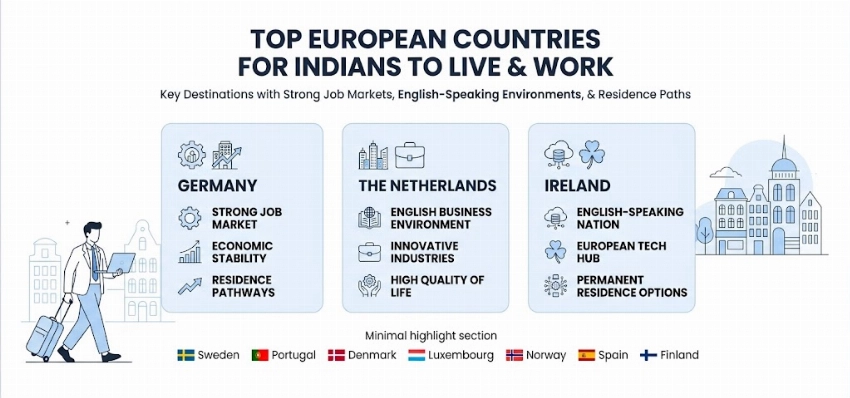
Here’s a list of the top 10 European countries to live and work in for Indians:
-
Germany
-
Netherlands
-
Sweden
-
Portugal
-
Denmark
-
Luxembourg
-
Norway
-
Spain
-
Finland
Note: Germany is the top country in Europe for Indians to move and settle in due to its huge labour shortage, easy EU blue card process and quick permanent residency process.
Also Read: How to Migrate to Germany from India? Experts Guide
How to Choose the Best European Country for Indians?
All the European countries have their advantages and disadvantages, and there is no such thing as one best country in Europe to live and work in for all.
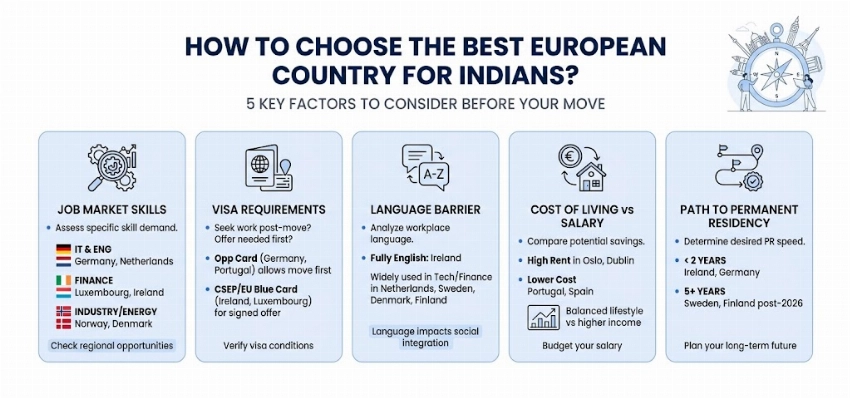
The choice of which one to select is determined by your priorities. Before you select the best country to migrate from India, consider these 5 questions:
-
Does the job market want your skills? Germany and Holland are in need of IT and engineering skills. There is a need for finance and banking professionals in Luxembourg and Ireland. Industry workers such as energy and pharma are in demand in Norway and Denmark.
-
Can you get the visa without a job in hand? With the Opportunity Card from Germany and visas from Portugal, you can move first and then seek work. Generally Ireland CSEP and Luxembourg EU Blue Card require an offer signed prior to flight.
-
Will the language barrier slow you down? The only fully English-speaking nation here is Ireland. Nearly all workplaces in the Netherlands, Sweden, Denmark and Finland operate in English as well, though, so language shouldn't exclude any of the best European countries to migrate to for tech and finance careers.
-
Does your salary actually stretch? Rent takes a huge bite out of a high salary in Oslo or Dublin. Portugal and Spain are far cheaper to live in in, and if saving money is more important than having a large payslip, this is the factor to take into consideration.
-
How fast do you want permanent residency? It takes less than 2 years to get there from Ireland and Germany. 5 years or more is available for Sweden and Finland after its 2026 rule change.
Note: If you still have to choose the best country to immigrate from India for your profession, then you should consider the job market first. A quick visa to a wrong job is simply postponing the true issue of finding the job you want.
Also Read: Best Countries for Indians to Settle in 2026: Expert Guide
Best Countries to Live and Work in Europe for Indians
Here’s a brief overview of the best countries to live and work in Europe for Indians:
1. Germany
Being top in the list of the best country to live and work for Indian engineers, IT professionals, and researchers, Germany has the most job vacancies, and the visa options are one of the easiest in Europe
-
Key Perks: more than one million skilled vacancies available, a quick path to permanent residency (21 months if the applicant meets B1 German language requirements, 27 months with only basic A1 proficiency), and the Opportunity Card, which allows the applicant to transfer a candidate on a point system without having a job offer.
-
Visa Options: EU Blue Card - €50,700 per year for the majority of occupations, or €45,934 per year for shortage occupations, recent graduates and IT specialists without a formal qualification (2026 rates). The Opportunity Card and Job Seeker Visa are for those who don't have a signed contract at this time.
-
Work Opportunities: High-demand industries offer job opportunities in engineering, IT, automotive, healthcare and renewable energy. Berlin is the place for startups, Munich and Stuttgart for engineering and cars and Frankfurt for finance.
-
Cost of Living: Average to good, varying significantly from city to city. The cost of living in Munich is the highest in Germany. Other similar salaries are much lower in Berlin.
Also Read: Explore Jobs in Germany for Foreigners: Career Guide 2026
2. The Netherlands
The Netherlands offers a quality lifestyle and a fast-paced career. The application process takes only 2-4 weeks for most visa applications, the fastest in Europe.
-
Key Perks: The 30% ruling is the first 30% for five years is tax-free (and 27% for new entrants from 2027). English is spoken nearly everywhere, even at work.
-
Visa Options: Highly Skilled Migrant visa - €5,942 per month if 30 or more; €4,357 per month if under 30; and €3,122 per month for recent graduates (2026 rates). The same salary floor is applied to the EU Blue Card.
-
Work Opportunities: Technology, finance, engineering, logistics, and energy are the best fields of work to find. Amsterdam and Eindhoven are the top recruitment centres.
-
Cost of Living: High, especially in Amsterdam. Their average monthly costs of living there, however, come to about €2,700 per month, which is somewhat mitigated because of the 30% tax discount.
Also Read: Job Opportunities in Netherlands for Indians in 2026: Update
3. Sweden
Sweden is for anyone who wants a real work-life balance, not just a high salary. Overtime abuse is genuinely rare here, and it's illegal to overwork your staff. Stockholm has also quietly become one of Europe's strongest tech cities. Nearly 60,000 Indians (by birth) call Sweden home today.
-
Key Perks: The generous parental leave, worker protection in terms of some of the best in Europe and English-speaking offices throughout the tech world in Stockholm and the engineering sector in Gothenburg.
-
Visa Options: Starting from June 2026, the minimum salary for Sweden's work permits increased from SEK 29,680 per month to SEK 33,390 per month or 90% of the national median wage. A lower 75% threshold is used for about 27 shortage jobs, a few of which are in healthcare and IT.
-
Work opportunities: Renewable energy, engineering, healthcare and technology are the most in-demand fields, almost exclusively in Stockholm.
-
Cost of Living: High, but affordable. Despite the high daily expenses, Stockholm's rent index is lower than in other cities such as Zurich, Oslo, and Dublin.
4. Portugal
Portugal is the lowest cost to live in on this list of best countries to live and work in Europe, along with the actual EU access and relaxed lifestyle. It is best to have an offer of employment from Portugal and have successfully passed the process to apply as a job seeker before you begin the process, as this has recently changed.
-
Key Perks: Rent and daily costs are noticeably lower than in Western or Northern Europe. The climate is warm, and Lisbon and Porto both have well-established, welcoming Indian and expat communities.
-
Visa Options: The D3 Highly Qualified Activity visa is the main route for employees, usually needing a salary of at least 1.5 times Portugal's national average. The D7 (passive income, from €920 a month in 2026) and D8 (digital nomad, from €3,680 a month) suit remote workers and people with independent income, not job seekers.
-
Work Opportunities: Tourism, tech and startups (Lisbon's Web Summit ecosystem), renewable energy, and agriculture lead hiring.
-
Cost of Living: Lisbon's 2026 cost-of-living index sits well below Dublin, Oslo, or Stockholm; your money simply goes further here.
5. Ireland
Of all these countries, Ireland is the only nation that is entirely English-speaking, thus eliminating another aspect of the relocation stress. It is also the home of the European headquarters of Google, Meta, and some of the big pharma firms.
-
Key Perks: Zero language barrier, a genuinely fast 21-month route to long-term Stamp 4 residency, and automatic full work rights for your spouse via the Stamp 1G visa, no separate permit needed.
-
Visa Options: Critical Skills Employment Permit (CSEP) - €40,904/year for jobs on the Critical Skills list that require a degree (as of March 2026 from €38,000) or €68,911/year for other qualifying jobs that do not specify a degree. For more generic jobs, the General Employment Permit is €36,605 per year.
-
Work Opportunities: Technology, pharmaceuticals, finance, and med-tech dominate, almost entirely in Dublin, with smaller hubs in Cork and Galway.
-
Cost of Living: High. The cost of living and rents in Dublin are among the highest in this list, even higher than the prices in the Nordic capitals, but salaries and free work rights for spouses compensate for this.
Also Read: Ireland Work Visa: Application, Requirements & More in 2026
6. Denmark
Denmark consistently ranks among the world's safest and happiest countries, and it backs that up with real rules, a standard 37-hour workweek here, not just a nice idea on paper. Denmark doesn't publish exact nationality counts, but around 40,000 Hindus live in the country today, a useful stand-in for the size of its South Asian community.
-
Key Perks: One of the shortest standard workweeks in Europe, very little wealth inequality, and an easy location between Sweden and Germany for weekend travel.
-
Visa Options: The Pay Limit Scheme is the main route, DKK 552,000 a year (roughly €74,000) on the standard track, or DKK 446,000 a year on the supplementary track, which comes with extra conditions like public job advertising. The Positive List offers a separate route for specific shortage jobs.
-
Work Opportunities: Pharmaceuticals, renewable energy (especially wind power), technology, and agriculture, mostly centred around Copenhagen.
-
Cost of Living: High, similar to Norway and Sweden, but balanced by strong salaries and free universal healthcare.
7. Luxembourg
Small country, big pay cheque. Luxembourg pays the highest average salaries in Europe and has an unusually international workforce, a huge share of residents are foreign-born, so you won't stand out as an outsider here. The Indian community is still small but growing fast from about 780 people in 2013 to around 5,700 by 2024, mostly working in banking, finance, and IT.
-
Key Perks: Europe's highest average salaries, a well-established international banking and finance community, and easy weekend access to Germany, France, and Belgium.
-
Visa Options: The EU Blue Card is the main route. The minimum salary rose to €65,652 a year in March 2026 (up from €63,408), set at 1.5 times the national average salary. Below that, you'd need a Salaried Worker Permit, which requires your employer to prove no local candidate was available.
-
Work Opportunities: Banking, investment funds, EU institutions, and a growing fintech scene.
-
Cost of Living: Very high, but so are the salaries. Housing is expensive relative to the country's tiny size, but take-home pay stays among the strongest in the EU.
8. Norway
Norway pairs dramatic fjords and nature with one of the world's strongest social safety nets. It's a great fit if you want a very high standard of living and don't mind paying a lot for it.
-
Key Perks: No annual quota or lottery for its skilled worker visa (unlike, say, the US H-1B), strong union-negotiated wages, and consistently top rankings for happiness and safety. There are also around 14,000+ Hindus in Norway today, a rough proxy for the country's growing Indian-origin community.
-
Visa Options: The Skilled Worker Permit is the standard route. After a May 2026 salary revision, the thresholds are NOK 545,400 a year for roles needing a bachelor's degree and NOK 624,700 a year for roles needing a master's degree, where no collective agreement applies. You can apply for permanent residence after 3 years.
-
Work Opportunities: Oil and gas, maritime work, engineering, IT, and healthcare. Oslo, Bergen, and Stavanger (the oil hub) are the key cities.
-
Cost of Living: Very high. Oslo's 2026 cost-of-living index is one of the highest in Europe, though wages and welfare benefits are built to match it.
Also Read: Jobs in Norway with Visa Sponsorship: 2026 Career Guide
9. Spain
Spain suits Indians who want a genuinely relaxed, family-friendly lifestyle without giving up EU access. It's also become popular with remote workers thanks to a dedicated digital nomad visa. The Indian community here has grown quickly too, now numbering close to 74,000 people, concentrated mainly around Madrid and Barcelona.
-
Key Perks: A noticeably lower cost of living than Northern Europe, a clear visa path for remote workers, and a warm, social culture that's easy to settle into.
-
Visa Options: The Digital Nomad Visa needs €2,849 a month in 2026 (200% of Spain's minimum wage) for remote workers or freelancers earning at least 80% of their income from outside Spain. The Non-Lucrative Visa (around €2,400 a month) suits people with passive income but doesn't allow any work at all. If you have a direct job offer from a Spanish company, standard skilled-worker routes apply instead.
-
Work Opportunities: Tourism, technology (Madrid and Barcelona's startup scenes), renewable energy, and agriculture.
-
Cost of Living: Lower than Northern and Western Europe - similar to or slightly higher than Portugal, and well below the Nordic countries or Ireland.
10. Finland
Finland has topped the world's happiness rankings for years running, and its immigration system backs that up, it's fast, digital, and has very little red tape. The Indian community has grown from under 500 people in the early 2000s to around 18,000 today, largely thanks to tech recruiters like Nokia hiring engineers directly from India.
-
Key Perks: Consistently the world's happiest country, one of the most gender-equal societies anywhere, and job-loss protection introduced in 2025 that keeps your residence permit valid while you look for new work.
-
Visa Options: The Specialist Permit and EU Blue Card share a 2026 threshold of €3,937 a month, processed through a genuinely fast 2-week Fast Track with a travel visa issued alongside it. The standard Employed Person Permit covers other roles at a €1,600 a month minimum. One thing to note: Finland's January 2026 reform pushed the standard permanent residence wait from 4 to 6 years, though high earners (€60,000+ a year) and shortage-profession specialists can still get there in 4 years with basic language skills.
-
Work Opportunities: Technology (gaming companies like Supercell and Rovio), forestry and bioeconomy, cleantech, and healthcare, centred in Helsinki and Espoo.
-
Cost of Living: Moderate to high, and clearly cheaper than Norway or Denmark, but still pricier than Southern Europe.
Also Read: Which Country is Best for Job Opportunities in 2026?
Conclusion
There's no single best countries to live and work in Europe in 2026. Some of the best country to live and work for Indians are based on the right pick depending on matching your job, your visa timeline, and your lifestyle to what each country actually offers.
Still not sure which fits you best? TerraTern's immigration experts can walk you through visa eligibility, timelines, and paperwork for any of the countries above. Reach out, and we'll help you find the right country amongst the best countries to live and work in Europe.


 AI Summary