Key Highlights
- What Are the Work Visa Options for Indians in 2026?
- What Are the Top Countries with Easy Work Visa Processes for Indians?
- Which Country Has the Highest Visa Success Rate for Indians?
- Which Country Has the Highest Visa Rejection Rate for Indian Applicants?
- What Factors Influence Work Visa Approval Rates for Indians?
- What Challenges Do Indians Face in Obtaining Work Visas?
- Conclusion
Countries that offer easy working visas for Indians in 2026 are more likely to have streamlined documentation processes, expedient visa processing timelines, and well-defined skilled-migration pathways, notably including Germany's new Opportunity Card, Canada's point-based visa programs, Australia's skilled visa and employer-sponsored visa programs, the UAE's work visa process, and Singapore's Employment Pass system.
The emerging destinations in the EU with labour shortages that actively seek Indian professionals by introducing easy visa programs and digital applications.
What Are the Work Visa Options for Indians in 2026?
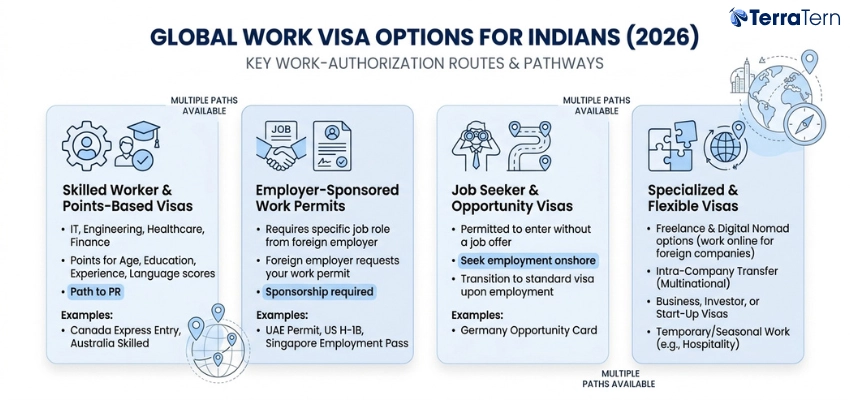
Work visas for skilled workers or points-based visas (Canada Express Entry, Australia Skilled visas, UK Skilled Worker, Germany skilled immigration and EU Blue Card) for professionals in IT, engineering, healthcare, finance and other similar fields with age, education, work experience and language scores.
-
Employer-sponsored work permits, such as UAE work permit, Singapore Employment Pass, EU national work permit, US H-1B and Australia employer nomination, in which a foreign employer provides a job role and requests to get your work permit.
-
Job seeker visas and opportunity visas (including Germany's Opportunity Card and other European job seeker visas) which permit visa holders to enter with no job offer, seek employment onshore and then transition to a standard work visa upon employment.
-
Intra-company transfer visas (L‑1 visas for US, ICT visas for UK, EU ICT visas etc.) are typically issued for multinational companies to transfer Indian employees to their overseas branches, usually for managerial, specialist, and senior IT positions.
-
Temporary or Seasonal work visas (short-term agricultural, hospitality, tourism, low-skilled (e.g. US H–2A/H–2B, New Zealand seasonal work schemes, some EU seasonal permits).
-
Business visas, investor visas or entrepreneur visas (such as Canada Start Up visa, US investor visas, UK and Singapore entrepreneur visas).
-
Visas for freelance, digital nomad or remote working such as those offered in Estonia, Portugal, Croatia, UAE and other countries that allow you to reside in the country and work online for foreign companies or your Indian employer.
-
For younger workers (typically 18-30 or 35 years), some countries (such as Australia, New Zealand, Canada and several European countries) offer youth mobility / working holiday visas for travel and temporary employment; at present there are few reciprocal visa arrangements between India and other countries in this category.
-
Full-time work opportunities with permanent work / immigrant category visas (such as Canada PR for skilled workers, some of the US EB categories and the long-term options of residence in the EU).
Expert Advice: "Easy" is relative to your profile; a country that's straightforward for an IT professional with a job offer may be considerably harder for someone without one, so match the country to your specific situation rather than picking from a generic ranking.
Also Read: Work Permit: All You Need To Know To Work Abroad
What Are the Top Countries with Easy Work Visa Processes for Indians?
Below are some of the countries with relatively easy or streamlined work visa application procedures for Indians, particularly in fields such as skilled occupations like IT, engineering, healthcare, and trades, that are considered to be among the best countries for skilled visa applications in 2026.
-
United Arab Emirates (UAE) – Robust demand for IT, construction, hospitality, logistics sectors and more, including the UAE long-term “Golden Visa” for highly skilled professionals and investors, and employer-sponsored work permits can be issued very quickly (often within days).
-
Germany – Multiple routes available: Opportunity Card (Chancenkarte) job-seeker visa and EU Blue Card for skilled workers; many jobs require no IELTS – if language or skills criteria are met.
-
Canada – Skilled worker visa with focus on PR with transparent points-based pathways (Express Entry, PNPs) and employer-sponsored. Popular in IT, healthcare, engineering and trades.
-
Australia – Skilled visas – in‑demand occupations (IT, engineering, trades, nursing) – occupation lists and points criteria.
-
Singapore – Simple Employment Pass and S Pass for mid- to high-skilled professionals in IT, finance, logistics and tech, easy online applications and relatively fast decision-making.
-
New Zealand – Accredited Employer Work Visa – High-demand occupations in construction, healthcare, trades, hospitality and some IT occupations – Defined skill-shortage lists.
-
Ireland – Critical Skills and General Employment is a framework with specific occupations, clear salary benchmarks and employer-led processes.
-
Smaller EU countries include Poland, Malta, Portugal – Usually, not as difficult to document, no IELTS, high demand in manufacturing, hospitality, logistics, some IT, national working permits, EU mobility once in place.
Pro Tip: The UAE's lack of a formal points system makes it feel "easier" to enter, but it also means approval hinges entirely on your employer's sponsorship, there's no independent skilled-migration pathway the way Canada or Australia offer.
Which Country Has the Highest Visa Success Rate for Indians?
-
The practical approval rate for Indians in the UAE for an employer-sponsored work visa is usually high, around 90-95%, provided that the employer, job offer, medical test, and documents are all genuine and complete.
-
The Indian worker visa approval rate in the United Kingdom is also high, with one report saying it was around 92.26%. Applicants need to have an approved sponsor, an eligible occupation, and salary requirements, however.
-
High approval prospects are possible in Singapore, particularly for applicants who meet the Employment Pass/S Pass salary, qualification, and employer requirements, which are around 80% to 85%.
-
Canada could be a good place to pursue strong, skilled applicants via Express Entry, Provincial Nominee Programs, or by employer. Nevertheless, the approval is heavily dependent on the availability of the funds, the documentation, and the type of program, as well as the CRS scores.
-
The employment outlook for those who are successful in the skills assessment and are eligible for work in Australia (due to English language requirements, health and character checks and sufficient points or a sponsor) is generally good.
-
For qualified IT workers, engineers, healthcare employees and others with qualifications, Germany may be a good choice via the EU Blue Card and the Opportunity Card, dependent on their language skills and qualification recognition.
-
If the applicant has a qualified employer and profile, the United States application process for Indians seeking an H-1B is typically less predictable, as it requires a lottery.
Key Note: A high national success rate doesn't guarantee your individual approval, it reflects a well-designed system, but your own documentation and eligibility match still do most of the work.
Also Read: Advantages and Disadvantages of Working Abroad From India
Which Country Has the Highest Visa Rejection Rate for Indian Applicants?
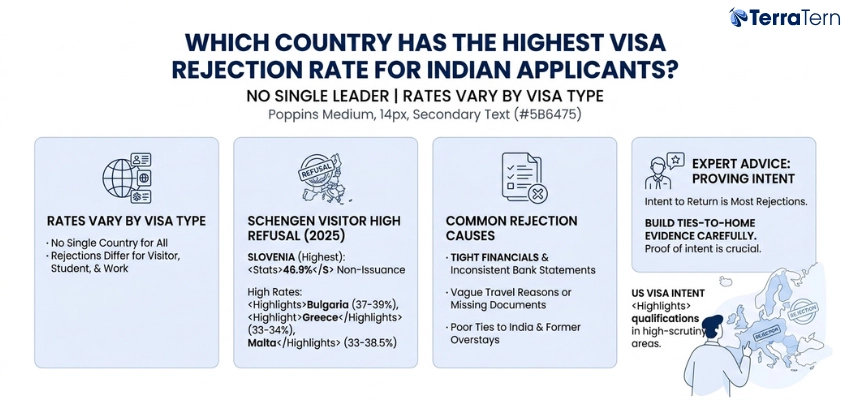
No single country has the highest rejection rate for all types of visas. The rates vary for work visas, student visas, visitor visas, and Schengen visas.
-
In 2025, the percentage of non‑issuance of Schengen visitor visas for Indian nationals was highest for Slovenia (46.9%). Other higher acceptance destinations included Bulgaria, Lithuania, Croatia, Greece and Malta.
-
The rejection/non-issuance rate for Bulgaria was around 37-39% (depending on the dataset and reporting method).travellerscoop+1
-
The rate for Greece was relatively high, approximately 33-34%, and for Malta, approximately 33-38.5% in various 2025 data sources.
-
For US visas, refusal rates can be high as the applicant has to convince the consular officer that he/she has a valid temporary purpose, working capital, and good chances of returning to India. The US does not have a single Indian visa rejection rate, but rather lists nationalities and the percentage who have been refused visas.
-
When ranking countries by nationality, it is an oversimplification to suggest a hierarchy for work visas. An offer of employment from a qualified employer, the right job, pay, qualifications, health, and paperwork generally outweigh the importance of being Indian.
-
Tight financial evidence, inconsistent bank statements, vague reasons for travel or employment to India, missing documents, poor connections to India, former overstays, and mismatched information are common causes for Indian applications to be rejected.
Advice by our Expert: Most rejections in high-scrutiny countries come down to proving intent to return, not lack of qualifications, build your ties-to-home-country evidence as carefully as your professional documentation.
What Factors Influence Work Visa Approval Rates for Indians?
-
Valid offer from a Licensed/Approved Employer: One of the most important components of an employer-sponsored application is a genuine job offer from a licensed or government-approved employer.
-
Qualifications: Relevant degree, professional licence and work experience must correspond to the occupation and job description. When an applicant's occupation is included on the shortage or priority list of occupations in their destination country, it can be helpful if that occupation is in demand.
-
Conditions of Employment: The salary offered should be commensurate with the minimum salary rate in the country, and linked to the applicant's skills and experience.
-
Language Skills: Some international companies, especially in Australia, Canada, and the UK, may require English results for their language tests; for some jobs in Europe, a result in German or the local language would enhance the application.
-
Documentation (passports, employment contracts, educational certificates, skills assessments, experience letters, police certificates, medical documentation, etc.) must be accurate and consistent.
-
Financial Capacity: In order to start work, the job-seeker needs to demonstrate that he or she will be able to support himself or herself until he or she is employed. Some routes to temporary work also require proof of financial capacity.
-
Relevant Record: Medical clearances, police clearances, and non serious criminal / immigration record are important.
-
Immigration History: Incomplete or inaccurate information, refusals, or previous overstays can impact chances of approval.
-
Real-world Purpose: Your career history, job, qualifications, compensation and intent should have a clear and convincing narrative.
-
Employer Compliance: Although a good applicant, they may be rejected due to unauthorisation of the sponsoring employer, the role being non-genuine, or the employer not meeting the requirements of sponsorship.
-
Approval Rate: subject to country-specific rules such as visa quotas, labour-market tests, points systems, occupation lists, processing backlogs, and policy changes, all of which can impact approval rates without regard to nationality.
-
Quality of Application: Incorrect documentation, missing documents, unexplained gaps, inconsistent bank records, or incorrect information may result in application rejection or delay.
Important Tip: Start your credential assessment before you start your visa application, not after, recognition processes often take longer than the visa itself and can quietly become the real bottleneck.
Also Read: Working Hours for Students in Canada: A Complete Guide
What Challenges Do Indians Face in Obtaining Work Visas?
-
Getting a Real Sponsor: Many countries call for a job offer from an authorized employer, and it can be challenging to get sponsored by an employer in India.
-
Rigorous Eligibility Criteria: Education, work experience, occupation, salary, age, language skills, professional licensure.
-
Skills Mismatch: The applicant's educational qualifications or experience are not closely aligned with the job they are applying for, which can negatively impact the application.
-
Refusals Due to Complex Documentation: Refusals may be due to missing, old, non-existent, or incomplete documentation like certificates, experience letters, police clearance, or employment contracts.
-
Professional Recognition: If doctors, nurses, teachers, engineers, social workers, and other regulated professionals plan to work, they might require credential assessments, registration, exams, or local licences to do so.
-
Language Barriers: English language proficiency may be necessary, and some countries like Germany, Austria, and some other European countries may require proficiency in the local language for certain professions.
-
Salaries: The provided pay rate may need to be at or above a minimum salary or match the applicant's job and experience.
-
Financial Requirements: These take care of the need to provide evidence of savings and/or accommodation and/or insurance and/or financial means to support you whilst you are waiting for the transition to a job.
-
Issuer-related Issues: If the employer has not been authorised, if the job is not genuine, if the sponsorship certificate is invalid, or if the job is not labour-market compatible.
-
Inconsistencies in Application: This can arise in the names, date of employment, salary information, bank statements, answers to questions, etc.Credibility problems with applications: These are related to differences in name, date of employment, salary information, bank statements, answers to questions, etc. Failure to be approved in the past or prior deportation, overstays, unauthorised work or providing false information may make future approval difficult.
-
Health and Character Checks: Conditions that may impact the rules of the destination or serious criminal history may have an impact on eligibility.
-
Quotas and Competition: Some countries do not accept more than a certain number of visas or draw visas by lot, ballot, or occupation priority.
-
Processing Delays and Changing Policies: Backlogs, limited embassy appointments, changing occupation lists, and new salary rules can cause delays and disruption to applications. The requirements for European applicants might also be different, as work permits are granted individually by the various European countries.
-
Financial and Emotional Cost: Language tests, credential assessments, document translations, medical examination, legal fees and travel costs may all be substantial, particularly when the application is denied.
Expert Advice: Financial proof requirements are one of the most commonly underestimated parts of the process — start gathering bank statements and income documentation well before you think you'll need them, since most require a consistent history, not just a current snapshot.
Also Read: Australia Working Holiday Visa for Indians: Latest Guide
Conclusion
There are several promising options for Indians to pursue their careers abroad in 2026, including skilled-worker visa programmes in countries like UAE, which provide expedited processing for job offers from companies; the opportunity card in Germany, which offers flexibility by accepting applications from any employer; and other skilled worker visas and employer-sponsored visas in countries such as Canada, Australia, New Zealand, Singapore, Ireland, and the UK that are available for qualified professionals.
If you're unsure which pathway fits your profile, TerraTern can help you assess your eligibility, understand your visa options, and prepare your application for your chosen destination.