
Key Highlights
- What are the Working Hours for Students in Canada?
- Who Is Eligible to Work Off Campus as a Student in Canada?
- How Many Hours Can Students in Canada Work During Breaks and Holidays?
- What Are the Rules for On-Campus Work for Students in Canada?
- What Changed With the Co-op and Internship Rules for Students in Canada?
- What Are the Best Part-Time Jobs for Indian Students in Canada and How Much Can They Earn?
- What Are the Consequences of Exceeding Working Hours in Canada?
- Can Students in Canada Work Remotely for Employers Outside Canada?
- How Do Working Hours in Canada Affect a Student's PGWP and PR Pathway?
- 2025–26 Industry Context Section
- Conclusion
What are the Working Hours for Students in Canada?
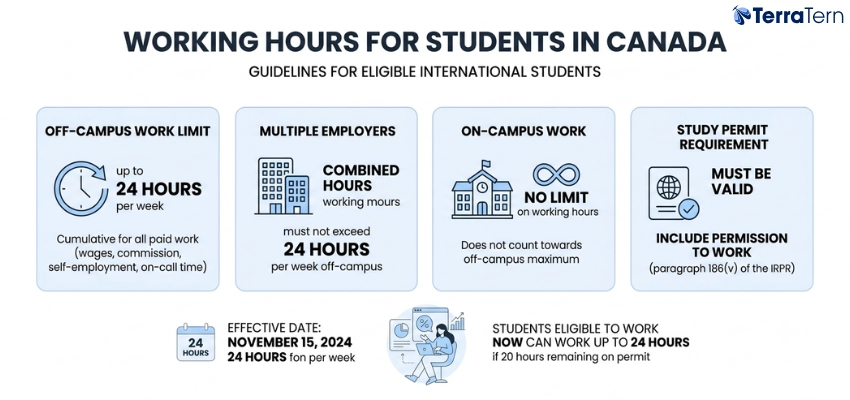
The new rule for Working hours for students in canada gives eligible international students the option to work up to 24 hours per week outside of school on November 15, 2024.
-
This 24-hour limit is cumulative for all paid hours (including wages, commission, on-call time, and self-employment hours).
-
If a student works for more than one employer, both employers will be combined and will not exceed 24 hours per week off-campus.
-
There is no limit on the number of hours that can be worked on-campus, and on-campus work will not count towards the maximum of 20 hours per week for off-campus work.
-
A study permit must be valid and include permission to work under paragraph 186(v) of the IRPR.
-
If there are 20 hours remaining on a study permit, students may work up to 24 hours if they are eligible to work now.
|
Work Type |
During the Academic Term |
During Scheduled Breaks |
|
On-Campus Work |
Unlimited hours |
Unlimited hours |
|
Off-Campus Work |
Up to 24 hours/week |
Unlimited hours |
|
Co-op/Internship (post-secondary) |
No limit, if it is part of the program and meets eligibility rules |
Unlimited hours |
|
Remote freelancing for a foreign employer |
Not counted toward the 24-hour cap, if it is truly for a non-Canadian employer and does not involve the Canadian labour market |
Not counted toward the 24-hour cap |
As per TerraTern Expert Divyansh, Many Indian students don't realise that on-campus work is completely separate from the 24-hour off-campus limit , you could legally work 24 hours off-campus AND unlimited hours on-campus simultaneously, though this level of workload would almost certainly harm your academic performance.
Also Read: Know The Working Hours for Students in Canada
Who Is Eligible to Work Off Campus as a Student in Canada?
If you are an international student studying for a full-cycle program (6 months or more), a degree, a diploma or a certificate with a valid study permit application issued by the DFO when you were on your country's study permit, and you have work conditions and a Social Insurance Number (SIN) then you can work off campus in Canada.
What Are the Exact Conditions Needed to Work Off Campus in Canada?
Full-time at a designated Learning Institution, unless eligible for the final semester, in which case may take classes part-time.
-
Participated in a program for at least six months to earn a degree, diploma, or certificate.
-
Classes have already begun; work cannot take place off campus before day one.
-
Have a valid study permit or have applied to extend a study permit prior to expiration.
-
Work conditions are included on your study permit.
-
Have a valid social insurance number (SIN).
-
Not eligible: ESL or FSL students, general-interest or self-improvement courses, preparatory/pathway programs before the beginning of the main program.
-
Switching to another school: cannot work from off campus between schools.
-
Authorised leave: off-campus work is not allowed during leave.
-
Final semester: If you have studied full-time in previous semesters, you may be able to study part-time in the final semester.
Important Note: If your study permit does NOT have work conditions printed on it, you can request a free amendment from IRCC before applying for your SIN. This is a common issue for Indian students who applied for study permits before this condition was standard, and it's easily fixed without a new application fee.
How Do Indian Students Apply for a Social Insurance Number (SIN) to Work in Canada?
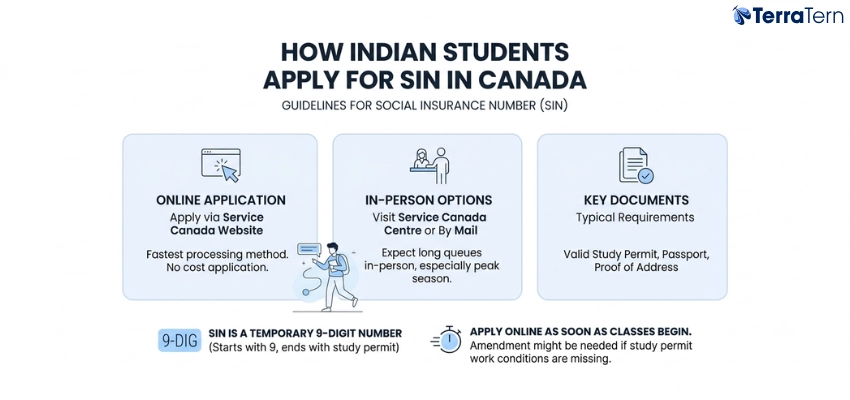
Working hours for students in canada must have a valid study permit, and Indian students require a SIN number to be able to legally work in Canada.
-
SIN is a Social Insurance Number – a 9-digit number issued by the government for employment, tax, and benefits.
-
If the work conditions are not listed on the study permit, ask for a free amendment prior to applying.
-
Apply for a SIN online to process as quickly as possible through Service Canada.
-
You can also apply in person at a Service Canada Centre or by mail.
-
Documents required typically are a valid study permit, passport, and proof of address.
-
No cost for the SIN application and can be processed online in minutes to a few days.
-
For international students, the temporary SINs will typically begin with a 9 and end when your study permit expires, and may be renewed when your study permit is extended.
Expert Advice: Apply for your SIN online through the Service Canada website as soon as your classes begin. In-person centres in cities like Toronto and Vancouver can have long queues, especially in September during peak student arrival season.
How Many Hours Can Students in Canada Work During Breaks and Holidays?
International students in Canada enjoy unlimited working hours for students in Canada during scheduled academic breaks, including summer, winter holidays, and reading weeks lasting at least seven consecutive days. This unlimited break work is capped at 180 days per calendar year, after which the regular weekly limits resume.
What Counts as a "Scheduled Break" Under IRCC Rules?
Under IRCC rules, it constitutes a scheduled break
-
Minimum duration: Seven consecutive days, recognised by the institution
-
Scheduling requirement: Set by the school, not a personal vacation during term
-
Qualifying breaks: Summer, winter or Christmas break, spring reading week
-
Non-qualifying gaps: Personal leave during term and inter-program gaps don't qualify
-
Extended-break rule: Breaks over 150 consecutive days count only the first 150 days
-
Annual cap: Unlimited working hours for students in Canada max out at 180 days
Can Students Work Full-Time in Canada During Their Final Semester?
May students work full-time in canada in the final semester
-
Final-semester exception: Students no longer needing a full course load may work unlimited off-campus hours if enrolled full-time in all previous semesters
-
On-campus eligibility: Final-semester on-campus work also qualifies for unlimited working hours for students in Canada, under the same conditions
-
PGWP bridge: Graduates who applied for their PGWP before the study permit expired may work full-time while awaiting the PGWP decision
Expert Tip: The 180-day annual cap on unlimited break work is the most overlooked rule , Indian students who plan to work full-time through multiple break periods in a single year (e.g., a January intake with both a winter break and a long summer) should map out the total break days early to avoid accidentally breaching this limit.
What Are the Rules for On-Campus Work for Students in Canada?
International students in Canada can work unlimited hours on campus throughout the academic year, including during class terms, without a separate work permit, as long as they hold a valid study permit with on-campus work conditions and remain enrolled full-time at a designated learning institution.
-
Definition: On-campus work means jobs located within the physical boundaries of the institution where the student is enrolled
-
Multi-campus rule (U of T example): For institutions with multiple campuses, a campus in a different municipality counts as off-campus for students enrolled at another campus
-
Eligible roles: Cafeteria jobs, library work, research labs, professors' research assistant positions, student union roles, and administrative support
-
No hourly cap: Unlike off-campus work, on-campus jobs carry no 24-hour weekly restriction — a key edge for maximising working hours for students in Canada
-
No extra permit needed: On-campus work is authorised directly through the study permit's conditions
-
Full-time enrolment required: Students must stop on-campus work if they drop to part-time status or go on leave (except during their final semester)
-
Start date rule: On-campus work cannot begin until studies officially begin, mirroring the rule for off-campus work
Important Tip: On-campus roles such as research assistants, teaching assistants, or library staff often pay CAD 18–25/hour with no hour limit. For Indian students at universities with active research departments, these are the highest-value jobs available and don't even count toward your off-campus 24-hour cap.
What Changed With the Co-op and Internship Rules for Students in Canada?
As of April 1, 2026, eligible post-secondary international students in Canada no longer require a separate co-op work permit to participate in mandatory work placements, such as co-ops, internships, or practicums. A valid study permit with on-campus work conditions is now sufficient, simplifying working hours for students in Canada.
What Was the Old Co-op Work Permit Rule and What Changed?
While standard working hours for students in canada apply to regular jobs, mandatory academic placements now follow these simplified rules:
-
Old rule (pre-2026): A study permit plus a co-op permit
-
New rule (April 1, 2026): A study permit with work conditions suffices
-
Applies to: Post-secondary DLI students, mandatory placement, 50% or less
-
Still required for: Secondary students
-
Pending applications: IRCC may withdraw submitted co-op permits
-
Existing permits: Remain valid for the full validity period
-
DLI letter: Confirmation of placement may be requested
As per TerraTern Expert: The April 2026 co-op permit elimination is a major win for Indian students in STEM, business, and healthcare programs. Programs with mandatory co-op requirements (like University of Waterloo's famous co-op system) are now administratively simpler, removing one barrier to securing industry placements.
What Are the Best Part-Time Jobs for Indian Students in Canada and How Much Can They Earn?
International students working 20–24 hours/week in Canada typically earn CAD 1,200–1,760/month (approximately INR 79,000–1,16,000/month). Average part-time wages range from CAD 13–25/hour depending on the role and province, while standard working hours for students in canada dictate maximum limits during academic terms.
Which Part-Time Jobs Are Most Popular and Highest Paying for Indian Students?
Here is a breakdown of common roles and their expected wages for the 2025–26 academic year:
|
Job Role |
Avg. Hourly Pay (CAD) |
Type |
Notes for Indian Students |
|
Tutor / Academic Coaching |
CAD 20–60/hr |
On/Off-campus |
High demand; leverage STEM skills |
|
Teaching Assistant (TA) |
CAD 20–30/hr |
On-campus |
Applied through department |
|
Research Assistant (RA) |
CAD 18–25/hr |
On-campus |
No hour limit; high ROI |
|
Barista / Café Staff |
CAD 15–18/hr |
Off-campus |
Flexible; widely available |
|
Retail Sales Associate |
CAD 15–18/hr |
Off-campus |
Largest employer of int'l students |
|
Server / Bartender |
CAD 14–17/hr + tips |
Off-campus |
Tips can double effective earnings |
|
Data Entry Clerk |
CAD 16–20/hr |
Off-campus |
Remote-compatible |
|
Driver (Uber/Lyft) |
CAD 18–25/hr |
Off-campus |
Flexibility; gig economy |
|
Freelancer |
CAD 25–55/hr |
Foreign clients |
Does NOT count toward limits |
Based on a current exchange rate of approximately 1 CAD ≈ 66 INR, here is what standard working hours for students in canada look like in practical earnings:
|
Hours Worked/Week |
Hourly Rate (CAD) |
Monthly Earnings (CAD) |
Approx. Monthly Earnings (INR) |
|
15 hrs (conservative) |
CAD 15 |
CAD 900 |
~INR 60,000 |
|
20 hrs (moderate) |
CAD 16 |
CAD 1,280 |
~INR 85,000 |
|
24 hrs (maximum term) |
CAD 18 |
CAD 1,728 |
~INR 1,14,000 |
|
40 hrs (break period) |
CAD 16 |
CAD 2,560 |
~INR 1,69,000 |
Where Can Indian Students Find Part-Time Jobs in Canada?
Indian students are seeking employment in Canada on a part-time basis.
-
Government Job Bank: Filter specifically for student-friendly roles.
-
University career centres: Your first stop for on-campus connections.
-
Online boards: Search Indeed, LinkedIn, Workopolis, and Glassdoor.
-
Community networks: Check Facebook groups and Indian community boards.
-
Campus networking: Connect with professors and Indian student associations.
-
Strategic timing: Apply 2–3 weeks before the September rush.
-
Compliance check: Always track standard working hours for students in canada.
Pro Tip: Tutoring fellow students, especially in math, science, or coding, is the highest-return part-time work for Indian students in Canada. At CAD 20–60/hour with flexible scheduling, it outperforms almost every service-industry role while directly building your Canadian professional network.
What Are the Consequences of Exceeding Working Hours in Canada?
Exceeding working hours for students in Canada breaches study permit conditions and can carry serious consequences. Working more than 24 hours per week off-campus during academic sessions can trigger loss of student status, denial of study or work permit applications (including the PGWP), inadmissibility findings, and potential removal from Canada.
What Happens If a Student Works More Than 24 Hours a Week in Canada?
Breaching working hours for students in Canada can trigger a cascading set of penalties:
-
Loss of student status: IRCC deems non-genuine
-
PGWP denial: compliance risks permit refusal
-
Future permit refusals: study/work applications may fail
-
Inadmissibility finding: triggers IRPA section 41
-
5-year bar: misrepresentation invokes IRPA section 40
-
Removal from Canada: extreme cases mean deportation
-
Immigration record flag: violations stay flagged
Key Note: The most dangerous time for Indian students is when switching between two programs ,many incorrectly assume they can keep working during the gap between programs, but IRCC is clear that off-campus work is not permitted during program transitions unless the gap is 150 days or fewer and all other conditions are met.
Can Students in Canada Work Remotely for Employers Outside Canada?
Yes international students in Canada can legally work remotely for employers based entirely outside Canada, including Indian companies, without a work permit and without it counting toward working hours for students in Canada limits, provided the employer has no financial ties whatsoever to Canada and the student never enters the Canadian labour market in any working capacity at all.
-
IRCC rule: remote work for a foreign employer isn't entering the Canadian labour market, so it falls outside limits
-
Employer must qualify: main business conducted outside Canada, no CRA business number, no Canadian business address
-
Profit test: employer must accrue profits principally outside Canada, not from Canadian clients
-
Disqualifying scenario: serving Canadian clients or being paid by a Canadian entity counts as off-campus work under the 24-hour cap
-
Tax reality: Indian students are typically Canadian tax residents and must report worldwide income, including Indian freelance earnings, to the CRA
-
CPP contributions: self-employed freelance income may trigger Canada Pension Plan obligations
-
Who this helps: especially relevant for Indian students freelancing for Indian tech, digital marketing, or content companies while studying in Canada
As per TerraTern Expert Shreya, Indian students who do freelance work for Indian startups or digital agencies back home can continue doing so in Canada without a work permit and without it counting toward the 24-hour off-campus cap but they must ensure the client has zero Canadian financial connections and must declare this income on their Canadian tax return.
How Do Working Hours in Canada Affect a Student's PGWP and PR Pathway?
Compliance with working hours for students in Canada directly impacts PGWP eligibility. IRCC carefully reviews a student's entire study period for work authorisation breaches when processing PGWP and PR applications, and any single violation can result in outright PGWP denial and future permit refusals.
How Does Part-Time Work During Studies Help Indian Students Get Canadian PR?
Part-time work during studies helps Indian Students Get Canadian PR
-
CEC doesn't count part-time work. Express Entry's Canadian Experience Class only credits post-graduation full-time skilled work, not study-period jobs
-
Building a foundation through part-time work still creates Canadian references, work history, and workplace familiarity
-
PGWP work counts one year of NOC TEER 1–3 experience under a PGWP qualifies for Express Entry
-
A clean record when respecting working hours for students in Canada during studies means stronger PGWP and Express Entry applications
-
Bridging benefit: applying for a PGWP before permit expiry allows full-time work during processing
-
CEC eligibility trigger that the bridging period's full-time work does count toward CEC
Pro Tip: The single most important compliance action for Indian students is this: apply for your PGWP before your study permit expires; if you do, you can legally work full-time while waiting for PGWP processing, and every month of that work counts toward your Canadian Experience Class PR application.
2025–26 Industry Context Section
6 current facts:
-
24-hour off-campus limit confirmed (November 2024): IRCC raised the limit from 20 to 24 hours per week for eligible international students during academic sessions, effective November 15, 2024 (IRCC)
-
Co-op permit eliminated (April 2026): As of April 1, 2026, eligible post-secondary students no longer need a separate co-op work permit for mandatory internships or work placements (IRCC, April 2026)
-
Over 460,000 active study permit holders in Canada as of January 31, 2026 (IRCC data via CICNews)
-
Indian students = largest international student group: Indian nationals make up nearly 40% of Canada's total international student population (IRCC data)
-
Average part-time earnings: CAD 13–22/hour depending on role and province; working 20–24 hours/week generates roughly CAD 1,200–1,600/month (Glassdoor, 2025; LMI Canada)
-
International students contribute ~CAD 22 billion annually to Canada's economy, supporting over 170,000 jobs (IRCC statement, 2024).
Conclusion
For Canadian students, managing work hours while pursuing academic goals is hard. Yet, the experience harbors the potential for immense personal and professional growth. Working hours for students in Canada is essential to address as it affects thousands of international students who come to Canada each year. We know it can be confusing to navigate the rules about working hours. Terratern's expertise in the visa process can significantly alleviate these pressures. Terratern offers personalized guidance. It ensures that students follow work regulations based on their study permits.
At TerraTern, we understand the challenges that come with being a student in Canada. We offer study visa solutions that make it easier for students to balance their academic goals with work opportunities. Our team of experts is well-versed in the visa process and can provide personalized guidance to ensure students are following all necessary regulations.


 AI Summary