

Key Highlights
- What Is the DAAD Scholarship and Why Does It Matter for Indian Students?
- What Types of DAAD Scholarships Are Available for Indian Students?
- What Are the DAAD Scholarship Eligibility Criteria for Indian Students?
- What Are the Benefits of Winning a DAAD Scholarship Germany?
- What Documents Are Required to Apply for the DAAD Scholarship?
- How Do You Apply for the DAAD Scholarship Step by Step?
- What Are the DAAD Scholarship Deadlines for Indian Students in 2026?
- What Is the DAAD Scholarship Selection Process and Acceptance Rate?
- What Happens After You Win the DAAD Scholarship? (Pre-Departure Checklist)
- What Are the Top Tips to Improve Your DAAD Scholarship Chances as an Indian Student?
- 2026 Industry Context Section
- Conclusion
The DAAD Scholarship 2026 allows students from India to study in Germany at renowned universities without having to bear the burden of high tuition fees. This prestigious scholarship is offered by the German Academic Exchange Service (DAAD) to qualified candidates for the bachelor's (plus) course, master's course, and doctoral course in Germany, including tuition fees, living expenses, travel expenses, and health insurance. The Scholarship helps make world-class education affordable, alongside Germany's tuition-free public universities. This guide provides information on program eligibility, application requirements, required documents, and 2026 deadlines.
What Is the DAAD Scholarship and Why Does It Matter for Indian Students?

The DAAD Scholarship in Germany is a crucial opportunity for Indian candidates. India is among the first two countries from which DAAD students hail, and it remains India's prime partner. The program offers a wide array of conferences, a powerful alumni network and comprehensive language preparation courses, all of which are free of charge.
-
The organisation is called Deutsche Akademischer Austauschdienst (German Academic Exchange Service).
-
Established: 1925 (Government-backed)
-
Global Reach: DAAD funds over 140,000 students and researchers worldwide annually.
-
Employed: €992 /month (plus health insurance and expenses for travel)
-
PhD Stipend: €1,300 to €1,400/month
-
India's Children: DAAD supported 2,785 Indian students in 2023 alone, with India ranking among the top nationalities for DAAD funding. in rankings of the largest DAAD-funded study abroad programs.
As per our TerraTern Expert Shreya, the DAAD Scholarship is not just financial support; it's a gateway into Germany's academic ecosystem, alumni network, and a 10-year post-study career advantage. Indian students who receive it often describe it as a career-defining credential, not just a funding source.
Also Read: Germany PR After Masters: Complete Pathway for Indian Students
How Is DAAD Different from Other Germany Scholarships?
During the process of exploring your financing opportunities for applying to the DAAD Scholarship Germany, you will come across a range of federal, public, and private financing options. But DAAD remains distinct due to its size, user group, and monthly financial coverage. In order to find the most suitable funding for your academic profile, compare the flagship DAAD Master's award with other important funding opportunities in Germany, as included in the table below.
|
Scholarship Program |
Primary Target Audience |
Monthly Funding Level |
Language Requirement |
Key Distinctive Feature |
|
DAAD Scholarship |
International postgraduates & professionals |
€992/month + full insurance & flights |
English or German (depends on the course) |
Fully funded ecosystem with mandatory language prep courses. |
|
Deutschlandstipendium |
High-achieving enrolled students (all nationalities) |
€300/month |
Typically German |
Merit-based; half funded by the government and half by private sponsors. |
|
Heinrich Böll Foundation |
Socially/politically active green-politics students |
Up to €934/month + €300 allowance |
Strict German proficiency (B2/C1) |
Focuses heavily on civil engagement and socio-political values. |
|
Erasmus Mundus |
Global joint-degree Master's cohorts |
€1,000 to €1,400/month |
English |
Requires studying across at least two different European countries. |
Important Tip: Unlike most other German scholarships that require language proficiency or enrollment at a German university, DAAD allows applicants to apply before receiving university admission, making it one of the most accessible routes for Indian students.
Also Read: DAAD Scholarship for Masters in Germany for Indian
What Types of DAAD Scholarships Are Available for Indian Students?
The DAAD Scholarship for Indian Students encompasses a diverse suite of funding options tailored to distinct academic milestones. Rather than offering a singular, blanket grant, the German Academic Exchange Service customises its fellowships based on your study level, career longevity, and specific scientific objectives.
|
Program Name |
Level |
Stipend |
Deadline |
Key Requirement |
|
EPOS (Development Postgraduate) |
Master’s / PhD |
€992/month (Grads) / €1,400/month (PhD) |
Aug–Nov (Varies by course) |
Minimum 2 years of relevant post-bachelor's work experience. |
|
Helmut-Schmidt Programme (PPGG) |
Master’s |
€992/month |
June 1 – July 31 annually |
Degree in Law, Economics, or Social Sciences; career goal in public policy. |
|
GSSP (Graduate School Programme) |
PhD |
€1,400/month |
Varies by host graduate school |
Must apply directly to a participating German graduate school first. |
|
DAAD Research Grants |
Doctoral / Postdoc |
€1,400/month |
Generally, October/November |
Structured research proposal and a formal invitation from a German supervisor. |
|
DAAD WISE (STEM Internships) |
Undergraduate |
€750 to €861/month |
October 15 annually |
3rd/4th year STEM students at top Indian institutes (IIT/NIT/IISc). |
|
DAAD DLR Research Fellowship |
PhD / Postdoc / Space |
€1,400 to €2,760/month |
Rolling / Varies by vacancy |
Specialised research aligned with the German Aerospace Centre. |
|
University Summer Courses (HSK) |
Bachelor's / Master's |
€1,134 (One-time institutional grant) |
Early December annually |
Minimum B1 German language proficiency at the time of application. |
Expert Advice: Indian students often apply for the wrong DAAD program. The EPOS scholarship (Development-Related Postgraduate Courses) is ideal for students with 2+ years of work experience, while WISE is exclusively for women from IITs, NITs, and IISc. Knowing the distinction saves months of wasted preparation.
Which DAAD Scholarship Is Best for Master's Students from India?
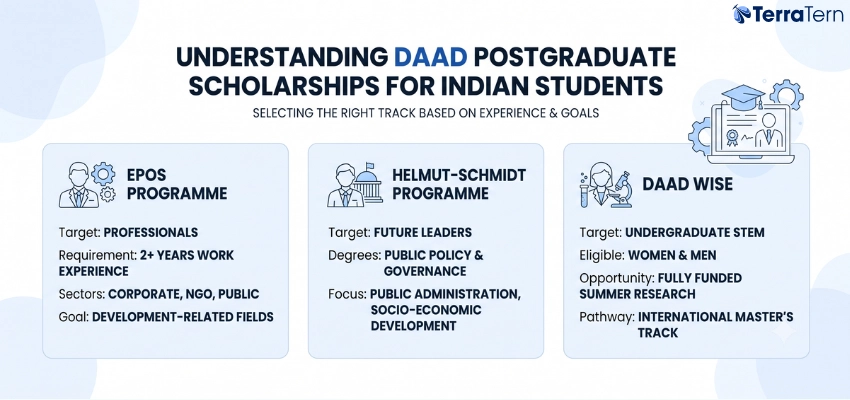
Navigating a DAAD Scholarship for Indian Students application at the postgraduate level requires targeting a specific track based on your professional experience and discipline:
-
EPOS Programme: Best for professionals with 2+ years of verified work experience in corporate, NGO, or public sectors looking to join development-related fields.
-
Helmut-Schmidt Programme: Ideal for future leaders pursuing degrees in public policy, governance, public administration, or socio-economic development.
-
DAAD Wise: Perfect for undergraduate women and men in STEM fields seeking a fully funded summer research program before transitioning into an international Master's track.
Expert Tip: Master's applicants with no work experience should not apply for EPOS; they will be screened out. Instead, explore the Helmut-Schmidt Programme or the DAAD International Postgraduate Studies scholarship, which have different experience requirements.
Are There DAAD Scholarships for PhD and Research Students?
Yes, Germany heavily prioritises advanced scientific collaboration, offering robust tracks under the DAAD Scholarship for Indian Students umbrella for doctoral and postdoctoral candidates:
-
Higher Financial Coverage: Doctoral stipends sit at €1,400/month, supplemented by full health insurance, travel allowances, and annual research budgets.
-
Key Entry Pathways: Scholars can utilise the GSSP for pre-structured doctoral schools, Research Grants for independent projects (ranging from short-stays to full 4-year degrees), or the prestigious DLR Fellowship for aerospace and engineering breakthroughs.
-
Critical Success Factor: For independent paths, securing an official, signed invitation letter from a German university supervisor before applying is absolutely mandatory and dramatically elevates your profile.
Important Tip: PhD applicants should obtain written confirmation from a German university supervisor before applying for DAAD research grants; applications without an academic host are significantly less competitive.
Also Read: How to Get Admission in German Universities for Indian Students
What Are the DAAD Scholarship Eligibility Criteria for Indian Students?
Understanding DAAD Scholarship eligibility before you apply can save you months of wasted effort. Use this checklist to confirm where you stand:
-
Academic Qualification: Completed or final-year bachelor's degree from a recognised university, with consistent academic performance in your core subject area.
-
CGPA Threshold: Minimum CGPA of 7.5–8.5/10, varying by program; a key factor universities and DAAD reviewers weigh heavily during shortlisting.
-
Degree Recency (6-Year Rule): Your bachelor's degree must not be older than 6 years at the scholarship's start date, not your application date.
-
Work Experience: At least 2 years of relevant professional experience is required for EPOS and Helmut-Schmidt program applicants specifically.
-
Language Proficiency: IELTS 6.0–6.5 or TOEFL 80–90 for English-taught programs; TestDaF 4 or DSH-2 for German-taught programs.
-
Nationality: Open to citizens of India, Bangladesh, Bhutan, Nepal, and Sri Lanka under the South Asia regional quota.
-
Class Standing: No minimum age limit, but applicants should fall in the upper third of their graduating class (ideally 75%+ aggregate).
As per TerraTern Expert: The "6-year rule" is the single most commonly overlooked eligibility trap. If your bachelor's degree is from 2019 and you plan to apply in October 2026 for an October 2026 start, you are on the borderline; DAAD calculates from degree completion to scholarship start date, not the application date. Students close to this limit should apply for EPOS instead.
What Is the DAAD 6-Year Rule and Does It Apply to You?
A bachelor's degree must be completed within 6 years (72 months) of your program's start date in Germany, calculated from the graduation month, not the application month.
-
Example: A degree completed in June 2019 with a planned October 2025 start equals 6 years and 4 months old, which misses the cutoff for most general DAAD programs.
-
The Trap: Many applicants miscalculate using their application date instead of the actual program start date, only discovering ineligibility after submission.
-
The Workaround: If you exceed the limit, apply for EPOS instead; it waives the recency rule but requires 2 years of professional work experience.
-
Quick Check: Count months from your graduation date to your intended program start date; if it crosses 72 months, standard DAAD Scholarship eligibility no longer applies to you.
-
DAAD vs University Requirements: The DAAD sets a baseline score, but individual German universities often require higher IELTS or TestDaF thresholds for admission.
-
Practical Tip: Always check both the DAAD program requirement and the host university's admission requirement separately; meeting one doesn't guarantee meeting the other.
Pro Tip: A simple way to check is to count from your graduation month to the month your program starts in Germany (not the application date). If it exceeds 72 months (6 years), you do not qualify for most general DAAD programs.
What Language Score Do You Need for the DAAD Scholarship?
The following table illustrates the language score needed for the DAAD scholarship:
Important Tip: Indian students applying for English-medium programs at German universities typically need an IELTS score of 6.0–6.5 for DAAD eligibility, but the university's own admissions threshold may be higher. Always check both requirements separately
What Are the Benefits of Winning a DAAD Scholarship Germany?
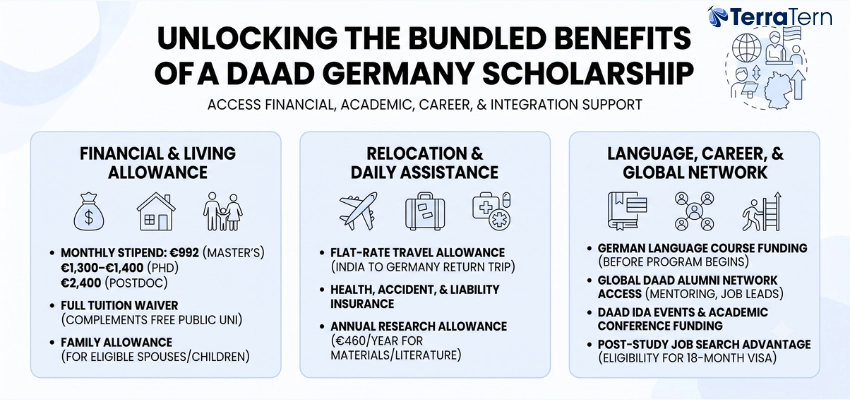
The DAAD Scholarship Germany opens access to far more than a monthly stipend; it bundles financial support, academic resources, career services, and cultural integration benefits that together make studying or researching in Germany far easier.
-
Monthly Stipend (Living Allowance): €992 (Master’s).
-
Monthly Stipend (PhD): €1,300–€1,400.
-
Monthly Stipend (Postdoc): €2,400.
-
Full Tuition Waiver at Public Universities: Most German public universities charge no tuition for international students; DAAD complements this by covering living costs, so tuition is effectively no barrier.
-
Health, Accident, and Personal Liability Insurance: Basic medical and liability coverage included or supported, reducing upfront insurance costs and administrative hassles.
-
Flat-Rate Travel Allowance: Return travel support from India to Germany (one trip) to ease relocation expenses.
-
Annual Study/Research Allowance: €460/year for materials, literature, or research-related purchases.
-
Pre-Program German Language Course Funding: Financial support for intensive German language courses before the program begins (where applicable).
-
Family Allowance (If Applicable): Additional monthly support for spouses and children in eligible cases, helping families relocate.
-
DAAD Alumni Network Access: Global alumni community across 60+ countries offering mentoring, job leads, and peer support.
-
DAAD IDA Events and Academic Conference Funding: Funding and organisational support to present at conferences, attend DAAD networking events, and participate in academic symposia.
-
Post-Study Job Search Advantage: After graduation, eligibility for the 18-month German job seeker visa, giving time to find skilled employment in Germany.
Key Note: Most Indian applicants focus only on the monthly stipend when calculating DAAD's value. The health insurance alone, valued at €100–€150/month in Germany, represents significant savings. When combined with free tuition, the true financial benefit often exceeds INR 15 lakh per year.
What Documents Are Required to Apply for the DAAD Scholarship?
Keep all documents in PDF format and mail one copy of the application summary to the nearest DAAD India regional office. Mandatory documents for all applicants are:
-
Completed DAAD online application form submitted via the funding-guide.de portal; save and download the application summary/printout. (Format: PDF)
-
CV / Résumé Europass format preferred; include education, research, publications, and contact details. (Format: PDF)
-
Letter of Motivation(LOM)1–3 pages (max 2 pages recommended), in English or German. Explain academic background, career goals, why Germany, and why DAAD. (Format: PDF)
-
Two Letters of Recommendation from professors or employers, on official letterhead, signed and dated. (Format: PDF scans)
-
Official academic transcripts and degree certificates for all tertiary degrees; include certified English translations if originals are in another language. (Format: PDF)
-
Proof of language proficiency, IELTS/TOEFL or TestDaF scores as required by the specific program (attach score reports). (Format: PDF)
-
Proof of work experience, employment certificates, or detailed recommendation letters if the program requires professional experience. (Format: PDF)
-
Research proposal mandatory for PhD or research grants; clearly state objectives, methodology, timeline, and host institution/supervisor if known. (Format: PDF)
-
Passport copy, biographic page (validity recommended for at least 6 months beyond planned stay). (Format: PDF)
-
Application summary printout, two copies recommended: one for applicant records, one mailed to the DAAD India regional office as instructed. (Format: printed PDF)
As per our TerraTern Expert Divyansh, the Letter of Motivation (LOM) is the most important document in your DAAD application; it is actively discussed during selection committee meetings. It should be 2 pages maximum and clearly explain your academic background, career goals, and why Germany specifically. Never make it a résumé in prose form.
Also Read: What Is the Total Cost of Study in Germany for Indian Students?
How Should You Write a DAAD Motivation Letter That Wins?
Open with a one-sentence summary of your current status and objective (e.g., "I am an MSc Environmental Engineering graduate seeking a DAAD Scholarship to pursue a research-based Master's at [University]").
-
Structure: Academic background → Research/Professional experience → Clear study/research objectives → Why Germany and the chosen university/program → Why DAAD and how the scholarship will advance your career.
-
Be Specific: name programs, supervisors, research groups, and institutions; cite two measurable goals (publications, projects, career outcome).
-
Show Fit: explain how your past experience prepares you for the proposed project and how the German academic environment is uniquely suited.
-
Keep Tone Professional and Personal: evidence-based claims with one short personal motivation sentence.
-
Length and Format: maximum 2 pages (hard limit 3 pages); use 11–12 pt font, 1–1.15 line spacing, and standard margins.
-
Common Mistakes to Avoid: repeating your CV in prose, being generic ("I want to study in Europe"), vague career plans, exceeding page limit, poor language/editing.
-
Selection Criteria Focus On: academic excellence, clarity and feasibility of the project or study plan, motivation and personal fit, and potential impact on the home country or field.
Important Tip: The DAAD selection committee is looking for specificity, not aspiration. "I want to study in Germany because it has great universities" is the weakest opening. Instead, name the specific program, cite a German professor's research, and explain the direct connection to your career trajectory in India.
How Do You Apply for the DAAD Scholarship Step by Step?
The DAAD Scholarship application process is straightforward but requires careful preparation. Below is a concise, numbered 10-step walkthrough you can follow from finding the right grant to receiving the award letter.
-
Identify the right DAAD scholarship by searching the DAAD Funding Guide (funding-guide.de) by level, subject, country, and deadline.
-
Check eligibility, verify CGPA, the 6-year rule, required work experience, and language test minimums for your chosen grant.
-
Register on the DAAD portal, create your account on the DAAD application portal (funding-guide.de / mydaad).
-
Complete the online application form, fill in details, and upload documents; this usually takes ~30 minutes.
-
Prepare and upload documents, following the document checklist (CV, LOM, transcripts, recommendations, language proof, research proposal, passport).
-
Download and print the application summary. Save the PDF and print the application summary/overview.
-
Mail the application summary and send one printed copy (plus one for your records) to the nearest DAAD India regional office, as instructed.
-
Tracking your application will take 5–6 months for processing. Use portal updates and regional office contacts for status queries.
-
Interview (if applicable): Attend a selection interview or online assessment when invited; prepare a concise pitch and discuss your motivation and project.
-
Receive award letter: Successful candidates receive an email and an official award letter with the next steps for visa, enrollment, and funding start
Expert Tip: Do not wait for the portal to open before preparing your documents. Start your LOM, gather LORs from professors, and have transcripts attested at least 2 months before the deadline. The portal opens only 6 weeks before the deadline, leaving very little time for document preparation.
What Are the DAAD Scholarship Deadlines for Indian Students in 2026?
DAAD deadlines change yearly, and always verify the specific program page on the official DAAD portal before you apply. DAAD Scholarship deadlines below are drawn from the DAAD funding pages and program calls (verified June 2026) and should be used as a starting guide.
|
Program |
Level |
Deadline (2026 cycle) |
Intake |
|
EPOS (Development-related postgraduate courses) |
Master’s |
Oct 2026 |
|
|
Helmut-Schmidt Programme (Public Policy & Governance) |
Master’s |
July 2026 (check specific call) |
Oct 2026 |
|
DAAD GSSP (Graduate School Scholarship Programme) |
PhD |
October 2026 (varies) |
Variable |
|
DAAD Research Grant |
Doctoral / Postdoc (short stays) |
Variable |
|
|
DAAD HSK Summer Courses |
UG / PG (language & culture) |
30 Oct 2026 (annual cycle) |
Summer 2026 |
|
DAAD WISE (Undergraduate Research) |
UG Research |
March 2026 (programme-specific) |
Summer 2026 |
Expert Advice: Most Indian applicants underestimate the 6-week portal window. For the October 2026 intake, the application portal typically opens in early September 2026, but the deadline is mid-to-late October 2026. Begin document preparation by July–August 2026 at the latest.
What Is the DAAD Scholarship Selection Process and Acceptance Rate?
DAAD Scholarship selection is usually a multi-stage process, combining eligibility checks with academic evaluation and a final committee decision. While exact figures vary by program, a realistic overall acceptance range is often around 10–15%, and strong, well-matched profiles may have better odds.
-
Preliminary Screening: DAAD first checks whether your application is complete and meets the basic eligibility rules, such as degree level, grades, language proof, and deadlines.
-
Academic Review: Subject experts assess your transcripts, motivation, and, for research or PhD applications, the quality and feasibility of the proposal.
-
Shortlisting: Some programs ask for a personal introduction or interview-style interaction to clarify your goals, fit, and preparedness.
-
Final decision: The DAAD selection committee makes the final award decision, either centrally or through the relevant country/program panel.
-
Notification and Timeline: Successful applicants are usually informed by email first, followed by the official award letter; the full process often takes about 3 to 6 months from submission to result.
Important Note: The acceptance rate improves dramatically with the quality of preparation, not just academic scores. Students who start 9 months early, target the right program, and craft a specific, evidence-based motivation letter consistently outperform applicants with higher GPAs who apply at the last minute.
What Happens After You Win the DAAD Scholarship? (Pre-Departure Checklist)
DAAD Scholarship winners still have a few important steps before departure, and handling them in the right order makes the move to Germany much smoother. After selection, you typically confirm the award, complete paperwork, sort your visa and housing finance documents, and then prepare for arrival and registration in Germany.
-
Accept the Award and Sign the Agreement: reply to DAAD promptly, formally accept the scholarship, and sign any scholarship contract or funding conditions they send.
-
Finalise Admission and Finance Proof: If you are not already admitted, complete your university application; for visa purposes, ensure your funding documents are ready, and note that DAAD support may cover or reduce blocked-account requirements.
-
Apply for the Germany Student Visa: Book your appointment with the German consulate in India, submit proof of admission/funding, passport, insurance, and other visa documents, and keep extra copies of everything.
-
Attend Orientation and Language Support: Join any DAAD pre-departure briefing, and enrol in a funded German language course if your award includes it.
-
Arrive and Register in Germany: After landing, complete local registration at the Residents’ Registration Office, then complete university enrollment and residence permit steps as required.
Pro Tip: The Germany student visa process takes 4–12 weeks at the German Consulate in India. Begin your visa application immediately after receiving the DAAD award letter; do not wait until you have university admission confirmation, as both processes can run in parallel.
What Are the Top Tips to Improve Your DAAD Scholarship Chances as an Indian Student?
Here are the top ways to improve your DAAD Scholarship eligibility and overall selection chances as an Indian student, especially if you want a stronger, more competitive profile.
-
Choose the Right Program: Match your degree, subject, work experience, and target level to the scholarship's exact criteria before applying; the best applications are those that fit the call precisely.
-
Start 9 Months Early: Begin early so you have time to improve documents, collect strong references, and avoid last-minute errors; DAAD timelines can be long, and preparation often matters as much as the application itself.
-
Strengthen your Motivation letter: Write a specific, evidence-based LOM that connects your academic background, German program, and Indian career goals; mention relevant German professors, research areas, or institutions where appropriate.
-
Pick the Right Referees and Admission Strategy: Use recommenders who know your academic or research work firsthand, and secure conditional university admission if possible, as it can make your profile more convincing.
-
Leverage your Transcript and Multiple Applications: Keep your CGPA trend steady and upward, then apply to multiple eligible DAAD tracks, if allowed; a strong final transcript and broader program fit can improve your odds.
Key Note: The single biggest differentiator between selected and rejected DAAD applications from India is not CGPA; it's the specificity of the motivation letter. Generic letters citing "excellent German education" are rejected at the first review stage. Named professors, specific research connections, and a clear post-graduation India contribution plan define winning applications.
2026 Industry Context Section
The key industry context facts are:
-
India is in the Top 2 globally for DAAD scholarship recipients. 2,785 Indian students received DAAD funding in 2023 alone (DAAD Annual Report 2023)
-
25+ DAAD scholarship programs are currently open to Indian applicants (DAAD India, 2026)
-
Acceptance rate for Indian applicants: approximately 10–15%; rises to 25–30% for applicants with a CGPA above 75% and a targeted motivation letter (Kadamb Overseas, 2026)
-
Monthly stipend (2026): €992 for Master's students; €1,300–€1,400 for PhD/Doctoral candidates; €2,400 for postdoctoral researchers (GyanDhan, updated 2026)
-
The total estimated annual value of a DAAD scholarship exceeds €15,000 when stipend, insurance, travel allowance, and study grant are combined (Kadamb Overseas, 2026)
-
Application processing time approximately 5–6 months from submission; students should begin preparing at least 7–9 months before their intended intake date
-
DAAD HSK Summer Courses portal opens September 1, 2026, with a deadline of October 30, 2026 (DAAD India, 2026)
Conclusion
The DAAD Scholarship is one of the best options for Indian students planning to study in Germany because it offers 25+ programs at the Master’s, PhD, and research levels, along with a monthly stipend of €992–€1,400, health insurance, travel support, and often a tuition waiver. For strong DAAD Scholarship eligibility, start 7–9 months early, focus on program fit, and make the Letter of Motivation exceptional. Ready to apply? Consult TerraTern for personalised DAAD guidance and visa support.
Contact TerraTern for more information on the DAAD Scholarship 2026: Complete Guide for Indian Students.



 AI Summary