

Key Highlights
- What are the ways for Germany PR After Masters?
- What Is Germany PR, and Why Should Indian Master's Graduates Care?
- What Are the Different Routes to Get Germany PR After a Master's Degree?
- What Are the Eligibility Requirements for Germany PRAfter a Master's?
- What Is the Step-by-Step Process to Get Germany PR After Your Master's?
- How Long Does It Take to Get Germany PR After a Master's Degree?
- What Are the Benefits of Germany PR After a Master's Degree for Indian Students?
- What Are the Common Mistakes That Can Delay or Derail Your Germany PR Application?
- How Does Germany PR After a Master's Compare to Other Countries for Indian Students?
- How Can TerraTern Help You Get Germany PR After Your Master's Degree?
- Conclusion
For Indian students, getting Germany PR after masters is now easier in 2026, the shortest path to which involves only 21-24 months of skilled work (qualifying skilled employment) upon completing a master's. Once you have earned a German master's degree, you can convert to an 18-month visa for employment, find a job in response to your academic qualifications and apply for the EU Blue Card (salary threshold: €35,100 for shortage occupations such as IT/engineering). You can apply for the Niederlassungserlaubnis (permanent settlement permit) in as little as 2 years with the required level of German B1 and regular social security payments.
What are the ways for Germany PR After Masters?
Students can obtain German PR after a Master's in Germany with an EU Blue Card (B1 German and €35,100+ salary) in as little as 21 months (after completing a Master’s in Germany). If no Blue Card, then 2 years of skilled work after graduation or 5 years of general residence. After graduation, you may receive an 18-month job-seeker permit that can help you find qualifying work.
These are key pathways to Germany PR from a Master's degree:
-
Higher Level of Qualification: Blue Card fast-track eligibility depends on the current salary threshold and language requirements, which should be checked against official German immigration guidance.
-
Graduate Settlement Permit: Some graduates may qualify for settlement after a period of skilled employment, pension contributions, and language proficiency.
-
Standard Pathway to Citizenship: A standard settlement pathway may require several years of continuous legal residence before eligibility for permanent residence or citizenship, depending on the route.
Also Read: How Many Years to Get PR in Germany? Fast-Track Guide
What Is Germany PR, and Why Should Indian Master's Graduates Care?
Niederlassungserlaubnis is a long-term settlement permit that allows indefinite residence, subject to legal conditions, which does not require visa renewals as it is a temporary residency attached to employment or a course. In the case of Indian Germany PR after a master's qualification PR implies:
-
No Permit Applications Required: change employers at any time without the need for a permit change for a job change or for starting a business.
-
Equal Social Benefits: Unemployment, child care, pension, etc., in the same measure as Germans
-
EU Mobility: Unrestricted access to the Schengen countries and facilitated access to other countries of the EU.
-
Citizenship Pathway: Citizenship after eight years in the country (or five years as of a new proposal for 2026). Germany offers Indian graduates a secure pathway to build a career in Europe. Indian student enrolment in Germany has risen steadily in recent years; verify the latest official figure before publication.
As per TerraTern Expert, Divyansh, Germany PR never expires as long as you visit Germany at least once every 6 months, making it a permanent insurance policy for Indian professionals even if they return to India temporarily.
What Are the Different Routes to Get Germany PR After a Master's Degree?
Indian Master's graduates have three main pathways for Germany PR after masters, the EU Blue Card fast track (21–27 months), the standard skilled worker route (4–5 years), and the German Graduate Route (2 years post-study work).
|
Route |
Min. Timeline |
Key Requirement |
|
EU Blue Card (B1 German) |
21 months |
€45,934+/yr salary + B1 German |
|
EU Blue Card (A1 German) |
27 months |
€45,934+/yr salary + A1 German |
|
German Graduate Route |
~2 years |
German degree + skilled job |
|
Skilled Worker Visa |
4–5 years |
Relevant employment |
-
A misconception that needs to be corrected is that student visa time is not considered towards PR eligibility.
-
50% study time counts towards the 5-year route for standard residence
-
A job seeker visa (18 months) doesn't count against the PR clock.
-
Master's grads are the most strategic of the group to receive a Blue Card because of the quickest service time (21 months).
-
The salary range for those in shortage fields (IT/engineering): €35,100 - €45,934; for others: €25,000 - €45,934.
Important Note: The job seeker visa after graduation is essential, but it counts zero toward your PR clock; your eligibility begins only from the date your Blue Card or work permit is issued.
How Does the EU Blue Card Fast-Track Work for Master's Graduates?
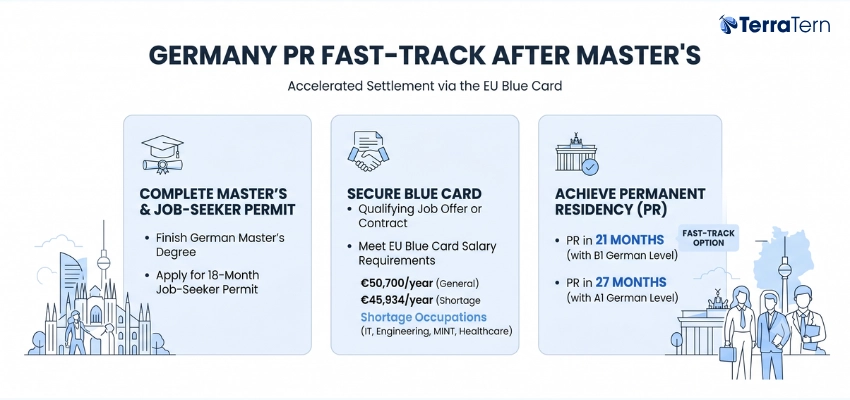
You can gain PR in 21 months (B1 German) or 27 months (A1 German) in Germany on this fast-track after completing your degree here with a salary above Germany's.
-
Meet the requirements for a German Master's and apply for a job-seeker permit.
-
Complete a German Master's degree and apply for an 18-month job-seeker permit.
-
You need a qualifying job offer or employment contract that meets the current Blue Card requirements.
-
Apply for the Blue Card with a salary of €45,934/year (shortage occupations: IT, engineering, MINT, healthcare) or €50,700 for others
-
A higher German language level can shorten the path to settlement under applicable rules.
-
Shortage occupations (STEM/IT/healthcare) qualify for the lower threshold of €45,934, which means that your Germany PR after masters is accelerated.
Expert Tip: Recent graduates who obtained their degree within the past 3 years qualify for a lower Blue Card salary threshold (€45,934) even in non-shortage professions, a significant advantage most applicants don't know about.
What Is the Standard Route to Germany PR without a Blue Card?
Without an EU Blue Card, Germany PR after masters graduates to have 5 years of qualifying skilled employment, B1 German, and continuous pension contributions.
-
5-Year Clock: Starts only after graduation; 50% of study time counts (e.g., 2-year Master’s = 1-year credit).
-
Qualifying Job: Must match your degree and be on a skilled worker visa (not self-employment or temporary work).
-
B1 German Required: Mandatory for PR under this route.
-
Less Popular: Slower than Blue Card; useful if salary is below €45,934 (non-shortage fields).
-
Pension Rule: Minimum 60 months of contributions needed for eligibility.
Expert Advice: Study time in Germany counts at only 50%, a 2-year Master's program contributes just 1 year toward the standard 5-year PR requirement, making the Blue Card fast-track significantly more time-efficient for most Indian graduates.
What Are the Eligibility Requirements for Germany PRAfter a Master's?
To qualify for Germany PR after masters, you must complete the required residence period, hold a relevant job, meet B1 German proficiency, show financial self-sufficiency, and make mandatory pension contributions.
|
Requirement |
Detail |
|
Residence Period |
|
|
Valid Permit |
EU Blue Card or skilled worker visa (student/job seeker visas don’t count) |
|
Employment |
Long-term contract matching your degree |
|
German Language |
|
|
Pension Contributions |
Continuous payments throughout employment |
|
Financial Stability |
No reliance on public welfare |
|
Housing & Record |
Adequate housing + no criminal convictions |
-
Degree Recognition: Indian graduates must verify their Master’s via Anabin/ZAB to convert to work permits
-
APS Certificate: Required for Indian students’ university admission and later work permit conversion
Important Tip: Many Indian Master's graduates assume their student visa time counts toward PR it does not. Your PR eligibility clock starts only when you switch to a qualifying employment permit, such as the EU Blue Card.
How Does the German Language Requirement Affect Your PR Timeline?
German proficiency is the biggest lever for Germany PR after masters: B1 cuts Blue Card PR to 21 months, while A1 is the minimum for the 27-month route.
-
A1 vs. B1: A1 = basic survival; B1 = independent daily/work communication (required for fastest PR)
-
B1 Certificates: Obtain via Goethe-Institut, telc, or ÖSD (widely accepted by Ausländerbehörde)
-
Study Timeline: 6–12 months of consistent study from zero to reach B1
-
ROI of B1: Saves 6 months = 6 extra months of higher earnings and job stability
-
Integration Course: Completing it + B1 test covers the 33-month standard route (non-Blue Card)
As per TerraTern Expert: Investing 6–9 months in reaching B1 German while on your job seeker visa is the highest-ROI activity for an Indian Master's graduate; it literally shaves 6 months off your path to permanent residency.
What Documents Are Required for Germany PR After a Master's Degree?
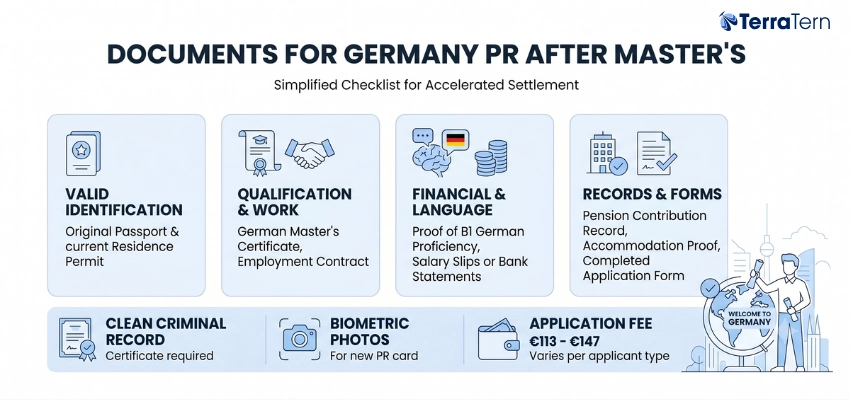
To apply for Germany PR after masters you must submit a complete set of documents to your local Ausländerbehörde. Ensure all documents are valid, up to date, and, if required, translated into German.
-
Valid passport (original + photocopies)
-
Current residence permit (EU Blue Card or skilled worker visa)
-
Master’s degree certificate (with certified translation if needed)
-
Employment contract (permanent or long-term, relevant to your qualification)
-
Proof of B1 German language proficiency (recognised certificate)
-
Pension contribution record from Deutsche Rentenversicherung
-
Proof of health insurance coverage
-
Accommodation proof (rental agreement or property ownership papers)
-
Financial proof (recent salary slips or bank statements)
-
Clean criminal record certificate
-
Biometric passport photographs
-
Completed the PR application form from your local Ausländerbehörde
-
Application fee of approximately €113 (standard applicants) to €147 (self-employed applicants)
Pro Tip: Begin collecting pension contribution records from your first month of employment. Deutsche Rentenversicherung can take 4–6 weeks to issue official statements, and missing this document is one of the most common causes of delays in PR applications.
Also Read: Is It Easy to Get a Job in Germany After a Master's? Experts Guide
What Is the Step-by-Step Process to Get Germany PR After Your Master's?
Getting Germany PR after masters follows a structured five-stage pathway, from graduation to permanent residency. You must complete your degree, switch to a post-study permit, secure Blue Card-eligible employment, build pension contributions, and finally apply for permanent settlement through your local immigration office.
-
Stage 1 — Complete Your Master’s Degree: Graduate from a recognised German university and ensure your qualification is approved under Anabin or ZAB. If your final certificate is delayed, request an Abschlussbescheinigung.
-
Stage 2 — Activate the Post-Study Job Seeker Permit: Apply at your local Ausländerbehörde within 1 month of graduation. This 18-month permit allows part-time work while searching for a full-time skilled role.
-
Stage 3 — Secure Blue Card-Eligible Employment: Find a job relevant to your qualification with salary thresholds of €45,934 (shortage occupations) or €50,700 (other sectors), then apply for the EU Blue Card.
-
Stage 4 — Build Eligibility Through Work: Maintain continuous employment, contribute to the German pension system, achieve B1 German proficiency, and avoid social welfare dependency.
-
Stage 5 — Apply for Germany PR: Book your Ausländerbehörde appointment, submit documents, provide biometrics, pay €113–€150, and wait 3–6 months to receive your Niederlassungserlaubnis
Key Note: Book your Ausländerbehörde appointment 3–6 months before your current permit expires. Appointment slots in major cities like Berlin, Munich, and Frankfurt are chronically overbooked, and permit gaps could interrupt your PR eligibility timeline.
What Happens If My Master's Certificate Is Delayed? Can I Still Apply for a Blue Card?
Yes, many applicants pursuing a master's can still proceed using an Abschlussbescheinigung, though approval depends on the local Ausländerbehörde.
-
Use an Abschlussbescheinigung as official proof of degree completion while awaiting the final certificate
-
Request it from your university after thesis submission and grade confirmation
-
Acceptance varies by city, so local Ausländerbehörde rules matter
-
Alternative route: apply using an Anabin-recognised Indian Bachelor’s degree if eligible
-
Always confirm directly with your immigration office before your job offer deadline when applying for Germany PR after masters.
As per TerraTern Expert Shreya, don't wait for your final Master's certificate before starting your job search; many employers and some Ausländerbehörden accept official graduation confirmations, and delays of 2–3 months in final certificates are common at German universities.
How Long Does It Take to Get Germany PR After a Master's Degree?
Securing Germany PR after a Masters degree takes as little as 21 months via the EU Blue Card if you possess B1 German proficiency. It takes 27 months with A1 German, or up to 5 years via the standard skilled worker route.
|
Pathway |
PR Timeline |
German Language Required |
Salary Minimum (2026) |
|
Blue Card + B1 German |
21 months |
B1 |
€45,934/yr (shortage occupations) |
|
Blue Card + A1 German |
27 months |
A1 |
€45,934/yr (shortage occupations) |
|
Skilled Worker Visa |
4–5 years |
B1 |
Market rate |
|
German Graduate Route |
~2 years of employment |
B1 |
Market rate |
-
The 18-month job-seeker period is not included in the settlement timelines above.
-
Processing Time: 3–6 months after submission; appointment wait: 1–6 months (city-dependent)
-
Realistic Total: 3–5 years from graduation to PR card (job search + eligibility + processing)
Important Note: Factor in 3–6 months of Ausländerbehörde appointment waiting time on top of your Blue Card eligibility period; the PR card won't arrive the day you become eligible; plan your permit renewals accordingly.
What Are the Benefits of Germany PR After a Master's Degree for Indian Students?
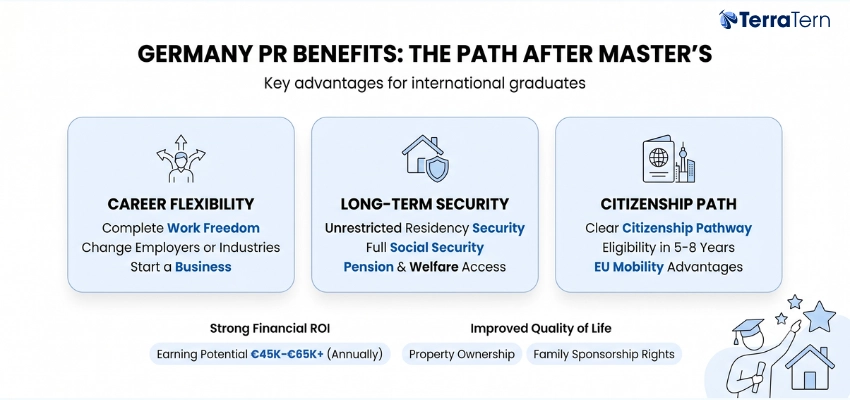
Securing Germany PR after masters gives Indian graduates long-term residency security, unrestricted career flexibility, stronger financial opportunities, and a clear pathway to citizenship. It offers permanent settlement benefits that significantly improve career growth, family stability, and return on investment compared to many other global study destinations.
-
Permanent residence security, no repeated visa renewals after receiving
-
Complete work freedom, change employers, switch industries, or start a business without additional approvals
-
Full social security access, healthcare, pension benefits, unemployment protection, and public welfare access
-
EU mobility advantages, eligibility for broader European residency opportunities through long-term residence status
-
Higher education benefits from easier access to subsidised education and financial aid for further studies
-
Property ownership opportunities improved eligibility for German bank loans and home financing
-
Family sponsorship rights bring spouse and children; spouses can typically work immediately
-
Pathway to German citizenship eligibility after 5–8 years of legal residence
-
Dual nationality advantages for recent reforms improve flexibility for long-term residents pursuing citizenship
-
Strong financial ROI, Indian professionals with PR after masters often earn €45,000–€65,000 annually, significantly higher than many equivalent starting salaries in India
Expert Tip: Germany PR comes with the right to apply for the Daueraufenthalt-EU status, which allows you to live and work across the European Union, effectively giving Indian Master's graduates access to 27 countries with a single permit.
Also Read: How to Get a Post-Study Work Visa in Germany as an Indian Student?
What Are the Common Mistakes That Can Delay or Derail Your Germany PR Application?
Many Indian graduates pursuing Germany PR after masters face avoidable delays due to documentation errors, visa gaps, or misunderstanding eligibility rules.
-
Assuming the Job Seeker Visa Counts Toward PR: It does not count toward Germany PR after a master's residency; only valid employment-based residence permits qualify.
-
Accepting a Job Unrelated to Your Master’s Degree: Your role must align with your academic qualifications to ensure EU Blue Card validity.
-
Allowing Residence Permit Gaps: Even a single permit lapse can pause or reset your PR eligibility timeline.
-
Claiming Social Welfare Benefits: Receiving Hartz IV or similar state support can disqualify your PR application.
-
Delaying Ausländerbehörde Appointments: Immigration office wait times in major German cities can extend for months.
-
Failing to Maintain Pension Contribution Records: Missing documentation from Deutsche Rentenversicherung can delay approval.
-
Switching to a Tourist Visa: This immediately interrupts your continuous legal residence period.
-
Skipping Degree Recognition Checks: Ensure your qualification is recognised through Anabin or ZAB before a Blue Card application.
-
Incorrectly Calculating Study-Period Credit: Study years count as only 50% toward the standard five-year PR route.
-
Staying Outside Germany for Extended Periods: Absences exceeding six months can invalidate accumulated PR eligibility
Expert Advice: If your current residence permit is approaching expiry and your appointment is still weeks away, apply for a Fiktionsbescheinigung (bridging certificate), it keeps you legally resident while your new permit is processed and protects your PR eligibility clock.
How Does Germany PR After a Master's Compare to Other Countries for Indian Students?
For Indian students, Germany PR after masters offers one of the fastest and most cost-effective permanent residency pathways globally. Germany’s 21–27 month EU Blue Card route is significantly quicker than Canada and Australia, while the UK offers no direct PR pathway after graduation.
|
Country |
Fastest PR Route After Study |
Language Requirement |
Approx. Cost |
PR Expires? |
|
Germany |
21–27 months (EU Blue Card) |
B1 German (21 months) or A1 (27 months) |
€113 – €150 |
No (Maintained with periodic residence) |
|
Canada |
2–5 years (Express Entry / PNP) |
IELTS / CELPIP required |
CAD $1,500+ |
No (Must meet residency obligations) |
|
Australia |
4+ years (Skilled Migration - 189/190) |
English required (IELTS/PTE) |
AUD $4,640+ |
No (Travel facility expires every 5 years) |
|
UK |
No direct PR from the study (Requires 5 years on Skilled Worker visa) |
English required |
£2,885+ (ILR application fee) |
No (Can lapse if absent for 2+ consecutive years) |
- Fastest Pathway: PR can be possible in as little as 21 months for some Blue Card holders who meet current salary and language conditions.
-
Lower Total Investment: Public universities often charge near-zero tuition, unlike Canada, Australia, or the UK.
-
Affordable PR Application Costs: Germany’s PR processing fees are substantially lower than those of competing destinations.
-
Rising Indian Student Preference: Indian student numbers in Germany grew from 49,000 (2022) to 59,419 (Winter 2024/25), reflecting growing trust in Germany’s education-to-PR model.
-
Strong “Backup Plan” Advantage: Even if you return to India later, holding German PR preserves long-term re-entry rights and future flexibility in a European career.
-
Better long-Term ROI: The combination of low study costs, strong salaries, and quick settlement makes Germany PR one of the smartest migration strategies for Indian students.
Pro Tip: Germany is currently the only major developed country offering a sub-2-year PR pathway from a Master's degree completion, a structural advantage that will remain significant even as other countries modify their immigration rules.
How Can TerraTern Help You Get Germany PR After Your Master's Degree?
Securing Germany PR after masters becomes significantly easier with expert guidance. TerraTern supports Indian Master’s graduates throughout the entire Germany PR journey from degree recognition and EU Blue Card processing to job search strategy, immigration documentation, and settlement support.
-
EU Blue Card Application Support: End-to-end assistance with eligibility checks, documentation, and visa filing.
-
Degree Recognition Guidance: Help with Anabin/ZAB evaluation to ensure qualification acceptance.
-
Job Search Assistance: CV optimisation, German employer targeting, and market-entry strategy.
-
German Language Preparation Support: Guidance for reaching the B1 level to accelerate PR eligibility.
-
Ausländerbehörde Appointment Strategy: Support for securing and preparing for immigration office appointments.
-
Post-Landing Settlement Services: Assistance with accommodation, city registration, banking, and onboarding.
Key Note: The difference between a successful and failed Germany PR application is almost always in the documentation and timing; errors in Ausländerbehörde submissions or permit gaps can cost applicants months. Working with certified immigration advisors significantly reduces this risk.
Also Read: Permanent Residence Germany: Guide for Indians & Expats
Conclusion
For Indian students seeking long-term international career growth, Germany PR after masters offers one of the fastest and most affordable permanent residency pathways worldwide. With low education costs, strong job opportunities, and a clear EU Blue Card route, Germany provides exceptional long-term value. Careful planning, timely documentation, and expert guidance can simplify the process, helping graduates confidently transition from higher education to permanent settlement and build a secure future in Germany.
Contact TerraTern for more information on Germany PRAfter Masters: Complete 2026 Pathway for Indian Students.