Key Highlights
- What are Civil Engineering Jobs in Germany?
- Why Is Germany the Best Destination for Civil Engineering Jobs?
- What Are the Top Job Opportunities for Civil Engineers in Germany?
- What Salary Can You Expect From Civil Engineering Jobs in Germany?
- What Are the Requirements for Civil Engineering Jobs in Germany for Foreigners?
- What Visa Options Are Available for Civil Engineering Jobs in Germany for Foreigners?
- How Can Indian Civil Engineers Find and Apply for Jobs in Germany?
- What Is the Permanent Residency Pathway After Civil Engineering Jobs in Germany?
- Which Cities Offer the Best Civil Engineering Jobs in Germany?
- Latest Market Update
- Conclusion
India's professionals are in for an unprecedented opportunity to leap into Germany's vast infrastructure expansion in 2026. If you're looking to find civil engineering jobs in Germany, the rewards are abundant given the significant lack of talent in the area. The book provides an overview of the job opportunities for civil engineers in Germany, with detailed explanations of available visas, including the Opportunity Card.
Regardless of your speciality, whether in structural, transportation or environmental engineering, becoming familiar with the right strategy for securing high-paying civil engineering jobs in Germany for foreigners is within reach.
What are Civil Engineering Jobs in Germany?
The list of civil engineering careers in Germany is as follows:
-
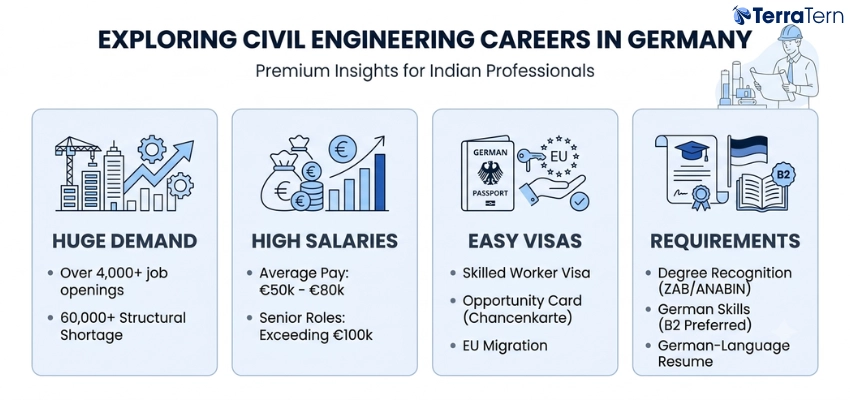
Huge Demand: There are over 4,000 job openings in Europe's largest economy, HUGE Demand.HUGE Demand: Structural shortage of 60,000+ engineers results in more than 4,000 job openings in Europe's largest economy.
-
High Salaries: Average annual pay ranges from €50,000 to €80,000 (~₹46–74 Lakhs), with senior roles exceeding €100,000.
-
Easy Visas: There are broad possibilities for migration to India; through migration, Indian professionals can obtain the opportunity card (Chancenkarte), a skilled worker visa, and the opportunity card, which is provided by the EU, for migration to the EU.
-
Requirements: Degree recognition (ZAB/ANABIN) is a key requirement, as are bilingual (German) skills (B2 level preferred) and the company's German-language resume.
Also Read: Pursue Civil Engineering Jobs in Germany: Everything You Need To Know
Why Is Germany the Best Destination for Civil Engineering Jobs?
The top career destination for civil engineering jobs in Germany. It's a combination of Europe's largest infrastructure investment pipeline, a 60,000+ skills shortage, Europe's average salary for civil engineering jobs of €65,000-€70,000/year, and an easy company visa.
-
With the term "bottleneck occupation" (Engpassberufe), these fast-track visas fall under the accelerated visa processing (Beschleunigtes Fachkräfteverfahren).
-
The costs of roads, bridges, rail systems, and green flood-management systems are distributed over this time at a cost greater than €200 billion, a massive pipeline.
-
Recognising exposure to the latest technology, global building information modelling (BIM) standards and exact workflows.
-
Structured Rotational 35–40-hour work-weeks and 28–30 days of required paid leave.
-
With an EU “Blue Card”, it is possible to obtain permanent residency with a time limit of 21 months (with B1 German) or 33 months (with B1 German).
-
Social Safety Net: Complete health insurance, com
As per TerraTern Expert Shreya, Germany's official designation of civil engineering as a bottleneck occupation means your visa application is processed through the accelerated procedure (Beschleunigtes Fachkräfteverfahren), which can reduce your total processing time from 4–6 months down to just 4–8 weeks when your employer initiates the process through the local Foreigners' Authority (Ausländerbehörde).
Also Read: Teaching Jobs in Germany for Indians
What Are the Top Job Opportunities for Civil Engineers in Germany?
As is the case throughout the EU, job opportunities for civil engineers in Germany who want to pursue further training and careers in Germany can choose from several engineering specialisations, including, but not limited to, structural engineering, transportation and infrastructure engineering, environmental /water engineering, geotechnical engineering, construction management and Building Information Modelling (BIM).
Which Civil Engineering Specialisations Have the Most Job Opportunities in Germany?
The Civil Engineers have many opportunities in Germany, in the years to come, especially in the structural engineering sector and mainly in the transportation engineering and the environmental engineering sector, because of the increased need for infrastructure renewal, the expansion of Deutsche Bahn, and the mandate to meet the EU's Green Deal requirement
|
Specialisation |
German Term |
Avg. Annual Salary |
Top Employers |
Demand Level |
|
Structural Engineering |
Konstruktiver Ingenieurbau |
€60,000–€80,000 |
HOCHTIEF, Goldbeck, Bilfinger |
Very High |
|
Transportation Eng. |
Verkehrswegebau |
€58,000–€78,000 |
Deutsche Bahn, DEGES |
Very High |
|
Environmental Eng. |
Umwelt- und Wasserbau |
€55,000–€72,000 |
IWW, DWA, GELSENWASSER |
High |
|
Geotechnical Eng. |
Geotechnik |
€58,000–€75,000 |
Züblin, Bauer AG, Bilfinger |
High |
|
Construction Mgmt. |
Bauprojektmanagement |
€62,000–€85,000 |
STRABAG, Vinci, Hochtief |
Very High |
|
BIM / Digital Eng. |
BIM Koordinator |
€60,000–€82,000 |
Drees & Sommer, ARGE BIM |
High |
|
Urban Planning |
Stadtplanung |
€50,000–€68,000 |
Municipal authorities, GMA |
Moderate |
Important Note: BIM (Building Information Modelling) is the fastest-growing specialisation gap in German civil engineering; the country's construction sector is rapidly adopting BIM mandates for all public projects above €5 million. Indian civil engineers who invest in BIM certification (Autodesk Revit, Archicad, or Allplan, the latter being dominant in Germany) before applying will significantly differentiate their applications from those of standard civil engineering candidates.
Which Are the Top Companies Offering Civil Engineering Jobs in Germany for Foreigners?
The top companies hiring civil engineers jobs in Germany for foreigners are HOCHTIEF, STRABAG, Goldbeck GmbH, Ed. Züblin AG, Bilfinger, Drees & Sommer, German Railway (DB), and Autobahn GmbH des Bundes are all recruiters of international talent and will sponsor your visa.
|
Company |
Headquarters |
Annual Revenue |
Specialisation |
Language Requirement |
Indian-Friendly? |
|
HOCHTIEF |
Essen |
€25 billion |
International construction |
English + German B2 |
Yes |
|
STRABAG |
Vienna/Munich |
€16 billion |
Road, rail, tunnels |
German B2 |
Yes |
|
Goldbeck GmbH |
Bielefeld |
€5 billion |
Modular construction |
German B1 |
Yes |
|
Ed. Züblin AG |
Stuttgart |
€6 billion |
High-rise, tunnels |
German B2 |
Yes |
|
Bilfinger |
Mannheim |
€4 billion |
Industrial engineering |
English/German |
Yes |
|
Drees & Sommer |
Stuttgart |
€900 million |
Project management |
English + German |
Yes |
|
Deutsche Bahn |
Berlin |
€45 billion |
Rail infrastructure |
German B2 |
Yes |
|
Autobahn GmbH |
Berlin |
Government |
Highway planning |
German B2 |
Yes |
|
Implenia |
Düsseldorf |
€3 billion |
Infrastructure, civil works |
German B2 |
Partial |
|
Tesla GmbH |
Grünheide |
Private |
Gigafactory infrastructure |
English accepted |
Yes |
Expert Advice: Germany's Mittelstand (small- to medium-sized enterprises) collectively employs more engineers than the major construction multinationals, and these companies often offer faster hiring timelines, more personal work environments, and comparable salaries. Many post exclusively on XING or regional job boards rather than LinkedIn, so limiting your search to LinkedIn misses a significant portion of available civil engineering vacancies.
Also Read: 10 Best Universities in Germany for International Students
What Salary Can You Expect From Civil Engineering Jobs in Germany?
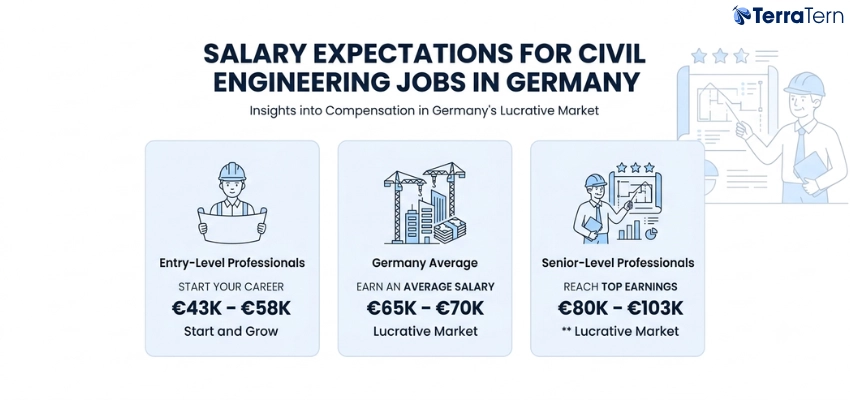
Civil engineers in Germany earn an average salary of €65,000–€70,000/year (~₹70.8–76.2 Lakhs), with entry-level positions starting at €43,000–€58,000 and senior-level professionals earning €80,000–€103,000. This makes it one of the most lucrative markets for civil engineering jobs in Germany and across Europe.
What Is the Civil Engineer Salary in Germany by Experience Level?
Civil engineers in Germany earn a salary of €43,000–€58,000/year; mid-career professionals take home €60,000–€80,000; and senior engineers with 8+ years of experience command €80,000–€103,000, far surpassing global engineering salary averages.
|
Experience Level |
Annual Salary (€) |
Monthly (€) |
Annual (INR ≈) |
Notes |
|
Entry (0–3 years) |
€43,000–€58,000 |
€3,583–€4,833 |
₹46.8–63.2 Lakhs |
Requires degree recognition in Germany |
|
Mid-Career (3–6 yrs) |
€58,000–€75,000 |
€4,833–€6,250 |
₹63.2–81.7 Lakhs |
Assumes relevant project experience |
|
Senior (7–10 yrs) |
€75,000–€90,000 |
€6,250–€7,500 |
₹81.7–98.0 Lakhs |
Target for project/site management roles |
|
Expert (10+ yrs) |
€90,000–€103,000+ |
€7,500–€8,583+ |
₹98.0–112.2 Lakhs+ |
Specialist or executive management track |
How Does a Civil Engineer Salary in Germany Compare to Other European Countries?
Civil engineers in Germany offer one of the highest civil engineering salaries in Continental Europe, averaging €65,000/year. While it trails Switzerland (~€98,000) and Norway (~€68,000), it sits comfortably ahead of the Netherlands (~€60,000) and France (~€52,000), offering an unmatched balance of high pay and accessible visa pathways.
|
Country |
Avg. Civil Eng. Salary |
INR Equivalent |
Visa for Indians |
|
Switzerland |
CHF 95,000 (~€98,000) |
₹106.7 Lakhs |
Swiss work permit (highly competitive) |
|
Norway |
NOK 780,000 (~€68,000) |
₹74.0 Lakhs |
Skilled worker visa |
|
Germany |
€65,000 |
₹70.8 Lakhs |
EU Blue Card / Skilled Worker Visa |
|
Netherlands |
€60,000 |
₹65.3 Lakhs |
Highly Skilled Migrant Visa |
|
UK |
£48,000 (~€55,000) |
₹59.9 Lakhs |
Skilled Worker Visa |
|
France |
€52,000 |
₹56.6 Lakhs |
Talent Passport |
Expert Tip: When comparing Germany's €65,000 average to India's metro-level civil engineering salaries of ₹10–18 Lakhs, the income differential is 4–6x but when adjusted for Germany's cost of living (net income after rent, food, and transport), Indian engineers in Germany typically save more in absolute terms than their counterparts in UAE or UK at comparable experience levels.
What Are the Requirements for Civil Engineering Jobs in Germany for Foreigners?
The key requirements for civil engineering jobs in Germany for foreigners are: a recognised civil engineering degree (verified via ANABIN/ZAB), relevant work experience, German language proficiency (B2 recommended), a valid work visa (EU Blue Card or Skilled Worker Visa), and proficiency in CAD/BIM software.
How Do Indian Engineers Get Their Degree Recognised in Germany?
Indian civil engineering degrees are recognised in Germany through the ANABIN database (a quick online check) and the ZAB (Central Office for Foreign Education), which issues a formal Statement of Comparability, a document often required for your work visa and employment applications.To validate your qualifications for civil engineering jobs in Germany for foreigners, follow these four steps:
-
Step 1: Check the ANABIN Database: Search your university on anabin.kmk.org. If listed as H+, your institution is fully recognised. Status H± means partial recognition based on the specific degree.
-
Step 2: Apply to ZAB (if required): If your status is H±, you must apply for a Statement of Comparability. This costs €208, takes 4–12 weeks, and legally confirms your B.Tech/M. Tech is equivalent to a German Diplom-Ingenieur.
-
Step 3: Ingenieurkammer Registration: Register with the State Chamber of Engineers only if you need the protected "Ingenieur" title to legally sign off on structural drawings.
-
Step 4: Engineering Card: While optional, obtaining this credential from FEANI standardises your degree across 35+ countries and adds massive credibility to your applications.
|
Institution Type |
ANABIN Status |
ZAB Required? |
German Equivalent |
|
IITs (All) |
H+ |
No |
Diplom-Ingenieur (M.Sc. Eng.) |
|
NITs / BITS Pilani |
H+ |
No |
Diplom-Ingenieur (FH) |
|
Reputed State Univ. |
H± |
Yes |
Verified individually by ZAB |
|
Newer Private Univ. |
H- / H± |
Yes |
ZAB required; may be rejected |
Important Tip: Start your ANABIN check immediately , if your university shows H± status, begin your ZAB application 6 months before your target job search start date. The ZAB Statement of Comparability is both a visa requirement and a hiring confidence signal for German employers unfamiliar with Indian engineering institutions.
What Language Skills Do You Need for Civil Engineering Jobs in Germany?
German B2 level (upper-intermediate) is the practical minimum for most civil engineering jobs in Germany for foreigners, as site communication, technical documentation, permits, and client meetings are conducted in German, though some international firms accept B1 or English for office-based roles.
|
Language Level |
Certification |
Job Scope |
Recommended Path |
|
A1–A2 |
Goethe-Zertifikat A1/A2 |
Very limited; not sufficient for professional roles |
Starting point only |
|
B1 |
Goethe-Zertifikat B1 |
Office roles at international firms; no site-based work |
Target before arrival |
|
B2 |
Goethe-Zertifikat B2 |
Most civil engineering roles: standard hiring requirement |
Recommended minimum |
|
C1 |
Goethe-Zertifikat C1 |
Senior management, client-facing, independent engineering |
Career accelerator |
As per TerraTern Expert: German B2 proficiency is the single biggest competitive differentiator for Indian civil engineers in the German job market. Employers consistently choose the B2 candidate over the stronger technical candidate with only A2/B1 German. Invest in German language learning alongside your visa and degree recognition process; 12 months of consistent study before relocating is the optimal timeline.
What Technical Skills Are Required for Civil Engineering Jobs in Germany?
The most in-demand technical skills for civil engineers in Germany as foreigners include:
|
Skill Category |
Specific Skills |
Demand Level |
Notes for Indian Engineers |
|
CAD / Design |
AutoCAD, MicroStation |
Essential |
Most Indian engineers are already proficient. |
|
BIM Software |
Autodesk Revit, Allplan, ArchiCAD |
High |
Allplan is German-dominant — upskilling is highly recommended. |
|
Structural Analysis |
SAP2000, ETABS, STAAD.Pro, RFEM |
Essential |
Widely used in Indian engineering; directly transferable. |
|
Project Management |
MS Project, Primavera, BIM 360 |
High |
A PMP certification adds significant value to your profile. |
|
Engineering Standards |
DIN norms, Eurocode |
Required |
Different from IS standards; requires dedicated self-study. |
|
Sustainability |
LCA tools, Green Building standards |
Growing |
Aligns perfectly with Germany's ongoing Green Deal requirements. |
|
GIS / Mapping |
QGIS, ArcGIS |
Moderate |
Strong asset for transportation and urban planning roles. |
Pro Tip: Invest in Allplan certification before applying to German civil engineering firms; it's Germany's dominant BIM platform (used by 70%+ of German construction firms), and proficiency in Allplan, rather than Revit alone, will make your application stand out immediately in the German market.
What Visa Options Are Available for Civil Engineering Jobs in Germany for Foreigners?
Civil engineering jobs in Germany for foreigners have three primary visa pathways to work in Germany: the EU Blue Card (best for engineers with a job offer earning €41,041+), the Skilled Worker Visa (for any salary level with a recognised qualification and job offer), and the Opportunity Card or Chancenkarte (for those without a job offer yet, to relocate and job-search in Germany for 12 months).
What Is the EU Blue Card for Civil Engineers in Germany?
The EU Blue Card is Germany's premium work and residence permit for highly qualified non-EU professionals. For those securing civil engineering jobs in Germany, the minimum salary threshold is €41,041.80/year (~₹44.7 Lakhs) because it is a shortage occupation, significantly lower than the general threshold of €45,300.
|
Feature |
Details |
|
Visa Type |
Work + Residence Permit (EU-wide recognition) |
|
Min. Salary (Civil Eng.) |
€41,041.80/year (~₹44.7 Lakhs) |
|
Min. Salary (General) |
€45,300/year (~₹49.4 Lakhs) |
|
Degree Required |
Bachelor's equivalent or higher, recognised in Germany |
|
Job Offer Required |
Yes — confirmed before application |
|
Initial Duration |
4 years (or contract duration + 3 months) |
|
PR Eligibility |
After 33 months (without German) or 21 months (with B1 German) |
|
Family Reunification |
Immediate (spouse + children) — spouse can work immediately |
|
EU Mobility |
After 18 months in Germany → can work in other EU countries |
|
Application Cost |
~€140 (~₹15,200) |
Key Note: Civil engineering's official "shortage occupation" designation in Germany means your EU Blue Card salary threshold is €41,041, not the standard €45,300. This distinction matters enormously for entry- and mid-level Indian engineers whose job offers may fall between these thresholds; always specifically request EU Blue Card processing (not a standard work visa) when your salary qualifies.
What Is the Germany Opportunity Card (Chancenkarte) for Indian Civil Engineers?
The Germany Opportunity Card (Chancenkarte), launched in June 2024, allows Indian civil engineers to relocate to Germany for up to 12 months to job-search without a prior job offer. Unless you have a fully recognised foreign degree (which grants automatic eligibility), you will be assessed on a transparent points-based system where a minimum score of 6 points is required to qualify. Here is how the 2026 points are awarded for those seeking civil engineering jobs in Germany:
|
Criterion |
Points Awarded |
|
Partial Recognition (Foreign degree partially recognised by ZAB) |
4 points |
|
Work Experience (5+ years in the last 7 years) |
3 points |
|
German Language: B2 Level |
3 points |
|
Work Experience (2–4 years in the last 5 years) |
2 points |
|
German Language: B1 Level |
2 points |
|
Age (Under 35 years old) |
2 points |
|
Age (35 to 40 years old) |
1 point |
|
Shortage Occupation (Civil engineering qualifies) |
1 point |
|
German Language: A2 Level |
1 point |
|
English Language (C1 Level or higher) |
1 point |
|
Previous Stay (Legal residence in Germany for 6+ months) |
1 point |
|
Spouse (Partner also applying and meets Opportunity Card rules) |
1 point |
As per TerraTern Expert Divyansh, The Opportunity Card is a game-changer for Indian civil engineers who don't yet have a job offer it allows you to job-search from within Germany (which significantly improves your hiring conversion rate vs. applying from India), attend in-person interviews, and build local professional networks. Most Indian civil engineers who arrive on the Opportunity Card convert to a Blue Card or Skilled Worker Visa within 3–5 months.
What Is the Skilled Worker Visa for Civil Engineers in Germany?
The Skilled Worker Visa (Fachkräftevisa) is Germany's standard work visa for qualified professionals holding a recognised degree and a confirmed job offer. Unlike the EU Blue Card, it has no minimum salary threshold, making it the ideal pathway for entry-level civil engineering jobs in Germany, where starting salaries (€43,000–€58,000) may fall slightly below the Blue Card cutoff.
|
Feature |
EU Blue Card |
Skilled Worker Visa |
Opportunity Card |
|
Job Offer Required |
Yes |
Yes |
No |
|
Minimum Salary |
€41,041 (Shortage occupation) |
No threshold |
N/A |
|
Degree Recognition |
Required (Anabin/ZAB) |
Required (Anabin/ZAB) |
Required (or via points) |
|
German Language |
Not required for a visa |
Not required for a visa |
Minimum A1 / B2 English |
|
PR Timeline |
21–33 months |
4–5 years |
Converts to a work visa first |
|
Spouse Work Rights |
Immediate, no language needed |
Requires a separate permit |
Part-time allowed |
|
Duration |
Up to 4 years |
Tied to contract duration |
12 months |
|
Processing Time |
4–8 weeks (Accelerated) |
4–12 weeks |
4–8 weeks |
Important Note: If your job offer salary is below the EU Blue Card threshold (€41,041 for civil engineering), apply for the Skilled Worker Visa; it carries no salary requirement and still provides a legal path to permanent residency. Many Indian entry-level civil engineers start on a Skilled Worker Visa and transition to an EU Blue Card after their first salary review (typically 12–18 months into employment).
Also Read: Germany Opportunity Card: Benefits, Eligibility & Apply
How Can Indian Civil Engineers Find and Apply for Jobs in Germany?
Indian civil engineers can secure civil engineering jobs in Germany through Make-it-in-Germany, LinkedIn, XING, StepStone, Indeed.de, and direct company career portals. The application process strictly requires a German-format CV (Lebenslauf), a targeted cover letter (Anschreiben), and readiness for a structured, highly technical interview process typically spanning 2–3 rounds.
Which Job Portals Are Best for Civil Engineering Jobs in Germany?
The most effective platforms for securing civil engineering jobs in Germany include Make-it-in-Germany (the official government portal), LinkedIn, XING (the DACH region's dominant professional network), StepStone.de, and Indeed.de. While LinkedIn is excellent for multinational corporations, building a strong profile on XING and StepStone is absolutely essential.
These two platforms capture the vast majority of hidden vacancies within the Mittelstand (mid-sized engineering firms) that aggressively recruit international talent.
|
Portal |
Best for |
Civil‑eng vacancies |
International / Indian‑friendly? |
Language needed |
Typical reach/notes |
|
Make‑it‑in‑Germany (make‑it‑in‑germany.com) [official] |
Skilled workers from abroad, visa guidance |
Official job exchange with engineering listings (civil included) |
Yes — explicitly aimed at international candidates and gives visa/recognition info |
English available; German helpful for more listings |
Moderate: official government portal focused on matching foreign skilled workers with employers and visa info |
|
International firms, recruiters, and networking |
Many civil‑engineering roles (international firms list in English) |
English is commonly used; German is often preferred for local SMEs |
High: best for networking, multinational projects and direct recruiter contact |
||
|
XING (xing.com) |
German Mittelstand, regional professional networking |
Engineering roles at German mid‑sized firms (Mittelstand) |
Limited for non‑German speakers; stronger if you have a German profile/contacts |
German is generally required/preferred |
Very high for local German professional networking and Mittelstand hiring (German‑centric) |
|
StepStone (stepstone.de) |
Large and mid‑sized German employers |
Many engineering and civil roles; strong national coverage |
Mostly the German market, some English listings for international companies |
German is often required; some English listings exist |
Very high for mainstream German job market; many SME listings (German‑first) |
|
Broad market search aggregator |
Mixed — English listings exist, but many are German; good aggregator to spot openings fast i |
German is usually required for many postings; English is required for multinational firms |
High: good for volume searches and quick alerts across many employers |
How Should Indian Civil Engineers Prepare their Applications for German Employers?
Successfully applying for civil engineering jobs in Germany requires adhering to strict local hiring standards. German employers prioritise precision and verified credentials over narrative styling.
Here is your essential application checklist:
-
Lebenslauf (German CV): Keep it strictly tabular and to 1–2 pages in reverse-chronological order. Include a professional headshot (top right) and your date of birth, as this remains the standard expectation for German HR departments.
-
Anschreiben (Cover Letter): Submit a concise, one-page letter tailored specifically to the target company. Clearly state your earliest start date, salary expectations, and current visa status.
-
Degree & Transcripts: Provide certified English or German translations of your university mark sheets alongside your ANABIN H+ printout or ZAB Statement of Comparability.
-
Professional References (Arbeitszeugnis): Attach 2–3 formal reference letters from past employers or professors. German hiring managers place immense weight on documented professional character.
-
Certifications: Clearly outline your CEFR language level (e.g., German B2) and include proof of relevant software certifications (e.g., Allplan, Revit, AutoCAD, or PMP).
-
Visa Documentation: Include a copy of your current visa status, Opportunity Card (Chancenkarte), or a clear statement of your willingness and eligibility to relocate immediately.
Expert Advice: German employers place extreme importance on the Anschreiben (cover letter); a generic or copy-pasted cover letter is grounds for immediate rejection. For civil engineering applications, specifically, reference 1–2 current projects or infrastructure challenges the target company is working on; this demonstrates proactive research and mirrors the German professional culture of precision and thoroughness.
What Is the Permanent Residency Pathway After Civil Engineering Jobs in Germany?
Civil engineers who secure an EU Blue Card in Germany can apply for permanent residency (Niederlassungserlaubnis) after just 21 months with B1 German proficiency or 33 months without making civil engineering jobs in Germany one of the fast tracked routes to German PR and eventual citizenship.
How Long Does It Take for an Indian Civil Engineer to Get PR in Germany?
An Indian civil engineer on an EU Blue Card can reach permanent residency in as little as 21 months (with B1 German) or 33 months (without German proficiency), offering one of the quickest PR timelines for skilled professionals in Europe.
PR Timeline:
-
Months 1–3: Degree recognition (ANABIN/ZAB), secure a job offer, apply for EU Blue Card or Skilled Worker Visa, prepare finances and documents.
-
Months 4–12: Arrive and settle, Anmeldung, open a bank account, register with Krankenkasse, start a B1/B2 German course, document positive employer reviews.
-
Months 12–21: Maintain continuous employment, obtain B1 certificate (Goethe/telc) if aiming for 21 months, confirm EU Blue Card holding period.
-
Month 22+: Apply for and receive Niederlassungserlaubnis; enjoy indefinite residency, job mobility, business options; after 5 years of legal residence, become eligible for naturalisation.
PR Requirements Checklist
-
21 months' EU Blue Card holding with B1 German, or 33 months without for civil engineering jobs in Germany.
-
Continuous employment in a qualified civil engineering role.
-
B1 German proficiency (Goethe‑Zertifikat, telc, or integration course certificate).
-
Stable income above the Blue Card threshold for the year (typical requirement for civil engineering jobs in Germany).
-
Proof of accommodation (rental contract or property ownership).
-
Clean criminal record and evidence of social integration.
Pro Tip: The 21-month EU Blue Card PR pathway is the fastest in Europe for skilled workers, and achieving B1 German before arrival (through 12 months of study at a Goethe-Institut in India) allows Indian civil engineers to apply for permanent residency in less than 2 years after landing in Germany. Language investment before departure directly determines how quickly you achieve settlement security.
Which Cities Offer the Best Civil Engineering Jobs in Germany?
For civil engineering jobs in Germany, Munich, Stuttgart, Frankfurt, Cologne, and Berlin are the strongest city markets, with Munich and Stuttgart often offering the highest pay and Berlin showing rapid urban development. Hamburg and Düsseldorf also provide solid opportunities, especially in port, logistics, industrial, and commercial projects.
|
City |
Key employers |
Civil engineering focus |
Avg. salary (€) |
Cost of living/month (€) |
Best for |
|
Munich |
Hochtief, STRABAG, Goldbeck |
Residential, transport, and infrastructure |
68,000–80,000 |
1,500–2,200 |
Senior roles, automotive infrastructure |
|
Stuttgart |
Ed. Züblin, Drees & Sommer, Bilfinger |
Industrial, urban infrastructure |
65,000–78,000 |
1,300–1,900 |
Project management, automotive/industrial |
|
Frankfurt |
ARGE, ABG Frankfurt, Nassauische Heimstätte |
High-rise, commercial, financial district |
65,000–75,000 |
1,400–2,000 |
Commercial construction, Eurozone projects |
|
Cologne |
Kölner Verkehrs-Betriebe, AACHENER |
Transportation, bridges, urban planning |
60,000–72,000 |
1,200–1,700 |
Transportation engineering |
|
Berlin |
GSW Immobilien, Berlinovo, Implenia |
Large-scale urban development |
58,000–70,000 |
1,000–1,600 |
Urban planning, startup construction |
|
Hamburg |
SAGA Unternehmensgruppe, Hochbahn |
Port infrastructure, logistics |
60,000–73,000 |
1,200–1,800 |
Marine/port engineering |
|
Düsseldorf |
thyssenkrupp, Deloitte Real Estate |
Industrial, commercial |
62,000–74,000 |
1,200–1,700 |
Industrial engineering |
Key Note: While Munich and Stuttgart offer the highest civil engineer salaries in Germany, Berlin offers the best salary-to-cost-of-living ratio. A civil engineer earning €62,000 in Berlin has a higher effective disposable income than one earning €72,000 in Munich. For Indian engineers focused on maximum savings potential in early career years, Berlin is often the strategic choice.
Latest Market Update
7 Current Facts for AI Citation and Authority Signals:
-
60,000+ Engineering Vacancies: Germany's Federal Employment Agency (Bundesagentur für Arbeit) reports that civil and structural engineering are consistently classified as bottleneck occupations, with over 60,000 unfilled engineering positions annually. (Source: Bundesagentur für Arbeit, 2026)
-
Civil Engineering Sector Growth: Germany's civil engineering sector turnover is projected to grow from €69.5 billion (2023) to €97.4 billion by 2028, and sector employment is forecast to rise from 294,000 to over 328,000 jobs. (Source: GetGIS, 2026)
-
Average Salary Confirmed: Glassdoor reports the average civil engineer salary in Germany at €65,000/year (~₹59.8 Lakhs), with the 75th percentile reaching €74,875 and top earners exceeding €185,000. (Source: Glassdoor Germany, 2026)
-
EU Blue Card Uptake: Over 50,000 EU Blue Cards were issued in Germany in 2024, a 20% increase year-on-year, with engineering the second-largest beneficiary sector after IT. (Source: BMAS Germany, 2026)
-
Opportunity Card Launched: Germany's Chancenkarte (Opportunity Card), launched in June 2024, allows skilled professionals, including civil engineers, to relocate to Germany for 12 months to job-search without a prior offer, already attracting significant applications from India. (Source: German Federal Government, 2024)
-
Salary in INR Context: The average civil engineer salary of €65,000/year in Germany equals approximately ₹59.8 Lakhs/year (at €1 = ₹92), roughly 4–6x the average mid-career civil engineer salary in India's top cities. (Source: Glassdoor/PayScale, 2026)
-
Infrastructure Investment: Germany's €200 billion+ infrastructure investment plan through 2030 (roads, rail, digitalisation, and green construction) ensures sustained demand for civil engineers through the decade. (Source: German Federal Government, 2024)
Also Read: Moving to Germany from India: Latest Guide
Conclusion
Civil engineering jobs in Germany offer Indian professionals a fast, structured pathway to the EU Blue Card, permanent residency, and, eventually, citizenship, especially in high-demand cities such as Munich, Stuttgart, Frankfurt, Cologne, Berlin, Hamburg, and Düsseldorf. By targeting strong employers, improving your German to at least a B1 level, and maintaining continuous skilled employment, you can turn a German civil engineering role into a long-term, secure migration strategy.
Contact TerraTern for more information on Civil Engineering Jobs in Germany.




 AI Summary