Key Highlights
- Is It Worth Moving to Germany from India?
- What Are the Visa Pathways for Moving to Germany from India?
- How to Move to Germany from India: Step-by-Step Process
- What Is the Real Cost of Moving to Germany from India?
- What Are the Best Jobs in Germany for Indian Professionals?
- What Are the German Language Requirements for Indians Moving to Germany?
- How Can TerraTern Help You With Moving to Germany from India?
- What is the Latest Market Update on Moving to Germany From India?
- Conclusion
Moving to the Germany from India covers the visa options (including the Blue Card, the Job-Seeker, the Opportunity Card/Chancenkarte, the freelance visa, and the vocational visa), realistic timescales and costs, the documents required at arrival, pre-departure tasks, arriving in Germany (including Anmeldung, bank, insurance, tax ID, and housing), and practical tips for job search, family relocation and long-term residence so you can confidently and efficiently move to Germany in 2026.
Is It Worth Moving to Germany from India?
Make the move to Germany in 2026? For many Indians with expertise, it can be a good thing, good worker protection, the right jobs in demand and excellent public service, but high living costs, housing shortages, language and bureaucracy requirements make it a decision that is not to be taken lightly and depends on the speciality, finances and tolerance for change.

Pros vs Cons: Germany (2026)
|
Aspect |
Cons (disadvantages) |
Cons (what to look out for): |
|
Jobs & career |
High demand in IT, engineering, healthcare and skilled trades; clear visa routes such as EU Blue Card and points‑based Opportunity Card for skilled workers. |
Increasing requirements for hiring in some fields, a competitive job market and a selective hiring process can make it a long wait to find a job without relevant experience or German. |
|
Salary & benefits |
Comprising paid leave, parental benefits and strong social security, in addition to typically higher gross salaries for comparable roles |
With high taxes and social contributions, take-home pay is lower, and effective tax rates could be as high as 30–45% based on income. |
|
Healthcare & education |
Financial access to universal-quality healthcare and virtually free public higher education for residents and children. |
Registration and insurance are required to access; initial navigation is bureaucratic. |
|
Cost of living & housing |
Neighbourhood that offers stable infrastructure, good transport links and high quality of living outside the risk of sudden price rises. |
In major cities, such as Berlin, Munich, and Hamburg, rents and living expenses have soared; the No. 1 relocation challenge is due to housing competition. |
|
Work culture & life balance |
Competitive wages, hours policy, vacation policy, and good work–life balance. |
The workplace is straightforward and rule-based; cultural adjustment in the workplace (e.g., punctuality, how to provide feedback, quiet hours) may be strict. |
Expect Advice: Germany rewards those who prepare thoroughly; the country's systems are excellent once you're inside them but unforgiving during the entry process. Invest in the German language early, verify your qualification recognition status before applying, and budget for upfront costs honestly.
Also Read: Moving to Germany From India: Visas, Jobs & Life Guide
What Are the Visa Pathways for Moving to Germany from India?
The key visa categories for Germany from India for 2026 include Employment Visa (EU Blue Card), Job‑Search Visa (Opportunity Card/Chancenkarte), Student Visa - Post‑Study Work, Freelance Visa, Visa for vocational training (Ausbildung), Reunion Visa, and Visa for short stays in the Schengen zone.
Key Visa Pathways:
-
EU Blue Card: It provides quick paths to PR and family reunification for highly skilled workers who have a job offer and are earning more than the Blue Card salary level (which is lower for "shortage occupations").
-
General Work Visa (Skilled Worker): For those who have a recognised qualification and a job offer if the conditions of the Blue Card are not satisfied; for an individual to work and be eligible for PR based on the Skilled Immigration rules.
-
Job-Seeker Visa: A national (D) visa which is issued to qualified applicants and gives them permission to enter Germany for a specified period (usually 6 months) to seek employment with the aim of securing a work permit.
-
Opportunity Card / Chancenkarte (points‑based): A points‑based route for entry and employment in the 2020s (points for qualifications, experience, age, and language) for skilled foreigners with no initial job offer can be converted into a work permit or Blue Card upon successful job prospects.
-
Student Visa - Post Study Work: International students are admitted to German universities and then have the option of applying for residence after their studies (time-limited) and later for a work visa or Blue Card.
-
Ausbildung (Vocational Training) Visa: For those who have been selected for a German vocational training programme (dual Ausbildung), including work components, and can be extended to further work residence.
-
Freelance / Self‑Employment Visa: For freelancers and the self-employed (popular for artists, IT consultants, etc.): must be able to present a viable business plan, clients and local economic interest, and adequate financial resources.
-
Family Reunion Visa: Spouses, minor children and certain dependent family members of legal residents or citizens may apply for a family reunion visa. The rules differ depending on the legal resident/citizen’s status (EU Blue Card holder, permanent resident, or German citizen).
-
Schengen Short-Stay Visa (C): For visits, tourism, and short business visits (maximum 90 days in any 180 days), not for long-term living or work.
Also Read: Top Job Opportunities in Germany: Experts Insights
What Is the EU Blue Card, and How Can Indian Professionals Apply?
EU Blue Card
-
A residence permit for highly skilled non-EU professionals who have a job offer, a recognised qualification and a salary above the threshold.
-
Indian nationals first apply for a national visa in India and then fill out the Blue Card once they have arrived in Germany.
-
It provides an additional pathway to residence and family reunification.
How Indians Apply?
-
Obtain a valid German job offer which fulfils the salary requirement.
-
Verify a degree with Anabin or a comparability certificate.
-
Apply for the German mission in India, get a visa in Germany and then register with the foreigners' office.
-
For IT specialists, a degree might not be required, but it is important to have strong experience.
How Does the Germany Opportunity Card Work for Indians?
-
The Germany Opportunity Card allows Indians to enter Germany without a job offer to look for employment for up to 1 year.
-
Typically, the applicant should have a recognised degree or vocational qualification, some basic language skills and sufficient financial resources to sustain themselves.
-
Qualifications, experience, age, language, and Germany links – points are awarded for this, and a minimum of 6 points is required.
-
It's also possible to do part-time work or short trial work while you are looking for a job before starting a work visa.
Who Should Choose the Job Seeker Visa?
-
Opt for the Job Seeker Visa if you hold a recognised degree, have good work experience and wish to spend some time in Germany to attend job interviews.
-
It is suitable for applicants who are quick to convert their offer to a work visa after obtaining an offer.
-
It's best suited for individuals who are not required to work for the duration of the search and can maintain themselves for up to six months.
-
The one thing that makes it less flexible than the Opportunity Card is that it's not that useful for most Indians who have an excellent job lined up.
Pro Tip: Most Indian applicants instinctively pursue the Job Seeker Visa because it seems the simplest, but for qualified professionals earning above €41,000, the EU Blue Card is faster and provides permanent residency 3.5 years sooner. Always calculate which route gets you to PR fastest, not just which gets you in the door.
Also Read: How to Move Out of India: Complete Step-by-Step Guide
How to Move to Germany from India: Step-by-Step Process
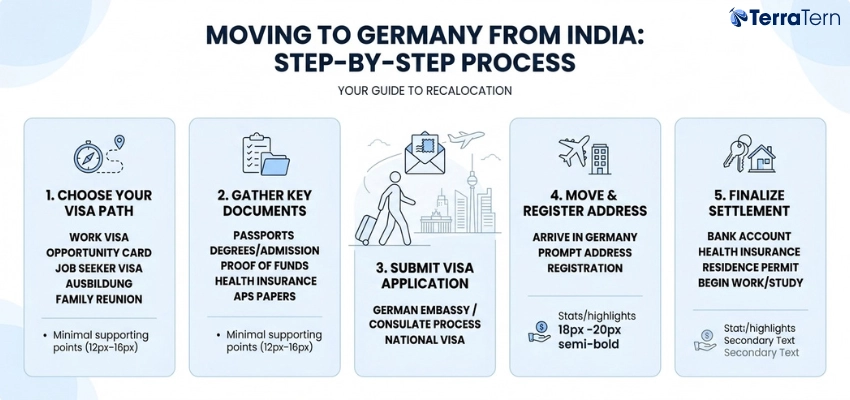
To Move to Germany from India: Step-by-Step Process:
-
Select your path first, i.e., the work visa, study visa, Opportunity Card, Job Seeker Visa, Ausbildung or family reunion.
-
Collect documents such as passports, degrees or admission letters, proof of funds, health insurance, translations, and APS / qualification papers.
-
Apply for the German national visa in India via the process of the Embassy/Consulate.
-
Upon approval, go to Germany and register your address promptly.
-
Open a bank account, get health insurance, obtain a residence permit, and begin work or study.
Key Note: The Anmeldung is the step most first-time movers underestimate; without it, you cannot open a German bank account, which means you cannot receive a salary, sign contracts, or access public services. Do this within 48 hours of arriving, not 14 days.
What Is the Real Cost of Moving to Germany from India?
-
Visa Fees: The visa fee is approximately €75 for an application for a visa for nationals.
-
Proof of Funds: for many student-style entries, it was around €11,208 in a blocked fund.
-
Health Insurance: It is available at a cost of approximately €100-€200 per month for basic coverage, or €400 per month with public coverage, which depends on the salary.
-
Flight from India: it varies from flight to flight, and it is several hundred euros one-way in general.
-
Initial Costs: Allow for €3000-€5000 costs, deposit, transport and basics for initial setup.
-
Rent Deposit: typically the first 3 months of cold rent plus possibly another 2 months for agency fees.
-
Monthly Living Expenses: €934 – €2483 for a single person (Munich is above this and Leipzig below). The rent for a 1-bedroom in a city varies from €700 to €2,000 and can be even higher in Munich.
-
Actual Spending on Visas: Indians may be able to budget anywhere between INR 10 lakh and INR 20 lakh, depending on the visa type, city and whether they have booked accommodation beforehand.
Also Read: Who Provides Reliable Immigration Consultancy for Skilled Workers Moving to Australia?
What Are the One-Time Moving Costs from India to Germany?
-
Visa & VFS Fees: €75 visa + service charges and translations (€50-€400).
-
Blocked Account / Initial Funds: €992-€13,092 (depending on the type of visa).
-
Flight (One-way): €500–€900.
-
Rent Deposit (Kaution): 2–3 months’ rent (€800–€4,500).
-
Initial Health Insurance & Admin: €360–€1,200.
-
Furnishing & Essentials: €200–€1,500.
What Are the Monthly Living Costs in Germany for Indians?
-
Rent (1‑BR / WG): €300 (WG) – €1,500 (1‑BR warm).
-
Groceries & Indian Groceries: €120–€280.
-
Health Insurance: students €110–€120, professionals €300–€450.
-
Transport (Deutschlandticket or Pass): €29-49.
-
Utilities, Internet & Mobile: €35–€70.
-
Leisure, Clothing, Remittances: €150–€600.
Advice by our Expert: The Kaution (rental deposit) is the single most shocking upfront cost for new arrivals; German landlords require 2–3 months of cold rent before handing over keys, meaning you could need INR 1.5–2.5 lakh liquid before your first day in the apartment. Budget for this entirely separately from your blocked account.
What Are the Best Jobs in Germany for Indian Professionals?
Here are some of the best professions in Germany for Indian professionals (points):
-
Software Developer / Full Stack Engineer — lots of demand, particularly in English, across startups and corporates.
-
Data Scientist / ML Engineer — high-paying role for machine learning, AI, and analytics expertise.
-
Cloud / DevOps Engineer — AWS, Azure, GCP skills are in high demand.
-
Cybersecurity Specialist — growing need in finance, infra and enterprise.
-
Automotive Engineer (EV & ADAS) - Embedded systems.
-
Mechanical / Industrial Engineer — central manufacturing / Industry 4.0 jobs.
-
IT Project / Product Manager — product-led companies / Digital transformation projects.
-
SAP Consultant — enterprise resource planning (S/4HANA) is in demand.
-
Healthcare Professionals (Doctors, Nurses, Pharmacists) — shortage of professionals, credential recognition required.
-
Research Scientist (Life Sciences, Biotech) – University/Industry Research and Development.
-
Finance & Risk Analyst — fintech, banking hubs like Frankfurt role goes to the skilled finance & risk analyst.
-
Renewable Energy Specialist – wind, solar, energy storage and grid integration.
-
Vocational Demand & Skilled Trades – electricians, plumbers, technicians and entry into the field are quicker in the area.
-
UX/UI Designer / Digital Marketer — Product companies/teams in e-commerce looking to hire internationally.
Expect Advice: In 2026, the Indian candidates landing German jobs fastest are those who combine technical skills with B2-level German — German employers, even in tech, increasingly prefer candidates who can collaborate with non-English-speaking colleagues.
Also Read: Provincial Nomination in Canada: Your Immigration Path
What Are the German Language Requirements for Indians Moving to Germany?
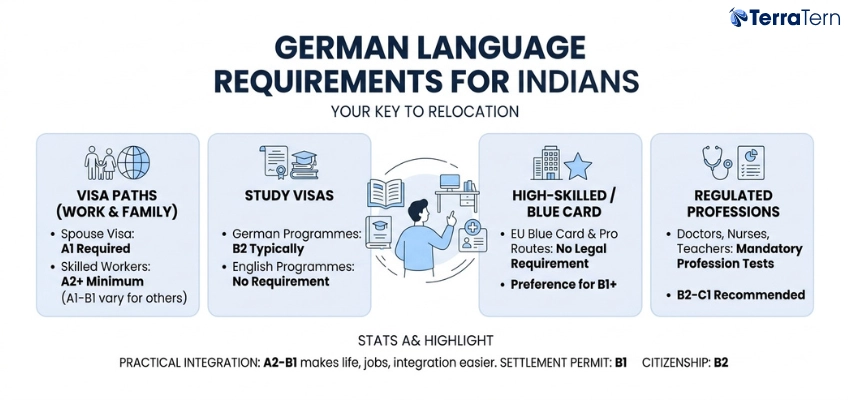
Here are some points to keep in mind when Indians are thinking of relocating to Germany to learn the German language:
-
Visa-specific Minimums: These vary from visa to visa; others may require only A1–B1; for these visitors, please refer to your visa type for the precise level of German required.
-
Work Visas (Skilled Workers): A2 is usually the minimum level of competency required; some jobs may call for B1 or above.
-
EU Blue Card & Many Professional Routes: usually no legal requirement in Germany, but preference is usually given to B1+.
-
Family Reunion: If the spouse is not eligible for exemption in one of the partner visa categories, they will need an A1 certificate.
-
Study Visas: German-taught programmes will normally require B2; English-taught programmes may not require any German. Settlement permits and citizenship are typically granted with B1 or B2 (and B2 for citizenship).
-
Profession Recognition: B2–C1 is recommended for safe practice: regulated professions (doctors, nurses, teachers) need profession-specific language tests.
-
Practical Advice: A2-B1 is not a legal requirement but makes life easier, helps with searching for jobs, and helps to integrate.
Advice by our Expert: The biggest myth TerraTern encounters is "I'll learn German after I arrive." Language acquisition in a foreign country while working full-time is significantly harder; candidates who achieve B2 before arrival navigate their first 6 months with dramatically less stress and are promoted faster.
Also Read: Germany Online Visa Application Portal For Indians
How Can TerraTern Help You With Moving to Germany from India?
TerraTern Helps You With Moving to Germany from India:
-
Eligibility Check: TerraTern supports you in the pre-application stage of German visas, work routes and points-based visa applications.
-
India Visa Assistance: It assists Indian applicants in visa applications and visa guidance for Germany work visa and immigration.
-
German Language Training: TerraTern also provides German language courses from A1 preparation to enhance job and visa readiness.
-
Job Access: It helps a candidate to get a job offer in Germany before he comes to Germany.
-
Qualification Review: TerraTern can support the assessment of educational equivalence via Germany's recognition systems.
-
End-to-end Assistance: It offers counselling, monitoring and after-landing assistance using a tech-enabled dashboard.
-
Targeted Support: mobility support for Indian nurses who want to move to Germany.
Advice by our Expert: Moving to Germany from India is a process with many interdependent steps, a misstep in qualification recognition delays everything downstream. Having an experienced immigration partner is the difference between a 6-month move and an 18-month one.
Also Read: How to Get PR in Ireland: Complete Guide for Indians
What is the Latest Market Update on Moving to Germany From India?
Here are the latest statistics and developments for moving to Germany From India:
-
Germany needs approximately 400,000 skilled workers per year to sustain its economy; the Federal Employment Agency classifies this as a structural shortage, not a cyclical one (Source: German Federal Employment Agency / Bundesagentur für Arbeit, 2025)
-
As of early 2026, approximately 260,000–280,000 Indians reside in Germany, making India one of the fastest-growing source countries for German immigration (Ministry of External Affairs data, 2026)
-
The EU Blue Card salary threshold for 2026 stands at €45,300/year (€41,041 for high-demand occupations including IT, engineering, and healthcare)
-
Germany's unemployment rate is approximately 3.7% — one of the lowest in Europe — signalling strong job market stability despite a noted IT sector softening in early 2026
-
The Opportunity Card (Chancenkarte), fully operational since June 2024, has become one of the most popular entry pathways for Indian professionals without a pre-arranged job offer.
-
German citizenship eligibility has been shortened to 5 years of residence (3 years with exceptional integration) — a significant reform from the previous 8-year requirement.
Conclusion
Indian migrants to Germany in 2026 can make a smart choice by choosing the right visa route, preparing documents carefully, planning initial costs and learning basic German for a more comfortable life and better job opportunities.
Germany offers stable career opportunities, good public systems and clear long-term settlement options, but adapting to a new country takes effort. If you need help with the Germany immigration process, TerraTern can help you choose the right visa, prepare your documents and understand the application process.




 AI Summary