


Key Highlights
- What Are the Standard APAC Shift Timings in India in 2026?
- Which Latest Countries Are Included in APAC Shift Coverage in 2026?
- Which Current Industries in India Offer APAC Shift Jobs in 2026?
- What Is the Latest APAC Shift Salary and Compensation in India?
- What Are the Latest Benefits of Working APAC Shifts in India?
- What Are the Current Challenges of Working APAC Shifts in India?
- How Do APAC Shifts Compare to Other Shifts in 2026?
- What Are the Latest APAC Shift Timings in Major Indian Cities?
- How to Find Current APAC Shift Jobs in India?
- What Are the Legal Rights of APAC Shift Workers in India in 2026?
- How to Succeed in APAC Shift Work in 2026?
- What Are the Future Trends for APAC Shifts in India?
- What Current Technology Tools Help APAC Shift Workers in 2026?
- Latest Facts About APAC Shift Work in India 2026 & Beyond
- Conclusion
The working hours are called APAC shift timings in India. These shifts typically run from 6.30 AM to 3:30 PM IST. Indian workers take these shifts in IT, BPO, customer support, and consulting to cooperate with the team in countries like Australia, Singapore, Japan, and New Zealand. The APAC shifts are day shifts compared to the EMEA night shifts. This provides employees with more free time in the evenings, enhancing work-life balance.
There are 50,000+ open jobs in Bengaluru, Pune, Hyderabad, Chennai, and Gurugram. The shifts usually offer higher pay, ranging from 10 to 15 per cent, compared to regular day shifts.
What Are the Standard APAC Shift Timings in India in 2026?

APAC shift timings in India are for the Asia-Pacific region. The term APAC means Asia-Pacific, encompassing Southeast Asian and Oceania countries.
Typical Timing Window
-
6:30 AM – 3:30 PM IST (most common)
-
An early start will enable it to keep with the Australian morning hours and Singapore/Japan afternoon hours.
Value
-
Allows working with APAC clients in real time.
-
Offers a day shift schedule compared to US/EMEA night shifts.
-
Enhances a better work-life balance.
Semantic Variations
-
APAC work hours
-
Asia-Pacific shift schedule.
What Are the Latest Early APAC Shift Hours?
Early APAC shift timings in India:
-
Start: 6:30–7:30 AM IST
-
End: 2:30–3:30 PM IST
The companies with early APAC shift timings in India:
-
Accenture
-
TCS
-
Wipro
What Are the Current Mid-APAC Shift Timings?
Mid APAC shift timings in India:
-
Start: 8:00–9:00 AM IST
-
End: 4:00–6:00 PM IST
Target Markets:
-
Singapore
-
Malaysia
-
Thailand
-
Japan
Industries that have favoured mid-shifts:
-
IT services to the Southeast Asian markets.
-
Regional operations and consulting.
Advantages vs Early APAC shift timings in India:
-
More sleep time in the morning
-
More fit with some customers.
-
Minor overlaps with Indian day shifts.
What Are the Extended APAC Shift Variations in 2026?
The common APAC variations are:
-
Australian-heavy operations start at 5.00 AM.
-
Flexible 7:30 AM –4:30 PM shifts
-
Staggered shifts on projects.
Purpose:
-
Adjust to client needs
-
Support facilities in various APACs in real time.
Which Latest Countries Are Included in APAC Shift Coverage in 2026?
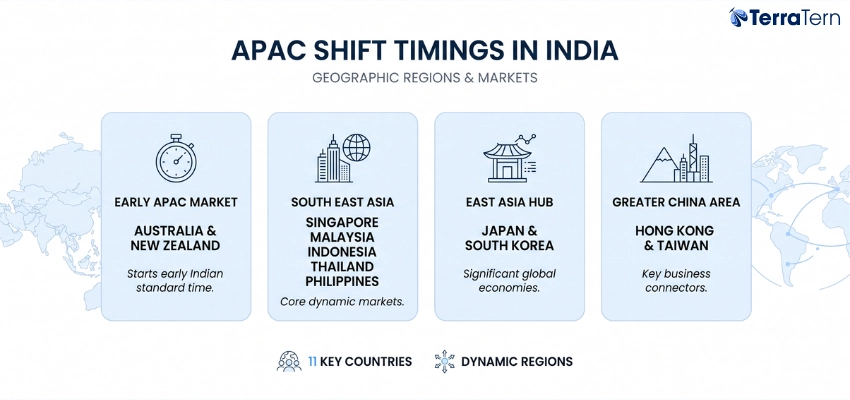
APAC shift timings in India include:
-
Australia
-
New Zealand
-
Singapore
-
Japan
-
South Korea
-
Malaysia
-
Thailand
-
Philippines
-
Indonesia
-
Taiwan
Which Current Industries in India Offer APAC Shift Jobs in 2026?
India has several significant industries that work on APAC shift timings in India to provide services to the Asia-Pacific.
-
IT & Software: Programmers, analysts, and project managers deal with real-time liaisons with the APAC teams.
-
BPO & Customer Support: Voice and non-voice services serve Singaporean, Japanese, and Australian customers.
-
Finance & Banking: HSBC and Standard Chartered are global banks that operate in APAC trading and support back-office operations.
-
Consulting and E-commerce: Deloitte, Amazon, and Flipkart oversee regional operations and support.
-
Healthcare Digital Marketing: Medical coding, telehealth, and digital agencies look at APAC markets.
Also Read: Singapore Immigration: A Comprehensive Guide
How Do IT and Software Companies Use APAC Shifts in 2026?
Key Roles:
-
Full-stack developers
-
QA engineers
-
Cloud architects
-
Technical project managers
Major Companies:
-
Infosys
-
TCS
-
Wipro
-
Tech Mahindra
Benefits:
-
Direct client interaction
-
International exposure
-
Opportunities for career development.
What APAC Shift Roles Exist in the Latest BPO and Customer Support?
The following roles exist in the BPO and customer support:
-
Customer service
-
Technical support
-
Voice process
-
Non-voice operations
Requirements:
-
Accent neutralisation (Singapore/Australia)
-
Cultural training
-
Skills in cross-border communication.
How Do Current Financial Services Use APAC Shift Timings?
The following roles exist in the financial services:
-
Banking operations
-
Trading support
-
Financial analysis
-
Investment services
Employers:
-
HSBC
-
Standard Chartered
-
JP Morgan APAC operations
Alignment:
-
Markets of Singapore and Hong Kong.
-
Shift provides support for trading and operations in real time.
What Other Industries Offer APAC Shift Opportunities in 2026?
Other industries that offer APAC shift timings in India:
-
Consulting (McKinsey, Deloitte APAC teams)
-
E-commerce (Flipkart International, Amazon).
-
Health assistance (telemedicine, medical coding)
-
Agencies that provide digital marketing to APAC clients.
What Is the Latest APAC Shift Salary and Compensation in India?
The APAC shift timings in India compensation are:
-
Freshers or low-experience (0-3 years) entry-level jobs in the APAC shift or International BPO/Customer Support are typically paid 22,000-35000/month in the big cities of India.
-
Non-voice or technical support jobs at the mid-level or level would have a salary of between 40,000 and 60,000+/month, depending on skills, area of specialisation, location of the client, and the time of the shift. (Premium will be increased further according to Australia/Japan-aligned shifts.
-
Managerial or specialist (e.g., APAC Business Development Manager, Payroll Specialist, etc.), the annual compensation might be INR 8- 45+ lakhs per annum based on experience, responsibility, industry, etc.
How Much Do Current APAC Shift Workers Earn in India?
The APAC shift timing workers in India earn the following:
-
Entry-Level: INR 3.5–5 LPA
-
Mid-Level: INR 6–10 LPA
-
Senior-Level: INR 12–20 LPA
Additional Allowances:
-
10–15% shift differential
-
Transportation
-
Meal allowances
-
Performance bonuses
What Additional Benefits Come with APAC Shift Positions in 2026?
The benefits of APAC shift timings in India are:
-
Health insurance (80%+ of companies)
-
Contributions to the provident funds.
-
Performance bonuses
-
Yoga sessions and gymnasiums.
-
Work-at-home policies.
What Are the Latest Benefits of Working APAC Shifts in India?
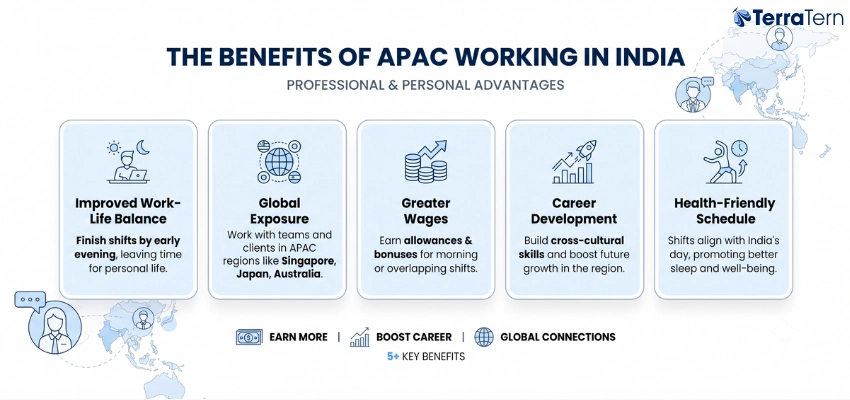
There are several professional and personal benefits associated with APAC working in India:
-
Improved Work-Life Balance: The hours in APAC tend to finish in the evenings, and people can do whatever they like (compared to night shifts in the US/UK).
-
Global Exposure: Workers cooperate with clients and work groups in Asia-Pacific countries such as Singapore, Japan, and Australia.
-
Greater Wages Than Day Shifts: In the APAC, many companies provide shift allowances or bonuses on early-morning shifts or new shifts that overlap with the previous one.
-
Career Development: APAC market experience improves cross-cultural communication, customer relationships, and leadership competence.
-
Health-Friendly Schedule: APAC shifts are more compatible with the time of day in India, which means that employees do not experience as many problems with sleep and lifestyle.
-
Networking Opportunities: Establish professional relationships on the international front and broaden future career opportunities within the APAC region.
How Do Current APAC Shifts Improve Work-Life Balance?
The work-life balance on APAC shift timings is:
-
Early finish (2:30–3:30 PM)
-
Evening, family, hobby, and education freedom.
-
The benefits of morning productivity.
-
Do not travel on the metro during the evening.
What Career Growth Opportunities Exist in APAC Shifts in 2026?
The career opportunities that exist in APAC shift timings in India are:
-
International exposure
-
Cross-cultural communication competencies.
-
Faster career progression
-
Regional team leadership opportunities.
-
International transfer possibility.
How Do Latest APAC Shifts Benefit Financial Planning?
The financial planning benefit APAC shift timings in India like:
-
Higher compensation
-
Better savings potential
-
Banking and errands are available during the day.
-
Shifting premium investment opportunities.
What Are the Current Challenges of Working APAC Shifts in India?
Although APAC shifts provide global exposure and improved hours compared to night shifts, the shifts have some challenges:
-
Early Start Time: The shifts can start at 4–6 AM to match markets such as Australia or Singapore.
-
Sleep Disturbances: Adapting early may impact the sleep schedule and morning habits.
-
Social inactivity: Waking up early and leaving in the middle of the afternoon may limit social or family life.
-
Problems with Transportation: It is possible that in the early mornings, there is a lack of transportation, and the company has to hire cabs or arrange personal transportation.
-
Communication Barriers: There may be a language or coordination difficulty in dealing with teams in different APAC cultural environments.
-
Overlapping of Workloads: Handling tight deadlines in different time zones may increase workload during high business periods.
Also Read: How To Prepare For an Australia Immigration Interview: Student Visa
What Are the Early Wake-Up Challenges in 2026?
The wake-up challenges under APAC shift timings in India are:
-
4:00–5:00 AM wake-ups
-
Sleep schedule adjustments
-
Limitations due to social and family schedules.
Tips to Manage:
-
Stick to a regular sleep schedule.
-
Get evening tasks ready beforehand.
-
See blackout curtains to sleep well.
How Does the Latest APAC Shift Affect Social Life?
The APAC shift timings in India affect social life in the following ways:
-
Minimal intercommunication with ordinary colleagues.
-
Nightlife can be challenging.
-
Planning on the weekend gains significance.
Strategies:
-
Pay attention to social life during the weekend.
-
Arrange afternoons/early evening gatherings.
What Current Health Considerations Exist for APAC Shift Workers?
The following health considerations exist for APAC shift timings in India:
-
Always have good sleep hygiene.
-
Exposure to vitamin D in the mornings.
-
Regular health check-ups
-
The prevention of eye strain in early screen work.
-
Frequent exercise sessions.
How Do APAC Shifts Compare to Other Shifts in 2026?
The times of APAC shifts in India (approximately 6:30 AM to 3:30 PM) are more consistent with regular working hours and thus provide a superior balance in work and life as well as healthier habits. Conversely, the US shifts timings in India from 6:30 PM to 3:30 AM are complete night shifts, which interfere with sleep patterns but usually attract high allowances. EMEA changes from 2:30 PM to 11:30 PM are between them, providing the company with good exposure to European clients but interfering with the evening social time.
Generally, APAC shifts are recommended to professionals who must work during the day, have reduced health complications, and would conform to the lifestyle of Indians. In contrast, other shifts are better suited to people who want to earn more and are willing to be exposed to global clients.
What Are the Latest APAC Shift Timings in Major Indian Cities?
The timings of the APAC shifts between the metros in India are relatively uniform, with only minor differences depending on the policies of the companies and the locations of their clients.
-
Bengaluru: 6:00 AM to 3:00 PM (typical of IT and BPO companies with clients in Singapore or Australia).
-
Hyderabad: 6:30 AM 3:30 PM (technology parks and financial services).
-
Pune: 7.00 am. 4.00 PM. ( consulting, ITES, and shared services).
-
Gurugram: 6:30 am 3:30 PM ( multinational banks and customer operations).
-
Chennai: 7:00 AM- 4:00 PM (engineering, manufacturing support, and IT).
-
Mumbai: 7:30 am 4:30 PM (finance, logistics, and trading support).
What Are the Current APAC Shift Timings in Bengaluru?
The APAC shift timings in India in Bengaluru are:
-
15,000+ APAC positions
-
Top employers are Infosys, Wipro, Accenture, and IBM.
-
Early start is 6:30–7:30 am, and ends at 2:30–3:30 pm.
-
Remote and flexible work situations.
What Are APAC Shift Timings in Pune in 2026?
Kharadi IT Park, Magarpatta, Hinjewadi APAC shift timings are:
-
Employers: Cognizant, Tech Mahindra, and Persistent Systems.
-
Timings: 6:30–7:30 AM M start, 3:00–3:30 PM M end
-
Salary Ranges: INR 4–12 LPA
How to Find Current APAC Shift Jobs in India?
It has never been easier to find APAC shift jobs in India with numerous international companies as the recruiters of Asia-Pacific shifts. Here's how you can get started:
-
Job Portals: Find the terms APAC shift, day shift international process, or Australia/Singapore support in job search platforms such as Naukri, LinkedIn, and Indeed.
-
Company Websites: Visit the career pages of multinational companies such as Accenture, Deloitte, HSBC, Amazon, and TCS, which often show openings for APAC shifts.
-
Recruitment Agencies: Collaborate with organisations outsourcing global processes or having shared service positions.
-
Networking: These are professionals already involved in APAC processes who give invites to the insider network on LinkedIn.
-
Filter by Timing: When searching, filter by jobs that say 6:00 AM- 3:00 AM, 3:00 PM, or Asia-Pacific clients, typically indicative of APAC shifts.
Also Read: Japan Immigration Made Easy: Everything You Should Know
Which Job Portals List APAC Shift Positions in 2026?
The following job portals list APAC shift positions:
-
Naukri.com (5,000+ listings)
-
LinkedIn Jobs
-
Indeed India
-
Monster India
-
Shine.com
-
Glassdoor
Search Tips:
-
Use keywords like "APAC shift"
-
Filter by shift type
-
Set location preferences
-
Create job alerts
How to Prepare for the Latest APAC Shift Job Interviews?
To prepare for the latest APAC shift job interviews, do the following:
-
Show time management skills.
-
Emphasise availability early in the morning.
-
Elaborate on APAC market know-how.
-
Talk about cultural adaptability.
-
Get ready for technical and role-specific questions.
What Current Skills Are Required for APAC Shift Roles?
The following skills are required for APAC shift roles:
-
Good communication (English, neutral accent)
-
Time management and self-discipline.
-
Technical skills (job-related skills)
-
Cross-cultural awareness
-
Flexibility in APAC client preferences.
What Are the Legal Rights of APAC Shift Workers in India in 2026?
The workers in the APAC shift in India are covered by different labour laws that guarantee fair treatment, safety, and well-being. The following are the most essential rights and regulations:
-
Working Hours: Under the Shops and Establishments Act (state-specific) and the Factories Act, 1948, employees should not be compelled to work more than 8-9 hours a day or 48 hours a week without being paid overtime.
-
Overtime Pay: Any additional time after the legally stipulated limit should be paid at twice the regular wage rate.
-
Weekly Rest: Workers have a right to one day off at least once a week, usually on a Sunday, or compensatory rest in case they have to work during weekends.
-
Health and Safety: Employers should ensure good working conditions, proper rest, and other simple facilities such as toilets and hospitals.
-
Women's Safety: In the case of women with early-morning APAC shifts (before 6 AM), the employer is expected to provide safe transportation, security, and consent-based shift scheduling according to government regulations.
-
Leave Benefits: Employees get casual, earned, and sick leave, which are regulated by the company policy and the local labour legislation.
What Does the Latest Indian Labour Law Say About Shift Work?
Regulated by the Shops and Establishments Acts and the Factories Act 1948, the latest Indian labour law says the following:
-
Max working hours is 9/day, 48/week
-
Mandatory rest, extra hours of work, and weekly leave.
-
Differences between states (Karnataka, Maharashtra, Telangana).
What Current Transportation and Safety Requirements Apply?
The following transportation and safety requirements apply:
-
Employer-provided cabs/shuttles
-
Secure collection and delivery points.
-
Women employee security: CCTV cameras, bodyguards, travelling in groups.
What Compensation and Benefits Are Legally Mandated in 2026?
The following compensation and benefits are legally mandated:
-
Minimum wage compliance
-
Shift allowances
-
Contributions to the provident fund.
-
ESI and gratuity eligibility.
How to Succeed in APAC Shift Work in 2026?
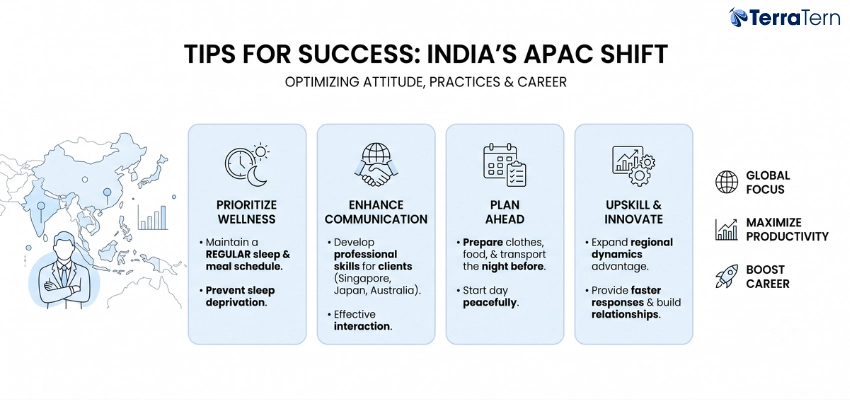
It takes the proper attitude, practices, and occupation to succeed in India's APAC shift timings. The following are tips that can be used to ensure that you are the best:
-
Be Consistent: It is essential to have a regular sleep schedule and a regular meal schedule so one does not become sleep-deprived or hungry in the early hours.
-
Things to Plan The Night Before: Set out clothes, food, and transportation to avoid the morning rush and begin your day with tranquillity.
-
Focus on Communication Skills: Most APAC jobs involve working with clients in Singapore, Japan, or Australia; thus, effective and professional communication is one of the priorities.
-
Expanding the Time Zone Advantage: Take advantage of the overlapping work hours to create good relationships with the Asia-Pacific clients and provide quicker responses.
-
Keep informed about Regional Dynamics: APAC market awareness, cultural, and business etiquette will help make you unique.
-
Balance Health and Productivity: To prevent burnout, one must take short breaks, eat healthy food, and rest well after work.
-
Request Feedback and Upskill: Continuously request feedback from the manager and enrol in online courses to progress to leadership or a specialist.
What Latest Sleep Management Strategies Work Best?
The following sleep management strategies work best under APAC shift time in India:
-
Consistent sleep schedule
-
Black curtains and cool room temperature.
-
White noise for better rest
-
Should not take caffeine within 4 hours of sleep.
-
Power naps post-shift
How to Maintain Current Productivity in APAC Shifts?
One can maintain productivity in APAC shift timings in India by:
-
Pre-shift planning
-
Optimal productivity hours exploitation.
-
Break management
-
Ergonomic workspace setup
What Latest Work-Life Balance Strategies Are Most Effective?
The work-life balance strategies that are the most effective are:
-
Afternoon use of free time.
-
After-hours contact with the family.
-
Weekend concentration of social life.
-
Time for personal hobbies
What Are the Future Trends for APAC Shifts in India?
The hybrid and remote shift options (60% of positions)
-
Automation and AI are decreasing monotonous labour.
-
GCC growth is 100,000+ new APAC jobs by 2026.
-
Experiments on four-day workweeks.
-
Improvements in wellness programs.
Collaboration that is made possible through technology that minimises asynchronous overlap.
What Current Technology Tools Help APAC Shift Workers in 2026?
Working in the APAC shift time in India efficiently and using the right tools is possible. Here's a short guide:
Communication Tools
-
Slack and Microsoft Teams: To use instant messaging and collaboration with the team.
-
Zoom and Google Meet: The video calls with the APAC clients.
-
Loom & Notion: Asynchronous communication and documentation.
Apps in Productivity and Time Management
-
Asana, Trello, Monday.com: Task and project management.
-
Clockify, Toggl: Manage work time and productivity.
-
Google Calendar & Calendly: Plan appointments and deal with different time zones.
-
Focus Tools (Pomodoro, Forest app): Become more concentrated in the morning.
Health & Wellness Apps
-
Sleep Cycle, Pillow: Track the quality of your sleep and wake up refreshed.
-
Headspace, Relax: Meditation and stress relief.
-
Nike Training Club, Fitbit: Fitness tracker and workouts.
-
Vitamin D Reminder programs: Make sure to get enough sunlight among early morning workers.
Also Read: Australia Shift Time in India: Experts' Insights
Which Communication Tools Are Essential in 2026?
The essential communication tools for APAC shift timing in India are:
-
Slack, Microsoft Teams, Zoom, Google Workspace.
-
Asynchronous tools like Loom and Notion.
What Latest Productivity and Time Management Apps Work Best?
These productivity and time management apps work best for APAC shift timing in India:
-
Task Management: Asana, Trello, Monday.com.
-
Time Tracking: Toggl, Clockify.
Tools of concentration are the Forest app and Pomodoro timers.
Which Current Health and Wellness Apps Support Shift Workers?
These wellness apps support APAC shift timing for Indian workers:
-
Sleep Monitoring: Pillow, Sleep Cycle.
-
Meditation: Headspace, Calm
-
Fitness: Adidas Training, Fitbit.
Latest Facts About APAC Shift Work in India 2026 & Beyond
-
Job Market Expansion: APAC shift positions in India increased 18% in 2024-2026, with over 50,000 active openings across IT, BPO, and financial services sectors as of October 2026.
-
Salary Growth Leadership: India leads the APAC region with a 9.5% projected salary increase for 2026, with APAC shift workers receiving an additional 10-15% shift differential.
-
Remote Work Integration: 60% of APAC shift positions now offer hybrid or fully remote options, up from 35% in 2023, reflecting post-pandemic workplace transformation.
-
GCC Dominance: Global Capability Centres added 100,000+ jobs in FY2024-25 compared to 11,000 by traditional IT firms, with a significant APAC shift component for regional support.
-
Workforce Preferences: Asia-Pacific workers prioritise flexible working hours (59%) and wellbeing over compensation, driving APAC shift policy changes.
-
Benefits Evolution: Medical inflation in APAC is projected at 12.3% for 2026 (highest globally), prompting employers to enhance health benefits for shift workers.
-
Regulatory Updates: 2024 labour law amendments mandate enhanced safety measures, transportation requirements, and compensation transparency for shift workers across Indian states.
Conclusion
The APAC shift schedules in India give professionals an exceptional career opportunity. The employees have early morning schedules (6:30 AM- 3:30 PM IST), allowing them to receive higher payment, global exposure, and better work-life balance. Such changes are perfect for those aiming at the Asia-Pacific markets, where early career advancement and time to spend with family in the evenings are possible.
The APAC shift work is also becoming more remote, with more Global Capability Centres (GCCs). Job seekers should seek opportunities and embrace the best strategies to ensure career growth and achievement. Contact TerraTern for more information on APAC shift timings in India.




 AI Summary