Key Highlights
- What is the Average Australian Pilot Salary in 2026?
- What Is the Salary for a Pilot in Australia by Career Stage?
- What Is the Co-Pilot Salary in Australia?
- What Is the Helicopter Pilot Salary in Australia?
- What Is the Fighter Pilot Salary in Australia?
- What Factors Affect Pilot Salary in Australia?
- How Does the Pilot Shortage in Australia Affect Salaries in 2026?
- What Is the Pilot Salary in Australia by City?
- How Can Indian Pilots Work in Australia and Earn These Salaries?
- Is a Pilot Career in Australia Worth the Investment?
- Conclusion: Why Australia Pilot Salary in 2026 Makes This a High Potential Career
The average pilot salary in Australia in 2026 is around A$144,375 per year or about A$73 per hour. Entry-level pilot positions start at around A$68,000 per year, with senior roles up to A$330,000 per year. Relocating to Sydney brings in the highest average salary of A$165,000, Canberra at A$162,000 and Hoboken at A$127,500. The average salary of a pilot, after tax, is around A$104,565 per year, which is A$8,714/monthly. Major airlines such as Qantas offer significantly higher remuneration – commercial pilots can earn up to AUD$200,000 base salary and experienced Captains earn in excess of AUD$400,000 plus bonuses up to AUD$50,000 per year. This in-depth salary guide discusses salary ranges by experience level, salary comparisons across the city, take-home pay calculations, and salary factors in Australia's aviation industry.
What is the Average Australian Pilot Salary in 2026?
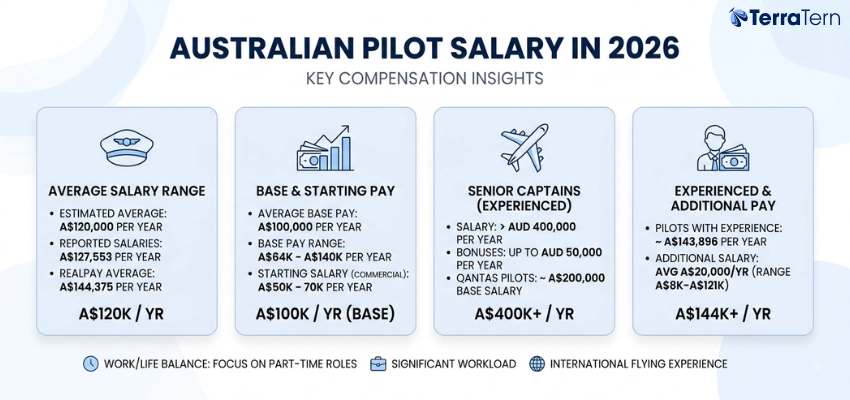
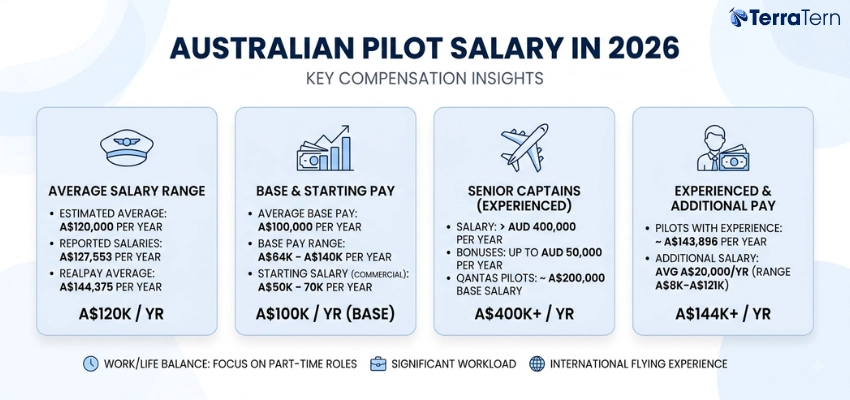
Average pilot salary (2026) Australia: A$120,000 per year or A$58 per hour The average salary is $127,553 per year, based on 82 reported salaries. The average salary is A$127,553 / year (82 salaries reported).
-
RealPay average (2026): A$144,375 per year, all Australian cities
-
Commercial pilot average (Payscale 2026): AU$92,432 per year
-
Average full-time salary (pilots earn significantly more than this): A$78,800
-
The average salary for this job is calculated from the bottom 25% and the top 75% salaries. Average salary range: AUD 72,411 to 260,500 per year (25th to 75th percentile).
-
Base pay range: A$64,000 – A$140,000 per year, with average base pay of A$100,000
-
Starting salary for commercial pilots: AUD 50k – 70k per year
-
Pilots with experience in international flying: Approx. A$143,896 per year
-
Very high earners (90th percentile): A$907,492 or less per year
-
Qantas commercial pilots: A base salary of approximately A$200,000 per year.
-
Senior Captains (experienced): More than AUD 400,000 per year (plus bonuses of up to AUD 50,000).
-
Main focus: Particular emphasis on part-time roles and work/life balance.Significant workload: The workload is significant; however, there is a particular focus on part-time roles and work/life balance.
-
Additional salary: Average A$20,000/year (range A$8,000 – A$121,000) beyond base pay
Expert Advice: Australia's pilot salary market is bifurcated — entry-level roles pay modestly during the "investment phase," but senior captains at legacy carriers are among the highest-paid professionals in the country, earning more than most doctors and lawyers.
What Is the Salary for a Pilot in Australia by Career Stage?
There are 7 Career Stages for a Pilot in Australia. For an Australian pilot there are 7 Career Stages and salaries.
Pilot salaries in Australia range widely depending on the stage of their career, from entry-level at A$83,928 a year to senior-level at A$139,879 a year, and experienced captains at the major airlines make upwards of A$400,000 per year.
Fill out the Salary Table by Career Stage.
|
Career Stage |
Years of Experience |
Monthly Salary (AUD) |
Annual Salary (AUD) |
|
Entry Level |
0–2 years |
$6,994 |
$83,928 |
|
Early Career |
2–5 years |
$7,926 |
$95,118 |
|
Mid-Career |
5–10 years |
$9,325 |
$111,903 |
|
Experienced |
10–20 years |
$10,724 |
$128,689 |
|
Senior Level |
20+ years |
$11,657 |
$139,879 |
Additional Career Stage Details by Role
|
Role/Position |
Annual Salary (AUD) |
Key Notes |
|
Flight Instructor (starting) |
$59,679 |
After training, building flight hours |
|
First Officer (1–3 years) |
$94K–$110K |
Below national average initially |
|
First Officer (4–6 years) |
~$93K |
Mid-level co-pilot |
|
Experienced Pilot (15+ years) |
~$183K |
Senior pilot at Melbourne |
|
International Pilot (experienced) |
~$143,896 |
Requires testing/documentation |
|
Qantas Commercial Pilot |
~$200,000 |
Base salary |
|
Senior Captain (experienced) |
$400,000+ |
Plus up to $50,000 bonus yearly |
|
Typical Pay Range |
$72,411–$260,500 |
25th to 75th percentile |
|
Top Earner (90th percentile) |
$547,492 |
Highest reported salary |
|
Salary Trajectory |
$100K–$290K |
From start to highest seniority |
How Much Does a Cadet/Trainee Pilot Earn in Australia?
-
After training, Qantas cadets should be paid somewhere around the $60,000 mark per year, in Year 1.
-
The cost of training is between AUD 80,000 and 120,000 at partner schools.
-
Student pilots get little or no training pay for flying time throughout training.
-
The total money earned during a career lasts for 30+ years and will far surpass $5M.
-
It takes about 2 years to recover the investment.
What Is a Flight Instructor's Salary in Australia?
-
Building flight hours: Average salary is $59,679/year for flight instructors
-
Actually, reports mean: $64,193/year (4 salaries reported)
-
Another average indicates: $82,420/year
-
Perth instructor flying average: $151,119/year (AUD 103,970–184,516 range)
-
Usually $20-$40 per hour, based on school and certification
How Much Does a Regional First Officer Earn in Australia?
-
First officer's starting salaries are below the national average initially.
-
The average salary for pilots is $120,000 per year across the country.
-
The average salary for regional airline pilots in a year is $91,508-$111,492 depending on experience.
-
Salary trajectory starts at $100,000/year estimate
-
With experience, pilots make approximately 6 figures per year.
What Is a Domestic Airline First Officer's Salary?
-
First Officer (1–3 years): $94K–$110K/year
-
First Officer (4–6 years): ~$93K/year
-
First officer for general airline: $39,198 reported (single entry)
-
Average base pay: $100K/year ($64K–$140K range)
-
Additional salary: $20K/year on top of base salary
How Much Does an Airline Captain Earn in Australia?
-
Aeroline Staff Pilots: ~$80,000 base salary per year
-
Experienced Captains: $400,000 yearly or more
-
If hired, this position offers the following compensation: Productivity-based bonus; additional annual compensation of $50,000.
-
Top earners (90th percentile): $547,492/year
-
Typical pay range: $72,411–$260,500 annually
What Is the Long-Haul Captain's Salary at Qantas?
-
Qantas commercial pilot salary: ~$200,000/year
-
Captains with more experience: more than $400,000/year
-
Bonuses: up to $50,000 yearly
-
International fares are more expensive than domestic fares.
-
The larger the aircraft, the higher the pay for captains
Pro Tip: The biggest salary leap in an Australian pilot's career occurs when transitioning from regional to domestic major airline — a move that can double or even triple your annual income almost overnight.
What Is the Co-Pilot Salary in Australia?
Co-Pilot (First Officer) Salary in Australia
|
Experience Level |
Annual Salary (AUD) |
Notes |
|
Entry-level (0–1 year) |
$85K–$99K/year |
Below national average initially |
|
First Officer (1–3 years) |
$94K–$110K/year |
Developing experience |
|
First Officer (4–6 years) |
~$93K/year |
Mid-level co-pilot |
|
Second-year First Officer |
~$160K/year |
Rising to $200K in 2 years |
|
Qantas First Officer (starting) |
~$168,000/year |
Major airline |
|
Qantas First Officer (experienced) |
$200K–$250K/year |
Senior first officer |
|
Single-engine aircraft |
$39,198/year |
Lower-end commercial pilot |
|
Multi-engine aircraft (19,000kg+) |
$57,522/year |
Higher-end commercial pilot |
|
Airline Pilot/Copilot average (2026) |
AU$102,119/year |
PayScale data |
|
Average base pay |
$100K/year |
Range: $64K–$140K |
|
Typical pay range |
$72,411–$260,500/year |
25th to 75th percentile |
|
Salary trajectory |
$100K–$290K/year |
From start to highest seniority |
|
Additional salary |
$20K/year average |
Range: $8K–$121K |
|
Starting pay (commercial pilot) |
$50K–$70K/year |
Industry entry-level |
Key Note: The co-pilot salary gap between low-cost carriers and full-service carriers in Australia is narrowing rapidly, with Virgin Australia's 2026 EBA pushing FO pay to levels previously seen only at legacy carriers.
What Is the Helicopter Pilot Salary in Australia?
Helicopter Pilot Salary in Australia
|
Category |
Salary (AUD) |
Details |
|
Average Salary (2026) |
AU$84,580/year |
PayScale data |
|
Median Salary |
AU$85,000/year |
50th percentile |
|
Median (Reddit estimate) |
AU$75,000/year |
Industry estimate |
|
Base Salary Range |
AU$49K–AU$148K/year |
10th–90th percentile |
|
Total Pay Range |
AU$50K–AU$152K/year |
Includes bonuses/overtime |
|
Entry-Level (<1 year) |
AU$60,000/year |
Based on 5 salaries |
|
Early Career (1–4 years) |
AU$60,000/year |
Based on 10 salaries |
|
Lowest Pay |
AU$49,000/year |
Entry-level minimum |
|
Highest Pay |
AU$148,000/year |
Senior/experienced |
|
CPL Rotary Wing |
AU$50K–AU$80K/year |
Commercial license start |
|
Current Job (Reddit) |
AU$90,000/year |
With small benefits |
|
2000+ Hours (Line Roles) |
AU$150K+/year |
Multi-IFR time |
|
Commercial Skills (2025) |
AU$70,400/year |
Range: $46K–$138K |
|
EMS Skills (2025) |
AU$104,275/year |
Emergency Medical Services |
|
Melbourne Average (2025) |
AU$59,000/year |
City-specific |
|
Full-Time Median (Weekly) |
$2,400/week |
$124,800 annually |
How Much Do Entry-Level Helicopter Pilots Earn in Australia?
-
Mid-level (1 - 4 years): AU$70,000/year total compensation
-
Early career (1–4 years): AU$60,000/year average
-
Entry level in London: £40,000/year
-
This is a good starting pay for a CPL in the Rotary Wing.
-
Lowest pay: AU$49,000/year
-
First job (Reddit example): AUD$8,000 in total (6 months part-time)
-
After-tax income from first full-time job: AU$600 per week
What Is the Salary of an Experienced Helicopter Pilot?
-
Experienced pilot median: AU$84,580/year (national median)
-
Median full-time: AU$124,800/year ($2,400/week)
-
Permanent positions (line) > 2000 hours: AU$150K+/year annually
-
Mining industry 100%: AU$140K – AU$220K+ per year
-
Highest pay: AU$148,000/year
-
The salary range for Senior level (Melbourne) is AU$86,000/year.
-
Pay: AU$90,000/year with benefits.
How Much Does a Military Helicopter Pilot Earn in Australia?
-
Starting salary (training): AU$27,722/year + 16.4% superannuation
-
Training completion: AU$80,955/year (plus super) – generous
-
Pay increments: Step up in training ranks
-
Paid from day one: Regardless of age/experience
-
The Aviation Capability Group's superannuation rate is 12.75%. The superannuation rate for the Aviation Capability Group is 12.75%.
-
$17,000 wage sacrifice: QGAir Rotary Wing Staff
Advice by our Expert: Helicopter pilots in Australia face a longer "low-pay" early career phase than fixed-wing airline pilots — the critical breakthrough comes at the 2,000-hour mark, after which offshore and specialist roles open up with AUD 150,000+ packages.
What Is the Fighter Pilot Salary in Australia?
-
Glassdoor reports that the average salary of pilots working for the Air Force is $150,000 per year.
-
Base pay range: $93K–$158K/year
-
RAAF Pilot average range: $130,000–$234,000/year
-
Senior officer pay (RAAF): $82,123/year (before additional pay/benefits)
-
Salaries in the range of $130K to $234K are for F-35A Lightning II fighter pilots.
-
Fast Jet Pilot (ADF): Day 1 Salary + 16.4% Superannuation
-
After training completion: At least $95,000+/year (plus 16.4% super)
-
Insolvency: 0% (no data received)
-
Compensation range: $97K to $314K/year (plus additional compensation)
-
Compensation for training: from day 1 (no matter what your age/experience level).
-
The benefits are: Assistance in purchasing a home, free education/medical training
How Are RAAF Fighter Pilots Paid?
-
All ages/experience paid from day one of training
-
Rate of pay: $78,023.00 per year, post-training completion
-
Experienced/Advancement Base Pay raises: Base pay rises with advancement/experience
-
Superannuation: 16.4% (4.4% higher than the Australian standard)
-
Officer Aviation Remuneration Structure allowance: based on Seniority (Sqn Leader/Wg Cdr)
-
Support: Home purchase support, subsidised home loan/rent, free medical/dental.
-
Full tuition training: Degree + Military training for free!
What Is the Career Path of a Fighter Pilot in Australia?
-
Direct entry to the Air Force, or a 3-year degree at ADFA Canberra.
-
Initial Military Training: 2-3 years of full-time military service that includes a degree upon completion.Initial Employment Training: 2-3 years of full-time civilian employment after graduating from college.
-
Integrated training: It refers to the combination of academic study and military development.
-
Officer Aviation career specialisation: 2 pathways – Mission and Pilot
-
Lifting Qualifications: Flying Officer, Flight Lieutenant, Squadron Leader, Wing Commander
-
A commitment to serve for at least 4 years for fast jet pilots.
How Does a Fighter Pilot's Salary Compare to a Commercial Pilot's?
-
Average salary for an RAAF Fighter Pilot is $130K - $234K per annum.
-
Senior Fighter pilot: ~$150K
-
Private aircraft pilot: ~$200K/year
-
Senior airline pilots: May make over $547K/year
-
Commercial pilots generally earn more, particularly pilots from major airlines as captains
-
Civilian benefits: Free training, extensive benefits package, better pension.
-
Business benefits: Better long-term compensation and a more flexible schedule
Expert Advice: For Indian aspirants, fighter pilot roles in the RAAF require Australian citizenship — making this route unavailable for Indian nationals. However, commercial airline pathways in Australia are fully open to skilled migrant pilots on the relevant visa.
What Factors Affect Pilot Salary in Australia?
Here are some of the Factors affecting Pilot Salary in Australia:
-
Years of experience: Salary is related to years of experience, ranging from entry level to senior level.
-
Commercial, ATPL and aircraft endorsements will help to improve earning potential with type of pilot licence.
-
Employer/Airline: Qantas commercial pilots receive a base salary of ~$200K, and those working for major airlines are paid more than regional airlines.
-
The bigger and longer the flight, the higher the pay rate, as in the case of larger aircraft and international, long-distance flights.
-
The reason why the route profile is different is that international flights for long distances cost more than domestic.
-
Cargo vs. passenger transport: Deciding to transport cargo or passengers impact salary
-
Seniority: Promotions, rostering and remuneration is decided by the seniority system in the airline.
-
Location: Salaries are dependent on city (Sydney: $165K; Canberra: $162K; Hobart: $127.5K)
-
Flight hours: The higher the number of hours flown, the more the salary, particularly for line jobs.
-
Job title/role: Captain makes a lot more money than a First Officer ($200K – $400K+ compared to $100K – $110K).
-
Industry demand: Salary packages improve as there are more opportunities because of fleet growth and retirements.
-
Economic factors: Aviation industry sensitive to economic changes or external influences such as pandemics
-
Specialised certifications: Aircraft type ratings and special endorsements enhance earning potential
-
Productivity Based Bonus/Additional pay – can amount up to $50K/year
-
International vs. domestic: International pilots who have experience get ~$143,896 per year.
How Does Airline Type Affect Pilot Pay in Australia?
-
Major airlines pay more: Qantas captains earn ~$200K base, experienced captains earn more than $400K.
-
There's a difference between international and domestic: Long-haul international flights are more expensive than domestic flights.
-
The bigger the aircraft the higher the pay: Bigger aircraft pay more to their captains.
-
Cargo vs. passenger: When transporting cargo or passengers, the salary difference is affected.
-
Regional vs. major: Regional pilots are paid less but start at a lower level; Major airlines pay more.
-
Commercial airline pilots make more money than others in the aviation industry.
How do experience and flight hours impact pilot salary?
-
The more someone has worked, the higher their average salary will be: Years of Experience.
-
Entry-level (<1 year): ~$85K–$99K/year
-
Early career (1–4 years): ~$88K–$110K/year
-
Mid-career (5–10 years): ~$111K/year
-
Senior (20+ years): ~$139K/year
-
Flight hours have an impact: The more a pilot flies, the more money they make.
-
Seniority system – Promotions, roster and salary based on seniority.
-
2000+ hours line roles: Can earn $150K+/year
Do Pilot Benefits and Allowances Add to the Total Package?
-
Additional salary: Average amount of $20,000/year over base salary (range from $8,000 to $121,000/year).
-
Productivity based bonus: Some pilots may receive an additional $50K/year.
-
Livestock: $1,000/head with a limit of 250 head per year for taxpayers and $600/head for non-taxpayers, per year
-
Total package = $300K Taxable + $25K-$30K Allowances = ~$325K total
-
Superannuation (RAAF): 16.4% (4.4% above the Australian standard)
-
The benefits include: Home purchase assistance, free medical/dental, subsidised housing.
-
Six week vacation is a term used to refer to the annual leave that is granted to airline pilots.
-
Travel privileges for staffs based on seniority.
Pro Tip: In Australia's current pilot-shortage market, allowances and bonuses can add AUD 20,000–60,000 to a pilot's base salary — meaning the "advertised" base salary can significantly underrepresent the true total package.
How Does the Pilot Shortage in Australia Affect Salaries in 2026?
-
Salaries soaring: Unprecedented pilot shortage leads to promising six-figure salaries and job security
-
The demand far exceeds the supply: Airlines having trouble filling the empty seats in the cockpit, pushing up compensation.
-
Significant airlines raise pay rates: Lifestyle arrangements are upgraded and pay packages are enhanced.
-
Sign-up bonuses & retention incentives: Airlines that provide signing bonuses and quick promotions
-
The salaries for instructors are increasing: Grade 3 Flight Instructor ~$60,000.
-
Major airlines' captains will earn much more, as of Virgin Australia's Commanders.
-
Senior captains make > $300K: Salaries for experienced captains are >$300K/year
-
Start-up pay: New pilots can earn $50,000–$80,000 annually
-
Shortfall of 24,000 pilots is estimated for 2026, largest ever for this year.
-
The surge in air travel which has taken place since the outbreak of the pandemic is a factor that is growing the demand for commercial pilots.The demand for commercial pilots is growing due to the increased demand for air travel since the pandemic.
-
Training bottlenecks: Flight schools with too few pilots to train quickly enough.
-
The retirement wave: Many foreseeable Senior pilots are approaching the mandatory retirement age.
-
Airlines are making significant investments in cadet pathways:
-
There are choices for pilots: Newly minted pilots of today have multiple job options.
-
Competitive salaries: Airlines are paying pilots competitive salaries to hire and keep them on the job.
-
Career opportunities: Virgin/Australia pilots can earn over $140K in just 3 years of flying for the airline.
Key Note: The 2026–2030 period represents a generational window of opportunity for aspiring pilots — the shortage is structural, not cyclical, and Australian airlines are actively competing with higher salaries and faster upgrades to secure talent.
What Is the Pilot Salary in Australia by City?
Pilot Salary in Australia by City
|
City |
State |
Average Annual Salary (AUD) |
Take-Home Pay After Tax |
Experience Level Data |
|
Sydney |
NSW |
$165,000 |
$116,837/year |
4-6 years: $107K/yr |
|
Canberra |
ACT |
$162,000 |
$115,052/year |
— |
|
Melbourne |
VIC |
$157,500 |
$112,375/year |
4-6 years: $93K/yr; 15+ years: $183K/yr |
|
Darwin |
NT |
$157,500 |
$112,375/year |
4-6 years: $93K/yr |
|
Perth |
WA |
$153,000 |
$109,697/year |
— |
|
Brisbane |
QLD |
$142,500–$145,936 |
$103,806/year |
4-6 years: $112K/yr |
|
Gold Coast |
QLD |
$138,000 |
$101,117/year |
— |
|
Jandakot |
WA |
$138,803 |
$98,000/year |
— |
|
Adelaide |
SA |
$135,000 |
$99,325/year |
4-6 years: $46K–$54K/yr; 1-3 years: $90K/yr |
|
Wollongong |
NSW |
$132,000 |
$97,322/year |
— |
|
Newcastle |
NSW |
$132,000 |
$97,322/year |
— |
|
Townsville |
QLD |
~$130,000 |
$96,000/year |
1-3 years: $94K–$110K/yr |
|
Geelong |
VIC |
$130,500 |
$96,321/year |
— |
|
Hobart |
TAS |
$127,500 |
$94,319/year |
— |
|
Bankstown |
NSW |
$140,501 |
$100,000/year |
— |
|
Karratha |
WA |
$145,936 |
$103,000/year |
Highest-paying city near Australia |
|
Frances |
SA |
$85,000 |
$70,000/year |
4-6 years: $85K/yr |
Pro Tip: Don't just evaluate the gross salary figure when choosing a base city an AUD 10,000 lower salary in Perth compared to Sydney can result in tens of thousands more in annual savings after accounting for rent and living expenses.
How Can Indian Pilots Work in Australia and Earn These Salaries?
|
Category |
Requirement/Pathway |
Details |
|
Visa Options |
Subclass 482 (Temporary Skill Shortage) |
Medium-term stream available for pilots; employer-sponsored |
|
Subclass 491 (Skilled Work Regional) |
State/territory nominated for regional areas; priority migration |
|
|
Subclass 494 (Skilled Employer Sponsored Regional) |
Employer-sponsored regional visa pathway |
|
|
CASA Licensing Conversion |
ICAO-Approved License |
Must have PPL/CPL from an ICAO-approved country (India qualifies) |
|
ARN Application |
Apply for an Aviation Reference Number with CASA |
|
|
CASA Class 1 Medical |
Obtain a current Australian medical certificate |
|
|
English Language Proficiency |
Level 6 required (ICAO standard) |
|
|
Flight Experience Requirements |
Minimum Flight Time |
500 hours total on multi-crew aircraft (Virgin Australia) |
|
Command Experience |
300 hours in command of powered fixed-wing aircraft |
|
|
Licenses Required |
ATPL/CPL |
Australian ATPL or Commercial Pilot Licence (CPL) with all ATPL theory passes |
|
Instrument Rating |
Australian Instrument Rating with MEA, IAP 2D and IAP 3D endorsement |
What Visa Do Indian Pilots Need to Work in Australia?
-
Each stream has its own specific visa requirements. Each stream has a specific visa requirement, and subclass 482 (Temporary Skill Shortage) is a medium-term stream for pilots on employer nomination.
-
Pilots – State/territory nominated (Subclass 491 – Skilled Work Regional)
-
Skilled Employer Sponsored Regional (subclass 494): Employer sponsored regional visa pathway
-
After successful completion of a Diploma of Aviation (CPL + Instrument Rating), a subclass 485 (Temporary Graduate) visa is available.
-
This subclass 189/190 (Skilled Independent/State Nomination) visa is a permanent visa for skilled migrants who are seeking a permanent visa to Australia.
-
Subclass 407 (Training Visa): For pilots who wish to gain some experience in Australia training.
-
India is a new destination on the list and will join from Oct 2024 with a maximum visa capacity of 1,000 (work and holiday visa) for the age group 18-30 with a ballot auction system.
-
On the Core Skills Occupation List (CSOL) for priority visa processing, pilots are now listed as an Accredited Employer Sponsored Occupation.
How Does CASA Licence Recognition Work for Indian Pilots?
-
ICAO Approved License: Indian DGCA license is approved by ICAO & is CASA convertible.
-
Before CASA: Register for an Aviation Reference Number with CASA
-
CASA Class 1 Medical: Australian medical certificate required (must be current)
-
English Proficiency: AELP-6 (Aviation English Language Proficiency) required
-
CPL Theory Exams: Take two CPL theory exams (conversion).
-
Flight Test: A full flight test is required to convert to a CASA licence from a CPL.
-
This form, CASA Form 61-4B, is to be submitted once you have finished the CPL conversion.
-
Skills Assessment Required: CASA assesses skills for skilled migration (Form 79)
-
5 Years of Work Experience: What is required for skills assessment in skilled migration
-
Apply for an Aviation Security Identification Card: ASIC Card.
-
CASA Licence Global Recognition: The CASA license is recognised by ICAO and the world.
-
DGCA Conversion CASA CPL Accepted by DGCA India for CASA CPL License Conversion with logbook.
What Is the Realistic Starting Salary for an Indian Pilot in Australia?
-
General Aviation: $60,000 - $80,000/year as a Flight Instructor or Charter pilot, Entry level
-
First Year Airline: ~$100,000/year starting salary for First Officer
-
According to the Jetstar First Officer's base salary, it is approximately $130,000 per year.
-
After 1-3 Years Experience: $94K–$110K/year for First Officers
-
Second Year Fourth Officer: ~$180,000/year (rising to $220K in 2 years)
-
Minimum Hours for Airlines: 1,000-1,500 hours of flight time with 500 multi-engine hours required
-
Realistic Start Period for Airline First Officer (after migration): 3-5 years
-
After 4-6 Years: ~$93K/year or as high as $183K/year for experienced pilots
Advice by our Expert: Indian pilots with an ICAO-compliant DGCA licence and 1,500+ hours are in a strong position to enter the Australian aviation market — the pilot shortage means airlines are actively looking at experienced international candidates.
Is a Pilot Career in Australia Worth the Investment?
Financial Pros
-
Increased earning potential: Average salary for a pilot is $120K – $144K per year, captains can earn between $200K – $400K+ per year.
-
Average Salaries: Top earners are making $547K+ (90th percentile pilots make more than half a million a year)
-
Attractive salary trajectory: Entry $85K to Senior $290K+
-
Tax advantages: After-tax take-home ~70% of gross (e.g., $144K → $104K/year net)
Career Advantages
-
Job security: Pilots are in short supply, which provides unprecedented job security!
-
Excellent opportunity for multiple career tracks including: flight instructor, charter, military, cargo and airlines
Investment Requirements
-
Training cost: AUD 80,000-120,000 for cadet program training
-
CPL Course includes: Commercial Pilot Licence (CPL) - About 12 months course duration
Challenges to Consider
-
No visa guarantee: Study then go back; no working rights guaranteed.
-
Bureaucratic conversion: DGCA conversion is a paperwork and no-accident certificate process.
Break-Even Analysis
-
The ROI is realized in about 2 years from when the works began.
-
30-year career earnings: Usually surpass $5M+ lifetime earnings
Expert Advice: For Indian aspirants, training in Australia combines world-class CASA-regulated aviation education with the most favourable pilot job market in a generation — making the investment case stronger now than at any point in the past two decades.
Conclusion: Why Australia Pilot Salary in 2026 Makes This a High Potential Career
Australia's pilot salary opportunities in 2026 have never been better, thanks to a dire shortage of pilots with 24,000 jobs to be filled, and unprecedented job security and salary opportunities. Entry-level pilots can earn a wage of A$68,000 to A$85,000 per year, while an experienced captain with major airline, such as Qantas, can make a minimum of A$200,000 to A$400,000+ per year, with bonuses up to A$50,000. The salaries range depending on the city, with Sydney being the highest at A$165,000, Canberra at A$162,000 and specialist positions such as helicopter pilots coming in at A$84,580, and RAAF fighters at A$130,000–A$234,000. Indian pilots must convert to CASA and then obtain skilled migration visas (Subclass 482, 491 or 494) and accumulate flight hours (1000-1500), and the investment in training is A$80,000-A$120,000, but the return on investment is realized in 2 years or less, and lifetime earnings are over A$5M+.
Australia remains an attractive country for aircraft pilots to work in for a variety of reasons even with visa uncertainty and complex processes for the conversion, such as high pay, strong demand, opportunities for global mobility, and generous benefits.
Contact TerraTern for more information on Australia pilot salary.




 AI Summary