Key Highlights
- What Is a Visa Sponsorship in New Zealand?
- Types of Sponsorship Visas Available
- Who Is Eligible for Visa Sponsorship Jobs in New Zealand?
- Top Industries Offering Visa Sponsorship Jobs in New Zealand (2026)
- How to Check if a New Zealand Employer Can Sponsor You?
- Companies That Sponsor Visas in New Zealand
- Jobs in New Zealand for Foreigners with Visa Sponsorship: Indian Applicants
- Best Cities and Regions for Visa Sponsorship Jobs in New Zealand
- How to Find Visa Sponsorship Jobs in New Zealand (Step-by-Step)
- Application Process for the AEWV: Step-by-Step
- 2026 AEWV Rules and Recent Changes
- Salary Benchmarks: What Can You Earn in 2026?
- Living and Working in New Zealand: What to Expect
- Pathway from Work Visa to Permanent Residency
- Is IELTS Required for a Visa Sponsorship Job in New Zealand?
- Documents Required for a New Zealand Sponsorship Visa
- Challenges to Prepare For
- How to Avoid Fake New Zealand Visa Sponsorship Jobs?
- Future Outlook: Why 2026 Is a Strong Year to Apply
- Conclusion
New Zealand sponsorship visa in 2026 will present an opportunity to the international labour force, such as Indian nationals with 12th -grade qualifications, to work in a booming economy with labour shortages in the agricultural, health care, construction, hospitality, and IT sectors. Accredited employers sponsor skilled, semi-skilled, and entry-level jobs in their programs and offer fair wages, training, and residency opportunities in the midst of high demand for positions such as caregivers, truck drivers, nurses, and farm workers through programs like the Accredited Employer Work Visa (AEWV) and Recognised Seasonal Employer (RSE) scheme. This guide will provide you with the necessary actions, such as searching for jobs on online platforms such as Seek.co.NZ, TradeMe Jobs and Indeed, as well as meeting the requirements such as job opportunities, health screening and skills acknowledgement, and guarantees a seamless transition into employment and living in this English-speaking country with high labour security standards.
What Is a Visa Sponsorship in New Zealand?
New Zealand sponsorship visa enables approved employers or individuals to sponsor the visas of foreign workers, mostly through the Accredited Employer Work Visa (AEWV).
-
Before nominating foreign talent to particular positions, employers should be accredited by Immigration New Zealand (INZ) and demonstrate that they do not have any qualified workers available locally.
-
It applies to work visas such as AEWV, but also to visitor or student visas, where sponsors will cover expenses such as accommodation or maternity.
-
Individual sponsors must be eligible and must be a NZ citizen or resident (some visas require 3 or more years of residency), and cannot be bankrupt or be deported.
-
Organisations should be NZ companies, trusts or societies which do not have financial problems such as receivership.
-
Sponsors place submissions (e.g., INZ 1025 or online declarations) that bind them to obligations until the expiry of the visa or the departure of the person.
-
It is done through a Job Check by the employer, and then the application by a worker with health, skills, and character checks.
-
Visa approval or arrival and cannot be canceled, sponsorship activities to support the 2026 labor requirements in industries such as healthcare and agriculture.
Also Read: New Visa Sponsorship Jobs in New Zealand for Indians
Types of Sponsorship Visas Available
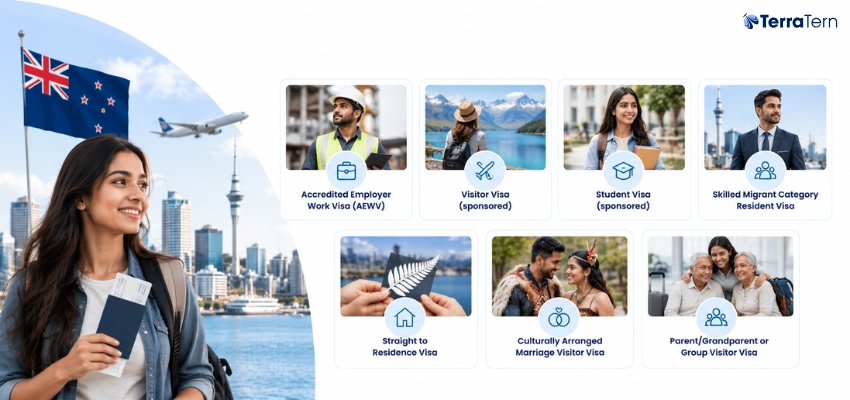
There are a number of New Zealand sponsorship visas, primarily based on work, visitor, student, or family requirements, with accredited employers or other eligible individuals/organizations sponsoring applicants.
-
Accredited Employer Work Visa (AEWV): Under accredited employers, skilled, semi-skilled, or unskilled workers can work on shortage jobs in the areas of agriculture and health.
-
Visitor Visa (sponsored): Temporary visits where the financial support is provided by a sponsor (NZ citizen/resident) can be made online or on paper, such as INZ 1025.
-
Student Visa (sponsored): Need to have a sponsor to finance the course and living expenses.
-
Skilled Migrant Category Resident Visa: Residence visa commonly with employer job opportunities to provide economic inputs.
-
Straight to Residence Visa: In cases where Tier 1 jobs in the Green List are accredited with an employer sponsorship, they can immediately obtain permanent residency.
-
Culturally Arranged Marriage Visitor Visa: Visitors are sponsored by a supporting partner to undertake visits of a certain cultural nature.
-
Parent/Grandparent or Group Visitor Visa: Authorization of family visits on paper with the help of form INZ 1025.
Who Is Eligible for Visa Sponsorship Jobs in New Zealand?
The New Zealand sponsorship visa employment is mainly eligibility to foreign workers who have job offers with accredited employers under schemes such as the Accredited Employer Work Visa (AEWV).
-
An offer of a confirmed job by an INZ-approved employer in New Zealand in fields such as healthcare, agriculture, construction, or hospitality.
-
Applicant has relevant qualifications, certifications, or work experience that is in line with the job position, particularly when listed on shortage lists such as the Green List or in-demand occupations.
-
Good health (medical certificate) and character (police clearance certificate).
-
Original passport and other minor documents such as CV, education certificates, and experience (e.g. payslips, offer letters).
-
Skilled positions (e.g. IELTS 7 or higher) are English-speaking, but the entry level/unskilled positions of the Indian nationals could be more relaxed.
-
Age is normally 18+; there is no specified upper limit, but the positions are full-time.
-
In the case of unskilled/semi-skilled applicants (e.g., 12th pass), consider jobs with labor shortages such as farm work or care-giving with on-the-job training.
Also Read: HR Vacancies in New Zealand for Indian Professionals
Top Industries Offering Visa Sponsorship Jobs in New Zealand (2026)
The future of New Zealand sponsorship visa on the Accredited Employer Work Visa (AEWV) is based on labor shortages in the country through more than 24,000 accredited employers in the major industries.
-
Accommodation and Food Services: Leads with 4,027 employers; chefs, cooks, hotel employees and baristas are in demand in tourism spots such as Queenstown and Auckland.
-
Construction: 3,529 employers who sponsored the work of builders laborers (11,681 grants), carpenters (8,159 grants), electricians, and plumbers during housing booms.
-
Agriculture, Forestry, and Fishing: 2,560 employers of dairy workers, fruit pickers and forestry jobs, particularly in Canterbury and Hawke s Bay under RSE scheme.
-
Retail Trade: 2,270 employers are seeking sales and service personnel in high volume locations.
-
Production: 2,107 employers of production and assembly line workers.
-
Health Care and Social Assistance: 1,395 employer.
-
residency pathway aged roles.
-
Transport and Warehousing: 1,292 employers, with truck drivers (4,715 grants) being the most prominent, and logistics personnel.
How to Check if a New Zealand Employer Can Sponsor You?
If you are thinking of applying for work in New Zealand for Indian, here are the steps you need to take:
-
Determine the employer's legal/trading name.
-
Look for the employer on the Accredited Employer List on Immigration New Zealand website.
-
Verify accreditation is up to date.
-
Be sure to read the job ad thoroughly.
-
See if the employer supports visa applications or accepts applications from overseas candidates.
-
Ensure that the employment is in line with the appropriate AEWV.
-
Don't presume that because an employer is accredited, that all jobs are able to be sponsored.
An accredited employer may still post jobs that are for persons who already have the right to work in New Zealand. Always evaluate the job, never the company.
Companies That Sponsor Visas in New Zealand
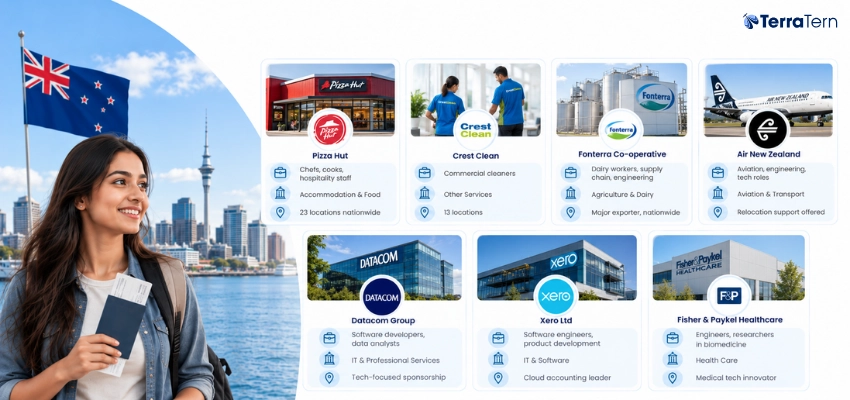
In 2026, there are more than 24,000 accredited employers in New Zealand who are eligible to be a visa sponsor under the Accredited Employer Work Visa (AEWV) program.
Remarkable Visa Sponsoring Companies.
|
Company |
Industry/Sector |
Notable Roles Sponsored |
Locations/Notes |
|
Pizza Hut |
Accommodation & Food |
Chefs, cooks, hospitality staff |
23 locations nationwide |
|
Crest Clean |
Other Services |
Commercial cleaners |
13 locations |
|
Fonterra Co-operative |
Agriculture & Dairy |
Dairy workers, supply chain, and engineering |
Major exporter, nationwide |
|
Air New Zealand |
Aviation & Transport |
Aviation, engineering, tech roles |
Relocation support offered |
|
Datacom Group |
IT & Professional Services |
Software developers, data analysts |
Tech-focused sponsorship |
|
Xero Ltd |
IT & Software |
Software engineers, product development |
Cloud accounting leader |
|
Fisher & Paykel Healthcare |
Health Care |
Engineers, researchers in biomedicine |
Medical tech innovator |
Also Read: CAP New Zealand Nurses Requirements: Latest Experts Guide
Jobs in New Zealand for Foreigners with Visa Sponsorship: Indian Applicants
New Zealand sponsorship visa employment to applicants of Indian origin via the Accredited Employer Work Visa (AEWV) to address labour shortages with routes to 12th-pass or skilled foreigners.
-
Roles in healthcare: Registered nurses, aged care workers (such as Aranui Home and Hospital); salaries NZD 60,000-95,000; requires nursing qualifications/experience.
-
Hospitality Employment: Baristas, Chefs, Cooks in either Golden Bengal Cafe or pizza hut; entry-level with visa assistance, minimum of 30 hours/week.
-
Construction/Trades: laborers of builders, carpenters, electricians, plumbers; high demand with 11,000+ grants; trade certifications increase opportunities.
-
Agriculture/Horticulture: Dairy/farm workers, fruit pickers through Fonterra or Zespri; RSE scheme adapted to unskilled Indians through training.
-
Transport/Logistics: MRS Enterprises or Qube courier/truck drivers; must have 3+ years experience and be NZ Class 1 licensed after arrival.
-
IT/Engineering: Datacom/Xero- Software developers, engineers (civil/mechanical); degree required, 2 years experience, IELTS skilled position.
-
Cleaning/Services: Commercial cleaners at Crest Clean; unskilled entry point of 12 th -pass applicants who are fully sponsored.
Expert Advice: India is not on the bilateral Working Holiday Visa list, which makes the AEWV the primary and most reliable pathway for Indian nationals seeking to work in New Zealand.
Best Cities and Regions for Visa Sponsorship Jobs in New Zealand
Job availability in New Zealand sponsorship visa varies significantly by location.
|
Location |
Common Employment Areas |
|
Auckland |
IT, healthcare, construction, hospitality, logistics |
|
Wellington |
IT, professional services and technical roles |
|
Christchurch |
Engineering, construction, healthcare and logistics |
|
Queenstown |
Tourism, hospitality and food services |
|
Canterbury |
Agriculture, manufacturing and logistics |
|
Waikato |
Agriculture, manufacturing and supply chain |
|
Hawke’s Bay |
Agriculture, horticulture and food production |
How to Find Visa Sponsorship Jobs in New Zealand (Step-by-Step)
Work in New Zealand for Indian need to use job portals and networks to target the accredited employers through the Accredited Employer Work Visa (AEWV) process to find New Zealand sponsorship visa.
-
Search high-demand industries, such as healthcare, construction, agriculture, and hospitality across websites such as Seek.co.nz, TradeMe Jobs, Indeed NZ, and LinkedIn; filter by visa sponsorship or accredited employer.
-
Revise your resume, LinkedIn profile, and cover letter to emphasize the skills and experience (even in 12th-pass jobs) that are relevant as well as willing to move to the Green List jobs; customize applications to Green List jobs.
-
Directly apply to accredited employers (e.g., Fonterra, Crest Clean) or recruitment agencies, such as Working In New Zealand; referrals through Indian diaspora networks.
-
Technical/behavioral questions and asking questions about visa support, relocation, and onboarding are the best ways to prepare to interviews.
-
Get an official job offer; employer checks Job Check with Immigration NZ and provides your AEWV application with contract information.
-
Apply online through Immigration NZ using your passport, qualifications, health/character certificates, English evidence (where applicable) and fees.
-
On approval, relocate: arrange travel, accommodation, bank account, IRD number, and local registration (e.g., doctor, license).
Also Read: Age Limit for Nurses in New Zealand: Experts Insights
Application Process for the AEWV: Step-by-Step
The Accredited Employer Work Visa (AEWV) application scheme allows foreign workers, such as the Indian nationals, to work with accredited New Zealand employers following a managed employer-based series.
-
Secure Job Offer: Get a full-time (30 or more hours/week) employment opportunity with an employer accredited by INZ and earning at or above the median wage (NZD 31.61/hour in 2026), at a salary that reflects your skills/experience.
-
Employer Job Check: The employer publicizes position (21-30 days), contacts Work and Income (when low-skilled), completes online Job Check to provide evidence that there is no appropriate Kiwis in the market; valid 6 months.
-
Assemble Documents: prepare passport, job contract, proofs of qualifications/experience (2 or more years in most jobs), health certificate, police clearance, English test (if ANZSCO 4/5) and translations.
-
Employer Provides Token: Post-Job Check approval, employer creates a job token connecting your application to the job.
-
Apply Online: Register Immigration NZ Online account, fill in token, upload documents, pay application fee (NZD 750870), and apply; will process within 20-30 working days.
-
Health/Character Checks: INZ can demand medical exam and police certificates, which have not been submitted in advance; be in good health/character.
-
Visa Decision & Travel: Approval email with eVisa; activate on arrival with IRD number configuration and employer onboarding.
2026 AEWV Rules and Recent Changes
New Zealand's work-visa system has undergone several changes that applicants should understand.
General median-wage requirement removed
The general median-wage requirement for AEWV applications was removed in 2025.
However, the median wage continues to affect some other immigration settings.
National Occupation List expansion
From 9 March 2026, Immigration New Zealand recognised 47 additional skill-level 1–3 occupations under the National Occupation List for AEWV purposes.
The NOL is gradually replacing ANZSCO in the immigration system.
English-language requirements
English requirements depend on the skill level and circumstances of the role. Applicants should not assume that every skilled position requires IELTS 7.
Work experience and qualifications
Applicants must meet the applicable skills requirements for their occupation. Depending on the role, this can involve relevant work experience, qualifications or occupational registration.
Salary Benchmarks: What Can You Earn in 2026?
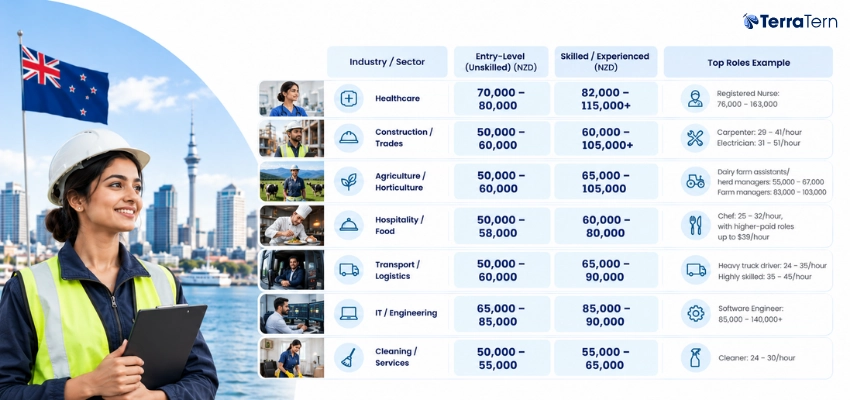
The AEWV salary benchmarks in New Zealand sponsorship visa jobs minimum wage of at least the median wage of NZD 35/hour (or NZD 72,800/year of 40 hours) will apply to the average salary, with the average of about NZD 81,484 per year pushed upward by the skilled labour markets.
AEWV-Eligible Salary Ranges (Annual, NZD)
|
Industry/Sector |
Entry-Level (Unskilled) (NZD) |
Skilled/Experienced (NZD) |
Top Roles Example |
|
Healthcare |
70,000- 80,000 |
82,000- 115,000+ |
Registered Nurse: 76,000- 163,000 |
|
Construction/Trades |
50,000- 60,000 |
60,000- 105,000+ |
Carpenter: 29- 41/hour Electrician: 31- 51/hour |
|
Agriculture/Horticulture |
50,000- 60,000 |
65,000- 105,000 |
Dairy farm assistants/herd managers: 55,000–67,000; farm managers: 83,000–103,000 |
|
Hospitality/Food |
50,000- 58,000 |
60,000- 80,000 |
Chef: 25–32/hour, with higher-paid roles up to $39/hour |
|
Transport/Logistics |
50,000- 60,000 |
65,000- 90,000 |
Heavy truck driver: 24–35/hour; highly skilled: 35–45/hour |
|
IT/Engineering |
65,000- 85,000 |
85,000- 90,000 |
Software Engineer: 85,000–140,000+ |
|
Cleaning/Services |
50,000- 55,000 |
55,000- 65,000 |
Cleaner: 24–30/hour |
Also Read: Visa Sponsorship Jobs in Singapore: Guide for Indian Professionals
Living and Working in New Zealand: What to Expect
The working and living conditions in New Zealand sponsorship visa provide work in New Zealand for Indian workers with high quality of life and high work-life balance, breathtaking nature, and security, albeit high living costs that must be carefully managed.
Work Culture
-
Anticipate casual yet professional working environments with 38-40 hour working weeks, 20 days annual leave, 10 sick days and 26 weeks paid parental leave.
-
Kiwis focus on teamwork, equality and doing the job without working overtime.
Cost of Living
-
Rent prevails: NZD 600/week in Auckland/Queenstown in a 2-bedroom; food to feed two people costs about NZD 200/week; total comfortable living costs about NZD 600/person/week before taxes.
-
The cost of utilities and WiFi is affordable, whereas housing is not insulated in most locations.
Lifestyle Perks
-
Safe (low crime, no dangerous animal), community-oriented and outdoor adventure, sports, and family time; the best OECD scores of work-life and access to nature.
-
There is subsidised healthcare, good schools and recreation among the residents.
Pathway from Work Visa to Permanent Residency
New Zealand sponsorship visa offers straightforward routes between temporary work schemes such as the AEWV to permanent residence (PR), particularly in skilled occupations on shortage lists, which can be beneficial to Indian applicants in high-demand fields.
Main Pathways
-
Green List Tier 1 (Straight to Residence): PR applied immediately to critical shortage occupations (e.g., nurses, engineers) that offers 1.5x median salary (NZD 52.50/hour); no previous NZ work required.
-
Green List Tier 2 (Work to Residence): Work 24 months in qualified jobs (e.g., teachers, IT specialists), apply to get residence visa with resultant PR after 2 years.
-
Skilled Migrant Category: Gain 6 points on skilled employment (bachelors+ or occupational registration or 1.5 median wages), work experience in NZ, education; express interest to be invited to apply.
Key Steps to PR
-
Work in qualifying position 24+ months with average (NZD 35/hour) and good standing.
-
Apply resident visa (e.g., Work to Residence or Skilled Migrant); the processing time is 3-9 months, fee is approximately NZD 4,000.
-
Get Permanent Resident Visa (unlimited travel/work rights) after 2 years on resident visa.
Also Read: Most in Demand Jobs UK​ : Guide to Top Careers & Visas
Is IELTS Required for a Visa Sponsorship Job in New Zealand?
Not all New Zealand sponsorship visa AEWV applicants must have IELTS.
The level of English proficiency may be dependent on the nature of the job. The current rules for the INZ require English evidence for some of the roles at skill-level 3-5 AEWV, and treat the roles at skill-level 1-2 differently.
Applicants should therefore ensure that they check the English requirement for the position they are applying for rather than assuming that IELTS 7 is required for the position.
Other evidence of English may be relevant as appropriate to the circumstances and to the immigration instructions.
Documents Required for a New Zealand Sponsorship Visa
Applicants of New Zealand sponsorship visa may need:
-
Valid passport
-
Employment agreement
-
Job offer
-
Evidence of qualifications
-
Employment reference letters
-
Evidence of relevant work experience
-
If applicable, the requirement for occupational registration,
-
Police Certificate (if necessary)
-
Medical or chest X-ray evidence (if necessary),
-
English-language evidence (where necessary)
-
All documents were translated as needed
Immigration New Zealand have provided a document checklist for applicants to follow when submitting their application.
Challenges to Prepare For
Indian workers under the AEWV New Zealand sponsorship visa encounter a number of challenges which are predictable in the form of financial stresses, social difficulties, and it becomes easier with preparations.
Financial Pressures
-
Housing expenses (0.40-0.50 of income in cities such as Auckland NZD 600+/week on shared 2-bedroom flats) and imported Indian groceries (costing more because of remoteness) are even more expensive.
-
One-person living costs: NZD 600-800/week including rent, food, transport; median wage is enough to be able to afford basics but slow progress in saving on 12th-pass jobs.
Employment Risks
-
Exposure to exploitation such as the loss of jobs or low wages; some migrants pay thousands of dollars to get a visa and are met with unemployment.
-
The most important thing is to find accredited employers, which will avoid scams involving Indians.
Social Integration
-
Language/accent issues and micro discrimination (26% of new migrants complain about it), which result in isolation; become part of Indian community groups.
-
Home sickness due to distance to family; flights and prices are a barrier to visiting home.
Practical Adjustments
-
The cold climate, informal work culture (Kiwi) and rural employment depending on cars demands adjustment; consider plans on winter utilities and license.
How to Avoid Fake New Zealand Visa Sponsorship Jobs?
Job scams for New Zealand sponsorship visa can target people looking for overseas employment.
Watch for these warning signs:
-
Guaranteed jobs or guaranteed visas
-
Requests for large payments in exchange for a job offer
-
Employers that cannot be independently verified
-
Recruitment advertisements using only WhatsApp or social media
-
Pressure to transfer money quickly
-
Fake employment contracts
-
Requests for unnecessary passport or financial information
-
Claims that an applicant can obtain an AEWV without a qualifying job offer
Applicants should verify the employer's accreditation and independently confirm the vacancy before making employment or visa-related decisions.
An employer's accreditation also does not mean that the employer can charge a worker for recruitment costs that the employer is legally responsible for.
Future Outlook: Why 2026 Is a Strong Year to Apply
The Indian applicants for New Zealand sponsorship visa will find the year 2026 to be the best year when they could be sponsored for an AEWV visa in New Zealand because of the recent policy expansions and alignment of the labour market.
Policy Expansions
-
In March 2026, it added 47 new Skill Level 1-3 jobs to the National Occupation List (NOL) to allow AEWV to access more semi-skilled positions such as caregivers and trades, facilitating entry into the workforce by 12th-pass.
-
Media wage increased to NZD 35/hour, quicker processing (80% in 5.5 weeks) and better clarity in open work visa regulations since April, stabilizing paths in the face of economic recovery.
Market Demand
-
Continued agricultural, healthcare and construction shortages maintain sponsorship by 24,000+ accredited employers, and Green List Tier 1/2 routes speed up PR to demand positions.
-
Apply (3-6 months in advance) to take advantage of pre-peak season recruitment and escape quota frenzy on schemes such as Working Holiday visas.
Also Read: Best US Visa Consultants in Bangalore: Guide, TerraTern
Conclusion
New Zealand sponsorship visa in 2016 are a good option for skilled Indian professionals seeking opportunities in the Accredited Employer Work Visas (AEWV) scheme in in-demand fields such as health care, IT, engineering, hospitality and trades, with more than 100+ positions available on websites like Indeed and Trade Me. Key factors for success in New Zealand sponsorship visa include aligning skills with Green List or skills shortage occupations, gaining employer support through job sites such as LinkedIn, and streamlined immigration processes that focus on work experience and English language proficiency for residency. Apply early, network and stay informed of policy changes to translate opportunities into rewarding careers in this friendly job market.


 AI Summary