

Key Highlights
Germany is one of the most attractive countries in Europe to live in, with excellent careers, public services, quality of life, and cultural scenes. German cities continue to offer attractions in 2026 from the hustle and bustle of thriving economic centers to student-friendly hubs and more tranquil places where nature and family life are emphasized.
This guide will examine the top 10 cities in Germany and the best places to live in 2026, and examine what makes each city so attractive to live in in the areas of employment, housing, education, transport, lifestyle, and livability.
What Are the Top 10 Cities in Germany?
These are 10 of the best German cities to consider in 2026 based on a variety of factors including quality of life, employment opportunities, infrastructure, affordability, culture, and lifestyle.
-
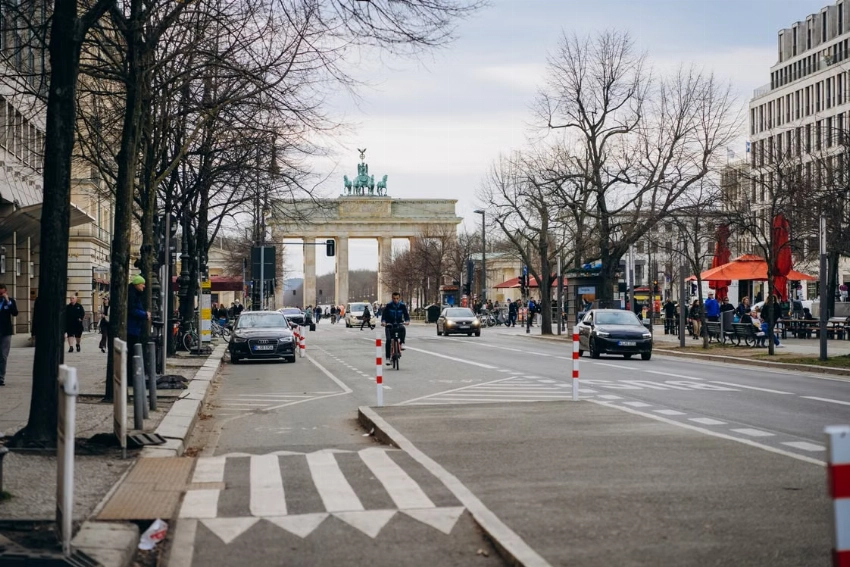
Munich: Great employment opportunities, lucrative salaries, secure, and quality of life.
-
Berlin: Germany's capital is a city where startups, technologies, culture, and international communities are at home.
-
Hamburg: a city of green and prosperous industries, logistics, media, aviation, and maritime.
-
Frankfurt: The number one financial center for banking, finance, and international careers.
-
Stuttgart: Major center for automotive and engineering industries and strong purchasing power.
-
Düsseldorf: Business, fashion and trade center, with high satisfaction of residents.
-
Cologne: A vibrant and hospitable city, boasting a robust and thriving media, entertainment, education, and business industry.
-
Leipzig: a city that is gaining in popularity and is relatively inexpensive, and boasts a dynamic creative and technology landscape.
-
Nuremberg: provides a pretty good mix of work, infrastructure, and relatively low cost of living.
-
Hannover: Famous for its trade fairs, insurance industry, manufacturing,g and excellent transportation.
Expect Advice: Population rank alone doesn't tell you where to live, study, or work — a smaller city like Leipzig or Stuttgart can offer better opportunities for your specific goals than a bigger one.
Also Read: 20 Best Places to Visit in Germany: Latest Guide
What Are the Top 10 Biggest Cities in Germany by Population?
Germany's biggest cities are listed below based on 2025 population in the city proper. The figures are for city dwellers and not for the metropolitan areas.
Berlin: 3,700,577 people
-
Germany's capital and biggest city is Berlin.
-
It is a key hub for government, tech, startups, culture, education and tourism.
-
In 2025, the city's population grew by approximately 15,300 people to over 3.7 million.
Hamburg: 1,869,473 people
-
Hamburg is the second largest city in Germany and is one of the largest port cities in Europe.
-
It is a well-integrated economy with logistics, shipping, air traffic, media, and international trade.
-
The city gained approximately 6,900 people in 2025.
Munich (München): 1,505,036 people
-
Bavaria's capital is Munich, which is also Germany's third largest city.
-
It has a solid reputation in a variety of industries, such as technology, automotive, finance, engineering,g and research.
-
In addition, Munich is one of the most popular cities in Germany for foreigners to live in, but it is also one of Germany's relatively expensive cities.
Cologne (Köln): 1,025,523 people
-
Cologne is North Rhine-Westphalia's most populous city.
-
It's known for its cultural events, universities, media industry, and cathedral.
-
Cologne is Germany's 4th largest city with over 1 million inhabitants.
Frankfurt am Main: 760,656 people
-
Frankfurt is the financial and business hub of Germany.
-
The city is home to important financial institutions and has one of Europe’s busiest international airports.
-
It is also highly appealing to professionals and businesses, owing to its international employees.
Düsseldorf: 619,444 people
-
North Rhine-Westphalia is the capital of the state of Düsseldorf.
-
It is an important center for business, finance, fashion, trade fairs, telecommunications, and international companies.
-
The city is also known for its shopping districts and cultural scene.
Leipzig: 615,932 people
-
Leipzig is one of the fastest-growing big cities in eastern Germany.
-
Its culture and creative industry is thriving, as well as the growth of technology, logistics, and business industries.
-
It now has almost the same size as Düsseldorf.
Stuttgart: 609,365 people
-
Stuttgart is the capital of the state of Baden-Württemberg and a large industrial city.
-
It's especially known to the automotive and engineering sectors.
-
There are also good research institutions, universities, and a reasonably well-developed local economy.
Dortmund: 600,880 people
-
The city of Dortmund is one of the largest cities in the 'Ruhrgebiet'.
-
It was traditionally known as a center for coal and steel production, and is now a hub for services, technology, education, and logistics.
-
The city is also famous for its popularity in football.
Bremen: 588,413 people
-
Bremen is a historic Hanseatic city and is also a major port and industrial city in Germany.
-
Logistics, aerospace, manufacturing, food production, and maritime are key industries.
-
The 10 cities having the largest populations in Germany include Bremen.
Pro Tip: If you're comparing population figures across different articles and getting slightly different numbers, check whether the source is measuring city limits or the broader metro/urban area, both are valid, but they're not the same number.
What Are the Top 10 Beautiful Cities in Germany?
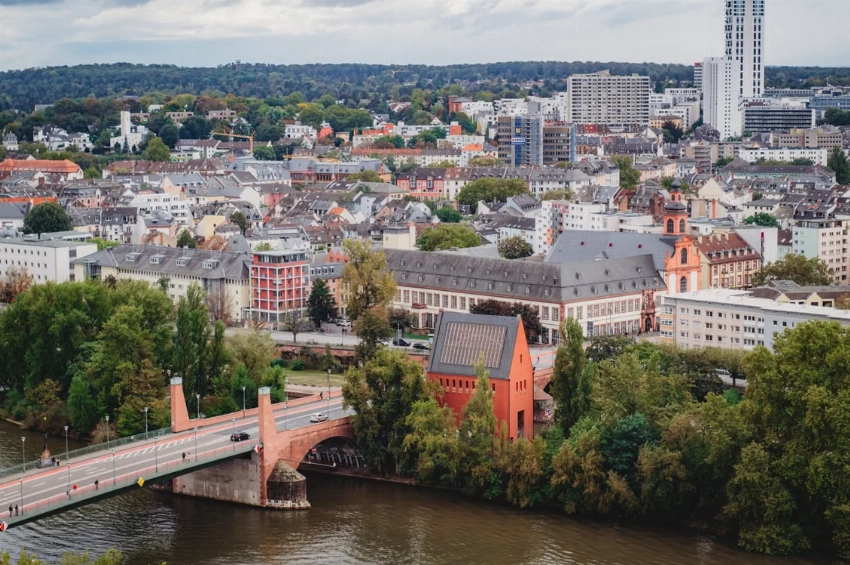
Germany offers numerous beautiful cities, from medieval cities to historic old quarters, and also elegant modern cities, surrounded by rivers, lakes and mountains. Beauty is in the eye of the beholder, but the following 10 are often touted for their architecture, history, scenery and unique atmosphere.
-
Heidelberg: Well-known for its Old Bridge, Old Town, Heidelberg Castle, and for its scenic setting along the Neckar River.
-
Dresden: Home to magnificent Baroque buildings, such as the Frauenkirche, Semperoper, the Zwinger Palace and beautiful views along the Elbe River.
-
Hamburg: A lovely harbour city, with the Elbphilharmonie, a historic Speicherstadt, Alster Lake and the Elbe.
-
Munich: Traditional Bavarian architecture paired with beautiful squares, historic buildings, museums and parks and the impressive Marienplatz.
-
Lübeck: A historic Hanseatic city renowned for its brick Gothic architecture, medieval streets, canals, and UNESCO-listed Old Town.
-
Bamberg: With its highly preserved historic centre, its colourful half timber houses, its medieval streets and its unique riverside architecture.
-
Rothenburg ob der Tauber: A medieval town with cobblestone streets, coloured half-timbered houses, old town walls and old town views : a fairytale setting.
-
Freiburg in the Breisgau: Freiburg is situated in the vicinity of the Black Forest region and is characterized by its picturesque medieval center, small waterways, historic buildings and pleasant natural environment.
-
German Beauty: historic buildings, grand architecture, modern buildings, parks, street art and the River Spree.
-
Cultural Heritage: Best known for the spectacular Cologne Cathedral, the Rhine waterfront, historic Old Town and the unique Hohenzoller Bridge (Hohenzollerbrücke), Cologne (Köln).
Key Note: If a picturesque old town matters more to you than city size, look beyond the population top 10 — several of Germany's most visually stunning cities are also some of its smallest.
Also Read: Top Places to See in Austria: Experts Travel & Visa Guide
Which German Cities Are Best for Indian Students and Professionals?
Germany has several wonderful cities for Indian students and professionals, but it depends on what type of study you are pursuing, what type of career path you are aiming for, budget, lifestyle, etc. Some of the best choices for 2026 are the following:
Berlin: Best for Technology, Startups & International Life
-
Berlin is home to a significant number of expats and a vibrant startup and tech scene.
-
It provides universities like TU Berlin, Humboldt University, and Freie Universität Berlin.
-
Perfect for IT, software, business, media, design,n and entrepreneur students and professionals.
-
Cost of living may be more affordable, but housing is competitive compared to Munich.
Munich: Best for Engineering, IT, High-Paying Careers
-
Munich is one of Germany's leading cities in engineering, automotive, technology, finance and research.
-
It is home to institutions such as the Technical University of Munich (TUM) and LMU Munich.
-
The city offers great job opportunities but also has some of the highest housing and living expenses in Germany.
-
Especially interesting for those professionals who target large technology, automotive, and engineering companies.
Frankfurt: It is the hub of finance, banking & business activities.
-
Frankfurt is the financial hub of Germany and a good option for finance, banking, consulting, economics,s and business.
-
It is home to a large number of international companies and financial institutions.
-
Professionals who are more comfortable working in English can benefit from its international environment.
-
Housing costs are somewhat high, particularly living costs.
Stuttgart: Best in Auto & Mechanical Engineering.
-
Stuttgart is a great location for automotive, mechanical engineering, manufacturing, and technology.
-
There are good links in the wider region to large industrial employers.
-
It's especially recommended for engineering students seeking internships and graduate employment opportunities.
-
For Indian students, it is important to take into account further tuition regulations for numerous non-EU students at Baden-Württemberg public universities.
Hamburg: Best for Logistics, Aviation & Balanced Lifestyle
-
Hamburg is the place where you can find the best job opportunities in the logistics, aviation, and balanced lifestyle sectors.
-
Logistics, maritime industries, aviation, media, and business are important sectors.
-
It has a number of universities and a large number of international residents.
-
Can be a viable choice for students who prefer not to choose Munich or Frankfurt when offered the choice of a large city.
Aachen: Best for Engineering & Technical Students
-
RWTH Aachen University, one of Germany's most renowned technical universities, is especially famous in Aachen.
-
It's a potent choice for students who are interested in engineering, computer science, technology,y and research.
-
The cost of living is more affordable than in Munich and Frankfurt.
-
It's also close to Belgium and the Netherlands, offering an international atmosphere.
Dresden: is the place to go for affordable technical education.
-
Technical schools, research, and a relatively low cost of living make Dresden a good choice.
-
The city of Dresden makes a good place for students of engineering, computer science, technology and research.
-
It may be particularly appropriate for students with a small budget.
Leipzig: Best for Budget-Conscious Students.
-
Leipzig is one of the more affordable major German cities.
-
It has a growing creative, technology, logistics, and business scene.
-
Lower housing costs can make it attractive to international students who want to control their monthly expenses.
-
The English-language professional job market is smaller than in Berlin or Munich, so German skills can be particularly valuable.
Cologne: Best for Media, Business & Social Life
-
Cologne is a major center for media, entertainment, insurance, business, and education.
-
It has a big and diverse population, which makes it an international and student-friendly environment.
-
The city is also highly networked with Düsseldorf as well as other major economic hubs in the state of North Rhine-Westphalia.
-
The lively urban environment makes it a good all-round option for students and professionals.
It is considered to be the best for research and academic life in the area of Heidelberg.
-
Heidelberg is especially interesting for medical students, students interested in the life sciences, natural sciences, and research.
-
Heidelberg University is one of the most internationally recognised universities in Germany.
-
The city provides an historical and student-friendly ambiance.
-
If you are a student from outside the European Union, be aware that you may have to pay tuition fees, which apply to non-EU students, in Heidelberg.
Advice by our Expert: Choose your German city around your career field first, and lifestyle preferences second — an engineering graduate will usually find far more relevant opportunities in Stuttgart or Munich than in a smaller, prettier city.
How Do You Choose the Right City in Germany for You?
Deciding which city in Germany to choose is a matter of your study or career aspirations, budget, lifestyle, and your plans. Take into account the following:
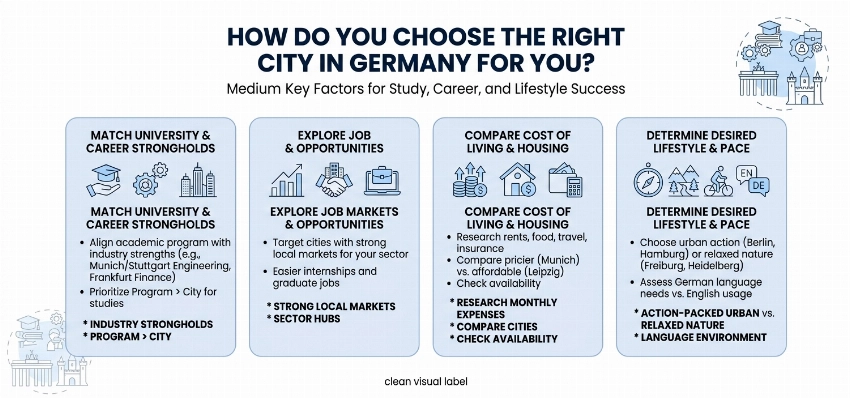
Select the City where you're Going to Work:
-
The first step is to find out in which area your university program or industry has its best strengths.
-
Wall Street: New York, Chicago, London
-
Finance, banking: Frankfurt
-
Media and logistics: Hamburg, Cologne
-
Bicycle manufacturing: Mönchengladbach, Hagen, Essen, Wattenscheid, Karlsruhe, Ulm, Austria, and Munich.Cyclical economy: Ulm, Austria, and Munich.
Compare the Cost of Living:
-
One of the most significant disparities between German cities is housing.
-
While Leipzig and Dresden might be on the lower end of the price scale, Munich and Frankfurt tend to be pricier.
-
Research the rents, meals, travel, health insurance and other monthly costs before you make your choice.
Verify that the University has the Courses Selected in the Course Availability Section Available for Enrollment:
-
If you're a student, consider the program and not the city in general.
-
Verify the admission criteria, course language, course content, tuition or semester rates, campus location, and internships.
Look at Job and Career Opportunities:
-
Think about where businesses in your industry are located.
-
Munich and Stuttgart are good choices for engineering and automotive-related jobs, while Frankfurt is a good choice for finance-related jobs, and Berlin is a good choice for technology and startups.
-
Internships and job opportunities for graduates are easier to secure in a strong local job market.
Review Your German Language Skills:
-
German is becoming more important for daily life and jobs, while English is used extensively, also internationally, in universities and businesses.
-
For those who want to find English-speaking environments, Berlin and Frankfurt are more likely to be good places to start.
-
However, studying German can open up opportunities to you, especially in areas away from the main international centres.
Consider Your Way of Life:
-
If you're a night owl, interested in culture and an action-packed environment, then try Berlin, Hamburg or Cologne.
-
Cities like Freiburg, Heidelberg or Dresden might be a better choice if you want to spend more time in nature, in a more relaxed and quiet environment.
Check Housing Availability:
-
Finding any kind of affordable living in popular cities can be tough.
-
Find information about the student housing, shared flats (WG), private rentals, and commute times before deciding on which university or job offer to apply for.
-
Occasionally, it's possible to live in a nearby smaller community that offers access to a larger city, which can save money.
Expect Advice: Don't choose a German city purely on population rank or postcard appeal, match it to your specific study or career goal first, and treat the "best cities" list as a shortlist, not a final answer.
Also Read: 10 Best Places to Visit in Spain from India: List & More
Conclusion
Germany is a wonderful combination of work, public services, cultural activities, and way of life. Munich, Berlin, Hamburg, Frankfurt, and Stuttgart are still considered to have robust economies and high quality of life, and cities like Leipzig and Düsseldorf are great options depending on budget and lifestyle in 2026. Recent 2026 rankings also feature cities like Erfurt and Augsburg when it comes to residents' satisfaction, depending on what you care about: jobs, affordability, safety, happiness,s or living standards.
Want visa guidance for Germany? You must contact TerraTern right now. With an expert team and over a hundred services, TerraTern will help you realize your dreams easily!




 AI Summary