Key Highlights
- What Are Tier 1 Universities in the UK?
- What Is the Complete List of Tier 1 Universities in the UK for 2026?
- What Are the Key Benefits of Studying at a Tier 1 University in the UK for Indian Students?
- What Are the Admission Requirements for Tier 1 Universities in the UK for Indian Students?
- How Can Indian Students Apply to Tier 1 Universities in the UK?
- What Scholarships Are Available for Indian Students at Tier 1 UK Universities?
- What Are the Tuition Fees and Living Costs at Tier 1 Universities in the UK for 2026?
- How Do Tier 1 UK University Rankings Compare in 2026?
- What Are the Best Programmes at Tier 1 Universities in the UK for Indian Students?
- What Is the Difference Between Tier 1 and Tier 2 Universities in the UK?
- Conclusion
Tier 1 universities in UK are those which consistently appear in the top spots in the world ranking system and provide better placements for Indian students, such as the University of Oxford, Cambridge University, Imperial College London, LSE, and UCL. This article clarifies the meaning of the term ‘tier 1', the 2026 university rankings, average fees for universities in GBP and INR, popular courses, and the most important eligibility criterion for Indians to choose the best universities within their budget and profile.
What Are Tier 1 Universities in the UK?
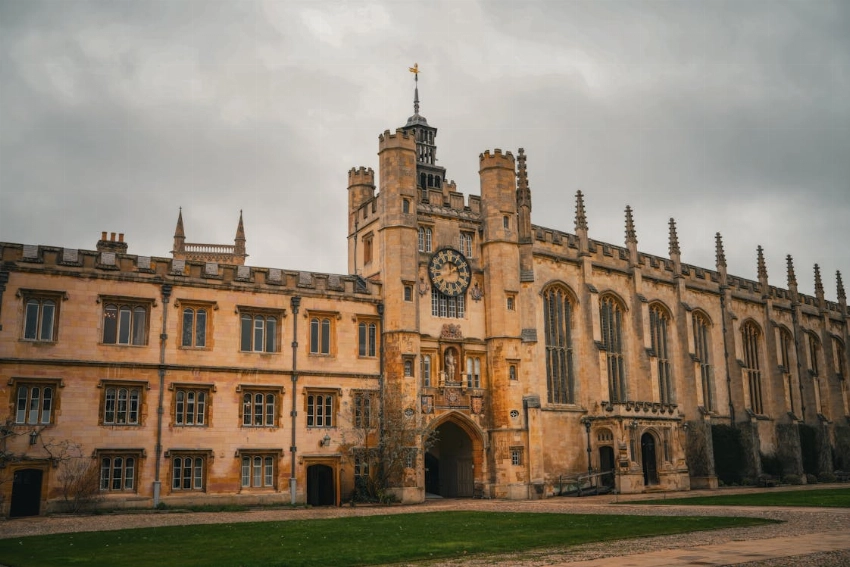
Tier 1 universities in UK refers to informally defined as the highest quality in terms of research, selection and prestige that do not form a formal category of the UK government.
-
They are primarily the G5 “Golden Triangle” universities - Oxford, Cambridge, Imperial College London, LSE and UCL, which all feature amongst the top universities in the UK and the world.
-
Most of the universities in UK are from the Russell group of 24 universities, but those that maintain high global rankings are seen as tier 1.
-
The leading indicators that have been used to determine universities in UK include QS World University Rankings, Times Higher Education (THE), and Academic Ranking of World Universities (ARWU).
-
In the real world, tier 1 universities have very high research output, low acceptance rates, and excellent graduate employability and salary outcomes globally.
As per TerraTern Expert, Shreya, the term "Tier 1" is not an official UK government classification; it is an industry-standard shorthand used by recruiters and counsellors to identify the top-performing subset of Russell Group universities, especially the G5, which dominate global employer preference surveys.
Also Read: Study in Top UK Universities Without IELTS & Guide
What Is the Complete List of Tier 1 Universities in the UK for 2026?
These core tier 1 universities in UK for 2026 according to the QS World University Rankings 2026, are:
|
University (tier 1 universities in uk) |
QS World Rank 2026 |
THE World Rank 2025/26* |
Approx. Acceptance Rate |
Annual Tuition (INR, approx.) |
Specialisation Strength |
Location |
|
Imperial College London |
2 |
8 |
15–33% (highly selective) |
INR 40L–INR 50L/year (STEM-heavy) |
Engineering, Computing, Medicine, Business |
London |
|
University of Oxford |
4 |
1 |
17–20% 1 |
INR 39L–INR 65L/year (UG–MBA) |
Humanities, PPE, Law, Sciences |
Oxford |
|
University of Cambridge |
6 |
3≈ |
21–25% |
INR 28.5L–INR 48L/year |
Mathematics, Engineering, Economics |
Cambridge |
|
UCL (University College London) |
9 |
22 |
35–38% (most accessible G5) |
INR 30L–INR 50L/year |
Architecture, Engineering, Medicine, Law |
London |
|
King’s College London (KCL) |
31 |
38 |
13–44% (varies by course) |
UG ~INR 15L; PG ~INR 11L+/year |
Medicine, Law, and International Affairs |
London |
|
University of Edinburgh |
34 |
10–40% (selective) |
~INR 27.1L/year (relatively affordable) |
Arts, Sciences, Informatics |
Edinburgh |
|
|
University of Manchester |
55 |
Up to ~70% (most accessible tier 1) |
INR 10.2L–INR 35L/year |
Engineering, Business, Materials, Science |
Manchester |
|
|
University of Bristol |
78–80 |
UG ~INR 31L; PG ~INR 40L/year |
Engineering, AI, Business, CS |
Bristol |
||
|
London School of Economics (LSE) |
56 |
Top 50 globally (social sciences) |
9–21% (most selective in social sciences) |
~INR 29.6L (PG); UG up to INR 44L/year |
Economics, Finance, Policy, Law |
London |
|
University of Warwick |
74 |
Top 100 globally |
UG ~INR 41L; PG ~INR 50L/year |
Business, Economics, STEM |
Coventry |
Imperial College London — Is It the Top Tier 1 University in the UK?
Yes, Imperial College London's tier-1 UK status is clear, with QS 2026 placing it #2 globally and #1 in the UK, ahead of Oxford and Cambridge.
|
Metric |
Detail |
|
QS Global Rank 2026 |
2 |
|
Approx. Acceptance Rate |
~15–30% depending on course |
|
Indicative Tuition |
~INR 45.3L/year for many STEM programmes |
|
IELTS Requirement |
Overall 7.0, minimum 6.5 per band (typical) |
|
Class 12 Requirement |
Often 90–95% in relevant subjects (CBSE/ISC) |
|
Key Strengths |
Engineering, Medicine, AI, Business, Data Science |
|
Location Benefit |
Central London, strong tech and finance ecosystem |
|
Scholarships for Indians |
GREAT Scholarship India and other merit awards |
Important Note: Imperial is the only dedicated STEM-focused university in the UK's G5, making it the undisputed first choice for Indian students in engineering, data science, or medicine who want the strongest possible employer signal in the UK and globally.
University of Oxford — Why Is It a Top Tier 1 University in the UK?
A tier 1 university in the uk, the University of Oxford tops the list of tier 1 universities and ranks #4 in the world according to QS 2026 and #1 in THE 2025, and has an ultra-selective admissions process combined with historic prestige.
|
Metric |
Detail |
|
QS Global Rank 2026 |
4 |
|
THE Global Rank 2025/26 |
1 |
|
Approx. Acceptance Rate |
~17–20% overall |
|
Tuition (UG–PG/MBA) |
Roughly INR 39L–INR 65.6L/year depending on course |
|
IELTS Requirement |
7.0–7.5 overall, 7.0 per band for many courses |
|
Class 12 Requirement |
80–95%+ depending on board and subject |
|
Tests (course-specific) |
MAT, LNAT, BMAT, GMAT, GRE with strong scores |
|
Notable Features |
1:1 tutorials, 55+ Nobel winners, 30+ world leaders as alumni |
|
Key Careers |
Finance, consulting, law, policy, academia |
Expert Tip: Oxford's UCAS deadline of 15 October is non-negotiable. Indian students must begin drafting their personal statements and preparing teacher references at least 6 months in advance to meet this critical window.
University of Cambridge — What Makes It a Tier 1 University in the UK?
Cambridge stands firmly in the top tier of tier 1 universities in uk, ranked #6 worldwide by QS 2026 and top 3 worldwide by THE, and has stringent entry requirements and a high academic emphasis.
|
Metric |
Detail |
|
QS Global Rank 2026 |
6 |
|
THE Global Rank 2025/26 |
≈3 |
|
Approx. Acceptance Rate |
~21–25% |
|
Tuition Range |
About INR 28.5L–INR 48L/year |
|
IELTS Requirement |
7.5 overall, 7.0 per band for many courses |
|
Class 12 Requirement |
Often 90%+ across five relevant subjects |
|
Entrance Tests |
STEP, BMAT, plus strong GMAT/GRE for some PG courses |
|
Distinctive Feature |
31 independent colleges with close-contact teaching |
Expert Advice: Cambridge's collegiate system means you're applying to both a department AND a specific college. Indian students should research individual college cultures and acceptance patterns to maximise their chances.
UCL (University College London) — Is UCL a Tier 1 University in the UK?
UCL is highly regarded as one of the top tier 1 Universities in the uk, ranked #9 in QS 2026 and in the top 25 Universities in the world in THE Rankings.
|
Metric |
Detail |
|
QS Global Rank 2026 |
9 |
|
THE Global Rank 2025/26 |
22 |
|
Approx. Acceptance Rate |
Around 35–38% |
|
Tuition Range |
Roughly INR 30L–INR 50L/year |
|
IELTS Requirement |
7.0 overall, 6.5 per band (typical) |
|
Academic Threshold |
~GPA 3.3/4.0 or 85%+ in Class 12 equivalent |
|
Key Strengths |
Architecture (Bartlett), Engineering, Medicine, Law |
|
Location |
Central London has strong links to employers |
Important Tip: UCL's 38% acceptance rate makes it the most accessible G5 university for Indian applicants; however, competition for popular courses such as Computer Science and Law remains extremely high, with subject-specific requirements often exceeding the university's minimum.
London School of Economics (LSE) — Why Is LSE Considered a Tier 1 UK University?
LSE is one of the world's most prestigious social science universities, ranked #56 globally by QS 2026.
|
Metric |
Detail |
|
QS Global Rank 2026 |
56 |
|
Approx. Acceptance Rate |
About 9–21% (highly selective) |
|
Tuition (Indicative) |
PG ~INR 29.6L/year; UG up to ~INR 44L/year |
|
IELTS Requirement |
7.0 overall, 6.5 per band |
|
Academic Profile |
70–85%+ overall; strong maths/econ for quantitative courses |
|
Test Scores |
GMAT 650–720; GRE ≈320+ for many PG programmes |
|
Distinctive Features |
Students from 140+ countries; IB, policy and governance focus |
As per TerraTern Expert: LSE's 9% acceptance rate is deceptively low; its strength is in a very narrow set of disciplines (Economics, Finance, Political Science, Law). Indian students applying outside these core fields will find better ROI at other Tier 1 institutions.
University of Edinburgh — Is Edinburgh a Tier 1 University in the UK?
In uk, the University is ranked in tier 1, and QS 2026 rank #34 with strong research power in arts, sciences & informatics. It also provides the students with slightly lower tuition fees and English score requirements than universities in the G5 group, but is still recognised internationally
|
Metric |
Detail |
|
QS Global Rank 2026 |
34 |
|
THE Global Rank 2025/26 |
34 |
|
Approx. Acceptance Rate |
Around 10–40%, depending on the course |
|
Tuition |
Around INR 27.1L/year for many degrees |
|
IELTS Requirement |
6.5 overall, 5.5 per band (typical) |
|
Class 12 Requirement |
Often 80%+ overall |
|
Notable Feature |
Edinburgh Award for employability skills |
Pro Tip. Edinburgh offers the best value for money among Tier 1 UK universities for Indian students, with lower tuition, a lower IELTS requirement, and still within the Russell Group's elite research tier.
University of Manchester — What Makes Manchester a Tier 1 UK University?
Among the top tier 1 universities in UK by acceptance rate, Manchester is one of the easiest to get into, has a good research performance and is ranked #35 on the global list of QS 2026 universities
|
Metric |
Detail |
|
QS Global Rank 2026 |
35 |
|
THE Global Rank 2025/26 |
55 |
|
Approx. Acceptance Rate |
Up to ~57–76% depending on the subject |
|
Tuition |
Roughly INR 10.2L–INR 35L/year |
|
IELTS Requirement |
Around 7.0 overall, 6.0 per band |
|
Class 12 / PG Requirement |
80–95% in school; 60–80% in bachelor’s for PG |
|
Tests |
GMAT 600–700; GRE ≈310+ for some business/finance courses |
Key Note: Manchester's 76% acceptance rate makes it statistically the most accessible Tier 1 university, but Indian students should note this is an overall rate; competitive programmes like Computer Science, Law, and MBA have substantially lower acceptance rates.
King's College London — Is KCL a Tier 1 University?
King's College London is a tier 1 UK university in the heart of London, ranked #31 in QS 2026 and excelling in medicine, law and global affairs.
|
Metric |
Detail |
|
QS Global Rank 2026 |
31 |
|
THE Global Rank 2025/26 |
38 |
|
Approx. Acceptance Rate |
Around 13–44% |
|
Tuition |
UG about INR 15L; many PG courses around INR 11L+/year |
|
IELTS Requirement |
Often 7.5 overall, 7.0 per band for competitive courses |
|
Class 12 Requirement |
Around 90%+ overall for many programmes |
|
Specialisations |
Medicine, Law, International Relations, Nursing |
|
Entrance Tests |
LNAT and UCAT are required for some law/medicine pathways |
As per TerraTern Expert, Divyansh, KCL is the best choice among Tier 1 universities for Indian students targeting careers in healthcare, law, or international relations. Its proximity to London's legal and medical hubs creates unmatched internship and networking opportunities.
University of Bristol — Is Bristol a Tier 1 University in the UK?
The University of Bristol is a tier 1 universities in UK due to its ranking of #51 in the world according to QS 2026, high research impact and reputation in the field of engineering, computer science and business.
|
Metric |
Detail |
|
QS Global Rank 2026 |
51 |
|
THE Global Rank 2025/26 |
Around 78–80 |
|
Approx. Acceptance Rate |
About 60–70% |
|
Tuition |
UG about INR 31L; PG around INR 40L/year |
|
IELTS Requirement |
Typically, 6.5 overall |
|
Academic Requirement |
Class 12: 70–80%; GPA 6.0/10 or ≈3.2/4 |
|
Key Strengths |
Engineering, AI, Business, Computer Science |
Important Note: Bristol sits in the sweet spot of Tier 1 quality with a more accessible acceptance rate and comparatively lower tuition, a strong strategic choice for Indian students who want a Russell Group credential without Oxford/Cambridge-level competition.
University of Warwick — Why Is Warwick Considered a Tier 1 University?
It's known as a leading tier 1 business school in the uk, has a highly ranked economics department and STEM departments, and ranks #74 on the QS 2026 list.
|
Metric |
Detail |
|
QS Global Rank 2026 |
74 |
|
Approx. Acceptance Rate |
Around 14–30% |
|
Tuition |
UG roughly INR 41L; PG about INR 50L/year |
|
IELTS / Other Tests |
IELTS 6.5–7.0 typical; TOEFL and PTE also accepted |
|
Class 12 / PG Requirement |
Around 92% in Class 12 for some courses; 60–80% in bachelor’s for PG |
|
Special Strengths |
Warwick Business School, Economics, STEM |
|
Industry Links |
Strong ties in tech, consulting, and operations roles |
Expert Advice: Warwick's WBS (Warwick Business School) is one of the few UK business schools with triple accreditation (AACSB, EQUIS, AMBA) — for Indian students targeting MBA or MSc Finance, Warwick can rival LSE at a lower acceptance threshold.
What Are the Key Benefits of Studying at a Tier 1 University in the UK for Indian Students?
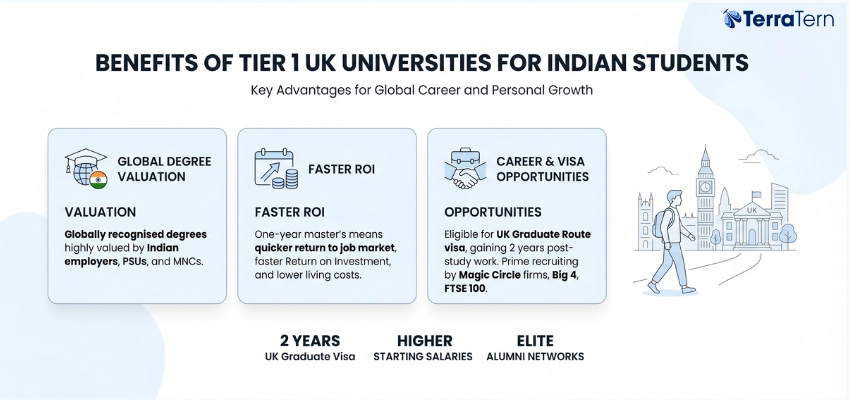
Studying at tier 1 universities in UK gives Indian students globally recognised degrees that are valued by Indian employers, PSUs, and multinational companies across sectors.
-
One-year master’s at tier 1 universities means faster ROI, lower living costs, and a quicker return to the job market than typical two-year programmes abroad.
-
Graduates from universities in UK can use the UK Graduate Route visa, gaining 2 years post-study work (3 years for a PhD) for career transition and UK experience.
-
Tier 1 universities in UK are primary hunting grounds for Magic Circle law firms, Big 4 consultancies, NHS trusts, and FTSE 100 recruiters, leading to higher starting salaries.
-
Students benefit from elite alumni networks, high-impact research labs, and close work with faculty driving global breakthroughs, boosting referrals and long-term international mobility.
Expert Tip: The 2-year Graduate Route visa is arguably the single biggest practical advantage of a UK Tier 1 degree; it allows Indian graduates to earn UK work experience and salaries immediately after graduation, dramatically improving the financial return on their tuition investment.
What Are the Admission Requirements for Tier 1 Universities in the UK for Indian Students?
For tier 1 universities in uk, Indian students usually need 80–95% in Class 12 for direct undergraduate entry (higher for CBSE/ISC, slightly lower bands for some state boards) and 60–80% in a relevant bachelor’s degree for postgraduate courses, plus IELTS scores between 6.5 and 7.5 depending on the university and programme.
What Academic Scores Do Indian Students Need for Tier 1 UK Universities?
Indian applicants to Tier 1 UK universities are assessed mainly on Class 12 (for UG) and bachelor’s percentage or GPA (for PG), mapped to UK 2:1 or First Class equivalents. Use this table as a quick benchmark (exact cut-offs vary by course and year):
|
University (tier 1 universities in uk) |
Typical UG Score (India) |
Typical PG Score (India) |
GMAT/GRE Expectation |
Notes on Level (UK Equivalence) |
|
Oxford |
90–95%+ CBSE/ISC; higher than state boards |
65–70%+ (First class, strong university) |
GMAT 650–730 or GRE 320+ for many PG courses |
Often UK First or strong 2:1 equivalent |
|
Cambridge |
65–70%+ First class |
High STEP/MAT; strong GMAT/GRE for some PG |
Typically UK First class expectation S |
|
|
Imperial College London |
85–90%+ CBSE/ISC; higher for STEM |
60–70%+ (UK 2:1/First equivalent) |
GMAT/GRE is often needed for Business/Analytics |
Usually UK 2:1 or above |
|
UCL |
80–90% CBSE/ISC; 85%+ for most competitive courses |
60–65%+ (UK 2:1 equivalent) |
GMAT/GRE for selective business/quant PGs |
UK 2:1 or strong 2:2 in some cases |
|
LSE |
85–90%+ with strong maths/econ for quant courses |
65–70%+ First class from good Indian universities |
GMAT 650–720 or GRE 320+ for many PGs |
UK 2:1–First, depending on the programme |
|
King’s College London |
85–90%+ for competitive UG |
60–65%+ for most PG courses |
GMAT/GRE sometimes for business/finance |
UK 2:1 target |
|
Edinburgh |
80–85%+ Class 12 overall |
60–65% (2:1 equivalent) |
Some STEM/business PGs may want the GRE/GMAT |
Usually UK 2:1 |
|
Manchester |
80–85%+; some courses accept slightly lower with strong subjects |
55–65% (2:2–2:1) depending on course |
GMAT 600–700; GRE ≈310+ for business/finance |
|
|
Bristol |
75–85%+ overall |
60–65%+ (2:1 equivalent) |
GMAT/GRE is sometimes requested for PG business |
UK 2:1 standard s |
|
Warwick |
85–92%+ for many UG offers |
60–70%+ depending on business/STEM course |
GMAT is often required for WBS; 600–700+ typical |
UK 2:1–First for tier 1 programmes |
What IELTS Score Is Required for Tier 1 Universities in the UK?
Most tier 1 universities in UK require an overall IELTS 7.5 (with 7.0 in each band) at Oxford and Cambridge, especially for essay-heavy or law programmes.
-
For Imperial College London, UCL, LSE, and King’s, Indian students typically need an overall IELTS score of 7.0, with at least 6.5 in each band, for competitive courses.
-
Edinburgh and Bristol often accept IELTS 6.5 overall (with minimum sub-scores between 5.5 and 6.0), making them slightly more flexible
-
Manchester and Warwick usually span IELTS 6.5–7.0 overall, with some foundation or less-demanding programmes starting at 5.5–6.0.
-
Many tier 1 universities also accept TOEFL iBT and PTE Academic as alternatives; band-by-band conversions broadly mirror IELTS requirements.
What Documents Are Required for Tier 1 UK University Applications?
Applications to tier 1 universities in UK require academic transcripts (Class 10, Class 12, and semester-wise bachelor’s mark sheets) plus final certificates where available.
-
A tailored Statement of Purpose is essential, aligned with each university’s expectations on academic fit, research interests, and career goals.
-
Most ask for 2–3 Letters of Recommendation from teachers or professors, along with an updated CV/Resume for PG and MBA profiles.
-
Valid passport, financial proof for at least one year’s tuition plus living costs, and relevant entrance test score reports (GMAT, GRE, LNAT, UCAT, MAT, STEP) are mandatory where applicable.
-
Indian students applying may also need a TB test certificate for the visa and an ATAS clearance for certain sensitive science or engineering programmes.
Important Note: Many Indian students underestimate the importance of the SOP. Tier 1 UK universities use it as the primary differentiator when academic scores are similar. Tailor each SOP to the specific teaching philosophy of the university (e.g., Oxford's tutorial system vs. Imperial's entrepreneurial culture).
Also Read: Study in UK Without IELTS: New Universities & Options
How Can Indian Students Apply to Tier 1 Universities in the UK?
Indian students apply to tier 1 universities in UK via UCAS for undergraduate courses (with 15 October deadlines for Oxford, Cambridge, and Medicine, and late-January for most others) and directly through each university’s online portal for postgraduate programmes, ideally starting profile building and test prep 12–15 months before the intended intake.
What Is the Step-by-Step UCAS Application Process for Tier 1 UK Universities?
Shortlist 3–5 tier 1 universities in UK and specific courses by July–August of your application year, checking entry requirements and tests early.
-
Take the IELTS/TOEFL/PTE by September, and, in parallel, draft your SOP and arrange 2–3 LORs tailored to tier-1 universities' expectations.
-
Register on UCAS, complete the application (personal details, education, course choices, SOP, references) and submit by 15 October for Oxford/Cambridge/Medicine or by late January for other tier 1 universities
-
For PG, apply directly via university portals from around September onward, then receive conditional/unconditional offers and pay deposits of about £3,000–£5,000.
-
After accepting your offer and receiving the CAS letter, apply for the UK Student Visa at least 3 months before the course start to join your chosen Tier 1 universities on time.
What Is the UK Student Visa Process for Indian Students Joining Tier 1 Universities?
-
Once an Indian student accepts an offer from a Tier 1 universities in UK and meets the conditions, the university issues a CAS (Confirmation of Acceptance for Studies) number used in the visa application.
-
Pay the Student Visa fee of £490 for bachelor’s and master’s courses, plus the immigration health surcharge as calculated on the official portal.
-
Show financial proof for fees plus living costs: £1,529 per month if your tier 1 university course in the UK is in London, or £1,171 per month outside London, held for 28 consecutive days.
-
Arrange a mandatory TB test certificate from a UK-approved clinic in India and obtain an ATAS certificate if your Tier 1 university in the UK offers certain sensitive science or engineering subjects.
-
Submit the online visa form, attend biometrics, and wait around 3 weeks for a decision; after completing your degree at a Tier 1 university, you can usually switch to the Graduate Route for 2–3 years of post-study work.
Pro Tip: The biggest mistake Indian students make is starting their IELTS preparation too late — for Tier 1 universities requiring 7.0–7.5, most students need 2–3 attempts, so begin at least 8 months before your target application deadline.
What Scholarships Are Available for Indian Students at Tier 1 UK Universities?
Indian students targeting Tier 1 UK universities (such as Oxford, Cambridge, Imperial, UCL, LSE, Edinburgh, Manchester, and King's College London) have access to fully funded options like Chevening, Gates Cambridge, and Rhodes Scholarships, alongside targeted awards like GREAT Scholarships (£10,000) and university-specific funds.
What Are the Best Government-Funded Scholarships for Tier 1 UK Universities?
Fully funded government-backed awards are open to Indian students across Tier 1 universities, often requiring strong academics (e.g., 2:1 equivalent or higher) and leadership potential.
|
Scholarship |
University |
Value |
Eligibility |
|
Chevening Scholarship |
Any UK university |
Fully funded (fees + living + airfare) |
Indian students with 2+ years of work experience, leadership potential |
|
Gates Cambridge |
Cambridge |
Fully funded (up to £300,000 total) |
Outstanding postgrads under 30, leadership focus |
|
Rhodes Scholarship |
Oxford |
Fees + £19,800/year stipend |
Merit-based postgrads, age upto 27 years |
|
Commonwealth Scholarship |
Any |
Fully funded (fees + airfare + stipend) |
2:1 degree, PhD/postgrad level |
Which Tier 1 UK Universities Offer Scholarships Specifically for Indian Students?
Tier 1 universities offer scholarships tailored for Indian students, often £5,000-£10,000 towards tuition for one-year postgrad courses; deadlines for 2026-27 intake are mostly Jan-May.
|
University |
Scholarship |
Value |
Deadline 2026 |
|
Imperial College London |
GREAT Scholarship India |
£10,000 tuition |
7 January |
|
UCL |
India Excellence Scholarship |
£5,000 (33 awards) |
26 February |
|
University of Manchester |
Global Futures Scholarship |
£10,000/year |
March/April |
|
University of Edinburgh |
India Merit Scholarship |
£5,000 PGT |
May (TBC) |
|
King's College London |
Vice-Chancellor's Awards |
£10,000 (30 PG) |
31 May |
|
LSE |
Taught Master's Scholarship |
Up to £41,666 (full fees + living) |
Check portal |
Key Note: Most Tier 1 university-specific scholarships require an existing offer of admission before you can apply ,so secure your conditional offer first, then immediately pursue scholarship applications. Missing this sequencing is the most common reason Indian applicants waste funding opportunities.
What Are the Tuition Fees and Living Costs at Tier 1 Universities in the UK for 2026?
Tuition fees at tier 1 universities in UK range from approximately £9,250 to £59,500 per year (INR 10.2L–INR 65.6L). Total annual costs, including living expenses, range from INR 25L to INR 90L+ depending on the city and programme.
What Is the Total Cost of Studying at a Tier 1 UK University for Indian Students?
For Indian students, the total cost combines tuition, location-based living expenses, and mandatory extras. Based on the 2026 exchange rate (1 GBP ≈ INR 110.25), studying at top UK institutions requires factoring in visa fees, health surcharges, flights, and accommodation to understand your true annual financial commitment.
|
University (Location) |
Annual Tuition (Approx) |
Annual Living Expenses |
Total Annual Cost (INR) |
|
LSE (London) |
£26,200 (INR 28.8L) |
£18,348 (INR 20.2L) |
~INR 49.0L |
|
Cambridge (Outside London) |
£33,000 (INR 36.3L) |
£14,052 (INR 15.5L) |
~INR 51.8L |
|
Edinburgh (Outside London) |
£24,600 (INR 27.1L) |
£14,052 (INR 15.5L) |
~INR 42.6L |
|
Manchester (Outside London) |
£25,500 (INR 28.1L) |
£14,052 (INR 15.5L) |
~INR 43.6L |
Which Is the Most Affordable Tier 1 University in the UK for Indian Students?
Finding affordable options requires balancing tuition against regional living expenses:
-
Top Value: The University of Edinburgh (~INR 27.1L/year tuition) and the University of Manchester (from INR 10.2L for some programmes) emerge as the most affordable.
-
The Trade-off: Lower tuition cities (Edinburgh, Manchester, Bristol) also boast significantly lower living costs than London.
-
Programme Structure: 1-year Master's programmes provide overall better value than 2-year equivalents abroad by halving living expenses.
As per TerraTern Expert, Divyansh, Indian students often underestimate the UK's Immigration Health Surcharge (IHS), at £776/year, a 2-year Master's programme requires £1,552 in IHS payments alone, which must be paid upfront during the visa application. Budget for this separately.
Also Read: UK IELTS Band Requirements: Visa & University Guide
How Do Tier 1 UK University Rankings Compare in 2026?
Rankings vary significantly by methodology. Imperial currently ranks #2 globally (QS 2026), while Oxford holds the #1 spot (THE 2025). Indian students should cross-reference QS, THE, and the Complete University Guide rankings alongside subject-specific tables to identify the best tier 1 universities in UK for their specific career goals.
Which Ranking System Should Indian Students Use for Tier 1 UK Universities?
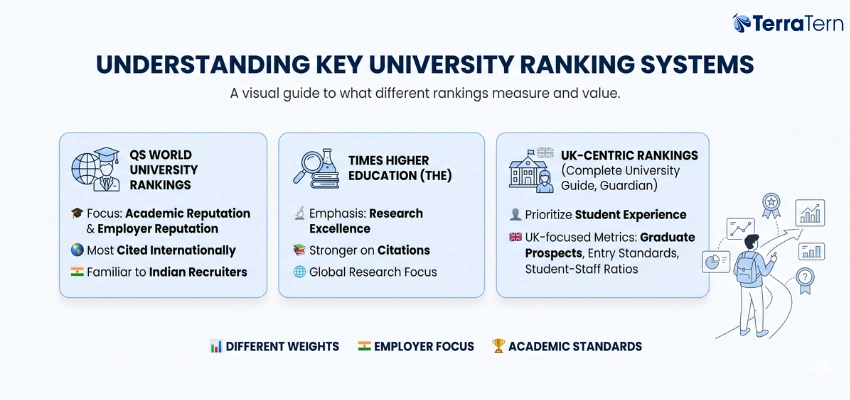
Navigating global rankings can feel like decoding a complex puzzle. Each system weighs factors differently:
-
QS World University Rankings: Focuses heavily on academic reputation and employer reputation. It is the most cited system internationally and the one most familiar to Indian employers and recruiters.
-
Times Higher Education (THE): Places a stronger emphasis on research excellence and citations.
-
Complete University Guide & The Guardian: These are UK-centric and prioritise the "student experience," including entry standards, student-staff ratios, and graduate prospects.
This table compares the standing of the elite tier 1 universities in UK across the major global and domestic leaderboards.
|
University |
QS 2026 |
THE 2025 |
Complete University Guide 2026 |
|
Imperial College London |
#2 |
#8 |
Top 5 |
|
University of Oxford |
#4 |
#1 |
#1 |
|
University of Cambridge |
#6 |
#5 |
#2 |
|
UCL |
#9 |
#9 |
Top 10 |
|
King’s College London |
#31 |
#38 |
Top 15 |
|
University of Edinburgh |
#34 |
#30 |
Top 5 |
|
University of Manchester |
#35 |
#51 |
Top 15 |
|
LSE |
#56 |
#46 |
Top 10 |
|
University of Bristol |
#51 |
#81 |
Top 15 |
|
University of Warwick |
#74 |
Top 100 |
Top 15 |
Important Note: Never rely on a single ranking system; Oxford ranks #1 in THE but #4 in QS, while Imperial is #2 in QS but #8 in THE. For Indian students, QS rankings tend to carry more weight in terms of brand recognition with domestic employers, while subject-specific rankings matter most for academic and research careers.
What Are the Best Programmes at Tier 1 Universities in the UK for Indian Students?
The most popular and career-rewarding programmes for Indian students at tier 1 universities in UK include Computer Science, Data Science, MBA, Finance, Law, Engineering, and Medicine, with specific universities leading in each discipline to ensure high global employability.
Which Tier 1 UK Universities Are Best for STEM Programmes?
For Indian students targeting high-growth sectors like AI and Biotechnology, these institutions offer world-class research facilities and industry links:
-
Imperial College London: Global leader in Engineering, AI, Computer Science, and Medicine.
-
University of Cambridge: Unmatched for Mathematics, Natural Sciences, and Engineering.
-
University of Manchester: Specialises in Computer Science, Biotechnology, and Physics (notably Graphene research).
-
University of Bristol: Highly regarded for Engineering and Computer Science innovation.
Which Tier 1 UK Universities Are Best for Business and MBA?
These business schools are the preferred choice for those seeking high ROI and global networking opportunities:
-
London Business School (LBS): While specialised, it is the UK’s premier MBA destination with elite placement outcomes.
-
Oxford (Saïd) & Cambridge (Judge): Offer prestigious 1-year MBAs; typical GMAT scores range from 690–740+.
-
LSE: The gold standard for Finance, Accounting, and Management.
-
Warwick Business School: Renowned for its 12-month MBA and strong connections to the UK's financial hubs.
Which Tier 1 UK University Is Best for Law and Social Sciences?
Securing a seat in these programmes requires passing the LNAT and demonstrating exceptional academic rigour:
-
Oxford & Cambridge: Ranked #1 and #2 for Law; both require the LNAT and have competitive acceptance rates (~12-15%).
-
LSE: The global authority for Economics, Sociology, and Political Science.
-
King’s College London (KCL): A top-tier choice for Law and International Relations, located in the heart of London’s legal district.
Pro Tip: For Indian students targeting tech careers, Imperial's proximity to London's Silicon Roundabout and Cambridge's ties to the Cambridge tech cluster provide unmatched placement ecosystems, both of which consistently place 95%+ of Computer Science graduates within six months.
What Is the Difference Between Tier 1 and Tier 2 Universities in the UK?
Tier 1 universities in UK (G5 plus the very top Russell Group) usually sit inside the global top 100, have tougher entry standards (often sub-25% acceptance), higher tuition, and the strongest employer brand and research power. Tier 2 universities are typically ranked roughly 100–400 globally, offer higher acceptance rates, slightly lower IELTS band scores, and lower fees, making them smarter choices for budget-conscious or profile-building Indian students.
|
Dimension |
Tier 1 Universities in UK (G5 + top Russell Group) |
Tier 2 Universities (rest of Russell Group + strong others) |
|
Typical global ranking range |
Roughly top 1–100 globally (QS/THE) |
Roughly 100–400 globally |
|
Acceptance rate |
Often below 20–25% for many courses |
Commonly 30–70%, depending on the course |
|
Average annual tuition (international) |
Higher: often INR 25L–INR 55L+ per year |
Moderate: often INR 15L–INR 30L per year |
|
Usual IELTS requirement |
7.0–7.5 overall (bands 6.5–7.0) |
6.0–6.5 overall for many programmes |
|
Employer brand |
Target schools for Big 4, Magic Circle, elite IB/consulting and top tech |
Strong regional/national brand; still good but slightly less “elite” signalling |
|
Research output & intensity |
Very high; major global research hubs, larger research funding |
High to medium; good research but narrower global visibility |
|
Typical Indian applicant profile |
85–95%+ in Class 12, very strong SOP/LORs, higher IELTS, often solid internships |
70–85%+ in Class 12, decent profile; good fit for realistic and value-for-money plans |
|
When it’s the smarter choice |
For maximum brand value, global mobility, and top-tier recruiting pathways |
For a lower budget, slightly safer admits, specific niche subjects, or strong backup options |
|
Example universities |
Oxford, Cambridge, Imperial, UCL, LSE, Edinburgh, Manchester, Bristol |
University of Exeter, Durham, Leeds, Newcastle, Nottingham, Southampton, Queen’s Belfast |
Also Read: Exams for Foreign Studies: New Exam Guide by Experts
Conclusion
Choosing among tier 1 universities in UK depends on your goals, budget, and academic profile. If you want ultra-elite STEM, Imperial and Cambridge stand out; for broad prestige and leadership pathways, Oxford, LSE, and UCL are excellent. Edinburgh, Manchester, Bristol, KCL, and Warwick balance strong branding with slightly more accessible entry and costs. Shortlist based on course strength, city preference, and ROI, then align tests and profile accordingly.
Contact TerraTern for more information on Tier 1 Universities in UK 2026: Rankings, Fees & Guide for Indians.