


Key Highlights
- What is the Nursing Officer Salary in India?
- What is the Career Progression and Salary Growth for Nursing Officers in 2026?
- What is the Comparison of Nursing Officer Salaries Across Institutions in India in 2026?
- How Does Nursing Officer Salary Vary by City and State?
- What are the Additional Benefits and Allowances for Nursing Officers in 2026?
- How to Maximise Your Earnings as a Nursing Officer?
- Can Indian Nursing Officers Work Abroad and How Does the Salary Compare?
- What is the Future Outlook for Nursing Officer Salaries in India?
- What Will Be the Nursing Officer Salary After the 8th Pay Commission?
- Latest Facts and News
- Conclusion
Nursing officers in India play a crucial role in the healthcare system, offering support, care, and expertise to patients across various settings. In 2026, the nursing officer salary continues to evolve, with competitive pay scales, allowances, and career growth opportunities in institutions like AIIMS and ESIC and can be the ticket to easy immigration.
This guide offers an in-depth look into the nursing officer salary structure, focusing on AIIMS nursing officer salary and ESIC nursing officer salary, to help aspiring nursing professionals make informed decisions about their careers.
Discover the lucrative world of nursing officer salaries in India's top healthcare institutions. From competitive pay scales to attractive benefits, find out why pursuing a career as a nursing officer could be your path to financial stability and professional growth.
What is the Nursing Officer Salary in India?

In India, the starting basic pay of INR 44,900 per month under Pay Level 7 of the 7th Central Pay Commission (CPC) is the starting salary of a nursing officer in India.
The gross salary of between 70,000 and 85,000 per month is supplemented by necessary allowances such as Dearness Allowance (DA at an approximate rate of 53 per cent), House Rent Allowance, Transport Allowance, and Special Nursing Allowance.
|
Salary Component |
Amount / Details |
|
Basic Pay |
INR 44,900 (Pay Level 7) |
|
Dearness Allowance (DA) |
~53% of Basic Pay |
|
Other Allowances |
HRA, TA, and Nursing Allowance |
|
Gross Salary |
INR 70,000 – INR 85,000 per month |
|
Standard Deductions |
NPS, Income Tax, etc. |
|
Estimated In-Hand Salary |
INR 55,000 – INR 75,000 per month |
Also Read: Nursing Jobs in Canada for Indians: Salary, Requirements & More
What is the Career Progression and Salary Growth for Nursing Officers in 2026?
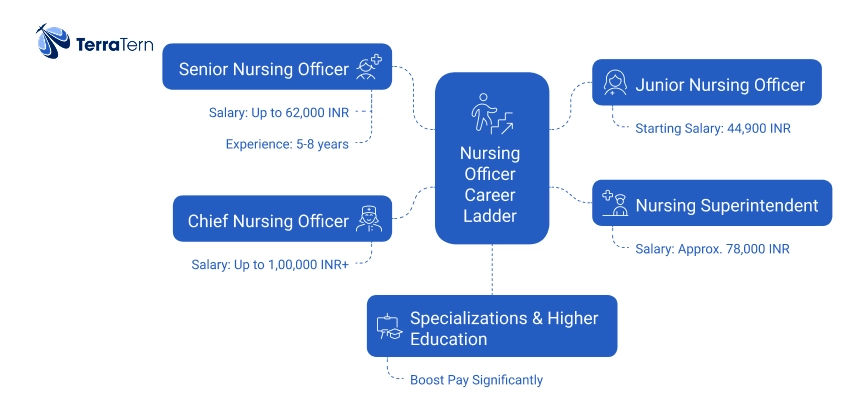
A career as a nursing officer offers significant growth opportunities, both in terms of salary and professional development. Here’s an outline of how nursing officers can progress:
-
Junior Nursing Officer (Entry-Level): Starting salary of 44,900 rupees with allowances.
-
Senior Nursing Officer: Promoted after 5–8 years, with salaries increasing up to 62,000 rupees.
-
Nursing Superintendent: A leadership role with pay of around 78,000 rupees, depending on experience.
-
Chief Nursing Officer: Top position with salaries reaching 1,00,000 rupees or more.
-
Specialisations: Additional qualifications in areas like critical care or paediatrics can lead to specialised roles with higher pay.
-
Higher Education: Pursuing a master's degree or certifications can fast-track promotions.
-
Increment Opportunities: Annual salary increments based on performance and the 7th Pay Commission.
With a clear career ladder and competitive growth options, nursing officers in institutions like AIIMS and ESIC can achieve both financial stability and professional fulfilment.
What is the Comparison of Nursing Officer Salaries Across Institutions in India in 2026?
Nursing officer salaries vary across institutions based on their pay structure, benefits, and work environment. Here's a quick comparison:
-
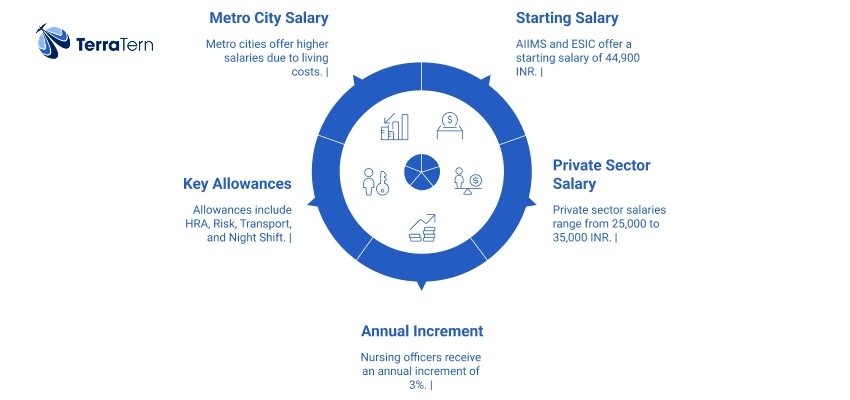
Starting salary: 44,900 rupees.
-
Benefits: Extensive allowances, including housing, travel, and risk allowances.
-
Pros: Government job security and growth potential.
-
Cons: Highly competitive recruitment process.
ESIC Nursing Officer Salary:
-
Starting Salary: 44,900 rupees with allowances.
-
Benefits: Pension schemes, health coverage, and night shift allowances.
-
Pros: Regular increments and employee benefits. (ESIC Nursing Officer Salary)
-
Cons: Heavy workload in ESIC hospitals.
Private Hospitals:
-
Starting Salary: 25,000–35,000 rupees.
-
Benefits: Limited perks and variable bonuses.
-
Pros: Flexible schedules and advanced equipment.
-
Cons: Less job security compared to government institutions.
Here's a comprehensive table comparing nursing officer salaries across AIIMS, ESIC, and private hospitals for a better and easier understanding:
|
Institution |
Starting Salary (INR) |
Allowances and Benefits |
Pros |
Cons |
|
AIIMS |
44,900 rupees |
Housing, travel, risk allowances, pension, and health coverage |
Government job security; career growth |
The highly competitive recruitment process |
|
ESIC |
44,900 rupees |
Pension, night shift, health benefits, annual increments |
Employee benefits: regular increments |
Heavy workload in ESIC hospitals |
|
Private Hospitals |
25,000–35,000 rupees |
Performance bonuses, minimal allowances |
Flexible schedules; exposure to new technology |
Lesser job security; limited benefits |
Also Read: BSc Nursing Job Vacancy: Latest Experts Job Guide
How Does Nursing Officer Salary Vary by City and State?
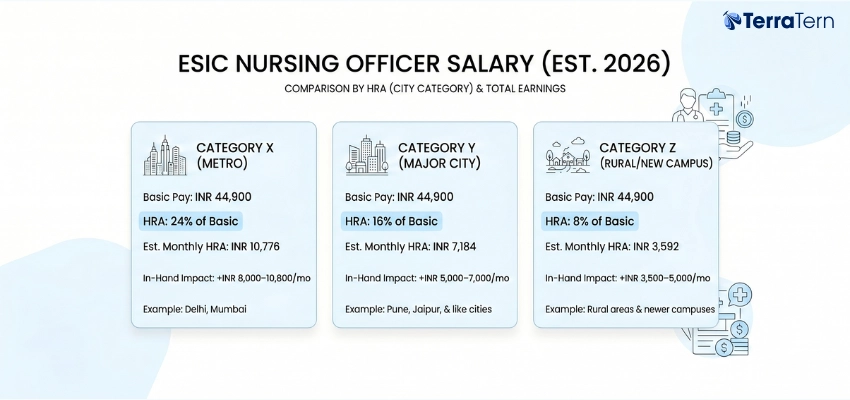
ESIC nursing officer salary varies based on HRA (X: 24% basic in Delhi/Mumbai; Y: 16% in cities like Pune; Z: 8% in rural areas) and TA, affecting the in-hand salary of INR 3,500–INR 10,800/month. Metro-based AIIMS institutions like Delhi typically offer higher HRA than newer campuses like Rishikesh.
|
City Category |
HRA % (Basic INR 44,900) |
Monthly HRA |
In-Hand Impact |
|
X (Delhi, Mumbai) |
24% |
INR 10,776 |
+INR 8,000–INR 10,800 |
|
Y (Pune, Jaipur) |
16% |
INR 7,184 |
+INR 5,000–INR 7,000 |
|
Z (Rural areas) |
8% |
INR 3,592 |
+INR 3,500–INR 5,000 |
Pro Tip: Requesting a posting in an X-category city can increase your effective monthly in-hand salary by INR 7,000–INR 10,000 purely through HRA. Location strategy is an underrated tool for salary optimisation.
Also Read: AIIMS Nursing Officer Salary: Complete Pay Guide
What are the Additional Benefits and Allowances for Nursing Officers in 2026?
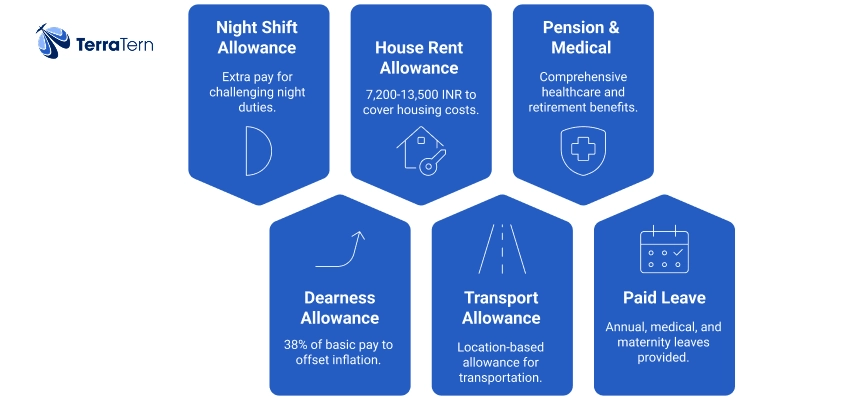
Nursing officers enjoy a wide range of benefits and allowances, making government healthcare roles highly desirable. Here’s a breakdown:
Key Allowances:
-
Night Shift Allowance: Additional compensation for night duty (nursing job perks).
-
Risk Allowance: For handling hazardous tasks in high-risk wards (healthcare worker benefits).
-
Uniform Allowance: Financial support for purchasing uniforms.
-
Dearness Allowance (DA): Covers inflation-related expenses, adjusted biannually.
-
House Rent Allowance (HRA): For accommodation expenses, it varies by city category.
Other Benefits:
-
Pension Schemes: Lifetime pension post-retirement, ensuring financial security.
-
Medical Coverage: Comprehensive health benefits for the officer and dependents.
-
Paid Leave: Annual, medical, and maternity leaves are available.
-
Annual Increments: Regular salary hikes based on the 7th Pay Commission guidelines.
Impact of Location on Nursing Officer Salaries
The geographical location of a nursing officer's workplace significantly impacts their salary and allowances.
Key Factors Influencing Location-Based Salaries:
City Tier Differences:
-
Metro Cities (Tier 1): Higher salaries due to increased living costs.
-
Tier 2 and 3 Cities: Moderate salaries with reduced allowances for living costs.
Special Allowances for Remote Areas:
-
Rural and Remote Postings: Additional incentives like hardship allowance and housing benefits.
-
Hilly or Tribal Regions: Extra allowances for challenging terrain and isolation.
Examples of Salary Variations:
|
Location |
Average Salary (per month) |
Allowances |
|
Metro Cities |
INR 50,000 - INR 70,000 |
HRA, Night Shift, Risk Allowance |
|
Tier 2 Cities |
INR 40,000 - INR 55,000 |
Reduced HRA, fewer special perks |
|
Rural Areas |
INR 45,000 - INR 60,000 |
Hardship Allowance, Free Housing |
Location-based differences ensure fair compensation while addressing regional disparities and healthcare workforce distribution.
How to Maximise Your Earnings as a Nursing Officer?
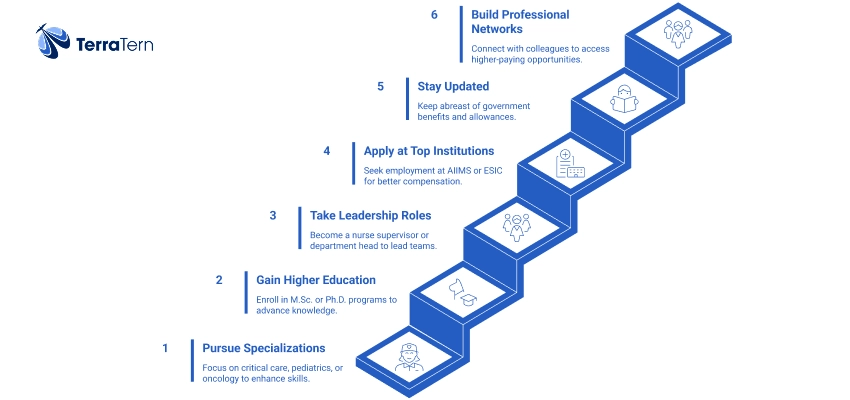
To enhance your earnings as a nursing officer, focus on upskilling, taking on responsibilities, and exploring additional income opportunities. With the nursing officer salary structure offering growth, opportunities in AIIMS nursing officer salary and ESIC nursing officer salary packages, expanding your skill set can lead to significant financial rewards.
-
Pursue specialised certifications in critical care, paediatrics, or oncology.
-
Enrol in postgraduate courses like M.Sc. Nursing or PhD programs.
-
Take leadership roles such as nurse supervisor or department head.
-
Write and have a strong cover letter showcasing your strengths and achievements
-
Work extra shifts, including night and weekend duties, for overtime pay.
-
Apply for nursing officer positions in institutions like AIIMS or ESIC.
-
Gain experience in high-demand urban areas or overseas healthcare systems.
-
Stay updated on government initiatives and allowances for healthcare workers.
-
Participate in clinical trials or research projects for additional income.
-
Build professional networks to access higher-paying job opportunities.
-
Keep track of annual appraisals and negotiate pay increments.
Can Indian Nursing Officers Work Abroad and How Does the Salary Compare?
Indian nursing officers, including those on ESIC nursing officer salary, leverage their government experience for high-paying roles abroad in the UK (NHS), Canada, Australia, the UAE, and Germany, often earning 3–10x domestic pay. Indian nursing officers pursuing international roles typically require IELTS/OET certification and country-specific credential recognition before applying.
|
Country/Employer |
Monthly Salary (Equivalent INR) |
Comparison to India (INR 70k avg.) |
|
India (AIIMS/ESIC) |
INR 70,000–INR 1,00,000 |
Baseline |
|
UK (NHS Band 5–6) |
INR 2.5–INR 4 lakh |
4–6x higher |
|
Canada (Provinces) |
INR 3–INR 5 lakh |
5–7x higher |
|
Australia (Public) |
INR 3.5–INR 5.5 lakh |
5–8x higher |
|
UAE (Private/Govt) |
INR 2–INR 4 lakh (tax-free) |
3–6x higher + perks |
-
Visa Pathways: UK Health & Care Visa (fast-track); Canada Express Entry (NOC 31301); Australia Subclass 189/190.
-
Certifications: IELTS/OET (7+ bands), NMC (UK), NCLEX (Canada), AHPRA (Australia).
-
TerraTern Support: Customised visa coaching, credential verification for seamless migration.
Key Note: A government nursing officer with 3–5 years of AIIMS/ESIC experience is highly competitive for international healthcare roles. Language proficiency (IELTS/OET) is often the biggest barrier, and addressing it early can accelerate the timeline by 12–18 months.
What is the Future Outlook for Nursing Officer Salaries in India?
As the healthcare sector grows, nursing officer salaries are projected to rise with government initiatives and global healthcare demands. Here's what to expect:
-
Increased Government Focus: Ongoing efforts to enhance healthcare worker compensation will lead to better salaries for nursing officers.
-
Impact of 7th Pay Commission: The 7th Pay Commission's recommendations will continue to positively influence nursing officer salary structures, bringing salary hikes.
-
Rising Demand for Skilled Nurses: Global healthcare demands, particularly post-pandemic, will boost salaries for skilled nursing officers, with ESIC nursing officer salary and AIIMS nursing officer salary benefiting.
-
Salary Growth Projections: Experts predict a steady rise in nursing officer salaries by 10-15% over the next 5 years due to expanding healthcare infrastructure.
-
Specialised Nursing Roles: Pursuing advanced certifications in critical care or other specialisations will open doors to higher-paying positions.
-
BSc Nursing Jobs: This degree is blooming like never before and has a great outlook for the future of nursing jobs.
As the healthcare sector evolves, nursing officers can expect salary growth driven by government policies and the expanding job market.
What Will Be the Nursing Officer Salary After the 8th Pay Commission?
The 8th Pay Commission (8th CPC), expected in 2026, will revise ESIC nursing officer salary via DA merger and higher fitment factor (likely 2.5–3.0 vs 2.57 now), boosting AIIMS nursing officers to secure high-demand roles.
-
Timeline: The 8th Pay Commission is expected to be constituted and recommend salary revisions, but no official implementation date has been confirmed as of 2026. Projections are estimates only.
-
Conservative Projection: Gross INR 1.43–INR 1.56 lakh/month; in-hand ~INR 1.25 lakh.
-
Optimistic Projection: Fitment 3.0+ pushes gross to INR 1.6–INR 1.8 lakh.
-
Key Changes: Full DA merger (currently 50%); expanded pay matrix.
-
Career Edge: Positions nursing among India's top secure healthcare jobs with inflation-proof hikes.
As per TerraTern Expert: Even under conservative 8th CPC estimates, a nursing officer's salary could double compared to 2020 levels, making this one of the most financially rewarding government healthcare careers in India.
Latest Facts and News
- ESIC Nursing Officer recruitment 2026 announced with 1930 vacancies
-
7th Pay Commission recommends a 3% annual increment for nursing officers
-
New allowances introduced for nursing officers working in high-risk areas
-
The government plans to increase the nursing workforce by 20% by 2026
Conclusion
In conclusion, nursing officer salaries in India, including the AIIMS nursing officer salary and ESIC nursing officer salary, are competitive, with institutions like AIIMS and ESIC offering attractive compensation packages and benefits.
The growing demand for skilled nursing officers, along with government initiatives, ensures a bright future for nursing officers. Pursuing a career in nursing not only provides financial stability but also offers opportunities for professional growth.
At TerraTern, we are here to clear all doubts regarding nursing officer salary and related topics, helping you navigate your career path with ease.


 AI Summary