


Key Highlights
- What is the Nursing Officer Salary?
- What Is the Nursing Officer Salary Structure in India?
- What Is the AIIMS Nursing Officer Salary in 2026?
- What Is the ESIC Nursing Officer Salary in 2026?
- What Are the Career Growth and Promotion Prospects for Nursing Officers?
- What Will Be the Nursing Officer Salary After the 8th Pay Commission?
- How Does Nursing Officer Salary Vary by City and State?
- Can Indian Nursing Officers Work Abroad and How Does the Salary Compare?
- What Are the Key Benefits and Perks of a Nursing Officer Job Beyond Salary?
- 2026 Industry Context Section
- Conclusion
With healthcare growing in India in 2026, the need to know the entire nursing officer salary system is essential to future medical practitioners. Top-level government institutions are highly competitive in terms of remuneration, which is governed by the 7th Pay Commission. As an example, the AIIMS nursing officer salary is highly desirable and offers excellent benefits and career advancement. In the same vein, the salary of an ESIC nursing officer salary offers excellent financial stability, comprehensive allowances, and long-term job security.
What is the Nursing Officer Salary?
In India, the starting basic pay of INR 44,900 per month under Pay Level 7 of the 7th Central Pay Commission (CPC) is the starting salary of a nursing officer in India. The gross salary of between 70,000 and 85,000 per month is supplemented by necessary allowances such as Dearness Allowance (DA at an approximate rate of 53 per cent), House Rent Allowance, Transport Allowance, and Special Nursing Allowance.
|
Salary Component |
Amount / Details |
|
Basic Pay |
INR 44,900 (Pay Level 7) |
|
Dearness Allowance (DA) |
~53% of Basic Pay |
|
Other Allowances |
HRA, TA, and Nursing Allowance |
|
Gross Salary |
INR 70,000 – INR 85,000 per month |
|
Standard Deductions |
NPS, Income Tax, etc. |
|
Estimated In-Hand Salary |
INR 55,000 – INR 75,000 per month |
Also Read: Nursing Officer Salary: AIIMS, ESIC Latest Pay Guide
What Is the Nursing Officer Salary Structure in India?
The 7 th Pay Commission is a strict body which governs the nursing officer salary in India. The basic pay would be INR 44,900 per month, with placement at Pay Level 7. Professionals enjoy a very competitive in-hand salary, after usual statutory deductions.
1. Pay Level 7 Framework: Under the 7th Central Pay Commission (CPC), Pay Level 7 establishes a standardised base pay (starting at INR 44,900) with guaranteed annual increments, ensuring steady financial growth throughout a nursing officer's career.
2. Gross Salary vs In-Hand Salary: Gross salary is total monthly earnings, including basic pay and all allowances, before any deductions.
-
The last figure to be charged to the bank account of the employee is the In-Hand (Net) Salary, which is the final amount to be charged to the bank account of the employee after all the mandatory deductions have been made, such as the National Pension System (NPS), income tax and professional tax.
3. HRA City Classifications: House Rent Allowance varies by city classification and directly affects your gross monthly earnings.
-
Class X Cities (Metros): 24% of Basic Pay
-
Class Y Cities: 16% of Basic Pay.
-
Class Z Cities: 8% of Basic Pay
|
Salary Component |
Details / Estimated Amount |
|
Basic Pay |
INR 44,900 (Pay Level 7) |
|
Dearness Allowance (DA) |
Variable (~53% of Basic Pay) |
|
House Rent Allowance (HRA) |
8%, 16%, or 24% of Basic Pay (Based on Z, Y, X city) |
|
Transport Allowance (TA) |
Varies based on city tier + DA on TA |
|
Nursing Allowance |
Fixed monthly allowance (typically INR 7,200) |
|
Night Duty Allowance |
Calculated dynamically per eligible shift |
|
Gross Salary |
INR 70,000 – INR 85,000 per month |
|
Deductions |
NPS (10% of Basic + DA), Income Tax, CGHS |
|
In-Hand (Net) Salary |
INR 55,000 – INR 75,000 per month |
As per TerraTern Expert, Divyansh, the nursing officer salary table should be presented with both gross and in-hand figures side by side; most candidates confuse the two, and this distinction dramatically increases page engagement and return visits.
What Is the AIIMS Nursing Officer Salary in 2026?
The AIIMS nursing officer salary in 2026 starts with a basic pay of INR 44,900 per month under Pay Level 7, generating a gross salary of INR 75,000 to INR 81,000 per month, and yielding an estimated in-hand salary of INR 55,000 to INR 75,000 per month after deductions. Recruited centrally through the AIIMS NORCET exam, candidates benefit from a robust and standardised financial structure across all institute branches:
-
City-Wise HRA Variation: Your location dictates your House Rent Allowance. Delhi AIIMS offers 24% HRA, while smaller city AIIMS fall into the 16% or 8% brackets.
-
Starting Annual Package: Fresh recruits start with an estimated annual package ranging from INR 8.64 lakh to INR 9.84 lakh.
-
Statutory Deductions: The difference between gross and net pay arises from deductions such as the National Pension System (NPS at 10% of Basic + DA), income tax, and professional tax.
Full AIIMS Nursing Officer Salary Breakdown
|
Salary Component |
Estimated Amount per Month |
|
Basic Pay (Pay Level 7) |
INR 44,900 |
|
Dearness Allowance (DA) |
~53% of Basic Pay |
|
House Rent Allowance (HRA) |
8%, 16%, or 24% of Basic Pay |
|
Transport Allowance (TA) |
Varies + DA on TA |
|
Nursing Allowance |
INR 7,200 (Standard) |
|
Gross Salary |
INR 75,000 – INR 81,000 |
AIIMS Nursing Officer Salary: Gross vs. In-Hand
|
Metric |
Amount Range |
Definition |
|
Gross Salary |
INR 75,000 – INR 81,000 |
Total earnings before any statutory deductions. |
|
In-Hand Salary |
INR 55,000 – INR 75,000 |
Net take-home pay after NPS, taxes, and CGHS deductions. |
What Are the Allowances Included in the AIIMS Nursing Officer Salary?
Beyond the base pay, the AIIMS nursing officer salary is heavily supplemented by specific government allowances designed to cover living, travel, and professional expenses:
-
Dearness Allowance (DA): Currently around 53% to offset inflation (Taxable).
-
House Rent Allowance (HRA): Ranges from 8% to 24% based on the city (Partially Taxable).
-
Transport Allowance (TA): Approximately INR 2,500 monthly to cover commuting (Taxable).
-
Nursing Allowance: A specialised fixed allowance, typically INR 2,400 to INR 7,200 (Taxable).
-
Duty Allowances: Night Duty and Overtime Allowances are calculated dynamically based on shifts (Taxable).
-
Uniform & Medical Benefits: An annual uniform allowance of INR 1,500–INR 3,000 (Non-Taxable) alongside comprehensive CGHS medical coverage.
Important Note: Night Duty Allowance and Overtime Allowance are often overlooked in salary calculations. For nurses in busy AIIMS units, these can add INR 5,000–INR 10,000/month to actual take-home pay.
What Is the AIIMS Nursing Officer Annual Package?
Calculating the total yearly earnings reveals a highly lucrative career path. The total AIIMS nursing officer salary package, calculated as (Basic Pay × 12) plus all annual allowances, offers immense financial growth:
-
New Joiner Package: Fresh NORCET recruits can expect a starting package of INR 8.64 lakh to INR 9.84 lakh annually.
-
Experienced Officer Package: With seniority, this scales significantly to INR 13.20 lakh – INR 17 lakh annually.
-
Increment Progression: Governed by Pay Level 7, officers secure guaranteed year-by-year 3% increments on their basic pay.
-
Career Growth: Promotions and performance-linked increments further elevate the long-term financial package.
Expert Advice: Incremental progression under Pay Level 7 means salary grows each July automatically. A nurse starting at a basic salary of INR 44,900 will reach INR 56,900 in ~5 years without a promotion.
What Is the ESIC Nursing Officer Salary in 2026?
The ESIC nursing officer salary in 2026 is INR 44,900 (Pay Level 7). Depending on the posting location, gross monthly earnings range from INR 70,000 to INR 85,000, yielding a net in-hand salary of INR 55,000 to INR 70,000. ESIC Nursing Officers are recruited through ESIC's own staff selection process.
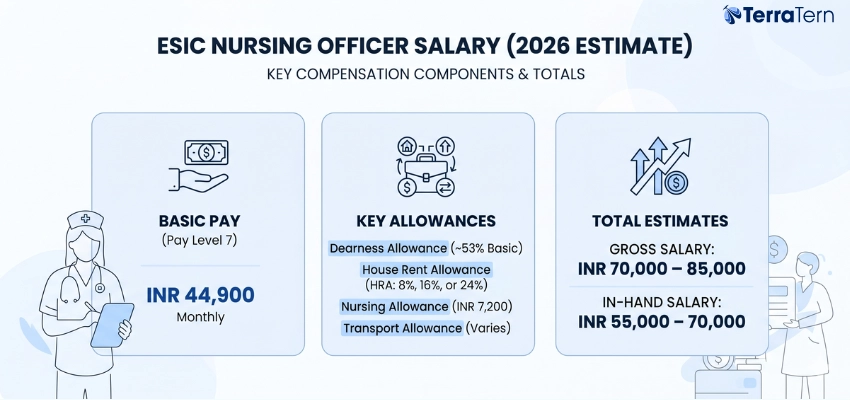
ESIC Nursing Officer Salary Structure Breakdown
|
Salary Component |
Estimated Amount per Month |
|
Basic Pay (Pay Level 7) |
INR 44,900 |
|
Dearness Allowance (DA) |
~53% of Basic Pay |
|
House Rent Allowance (HRA) |
8%, 16%, or 24% of Basic Pay |
|
Transport Allowance (TA) |
Varies based on city tier |
|
Nursing Allowance |
INR 7,200 |
|
Gross Salary |
INR 70,000 – INR 85,000 |
|
Estimated In-Hand Salary |
INR 55,000 – INR 70,000 |
How Does ESIC Nursing Officer Salary Compare to AIIMS Nursing Officer Salary?
While both institutions follow the 7th CPC framework, comparing the ESIC nursing officer salary with that at AIIMS reveals distinct operational differences. Both start at Pay Level 7 (INR 44,900 basic pay), but AIIMS officers often secure a slightly higher HRA due to major-metro postings.
Nursing Officer Salary Comparison: AIIMS vs. ESIC vs. PGIMER
|
Component |
AIIMS |
ESIC |
PGIMER |
|
Basic Pay |
INR 44,900 |
INR 44,900 |
INR 44,900 |
|
Pay Level |
7 (7th CPC) |
7 (7th CPC) |
7 (7th CPC) |
|
Gross Salary |
INR 75,000 – INR 81,000 |
INR 70,000 – INR 85,000 |
~INR 83,049 |
|
In-Hand Salary |
INR 55,000 – INR 75,000 |
INR 55,000 – INR 70,000 |
~INR 83,049 |
|
Recruitment Body |
AIIMS NORCET |
UPSC |
PGIMER Direct |
Expert Tip: For candidates choosing between AIIMS and ESIC, the salary difference is minimal; the real differentiator is the work environment, research opportunities at AIIMS vs. ESIC's broader district-level network.
Also Read: AIIMS Nursing Officer Salary: Latest Figures & Updates
What Are the Career Growth and Promotion Prospects for Nursing Officers?
Nursing officers in India, including ESIC nursing officer salary structures, progress from Staff Nurse Grade II to Chief Nursing Superintendent over 30–35 years via Departmental Promotion Committees (DPC).
|
Rank |
Pay Scale |
Approx. Experience |
|
Staff Nurse Grade II (Joining) |
INR 44,900–INR 1,42,400 |
0 years |
|
Staff Nurse Grade I |
INR 47,600–INR 1,51,100 |
8–10 years |
|
Assistant Nursing Superintendent |
INR 53,100–INR 1,67,800 |
15–18 years |
|
Deputy Nursing Superintendent |
INR 56,100–INR 1,77,500 |
24–26 years |
|
Chief Nursing Superintendent |
INR 78,800–INR 2,09,200 |
30–35 years |
-
DPC Process: Seniority-cum-merit evaluation; requires ACRs and no disciplinary issues.
-
Fast-Tracking: Post-Basic BSc or MSc Nursing adds points, enabling 2–5 year acceleration.
-
Lateral Moves: Nursing educator, ICU specialist, OT technician for specialised growth.
Important Tip: Pursuing a Post-Basic BSc or MSc Nursing while serving can accelerate promotions by 3–5 years, a strategic investment that compounds across the entire salary trajectory.
What Will Be the Nursing Officer Salary After the 8th Pay Commission?
The 8th Pay Commission (8th CPC), expected in 2026, will revise ESIC nursing officer salary via DA merger and higher fitment factor (likely 2.5–3.0 vs. 2.57 now), boosting AIIMS nursing officers to secure, high-demand roles.
-
Timeline: The 8th Pay Commission is expected to be constituted and recommend salary revisions, but no official implementation date has been confirmed as of 2026. Projections are estimates only.
-
Conservative Projection: Gross INR 1.43–INR 1.56 lakh/month; in-hand ~INR 1.25 lakh.
-
Optimistic Projection: Fitment 3.0+ pushes gross to INR 1.6–INR 1.8 lakh.
-
Key Changes: Full DA merger (currently 50%); expanded pay matrix.
-
Career Edge: Positions nursing among India's top secure healthcare jobs with inflation-proof hikes.
As per TerraTern Expert: Even under conservative 8th CPC estimates, a nursing officer's salary could double compared to 2020 levels, making this one of the most financially rewarding government healthcare careers in India.
How Does Nursing Officer Salary Vary by City and State?
ESIC nursing officer salary varies based on HRA (X: 24% basic in Delhi/Mumbai; Y: 16% in cities like Pune; Z: 8% in rural areas) and TA, affecting the in-hand salary of INR 3,500–INR 10,800/month. Metro-based AIIMS institutions like Delhi typically offer higher HRA than newer campuses like Rishikesh.
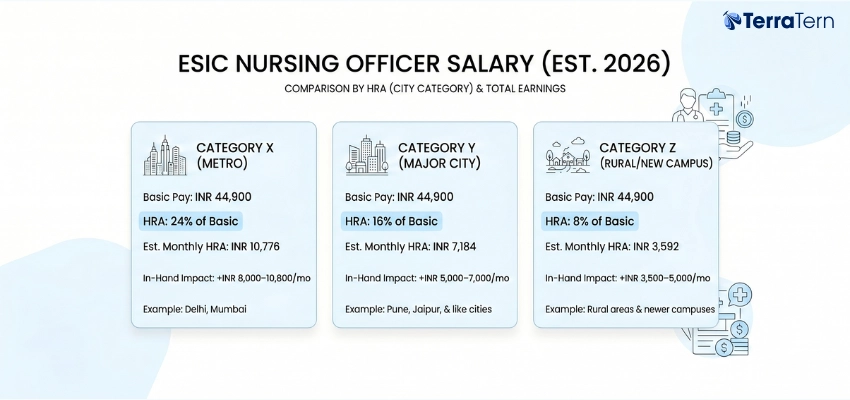
|
City Category |
HRA % (Basic INR 44,900) |
Monthly HRA |
In-Hand Impact |
|
X (Delhi, Mumbai) |
24% |
INR 10,776 |
+INR 8,000–INR 10,800 |
|
Y (Pune, Jaipur) |
16% |
INR 7,184 |
+INR 5,000–INR 7,000 |
|
Z (Rural areas) |
8% |
INR 3,592 |
+INR 3,500–INR 5,000 |
Pro Tip: Requesting a posting in an X-category city can increase your effective monthly in-hand salary by INR 7,000–INR 10,000 purely through HRA. Location strategy is an underrated tool for salary optimisation.
Also Read: AIIMS Nursing Officer Salary: Complete Pay Guide
Can Indian Nursing Officers Work Abroad and How Does the Salary Compare?
Indian nursing officers, including those on ESIC nursing officer salary, leverage their government experience for high-paying roles abroad in the UK (NHS), Canada, Australia, the UAE, and Germany, often earning 3–10x domestic pay. Indian nursing officers pursuing international roles typically require IELTS/OET certification and country-specific credential recognition before applying.
|
Country/Employer |
Monthly Salary (Equivalent INR ) |
Comparison to India (INR 70k avg.) |
|
India (AIIMS/ESIC) |
INR 70,000–INR 1,00,000 |
Baseline |
|
UK (NHS Band 5–6) |
INR 2.5–INR 4 lakh |
4–6x higher |
|
Canada (Provinces) |
INR 3–INR 5 lakh |
5–7x higher |
|
Australia (Public) |
INR 3.5–INR 5.5 lakh |
5–8x higher |
|
UAE (Private/Govt) |
INR 2–INR 4 lakh (tax-free) |
3–6x higher + perks |
-
Visa Pathways: UK Health & Care Visa (fast-track); Canada Express Entry (NOC 31301); Australia Subclass 189/190.
-
Certifications: IELTS/OET (7+ bands), NMC (UK), NCLEX (Canada), AHPRA (Australia).
-
TerraTern Support: Customised visa coaching, credential verification for seamless migration.
Key Note: A government nursing officer with 3–5 years of AIIMS/ESIC experience is highly competitive for international healthcare roles. Language proficiency (IELTS/OET) is often the biggest barrier, and addressing it early can accelerate the timeline by 12–18 months.
What Are the Key Benefits and Perks of a Nursing Officer Job Beyond Salary?
ESIC nursing officer salary complements robust perks in central government roles like AIIMS, adding 30–50% effective value through security and welfare.
-
CGHS Medical: Free treatment for self/family (INR 20,000–INR 50,000 annual value).
-
NPS Pension: 14% govt. match; INR 1–2 crore corpus over 30 years.
-
Job Security: Permanent tenure, no layoffs.
-
Leave: 30 EL + 20 CL days/year; 180 maternity days.
-
Allowances: INR 3,000 nursing + uniform
- House Building Advance (HBA): Up to ₹25–34 lakh depending on city category, as per current Central Government rules.
-
Housing/Subsidy: Campus quarters (INR 5,000–INR 15,000 savings); canteen at 50% cost.
-
Study Leave: Paid time for MSc/PhD.
As per TerraTern Expert, the total compensation for a nursing officer position, including CGHS, NPS, and leave encashment, can add 25–35% to the cash salary, making it far more competitive than equivalent private hospital roles.
2026 Industry Context Section
Latest Statistics & Trends:
-
Basic Pay (2026): INR 44,900 (minimum) to INR 1,42,400 (maximum) under Pay Level 7, 7th CPC, applicable across AIIMS, ESIC, PGIMER, and most central government hospitals
-
In-Hand Range: INR 55,000–INR 75,000/month at AIIMS; INR 55,000–INR 70,000/month at ESIC, depending on city class
-
8th Pay Commission Projection: Conservative estimates place gross monthly salary at INR 1.43–INR 1.56 lakh after the 8th CPC revision
-
DA Rate (2026): 53% of basic pay, updated periodically by the Central Government
-
Nursing Allowance: INR 2,400–INR 4,800/month (additional benefit exclusive to nursing cadre)
-
Career Peak: Chief Nursing Superintendent can earn INR 78,800–INR 2,09,200/month after 30–35 years of service
-
International Comparison: Indian-trained nursing officers moving abroad (UK, Canada, Australia) can earn INR 2.5–INR 5 lakh/month, a key metric for Indian nursing professionals planning to migrate abroad.
Also Read: Chief Nursing Officer Salary: Latest Complete Pay Guide
Conclusion
Nursing officer salary offers strong financial stability, with AIIMS nursing officer salaries at INR 70,000–INR 1 lakh/month and ESIC nursing officer salaries similarly competitive under the 7th CPC. Promotions, HRA variations, and perks like CGHS/NPS enhance long-term value. Abroad, UK/Canada roles multiply earnings 4–8x via streamlined visas ideal for ambitious professionals eyeing global growth.
Contact TerraTern for more information on Nursing Officer Salary: A Comprehensive Guide to AIIMS and ESIC Compensation (2025 Update).




 AI Summary